Table of Contents
What Is a B2B Outbound Sales Team?
B2B Sales Team Structure: The Three Core Models
Key Roles in a B2B Outbound Sales Team
How to Build a B2B Sales Team In-House (Step-by-Step)
How to Hire a B2B SaaS Sales Team: What to Look For
How to Train a B2B Sales Team That Actually Performs
Outsource B2B Sales Team: When It Makes More Sense Than Hiring
In-House vs. Outsourced B2B Sales Team: Side-by-Side Comparison
The Essential Tech Stack for a B2B Outbound Sales Team
How Cleverly Helps B2B Companies Build Pipeline Without the In-House Overhead
Conclusion
Frequently Asked Questions
Modified On :
April 21, 2026
Key Takeaways
- Building a B2B sales team is a sequencing problem — systems and structure must come before headcount, or you'll rebuild six months later.
- The three core B2B sales team structure models (Assembly Line, Island, Pod) each suit different company stages and deal types — choosing wrong creates friction no amount of talent can fix.
- A fully loaded in-house SDR costs $98,000–$173,000 per year when you factor in benefits, tools, ramp time, and management overhead.
- Outsourced SDR teams go live in 1–4 weeks vs. 3–6 months to ramp an in-house hire — a critical advantage when you need a pipeline now.
- Over 70% of B2B companies plan to expand outsourced SDR investment through 2026 to improve agility and maintain pipeline flow without fixed overhead.
- The smartest move in 2026 is to validate your outbound playbook first — then decide whether to bring it in-house or keep it outsourced.
Have you noticed many B2B outbound sales teams are built by accident.
A founder promotes their best rep to manager, hires two SDRs off LinkedIn, and then wonders why pipeline got worse instead of better.
Sound familiar? It happens more than anyone admits.
In 2026, building an outbound sales team isn't just a hiring decision — it's a strategic choice between three very different paths: hire in-house, train from within, or outsource entirely. And picking the wrong path at the wrong company stage costs months of lost pipeline and hundreds of thousands in wasted budget.
Multichannel outreach lifting response rates 287% over single-channel is the standout benchmark — teams still running email-only are leaving the majority of replies on the table. The opportunity for well-structured outbound teams has never been bigger. But structure is everything.
According to Emergence Capital's survey of 560+ B2B software companies, 36% of companies decreased SDR and BDR headcount in the past year — the highest reduction rate among all sales roles. That's not a sign that outbound is dying. It's a sign that teams built without the right foundation don't survive.
This guide covers everything you need to build a B2B sales team the right way — team structure, core roles, step-by-step hiring, training frameworks, the outsourcing case, and how to decide which path fits your business stage.
What Is a B2B Outbound Sales Team?
A B2B outbound sales team is a dedicated group responsible for proactively generating pipeline through outbound channels — cold email, cold calling, LinkedIn outreach, and multi-touch sequences.
The key word is proactively. Outbound means your team goes looking for buyers, not the other way around.
This is different from inbound sales, where prospects raise their hand through content, ads, or organic search. Most B2B companies need both motions, but outbound is especially critical when you have longer sales cycles, high ACVs, and a niche ICP that can't be reached cost-effectively through inbound alone.
What an outbound team is built to do:
- Identify and research target accounts within the ICP
- Qualify decision-makers and key stakeholders
- Book meetings and hand off to Account Executives
- Maintain consistent pipeline flow regardless of inbound volume
The AI SDR market is projected to hit $15.01B by 2030, and 81% of sales teams have implemented or are experimenting with AI — 41% at full implementation. The outbound function is evolving fast. But the underlying mission — get the right conversations started with the right people — hasn't changed at all.
🤝 Hiring SDRs Is Expensive. We’re Not.
Get LinkedIn, cold email & cold calling—fully done-for-you. More meetings, half the cost of building in-house.
B2B Sales Team Structure: The Three Core Models
Structure is the foundation of any B2B sales team. The wrong model creates handoff friction, rep burnout, and slow pipeline velocity — regardless of how talented the individuals are.
There are three models worth knowing. Here's when each one works and when it breaks.
The Assembly Line Model
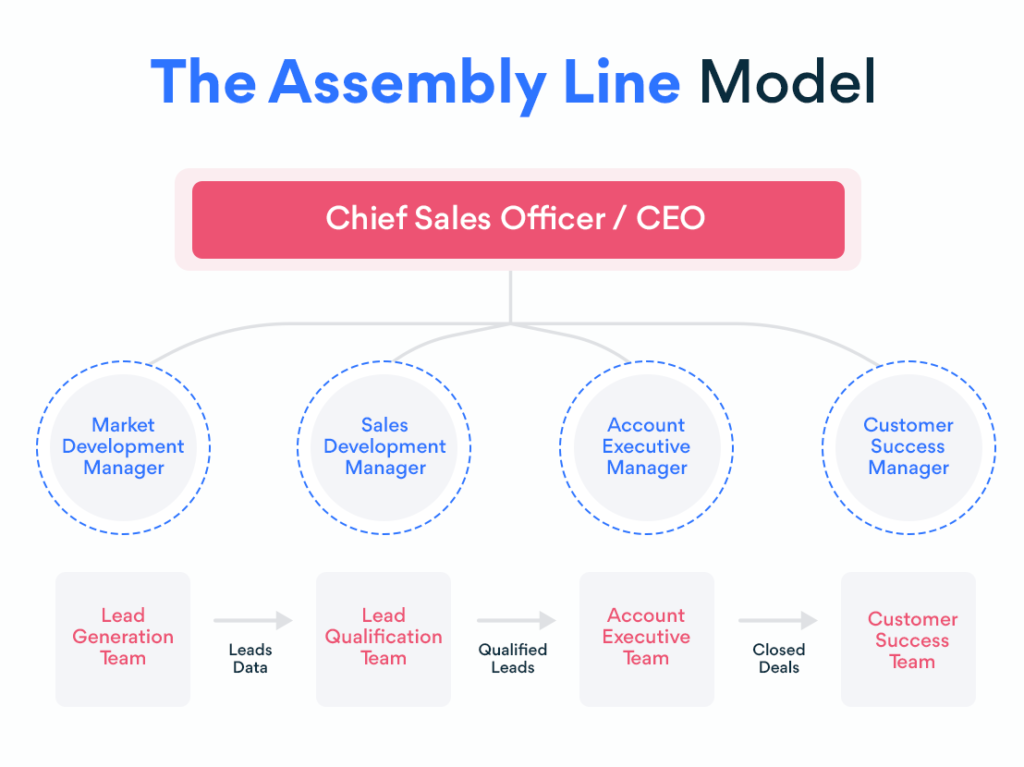
In the Assembly Line model, roles are specialized by stage. SDRs prospect, AEs close, and CSMs handle retention. Nobody owns the full cycle — each person is a specialist in their lane.
This is the most common model for teams with 10–20 reps running mid-market deals at decent volume. The benefit is efficiency — reps get very good at their specific part of the funnel.
The most common breakdown point is the SDR-to-AE handoff. When the person who qualifies a lead isn't the person who closes it, context gets lost. Deals slip through the gap, and AEs spend time re-qualifying instead of closing.
The Island Model
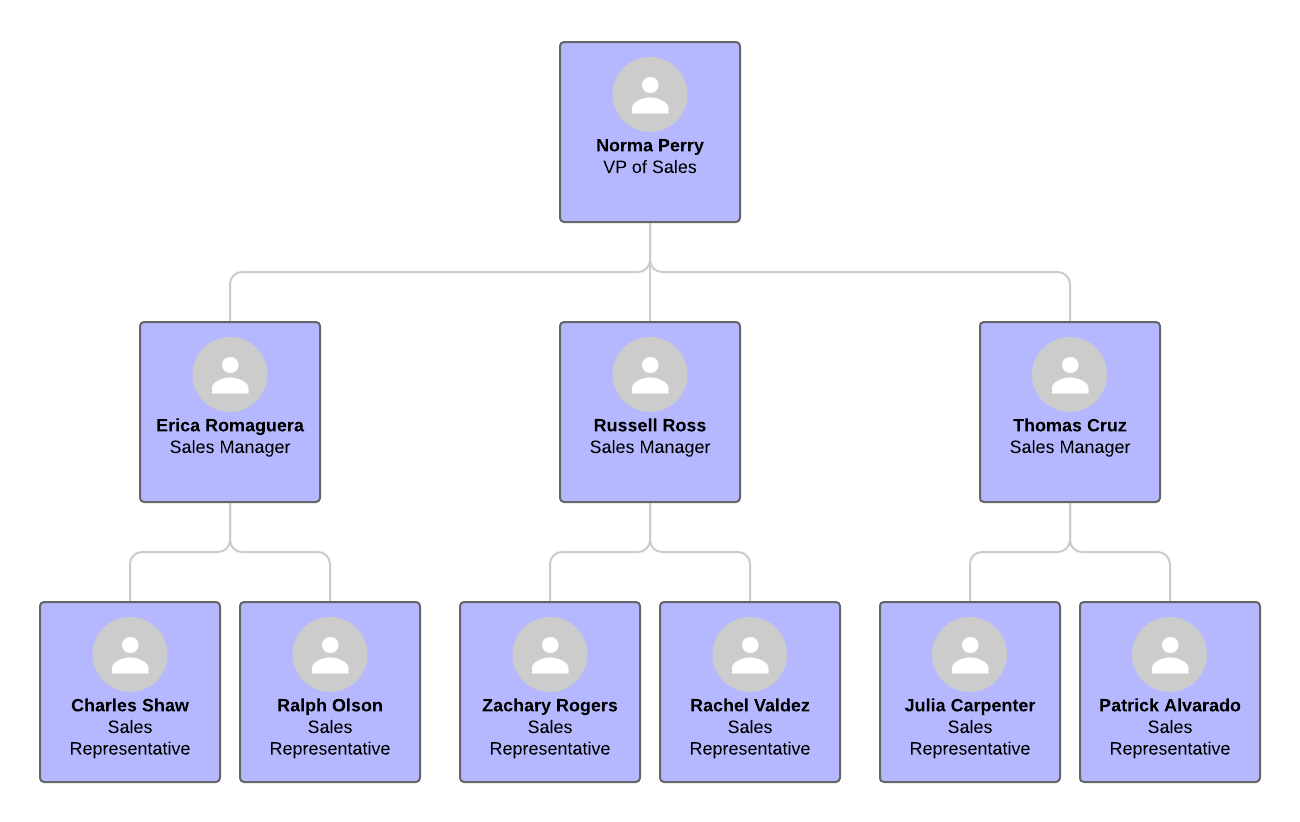
In the Island model, one rep owns the full sales cycle — from cold prospecting all the way to signed contract. No handoffs, no specialization.
This works well for early-stage teams under 10 reps or founder-led sales motions where deep product knowledge and relationship continuity matter. It's also faster to set up because there are fewer coordination requirements.
The limitation? It doesn't scale. As deal complexity increases and volume grows, island reps hit capacity and performance plateaus fast.
The Pod Model
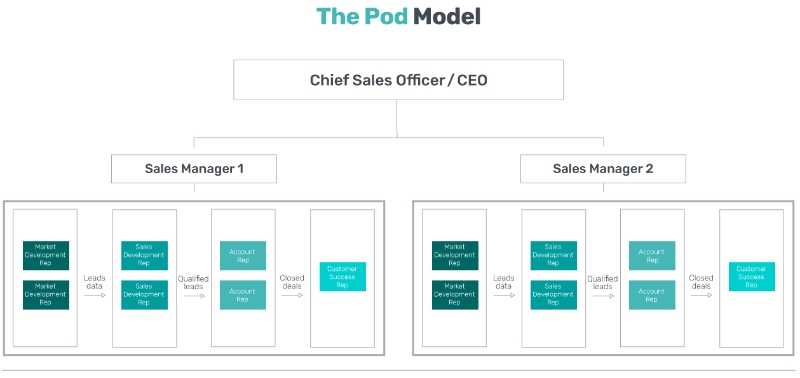
The Pod model organizes reps into small cross-functional units — typically an SDR, an AE, and a CSM — all targeting a specific set of accounts together. It's an account-based approach that creates shared ownership across the customer lifecycle.
This model is built for enterprise and ABM selling where deals involve multiple stakeholders, long cycles, and high ACVs. The pod creates alignment that individual handoffs can't replicate.
It does require sufficient headcount and strong coordination to execute well. Most teams shouldn't attempt the pod model until they have enough reps to fill the roles meaningfully.
Key Roles in a B2B Outbound Sales Team
Once you've chosen your structure, you need to know exactly who to put in it. These are the core roles in any B2B sales team structure.
BDR (Business Development Representative)
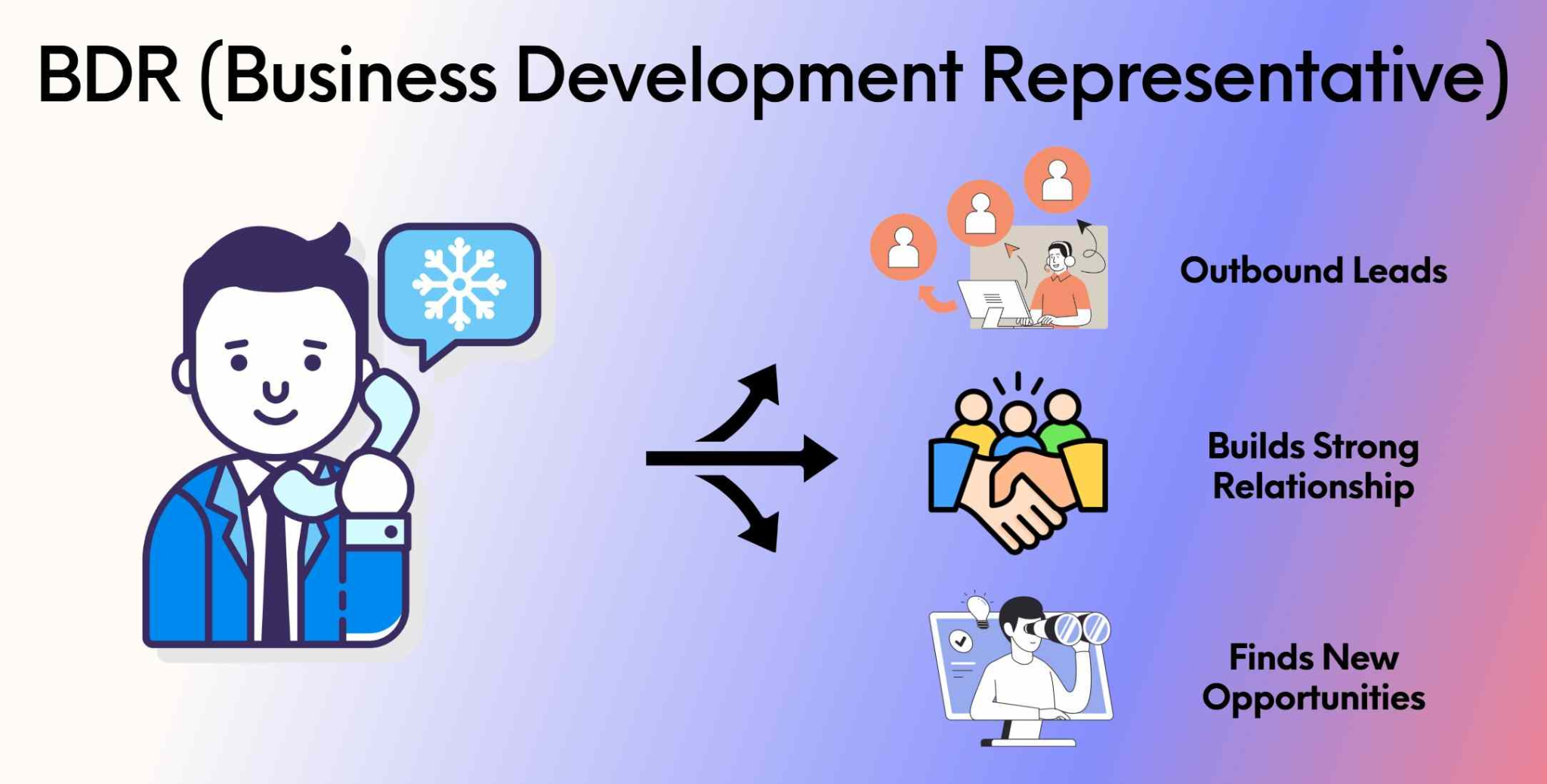
BDRs are outbound focused. Their job is cold prospecting — cold calling, LinkedIn outreach, cold email sequences — against accounts that have never heard of you.
Key metrics to track for BDRs: meetings booked, pipeline generated from cold outreach, and daily activity volume. A solid BDR is the top-of-funnel engine for any outbound motion.
SDR (Sales Development Representative)
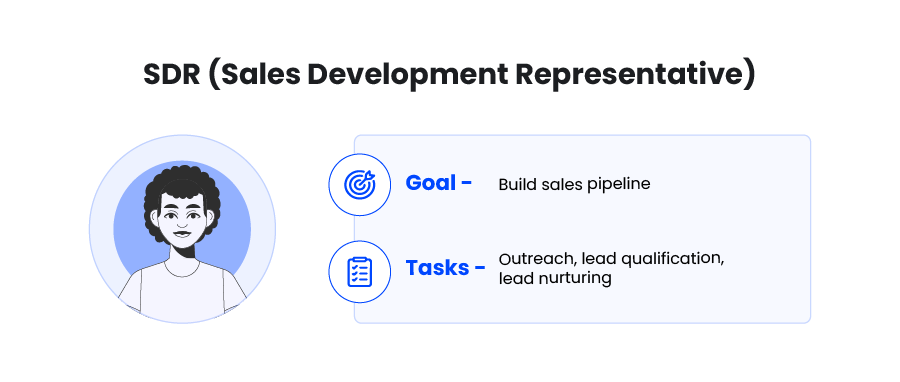
SDRs are inbound focused. They qualify leads who have already shown interest through marketing, then pass Sales Qualified Leads (SQLs) to Account Executives.
Their KPIs center on lead-to-SQL conversion rate and meeting show rate. Industry benchmarks show 52.7% conversion from SAL to SQL, with SDRs booking roughly 15 meetings per month.
Account Executive (AE)
The AE is the closer. They run demos, handle objections, negotiate, and sign contracts. They take qualified handoffs from SDRs and BDRs and own the full closing cycle.
A common starting ratio for outbound-heavy motions is 1 SDR per 1–2 AEs. As your team scales and meetings increase, that ratio will shift.
Sales Manager / Head of Sales
The sales manager owns team performance, pipeline forecasting, coaching, and process improvement. One important principle: hire this role after a repeatable process is proven, not before. A manager trying to build processes and manage reps simultaneously at an early-stage almost always struggles.
Revenue Operations (RevOps)
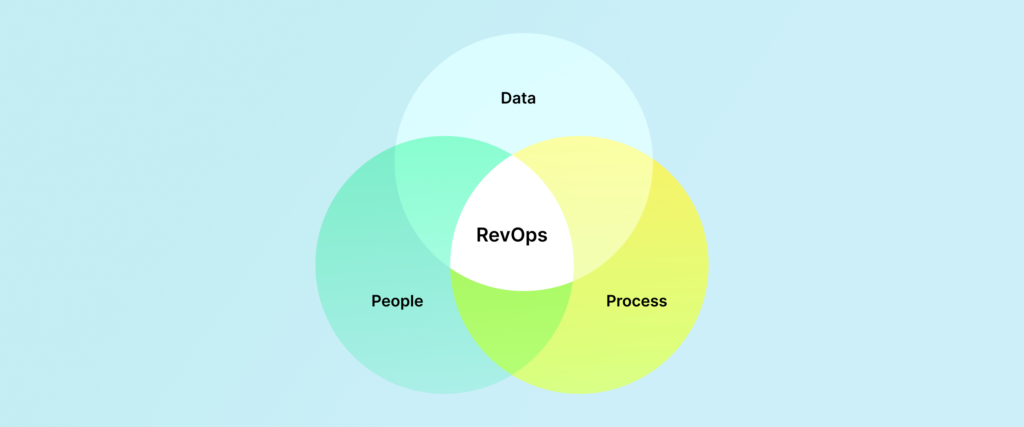
RevOps is the operational backbone — managing CRM hygiene, reporting, tooling, and data infrastructure. Reps with clean data, clear deal stages, and measurable workflows consistently outperform those without it.
Organizations now average 8.3 tools per SDR at roughly $187 per rep per month in software costs alone — and SDRs spend only 28% of their time actually selling. RevOps is what keeps that infrastructure from becoming a time sink.
📞 Skip the 6-Month Ramp. Start Getting Pipeline Now.
Trained SDRs, proven scripts, and outreach systems included. We fill your calendar—you focus on closing deals.
How to Build a B2B Sales Team In-House (Step-by-Step)
This is where most companies skip ahead too fast. The sequence matters just as much as the decisions themselves.
Step 1 — Define Your ICP and Qualification Criteria First
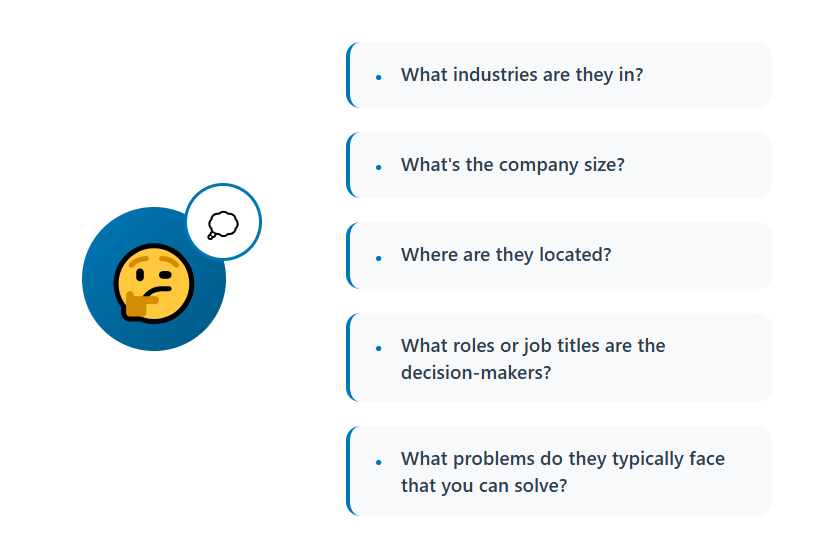
Before you hire anyone, be crystal clear on who you're targeting and what makes a lead qualified. If your reps don't know exactly who they're looking for, every conversation is a coin flip.
Document your ideal customer profile — industry, company size, title, pain points, and disqualifiers. This becomes the filter everything else runs through.
Step 2 — Build the System Before Adding Headcount
Set up your CRM, define your deal stages, and write a basic sales playbook before bringing anyone on. Reps joining a team with no documented process spend their first months figuring out what they're supposed to do — that's wasted ramp time.
Step 3 — Start With Founder-Led Sales

If you haven't sold the product yourself, you don't yet understand the buyer's objections, the real decision-making process, or what messaging actually resonates. Founder-led sales surfaces all of this before you ask reps to run the same plays.
Step 4 — Hire Your First AE Once You Have Repeatable Pipeline
Your first sales hire should be an AE who can take qualified conversations and close them — not someone you're asking to create pipeline from scratch. Wait until you have consistent inbound or an outbound motion that's generating meetings before making this hire.
Step 5 — Add SDRs in Pairs

Never hire a single SDR as a test. With one rep, you can't tell if performance issues are about the person, the messaging, the data, or the market. Start with two or three so you have a baseline for comparison and can identify patterns.
Step 6 — Build Onboarding With Your Current Team
Your best source of onboarding content is the reps already performing well. Document what they do, record call examples, and capture the objection responses that actually work. Training built from real performance data sticks better than anything off a shelf.
Step 7 — Layer In Customer Success to Protect Revenue
Once you're closing deals, your next priority is keeping them. Churn kills pipeline math fast. Customer Success doesn't need to be a large team early — one strong CSM protecting your base frees your AEs to focus on new business.
How to Hire a B2B SaaS Sales Team: What to Look For
Hiring the wrong SDRs is one of the most expensive mistakes in sales team building. Here's how to get it right.
The Five Traits That Actually Matter
Skills can be trained. These five traits can't be:
✅ Sales motor — Do they have the natural drive to make 50+ calls on a slow day?
✅ Confidence — Can they recover quickly from rejection and get back on the phone?
✅ Intellectual curiosity — Will they dig into your product and your buyer's world?
✅ Coachability — Do they act on feedback or defend their habits?
✅ Cultural fit — Will they raise the energy of the team or drain it?
Industry experience matters far less than attitude and process orientation. A coachable generalist will often outperform a seasoned rep who's too set in their ways.
Compensation Benchmarks for 2026
Median SDR OTE sits around $83,000–$85,000 with base salaries averaging $55,000–$60,000. BDRs land slightly higher at $90,000–$92,000 OTE. For most companies, a fully loaded SDR costs $98,000–$173,000 per year when you factor in benefits, tools, management overhead, and ramp time.
Plan accordingly. The sticker price of a hire is rarely the real cost.
The Productivity Reality
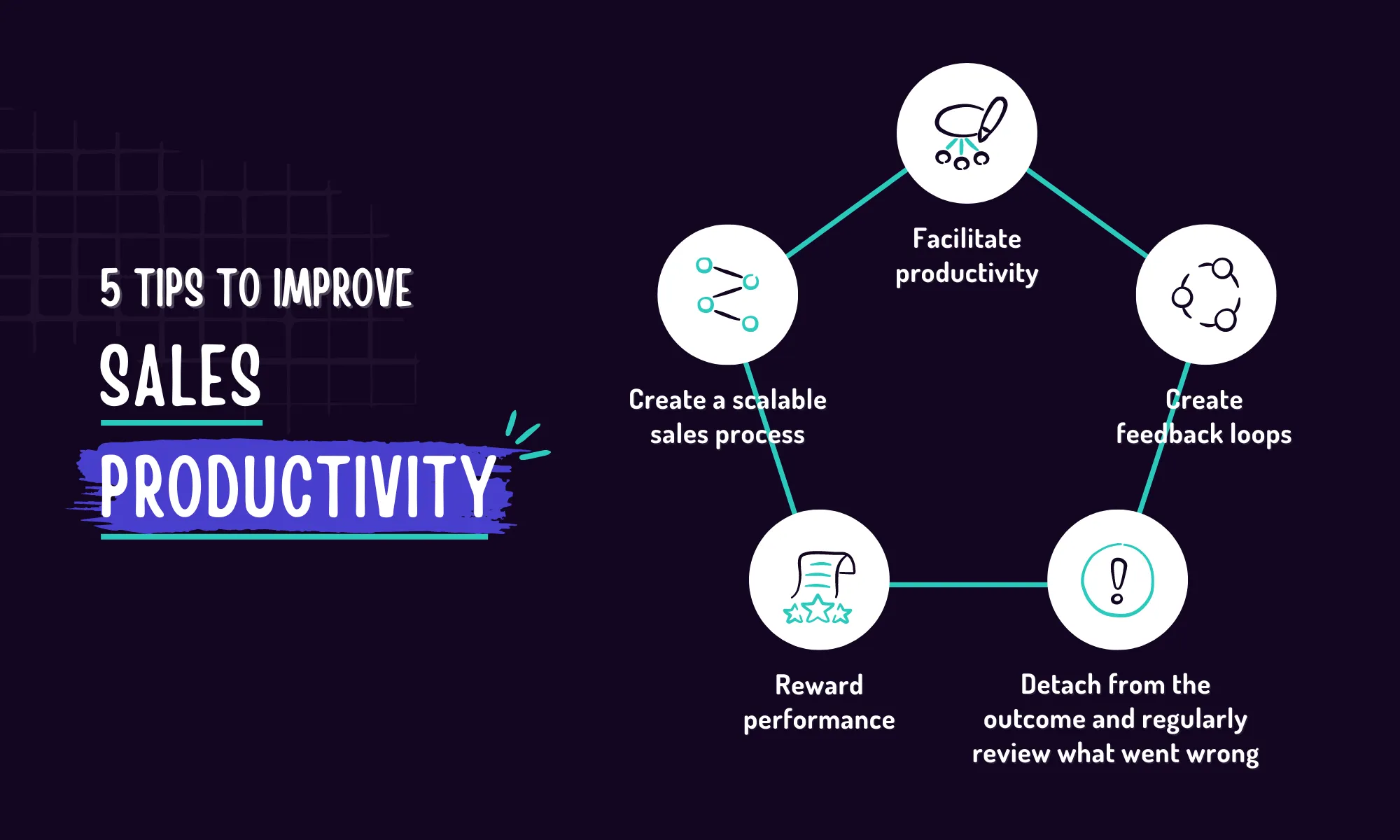
Median SDR tenure is 1.9 years and annual turnover runs 34–40%. That means if you hire an SDR today, statistically they'll be gone before their second work anniversary.
Factor this into your planning. The true cost of a bad hire isn't just the salary — it's the ramp time, the missed pipeline, and the re-hiring cycle. Get the hiring criteria right the first time.
How to Train a B2B Sales Team That Actually Performs
Training is one of the highest-ROI investments in sales. It's also one of the most commonly underfunded.
The Six Areas Every Onboarding Program Must Cover
Great onboarding isn't a single orientation day — it's a structured program covering:
✅ Product knowledge — reps need to understand what they're selling before they can talk about it credibly
✅ ICP and persona training — who they're targeting, what those buyers care about, and why they buy
✅ Messaging and talk tracks — the specific language that works across email, phone, and LinkedIn
✅ Tool proficiency — CRM, sequencer, dialer, data tools — reps should be fluent before going live
✅ Objection handling — documented responses to the top 10 objections your team actually hears
✅ Call and email practice — role-play and real examples before the first live outreach
Hyper-personalized emails deliver 2–3x higher reply rates, yet only 5% of reps personalize consistently. Training is what closes that gap between what's possible and what reps actually do.
Build a Living Sales Playbook
The playbook is your team's source of truth — processes, best-performing templates, objection responses, call recordings, and deal stage definitions. It should be updated regularly as new data comes in.
A playbook built from real performance beats any generic template, every time.
Ongoing Enablement Matters as Much as Onboarding
Weekly coaching, call reviews, and role-play sessions keep reps improving after their first 90 days. Reps who receive consistent feedback outperform those who are left to figure things out on their own.
One often-overlooked factor: clean data directly reduces ramp time. Reps who aren't chasing bad phone numbers or bouncing emails spend more time in real conversations — and that's where learning actually happens.
Outsource B2B Sales Team: When It Makes More Sense Than Hiring
The in-house build isn't always the right first move. Here's when outsourcing beats it.
The Real Cost of Building In-House Sales Team

A fully loaded SDR — salary, benefits, tools, management time, ramp cost — runs $135,000 to $215,000 in year one. That's before you've booked a single qualified meeting.
Now add the time cost. Average SDR ramp time is 3–6 months. In that window, your pipeline output is significantly below target while the rep is learning your product, ICP, and tools.
When Outsourcing Is the Right Call
Outsourcing tends to win in four scenarios:
- Early-stage companies that need pipeline before they can afford a dedicated sales hire.
- Teams entering new markets or verticals where in-house reps lack context.
- Existing teams at capacity that need additional outbound volume without headcount.
- Post-funding companies that need pipeline fast and can't afford a 6-month ramp cycle.
Outsourced SDR teams can launch new campaigns up to ~40% faster than hiring and training internally, and over 70% of B2B companies plan to expand outsourced SDR investment through 2026.
The Speed and Cost Comparison
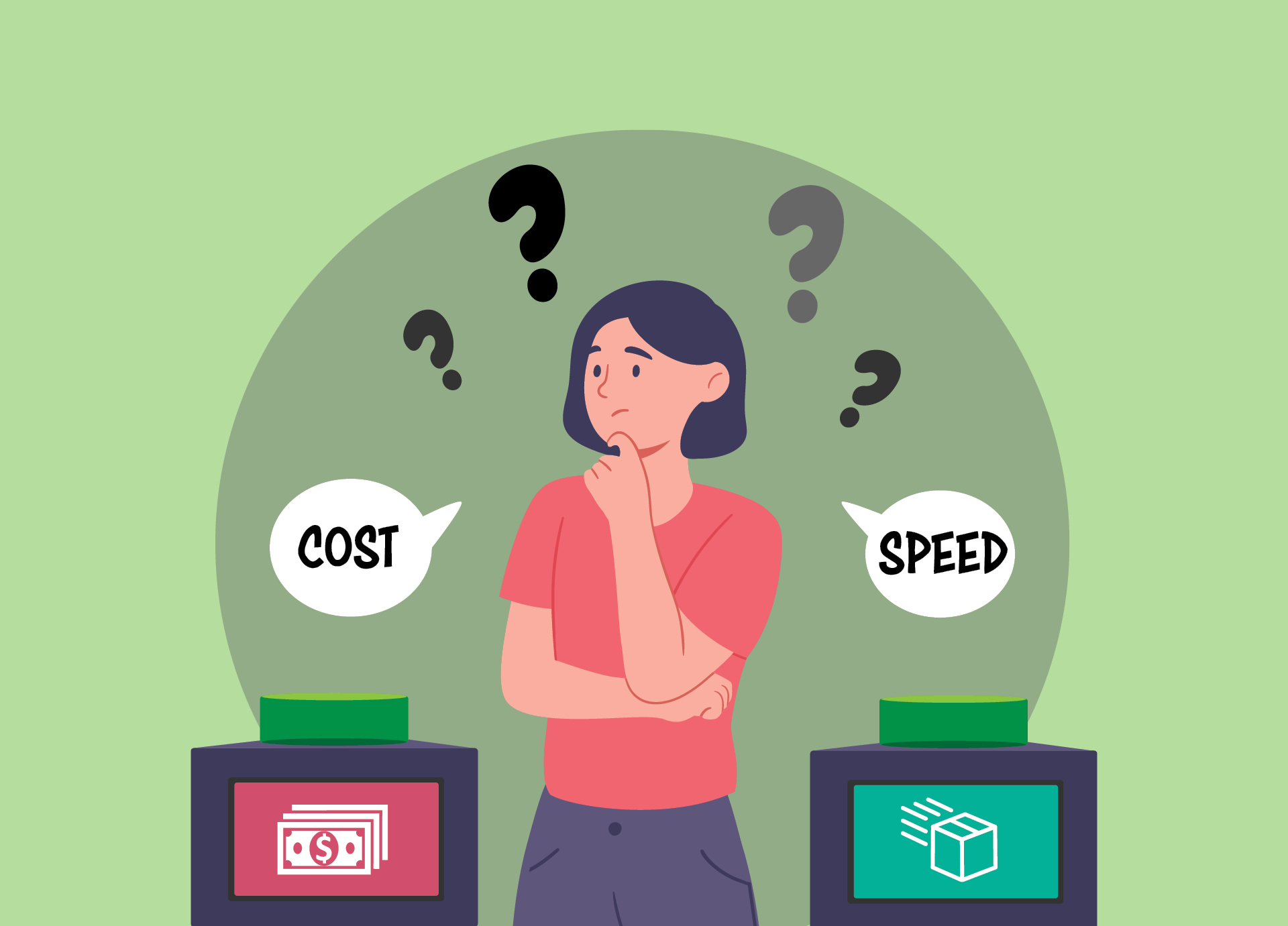
An agency engagement at $10K to $15K/month runs $120,000 to $180,000 annually and includes the tech stack, infrastructure, and operational expertise — and it's also productive 4 to 6 months sooner than an in-house hire.
That's a 4-month head start on pipeline. At a typical SDR generating $3M in pipeline annually, that's $1M in pipeline opportunity you simply don't get with the in-house path.
When Outsourcing Is Not the Right Fit
It's not a universal solution. If you're running high-ACV enterprise deals that require deep product knowledge and relationship depth over many months, a fully integrated in-house rep may outperform an outsourced counterpart.
And if you already have a proven, scaling outbound motion in-house, there's likely no reason to change it.
The smart sequencing approach: outsource first to validate the playbook, then bring it in-house once the motion is proven.
In-House vs. Outsourced B2B Sales Team: Side-by-Side Comparison
The honest takeaway: neither path is universally better. The right answer depends entirely on your stage, deal size, TAM, and how proven your outbound playbook is.
The Essential Tech Stack for a B2B Outbound Sales Team
Building the team without the right tools is like hiring a sales team and not giving them phones. Here's what a high-performing B2B outbound sales team needs in their stack.
1️⃣ CRM is the foundation. HubSpot, Salesforce, or Pipedrive for pipeline management, deal tracking, and rep activity. Everything else connects here.
2️⃣ Sales engagement platform handles email sequences, call tasks, and LinkedIn touchpoints in one orchestrated workflow. Apollo, Outreach, and Salesloft are the dominant options.
3️⃣ Data and enrichment is where teams often cut corners and pay for it later. Bad data inflates spend by 20–40% through wasted sends and compounding sender-reputation damage. Verified contact data isn't optional.
4️⃣ Dialer for cold calling at scale — Aircall, Orum, and Nooks are popular choices. The right dialer depends on call volume and whether you need parallel dialing capability.
5️⃣ LinkedIn Sales Navigator is a must for targeted prospecting and account research, especially for any team running LinkedIn outreach as a primary channel.
6️⃣ Call recording and coaching tools like Gong or Chorus let managers review real calls and give reps feedback on exactly what happened in the conversation — not just the outcome.
7️⃣ Intent data rounds out the stack by surfacing accounts actively researching your category. Reaching the right account at the right time changes conversion rates dramatically.
Organizations now average 8.3 tools per SDR at roughly $187 per rep per month — an enterprise sales team can easily spend $32,000 per SDR per year on software alone before salary, benefits, or management overhead.
Choose intentionally. A consolidated stack with fewer, deeper integrations beats eight loosely connected point solutions every time.
How Cleverly Helps B2B Companies Build Pipeline Without the In-House Overhead
Building an outbound team the right way — the right structure, clean data, trained reps, a tested playbook — takes months before you see a single qualified meeting. That's the reality most companies discover too late.
Cleverly removes that barrier entirely. We're a top-rated B2B lead generation agency running fully done-for-you outbound across LinkedIn lead generation, cold email, and cold calling.
What we handle end-to-end: ICP-based list building, verified multi-source data, multi-channel outreach, personalized messaging, A/B testing, and reply management — all the way to the meeting handoff.
Your team shows up to qualified conversations. We build the pipeline that makes them happen.
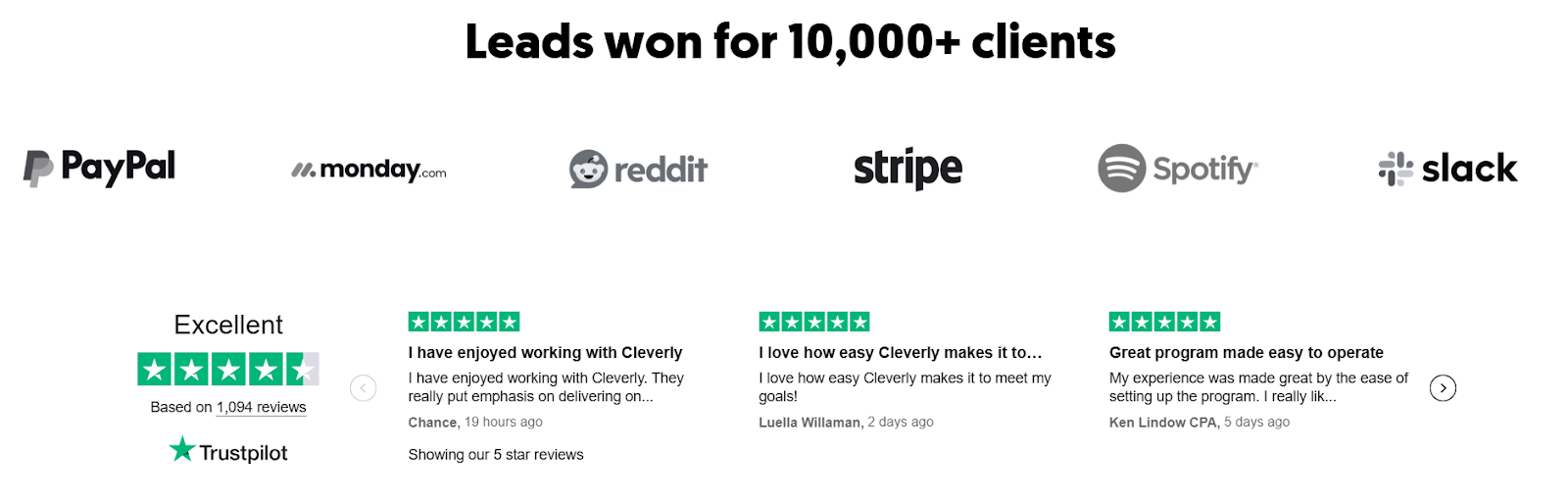
We've served 10,000+ clients including teams at Amazon, Google, Uber, PayPal, Slack, and Spotify — generating $312M in pipeline, $51.2M in closed revenue, and 53,000+ appointments set.
🚀 LinkedIn outreach starts at $397/month.
🚀 Cold email runs on a pay-per-performance model with no long-term contracts.
🚀 Cold calling comes with guaranteed appointments or we replace the SDR.
If you need pipeline now — not after a 6-month build — we're the fastest path to qualified B2B meetings.
🤝 Book a free strategy call with Cleverly
Conclusion
Building a B2B outbound sales team is a sequence problem, not just a hiring problem. Structure and systems have to come before headcount — every team that skips that step ends up rebuilding six months later.
There is no universally right answer between hiring in-house and outsourcing. The right path depends on your stage, deal size, TAM, and how proven your outbound playbook is. The companies winning in 2026 are the ones that validate the motion first, then decide how to scale it.
Whether you hire, train, or outsource — precision, process, and the right data are what separate teams that generate pipeline from teams that generate activity.
Frequently Asked Questions
Free Resource
How to Scale a Profitable Cold Call System
Get the complete guide — download it instantly now.
Free Ebook
Download the Free Guide
Enter your details to get instant access.
You're all set! 🎉
Your ebook is downloading now.
Click below if the download didn't start automatically.