

Table of Contents
What Are Commercial Real Estate Leads and Why Do They Matter?
What Makes Commercial Real Estate Lead Generation Different in 2026?
Strategy 1 — LinkedIn Outreach to Commercial Real Estate Decision-Makers
Strategy 2 — Cold Email Outreach to Property Owners and Investors
Strategy 3 — Internet Listing Services (ILS) and Online Property Platforms
Strategy 4 — Data-Driven Prospecting Using Property and Owner Databases
Strategy 5 — Content Marketing and SEO for Long-Term Inbound Lead Flow
Strategy 6 — Referral Networks and Strategic CRE Partnerships
Strategy 7 — Retargeting and Paid Advertising to Re-Engage High-Intent Prospects
How Cleverly Helps Commercial Real Estate Firms Generate Qualified B2B Leads
Conclusion
Frequently Asked Questions
Modified On :
July 30, 2026
Key Takeaways
- Commercial real estate lead generation requires a multi-channel, systematic approach — cold calls and referrals alone no longer fill a deal pipeline in 2026.
- There are two distinct lead types every CRE broker needs to master: owner/seller leads and tenant/buyer leads — each requires a completely different strategy.
- LinkedIn is the single most powerful digital channel for reaching CRE decision-makers, with 80% of all B2B leads from social media coming from LinkedIn — making it essential for commercial brokers.
- Data-driven prospecting using property owner databases and intent signals now separates top-producing CRE firms from everyone else.
- Brokers who combine outbound outreach (LinkedIn, cold email, cold calling) with inbound channels (SEO, ILS platforms) generate significantly more consistent pipeline than those relying on one source.
- Partnering with a done-for-you commercial real estate lead generation agency like Cleverly is the fastest way to launch systematic, multi-channel outbound without building an in-house team.
If you're still relying on referrals and cold calls as your primary sources of commercial real estate leads, you're fighting a harder battle than you need to.
The CRE market has shifted hard. Commercial real estate campaigns on paid channels average $75 to $120 per lead — and that's just for paid ads.
Meanwhile, the Mortgage Bankers Association reported that 20% ($957B) of outstanding commercial and multifamily mortgage balances matured in 2025, creating a market where urgency and deal activity are high, but so is competition for qualified conversations.
The brokers winning in 2026 aren't the ones making more calls or sending more emails. They're the ones who've built a repeatable system that generates commercial real estate leads across multiple channels — consistently, not sporadically.
This guide covers 7 proven strategies to generate qualified CRE leads in 2026, whether you're a solo broker, a CRE firm, or a business development team looking to build a more predictable pipeline.
We'll cover digital outbound, data-driven prospecting, ILS platforms, SEO, referral networks, and paid retargeting — and exactly when to use each one.

What Are Commercial Real Estate Leads and Why Do They Matter?
Not every contact in your database is a lead. In commercial real estate lead generation, a lead is someone actively in a decision window — an investor evaluating an acquisition, a business owner searching for office or retail space, a tenant whose lease is expiring, or a property owner considering disposition.
The quality of a CRE lead is defined by timing, fit, and intent. A contact who matches your ICP but has no immediate need is a prospect to nurture. A contact who matches your ICP and has an active need is a lead worth prioritizing.
The Two Distinct Lead Types in CRE
This distinction matters more in commercial real estate than almost any other sector:
- Owner/seller leads — property owners considering selling, refinancing, or repositioning an asset. Usually driven by equity position, debt maturity, or market conditions.
- Tenant/buyer leads — businesses actively searching for space, expanding into a new market, or coming up on a lease renewal decision.
Each requires a completely different outreach message, channel mix, and follow-up sequence. Mixing the two in the same campaign is one of the most common mistakes CRE teams make.
Why CRE Lead Generation Is Harder Than Residential
Commercial deals are fundamentally different. Decision cycles can run 6 to 18 months. Multiple stakeholders — corporate real estate, finance, legal, facilities — are often involved in a single transaction. B2B buying committees now average 6.3 stakeholders involved in deals, and CRE transactions are no exception.
That complexity makes consistent commercial real estate lead gen non-negotiable. If you're not filling your pipeline continuously, you're one slow quarter away from a revenue problem.
🏢 Listings Don’t Close Deals. Conversations Do.
We run LinkedIn, cold email & calling to book qualified meetings. Done-for-you outreach that fills your pipeline.
What Makes Commercial Real Estate Lead Generation Different in 2026?
Today's CRE buyers, investors, and tenants research extensively before they ever contact a broker. Research shows that buyers visit an average of 4.3 real estate websites before submitting an inquiry to an agent.
The same behavior is playing out in commercial real estate — by the time a prospect reaches out, they've already formed opinions about who they want to work with.
That means your digital presence — LinkedIn profile, company website, content, ILS listings — is your first impression. Brokers who look credible and authoritative online warm up the conversation before outreach ever happens.

Traditional Methods Are No Longer Sufficient on Their Own
Cold calling still works. Referrals still close. But neither is a standalone strategy anymore. CRE contact data and property intelligence live across multiple systems — brokerage databases, assessor records, LLC ownership structures, and spreadsheets — so lists get outdated fast. Without a data-driven approach to keep your targeting clean and current, even great outreach hits the wrong people at the wrong time.
The Opportunity for Systematic Brokers
CRE brokers are still running sporadic, relationship-dependent pipelines. The ones building systematic, multi-channel commercial real estate lead generation systems are pulling disproportionately more deals — not because they're smarter, but because they're more consistent.
Strategy 1 — LinkedIn Outreach to Commercial Real Estate Decision-Makers
48% of real estate agents use LinkedIn compared to 90% on Facebook — and the key difference is that LinkedIn works better for commercial real estate than residential. That gap represents a massive opportunity. Your competition is concentrated on the wrong platform.
4 out of 5 LinkedIn members drive business decisions, making it the highest-value B2B platform. For CRE brokers targeting investors, CFOs, corporate real estate directors, and business owners, there's no more direct path to the right person.
How to Target the Right Profiles
Start with a precise ICP before you send a single connection request. For CRE, that means filtering by:
- Job titles: CFO, VP of Real Estate, Director of Facilities, Asset Manager, Managing Partner
- Company size: Match to the deal size you're pursuing (SMB tenants vs. enterprise occupiers vs. institutional investors)
- Industry verticals: Tech, healthcare, logistics, financial services — depending on your market
- Geography: Limit to markets where you have active listings or deal velocity
LinkedIn Sales Navigator makes this filtering precise and repeatable. The average Sales Navigator user can make 3.6x more connections with decision-makers than the average non-user — worth the investment if you're doing serious outbound.
What Good CRE LinkedIn Messaging Looks Like
Don't pitch in the first message. Ever. The goal of a LinkedIn connection request in CRE is to start a conversation, not close a deal.
Lead with relevance — a market insight, a recent transaction in their submarket, a lease expiration signal. Something that shows you've done 30 seconds of research on them specifically.
Including a personalized message in a connection request significantly boosts the reply rate to 9.36% compared to 5.44% with no message — a difference that compounds enormously at scale.

The Compounding Benefit
LinkedIn outreach builds on itself. Every connected investor, tenant, and owner becomes part of a network that sees your market updates, deal highlights, and thought leadership content. Over 12 to 18 months, a well-maintained LinkedIn presence generates inbound interest that doesn't require active outreach at all.
🚀 More Deals Start With Better Outreach
$312M pipeline generated across outbound channels. We handle prospecting → outreach → booking—you close.
Strategy 2 — Cold Email Outreach to Property Owners and Investors
Cold email remains one of the highest-ROI outreach channels in commercial real estate lead gen when it's done right. The key words being "done right."
Most CRE cold email fails because it's sent from the wrong domain, to unverified lists, with generic copy that reads like a blast — not a targeted outreach.
When the infrastructure is clean and the messaging is relevant, cold email lets you reach property owners and investors who aren't active on LinkedIn and who would never respond to a cold call.
Building CRE-Specific Prospect Lists
Your list quality determines your campaign quality. For CRE cold email, you need:
- Property owner contact data — sourced from county assessor records, owner databases, or enrichment platforms like Reonomy or CoStar
- Investor contact data — from fund databases, LinkedIn exports, or intent-signal platforms
- Business decision-maker emails — for tenant outreach targeting companies actively expanding or relocating
Multi-source verification matters here. A single-source list will have stale emails that burn your sender reputation fast.
What CRE Cold Email Messaging Should Look Like
The best-performing commercial real estate lead generation emails are educational and market-relevant — not promotional. Think: "Here's what's happening in your submarket" not "Let me tell you why we're the best broker."
A strong CRE cold email sequence looks like:
- Email 1: A relevant market insight or observation tied to their specific property or portfolio
- Email 2: A value-add — recent comp data, a market report, a relevant transaction summary
- Email 3: A direct, soft ask — "Are you evaluating any changes to your portfolio in Q3?"
- Email 4: A final follow-up with a clear door-open close
Deliverability Basics You Can't Skip
Sending from your primary domain puts your entire business email reputation at risk. Always use dedicated secondary sending domains. Make sure SPF, DKIM, and DMARC are properly configured, and warm up every inbox for at least 14 to 21 days before your first live campaign.
Strategy 3 — Internet Listing Services (ILS) and Online Property Platforms

How ILS Flips the Prospecting Dynamic
Every other strategy on this list requires you to go out and find leads. ILS platforms flip that — motivated buyers, tenants, and investors come to you. That's a fundamentally different lead quality.
Someone who found your listing on CoStar or CREXi and requested information has already done their research and is in active search mode.
The catch: ILS leads only flow if your listings are optimized well enough to surface in search results and compelling enough to prompt action.
Platforms Worth Being Active On
The major platforms for commercial real estate lead generation via ILS:
- CoStar — the dominant platform for institutional and mid-market CRE. High reach, high cost, high competition.
- LoopNet — powered by CoStar data, more accessible for smaller deals and broader audiences.
- CREXi — fast-growing alternative with strong transaction and auction capabilities.
- Niche vertical platforms — sector-specific platforms for industrial, retail, or multifamily that attract specialized investors and tenants.
Optimizing Listings for Maximum Lead Flow
A mediocre listing on CoStar is nearly invisible. A well-optimized one generates consistent inbound. Prioritize:
- Detailed, keyword-rich descriptions that include submarket, property specs, and relevant deal terms
- High-quality photography and, where relevant, virtual tours (listings with video generate 403% more inquiries, per industry data)
- Accurate, current data — stale listings damage credibility fast
- Clear, direct calls-to-action with multiple contact options
Strategy 4 — Data-Driven Prospecting Using Property and Owner Databases

The brokers generating the most commercial real estate leads in 2026 aren't the ones with the biggest Rolodex. They're the ones with the cleanest, most current data on who owns what, what's likely to sell or lease next, and who the right decision-maker is at every account.
Predictive analytics platforms now let you filter properties by indicators of near-term transaction likelihood: ownership duration, equity position, recent ownership changes, permit activity, debt maturity dates, and more.
How to Build a High-Fit Prospect List From Property Data
A systematic data-driven prospecting workflow looks like this:
- Define your target asset class and geography — office, industrial, retail, multifamily, or mixed-use, narrowed to submarkets where you have active deal flow
- Pull a filtered property list — filter by property type, ownership duration (longer = higher disposition likelihood), equity position, and size
- Access verified owner contact data — through platforms like Reonomy, ProspectNow, or CoStar
- Layer in intent signals — recent permit activity, business expansion signals, lease expiration timelines
- Enrich with decision-maker contact details — especially for institutional or fund-owned properties where the right contact isn't the LLC entity itself
Tools Worth Knowing
- CoStar / LoopNet — property intelligence and market data
- Reonomy — property owner data and contact enrichment for commercial properties
- ProspectNow — predictive analytics for identifying likely sellers and renters
- Clay — data enrichment platform for building multi-source verified contact lists
Strategy 5 — Content Marketing and SEO for Long-Term Inbound Lead Flow

Why CRE Buyers Research Before They Reach Out
Today's buyers visit an average of 4.3 real estate websites before submitting an inquiry to an agent. In commercial real estate, that research phase is even longer — deals are bigger, decisions are slower, and stakeholders do extensive due diligence before contacting a broker.
That research phase is an opportunity. If your firm's content answers the questions your ICP is asking — cap rate trends in your submarket, industrial demand signals, office market absorption rates, investment thesis guides — you capture inbound interest before the competition even knows a prospect is looking.
Building a Content Strategy That Generates CRE Leads
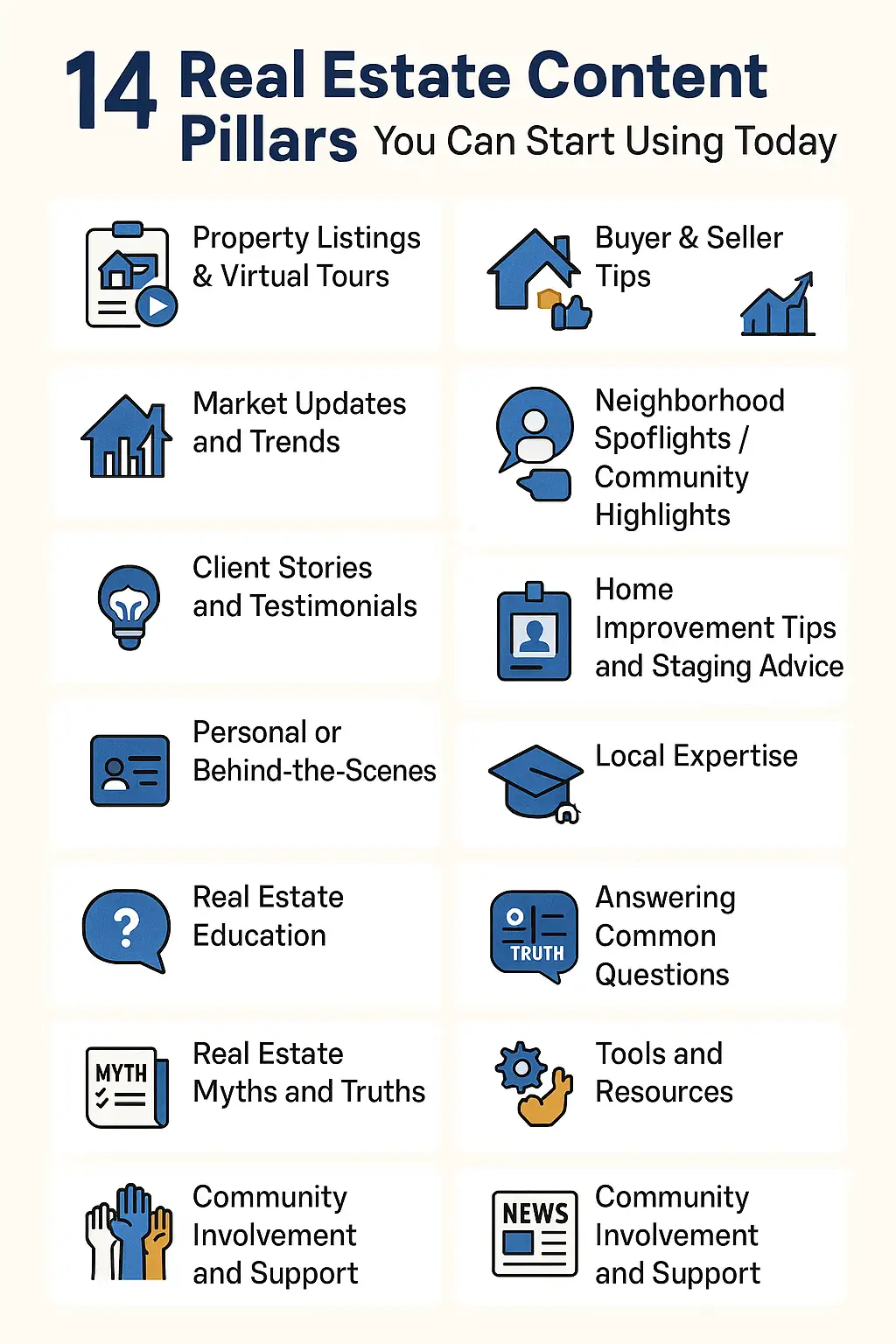
The highest-performing commercial real estate lead generation content is educational and hyperlocal. Focus on:
- Submarket reports — quarterly updates on vacancy rates, absorption, lease rates, and notable transactions in your target markets. These rank for high-intent local search terms and establish immediate authority.
- Investor guides — content addressing how to underwrite deals in your asset class, what cap rates look like right now, how to evaluate a 1031 exchange opportunity. This attracts buyers at the research stage.
- Tenant guides — how to evaluate space options, what to look for in a lease negotiation, how to plan a relocation or expansion. This pulls in businesses at the earliest stage of a real estate decision.
Gated Content for Lead Capture
Don't give everything away. Offer high-value market reports, deal analysis templates, or buyer guides behind a short lead form. The form completion creates a lead you can follow up with directly — someone who has self-identified as researching CRE in your market.
Realistic Expectations
SEO and content are long-term plays. Expect 4 to 6 months before you see meaningful organic traffic. The payoff is compounding and cost-effective once it kicks in, but this is not a fast-pipeline strategy. Pair it with outbound channels for immediate lead flow while the organic engine builds.
Strategy 6 — Referral Networks and Strategic CRE Partnerships

Why Referrals Close at the Highest Rate — But Can't Be Your Only Source
Referred leads close faster, require less convincing, and tend to come with built-in trust. In commercial real estate, a referral from an attorney, accountant, or mortgage broker is essentially a warm introduction to a qualified prospect.
The problem is that referrals are passive. You can't control the volume or timing. A broker who relies exclusively on referrals for commercial real estate leads has no predictability — and no pipeline when the referrals slow down.
The fix: systematize referrals while building outbound channels that don't depend on them.
Building a Structured Referral System
Most referral business in CRE happens accidentally — a client mentions you to a colleague, and eventually that colleague calls. That's not a system. A structured referral approach looks like:
- Ask every closed client directly: "Is there anyone in your network who might be facing a similar situation?"
- Make it easy to refer — a short email template they can forward, or a one-sentence description of exactly who you're looking to work with
- Follow up with clients at 90-day and 6-month marks — that's often when they hear about a colleague's real estate need
Strategic CRE Partnerships Worth Building
The highest-value referral sources for CRE brokers are the professionals who see real estate decisions before they're made:
- Commercial lenders and mortgage brokers — they know who's buying, refinancing, or over-leveraged
- Business attorneys and M&A advisors — acquisitions and reorganizations often trigger real estate moves
- CPAs and financial advisors — especially valuable for investor referrals and 1031 exchanges
- Business consultants and fractional executives — they know which companies are growing or contracting before anyone else
Invest in these relationships systematically — quarterly lunches, mutual referral agreements, co-hosted educational events for clients.
Strategy 7 — Retargeting and Paid Advertising to Re-Engage High-Intent Prospects
Why Most CRE Prospects Don't Convert on First Contact
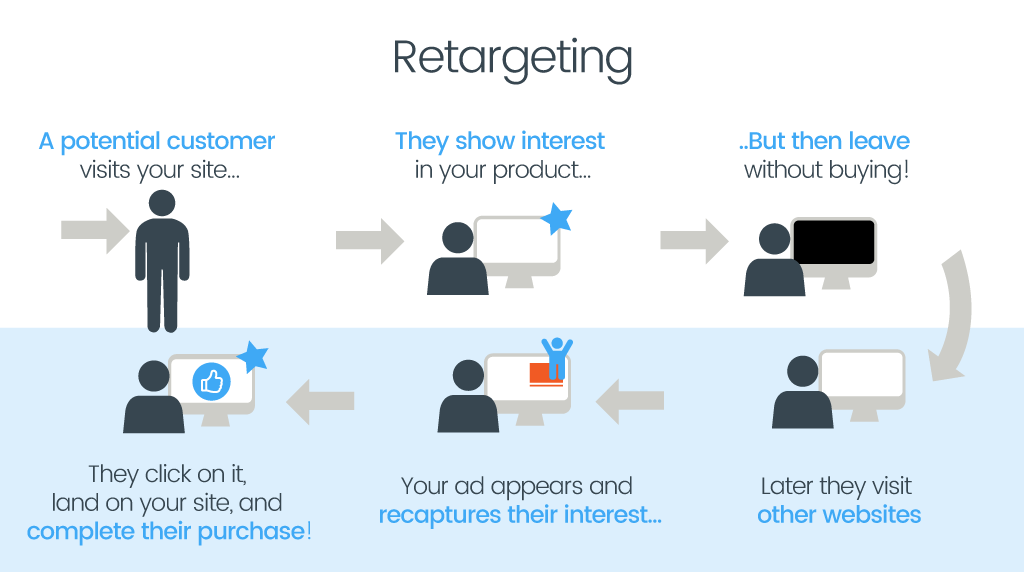
In commercial real estate, a prospect who visits your website, downloads a market report, or engages with your LinkedIn post is almost never ready to transact immediately. They're in research mode — and they're going to keep researching for weeks or months.
Retargeting is how you stay top-of-mind throughout that research window, so when they're finally ready to act, you're the broker they call.
LinkedIn Retargeting for CRE Decision-Makers
LinkedIn lets you build custom audiences from people who have visited your website, engaged with your content, or been part of an uploaded contact list. For CRE, this is particularly valuable — you can serve targeted content (market reports, deal highlights, case studies) to people who have already self-identified as interested in your market.
LinkedIn retargeting ads work best when the content is genuinely useful — not "call us today" ads, but submarket updates or investor insights that reinforce your authority.
Google Search and Display for High-Intent CRE Keywords
Paid search captures prospects in active research mode. Targeting terms like "industrial space for lease in [submarket]" or "office building for sale [city]" puts your listing or firm directly in front of buyers and tenants at peak intent. Commercial real estate campaigns average $75 to $120 per lead via paid channels — expensive, but the deal size in CRE makes the math work when conversion rates are healthy.
Website Visitor Identification for CRE Prospecting
Tools like Clearbit, Koala, and RB2B can now identify which companies are visiting your website — even when they don't fill out a form. For CRE, this creates a prospecting signal: if a company in your target tenant profile visits your industrial listings page, that's a warm outbound trigger.
Budget Reality Check
Paid channels amplify organic and outbound efforts — they don't replace them. Retargeting is most effective when layered on top of an active outbound and content engine. On their own, paid ads in CRE tend to generate a lot of impressions and very few qualified conversations.
How Cleverly Helps Commercial Real Estate Firms Generate Qualified B2B Leads

Generating consistent commercial real estate leads at scale requires precision targeting, verified data, and multi-channel execution — most CRE firms don't have the in-house infrastructure to do this efficiently.
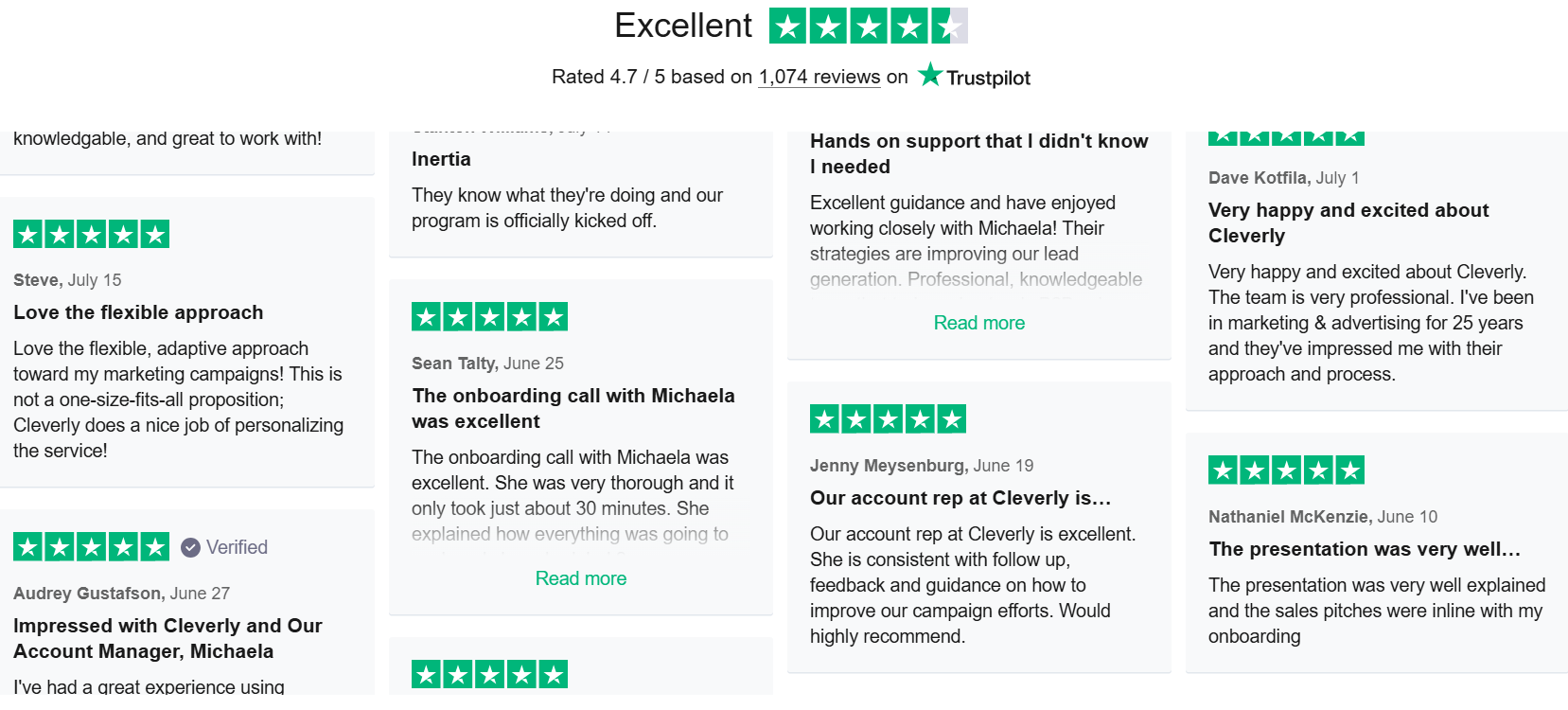
That's exactly where Cleverly comes in. We're the highest-rated done-for-you B2B lead generation agency, and we work with CRE companies that need a systematic outbound engine without hiring and managing an SDR team.
Here's what we deliver for CRE clients:
- ICP-based list building with verified owner, investor, and decision-maker contacts — filtered by asset class, geography, and deal criteria
- LinkedIn lead gen to the investors, CFOs, and corporate real estate leaders who make CRE decisions, with personalized messaging built around your market and offer
- Cold email campaigns structured around market relevance and education — not generic pitch blasts
- Cold calling through our $5M appointment-setting system that books 10 to 30 qualified sales calls per month, with a dedicated, trained SDR ready in 2 weeks
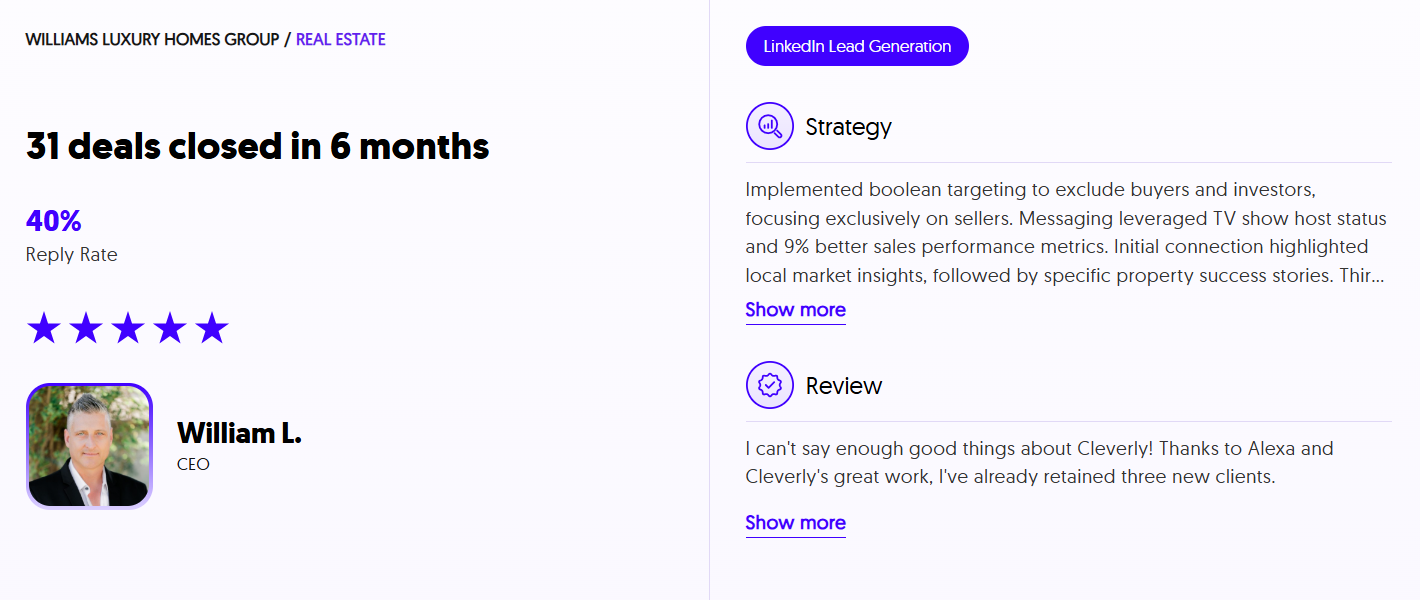
We focus on qualified conversations — not vanity metrics. Our outbound systems complement your existing referral and inbound pipeline, adding a consistent, controllable source of new leads that doesn't depend on timing or relationships.
Trusted by 10,000+ B2B companies, we've generated $312M in pipeline and set 53,000+ appointments across thousands of outbound campaigns.
🤝 Looking to generate a consistent pipeline of qualified commercial real estate leads?
Book a strategy call with Cleverly and we'll show you exactly how we'd approach your outbound.
Conclusion
Consistent commercial real estate lead generation in 2026 isn't about finding one magic channel — it's about building a system where multiple channels reinforce each other.
Start with two or three strategies from this guide, commit to them for 90 days, and measure results before expanding.
The fastest path to a full deal pipeline is pairing the right channels with accurate data and relevant, consultative outreach — and then staying consistent long enough for the system to compound.
Frequently Asked Questions
Free Resource
How to Scale a Profitable Cold Call System
Get the complete guide — download it instantly now.

Free Ebook
Download the Free Guide
Enter your details to get instant access.
You're all set! 🎉
Your ebook is downloading now.
Click below if the download didn't start automatically.


