Table of Contents
What Is a LinkedIn Connection Message (and Why It Matters)
LinkedIn Connection Message Character Limit Explained
LinkedIn Connection Message Acceptance Rates: What the Data Shows
What Makes a LinkedIn Connection Message Get Accepted
LinkedIn Connection Message Frameworks That Work
LinkedIn Connection Message Examples (By Use Case)
What to Say After They Accept: LinkedIn Follow-Up Messages
When NOT to Send a LinkedIn Connection Message (or What to Avoid)
How Connection Messages Fit Into a Full LinkedIn Outreach Strategy
How Cleverly Uses LinkedIn Connection Messages to Start Real Sales Conversations
Conclusion
Frequently Asked Questions
Modified On :
July 7, 2026
Key Takeaways
- Keep your LinkedIn connection message under 200 characters for better acceptance rates.
- Personalize with specific context (recent posts, shared interests, mutual connections) instead of generic compliments.
- Never pitch in your connection request - save sales conversations for after they accept.
- Use a simple structure: context + relevance + soft CTA (or none).
- Connection acceptance is just step one - real lead generation happens in the follow-up sequence.
- Test different messaging angles and track what improves your acceptance and reply rates.
You send a LinkedIn connection request. They ignore it.
Very common right?
We've sent millions of LinkedIn connection requests on behalf of 10,000+ clients - and the patterns of what gets accepted (and what gets ignored) are very consistent.
The thing is, most connection requests fail because they're lazy, generic, or just plain weird.
But when you nail your LinkedIn connection message, you go from getting ghosted to starting real conversations with people who actually want to talk to you.
Let's fix your connection game.
What Is a LinkedIn Connection Message (and Why It Matters)
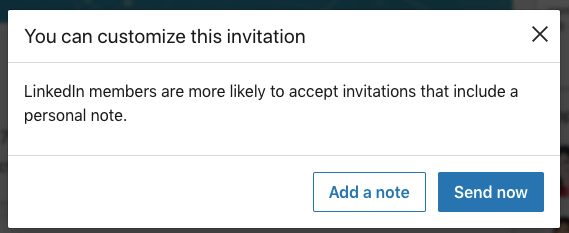
A LinkedIn connection message is that short note you can add when sending a connection request on LinkedIn.
Like your digital handshake. You can either send a blank request (boring) or add a personalized message (smart).
Here's what changes when you add a message:
When you send a LinkedIn connection request message, you're not just another random face in someone's inbox. You're giving context.
People are significantly more likely to accept requests with personalized messages — in our experience sending millions of connection requests for clients, the gap between blank requests and personalized ones is substantial. You're giving them context. Context makes saying yes easy.
Why your message matters:
- Acceptance rate jumps: Personalized messages get accepted way more than blank requests.
- Better replies after connecting: When people accept your request, they're already warmed up to respond.
- Builds immediate trust: You're showing you did your homework instead of mass-spamming.
When you need a message vs when it's optional
LinkedIn requires a message when connecting with people outside your network (3rd-degree connections or beyond).
For 2nd-degree connections, it's optional but still recommended. Skip the message and you're just another number.
Connection messages and modern lead generation
If you're doing any serious LinkedIn lead generation service work, your LinkedIn message for connecting is step one.
It's not about pitching right away. It's about opening doors. Get this part right, and everything else (conversations, meetings, deals) becomes easier.
Also Check: How to Use LinkedIn for B2B Lead Generation
🔥 Get Accepted. Get Noticed.
Cleverly writes and sends LinkedIn connection messages that turn cold profiles into real conversations. Starting at $397/mo.
LinkedIn Connection Message Character Limit Explained
LinkedIn connection request notes are limited to 300 characters for Premium users and 200 characters for free accounts. That's roughly 2–3 short sentences.
Even with 300 characters available, the best-performing messages we've seen stay under 200. People skim. They don't read novels in connection requests.
Why shorter actually wins:
Here's something we've noticed after sending millions of connection requests: shorter messages get better responses.
Even if you have 300 characters available, using 150-200 usually performs better. People skim. They don't read novels in connection requests.
Think about it. You're scrolling LinkedIn between meetings. Would you rather read a wall of text or a quick, clear message that gets to the point? Exactly.

Common character limit mistakes
- Cramming your life story: Nobody needs your full background in a connection request.
- Over-explaining: "I noticed you work at X and I also work in Y and I thought we could connect because..." Just stop.
- Using complex sentences: Long, winding sentences eat up characters and lose attention.
- Adding unnecessary fluff: Words like "just wanted to reach out" waste 25+ characters.
Clarity beats persuasion every time
Your LinkedIn connection message isn't a sales pitch. It's an introduction. Focus on one clear reason you're connecting.
Skip the clever wordplay. Skip the hype. Just be direct and honest.
✅ Good: "Saw your post on sales automation. Would love to connect and learn more about your approach."
❌ Bad: "I was scrolling through my feed and happened to come across your incredibly insightful post about sales automation strategies and I thought it would be mutually beneficial if we could connect to exchange ideas."
See the difference? Same intent, half the characters, way more readable.
Learn More: Linkedin Lead Generation Strategies to Consistently Generate 30+ Leads Per Month
LinkedIn Connection Message Acceptance Rates: What the Data Shows
Here's the honest answer on benchmarks: there's no single source of truth because acceptance rates vary significantly based on your profile strength, targeting quality, message relevance, and whether you're sending to second-degree or third-degree connections.
That said, here's what we've observed across millions of connection requests sent through Cleverly:
Blank connection requests — acceptance rates typically fall between 20–30% for second-degree connections. For third-degree, closer to 15%.
Personalized messages — acceptance rates jump to 35–50% for second-degree connections when the message is specific and relevant. The difference isn't magic. It's just that you gave the person a reason to say yes.
Short messages (under 150 characters) vs. long messages (250+ characters) — shorter messages consistently outperform longer ones. Length is not a proxy for effort. A two-sentence message that's specific beats a five-sentence message that's generic every time.
The "3x more likely" stat — some context
You'll see references to personalized messages being 3x more likely to get accepted. That's in the right ballpark based on what we see, but the multiplier depends heavily on the baseline. If you're targeting very cold, third-degree connections with no personalization, that gap can be even larger. If you're targeting warm audiences with existing familiarity, the lift from personalization is smaller.
The actual lever is relevance, not personalization for its own sake. Inserting someone's company name into a generic template is not personalization — it's a mail merge. What moves acceptance rates is showing you understood why this person is worth connecting with.
Check This Out: LinkedIn Lead Generation Strategies to Consistently Generate 30+ Leads Per Month
🚀 Turn Connections Into Clients
We handle targeting, copy, and follow-ups on LinkedIn, so your inbox fills with replies, not silence.
What Makes a LinkedIn Connection Message Get Accepted
A good LinkedIn connection request message feels personal without trying too hard. It's about showing you actually looked at their profile, not just copy-pasted their name into a template.
Personalization that actually works
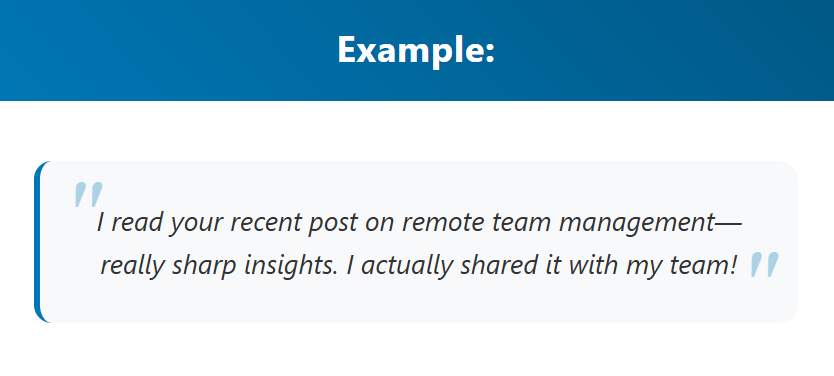
Reference something specific: a recent post they shared, a company move, a mutual connection, or shared interest. What doesn't work? Generic compliments like "I love your content" or "You have an impressive background." Everyone says that.
Relevance beats flattery
People accept connections when there's a clear, relevant reason. You work in the same industry. You're solving similar problems. You're both in the same LinkedIn group. That's relevance. Telling someone they're "a thought leader" is just flattery, and most people see right through it.
Give them a reason without pitching
Your LinkedIn message for connecting should answer one question: "Why is this person reaching out?" But here's the trick: answering that question doesn't mean selling something.
Good reasons: wanting to learn from their experience, exploring collaboration opportunities, expanding your network in their industry.
Bad reasons: "I have a solution for you" or "Let's schedule a call to discuss how we can help."
Value-first isn't code for sales pitch
When we talk about leading with value, we don't mean offering a free consultation or sending a case study. Value means being genuinely interested in them, not what you can get from them. Ask a thoughtful question. Mention something helpful. Show up as a human, not a sales bot.
The connections that stick? They start with curiosity, not a quota.
Check This Out: Linkedin Inmail vs Messages: What Gets You More Leads
LinkedIn Connection Message Frameworks That Work
Every strong LinkedIn message for connecting follows a simple structure. You don't need 10 different templates. You need one solid framework and the ability to adapt it.
The basic structure
- Context: How you found them or what caught your attention
- Relevance: Why connecting makes sense for both of you
- Soft CTA (or none): A question, a statement, or just leaving it open
That's it. Three parts. Most people mess up by skipping context or jumping straight to asking for something.
Questions vs statements
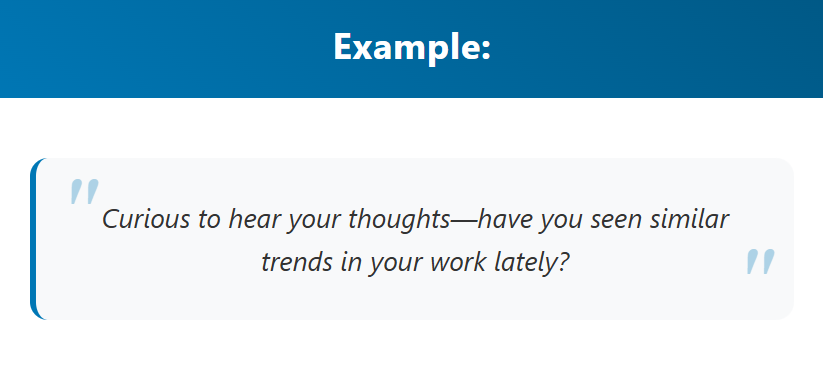
Questions work when you're genuinely curious: "How are you handling X in your role?" Statements work when you're adding context: "I'm also in fintech and expanding my network with other founders."
Don't force a question if you don't need one. Sometimes just explaining why you're connecting is enough. People will accept and reply if they're interested.
Framework for cold prospects
You have zero relationship. Keep it short and relevant.
"Saw you're leading sales at [Company]. I work with B2B teams on similar challenges. Would be great to connect."
No fluff. No over-explaining. Just context and relevance.
Framework for warm audiences
They engaged with your content or you've interacted before. Reference that.
"Thanks for commenting on my post about outbound strategy. Your take on response rates was spot on. Let's connect."
You're building on existing familiarity. Much easier.
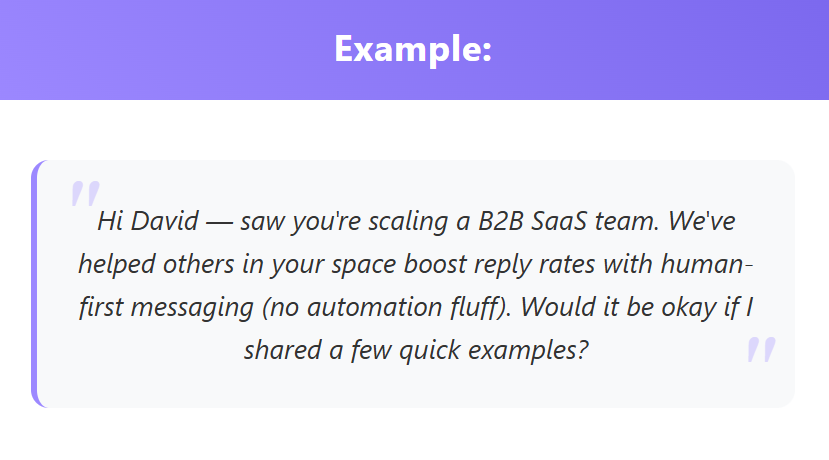
Framework for mutual connections
Mention the mutual connection if it's relevant.
"I see we're both connected to [Name]. I'm also in SaaS sales and expanding my network. Would love to connect."
Don't name-drop just to name-drop. Only mention mutual connections if it adds context or credibility to why you're reaching out. If the mutual connection isn't relevant, skip it.
The best LinkedIn connection message feels natural, not templated. Use these frameworks as guides, not scripts.
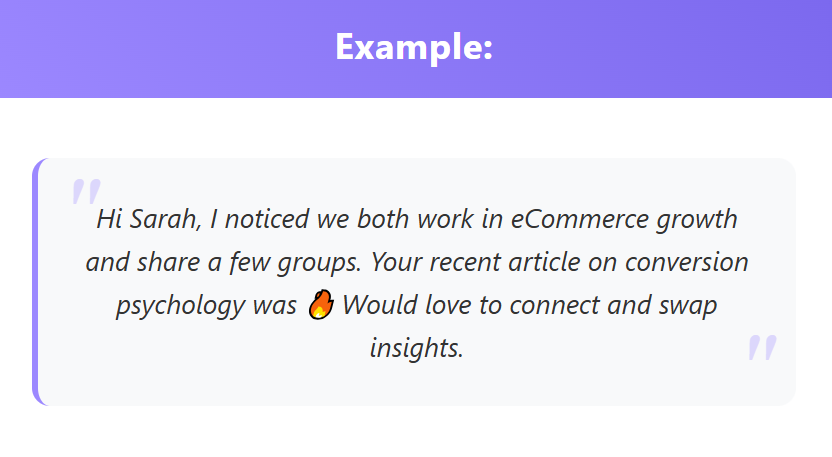
LinkedIn Connection Message Examples (By Use Case)
Here are real LinkedIn connection message template examples that work. None of these are trying to sell. They're just opening doors.
For B2B founders:
"Saw you recently raised a Series A. I'm building in the same space and would love to connect with other founders navigating similar growth challenges."
What it does: Shows relevance, shared experience, no ask. Just founder to founder.
For sales leaders:
"I lead sales at a mid-market SaaS company. Noticed you're dealing with similar team scaling challenges. Would be good to connect."
What it does: Establishes common ground. No pitch, just acknowledging you're in the same boat.
For marketing leaders:
"Your post on attribution models was really practical. I'm handling similar issues on our team. Let's connect?"
What it does: References something specific they shared, shows you're solving similar problems.
For recruiters:
"I see you're hiring for sales roles at [Company]. I'm connected with a few strong reps who might be a fit. Happy to connect."
What it does: Offers potential value without being pushy. Leaves the door open.
For partnerships:
"Looks like we're both working with early-stage B2B companies. Might make sense to connect and explore overlap."
What it does: Suggests mutual benefit without forcing a conversation.
For job changers (they just started a new role):
"Saw you just joined [Company] — congratulations on the move. I work with [function/industry] teams and would love to connect."
What it does: The job-change trigger is one of the highest-converting LinkedIn outreach moments. It's relevant, timely, and requires zero explanation for why you're reaching out.
For content engagement (they posted something you actually read):
"Your post on [specific topic] made me rethink how we approach [your challenge]. Would love to connect and follow more of your thinking."
What it does: References something real. Doesn't ask for anything. Works because it's genuinely about them.
For event or webinar attendees:
"We were both at [event/webinar] last week. Your question about [specific topic] was the most practical thing said all day. Let's connect."
What it does: Shared context does the personalization work. Short, specific, no pitch.
For alumni or shared group connections:
"I see we're both members of [group/alumni network]. I'm working in [industry] and expanding my network with others who've come through [school/group]. Would love to connect."
What it does: Common affiliation creates instant credibility. Simple, honest ask.
For recruiters reaching decision-makers (not sourcing — selling):
"Noticed you're scaling the [function] team at [Company]. I work with hiring managers on exactly this. Would be great to connect."
What it does: Acknowledges what they're focused on right now. Positions you as relevant without claiming anything.
What these all have in common:
Each LinkedIn connection message template is under 200 characters. They're specific enough to feel personal but short enough to skim. No one's asking for a meeting, a demo, or a call. Just connecting like normal humans do.
Copy these structures, swap in your details, and you're good to go.
What to Say After They Accept: LinkedIn Follow-Up Messages
Getting someone to accept is step one. What you send next determines whether that connection turns into a conversation or sits dormant in your network forever.
The biggest mistake people make here: going silent or immediately pitching. Both kill the relationship before it starts.
Here's a simple rule: your first follow-up message after connecting should either start a conversation or offer something useful. It should never open with "I wanted to share how we help companies like yours..."
Three follow-up message frameworks that work
The low-pressure conversation starter:
"Thanks for connecting, [Name]. Curious — how are you currently handling [relevant challenge]? I've been seeing a lot of teams rethink their approach lately."
Use this when: You have a genuine hook related to their work and want to start a real back-and-forth.
The value-first message:
"Hey [Name], thanks for connecting. I came across this [article/report/data point] on [topic] recently and thought of your work at [Company]. Sharing in case it's useful."
Use this when: You have a genuinely relevant resource. Don't use it as a fake reason to pitch — if the resource isn't actually good, skip this one.
The soft opener for warm-ish leads:
"Great to be connected, [Name]. I've been following what [Company] is doing in [space] — looks like an interesting time to be there. Happy to compare notes on [topic] if you're ever open to it."
Use this when: You have some context on their company or recent activity. Non-pushy, leaves the door open.
What to avoid in your follow-up
Don't send a calendar link in your first message after connecting. Don't start with "I hope this message finds you well." Don't immediately explain your product or service. You just got a yes — treat it like the beginning of a conversation, not the moment to close.
Learn More: LinkedIn Outreach: Complete Guide with Proven Strategies & Templates
When NOT to Send a LinkedIn Connection Message (or What to Avoid)
Not every connection request needs a message. And some messages are worse than no message at all. Here's what to skip.
When your profile looks empty
If your profile has no photo, a vague headline, and two bullet points under experience, don't bother with a personalized message yet. People will check your profile before accepting. Fix that first, then reach out.
When you're pitching in the first message
"Hi, I help companies like yours increase revenue by 40%..." Stop. Just stop.
Pitching in your LinkedIn connection message is the fastest way to get ignored. You're not connecting, you're cold calling. Save the pitch for after you've built some trust.
When you're using generic templates
LinkedIn's default "I'd like to add you to my professional network" message screams lazy. Same goes for obvious copy-paste jobs where you forgot to change the company name. People can tell. And they'll decline.
When you haven't looked at their profile
If you can't reference something specific about them, their work, or their content, you're not ready to send a LinkedIn message for connecting. Do the research first. Five minutes on their profile is enough.
When you're asking for too much too soon
"Can I get your phone number?" or "Let's jump on a call this week" in a connection request? Way too aggressive. You haven't even connected yet. Build the relationship first.
When it's all about you
Messages that only talk about your achievements, your company, or what you need are selfish. The best connection messages focus on them or find common ground. Make it about mutual interest, not your agenda.
💙 Better approach:
When you're unsure, follow them first. Engage with a few of their posts. Comment something thoughtful. Then send a connection request a week later. By that point, you're not a stranger anymore, and your message lands way better.
How Connection Messages Fit Into a Full LinkedIn Outreach Strategy
Your LinkedIn connection message isn't where you close deals. It's just the door opener. Too many people treat it like it's the whole strategy. It's not.
Connection first, pitch later
The connection request gets you in. That's it. You're not generating a lead yet. You're starting a conversation. The actual LinkedIn lead generation happens in what comes next: the follow-ups, the replies, the back and forth.
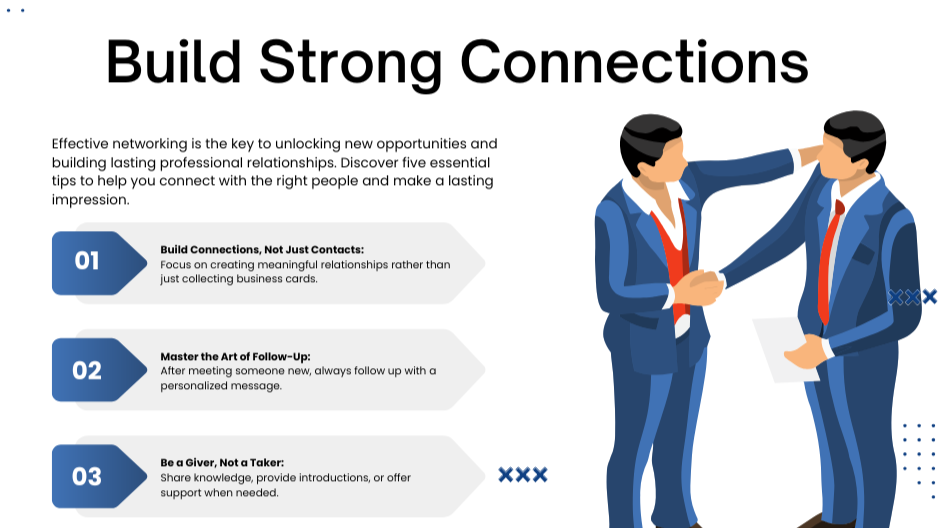
Think of it like meeting someone at a conference. You don't hand them a contract when you shake hands. You introduce yourself, find common ground, then follow up later.
Follow-ups are where the real work happens
Once someone accepts your connection, most people either go silent or immediately pitch. Both are mistakes.
The right move? Send a thank you message or start a genuine conversation. Reference something from their profile. Ask a thoughtful question. Show you're interested in them, not just what they can buy.
Why most deals die after acceptance
Here's the brutal truth: most people waste the connection. They get accepted, send a generic "thanks for connecting" message with a calendar link, and wonder why no one responds.
You just got someone to say yes to connecting. Don't blow it by immediately asking for their time or trying to sell. Warm them up first. Share something helpful. Engage with their content. Build actual rapport.
Sequencing and timing matter
Good LinkedIn outreach follows a sequence:
- Day 1: Send personalized connection request
- Day 3-5: They accept, you send a low-pressure follow-up
- Week 2: Engage with their content, maybe send a helpful resource
- Week 3-4: Start a real conversation based on their interests or challenges
Rushing this process kills your results. Stretching it too long and you lose momentum. The timing depends on how warm the lead is and how engaged they are.
🔥 The bigger picture:
Your LinkedIn lead generation service strategy should treat connection messages as step one in a longer game. Get the connection. Build trust. Start conversations. Then, and only then, introduce what you do and how you might help.
Most people skip straight to the ask. That's why most people fail on LinkedIn.
Explore More: Exact LinkedIn Sales Navigator Lead Workflow We Use to Book High-Quality B2B Meetings
How Cleverly Uses LinkedIn Connection Messages to Start Real Sales Conversations
We've sent millions of LinkedIn connection messages for over 10,000 clients, including companies like Amazon, Google, Uber, PayPal, Slack, and Spotify.
…That's resulted in $312 million in pipeline revenue and $51.2 million in closed revenue.
How we do it differently:
- We research your ICP first: Before we send a single request, we dig into who your ideal customers actually are. No spray and pray.
- Personalization at scale: Every message is customized based on the prospect's profile, industry, and recent activity. It feels human because it is human, just done at scale.
- We test everything: Acceptance rates, reply rates, messaging angles. We're constantly testing what works and what doesn't so your campaigns get better over time.
- Connection messages are just the start: Once someone accepts, we keep the conversation going naturally. No robotic "thanks for connecting" messages. Real dialogue that leads to real meetings.
- Appointment-setting that actually works: Our messages plug directly into workflows that book qualified meetings. You don't get random connections. You get people who are ready to talk.

We're not a spam agency. We're a conversation-first LinkedIn lead generation service that treats your prospects like humans, not numbers. Prices start at just $397/month.
Want connection messages that start conversations, not get ignored?
📢 Talk to Cleverly!

Conclusion
Your LinkedIn connection message doesn't need to be clever. It needs to be relevant. Short, human, and contextual beats long, salesy, and generic every single time.
Remember: getting someone to accept your connection request is just step one. The real work happens in the follow-up. That's where conversations turn into meetings, and meetings turn into deals.
Stop overthinking it. Be clear about why you're connecting. Keep it short. Sound like a real person. That's the whole game.
Now go fix those connection requests.
Frequently Asked Questions
Free Resource
How to Scale a Profitable Cold Call System
Get the complete guide — download it instantly now.
Free Ebook
Download the Free Guide
Enter your details to get instant access.
You're all set! 🎉
Your ebook is downloading now.
Click below if the download didn't start automatically.