Table of Contents
What is Waterfall Enrichment?
Why Single-Source Enrichment Fails B2B Sales Teams
How Waterfall Enrichment Works (Step-by-Step)
Waterfall Enrichment vs. Single-Source Enrichment
Key Benefits of Waterfall Enrichment for B2B Sales
Best Waterfall Enrichment Tools in 2026
How to Set Up Waterfall Enrichment for Your Outbound Stack
Common Waterfall Enrichment Mistakes to Avoid
How Cleverly Builds Outbound Pipeline with Verified Data
Conclusion
Frequently Asked Questions
Modified On :
May 20, 2026
Key Takeaways
- Waterfall enrichment queries multiple data providers sequentially until a verified contact is found, pushing match rates from the 40–60% single-source ceiling to 80%+.
- No single data provider — Apollo, ZoomInfo, Lusha — covers your full ICP. Their databases barely overlap. Waterfall closes that gap.
- Triple-layer email verification (syntax, domain, SMTP) is what separates waterfall from basic enrichment — it's what keeps bounce rates under 1% instead of 5–15%.
- Purpose-built platforms like FullEnrich and Clay are the fastest paths to waterfall enrichment; building it yourself is expensive and rarely delivers comparable coverage.
- Clean, verified contact data isn't just a nice-to-have — it's the foundation every downstream outbound activity (personalization, sequencing, cold calling) depends on.
You build a 500-contact ICP list. Solid targeting, right job titles, right company sizes. You run it through your data provider and come back with verified emails for 280 people. The other 220 contacts just sit there, unreachable.
That's not a targeting problem. Those contacts exist. They have email addresses. They just aren't in that one database.
Single-source enrichment tools consistently return contact data for between 40 and 60 percent of a standard B2B contact list. The contacts that come back empty aren't unfindable — they're in a different database. Apollo has some. Lusha has some. ZoomInfo has some. Hunter has some. No single provider has all of them.
Validity's 2025 survey found 37% of CRM users reported losing revenue as a direct consequence of poor data quality. Meanwhile, B2B contact data decays at roughly 2.1% per month, or about 22.5% annually. Stale single-source lists compound the problem fast.
Waterfall enrichment is the architecture the fastest-growing B2B sales teams use to solve this.
This guide covers what it is, how it works step-by-step, the concrete business benefits, how email and phone waterfall differ, whether you should build it or buy it, the best tools in 2026, and how to implement it in your outbound stack.
If you're an SDR, RevOps leader, or sales manager running any kind of outbound prospecting, this matters.
What is Waterfall Enrichment?
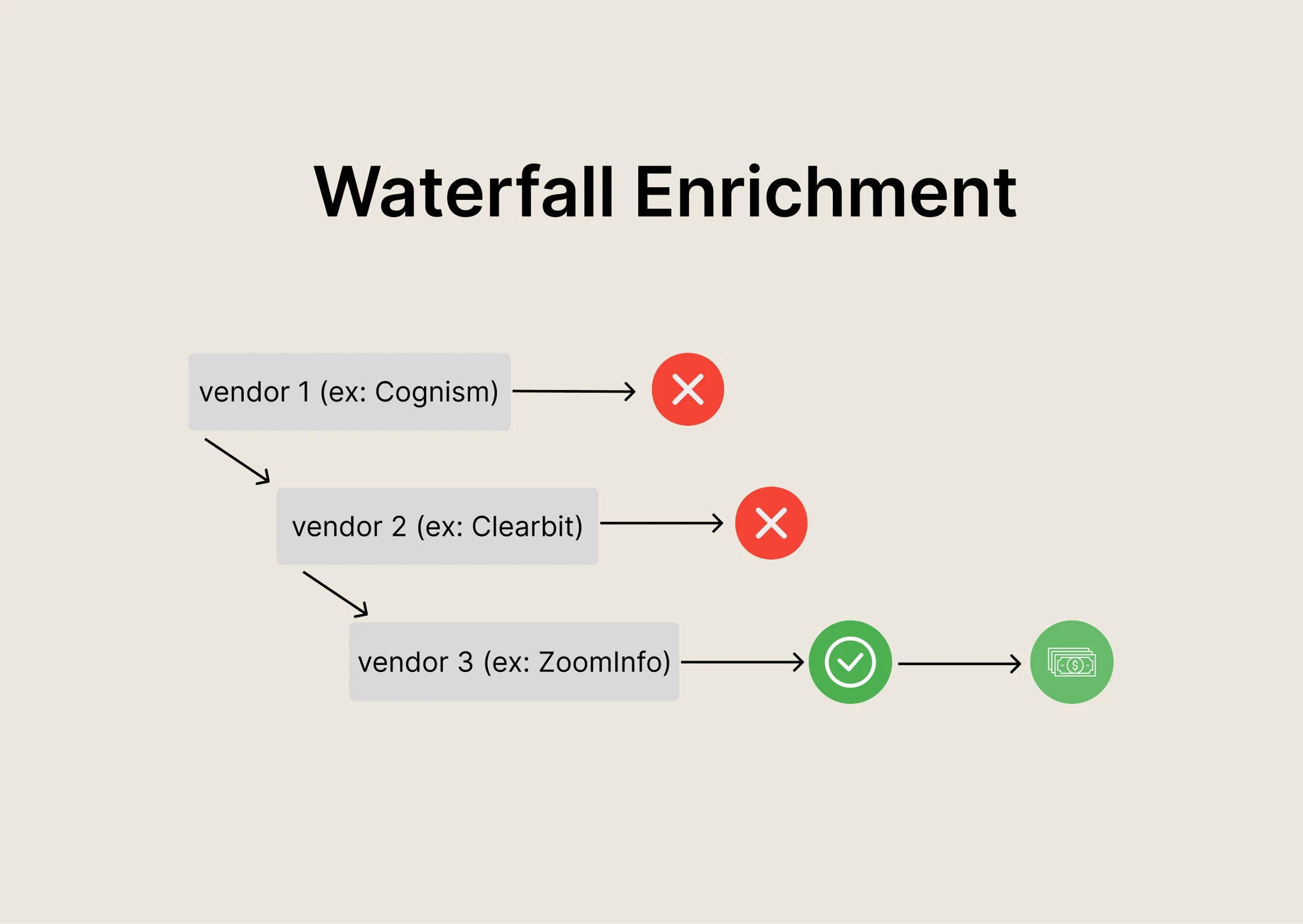
Waterfall enrichment is a data enrichment method that queries multiple providers in sequence — one after the other — until a verified email address, phone number, or other contact detail is found, rather than stopping after a single source comes up empty.
The waterfall image is fitting: data flows from one provider to the next. If Apollo finds the email, the process stops there. If not, it cascades to the next provider — Clearbit, Hunter, People Data Labs — until a valid result is returned.
The key distinction from regular enrichment: a standard tool returns whatever it finds (or doesn't). Waterfall enrichment only stops once a result has been verified — not just returned.
The core insight is straightforward: B2B data provider databases barely overlap. One provider might be excellent for tech profiles in North America, another for European SMBs, a third for direct-dial phone numbers. None of them cover everything.
The result of running a proper waterfall? With a single-provider approach, even the best-organized sales teams rarely exceed 60% coverage on their lists. The remaining 40% simply can't be reached — until waterfall enters the picture.
It's like calling multiple sources to confirm the same piece of information. The first source either confirms it or passes the baton. The rest fill in gaps the first one couldn't.
🎯 Better Data = Better Meetings
We combine enriched data with LinkedIn, cold email & calling. So your team talks to real buyers—not dead leads.
Why Single-Source Enrichment Fails B2B Sales Teams
Every major data provider has blind spots. Apollo is strong in North America but thinner in APAC. ZoomInfo dominates enterprise US data but underperforms for SMBs in Europe. Lusha has solid European coverage but gaps in other regions. None of them cover everything.
Single-source enrichment tools create systematic blind spots that leave nearly 60% of qualified prospects unreachable, regardless of how well they fit your targeting criteria.
The typical workaround teams reach for: broadening ICP criteria to compensate. If the data provider can't find enough contacts in your target segment, just expand the criteria. It feels logical. It's actually counterproductive — you're trading list quality for volume, and your SDRs spend time working contacts that were never a fit.
A static database refreshed quarterly has already lost meaningful accuracy before the refresh happens. Layer that decay rate on top of single-source coverage gaps, and you've got a real problem at scale.
The bounce rate consequence is where this gets costly fast. Non-validated single-source data typically produces bounce rates of 8–15%, which damages sender domain reputation over time.
Once your domain reputation takes a hit, every campaign you run performs worse — not just the one with bad data.
Missing 40% of your addressable market isn't a data inconvenience. It's 40% of potential pipeline you're not touching.
How Waterfall Enrichment Works (Step-by-Step)
The mechanics are simpler than most people expect. Here's how a properly configured waterfall runs from input to verified result.
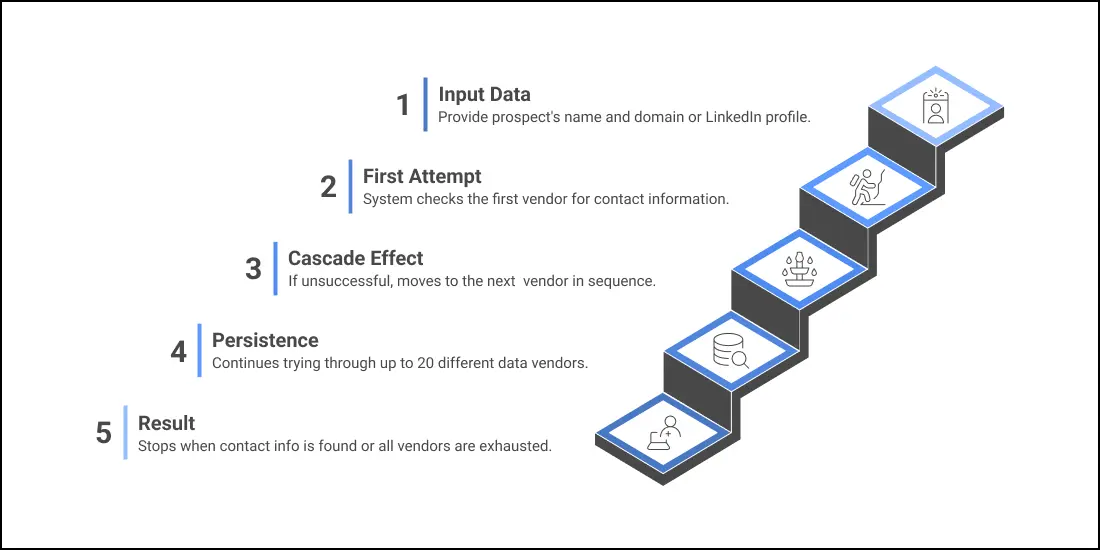
Step 1 — Input Submission
A contact is submitted with whatever identifying information is available. The most common combination: name + company domain. A LinkedIn URL or phone number increases match confidence, but name and domain alone is typically sufficient to kick off enrichment.
Step 2 — First Provider Query
The waterfall system sends the contact to Provider 1 in the sequence. That provider searches its database and returns a result — or doesn't.
Step 3 — Validation Check
If a result is returned, it passes through three-layer email verification before anything is marked clean:
- Syntax validation: Is the address correctly formatted?
- Domain validation: Does an active MX record exist for that domain?
- SMTP verification: Does this specific mailbox exist and can it receive mail?
All three checks must pass. A result that clears only one or two layers doesn't make it through.
Step 4 — Decision Point
Verified result: process stops. The email address is delivered.
Failed verification or no result: the system automatically moves to the next provider in sequence. No manual intervention required.
Step 5 — Sequential Querying Continues
The same validation loop repeats for each provider in the sequence. The system only stops when a verified result is found — or all sources in the waterfall have been exhausted.
Step 6 — Result Delivery
The verified contact info comes back alongside enriched firmographic data. The credit model is important here: you don't pay duplicate credits for data that's already been found. The system only continues if the field is still empty. You pay for success, not for attempts.
🚀 Most Outreach Fails Before the First Email
Wrong data. Wrong targeting. Zero replies. We fix the entire outbound system—done for you.
Waterfall Enrichment vs. Single-Source Enrichment
Here's the performance gap laid out plainly:
The number that matters most: on a list of 1,000 prospects, moving from a single source to a four-source waterfall delivers roughly 200 to 370 additional reachable contacts.
That's incremental pipeline that costs nothing beyond the enrichment credit itself, because those prospects already exist on your target list.
At any reasonable conversion rate, 200–370 additional contactable leads is measurable revenue impact.
Key Benefits of Waterfall Enrichment for B2B Sales
Better match rates are the headline. But the downstream business impact is what makes waterfall enrichment worth understanding in detail.
1) Contact More of Your ICP Without Broadening Targeting
This is the one teams get most excited about. Waterfall lets you keep your ICP tight while closing the coverage gap through data depth — not by relaxing criteria.
Wider ICP means more contacts but lower quality. Waterfall means the same ICP, more of them found. More contactable leads from the same target universe means more pipeline without changing who you're selling to. For SDRs and sales leaders, that's a significant operational difference.
2) Better Geographic Coverage
US-heavy providers underperform in APAC and EMEA. If your outreach targets contacts outside North America, a single-source tool built around a US-dominant database is going to disappoint you consistently.
A well-configured waterfall includes providers optimized per geography — teams running outreach across regions need multi-provider coverage to maintain consistent match rates globally.
A waterfall built with regional provider diversity delivers the same coverage quality in London that it does in Chicago.
3) Competitive Advantage Through Less-Contested Data
This one doesn't get talked about enough. The most popular data providers — Apollo, ZoomInfo, Lusha — are used by tens of thousands of sales teams simultaneously. Contacts in those mainstream databases are getting hit with cold emails from multiple senders at the same time.
Tapping into less popular data providers uncovers prospects your competitors haven't touched. That's how you gain a competitive edge — by reaching prospects with less-saturated inboxes. Higher reply rates aren't just about better copy.
They're about reaching people who aren't already fatigued by the same outreach everyone else is sending.
4) Lower Bounce Rates = Better Deliverability
Bounce rates above 2% damage sender domain reputation. Single-source data routinely produces bounce rates of 5–15%. Waterfall with triple SMTP verification brings that under 1%.
The compounding effect matters here: lower bounce rate means better inbox placement, which means better performance from every email you send — not just the campaign where you cleaned the data. Deliverability is cumulative. Protecting it is worth the effort.
Waterfall Enrichment for Emails vs. Phone Numbers
The same sequential architecture applies to both, but the mechanics differ enough to cover separately.
Email waterfall
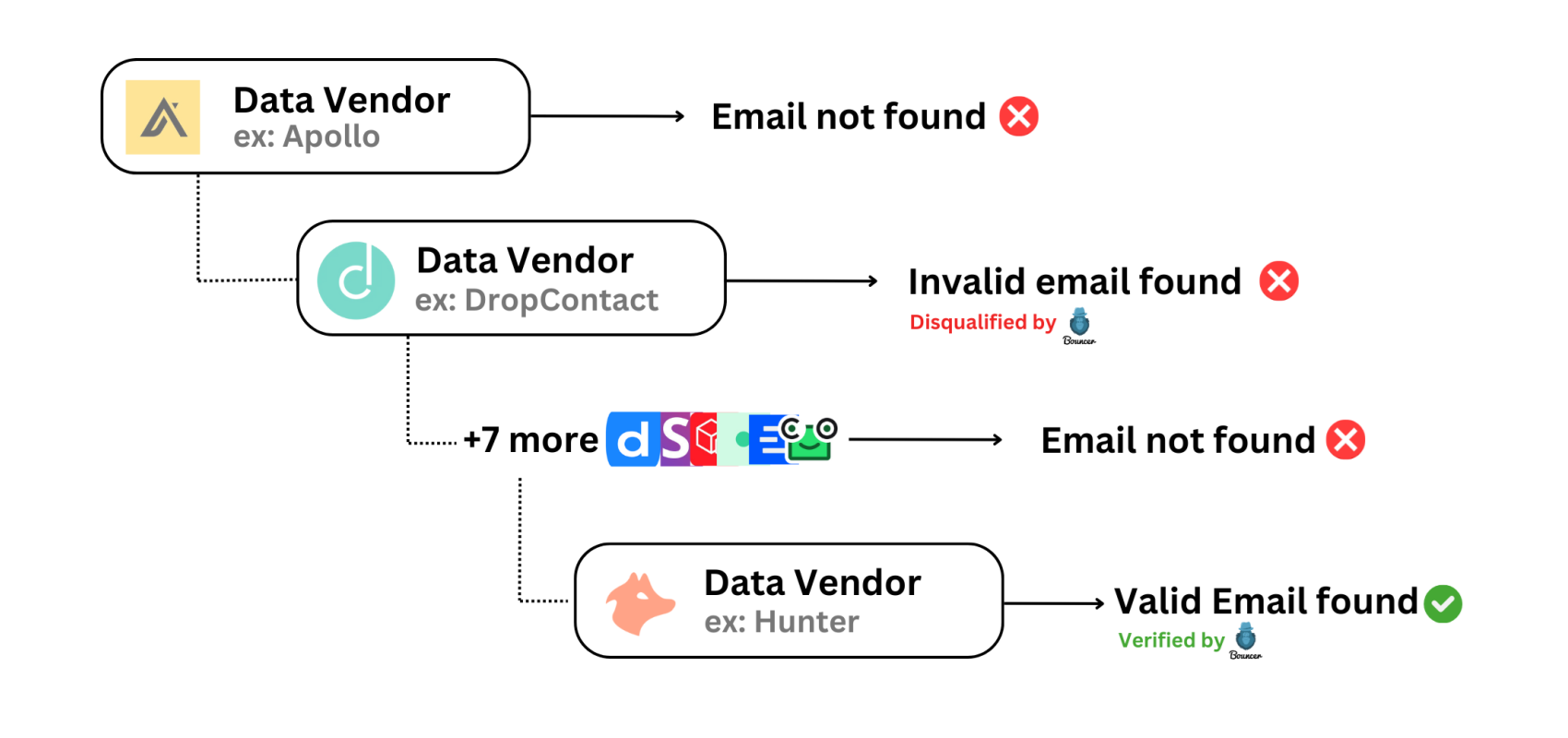
Starting with just a name and company domain, a well-configured email waterfall consistently reaches 80%+ match rates globally. Providers are stacked to maximize coverage — Prospeo, DropContact, Datagma, Hunter, PeopleDataLabs, Apollo, Lusha, and more are queried in sequence depending on geography and domain type.
Triple SMTP verification filters invalid results at each step so only clean addresses pass through.
Phone number waterfall
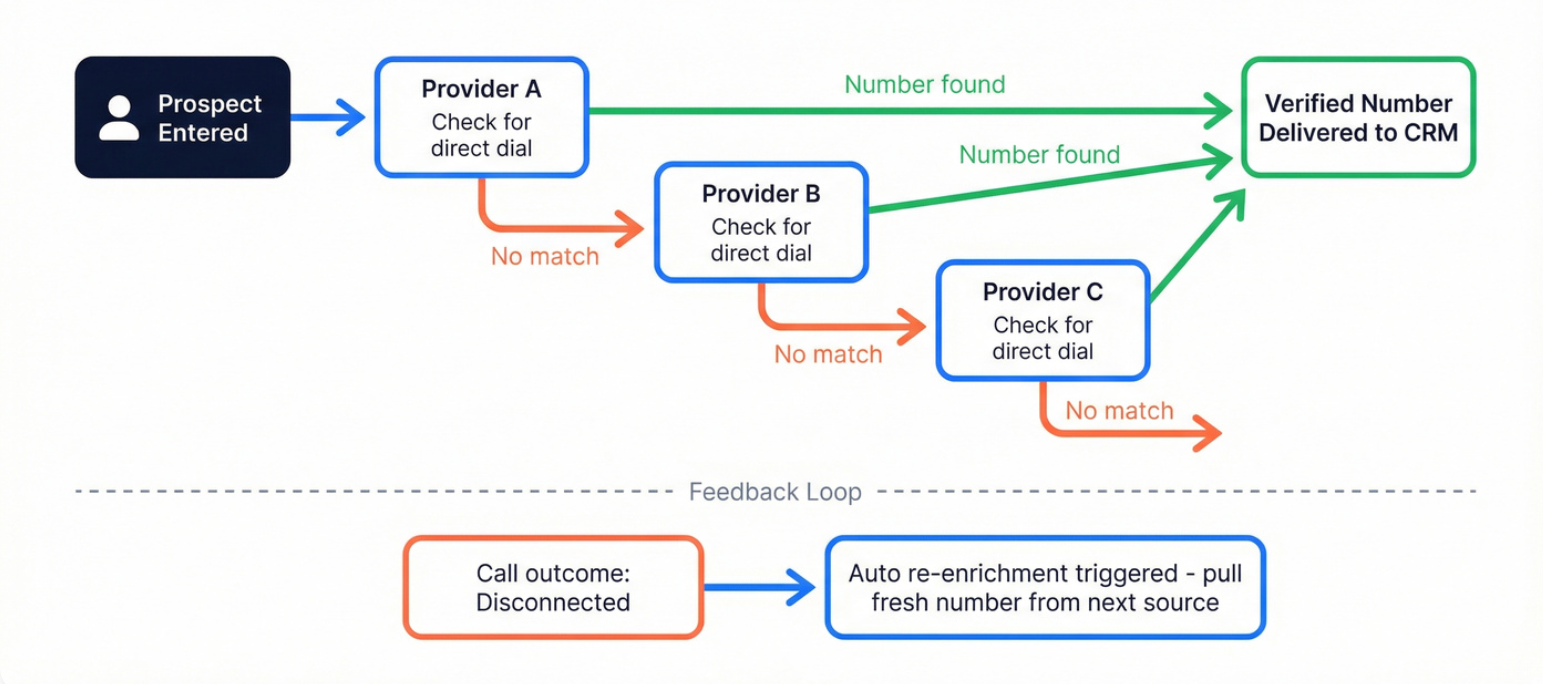
More complex. Mobile numbers change more frequently than email addresses, are harder to source, and are scattered across a more fragmented provider landscape. The best platforms handle an important nuance: landlines are returned free and enrichment continues until a verified mobile number is found.
If you're running cold calling alongside email outreach, phone waterfall is the infrastructure that makes direct-dial data viable at scale.
For outbound teams combining email sequences with cold calling, running both enrichment waterfalls in parallel gives you full contact coverage on each prospect rather than email-only reach.
Should You Build a Waterfall Enrichment System Yourself?
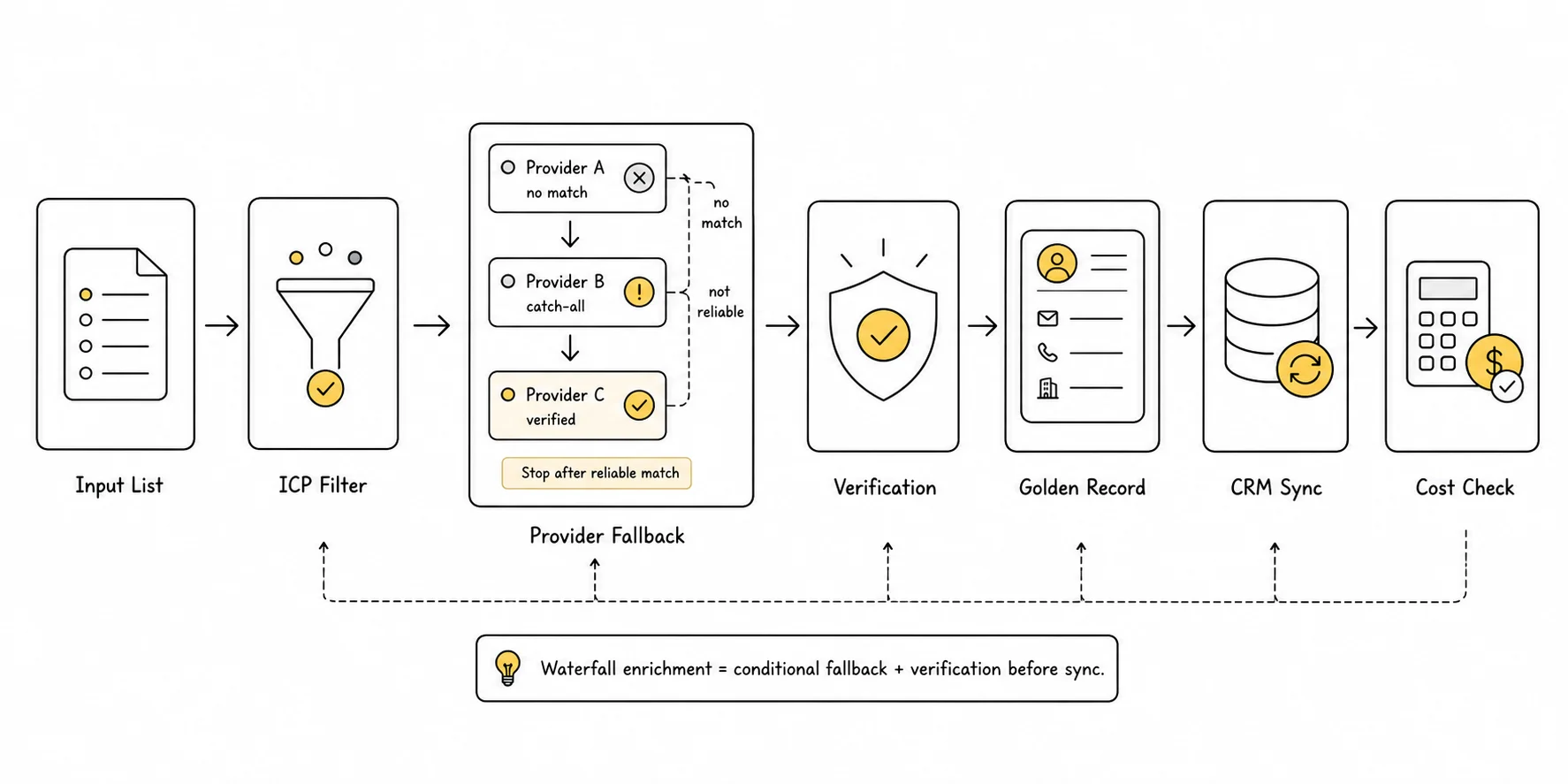
Technically, yes. Most teams with engineering resources could wire together a waterfall using Make or n8n, connecting a handful of data providers via their APIs and building validation logic on top.
The real question is whether the total cost justifies the effort.
What building in-house actually costs:
- Time: Initial development runs a week or more. Ongoing maintenance — API changes, rate limits, credit management, verification logic updates — adds up fast. A static enrichment setup built in-house degrades quickly without constant upkeep.
- Money: Platform automation costs (Zapier, Make, n8n) compound at scale. No volume discounts across multiple provider subscriptions. Each provider is a separate contract and credit system to manage.
- Coverage: Most in-house builds connect 3–5 providers. Purpose-built waterfall platforms check dozens of specialized sources to achieve 80%+ contact discovery rates — a 3-provider DIY build consistently underperforms.
- Verification: Building robust triple-layer SMTP verification is a project on its own. Teams that skip it end up with the same bounce rate problem they started with, just routed through more providers.
For teams with dedicated RevOps engineers, Clay is a powerful platform. For non-technical operators, simpler tools produce better ROI.
When building in-house makes sense: large engineering organizations with existing data infrastructure, significant monthly volume (10K+ records/month), and a dedicated team to maintain the system. For most B2B sales teams, a purpose-built platform delivers better results, faster, at lower total cost.
Best Waterfall Enrichment Tools in 2026
The market has split into two categories: standalone waterfall platforms built specifically for enrichment, and all-in-one sales platforms with waterfall capabilities built in. Here's where the main players land.
1. Clay — Best for Custom Waterfall Enrichment Workflows
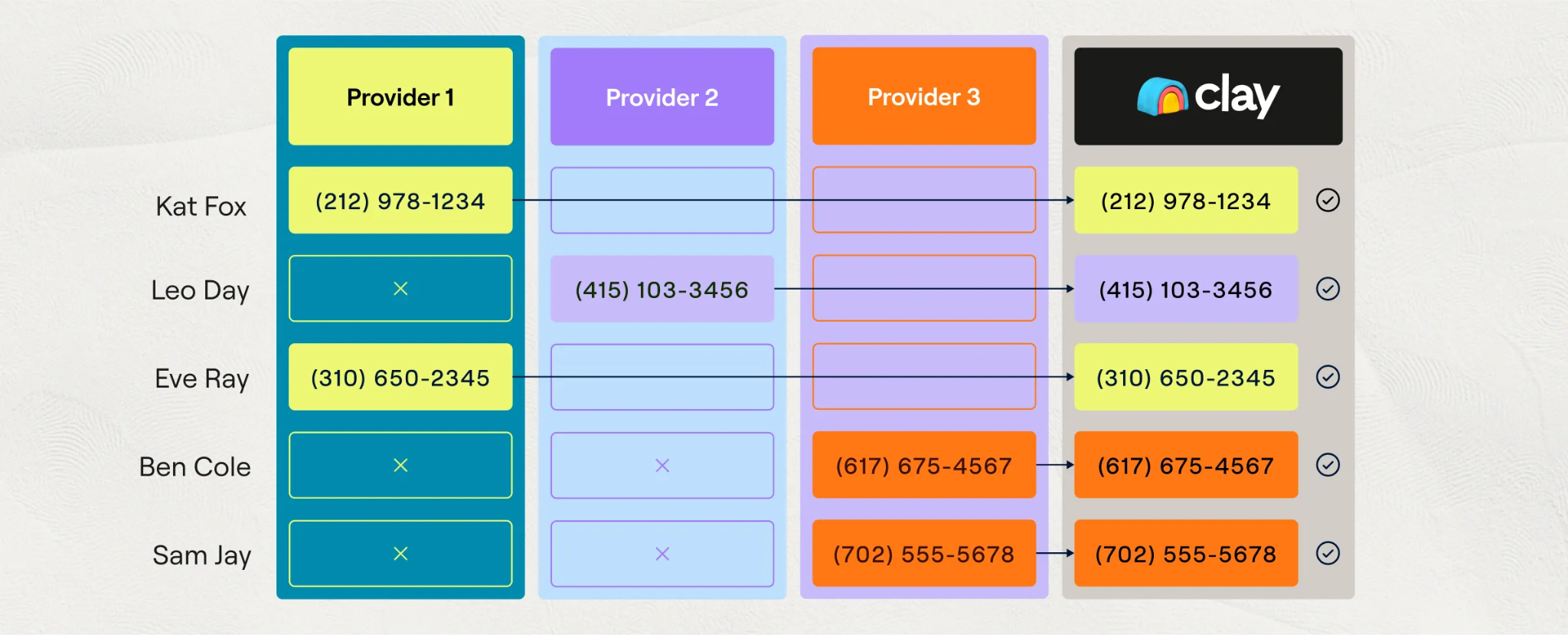
Clay waterfall enrichment is the most flexible option on the market. Clay connects to over 150 data providers and lets you run waterfall enrichment across them in a spreadsheet-like interface — when looking up a contact's email or phone, it queries multiple data providers in sequence until it finds a verified result.
You only pay for successful "hits," achieving 90%+ coverage while slashing cost per verified contact. Claygent, Clay's AI research agent, layers deep per-prospect intelligence on top of enrichment — pulling data from websites, LinkedIn profiles, and news articles that no standard API would surface.
The trade-off is real: Clay is expensive. Teams running sophisticated waterfalls across thousands of prospects can spend $2,000+/month quickly. No native sending means you'll pair it with a separate cold email tool. Pricing ranges from a free tier (100 credits/month) to $149/month Starter, $349/month Explorer, $800/month Pro, with enterprise custom pricing.
Best for: RevOps engineers and growth teams who want maximum control over enrichment logic and are comfortable building custom workflows.
2. Apollo.io — Best for All-in-One Enrichment + Sequencing
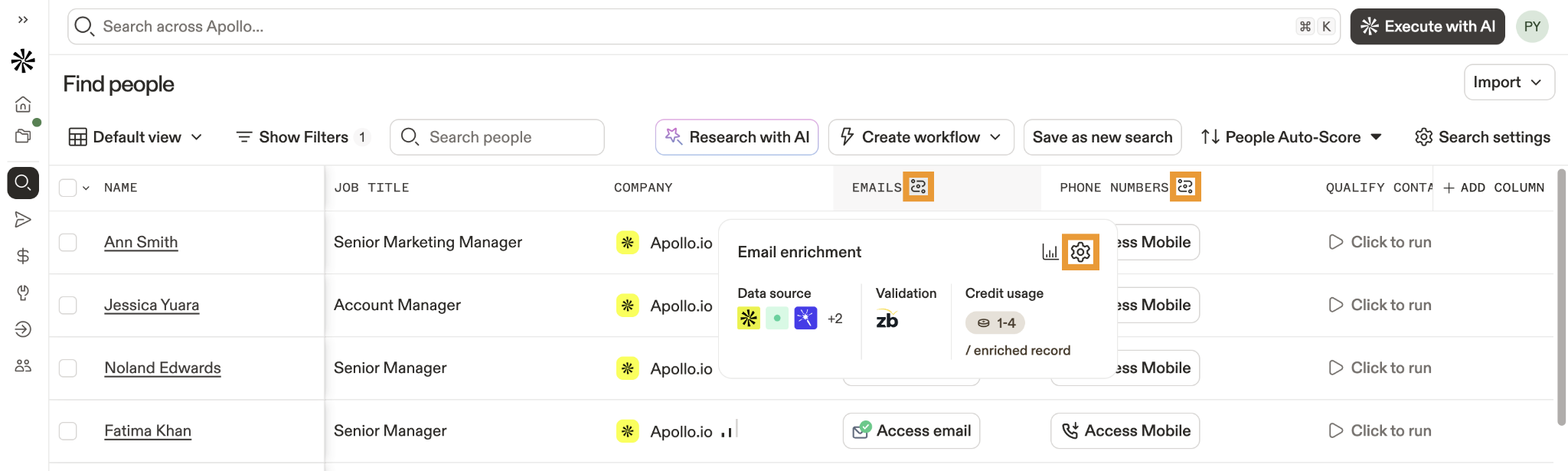
Apollo.io is an all-in-one sales intelligence and engagement platform that combines a 270M+ contact database with built-in email sequencing, a dialer, and AI-powered personalization tools.
The nuance on Apollo waterfall enrichment: Apollo is primarily a single-source provider. Its contacts come from Apollo's own database. If Apollo does not have a contact, there is no fallback to another provider — you get what Apollo has, and nothing more. However, many teams use Apollo as one provider within a Clay waterfall, getting the benefit of Apollo's database as part of a larger multi-source sequence.
Pricing is per-seat: $49/user/month (Basic), $79/user/month (Professional), $119/user/month (Organization), with annual billing required on paid plans.
Best for: Teams that want prospecting data and sequencing in one platform, without stitching tools together.
3. FullEnrich — Best Dedicated Waterfall Enrichment Platform
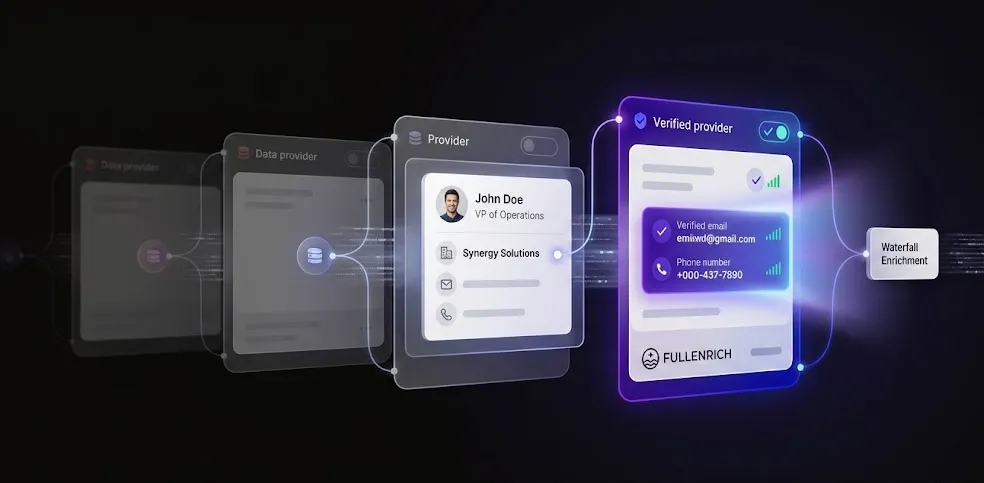
Purpose-built for waterfall enrichment with zero setup complexity. FullEnrich routes through 15+ providers at straightforward credit pricing — 1 credit per work email, 10 per mobile, 3 per personal email — and charges only on successful finds.
Independent benchmark testing across 24 tools found waterfall enrichment approaches delivering 96–98% accuracy compared to 80–85% from single-source tools like ZoomInfo and Apollo. Triple email verification keeps bounce rates under 1%. Landlines are returned free; enrichment continues until a verified mobile is found.
SOC 2 Type II certified, fully GDPR and CCPA compliant. Free to start with 50 credits on signup, no card required.
Best for: Teams that want dedicated waterfall without the engineering overhead of building or managing multiple provider subscriptions.
4. ZoomInfo — Best for Enterprise-Grade Data Coverage
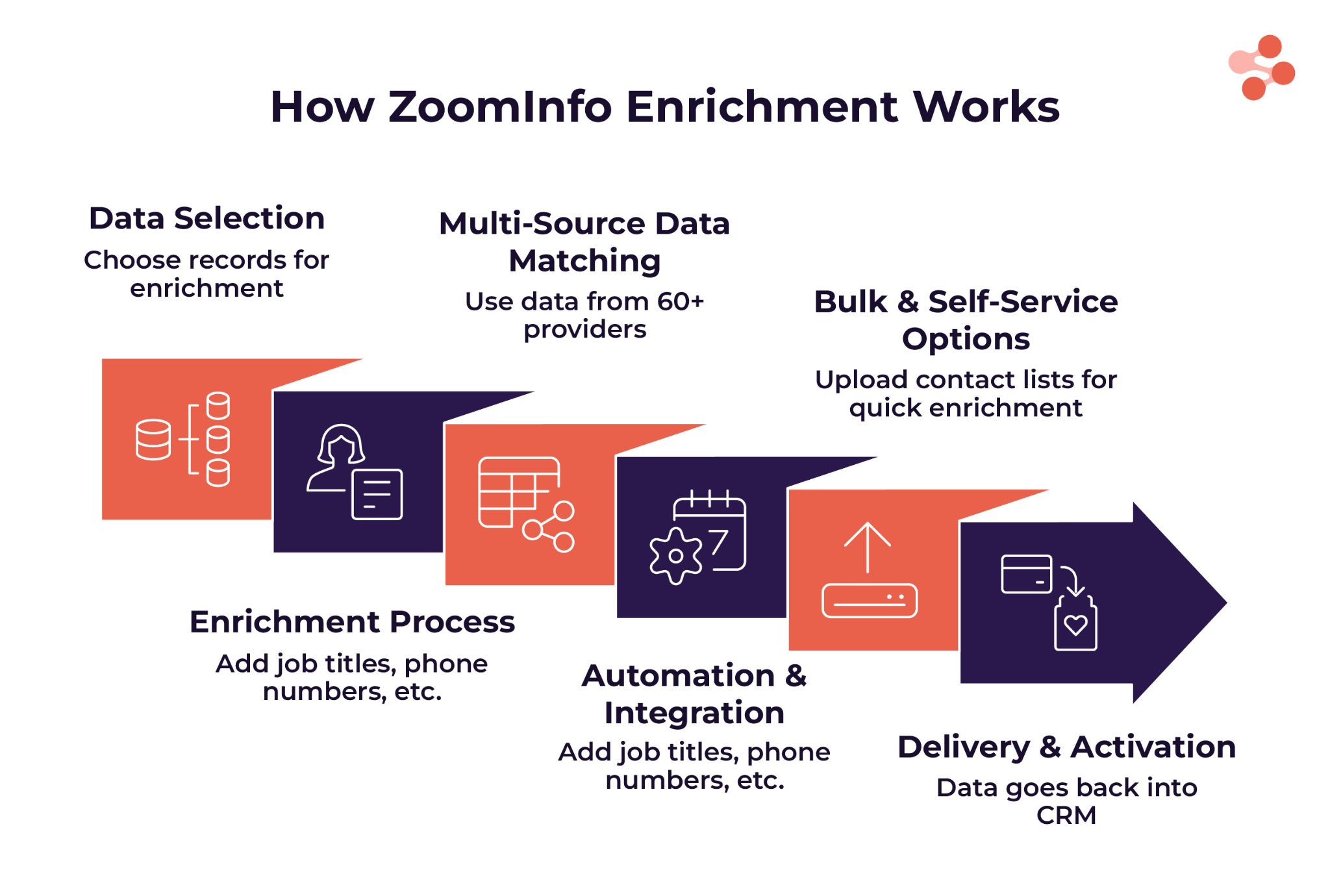
ZoomInfo runs one of the largest proprietary B2B databases, with particularly strong US enterprise coverage. ZoomInfo delivers 85% accuracy in independent benchmark testing alongside intent data and multi-source verification.
The cost is the limiting factor for most teams. ZoomInfo's entry-level pricing starts around $15K/year, with mid-market contracts landing $25K–$60K and 10–20% annual renewal increases.
Best for: Large enterprise sales teams with significant data budgets where total coverage and intent data integration justify the cost.
5. Lusha — Best for SMB-Friendly Enrichment with Compliance Focus
Lusha has strong European and UK data coverage with a clean GDPR compliance track record — an important consideration for teams running outreach into EU markets. The interface is accessible for smaller teams, and Lusha functions well as a provider layer within larger waterfall workflows (it's commonly used as one node in a Clay waterfall sequence).
Best for: SMBs needing strong European coverage and teams that want compliance confidence without enterprise pricing.
How to Set Up Waterfall Enrichment for Your Outbound Stack
Setup complexity depends on your team size and technical maturity. Three approaches cover most situations.
Option 1 — CSV-Based (Simplest)
Export your list from CRM or LinkedIn Sales Navigator. Upload the CSV to a waterfall platform (FullEnrich or Clay). Select enrichment fields — email, phone, or both. Download the enriched file and import it into your CRM or cold email tool. No technical setup required. Takes minutes.
Option 2 — CRM Integration
Connect your waterfall platform to HubSpot, Salesforce, or Pipedrive via a native integration or Zapier/n8n. New contacts get auto-enriched on entry — no manual CSV handling. Best for teams with consistent inbound leads or CRM-managed prospect lists where you want enrichment to happen automatically.
Option 3 — API / Automation
Connect the waterfall enrichment API directly into your existing outbound workflow. Trigger enrichment in real time at the point of lead capture — form submission, CRM entry, LinkedIn connection. Returns verified email, phone, and firmographic profile instantly. Best for RevOps teams managing high-volume automated workflows where latency matters.
Best practices across all approaches
- Verify ICP criteria before enrichment. Garbage in, garbage out. Waterfall improves coverage on a good list — it doesn't fix a poorly defined target.
- Refresh enriched lists every 90 days. B2B contact data decays at roughly 22.5% annually. A list that was clean six months ago isn't clean today.
- Track match rate, bounce rate, and credit consumption per campaign. If one provider in your sequence consistently underperforms, remove it and replace it with something better.
Common Waterfall Enrichment Mistakes to Avoid
Getting the architecture right matters. These are the mistakes that consistently undermine results.
❌ Treating waterfall as a one-time fix. Data decays. A list enriched three months ago has already degraded meaningfully. Re-enrich before every campaign, or at minimum on a 90-day cycle.
❌ Not verifying at each step. Apollo's "Verified" emails still bounce at a rate of 5–8%. In 2026, Google and Microsoft have drastically lowered their bounce thresholds — consistently hitting 5%+ risks domain blacklisting. Returning the first result without SMTP verification defeats the purpose of running a waterfall.
❌ Building in-house with too few providers. A 3–5 provider DIY build consistently underperforms a purpose-built platform with 20+ providers. The coverage difference is material.
❌ Ignoring phone number waterfall. Teams that enrich email only miss direct dial opportunities that cold calling requires. If calling is part of your outbound motion, phone waterfall isn't optional.
❌ Overlooking GDPR/CCPA compliance. Each provider in a waterfall has its own data collection practices, which may or may not align with regulations. One non-compliant provider in the chain creates liability for the whole operation. Verify every provider in your sequence, not just the one you trust most.
❌ Using waterfall to compensate for a weak ICP. High match rates on a poorly defined ICP produces a lot of wrong contacts very efficiently. Waterfall enrichment amplifies targeting quality — it doesn't replace the discipline of defining who you're actually going after.
How Cleverly Builds Outbound Pipeline with Verified Data
At Cleverly, we've seen the same thing play out across thousands of outbound campaigns: bad data doesn't just cause bounces — it breaks everything downstream. Personalization falls flat because the context is stale. Deliverability degrades because bounce rates creep up. SDRs waste time on contacts who have moved on. The pipeline number at the end of the quarter reflects all of it.
That's why verified, enriched contact data is the foundation of every outbound program we build.
When we take on a new client, we're not just running sequences — we're building the entire data layer that makes those sequences worth sending. ICP targeting, contact enrichment, data verification, and list refresh are baked into how we work, not treated as a one-time setup step.
Our done-for-you B2B lead generation service covers the full stack: we identify your ICP, build and enrich your prospect lists with verified contact data, write the copy, run LinkedIn outreach and cold email sequences, and handle responses. You're not managing tools, providers, or enrichment workflows — we handle all of it.
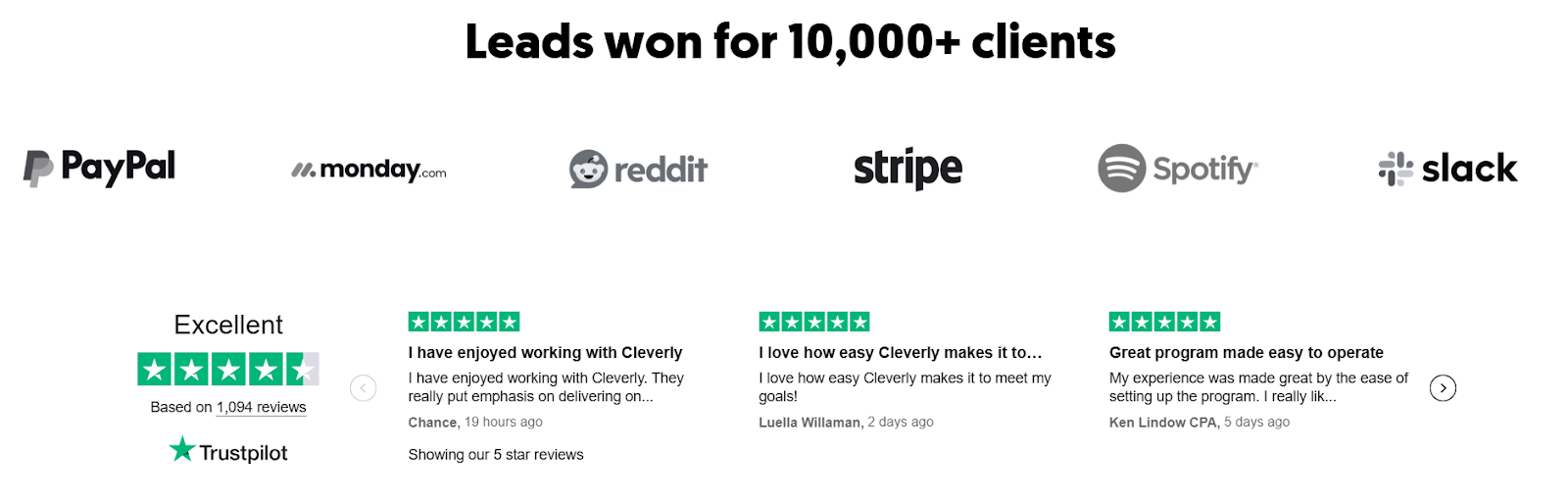
With $312M in pipeline generated across 10,000+ clients — including companies like Amazon, Google, Uber, and Slack — we know what clean data paired with sharp outreach produces.
LinkedIn outreach starts at $397/month. Cold email lead gen operates on a performance model where you pay only for meeting-ready leads we deliver. Month-to-month pricing, no long-term contracts. Cold calling is half the price of hiring in-house
Want verified, enriched prospect lists and full outbound execution handled end-to-end?
🤝 Book a strategy call with Cleverly
Conclusion
The core problem is structural: no single data provider covers your full ICP. It's not a quality gap — it's a coverage gap. Waterfall enrichment is the architecture that closes it.
Moving from single-source enrichment to a properly configured waterfall means going from 40–60% match rates to 80%+, and from 5–15% bounce rates to under 1%. Those numbers translate directly into more contactable prospects from the same ICP, better inbox placement, and cleaner pipeline.
Two practical paths: purpose-built platforms like FullEnrich for simplicity and speed, or Clay for teams that want maximum control over enrichment logic. Either way, don't build in-house unless you have the engineering resources and ongoing capacity to maintain it properly.
Waterfall enrichment isn't a tactical add-on. It's the data foundation that everything else — personalization, sequencing, cold calling — depends on to perform.
Better data means more of your ICP is reachable, which means more pipeline from the same outreach effort, without changing a single thing about who you're targeting.
Frequently Asked Questions
Free Resource
How to Scale a Profitable Cold Call System
Get the complete guide — download it instantly now.
Free Ebook
Download the Free Guide
Enter your details to get instant access.
You're all set! 🎉
Your ebook is downloading now.
Click below if the download didn't start automatically.