Table of Contents
What Is the Omnichannel Customer Journey?
Why the B2B Buyer Journey Has Changed
The B2B Omnichannel Customer Journey Stages
How to Build an Omnichannel Customer Journey Map
Omnichannel Customer Journey Examples in B2B
Best Platforms for Managing Omnichannel Customer Journeys
How to Measure Omnichannel Customer Journey Performance
Where Outbound Fits in the Omnichannel Journey
How Cleverly Fits Into Your Omnichannel Strategy
Conclusion
Frequently Asked Questions
Modified On :
July 27, 2026
Key Takeaways
- A buyer's journey only feels seamless when every channel shares the same context. The moment a prospect has to repeat themselves, the "omnichannel" experience breaks.
- Multichannel and omnichannel are not the same thing. Being present everywhere means nothing if your channels don't talk to each other.
- Journey maps only work when you build them around personas and the buying committee, not around a single generic "buyer."
- Outbound isn't a separate motion from your omnichannel strategy. It's one of the few channels you can fully control, which makes it the connective tissue between marketing and sales.
- Attribution models built for a single touchpoint (first-touch, last-touch) can't explain deals that involve dozens of interactions across months. You need a different way to measure what's working.
Something most B2B teams don't want to admit - by the time a prospect fills out your demo form, they've probably already made up their mind.
Forrester's Buyers' Journey Survey shows that 92% of B2B buyers begin the process with at least one vendor already in mind, and 41% have a single preferred vendor identified before any formal evaluation begins. If your brand isn't part of that early mental shortlist, the "sales process" is mostly theater.
The old idea of a straight-line funnel doesn't hold up anymore.
Modern B2B buyers use an average of 10+ touchpoints across multiple channels before making a decision, starting with a Google search, moving to LinkedIn, reading a case study, checking your G2 reviews, listening to a podcast, and asking a peer in Slack, all before raising their hand.
And depending on how you count, that number can be far higher. Benchmarks range wildly, from 88 touchpoints according to Dreamdata to 266 according to HockeyStack, depending on the definition used.
This guide breaks down what the omnichannel customer journey actually looks like in B2B, how to build a working journey map, and how to make sure your brand shows up credibly at every single stage, from the first anonymous search to the signed contract.

What Is the Omnichannel Customer Journey?
An omnichannel customer journey connects every touchpoint, email, LinkedIn, your website, live chat, phone calls, ads, events, into one continuous experience that carries context with it. The buyer doesn't have to reintroduce themselves every time they switch channels.
This is different from just showing up everywhere. Being on five channels isn't the goal. Making those five channels behave like one conversation is.
In B2B specifically, this matters more than most teams realize. The journey is well underway before your team even knows a deal exists. And once a buyer starts formally evaluating, the self-directed research doesn't stop.
B2B buyers now use 10 or more channels on average when researching, according to McKinsey's B2B Pulse survey, and a huge chunk of that research happens with no sales rep in the room at all.
Omnichannel vs. Multichannel: What's the Difference?
People use these terms interchangeably, and that's where the confusion starts.
The gap between the two shows up directly in the numbers. Companies with strong omnichannel strategies retain an average of 89% of their customers, compared to only 33% for those with weak omnichannel efforts.
That's not a small difference. That's the gap between a business that compounds and one that's constantly replacing churned accounts.
For B2B teams, the practical implication is simple: sales and marketing have to share data, not just tactics. A shared CRM view matters more than a shared content calendar.
🎯 Your Buyers Use Multiple Channels. So Should You.
Our LinkedIn, cold email, and cold calling campaigns work together to generate 15–30 qualified meetings every month.
Why the B2B Buyer Journey Has Changed
A few things have shifted the ground under B2B selling, and none of them are temporary.
The buying committee has grown. Most deals now involve buying committees of 6 to 10 people, and each person consumes content differently and engages on different channels. The champion might live on LinkedIn. The CFO might only care about a pricing PDF someone forwards them.
Self-service is the default, not the exception. Gartner's research shows that B2B buyers complete roughly 80% of their journey independently, which means your content and digital presence are doing the selling long before a rep gets on a call.
Channels have fragmented hard. B2B customer journey touchpoints now range from 15 to 266 per deal, and Gartner's own estimate puts the average closer to 27 touchpoints distributed across different channels, devices, and times.
AI is now part of the research stack. According to Apollo's 2026 research, 89% of B2B buyers now use generative AI as a primary research tool, which means brand visibility in AI-generated answers (ChatGPT, Perplexity, Gemini) is quietly becoming as important as page-one Google rankings.
The consequence is blunt: brands that aren't present, consistent, and credible across channels lose deals they never even knew they were in the running for.
The B2B Omnichannel Customer Journey Stages
The journey below breaks the buyer's path into five stages, but don't think of them as a straight line. Especially in complex deals, buyers move back and forth, loop back to research after a demo, or bring in a new stakeholder mid-evaluation who starts the awareness stage all over again.
Stage 1 — Awareness (First Touch)
The buyer notices a problem or opportunity and starts passive research. Nobody's raised their hand yet.
Channels active: Google search, LinkedIn content, industry publications, podcasts, word of mouth, AI Overviews.
What your brand needs here: SEO-optimized content, LinkedIn thought leadership, visible social proof, and a presence in AI-generated answers. First touch is often anonymous. Intent data tools can surface these signals before a buyer ever fills out a form.
Stage 2 — Research and Consideration
The buyer actively compares solutions. They read comparison posts, watch demos, check G2 and Capterra, and download whitepapers. More stakeholders start joining in, each asking different questions.
Channels active: your website (blog, case studies, pricing pages), review platforms, LinkedIn ads, email nurture, retargeting.
What your brand needs: content that handles objections directly, social proof broken down by industry or use case, and retargeting that stays relevant to whatever they just consumed. Nobody wants to see a generic ad after reading a specific case study.
Stage 3 — Vendor Evaluation
The committee narrows the list to 2 to 4 vendors and starts comparing seriously. They revisit your site, request demos, ask for references, and pull in legal and finance.
Channels active: direct sales outreach, demo calls, email follow-ups, proposals, peer referrals, your sales rep's LinkedIn profile.
What your brand needs: fast response times, personalized outreach that reflects what they've already researched, and content that helps your internal champion sell you to the rest of the committee.
Stage 4 — Decision and Close
Final negotiation, contract review, procurement sign-off. Volume drops but precision matters more. It's mostly 1:1 sales conversations at this point.
What your brand needs: clear ROI documentation, executive alignment, a contracting process with no friction, and a sales rep who has context on the entire journey, not just the last three calls.
Here's a small but real advantage: deals close faster when sales can reference prior engagement. Something as simple as "I saw you downloaded our enterprise guide last month" signals that the buyer isn't starting from zero with your team.
Stage 5 — Post-Sale and Expansion
The journey doesn't end at the signature. Onboarding, adoption, renewal, and expansion are all part of the same omnichannel experience, and this stage matters more than teams give it credit for.
89% of buyers switch suppliers after a bad onboarding experience, which makes this one of the highest-stakes stages in the whole journey.
Channels active: email, customer success calls, in-app messaging, community, NPS surveys, LinkedIn content.
Satisfied customers become advocates who influence the awareness stage for the next buyer, closing the loop. Omnichannel excellence post-sale isn't just about retention. It's a quiet engine for new pipeline.

🚀 One Journey. Multiple Channels. Predictable Pipeline.
With 53,000+ meetings booked and $312M+ in pipeline generated, Cleverly helps 10,000+ businesses turn omnichannel outreach into consistent revenue.
How to Build an Omnichannel Customer Journey Map
A journey map is the operational document that turns "omnichannel strategy" from a slide into something your team can actually execute. It aligns marketing, sales, and customer success around what the buyer is really experiencing at each stage.
Step 1 — Define Buyer Personas and the Buying Committee
Don't build one journey for "the buyer." Build persona-level journey lanes that converge at key decision points. Identify each role: initiator, champion, influencer, budget owner, end user, procurement. Map each one's core questions, preferred channels, and content needs by stage.
Step 2 — Identify All Touchpoints by Stage
List every possible interaction a buyer can have with your brand, organic, paid, outbound, referral, direct, product. Categorize each by journey stage. Then be honest about which touchpoints your team actually tracks versus which ones are currently invisible.
Step 3 — Map Channels to Buyer Intent
Not every channel serves the same intent, so match channel strategy to where the buyer is mentally, not just where they physically show up.
- Awareness: content, SEO, social, podcasts
- Consideration: retargeting, email, review sites
- Decision: outbound, demos, sales follow-up
The goal is for each channel to hand off context, not restart the conversation from scratch.
Step 4 — Find Gaps and Friction Points
Audit the current journey honestly. Where do buyers drop off? Where does the marketing-to-sales handoff break down? Where does the experience feel disjointed?
Common gaps worth checking first:
- No retargeting after someone consumes gated content.
- Sales unaware of a prospect's digital behavior before the first call.
- No structured follow-up after a demo.
- A mobile experience that quietly loses people.
Pull this from CRM data, session recordings, and win-loss analysis. The friction is usually more obvious once you go looking for it.
Step 5 — Orchestrate Cross-Channel Continuity
Orchestration means the buyer's experience updates across channels in real time. If they open an email, your retargeting ads should reflect it. If they attend a webinar, sales should get a signal.
You'll need a CRM (HubSpot, Salesforce), marketing automation, intent data, and ad platforms that actually share audience data with each other.
The goal: every channel knows what happened on the others, so the experience feels personal instead of stalkerish.
Omnichannel Customer Journey Examples in B2B
Concepts are easier to apply once you see them play out.
Example 1 — SaaS Company (Mid-Market Deal)
A buyer googles a pain point, finds a blog post, gets retargeted on LinkedIn, downloads a comparison guide, receives a personalized cold email from an SDR, books a demo, gets a nurture sequence, and closes in 45 days.
The win here is continuity. Every step knew what came before it. No repetition, no cold restarts. When the SDR referenced the exact comparison guide the buyer had downloaded, reply rates on that email doubled.
Example 2 — B2B Services Company (Enterprise Deal)
A 6-month cycle with multiple stakeholders: the CMO discovers the brand through a podcast, the VP of Sales sees a LinkedIn ad, an SDR sends a targeted LinkedIn message to the VP, the internal champion shares a case study, legal and procurement join late, and the deal closes after four discovery calls.
Each stakeholder entered through a different door with a different touchpoint history. What made it work was a shared CRM view that connected all of it, so marketing and sales never duplicated outreach or sent conflicting messages.
Best Platforms for Managing Omnichannel Customer Journeys
Managing omnichannel at scale needs platforms that unify data, automate triggers, and give sales and marketing a shared view of the buyer.
HubSpot
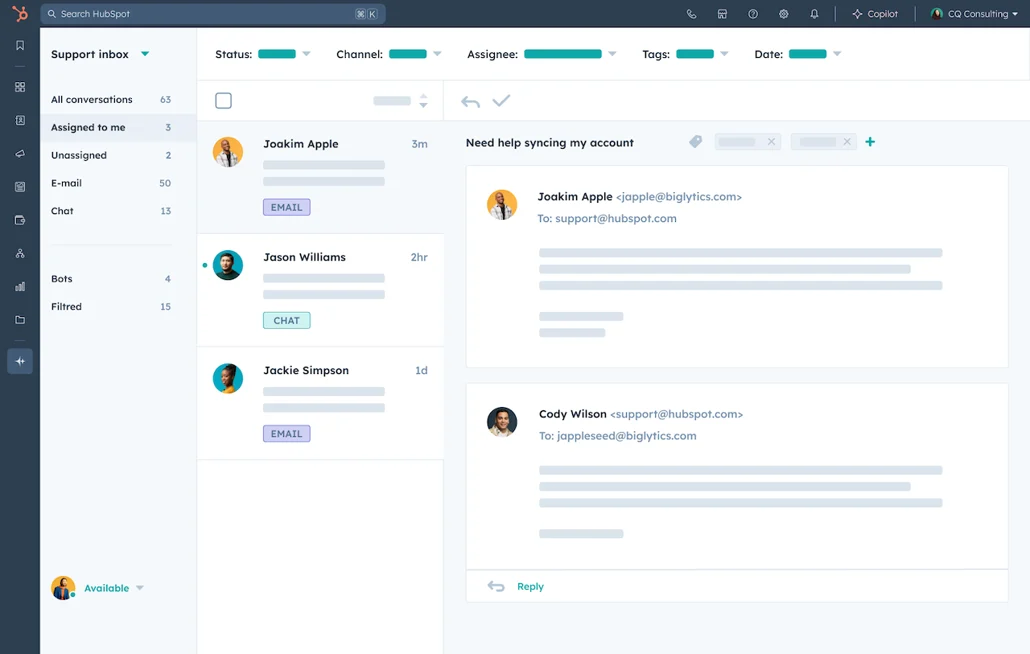
An all-in-one CRM, marketing automation, and sales engagement platform, best suited to SMB and mid-market teams. It tracks web behavior, email engagement, and ad clicks in a single contact timeline, with native integrations for LinkedIn Ads and Google Ads.
Salesforce + Marketing Cloud

Enterprise-grade CRM with deep journey orchestration through Marketing Cloud. Best for complex, multi-stakeholder deals with long sales cycles, since it connects marketing journeys to sales activity and customer success handoffs in one system.
6sense
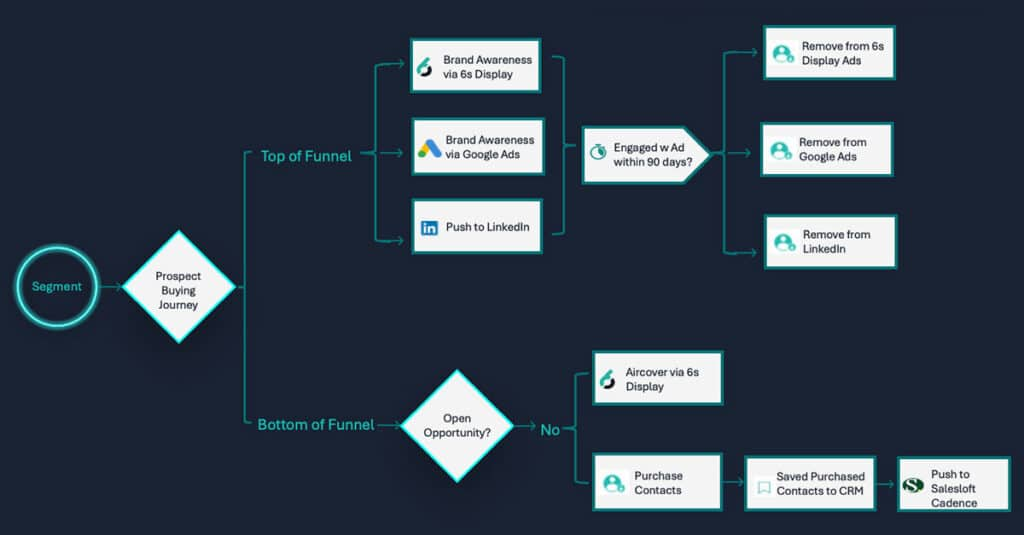
An intent data and account engagement platform that surfaces anonymous research activity and scores accounts by buying stage. It's built for triggering ads, email, and sales alerts based on account-level intent signals, which makes it a strong fit for ABM-aligned omnichannel programs.
Marketo Engage (Adobe)

Robust marketing automation for enterprise B2B, handling complex multi-touch nurture journeys with strong behavioral triggers and lead scoring. Works best paired with Salesforce for full-funnel visibility.
Apollo

Combines prospecting data with outbound sequencing across email, LinkedIn, and phone, useful for coordinating outbound touchpoints inside a broader omnichannel journey. It tracks engagement across sequences and surfaces real-time signals for sales follow-up.
How to Measure Omnichannel Customer Journey Performance
Here's the honest problem: first-touch and last-touch attribution models were built for a world with three touchpoints, not thirty. They can't explain a deal that touched a blog post, two LinkedIn ads, a cold email, and four sales calls over four months. You need multi-touch attribution to see the real picture.
Metrics worth tracking:
- Account penetration rate (percentage of target accounts engaged across 2+ channels)
- Touchpoints to opportunity
- Channel influence on pipeline
- Time from first touch to close
Journey health indicators:
- Drop-off rate by stage
- Channel engagement by persona
- Speed of handoff from marketing to sales
The benchmark worth aiming for: campaigns using three or more coordinated channels see 287% higher purchase rates than single-channel campaigns. If your team is running channels in isolation, that's the gap you're leaving on the table.
Pull this data from CRM attribution reports, intent platforms, and regular pipeline reviews where marketing and sales are looking at the same numbers, not two different dashboards.
Where Outbound Fits in the Omnichannel Journey
Outbound isn't separate from your omnichannel strategy. It's one of the few channels you fully control, especially for reaching accounts that haven't raised their hand yet.
The best outbound sequences reference the buyer's prior digital behavior: the content they consumed, the ads they clicked, the stage they're likely in based on intent signals.
LinkedIn outreach, cold email, and cold calling each play a different role depending on where the buyer sits in the journey. LinkedIn works well for early awareness and relationship building.
Email fits nurture and follow-up. Calling tends to land best mid-to-late funnel, when a real conversation moves things forward faster than another message in an inbox.
When outbound is coordinated with marketing's broader omnichannel program, it creates a kind of surround-sound effect. The buyer sees your brand on LinkedIn, gets a relevant cold email, and then receives a follow-up call, each one reinforcing the last instead of feeling like three separate pitches from three separate teams.
How Cleverly Fits Into Your Omnichannel Strategy
Coordinating outbound with the rest of your omnichannel program is easier said than done, especially when your team is already stretched across content, paid, and CRM management.
This is where a lot of companies bring in a dedicated outbound partner instead of trying to build the muscle internally.
We run outbound across LinkedIn, cold email, and cold calling as one coordinated system rather than three disconnected tactics.
That matters for the omnichannel journey specifically, because a prospect who gets a relevant LinkedIn message, then a cold email that references it, then a follow-up call, experiences one continuous conversation instead of three cold starts from three different reps.
We've run this system for 1,000+ active clients, generating 224.7K leads, $312M in client pipeline, and $51.2M in closed revenue along the way.

The process starts with a strategy call to map your ICP and offer, then we build the outreach infrastructure, targeting, and copy, and run coordinated campaigns across channels so your team gets qualified conversations without managing four separate tools.
Companies choose this over building it in-house for a simple reason: deliverability, copywriting, and infrastructure all take real time to get right, and most internal teams are stretched thin enough as it is.
Let’s get this started for your business as well. Book a free consultation!
Conclusion
B2B buyers don't move through a funnel anymore. They move through a web of touchpoints spread across channels, devices, and months.
The brands that win aren't the ones with the biggest budget. They're the ones that show up relevant, consistent, and credible at every stage, from the first anonymous Google search to the final signature.
Getting there takes three things working together: a clear map of your buyer stages and touchpoints, channels and content aligned to each stage, and a real handoff between marketing, outbound, and sales instead of three teams working off three different pictures of the same buyer.
Start by auditing your current journey and find the one gap that's costing you the most deals. Fix that first.
Frequently Asked Questions
Free Resource
How to Scale a Profitable Cold Call System
Get the complete guide — download it instantly now.
Free Ebook
Download the Free Guide
Enter your details to get instant access.
You're all set! 🎉
Your ebook is downloading now.
Click below if the download didn't start automatically.