

Table of Contents
The Real Numbers: Multichannel vs. Cold Email-Only
What Cold Email-Only Campaigns Do Well
What Multichannel Outreach Does Well
Multichannel Outreach vs. Cold Email-Only: Side-by-Side Comparison
How to Decide Between Cold Email-Only and Multichannel
Common Mistakes When Choosing Between the Two
How Cleverly Runs Multichannel Outreach That Outperforms Email-Only
Conclusion
Frequently Asked Questions
Modified On :
September 17, 2026
Key Takeaways
- Cold email still wins on cost and volume, but a lower cost per lead doesn't automatically mean a better cost per closed deal.
- Multichannel outreach only beats email-only when channels are coordinated with channel-specific messaging, not the same pitch copy-pasted across inboxes and DMs.
- The right choice depends on your team's resourcing and deal size, not which channel performs "better" in the abstract.
- Running more than one channel reduces the risk of losing a deal because a single email got buried or ignored.
- The smartest sequence is to validate your messaging and ICP with cold email first, then layer in LinkedIn and calling once you know what's working.
You send 200 cold emails this week. Six people reply. Two of those are "please remove me." That's not a broken campaign. That's the average in 2026.
Cold email reply rates have dropped from around 8.5% in 2019 to roughly 3.43% today, based on billions of emails analyzed across thousands of active workspaces. Inboxes are more crowded, spam filters are sharper, and AI-generated volume has made prospects harder to reach with email alone.
Meanwhile, sequences that combine email with LinkedIn and phone calls are outperforming single-channel outreach by up to 287% in response rate.
So does that mean multichannel outreach vs cold email is a settled debate? Not quite. Cold email is still the cheapest way to open pipelines at scale, and plenty of teams don't have the bandwidth to run three channels well.
This guide breaks down how multichannel and cold email-only campaigns actually compare on reply rates, cost, and close rates, and how to decide which one fits where your team is right now.
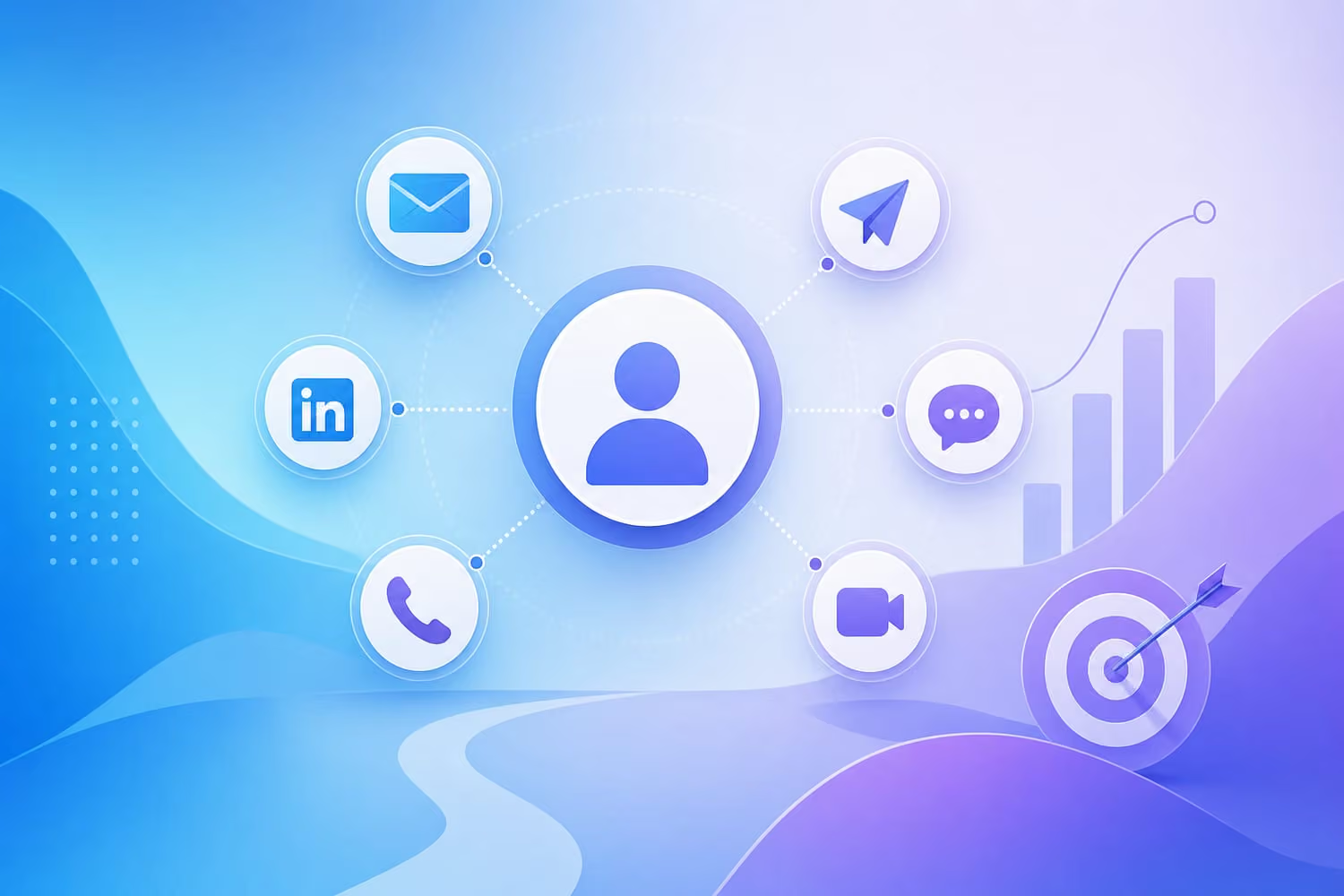
The Real Numbers: Multichannel vs. Cold Email-Only
Let's start with what the data actually shows, not what any one vendor wants you to believe.
Reply rates
Multichannel vs cold email prospecting breaks down like this: email-only campaigns average somewhere between 3% and 6%, with 3.43% as the most commonly cited industry benchmark.
Multichannel sequences that combine email, LinkedIn, and calls tell a different story. Research consistently shows outreach combining email, LinkedIn, and phone increases response rates by up to 287% compared to using just one channel.
Close rates, cost, and cycle length
The reply-rate gap is the headline number, but it's not the only one that matters. Campaign data going back to 2024 shows multichannel outreach producing over 20% higher close rates, 20% lower customer acquisition cost, and 25% shorter sales cycles compared to single-channel strategies.
How channels compound
You don't need all three channels running at once to see a lift. A well-run email-only motion typically caps out around 3% to 4% reply rates, while multichannel sequences consistently reach 8% to 12%. Each channel you add reduces the odds that a single missed touch costs you the whole conversation.
📈 Go Beyond One Channel
Cleverly combines LinkedIn, cold email, and cold calling to help B2B teams reach more prospects and generate qualified meetings.
What Cold Email-Only Campaigns Do Well
Cold email isn't outdated. It's just doing a specific job, and it does that job better than anything else.
Cost-efficiency
This is where cold email pulls ahead by a wide margin. Cold email typically costs $18 to $45 per lead, compared to $80 to $200 or more on LinkedIn. If your priority is filling the top of the funnel without burning through budget, email wins on outbound sales strategy math alone.
Scalability
One rep with a decent email stack can reach hundreds of prospects a day. LinkedIn and cold calling simply can't match that throughput because of platform limits and the time each touch takes.
Simplicity
A single-channel motion has fewer moving parts. You're not coordinating messaging across three platforms, tracking engagement in three places, or training reps on three different skill sets.
Best fit for cold email-only:
- Budget-constrained teams and early-stage startups without dedicated SDR capacity.
- Teams that are still validating their offer or ICP and need volume before they need precision.
- Anyone prioritizing cost-per-lead over maximum conversion right now.
What Multichannel Outreach Does Well
Multichannel sales outreach isn't about doing more work for its own sake. It's about showing up where your buyer actually pays attention.
Higher response and conversion
Meeting a prospect across the channels they use, instead of betting everything on their inbox, is why the reply-rate numbers above look the way they do. A prospect who ignores your email might still see your LinkedIn connection request or pick up the phone.
Redundancy
Every channel has a failure point. Emails land in spam. LinkedIn messages get buried under notifications. Calls go to voicemail. Running more than one channel means one failure doesn't end the conversation before it starts.
Compounding relevance
A prospect who's already seen your name on LinkedIn is more likely to open and actually read your cold email, because you're no longer a complete stranger. That familiarity effect is a big part of why the reply-rate lift is so consistent across studies.
Best fit for multichannel outreach:
- Teams with the resourcing to coordinate messaging across channels properly.
- Higher-value deals where deal velocity and conversion matter more than pure cost-per-lead.
- Companies that have already validated their messaging and are ready to scale conversion, not just volume.
🚀 Build More Pipeline
With 224.7K+ leads generated, 53,000+ meetings booked, and $312M+ pipeline, Cleverly helps 10,000+ businesses scale outbound.
Multichannel Outreach vs. Cold Email-Only: Side-by-Side Comparison
Think of this as a decision matrix, not a scoreboard. Neither approach "wins" outright; each fits a different stage and budget.
How to Decide Between Cold Email-Only and Multichannel
There's no universal right answer here. It comes down to where your team is and what you're optimizing for.
Start with resourcing
If your budget and team capacity are limited, or your main goal right now is cheap top-of-funnel volume, cold email-only is the right starting point. Don't add channels you can't properly staff.
Move to multichannel once you can coordinate it well
A poorly coordinated multi-channel attempt, three channels sending the same generic pitch, will underperform a focused, well-run cold email campaign every time. Multichannel only pays off when you have the bandwidth to run it properly.
Factor in deal size and sales cycle
Higher-value, longer-cycle deals justify the added cost and coordination effort of multichannel because one extra closed deal covers the added spend many times over. High-volume, lower-value motions often don't need it.
Follow a natural progression
A common and sensible path: validate your messaging and ICP fit with cold email first, since it's the cheapest way to test fast. Once the fundamentals are proven, layer in LinkedIn and calling to push conversion and close rates higher.
Common Mistakes When Choosing Between the Two
Most of the underperformance you'll see with either approach comes down to execution, not the channel choice itself.
❌ Assuming multichannel automatically wins. An uncoordinated multichannel motion, where every channel gets the same recycled message, can underperform a focused, well-run email-only campaign. The 287% lift only shows up with proper coordination.
❌ Copy-pasting the same message across channels. Email, LinkedIn, and calls each play a different role. Sending identical copy across all three undercuts the redundancy benefit multichannel is supposed to deliver.
❌ Staying cold email-only out of inertia. Plenty of teams have the resourcing to add channels but never do, simply because it's easier not to change what's already working, even when it's plateaued.
❌ Ignoring the cost-per-lead tradeoff. Adding an expensive channel like LinkedIn without validating that the extra conversion actually justifies the added cost is how multichannel budgets get wasted.
How Cleverly Runs Multichannel Outreach That Outperforms Email-Only
The data is clear that omnichannel lead generation beats email-only on reply rates and close rates, but that gap only shows up when channels are run in coordination. A badly executed multichannel campaign wastes the added spend without capturing any of the upside.
At Cleverly, we run LinkedIn, cold email, and cold calling as one connected motion instead of three disconnected efforts. Each channel gets its own messaging built around the role it plays in the sequence, rather than a single message pushed out everywhere. That coordination is what actually drives the response-rate lift the data shows, not simply adding more channels to a checklist.
We've generated $312M+ in pipeline for clients across every B2B industry, and our multichannel campaigns are built specifically for companies currently running cold email-only who want to know whether coordinated outreach across more channels would move the needle for them.
If you're running cold email-only right now and want to see what multichannel could realistically add, book a free consultation and we'll walk through your current setup.
Conclusion
Cold email-only wins on cost-efficiency and scalability, which makes it the right starting point for budget-constrained or early-stage teams still validating their offer.
Multichannel outreach delivers meaningfully higher reply rates, close rates, and shorter sales cycles, but only when the channels are coordinated with intent rather than duplicated across platforms.
The right call depends on your resourcing, your deal size, and whether you've already proven your messaging works. Multichannel isn't automatically better. It's better when you run it with the same rigor as a focused single-channel campaign, just across more touchpoints.
Frequently Asked Questions
Free Resource
How to Scale a Profitable Cold Call System
Get the complete guide — download it instantly now.
Free Ebook
Download the Free Guide
Enter your details to get instant access.
You're all set! 🎉
Your ebook is downloading now.
Click below if the download didn't start automatically.


