

Modified On :
June 24, 2026
Key Takeaways
- The lead management process starts with centralization — every lead from every source must enter one system of record before scoring, routing, or nurturing can work reliably.
- Lead scoring separates priority from noise by combining ICP fit with intent signals, so reps always know who to contact first without making that call from scratch on every lead.
- Routing speed is a revenue lever — the moment a lead qualifies, it needs to be assigned to the right rep automatically, with an immediate notification, so zero time is lost between qualification and first contact.
- Half of qualified B2B leads aren't ready to buy yet — a segmented nurture track with defined exit triggers is what keeps those leads in play until their timeline aligns with yours.
- Measurement closes the loop — tracking conversion metrics at every stage of the funnel is what identifies where leads are being lost and what changes will have the highest compounding impact on pipeline.
Plenty of B2B teams are generating leads. The problem is what happens after.
A staggering 80% of new leads never convert into a sale, often due to poor nurturing or misqualification. That's not a lead quality problem. That's a process problem.
Leads arrive from LinkedIn, cold email, paid ads, and events — and then land in different places, get assigned to the wrong rep, sit uncontacted for two days, and eventually go cold. Meanwhile, the budget that generated them keeps running.
75% of B2B marketers say more than 10% of their lead data is inaccurate, outdated, or non-compliant. That makes scoring unreliable, routing inconsistent, and follow-up nearly impossible to personalize at scale. And organizations lose 70% of prospects through inadequate follow-up processes — a number that reflects not a lack of effort, but a lack of structure.
A well-designed lead management process fixes this. It gives every lead a defined path through the funnel — from first contact to booked meeting — and gives your sales team a clear view of what to work, in what order, and what to say.
This guide walks through what that system looks like, where it breaks down, and how to build it in five sequential steps.
What is Lead Management?
Lead management is the end-to-end process of capturing leads from all sources, qualifying them against your ICP, routing them to the right rep, nurturing the ones who aren't ready, and tracking performance across the full funnel from first contact to closed deal.
It's worth separating this from lead generation, because the two get conflated constantly. Lead generation creates the pipeline. Lead management determines how much of that pipeline converts. You can have excellent outbound running — LinkedIn sequences, cold email, cold calling — and still produce poor revenue outcomes if the management layer is broken.
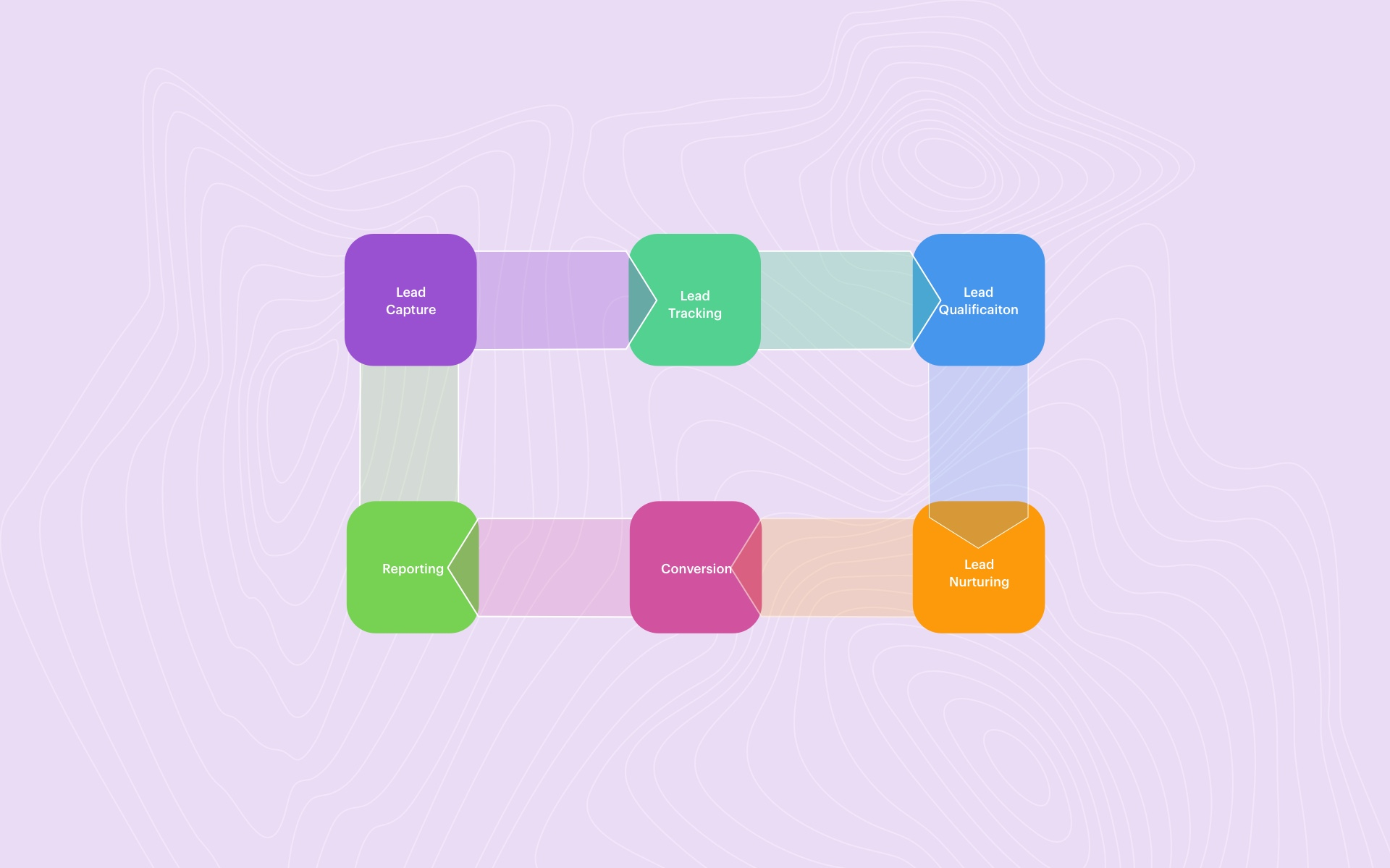
The lead management process stages in a well-built system look like this:
- Lead capture and centralization — all sources, one system of record
- Lead scoring and qualification — ICP fit plus buying intent, combined into a priority score
- Lead routing and assignment — the right rep, automatically, the moment a lead qualifies
- Lead nurturing — structured follow-up for leads not ready to buy yet
- Pipeline tracking and optimization — measuring what's working, fixing what isn't
Each stage feeds the next. A gap at stage one (incomplete data at capture) creates problems at stage two (inaccurate scoring). A failure at stage three (slow routing) kills conversion regardless of how good the qualification was. The system only works when all five stages are connected and functioning.
Without an effective lead management strategy, predictable problems emerge: sellers spend too much time pursuing the wrong prospects, deal cycles extend because the wrong individuals are in the funnel, and sales and marketing teams argue over SLAs instead of collaborating on pipeline.
🎯 A Better Lead Process Starts With Better Leads
Generate 15–30 qualified meetings per month through LinkedIn, cold email, and cold calling—all managed for you.
Why Lead Management Matters More Than Ever in 2026
The buying environment has changed significantly. The average B2B buying cycle is now 10.1 months, and the point of first contact has moved earlier — buyers are reaching out to vendors about 6–7 weeks earlier than before.
That's not necessarily good news. It means your management process has to stay relevant across a longer timeline, more touchpoints, and more stakeholders — without losing the lead along the way.
Speed-to-lead has become a real competitive separator. Only 7% of B2B companies consistently respond to leads within 5 minutes — yet companies responding within that window are 21x more likely to qualify the lead than those responding at 30 minutes. The average response time across B2B is still 42 hours. That gap is enormous, and it's entirely addressable with automation.

Companies investing in lead response automation see 20–30% increases in qualified opportunities within 6 months. That's not from generating more leads. That's from managing existing ones better.
On the AI side, the baseline has shifted. AI lead scoring adoption went from 23% in 2024 to 61% in Q1 2026. The MQL-to-SQL top-quartile gap widened from 15 points absolute in 2024 to 22 points in Q1 2026, and AI scoring is the proximate cause. Teams not using automated scoring aren't just behind — they're losing ground every quarter.
The revenue case is clear. Organizations automating their lead management processes enjoy a 10% boost in overall revenue generation. And when you factor in nurture, nurtured leads produce on average a 20% increase in sales opportunities versus non-nurtured leads. These aren't marginal gains — they're the compounding result of a system that doesn't let leads fall through.
The 5-Step Lead Management Process
Think of this as a sequential system where each step depends on the one before it. Capture creates the data. Scoring filters it. Routing gets the right lead to the right rep. Nurturing keeps the rest warm. And optimization improves the whole thing over time. Build it in order.
Step 1 — Capture and Centralize All Leads in One System
The most common failure point in the CRM lead management process is the first one: leads arriving from multiple sources and landing in multiple places. Some go into the CRM. Some land in someone's inbox. Some get pasted into a spreadsheet and forgotten. By the time a rep finds the lead, it's two days old.
The fix is simple in principle and harder to execute without deliberate setup: every lead, regardless of source, must enter a single system of record — the CRM — with a consistent set of fields populated at capture.
What to capture at intake:
- Name, company, title, email, phone
- Lead source (which channel — LinkedIn, cold email, paid, event, referral)
- Campaign or sequence context (which message or asset triggered the lead)
- Any notes from the initial conversation or form submission
The channel-to-CRM connection is what most teams leave incomplete. Web form leads need native integrations to push directly to the CRM on submission. LinkedIn outreach tools and cold email platforms need webhook connections so booked meetings or positive replies hit the CRM immediately. Events and referrals need a documented manual entry protocol — a shared standard, not rep discretion.
The enrichment layer on top of capture is what makes everything downstream faster. Basic data enrichment at intake — company size, industry, LinkedIn profile, tech stack — adds the context needed for accurate scoring without reps having to research every new lead manually.
Tools like Clay, Clearbit, and Apollo integrate directly with most CRM workflows and populate this data automatically the moment a lead is created.
Centralization isn't exciting. But it's the foundation every other step is built on, and the process breaks without it.
Step 2 — Score and Qualify Leads Against Your ICP
Not every lead deserves the same follow-up. A lead scoring system assigns a numerical value to each lead based on two dimensions: fit (how closely they match your ICP) and intent (how much buying behavior they're showing). Together, these tell your reps who to contact first without requiring a fresh judgment call on every single lead.
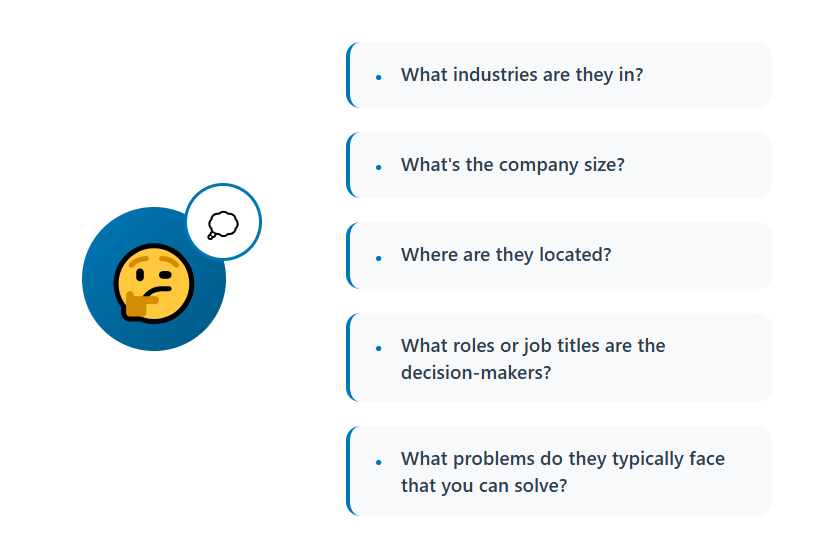
Fit scoring covers the firmographic dimensions of your ICP:
- Industry
- Company size (employee count and revenue)
- Seniority level and title
- Geography
Each dimension gets a weight that reflects how closely it maps to your highest-converting customer profile. A VP of Sales at a 200-person SaaS company might score a 90. The same title at a 15-person agency in the wrong vertical might score a 40.
Intent scoring covers behavioral signals that indicate buying readiness:
- Pricing page visit
- Demo or free trial request
- Content download (especially bottom-of-funnel content)
- Email reply or LinkedIn response
- Multiple website sessions in a short window
Each action adds points that elevate a lead's priority. A high fit score combined with intent behavior is your most sales-ready lead. A high fit score with no intent behavior goes to nurture.
Lead scoring tells you who to prioritize. Qualification frameworks tell you whether a lead can actually move forward. BANT (Budget, Authority, Need, Timeline), MEDDIC, and CHAMP are all effective depending on deal complexity. The key is having defined qualification criteria that both marketing and sales agree on — so a lead that passes qualification actually gets treated as qualified by both sides.
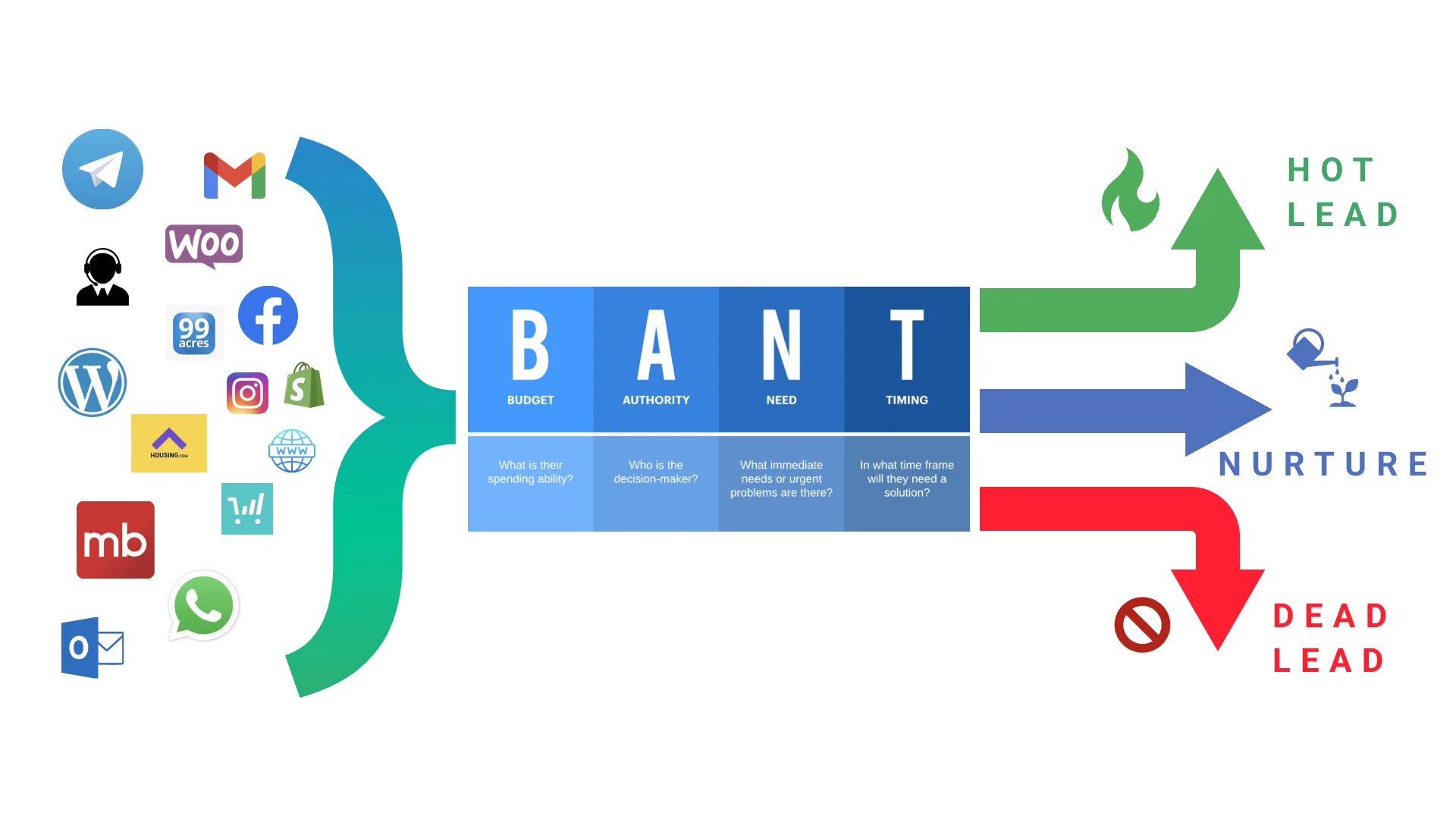
What about disqualified leads? Move them to a nurture track with a defined re-qualification trigger. A lead that doesn't have the budget today might have it next quarter. A lead whose timing is wrong might be right in 90 days. Don't delete — park with conditions.
Step 3 — Route Leads to the Right Sales Rep Immediately
Lead routing is the process of automatically assigning a qualified lead to the right rep the moment they hit the threshold. Not queuing it for a manual distribution meeting. Not leaving it in a shared inbox. The moment a lead qualifies — they get assigned, a task gets created, and the rep gets notified.
Why does this matter so much? 78% of customers buy from the first company that responds. When your routing is manual or delayed, you're handing that advantage to whoever picks up the phone first — and it may not be you.

Routing logic options depend on your team structure:
- Round-robin — distribute evenly across reps when territories and specialties don't apply
- Territory-based — assign by geography, industry, or vertical
- Account-based — route leads from target accounts to the dedicated AE managing that account
- Skill-based — route high-value enterprise leads to senior reps, SMB leads to junior reps
Most modern CRMs — Salesforce, HubSpot, Pipedrive — support workflow-based assignment rules natively. Define the criteria (score threshold, company size, territory) and the system handles assignment without human intervention. The routing logic itself takes an afternoon to configure. The operational discipline to maintain it is the harder part.
One thing teams consistently get wrong: routing without notification. A lead assigned to a rep who doesn't know they have it produces the same outcome as no routing at all. Automated Slack notifications, email alerts, and CRM task creation on assignment ensure the rep sees the lead immediately and knows to act.
The goal is zero lag between qualification and first contact.
Step 4 — Nurture Leads That Aren't Ready to Buy

The fraction of leads ready to buy the moment they enter your pipeline is small. 50% of leads are qualified but not yet ready to buy — meaning they fit your ICP, they have the potential to convert, but the timing isn't there yet.
Without a nurture track, those leads go cold and eventually buy from someone else. With a structured nurture sequence, they stay warm until their timeline aligns with yours.
A nurture track is a structured sequence of touchpoints — emails, LinkedIn messages, content shares, direct check-ins — delivered at defined intervals and triggered by behavior rather than just a calendar schedule.
The key to effective lead nurturing is segmentation. A single sequence for all leads produces irrelevant messaging for every segment. Different leads have different problems, different roles, and different buying stages. Segment nurture tracks by:
- ICP fit tier (high fit vs. moderate fit)
- Lead source (outbound vs. inbound behave differently)
- Buying stage (early research vs. active evaluation)
- Content engaged with (what they clicked or downloaded tells you what they care about)
Content that works in nurture: case studies that build confidence through social proof, educational content that demonstrates expertise, and direct personal check-ins from a rep that feel like a relationship rather than a workflow.
83% of buyers find it helpful when a company provides educational content during the nurturing phase. The goal is to stay relevant and useful — not to blast an automation sequence until they unsubscribe.
Nurture exit triggers are what turn a nurtured lead back into an active opportunity. Define them explicitly: a pricing page visit, a demo request, an email reply, a LinkedIn message, or a rep decision after a direct interaction. Without defined exit triggers, leads sit in nurture indefinitely and nothing happens.
Step 5 — Track, Measure, and Optimize the Full System
A lead management process you can't measure can't be improved. The data the system generates — by channel, by stage, by rep — is what tells you where leads are being lost and what changes will produce the highest return.
The metrics that matter at each stage:
Where to look for bottlenecks: if large numbers of leads enter the system but few become MQLs, either the lead quality is low or scoring criteria are miscalibrated. If MQLs aren't converting to SQLs, the qualification handoff or follow-up speed is the problem. If SQLs aren't becoming opportunities, routing or initial outreach is breaking down.
When you're ready to automate your lead management process, here's the sequence that scales:
- CRM data entry — via form integrations and enrichment tools
- Lead scoring updates — triggered automatically by behavioral actions
- Lead routing — rules-based in the CRM, zero manual intervention
- Initial follow-up sequence — first 1–2 touches automated, then rep-driven
- Re-engagement triggers — behavioral or time-based, pulling cold leads back into active pipeline
The optimization cadence: review stage-level metrics weekly, full-funnel metrics monthly. Small conversion rate improvements at each stage compound into significant revenue gains across the pipeline.
📈 More Qualified Leads. More Pipeline. Less Guesswork.
Join 10,000+ businesses that have used Cleverly to build a predictable outbound lead generation engine.
Common Lead Management Mistakes That Kill Pipeline Conversion
Understanding the lead management process flow also means understanding where it breaks. These are the failure modes that show up most consistently.
❌ No shared definition of a qualified lead
When marketing defines an MQL as anyone who fills out a form and sales defines an SQL as someone ready to buy this quarter, leads get passed too early, rejected by sales, and abandoned entirely. The fix is a documented, jointly-agreed qualification standard — one definition of MQL and SQL that both teams sign off on and the CRM enforces.
❌ Slow response time
66% of B2B companies take over an hour to respond to leads, and 35% take more than 24 hours. A lead that waits 24 hours has already talked to a competitor who responded in five minutes. Automated routing and immediate notification eliminate this — it's an operational problem, not a people problem.
❌ Treating all leads the same
One nurture sequence for every lead produces irrelevant messaging for everyone. A late-stage prospect evaluating vendors needs different content than a top-of-funnel contact who just downloaded a guide. Segmentation isn't optional in a working lead management system.
❌ No CRM hygiene discipline
Lead management data is only useful when it's accurate and complete. Source fields missing, stage dates not updated, activity not logged — these all make the data unreliable for scoring, attribution, and forecasting. Build hygiene requirements into the workflow itself, not into rep discipline.
❌ Abandoning leads after two touches
79% of marketing leads never convert into sales, and lack of lead nurturing is cited as a common cause. Most B2B leads need multiple meaningful interactions before they're ready to move. Reps who stop after two unanswered emails are leaving most of their potential pipeline untouched. A structured multi-touch sequence removes this from individual judgment.
How Cleverly Feeds Your Lead Management System With Qualified Outbound Leads
A lead management process is only as good as what's going into it. Most teams spend weeks optimizing their CRM workflows and scoring models — then find that the leads entering the system are too cold, too incomplete, or too loosely sourced to produce meaningful conversions.
That's the problem we solve at Cleverly. We're a done-for-you lead generation agency that feeds client pipelines with qualified outbound leads from LinkedIn, cold email, and cold calling — each one sourced, sequenced, and booked to calendar so your sales team is starting with warm conversations, not cold contacts.
Every meeting we book arrives tagged with source, channel, and campaign context, so it enters your CRM properly attributed and ready to work without additional research or data entry from your reps.
What that means for pipeline quality: our ICP matching, multi-touch sequencing, and qualification layer means leads arrive pre-screened. Not raw inquiries that need significant qualification work, but confirmed meetings with prospects who fit the profile and have shown enough intent to accept a conversation.
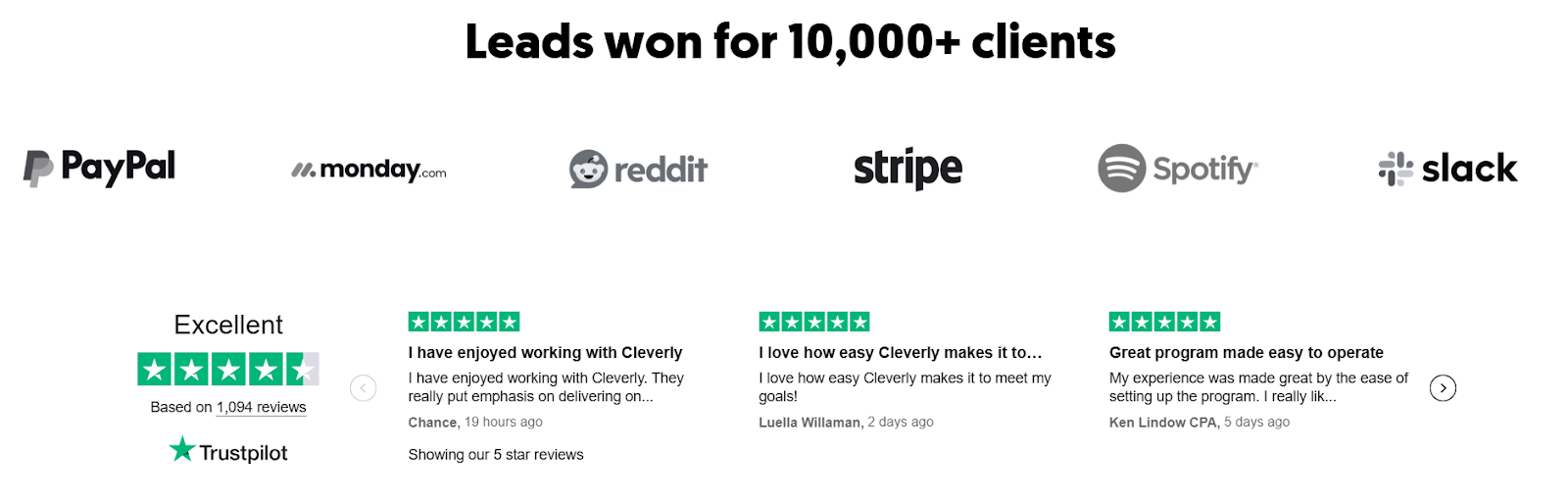
We've helped 10,000+ clients generate pipeline across every B2B vertical — including eBay, Airbnb, DocuSign, Loom, and Airtable — producing $312M in client pipeline and $51.2M in closed revenue. We're rated 4.6/5 on Trustpilot with 1,136+ reviews.
Our LinkedIn outreach services start at $397/month, and our cold email lead generation runs on a pay-per-lead basis, so you only pay for meeting-ready leads we send you.
If you want a system that generates and manages pipeline, you need both sides working. We handle the front end so your team can focus on the conversations.
Want to fill your lead management system with qualified outbound meetings? Book a strategy call with Cleverly and see how we'd build your pipeline from day one.
Conclusion
The pipeline problems most B2B teams are experiencing aren't lead generation problems. They're lead management problems. Leads are being generated, arriving in the system, and then lost — to slow follow-up, misrouting, bad qualification, or nurture sequences that go dark after two emails.
The five-step system in this guide — centralize, score, route, nurture, and optimize — gives every lead a defined path through the funnel and gives your sales team clarity on what to work and when.
Build it in order, automate what can be automated, and measure it at every stage. The compounding effect of a process that doesn't leak shows up in pipeline velocity and conversion rate faster than most teams expect.
Frequently Asked Questions
Free Resource
How to Scale a Profitable Cold Call System
Get the complete guide — download it instantly now.
Free Ebook
Download the Free Guide
Enter your details to get instant access.
You're all set! 🎉
Your ebook is downloading now.
Click below if the download didn't start automatically.


