Table of Contents
What Is B2B Lead Scoring?
Why B2B Lead Scoring Is Critical for Revenue Teams
Common B2B Lead Scoring Criteria That Actually Work
Popular B2B Lead Scoring Models Explained
How to Build a B2B Lead Scoring Model Step-by-Step
Automating B2B Lead Scoring at Scale
B2B Lead Scoring Examples
How Cleverly Helps B2B Teams Focus on Sales-Ready Leads
Conclusion
Frequently Asked Questions
Modified On :
August 31, 2026
Key Takeaways
- B2B lead scoring helps sales teams prioritize high-intent prospects and stop wasting time on leads that won't convert.
- Combine firmographic fit, role authority, behavioral signals, and engagement recency for accurate scoring that predicts actual buyers.
- Start with rule-based scoring for transparency, then layer in AI-assisted scoring once you have enough historical data.
- Set clear MQL and SQL thresholds so your team knows exactly when to nurture versus when to make immediate contact.
- Automate scoring through CRM and marketing tools to respond to hot leads in minutes, not hours or days.
- Review and adjust your scoring model quarterly based on real conversion data and feedback from your sales team.
Your sales team is probably chasing the wrong leads right now.
We've seen it happen countless times. SDRs spend hours calling prospects who were never going to buy. Sales leaders wonder why their pipeline looks healthy but nothing closes. RevOps teams can't figure out why conversion rates keep dropping despite more leads coming in.
The problem isn't effort. It's prioritization.
Without B2B lead scoring, you're essentially asking your team to guess which leads deserve attention. That guessing game costs you real money. Poor prioritization tanks SDR productivity, inflates your sales cycle, and kills close rates.
Worse, your best reps burn out chasing dead ends while actual buyers slip through the cracks.
B2B lead scoring solves this by giving you a systematic way to identify which prospects are most likely to convert. It's not complicated, but it does require the right framework.
In this guide, we'll walk you through:
- How B2B lead scoring models actually work
- The specific B2B sales lead scoring criteria that matter for your business
- Ready-to-use B2B lead scoring templates you can implement today
- How to automate lead scoring B2B sales methods without losing the human touch
Whether you're an SDR tired of cold leads, a sales leader trying to hit quota, a RevOps professional optimizing conversions, or a founder building a scalable sales process, this guide will show you how to stop wasting time and start closing more deals.
Let's get into it.

What Is B2B Lead Scoring?
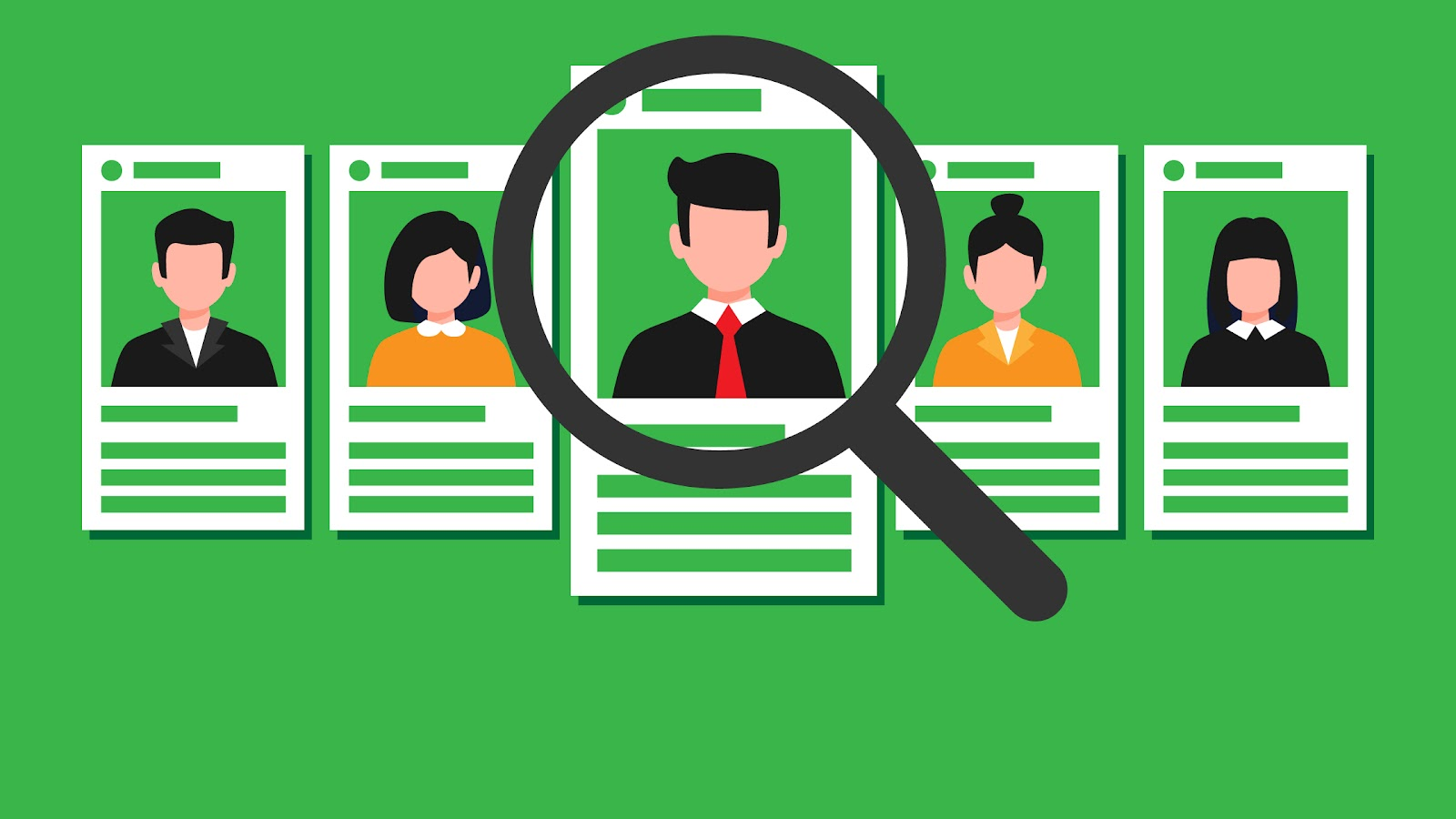
Lead scoring for B2B is a way to rank your prospects based on how likely they are to become customers.
You assign point values to specific behaviors and characteristics, then your team focuses on the highest-scoring leads first.
Lead scoring helps you figure out who's who.
Where people get confused - lead scoring for B2B isn't the same as lead qualification. Qualification is binary (yes or no, qualified or not). Scoring is a spectrum.
A lead might score 65 out of 100, which tells you they're warm but not ready yet. That context matters.
Why does this matter more in B2B?
B2B sales cycles are long. We're talking weeks or months, not impulse purchases. During that time, leads move through different stages at different speeds. Some download your whitepaper and ghost you. Others book a demo within 48 hours.
Without scoring, you treat both leads the same. With scoring, you know who to call today and who to nurture for next quarter. That distinction is what separates teams that hit quota from teams that don't.
Basically, lead scoring for B2B gives you a repeatable system for prioritizing the right conversations at the right time.
Learn More About: The B2B Buying Process
🔥 Only Talk to Sales-Ready Leads
Cleverly scores, filters, and delivers qualified leads across LinkedIn, cold email, and calling—so reps focus on buyers, not browsers.
Why B2B Lead Scoring Is Critical for Revenue Teams
B2B lead scoring does more than organize your CRM. It fundamentally changes how your revenue team operates by giving sales teams better visibility into prospects, interactions, and opportunities through CRM tools for B2B sales.
Your SDRs stop spinning their wheels.
Instead of working through a random list, they focus on high-intent prospects who actually want to talk. That means more meetings booked, less rejection fatigue, and better use of everyone's time.
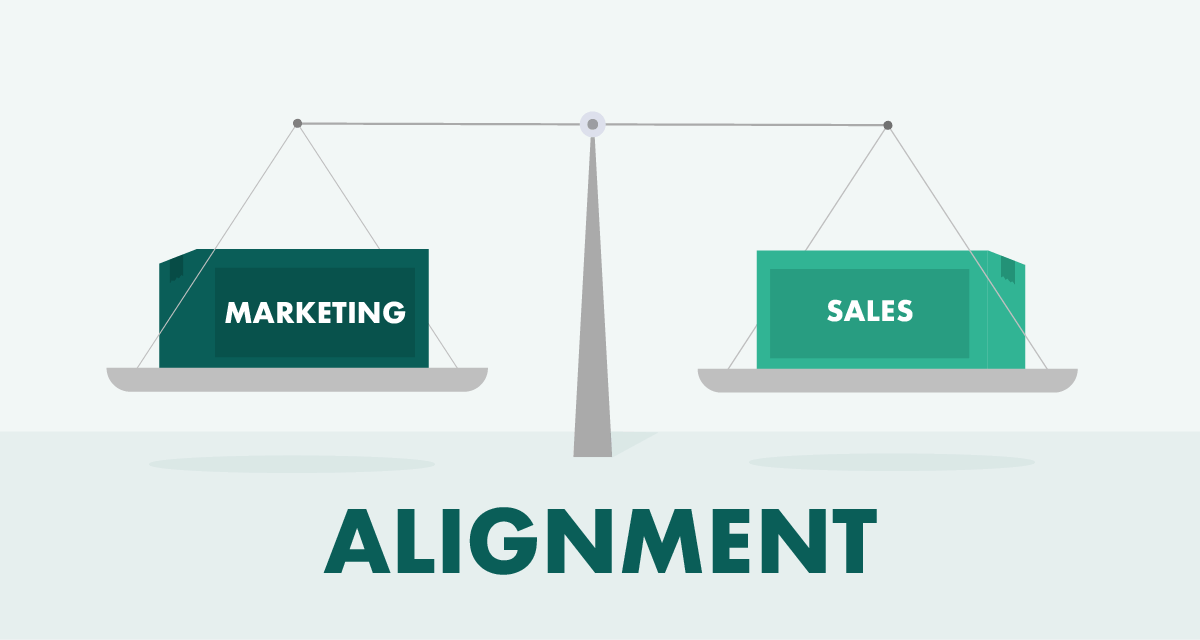
Sales and marketing finally speak the same language.
We've all seen the finger-pointing when leads don't convert. Marketing says the leads are good, sales says they're garbage. B2B lead scoring creates a shared definition of "qualified" that both teams agree on upfront. No more debates, just data.
Your conversion rates go up and sales cycles shrink.
When reps prioritize leads that are actually ready to buy, deals close faster. It's simple math. Less time chasing cold prospects means more time closing warm ones.
Pipeline forecasting becomes predictable.
With B2B lead scoring, you can see patterns. You know that leads scoring above 80 convert at X%. Leads between 60-79 convert at Y%. Suddenly your pipeline isn't a mystery anymore. You can forecast with confidence and allocate resources where they'll actually generate revenue.
The reality: companies without lead scoring are guessing. Companies with it are making informed decisions backed by real behavior data.
That's the difference between hoping you hit quota and knowing you will.
Also Check: The Perfect B2B Sales Strategy to Close More Deals (Proven Methods)
Common B2B Lead Scoring Criteria That Actually Work
Not all B2B sales lead scoring criteria carry the same weight. Here's what actually predicts whether a lead will convert.
Firmographic Data

This is your foundation. You're looking at company size, industry, and revenue to determine fit.
- Does the company have 50-500 employees (your sweet spot)?
- Are they in SaaS, fintech, or another target vertical?
- Do they have the budget to afford your solution?
If a lead checks these boxes, they start with a solid baseline score. If they're outside your ideal customer profile, their score stays low no matter what else they do.
Role & Seniority

A VP of Sales is worth more points than a junior SDR. Not because one person matters more, but because one can actually sign contracts.
Decision-makers (C-suite, VPs, Directors) get higher scores. Influencers (managers, coordinators) get moderate scores. Individual contributors get lower scores unless they're at a small company where titles don't reflect authority.
Behavioral Signals
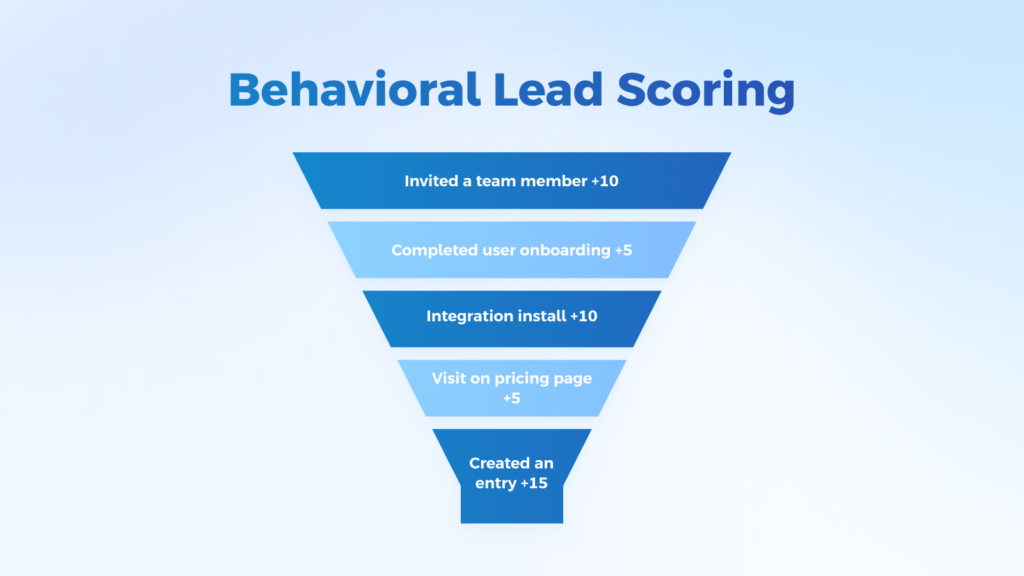
This is where B2B sales lead scoring criteria gets interesting. What actions is this person taking?
- Opened your email? Small boost.
- Replied to your outreach? Big boost.
- Booked a demo? Massive boost.
- Downloaded multiple resources in one session? They're researching hard.
Behavior tells you intent. Someone who's engaging consistently is telling you they're interested without saying it directly.
Intent Data

What content are they consuming? This reveals where they are in the buying journey.
- Reading blog posts? Early stage, just learning.
- Visiting your pricing page? Late stage, evaluating cost.
- Checking out case studies? They want proof it works.
- Comparing you to competitors? Decision time is close.
The deeper someone goes into high-intent pages, the higher their score climbs.
Engagement Recency

A lead who was active yesterday is hotter than one who engaged three months ago. Recency matters because buying intent fades.
If someone hasn't interacted with you in 60+ days, their score should drop. If they suddenly re-engage, it shoots back up. Timing is everything in B2B sales.
Negative Signals
Some signals should actually lower a lead's score:
- Email domain matches a competitor
- Job title includes "student" or "looking for opportunities"
- Company size is 1-2 people (unless you sell to solopreneurs)
- They're using a free email address for a "business" inquiry
These negative B2B sales lead scoring criteria help you filter out tire kickers and focus on real buyers.
The key is weighting these criteria based on what actually predicts closed deals in your business. Not every company scores the same way, and that's the point.
Explore Further: Ways To Increase Your Inbound B2B Leads (Proven Framework)
🚀 Meetings > MQLs
We don’t send “leads.” We send meeting-ready opportunities with clear intent—across channels you only pay for when it converts.
Popular B2B Lead Scoring Models Explained
There's no one-size-fits-all B2B lead scoring model. Different businesses need different approaches. Here are the four models that actually work in practice.
Demographic-Based Lead Scoring
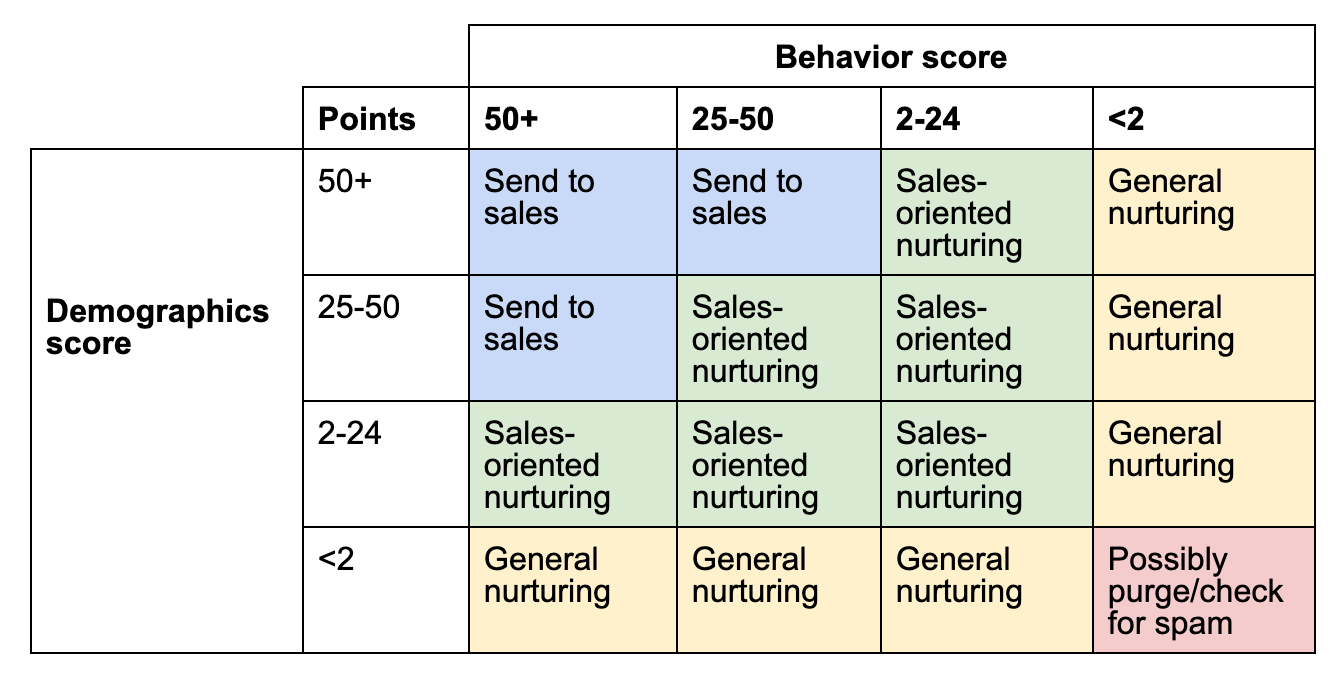
This B2B lead scoring model focuses on who the lead is.
You're scoring based on job title, company size, industry, location, and other fixed attributes. A Director at a 200-person SaaS company in your target market gets a high score. An intern at a 5-person startup outside your vertical gets a low score.
When it works best: Early in your lead scoring journey or when you have a very specific ICP (ideal customer profile). It's simple to set up and easy to understand.
The limitation: It doesn't account for actual interest. Someone might fit your profile perfectly but have zero intent to buy.
Behavioral Lead Scoring
This model tracks what the lead does.
You assign points based on actions like email opens, website visits, content downloads, webinar attendance, and demo requests. The more someone engages, the higher they score.
When it works best: When you have enough traffic and engagement data to track patterns. Great for inbound-heavy businesses.
The limitation: High engagement doesn't always equal buying intent. Someone might consume tons of content but never have budget or authority to purchase.
Predictive Lead Scoring
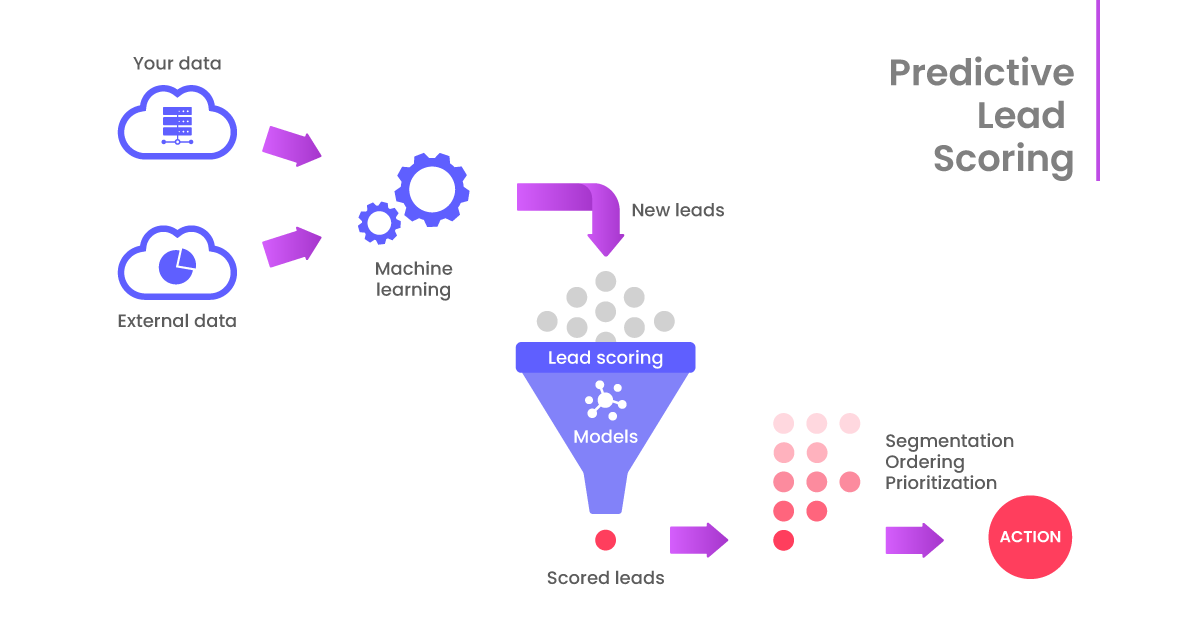
This B2B lead scoring model uses AI and machine learning to analyze your historical data.
The system looks at every lead that converted (and didn't convert), identifies patterns you might miss, and automatically scores new leads based on similarity to past winners. It gets smarter over time as it processes more data.
When it works best: When you have thousands of leads and closed deals in your CRM. The AI needs data to learn from.
The limitation: It's a black box. You might not understand why a lead scored high or low, which makes it harder to coach your team or refine your process.
Account-Based Lead Scoring (ABM)
Instead of scoring individual leads, you score entire accounts.
You evaluate the company as a whole, then track engagement across multiple contacts within that organization. If three people from the same company are engaging with you, that account's score jumps significantly.
When it works best: For enterprise sales with multiple stakeholders and long deal cycles. One contact rarely makes the decision alone.
The limitation: Requires more sophisticated tracking and a CRM that can handle account-level scoring. Not ideal if you're selling to small businesses with single decision-makers.
Which model should you use?
Most successful teams combine models.
Start with demographic scoring to establish baseline fit, layer in behavioral scoring to measure intent, and add account-based scoring if you're doing enterprise deals.
As you mature, predictive scoring can optimize the whole system.
The best B2B lead scoring model is the one you'll actually use consistently. Start simple, measure results, and evolve from there.
Dive Deeper: What is Automated Lead Nurturing and How Does it Work?
How to Build a B2B Lead Scoring Model Step-by-Step
Building a B2Blead scoring template doesn't have to be complicated. Here's how to create one that actually works for your business.
Step 1: Define Your Ideal Customer Profile (ICP)
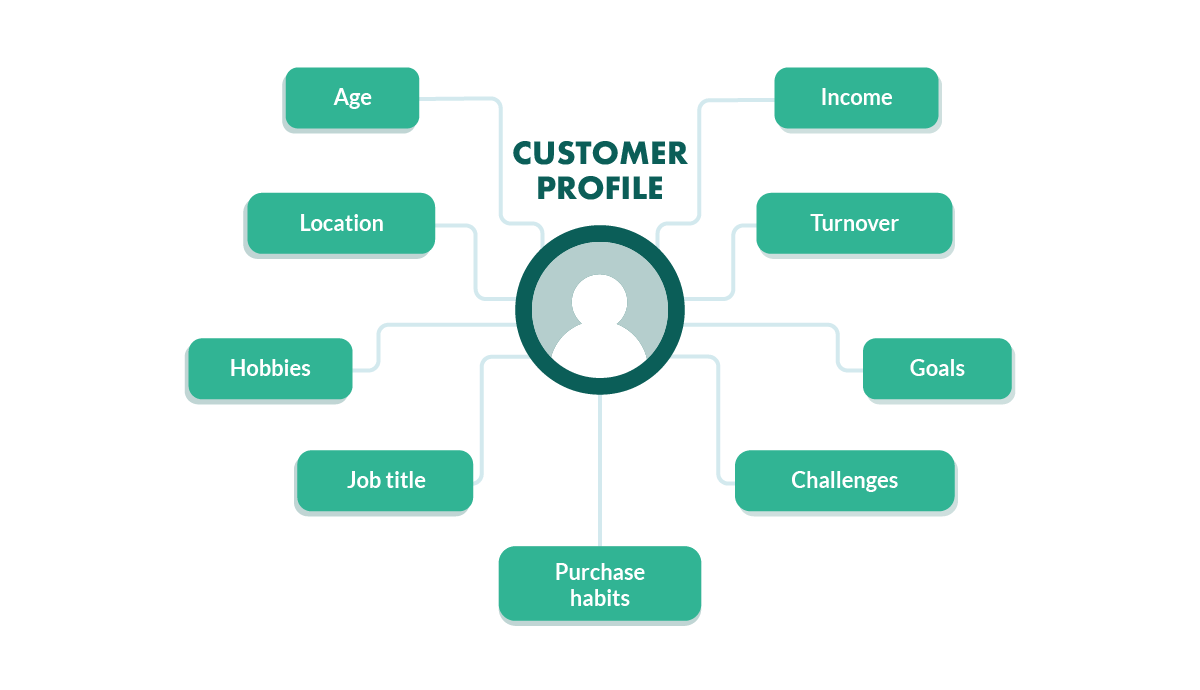
Before you score anything, you need to know what good looks like.
Look at your best customers. What do they have in common? You're looking for patterns in company size, industry, revenue, location, and tech stack. Write down the specific criteria that define a perfect-fit account.
Example ICP criteria:
- Company size: 50-500 employees
- Industry: B2B SaaS, fintech, or e-commerce
- Revenue: $5M-$50M annually
- Location: North America or Europe
- Job titles: VP Sales, Head of Marketing, RevOps Director
This becomes the foundation of your B2B lead scoring template. Leads that match your ICP start with higher baseline scores.
Step 2: Identify Buying Signals That Matter
Not all actions are equal. Figure out which behaviors actually predict closed deals.
Go through your CRM and identify what your best customers did before they bought. Did they attend a webinar? Visit the pricing page multiple times? Reply to outreach within 24 hours?
High-value signals to track:
- Replied to cold outreach
- Booked a demo or sales call
- Visited pricing page
- Downloaded case studies or ROI calculator
- Engaged with multiple pieces of content in one week
- Added to LinkedIn or responded on social
Lower-value signals:
- Opened an email (easy to accidentally trigger)
- Visited homepage once
- Downloaded a generic ebook
Focus on signals that show real intent, not passive interest.
Step 3: Assign Scores to Each Signal
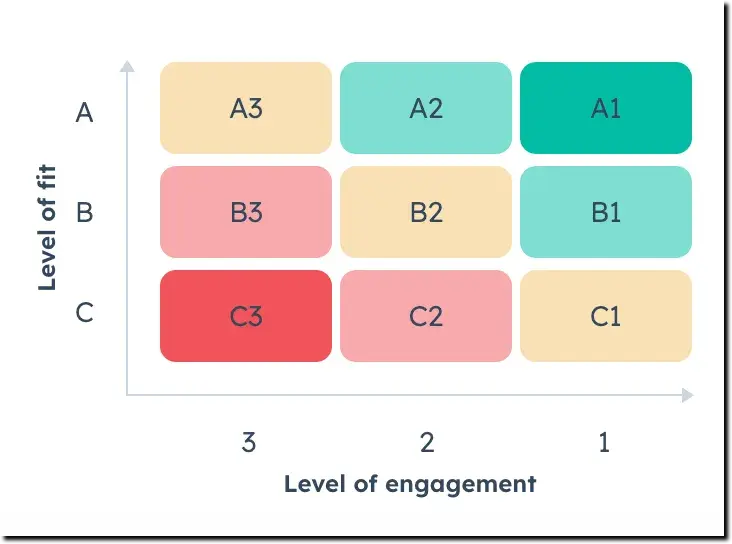
Now you're building the actual B2B lead scoring template. Assign point values based on importance.
Sample scoring framework:
Firmographic fit:
- Matches ICP perfectly: +25 points
- Partially matches ICP: +10 points
- Outside ICP: -10 points
Role and seniority:
- C-level or VP: +20 points
- Director or Manager: +15 points
- Individual contributor: +5 points
Behavioral signals:
- Booked demo: +50 points
- Replied to outreach: +30 points
- Visited pricing page: +25 points
- Downloaded case study: +15 points
- Opened email: +5 points
Engagement recency:
- Active in last 7 days: +10 points
- Active in last 30 days: +5 points
- No activity in 60+ days: -15 points
The exact numbers will vary for your business. Start with educated guesses, then refine based on results.
Step 4: Set Qualification Thresholds (MQL, SQL)
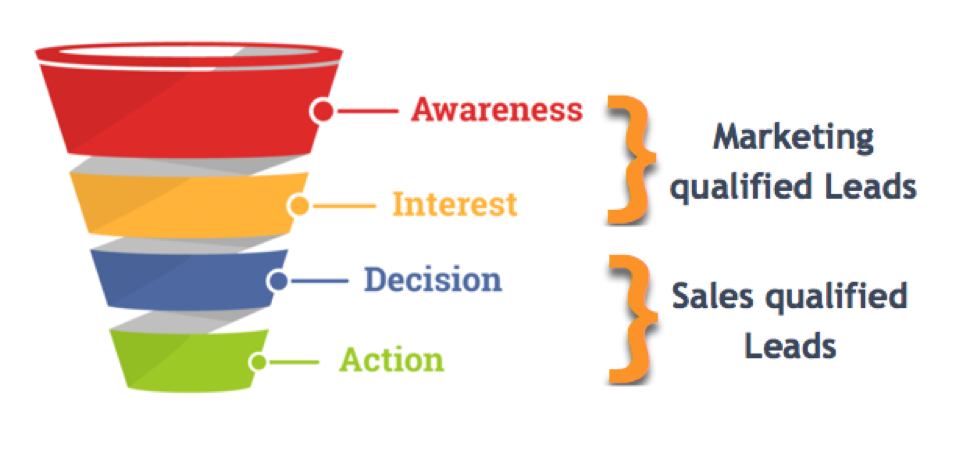
Your B2B lead scoring template needs clear cutoff points that tell your team when to act.
- Marketing Qualified Lead (MQL): The score where a lead is warm enough to pass to sales. Typically 50-70 points. They've shown some interest but aren't ready to buy yet.
- Sales Qualified Lead (SQL): The score where a lead should get immediate outreach. Usually 80+ points. They've demonstrated strong buying intent and fit your ICP.
Example thresholds:
- 0-49 points: Cold lead, nurture via marketing automation
- 50-79 points: MQL, pass to SDR for light touch outreach
- 80-100 points: SQL, prioritize for immediate contact
These thresholds tell everyone exactly when to take action. No more guessing or debating whether a lead is "ready."
Step 5: Continuously Review and Adjust Scores
Your first B2B lead scoring template won't be perfect. That's fine.
Review your scoring model every quarter. Ask yourself:
- Are high-scoring leads actually converting?
- Are we missing good leads because they score too low?
- Have any buying signals become more or less predictive?
- Is our ICP still accurate or has it shifted?
Talk to your sales team. They'll tell you if the leads they're getting are actually qualified or if the scoring needs tweaking. Use their feedback to adjust point values and thresholds.
At Cleverly, we've helped over 10,000 clients refine their lead qualification process through our LinkedIn outreach and cold email campaigns. We've seen firsthand how the right leads transform pipeline performance.
The key to a working B2B lead scoring template: Start simple, measure everything, and iterate based on real conversion data. A basic model you actually use beats a complex one that sits unused in your CRM.
B2B Lead Scoring Best Practices: What Separates Working Models From Abandoned Ones
Most B2B lead scoring templates don't fail because the math is wrong. They fail because nobody followed a few rules that separate a model your team actually uses from one that quietly rots in your CRM.
Interview your sales team before you build anything
The single most common reason lead scoring models get abandoned is that marketing or RevOps built them without sales in the room. Your reps have talked to more won and lost deals than anyone else in the building. They know which behaviors actually precede a signed contract, and that knowledge needs to shape your point weights before launch, not after the model has already routed six months of bad leads.
Build in score decay from day one
A lead who visited your pricing page 90 days ago and never came back is not the same as one who visited yesterday. If your model doesn't account for that, stale leads sit at the top of your queue indefinitely. Most teams handle this by reducing score by 5 to 10 points for every 30 days of inactivity. Set this rule when you build the model, not after your SDRs complain about calling ghosts.
Don't set thresholds until you've looked at your conversion data
The most common miscalibration goes one of two ways. Either the SQL threshold is too low and sales drowns in unqualified leads, or it's too high and genuinely ready buyers sit in nurture for months. The fix is empirical, not a guess. Pull every closed-won deal, find the average score those leads had at first sales contact, and set your SQL threshold 10 to 15 percent below that number.
Score what disqualifies a lead, not just what qualifies one
Teams that only reward positive behavior and skip negative scoring are one of the more common lead scoring mistakes out there. A competitor's email domain, a "student" or "looking for opportunities" title, a careers page visit, or a personal Gmail address on a business inquiry should all pull points down. Without negative scoring, these leads slip through as false positives and waste SDR time that should go to real buyers.
Never automate a model you haven't validated by hand
Before you connect scoring to routing, run it in read-only mode for 30 days. Score leads without acting on the score, then compare what the model says against what your reps actually think of those leads. Fix the weights before you let the system make routing decisions on its own.
A scoring model built on incomplete firmographic or industry data will produce confident-looking numbers that mean nothing, so this step matters even more than it sounds like it does.
Get these five right and your model survives its first quarterly review. Skip them and you'll be rebuilding from scratch by Q2.
Automating B2B Lead Scoring at Scale
Manual lead scoring works when you have 50 leads a month. It breaks completely when you're dealing with 500 or 5,000.
Why Manual Scoring Fails at Scale
Your team can't manually evaluate every lead that comes in. Someone opens an email at 9pm, visits your pricing page, downloads a case study, and books a demo by 10am the next day. If you're scoring manually, you miss that window entirely.
Speed matters in B2B sales. The company that responds first wins. Manual scoring means slow response times, missed opportunities, and frustrated prospects who move on to your competitors.
Using CRM + Marketing Automation for Real-Time Scoring
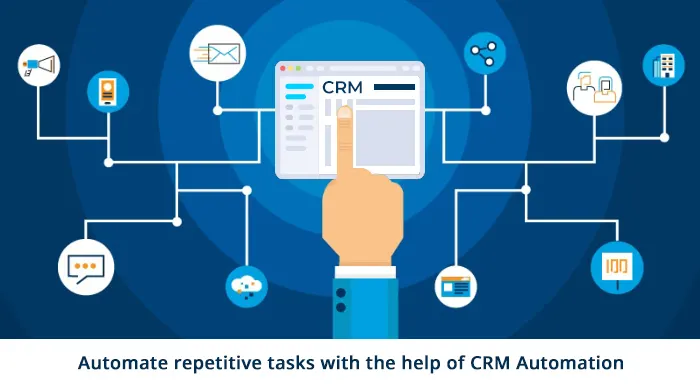
The easiest way to automate lead scoring B2B sales methods is connecting your CRM with your marketing automation platform.
Here's how it works:
Your marketing automation tool (HubSpot, Marketo, Pardot) tracks every action a lead takes. Website visit? Points added. Email reply? More points. Demo booked? Score jumps significantly.
These actions automatically update the lead score in your CRM in real time. When a lead crosses your SQL threshold, your CRM triggers an alert to the right SDR. No manual updates, no delays, no leads falling through cracks.
What you can automate:
- Firmographic scoring based on company data
- Behavioral scoring from email, cold email campaigns, and website engagement
- Automatic lead routing to the right rep based on score
- Score decay for inactive leads
- Re-engagement triggers when cold leads heat back up
This is the foundation for any serious attempt to automate lead scoring B2B sales methods.
AI-Assisted Scoring vs Rule-Based Scoring
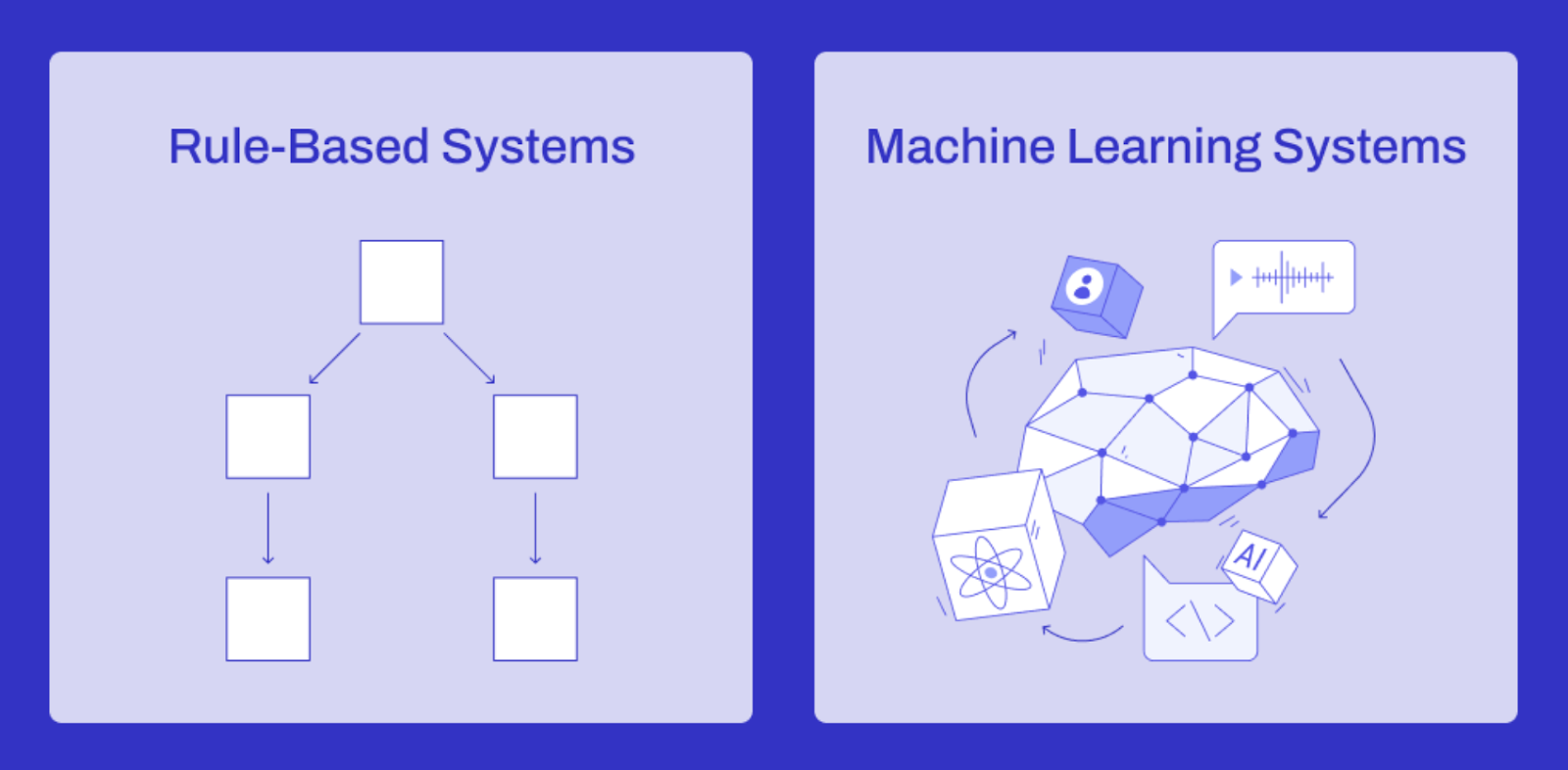
There are two main approaches to automation.
- Rule-based scoring is what we described above. You set the rules (pricing page visit = 25 points), and the system follows them. It's transparent, predictable, and easy to understand. You control exactly what gets scored and how much.
- AI-assisted scoring uses machine learning to find patterns you might miss. The system analyzes thousands of data points across your won and lost deals, then predicts which current leads look most like your best customers. It adapts automatically as your data changes.
Which should you choose?
Start with rule-based scoring. It's simpler to set up and easier to explain to your team. Once you have enough data (typically 1,000+ leads and 100+ closed deals), layer in AI-assisted scoring to catch opportunities your rules might miss.
Many companies that successfully automate lead scoring B2B sales methods use both: rules for the fundamentals, AI for the optimization.
How AI Lead Score Calculation Actually Works in B2B SaaS
We touched on AI-assisted scoring above, but "it uses machine learning" doesn't tell you much. Here's what's actually happening under the hood, and why it's fundamentally different from the rule-based scoring you just built.
The mechanics, in plain terms
A rule-based model runs on assumptions you set: pricing page visit equals 25 points because you decided that matters. An AI scoring model skips your assumptions entirely. It ingests your historical CRM data, both the deals you won and the ones you lost, and identifies which combinations of firmographic attributes, product usage, and engagement patterns actually correlated with closed revenue.
It then applies those learned patterns to score new leads as they come in. The weights come from your data, not from a meeting where someone argued that email opens should count for something.
The data threshold that determines whether this works
AI scoring needs volume to be reliable. Most practitioners recommend at least 1,000 labeled outcomes, meaning closed-won and closed-lost deals combined, before the model produces statistically meaningful predictions.
Below that, you're better off sticking with rule-based scoring, and this lines up with what most predictive scoring vendors will tell you privately: some teams start testing with a floor closer to 200 closed-won deals, but industry guidance generally points to needing at least six months of conversion outcomes before a predictive model learns meaningful patterns. Thin data doesn't just produce a worse model. It produces a model trained on a coincidence.
The three inputs that actually drive the score
- Firmographic fit signals. Company size, industry, and tech stack, usually pulled from enrichment tools like Clearbit or Apollo.
- Product usage signals for trial leads. Login frequency, feature adoption, and time-in-app. For SaaS specifically, these are the strongest predictors of conversion, stronger than almost anything else in the model.
- Engagement signals. Email reply rate, demo requests, and pricing page depth across both outbound and inbound touches.
Validate before you trust it
Don't flip the switch on a new AI scoring model without backtesting it first. Run it against historical data and check whether it would have correctly flagged the leads that actually closed. Then run it in parallel with your existing rule-based scoring for 30 days and compare which system produced more SQLs that converted. Commit to whichever one wins, not whichever one sounded smarter in the sales pitch.
Score decay works differently for SaaS trial leads
A trial user who hasn't logged in for 7 days should lose significant score, because inactivity at this stage is one of the strongest predictors of churn before it even happens. Most AI models handle this automatically, but it's worth checking your configuration rather than assuming it's on by default.
Why this matters right now
Adoption of AI-driven scoring isn't a future-state conversation anymore. Gartner's 2025 Sales Technology Report found 89% of revenue organizations now use AI-powered tools, up from just 34% in 2023, and intent-data layers on top of first-party scoring data nearly doubled in adoption year over year, from 24% to 47%.
The gap between teams running AI-assisted scoring and teams still doing everything by rule is closing fast, and it's closing in one direction.
That said, don't mistake "AI-powered" for "better by default." A model trained on generic vendor data, rather than your own closed-won history, will confidently score the wrong leads. The fix isn't more AI. It's making sure the AI is learning from your deals, not a generic template of what a SaaS buyer is supposed to look like.
When Automation Helps and When Humans Are Still Needed

Automation excels at:
- Tracking and scoring routine behaviors at scale
- Updating scores in real time 24/7
- Routing leads instantly based on score and criteria
- Identifying patterns across thousands of data points
- Eliminating human error and bias
Humans are still needed for:
- Setting the initial scoring framework and thresholds
- Reviewing edge cases that don't fit standard patterns
- Adjusting scores based on qualitative factors (conversation quality, strategic fit)
- Making final judgment calls on borderline leads
- Continuously refining the model based on market changes
At Cleverly, we combine automation with human expertise in our lead generation process. Our systems handle the data and scoring, but experienced SDRs make the final call on outreach strategy. That's how we've generated $312 million in pipeline revenue for over 10,000 clients.
The goal isn't to replace human judgment. It's to free your team from repetitive scoring tasks so they can focus on actual selling.
When you automate lead scoring B2B sales methods correctly, your SDRs spend less time updating spreadsheets and more time having conversations that close deals.
Start with basic automation, measure the results, and scale from there. The ROI shows up fast when your team can respond to hot leads within minutes instead of hours or days.
B2B Lead Scoring Examples
Theory is one thing. Real scenarios show you how B2B lead scoring actually impacts your pipeline. Here are two situations we see all the time.
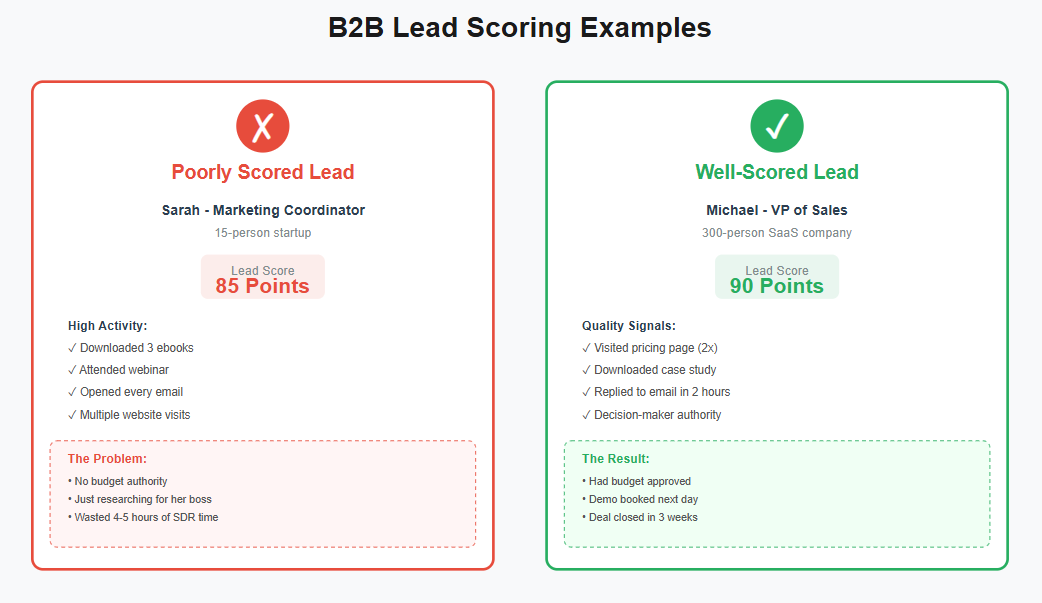
Example 1: The Poorly Scored Lead That Wasted Everyone's Time
The lead: Sarah, Marketing Coordinator at a 15-person startup. She downloaded three ebooks, attended a webinar, opened every email, and clicked through to the website multiple times.
The score: 85 points (marked as SQL, high priority)
What happened: An SDR spent two weeks trying to book a meeting. Sarah was responsive and friendly but had zero budget authority. She was doing research for her boss, who wasn't even aware she was looking at solutions. After three calls and multiple emails, the deal went nowhere.
The problem: The scoring model gave too much weight to engagement behavior and not enough to role and decision-making authority. High activity doesn't equal buying power.
Time wasted: Roughly 4-5 hours of SDR time that could have gone to actual decision-makers.
Example 2: The Well-Scored Lead That Closed in Three Weeks
The lead: Michael, VP of Sales at a 300-person SaaS company. He visited the pricing page twice, downloaded one case study, and replied to a cold email within two hours.
The score: 90 points (marked as SQL, immediate priority)
What happened: The SDR called him the same day he replied. Michael had budget approved, was evaluating three vendors, and needed a solution in place by quarter-end. He booked a demo for the next day. Three weeks later, the deal closed.
Why it worked: The scoring model correctly identified that seniority plus pricing page visits plus fast reply time meant serious buying intent. The SDR struck while the iron was hot.
Result: Fast response time, aligned timing, closed deal.
What Changed in the Scoring Logic
After analyzing dozens of situations like Sarah's, the company adjusted their B2B lead scoring model:
Before:
- Email opens: +5 points each
- Website visits: +10 points each
- Content downloads: +15 points each
- Role weight: Minimal difference between coordinator and VP
After:
- Email opens: +2 points (lowered, too easy to trigger)
- Website visits: +5 points for general pages, +20 for pricing/demo pages
- Content downloads: +10 points for top-of-funnel, +20 for case studies/ROI tools
- Role weight: C-level/VP (+25 points), Director (+15), Manager (+10), Coordinator (+5)
- New criterion: Decision-making authority verified via LinkedIn or company research (+20 points)
The impact:
High-engagement coordinators now score around 55-65 points (MQL for nurturing, not immediate outreach). Senior decision-makers with moderate engagement score 80+ points (SQL for immediate contact).
SDRs stopped chasing leads who couldn't buy and started closing deals faster. Conversion rates improved by 34% in the first quarter after the adjustment.
The lesson: Activity alone doesn't predict revenue. The best B2B lead scoring models balance engagement with actual buying power. Get that balance right, and your team focuses on leads that actually close.
B2B Lead Scoring Examples by Revenue Range
The Sarah and Michael examples above show what happens when you score individuals correctly or incorrectly. But one of the most underweighted scoring dimensions we see teams miss entirely is revenue range.
Here's why it matters so much. A $2M ARR startup and a $50M ARR mid-market company might have the exact same job titles on their org charts. VP of Sales at one, VP of Sales at the other. But they have completely different procurement processes, decision timelines, and contract values. Score them identically and you'll misallocate SDR time on both ends.
SMB target ($1M to $10M revenue). These companies move fast. Decision cycles run 2 to 4 weeks with a single decision-maker and real price sensitivity. Your scoring model should weight demo requests and reply speed heavily here. Behavioral intent tells you more than firmographic depth at this size, so don't over-filter. Keep the SQL threshold lower, around 60 points, or you'll bounce good leads out of the pipeline before sales ever sees them.
Mid-market target ($10M to $100M revenue). Now you're dealing with 2 to 5 stakeholders and 6 to 12 week evaluation cycles with a formal process behind them. Weight multi-stakeholder engagement heavily. If two or more contacts at the same company start engaging, the score should jump significantly, not just tick up. Pricing page visits and case study downloads matter more here than they did for SMB. Push the SQL threshold up to around 75 points.
Enterprise target ($100M+ revenue). RFPs, procurement teams, and cycles that stretch 6 to 18 months. A single contact's behavior isn't predictive at this level, no matter how engaged they seem. Weight account-level intent data from tools like Bombora or 6sense over any one person's activity. An account only qualifies as SQL once you see engagement across multiple stakeholders, not one enthusiastic champion. This isn't just theory: 2026 cohort analysis across 2,400 B2B accounts found intent-sourced leads convert at 18.7% to closed-won versus 5.5% for cold ICP-match leads, a gap that only widens at enterprise scale where account-level signal matters more than individual behavior.
How Cleverly Helps B2B Teams Focus on Sales-Ready Leads
Here's what we've learned from generating $312 million in pipeline revenue: lead scoring only works if you're starting with quality leads in the first place.
That's where Cleverly comes in.
We're a B2B lead generation agency that delivers meeting-ready leads directly to your calendar. No fluff, no tire kickers, just qualified prospects who actually want to talk.
Our approach is simple:
We handle the entire outbound process through three proven channels:
LinkedIn outreach (starting at $397/month), cold email campaigns (you only pay for meeting-ready leads we send), and our $5M cold calling system that books 10-30 qualified sales calls every month, guaranteed.
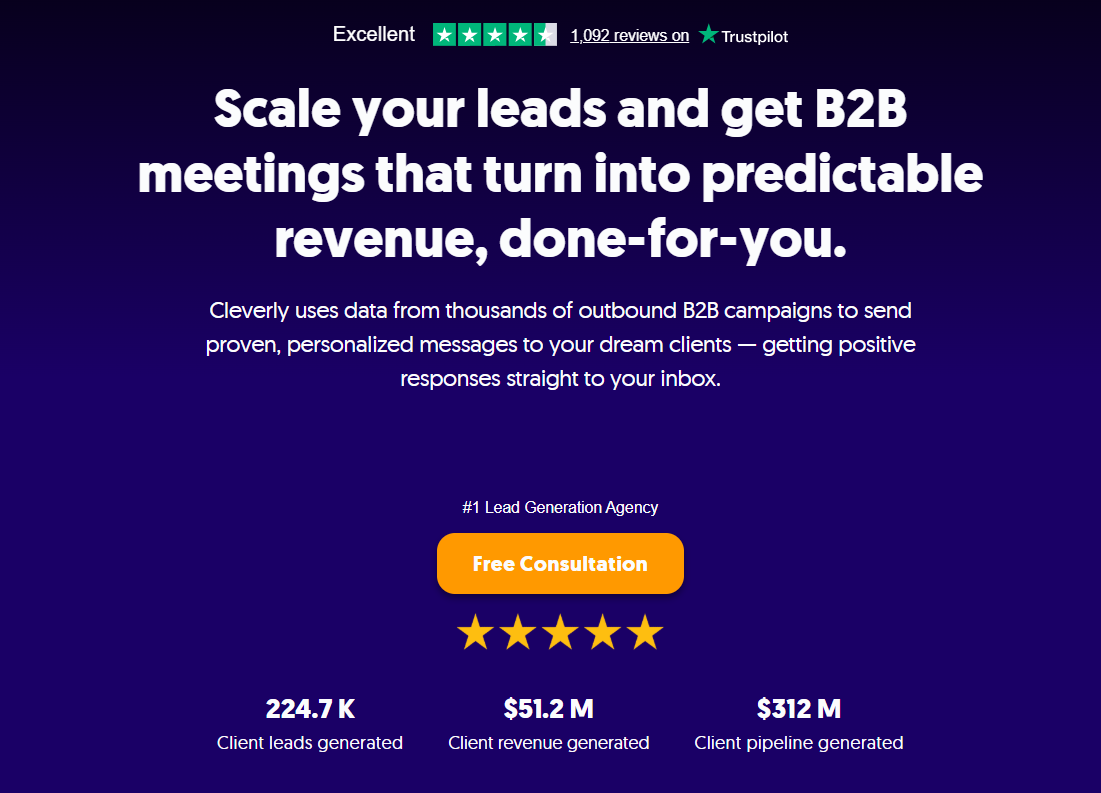
We've worked with over 10,000 clients including Amazon, Google, Uber, PayPal, Slack, and Spotify. The results speak for themselves: $51.2 million in closed revenue, 1M+ cold calls made, 53K appointments set.

Here's the difference: While you're refining your B2B lead scoring model internally, we're already doing the heavy lifting externally. Our team identifies high-fit prospects, runs the outreach, handles the back-and-forth, and only passes you leads that are ready to have a real conversation.
Your SDRs stop wasting time on cold prospects. Your pipeline fills with people who actually match your ICP. Your close rates improve because you're only talking to qualified buyers.

Ready to focus on closing instead of prospecting? Book a strategy call with Cleverly and let's build a lead generation system that actually fills your pipeline with sales-ready opportunities.
Conclusion
B2B lead scoring isn't something you set up once and forget about. It's a revenue discipline that directly impacts whether your team hits quota or falls short.
Prioritization beats volume every single time. You don't need more leads. You need the right leads at the right time.
A focused SDR working 20 high-scoring, well-qualified prospects will outperform someone blindly dialing through 200 random names.
Build your B2B lead scoring model, automate what you can, and let your team do what they do best: have meaningful conversations with people who are actually ready to buy. That's how you turn pipeline into revenue.
Stop guessing. Start scoring. Watch your close rates climb.
Frequently Asked Questions
Free Resource
How to Scale a Profitable Cold Call System
Get the complete guide — download it instantly now.
Free Ebook
Download the Free Guide
Enter your details to get instant access.
You're all set! 🎉
Your ebook is downloading now.
Click below if the download didn't start automatically.