Table of Contents
What Is B2B Lead Intelligence?
How Artificial Intelligence Enhances B2B Lead Generation
Why B2B Lead Intelligence Matters for Revenue Teams
Best B2B Lead Intelligence Software Tools in 2026
How to Use B2B Lead Intelligence Strategically
Lead Intelligence by Industry: IT Services, Telecom, and Fintech
Common Mistakes When Using Lead Intelligence Tools
How Cleverly Turns Lead Intelligence Into Qualified Pipeline
Conclusion
Frequently Asked Questions
Modified On :
September 14, 2026
Key Takeaways
- B2B lead intelligence goes beyond contact data by layering in firmographic, technographic, and behavioral intent signals.
- AI enhances prospecting precision but doesn't replace strategy, it just makes targeting sharper.
- High-quality intelligence directly reduces wasted outreach, lowers CAC, and shortens sales cycles.
- The best B2B lead intelligence software tools serve different needs, picking the right one depends on your team size and workflow.
- Intelligence without a structured outreach system won't move the needle, execution is what creates the pipeline.
- Always start with a clearly defined ICP before layering in any data or tools.
Most B2B teams don't have a leads problem. They have an intelligence problem.
They're sending outreach to the right job titles but the wrong companies. They're burning through lists without knowing who actually has buying intent. And spray-and-pray prospecting is getting harder every year as inboxes get crowded and buyers get smarter.
That's where B2B lead intelligence comes in.
AI-driven data is changing how teams prospect, prioritize, and personalize at scale, and the teams using it well are pulling ahead fast.
In this guide, we'll cover what B2B lead intelligence actually is, how AI enhances it, which tools are worth your attention in 2026, and how to turn intelligence into a real pipeline.

What Is B2B Lead Intelligence?
Lead intelligence for B2B is the practice of going beyond basic contact data to understand who your buyers are, what they care about, and when they're ready to buy.
Here's how the layers differ:
- Basic contact data: Name, email, job title, company
- Sales intelligence: Company size, revenue, tech stack, org structure
- Lead intelligence: Behavioral signals, intent data, engagement history, buying triggers
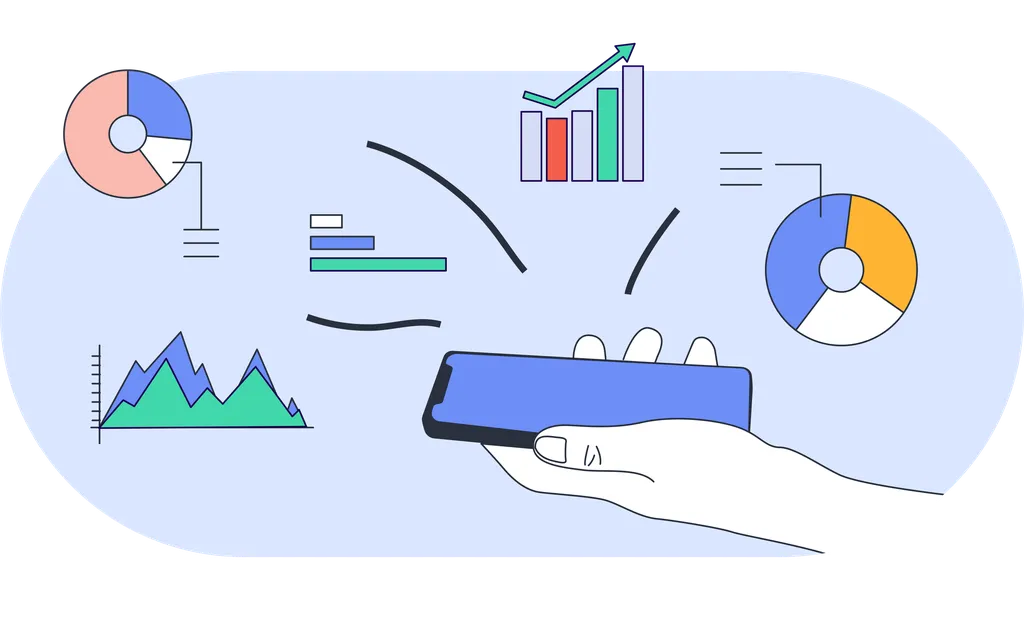
The intelligence layers that matter most:
- Firmographic data: Industry, company size, location, revenue range
- Technographic data: Tools and platforms a company currently uses
- Behavioral intent signals: Content consumed, topics researched, competitor pages visited
- Engagement insights: Email opens, ad interactions, website activity
When you stack these together, you stop guessing and start reaching out to people who actually have a reason to talk to you.
What Is B2B Lead Intelligence Software?
B2B lead intelligence software is a category of sales and marketing tools that collect, organize, and analyze prospect data — firmographic, technographic, behavioral, and intent data — to help revenue teams identify who to contact, when to reach out, and what to say.
The defining feature of lead intelligence software versus a basic contact database is the intelligence layer: tools don't just store data, they surface signals. A lead intelligence platform tells you that a prospect visited your pricing page three times this week, that their company just posted a VP of Sales job, and that they're using a competitor's product — all automatically, without manual research.
There are four main types of lead intelligence software:
Data enrichment tools (Apollo, ZoomInfo, Clearbit) fill gaps in your contact and company records with firmographic and contact data.
Intent data platforms (6sense, Bombora) track behavioral signals across the web to surface accounts actively researching solutions like yours.
Predictive scoring tools (HubSpot Einstein, Madkudu) rank leads by conversion likelihood based on fit and engagement signals. All-in-one platforms combine prospecting, enrichment, and outreach sequencing in one system.
The right tool depends on where your current process is breaking down — typically either data quality (enrichment tools) or timing (intent data).
B2B Sales Intelligence vs. Lead Intelligence vs. Marketing Intelligence
These three terms are often used interchangeably but describe meaningfully different things.
B2B lead intelligence focuses on identifying and prioritizing prospective buyers. It answers the question: who should we reach out to, and when? The data layer includes firmographics, technographics, intent signals, and behavioral data about prospects who haven't yet entered your sales process.
B2B sales intelligence is broader and covers the entire sales cycle — including accounts already in your pipeline. It includes deal signals, stakeholder mapping within active accounts, competitive intelligence, and engagement tracking during the sales process. Sales intelligence helps reps manage and advance open opportunities, not just identify new ones.
B2B marketing intelligence covers market-level data: industry trends, competitive positioning, campaign performance, and audience segmentation. It informs content strategy, ad targeting, and demand generation, rather than individual prospect prioritization.
In practice, the best revenue teams use all three. Lead intelligence feeds the top of funnel (who to target). Sales intelligence supports the middle and bottom (how to close). Marketing intelligence shapes the strategy that surrounds both.
The tools discussed in this guide primarily cover lead intelligence and sales intelligence. If your team is running both prospecting and account management, look for platforms like 6sense or Demandbase that bridge both functions.
🚀 From Signals to $312M+ in Pipeline
10,000+ companies trust Cleverly to convert buyer insights across LinkedIn, email, and phone into sales-ready meetings.
How Artificial Intelligence Enhances B2B Lead Generation
Artificial intelligence B2B lead generation isn't about replacing your sales team. It's about making every rep's effort count more.
Here's what AI actually does in a modern prospecting workflow:
- Data enrichment: Automatically fills gaps in contact and company records.
- Intent detection: Flags accounts actively researching solutions like yours.
- Predictive lead scoring: Ranks leads by likelihood to convert based on historical patterns.
- Automated research: Pulls relevant context on a prospect before outreach.
- Personalization at scale: Generates tailored messaging based on role, industry, and behavior.
- AI-assisted targeting: Narrows your ICP match so you're not wasting touches on bad-fit accounts.
The key thing to understand here: AI improves targeting precision. It doesn't replace a strong strategy or well-written messaging.
Teams that treat AI as a shortcut tend to get worse results than teams that use it to sharpen an already-solid process.

Also Check: How to Do B2B Market Research (Step-by-Step Guide)
Why B2B Lead Intelligence Matters for Revenue Teams
If your team is still running cold outreach off a basic contact list, you're leaving a lot on the table. B2B lead intelligence directly impacts your bottom line in ways that are easy to measure.
It helps you:
- Improve reply rates by reaching out with relevant context instead of generic pitches.
- Reduce wasted outreach by filtering out accounts that don't fit your ICP.
- Lower customer acquisition cost by focusing effort on high-probability accounts.
- Shorten sales cycles because you're reaching buyers closer to a decision.
- Improve meeting quality since you're talking to people with real buying intent.
- Enable account-based outreach by aligning sales and marketing around the same target accounts.
The difference between a 2% reply rate and an 8% reply rate often comes down to the quality of intelligence behind the outreach, not just the copy.
🧠 Intelligence Is Useless Without Execution
Cleverly turns lead data into pipeline using LinkedIn outreach, pay-per-meeting cold email, and guaranteed cold calling — done for you.
Best B2B Lead Intelligence Software Tools in 2026
The B2B Lead Intelligence Platform Market in 2026
The B2B lead intelligence software market has consolidated significantly over the past three years. ZoomInfo and Apollo dominate the contact data and enrichment layer for most mid-market and enterprise teams.
6sense and Demandbase have established themselves as the clear leaders in intent data and account-based marketing intelligence. A second tier of specialist tools — Cognism for compliance-first European data, LeadIQ for LinkedIn-centric SDR workflows, Lusha for lightweight contact lookup — serve teams with more specific needs.
The main trends shaping the market right now: AI-generated personalization is becoming a baseline expectation (most platforms now offer some form of AI email assist), real-time intent data is expanding beyond basic keyword tracking to include behavioral signals from first-party data sources, and pricing is shifting toward outcome-based models as buyers demand more accountability.
For most B2B teams, the decision comes down to whether you need broad data coverage (ZoomInfo, Apollo), deep intent signals (6sense, Bombora), compliance-first data (Cognism), or a flexible enrichment workflow builder (Clay). The platforms below are organized around what they do best.
Below are some of the leading B2B lead intelligence software platforms worth considering in 2026. Each one has a different strength, so the right pick depends on your team size, workflow, and goals.
1. ZoomInfo

ZoomInfo is one of the most comprehensive B2B lead intelligence software platforms out there. It combines a massive contact database with deep firmographic data and intent signals, making it a go-to for enterprise teams that need reliable, high-volume prospecting data backed by strong enrichment capabilities.
Best for: Large enterprises running high-volume outbound and ABM programs
Core intelligence capabilities:
- Detailed firmographic and org chart data across millions of companies
- Buyer intent signals based on topic-level research activity
- Real-time contact verification and data enrichment
AI features:
- AI-powered intent scoring to surface in-market accounts
- Predictive lead recommendations based on your historical win data
- Automated CRM enrichment and data hygiene
Ideal team type: Enterprise sales and marketing teams with dedicated RevOps support
2. Apollo.io
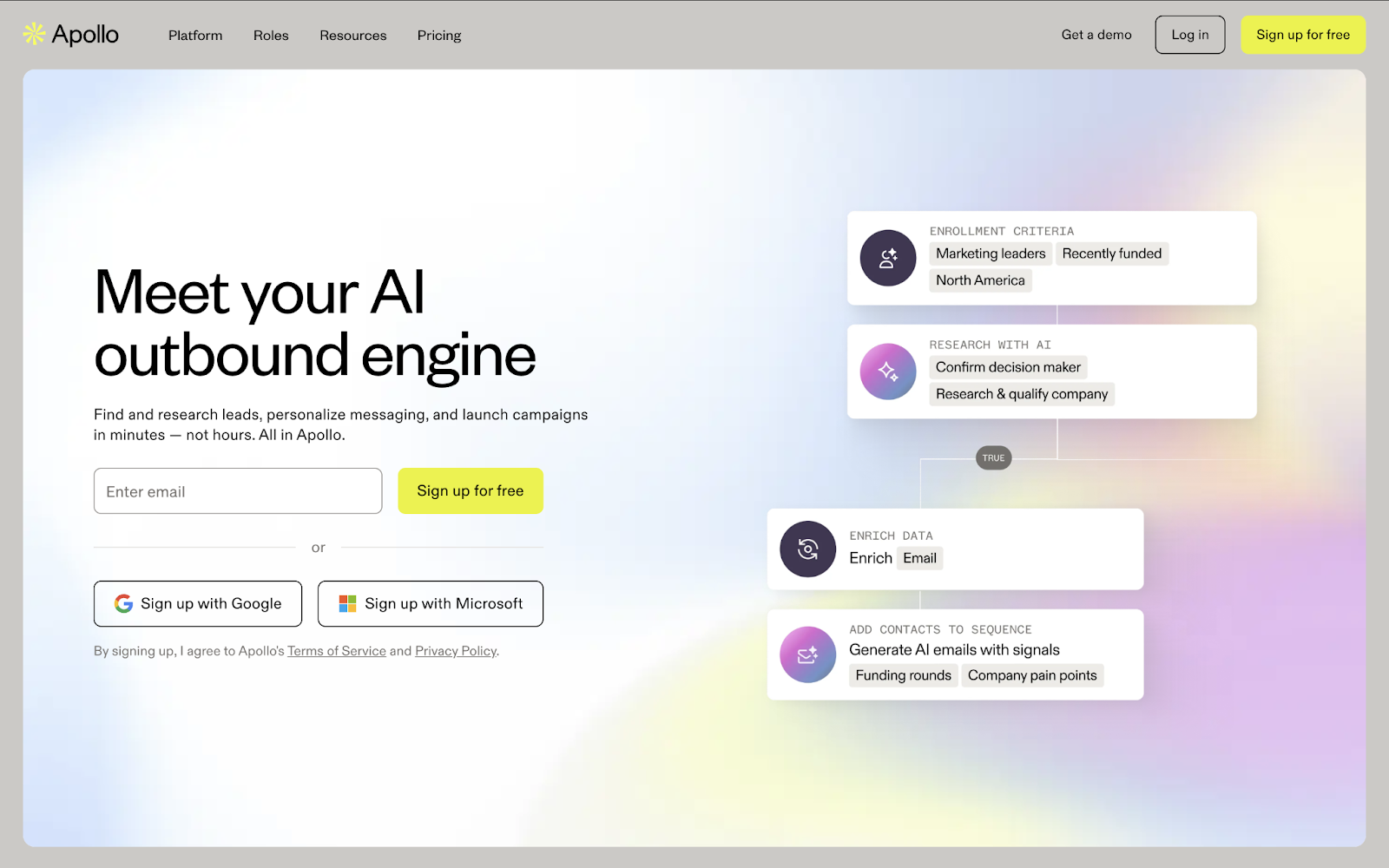
Apollo is a strong all-in-one option that combines a large contact database with built-in sequencing and AI tools. It's particularly popular with SDR teams because you can prospect, reach out, and track everything in one place without needing to stitch together multiple tools.
Best for: SMB to mid-market teams looking for an all-in-one prospecting and outreach platform
Core intelligence capabilities:
- Access to 275M+ contacts with email and phone data
- Advanced filtering by role, industry, tech stack, and funding stage
- CRM sync to keep contact records clean and up to date
AI features:
- AI-assisted email writing and personalization
- Lead scoring based on engagement and fit signals
- Smart account recommendations based on your ICP
Ideal team type: SDR and sales teams that want prospecting and sequencing under one roof
3. Clearbit (now part of HubSpot)
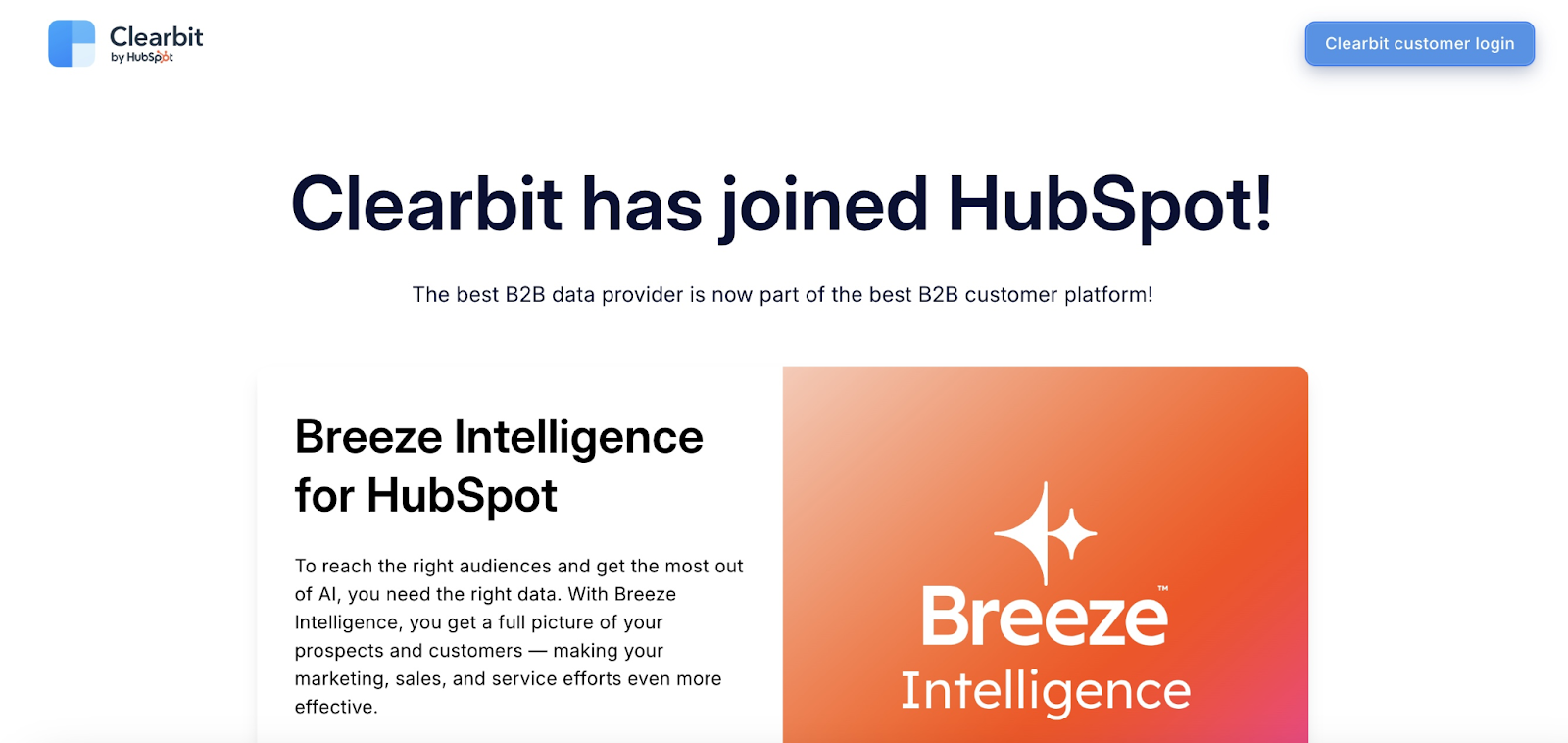
Clearbit built its reputation on real-time data enrichment and it does that really well. Now integrated into HubSpot, it automatically enriches inbound leads and CRM records the moment a prospect fills out a form or enters your database, so your team always has full context before reaching out.
Best for: Inbound-heavy B2B teams that want to enrich leads automatically at the point of capture
Core intelligence capabilities:
- Real-time firmographic and contact enrichment on form fills
- Company and contact data pulled from 100+ sources
- Website visitor identification and de-anonymization
AI features:
- AI-driven lead scoring based on enriched firmographic fit
- Automated data enrichment triggered by inbound activity
- Smart segmentation for marketing workflows
Ideal team type: Marketing and RevOps teams running on HubSpot
4. 6sense
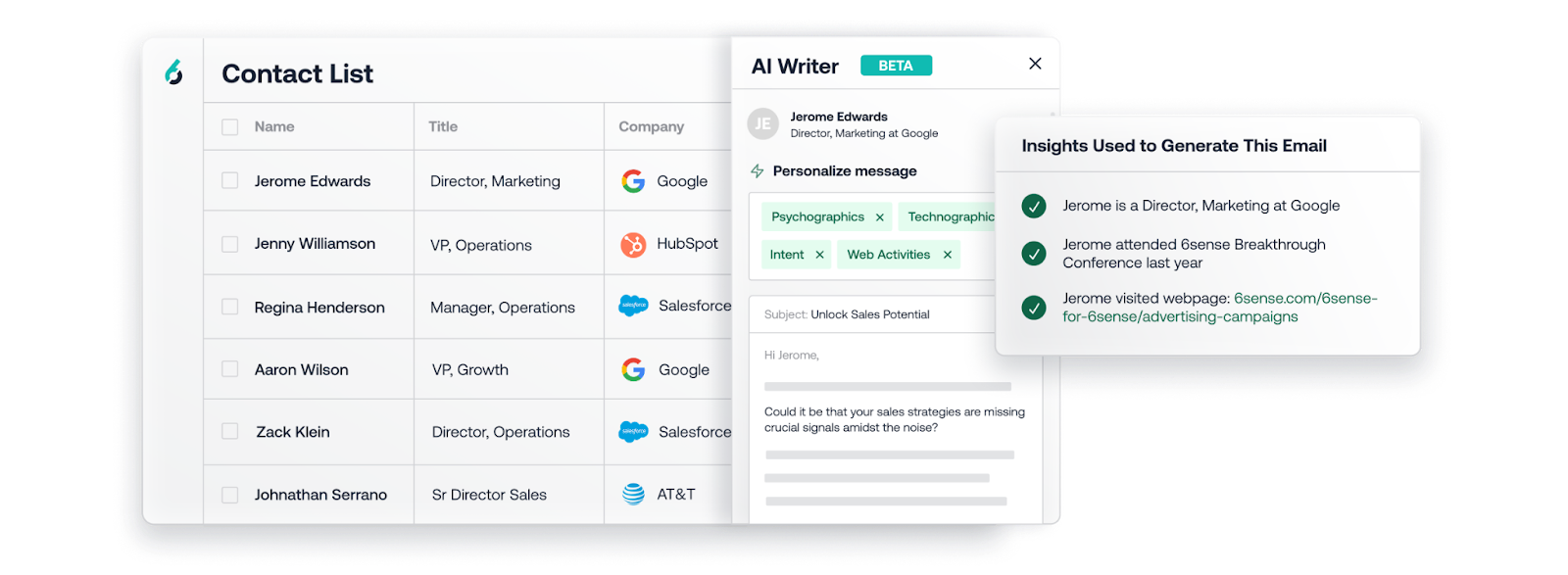
6sense is built around one core idea: identifying buyers before they raise their hand. It tracks anonymous buying behavior across the web and maps it to accounts, so your team knows which companies are actively researching solutions like yours even before they ever contact you.
Best for: Enterprise teams running account-based programs that need deep buyer journey visibility
Core intelligence capabilities:
- Anonymous visitor identification mapped to company accounts
- Account-level intent data across the full buying journey
- Pipeline intelligence and opportunity tracking
AI features:
- AI-powered predictive scoring to rank accounts by purchase readiness
- Buying stage detection to time outreach more effectively
- AI-recommended next best actions for sales reps
Ideal team type: Enterprise ABM-focused revenue teams with aligned sales and marketing
5. Demandbase
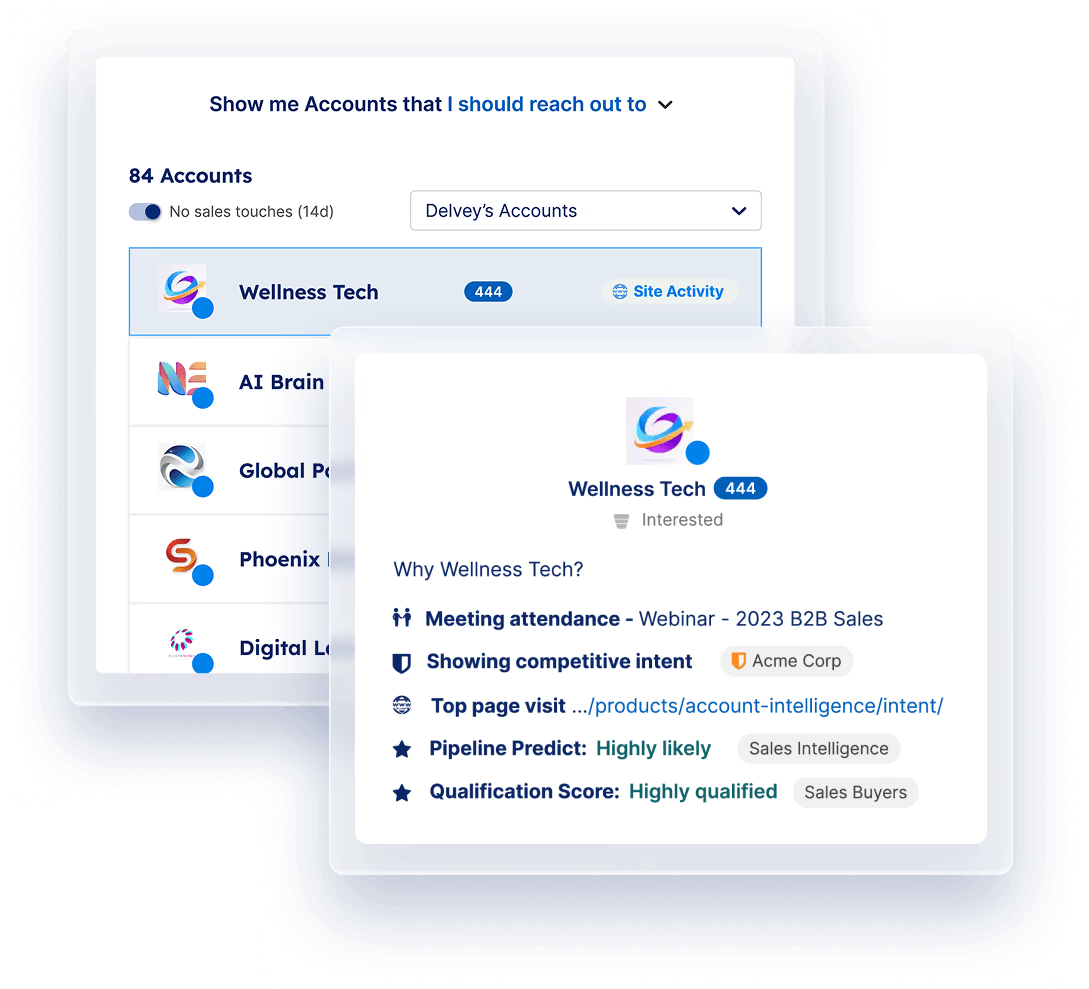
Demandbase is purpose-built for account-based marketing and it ties sales intelligence directly into your ABM execution. It helps you identify the right accounts, understand buying groups within them, and coordinate outreach across sales and marketing from one platform.
Best for: Enterprise B2B companies running coordinated ABM programs at scale
Core intelligence capabilities:
- Account identification and firmographic intelligence
- Buying group mapping within target accounts
- Ad targeting and engagement tracking at the account level
AI features:
- AI-powered account scoring based on fit and intent
- Buying group detection to identify all key stakeholders
- Predictive pipeline insights for sales prioritization
Ideal team type: Enterprise marketing and sales teams focused on strategic account growth
6. Cognism
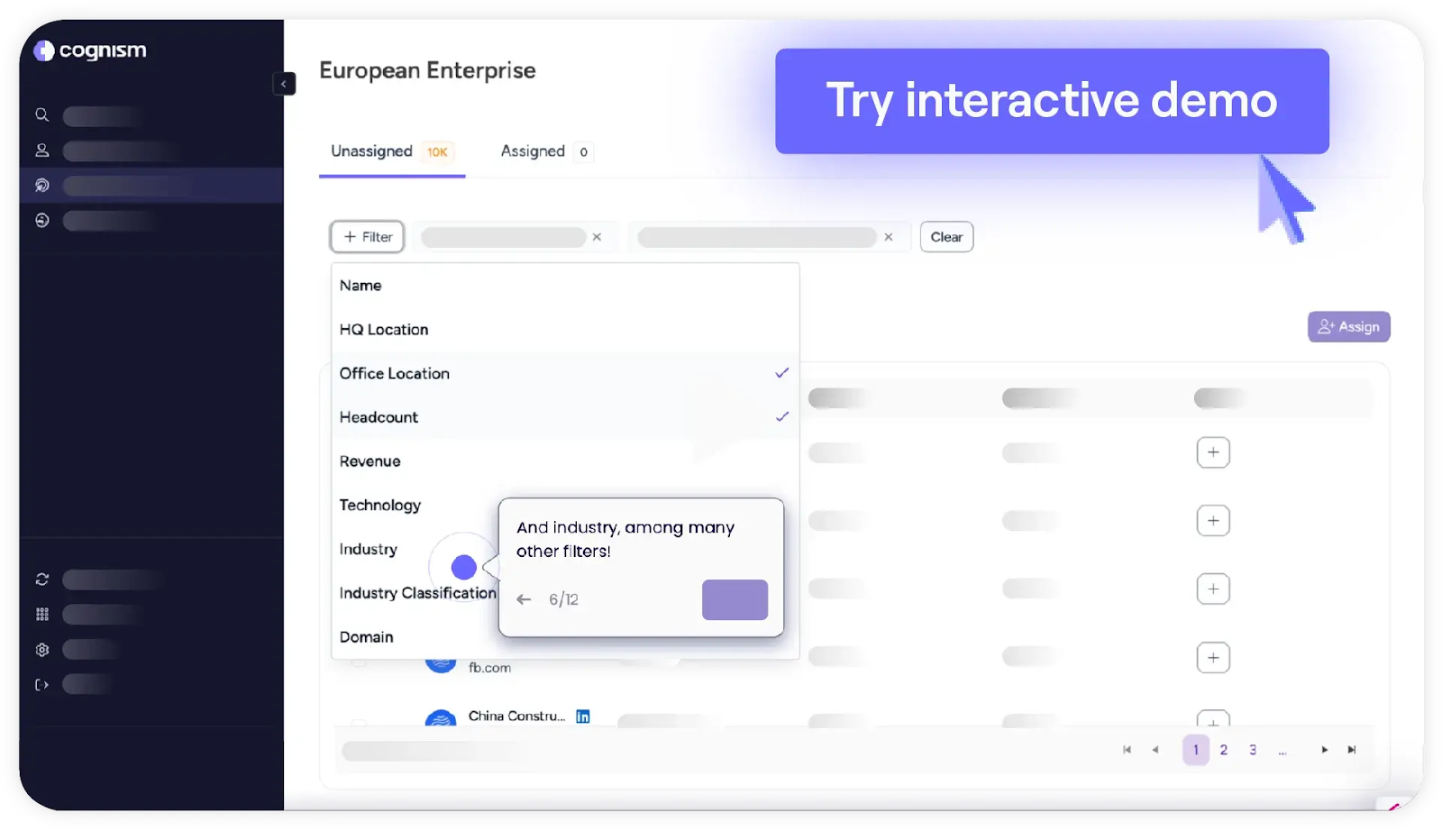
Cognism stands out in the best AI-powered sales intelligence tools for B2B space because of its focus on data compliance and phone-verified mobile numbers. It's especially strong for teams doing cold calling, where number accuracy and legal compliance matter a lot.
Best for: Sales teams that rely heavily on cold calling and need clean, compliant contact data
Core intelligence capabilities:
- Phone-verified mobile numbers with strong EMEA and US coverage
- GDPR and CCPA-compliant data sourcing
- Intent data powered by Bombora to surface in-market accounts
AI features:
- AI-assisted prospect list building based on ICP inputs
- Smart lookalike targeting to find similar accounts to your best customers
- Automated data validation and contact enrichment
Ideal team type: SDR teams running high-volume cold calling and cold email outreach
7. Lusha
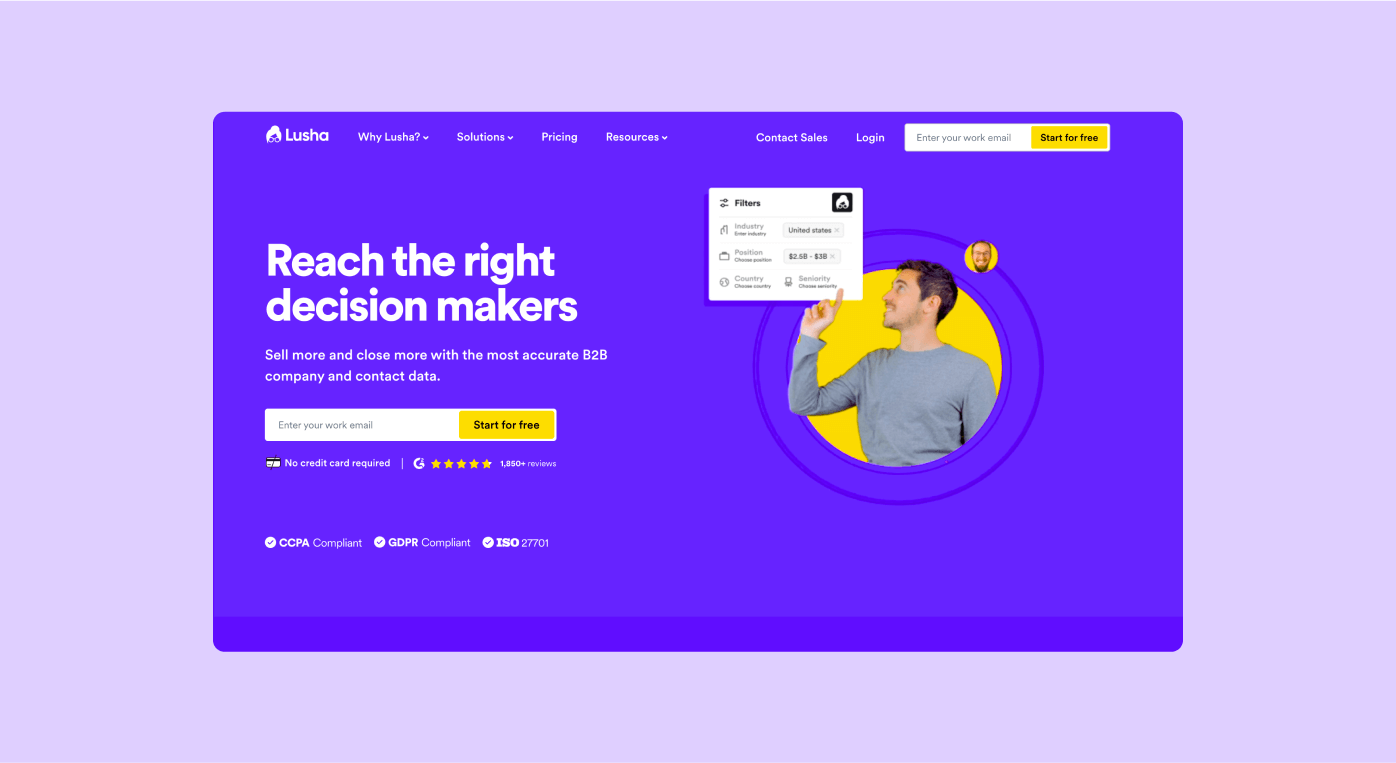
Lusha is straightforward and fast. It's designed for reps who need quick access to accurate contact details without a complicated setup. The Chrome extension makes it easy to grab emails and direct dials right from LinkedIn profiles or company websites.
Best for: Individual reps or small sales teams that need fast, lightweight contact lookup
Core intelligence capabilities:
- Direct dials and verified email addresses
- LinkedIn and web-based contact lookup via Chrome extension
- Basic company and role-level data
AI features:
- AI-powered similar prospect recommendations
- Automated contact suggestions based on your saved lists
- Basic lead scoring based on profile data
Ideal team type: Individual contributors or small SDR teams doing targeted manual outreach
8. Clay
Clay is one of the most flexible B2B lead intelligence tools available right now. It lets you pull data from 50+ sources and build custom enrichment workflows, making it ideal for teams that want highly personalized outreach at scale without doing hours of manual research per prospect.
Best for: Growth-focused teams that want custom data workflows and AI-powered research automation
Core intelligence capabilities:
- Data enrichment pulling from 50+ sources including LinkedIn, Apollo, Clearbit, and more
- Custom enrichment tables with conditional logic
- AI research agent that browses the web to find relevant prospect context
AI features:
- AI-generated personalized outreach based on enriched contact data
- Automated prospect research and summarization
- Smart data waterfall logic to find the best available data source
Ideal team type: Technically savvy SDR, growth, or RevOps teams that want to build custom prospecting systems
9. LeadIQ
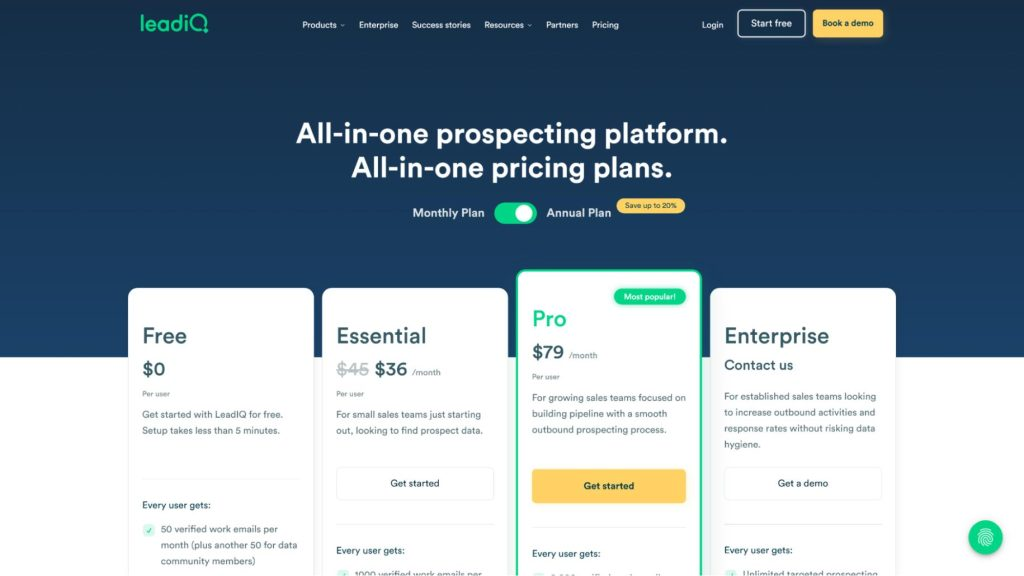
LeadIQ is built for SDRs who live on LinkedIn. It lets you capture prospect data directly from LinkedIn profiles with one click and push it straight into your CRM or sequencing tool, cutting out a lot of the manual copy-paste work that slows reps down.
Best for: SDR teams doing LinkedIn-heavy prospecting who want to capture and sequence leads fast
Core intelligence capabilities:
- One-click prospect capture directly from LinkedIn profiles
- Real-time contact verification and CRM sync
- Pipeline signal tracking to surface warm accounts
AI features:
- AI-generated outreach messages personalized to each prospect
- Smart pipeline signals to flag accounts showing buying activity
- Duplicate detection and data hygiene automation
Ideal team type: SDR teams with a strong LinkedIn prospecting workflow
10. Seamless.AI
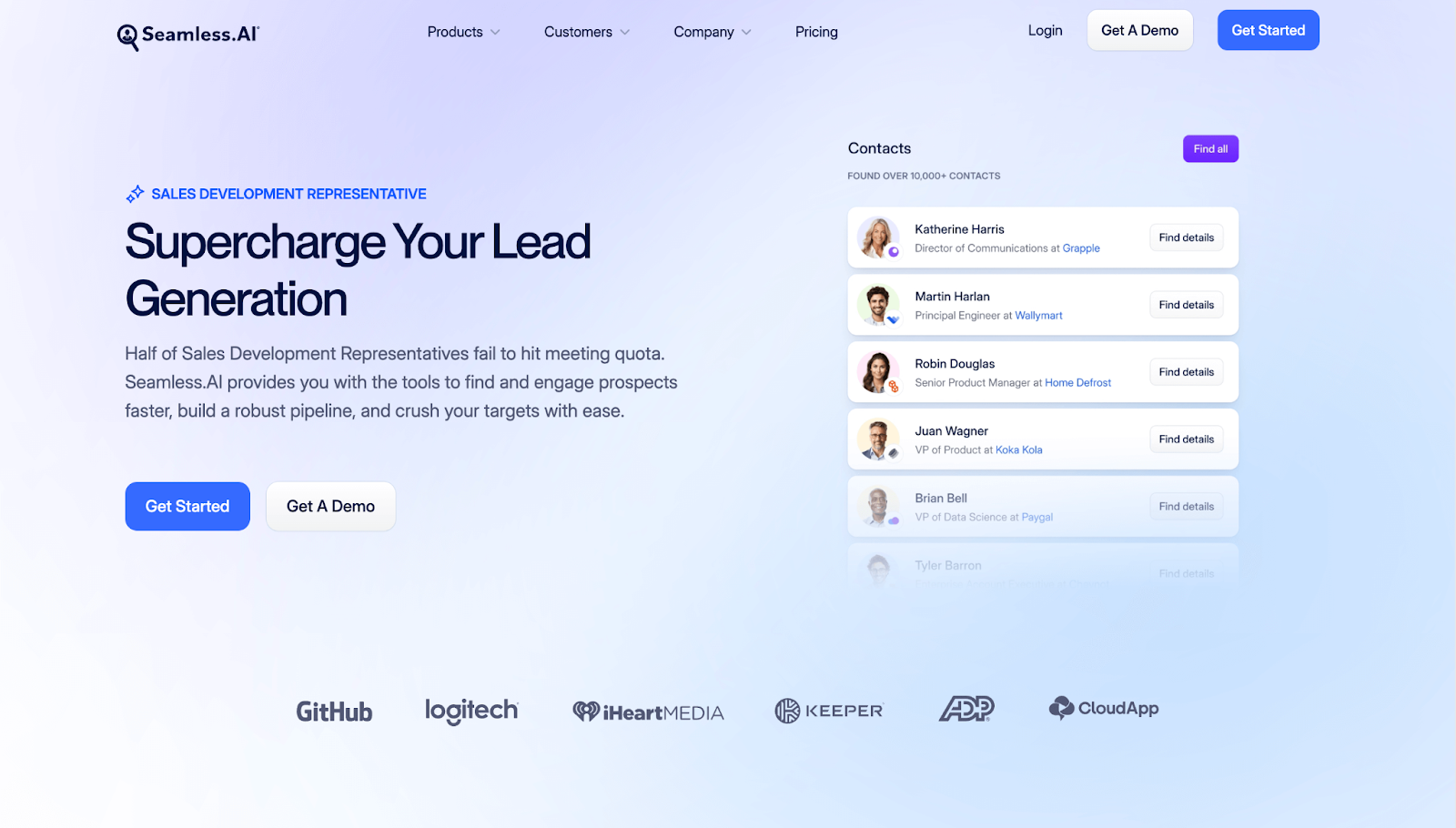
Seamless.AI uses artificial intelligence to find and verify contact data in real time rather than pulling from a static database. This means you're getting fresher contact data than many traditional list-building tools, which is a real advantage for teams doing high-volume outreach.
Best for: Sales teams that need high-volume, AI-verified contact discovery at speed
Core intelligence capabilities:
- Real-time AI-powered contact search and verification
- Email and direct dial discovery across a large company database
- LinkedIn integration for in-platform prospecting
AI features:
- AI-driven contact discovery that searches and validates in real time
- Autopilot mode for automated list building based on ICP criteria
- AI-powered pitch intelligence for tailored outreach messaging
Ideal team type: High-volume sales teams that prioritize speed and scale in prospecting
More Tools: Best Sales Productivity Tools for Modern B2B Sales Teams
How to Use B2B Lead Intelligence Strategically
Having the right B2B lead intelligence software is only half of it. How you use the data is what actually moves the needle. Here's a practical framework:
Step 1: Define Your ICP Clearly
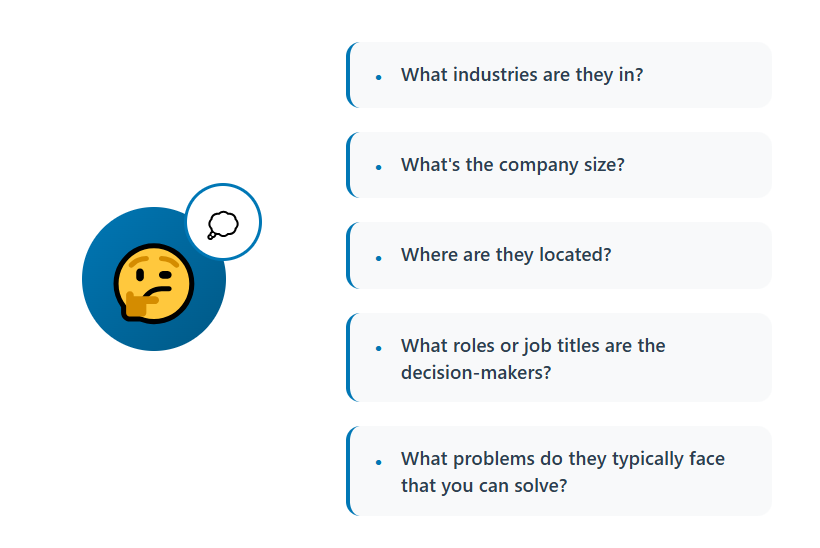
Before touching any tool, get specific. Industry, company size, tech stack, revenue, geography, hiring signals. Vague ICPs produce vague results.
Step 2: Enrich and Validate Your Data
Run your list through an enrichment tool to fill gaps and verify accuracy. Bad data wastes your team's time and kills email deliverability.
Step 3: Identify Intent Signals
Layer in behavioral and intent data to surface accounts that are actively in-market. These contacts should move to the top of your outreach queue.
Intent data works best when paired with a multi-touch outreach system — if your cold email outreach isn't converting warm intent signals into replies, the intelligence investment isn't doing its job.
Step 4: Prioritize High-Probability Accounts
Use predictive scoring to rank accounts by fit and intent. Focus your reps' energy on the top tier first.

Step 5: Deploy Multi-Touch Outreach
Intelligence tells you who to contact. Your sequence determines how. Multi-touch outreach is the key. Use a combination of LinkedIn, email, and calling to reach buyers across multiple touchpoints.
Step 6: Optimize Based on Engagement
Track what's working. Which segments are replying? Which messaging angles are getting meetings? Feed that back into your targeting.
Tools create insight. Execution creates pipeline.
Using Lead Intelligence During the Deal Cycle (Not Just Prospecting)
Most teams treat lead intelligence as a top-of-funnel tool — use it to build lists, identify intent, prioritize outreach. But the same intelligence signals that help you find the right prospects also tell you what's happening inside open opportunities.
Behavioral signals change mid-deal. A prospect who was engaging with your emails weekly and then goes quiet for 10 days is showing a signal. A contact who was your champion and just changed job titles within the company is showing a different signal. A company that starts visiting your pricing page three times a week after going dark on follow-ups is showing a buying signal your CRM alone won't flag.
How to use intelligence during active deals:
Track engagement signals from prospects in open pipeline — email open rates, website revisits, content downloads. Flag any drop-off as an early warning and use it as a prompt to re-engage before the deal goes cold.
Monitor stakeholder changes at target accounts. If the VP who was your champion leaves the company or changes roles, you need to know immediately — and you need to reconnect with whoever is now in that seat before a competitor does.
Watch for new decision-makers entering the conversation. If finance or procurement starts showing up on shared content, that's a signal the deal is moving forward internally and your messaging needs to shift toward ROI framing.
The teams that use lead intelligence only at the top of funnel are leaving deal-acceleration value on the table. The signal layer that tells you who to target also tells you how deals are progressing — if you're watching it.
At Cleverly, we've found that intelligence without a sequenced follow-up system produces almost no pipeline — regardless of how good the data is. The clients who see the biggest results are the ones who pair sharp targeting with consistent multi-touch outreach across LinkedIn, email, and calling. Intelligence narrows the list. Execution works the list.
Read More: Why Single-Channel Outreach Is Breaking Your Attribution Model
Lead Intelligence by Industry: IT Services, Telecom, and Fintech
Lead intelligence works differently depending on the industry you're selling into. The signals that indicate buying intent in managed IT services are not the same as those that matter in fintech or enterprise SaaS. Here's how to apply lead intelligence in two of the most active B2B verticals.
Lead Intelligence for IT Services and Telecom
IT services and telecom companies have a specific set of buying triggers that lead intelligence tools are well-positioned to surface. Companies in this space typically evaluate vendors when they're experiencing growth (new office locations, headcount expansion), going through a tech stack change (new CRM, new infrastructure), or responding to a security or compliance event.
The signals that matter most in IT and telecom:
Tech stack data is essential. If you're selling managed IT services, network solutions, or telecom products, knowing what infrastructure a company currently uses tells you where the gaps are and how to position your offer. Tools like Apollo and ZoomInfo surface tech stack information as part of their enrichment data.
Job posting signals are highly predictive. An IT services company hiring a Director of Infrastructure or a Telecom provider posting for a Network Operations Manager is signaling both growth and a potential pain point your offer might solve. These are warm triggers for outreach.
Company size and growth trajectory matter more in IT/telecom than almost any other sector because infrastructure needs scale with headcount. A company crossing 100 employees often triggers a need for managed IT; crossing 500 often triggers an enterprise telecom review.
For IT services lead generation specifically: The best-fit accounts typically have 50-500 employees, are in industries with high compliance requirements (finance, healthcare, legal), and are either growing fast or operating on aging infrastructure. Layer in intent data from 6sense or Bombora to surface companies actively researching "managed IT" or "network security" topics and your outreach timing improves dramatically.
For IT services and telecom teams, LinkedIn lead generation is often the highest-ROI channel for reaching the IT directors and operations leaders who actually own vendor decisions.
Lead Intelligence for Enterprise Fintech B2B
Fintech is one of the most data-rich B2B verticals for lead intelligence because the regulatory environment and funding cycle create clear, trackable buying signals.
The signals that matter most in fintech:
Funding events are the strongest trigger. A fintech company that just raised a Series B or C is almost always expanding its vendor stack — compliance tools, data infrastructure, sales automation, and payments infrastructure are typically evaluated within 60-90 days of a major funding close. Tools like Crunchbase and funding-enrichment layers in Apollo or ZoomInfo surface these in near real time.
Regulatory and compliance changes drive purchasing decisions. A fintech company facing a new compliance requirement (PCI-DSS updates, new AML reporting rules) often needs new tooling quickly and is in active buying mode even if they haven't started outreach to vendors yet. Intent data platforms that track regulatory content consumption can flag these companies early.
Headcount growth in compliance, risk, and engineering roles signals technology investment. A fintech hiring three compliance analysts and a VP of Engineering simultaneously is likely scaling infrastructure — a strong trigger for outreach with a data or infrastructure offering.
For enterprise fintech lead generation: Prioritize accounts with 200-1,000 employees, recent funding activity in the past 6 months, and hiring signals in compliance or engineering roles. Personalized outreach that references their recent funding round and connects your offer to their growth stage consistently outperforms generic messaging in this vertical.
Common Mistakes When Using Lead Intelligence Tools
Even teams with access to great B2B lead intelligence data make avoidable mistakes:
❌ Over-relying on data without validation: Enriched data still needs to be verified. Stale records and bad emails hurt more than they help.
❌ Ignoring messaging strategy: Intelligence tells you who to contact, not what to say. Personalization still requires good copywriting.
❌ Using intelligence without sequencing: A one-touch email to a high-intent account is still a wasted opportunity. You need a follow-up system.
❌ Targeting too broadly: More accounts doesn't mean more pipeline. Tighter targeting almost always outperforms volume-based approaches.
❌ Treating the software as the strategy: The tool is an enabler. Without a clear ICP, strong messaging, and consistent execution, the data doesn't matter.
How Cleverly Turns Lead Intelligence Into Qualified Pipeline
If your team doesn't have the bandwidth to execute consistently against your lead intelligence data, an outsourced SDR model gives you dedicated capacity without the overhead of building an internal team.
We've worked with over 10,000 B2B clients and generated $312 million in pipeline revenue and $51.2 million in closed revenue. One of the biggest reasons our outreach performs is that we lead with intelligence before we ever send a message.
How we approach it as a B2B lead generation agency:
- ICP-first strategy: Before building any list, we get clear on exactly who should be in it.
- AI-supported list building: We layer firmographic, technographic, and intent data to build precise prospect lists.
- Multi-touch sequencing: We run coordinated outreach across LinkedIn, cold email, and cold calling so your brand shows up everywhere your buyer is.
- Continuous optimization: We track meeting quality, not just volume, and adjust targeting and messaging accordingly.
- Focus on qualified conversations: Our goal isn't to flood your calendar. It's to book meetings with people who are actually ready to buy.
Whether it's our LinkedIn outreach (starting at $397/month), cold email (pay only for meeting-ready leads), or our $5M cold calling system that books 10 to 30 qualified sales calls every month, we handle the full execution so your team can focus on closing.

Intelligence without execution doesn't create pipeline. That's exactly the gap we fill.
🔥 Let’s get started. Shall we?
Conclusion
B2B lead intelligence is no longer optional for teams that want to compete. The buyers are more informed, the inboxes are more crowded, and the teams winning deals are the ones prospecting smarter.
AI improves precision but it still requires a solid strategy behind it. The tools on this list are enablers, not revenue drivers on their own. What actually drives results is strong targeting, the right message, and consistent multi-touch execution.
If you're serious about turning intelligence into pipeline, start with a clear ICP, use data to sharpen your focus, and build an outreach system that runs consistently.
Frequently Asked Questions
Free Resource
How to Scale a Profitable Cold Call System
Get the complete guide — download it instantly now.
Free Ebook
Download the Free Guide
Enter your details to get instant access.
You're all set! 🎉
Your ebook is downloading now.
Click below if the download didn't start automatically.