Table of Contents
What Is B2B Market Research?
Why B2B Market Research Matters
Types of B2B Market Research
B2B Market Research Methods That Actually Work
How to Do B2B Market Research (Step-by-Step Framework)
Common Mistakes in B2B Market Research
How B2B Market Research Improves Lead Generation
How Cleverly Uses Market Research to Improve B2B Outreach
Conclusion
Frequently Asked Questions
Modified On :
March 5, 2026
Key Takeaways
- B2B market research is the foundation of effective positioning, targeting, and outreach.
- Without research, you're guessing at your ICP and wasting budget on the wrong accounts.
- Use a mix of primary and secondary research to get both depth and scale in your insights.
- The best B2B market research methods combine customer interviews, win/loss analysis, and CRM data.
- Research isn't a one-time project, revalidate your findings every quarter as markets shift.
- Companies that align research with outreach consistently see lower CAC and stronger pipeline quality.
Too many B2B companies run outreach based on gut feeling and assumptions. Then they wonder why reply rates are low and CAC keeps climbing.
B2B market research fixes that.
When you know exactly who you're targeting, what they care about, and how your competitors are positioned, everything gets sharper. Your messaging lands better. Your pipeline fills with the right people. Your sales team closes faster.
This guide walks you through what B2B market research is, the key methods and types, a step-by-step framework, and how research directly improves lead generation.
What Is B2B Market Research?
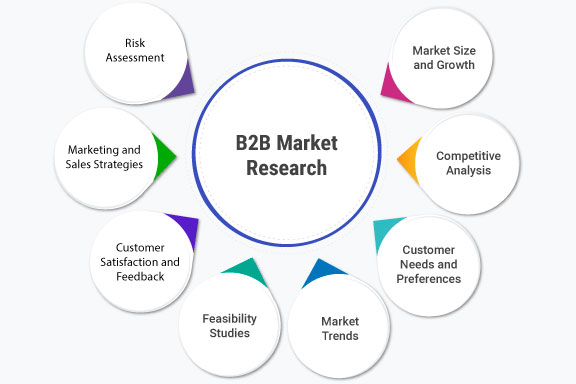
Market research for B2B is the process of gathering and analyzing information about your target market, buyers, competitors, and industry to make smarter business decisions.
It's different from B2C research in a few key ways:
- B2B buying cycles are longer and involve multiple decision-makers.
- Purchase decisions are driven by ROI and business outcomes, not emotion.
- Audience sizes are smaller but deal values are higher.
It's also not the same as customer feedback. Feedback tells you what existing customers think. Market research for B2B tells you about the broader landscape, including people who haven't bought from you yet.
The core focus areas of B2B market research are:
- Industry trends and where the market is heading.
- Buyer behavior and what drives purchase decisions.
- Competitive positioning and how you stack up.
Demand validation for new offers or market entry.
🚀 From Market Data to $312M+ Pipeline
10,000+ companies trust Cleverly to convert precise targeting across LinkedIn, email, and phone into sales-ready meetings.
Why B2B Market Research Matters
Skipping research doesn't save time. It wastes it. Here's what solid B2B market research actually does for your business:
- Reduces wasted marketing spend by narrowing your focus to segments that actually convert.
- Improves ICP clarity so your team stops chasing the wrong accounts.
- Sharpens your value proposition so messaging resonates immediately.
- Shortens sales cycles because you're speaking directly to real pain points.
- Improves conversion rates at every stage of the funnel.
- Supports account-based marketing by giving you the context to personalize at scale.
The companies that consistently outperform in outbound aren't just sending more messages. They're sending better ones, backed by research.
Types of B2B Market Research
Understanding the types of B2B market research helps you pick the right approach for each situation.
1. Primary Research
This is data you collect directly from the source.
- Customer interviews for deep qualitative insights.
- Surveys to gather structured feedback at scale.
- Focus groups to explore perceptions and reactions.
- Direct customer feedback from support, sales calls, and reviews.
2. Secondary Research
This is data that already exists that you analyze and apply.
- Industry reports from sources like Gartner, Forrester, or LinkedIn.
- Market trend data from public databases and trade publications.
- Competitor analysis of messaging, positioning, and pricing.
- Public data sources like LinkedIn, G2, and Crunchbase.
3. Quantitative Research
This is number-driven research focused on scale and patterns.
- Large-scale surveys
- CRM and funnel performance data
- Traffic, engagement, and conversion metrics
4. Qualitative Research
This is insight-driven research focused on the "why."
- Buyer interviews and discovery call recordings
- Sales team feedback and objection patterns
- Customer journey mapping
Most strong B2B market research strategies use a combination of all four.
Also Check: Brand Awareness vs Lead Generation - What Should B2B Companies Prioritize?
🔎 Research Is Step One. Outreach Closes Deals.
Cleverly turns market insights into pipeline with LinkedIn outreach, pay-per-meeting cold email, and guaranteed cold calling.
B2B Market Research Methods That Actually Work
Here are the B2B market research methods that consistently give the best signal:
Customer Interviews
Best for: Understanding buying motivations, pain points, and language your buyers actually use. Do this before any major messaging update.

Lost Deal Analysis
Best for: Finding out why you're losing. Talk to deals that went cold or chose a competitor. You'll learn more from losses than wins.
Win/Loss Analysis
Best for: Identifying patterns in your best customers so you can replicate them. Compare closed-won deals by industry, role, company size, and outreach channel.

Competitor Positioning Review
Best for: Spotting gaps in the market. Review competitor websites, G2 reviews, job postings, and LinkedIn content to understand how they're positioning.
LinkedIn and Community Research
Best for: Understanding what your buyers are talking about right now. Monitor LinkedIn posts, comment sections, Slack communities, and subreddits relevant to your ICP.

CRM Data Analysis
Best for: Finding patterns in your own pipeline. Look at deal velocity, conversion by segment, and where deals stall.
Survey Distribution to Existing Accounts
Best for: Validating assumptions at scale. Short, focused surveys sent to your customer base can surface insights quickly.
In-depth: Sales Forecasting vs Pipeline Management (Real Difference)
How to Do B2B Market Research (Step-by-Step Framework)
A simple framework for how to do B2B market research without overcomplicating it.
Step 1: Define Your Objective
Be specific about what you're trying to learn. Are you:
- Entering a new market?
- Validating a new product or offer?
- Refining your messaging and positioning?
Your objective shapes every decision that follows.
Step 2: Identify Your Target Segment
Narrow down the specific audience you're researching. Define by industry, company size, job title, geography, and buying stage. The tighter your segment, the more useful your findings.
Step 3: Collect Data (Primary + Secondary)
Use a mix of methods. Start with secondary research to understand the landscape, then use primary research to validate and go deeper. Aim for at least 8 to 10 customer or prospect interviews per segment.
Step 4: Analyze Patterns and Insights
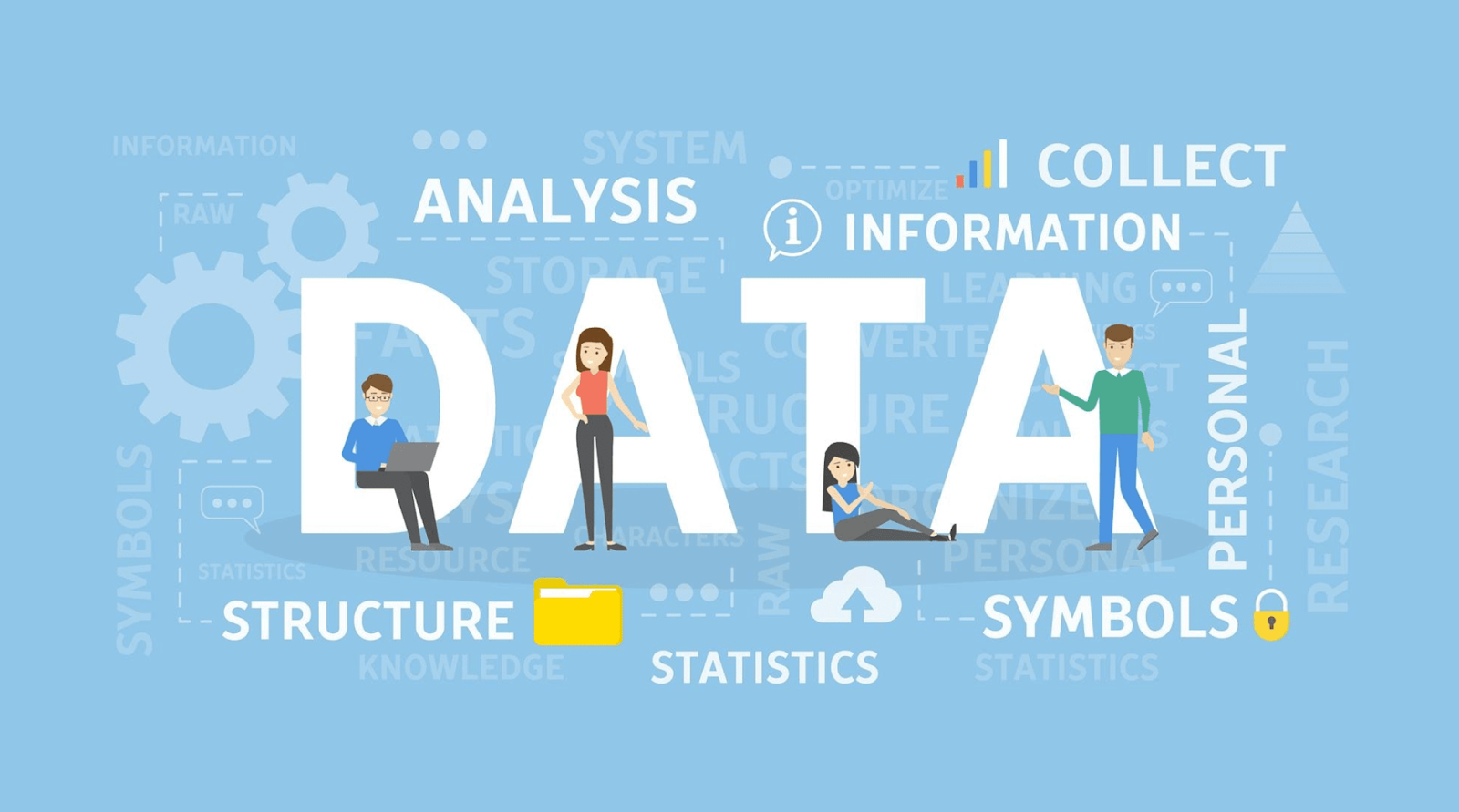
Look for recurring themes. What pain points come up most? What language do buyers use? Where do they stall in the buying process? Group your findings into clear categories.
Step 5: Apply Insights to Positioning and Outreach
This is where research pays off. Update your ICP, rewrite your messaging, adjust your targeting, and inform your outbound email sequences with what you've learned.

Step 6: Revalidate Quarterly
Markets shift. Buyer priorities change. What worked six months ago may not work today. Build a quarterly review into your process so your research stays current.
Read More: 13+ Sample Emails to Approach New Clients (Proven Templates + Tips)
Common Mistakes in B2B Market Research
Even experienced teams get this wrong. Watch out for these:
- Researching too broadly. If you're trying to understand "the B2B SaaS market," you'll end up with insights too vague to act on. Narrow your scope.
- Only using secondary data. Reports and trend data are useful, but they won't tell you what your specific buyers are thinking. Get on the phone.
- Ignoring sales team feedback. Your SDRs and AEs talk to prospects every day. Their objection notes and call recordings are a goldmine.
- Not translating research into action. Research that sits in a Google Doc helps no one. The goal is to apply it to messaging, targeting, and content.
- Treating research as a one-time effort. B2B market research is not a project. It's an ongoing process.
Here’s More: B2B Sales Mistakes That Quietly Kill Revenue
How B2B Market Research Improves Lead Generation
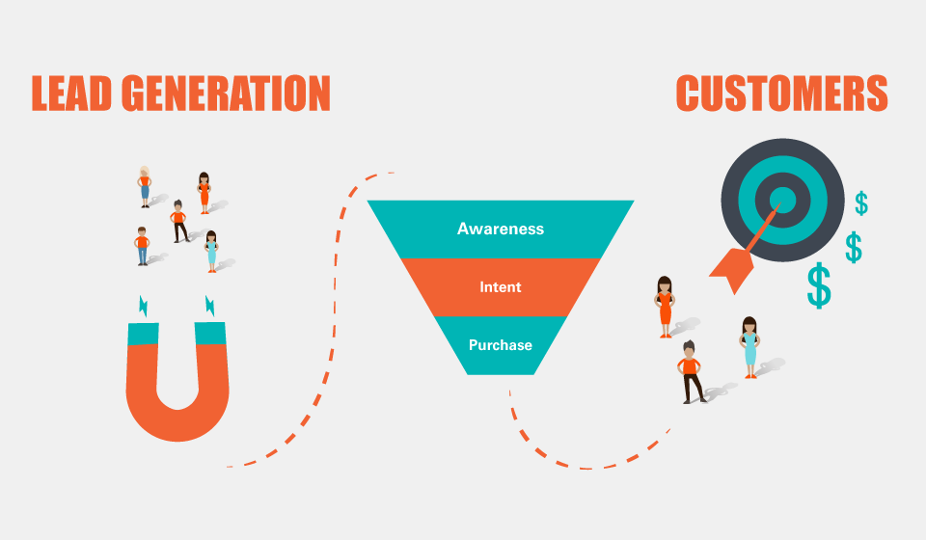
Research and lead generation are directly connected. Here's how B2B market research improves every stage of the funnel:
- Better targeting means you're reaching the right accounts from the start, not burning budget on the wrong ones.
- Higher reply rates because your messaging speaks directly to real pain points your buyers recognize.
- Improved meeting quality since better-qualified prospects show up with real intent.
- Lower CAC because you stop wasting spend on segments that don't convert.
- Stronger outbound messaging that gets responses instead of getting ignored.
Research doesn't just improve your top-of-funnel. It improves what happens after the first reply, too. When your team understands the buyer deeply, discovery calls are sharper, objections are handled better, and deals close faster.
Dive Deeper: How Much Does It Really Cost to Book a Sales Meeting?
How Cleverly Uses Market Research to Improve B2B Outreach
At Cleverly, we're the highest-rated, 100% done-for-you B2B lead generation agency and we've seen firsthand what happens when outreach is backed by real research versus just automation.
Every campaign we build starts with structure, not guesswork:
- ICP-first targeting based on researched firmographic and behavioral signals.
- Competitive analysis before outreach so messaging is positioned to stand out, not blend in.
- Role-based messaging tailored to each decision-maker based on research insights.
- Continuous optimization using reply rates, conversion data, and market feedback.
- Focus on qualified pipeline, not just outreach volume.
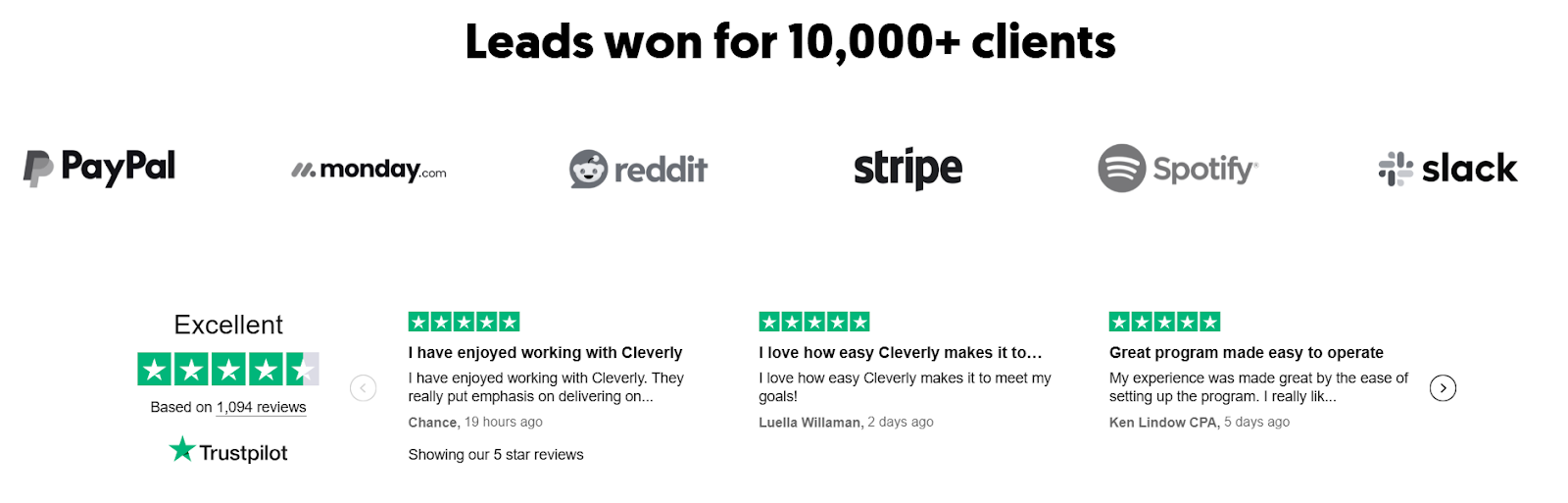
We've helped 10,000+ clients generate leads with companies like Amazon, Google, Uber, PayPal, Slack, and Spotify.
…That's resulted in $312M in pipeline revenue and $51.2M in closed revenue through LinkedIn outreach alone.
Our LinkedIn lead generation services start at just $397/mo. Our cold email lead generation works on a pay-per-meeting-ready-lead model so you only pay when we deliver.
And our cold calling service is a proven $5M system that books 10 to 30 qualified sales calls every month, guaranteed, with no-accent appointment setters, breakthrough call scripts, and a power dialer included at half the cost of in-housing.
Effective outreach starts with research, not automation.
🚀 Let’s get started!
Conclusion
B2B market research is not optional if you want sustainable growth. It's what separates companies that scale predictably from those that keep throwing spend at outreach and wondering why it's not working.
When you invest in research, you get sharper positioning, better targeting, more relevant messaging, lower wasted spend and a pipeline full of the right people
Companies that align research with outreach consistently outperform those that don't. Start with the framework in this guide and build the habit of revalidating your insights every quarter.
Frequently Asked Questions
Free Resource
How to Scale a Profitable Cold Call System
Get the complete guide — download it instantly now.

Free Ebook
Download the Free Guide
Enter your details to get instant access.
You're all set! 🎉
Your ebook is downloading now.
Click below if the download didn't start automatically.