Table of Contents
What Is a Go-To-Market Strategy?
Key Components of a Go-To-Market Strategy
GTM Strategy vs. Marketing Strategy: What's the Difference?
Go-To-Market Strategy Framework: 7 Steps to Build Yours in 2026
Go-To-Market Strategy Examples for B2B Companies
B2B SaaS Go-To-Market Strategy: What's Different in 2026
How Cleverly Helps B2B Companies Execute the Outbound Layer of Their GTM Strategy
Conclusion
Frequently Asked Questions
Modified On :
April 13, 2026
Key Takeaways
- A go-to-market strategy is a cross-functional operating system that connects product, sales, marketing, and customer success around one goal: generating revenue from the right customers.
- Most B2B companies don't fail because their product is bad — they fail because their GTM execution is broken, misaligned, or missing entirely.
- B2B buyers now contact sellers at just 61% of the way through their journey yet 95% of winning vendors were already on the buyer's Day One shortlist. That means your GTM motion has to create preference before outreach even starts.
- Your GTM motion (PLG, sales-led, or hybrid) should be dictated by your ACV. Under $5K ACV? Go PLG. $50K+? You need a sales-led motion with outbound at the center.
- The seven-step GTM framework: ICP definition, value positioning, motion selection, channel allocation, sales-marketing alignment, launch execution.
- Outbound lead generation is the most critical (and most difficult) execution layer of any GTM strategy. Bad data and generic messaging kill results regardless of how good the strategy looks on paper.
Great product. Zero traction. That’s a go-to-market problem.
A GTM strategy is not a marketing plan with a fancier name. It's the full cross-functional system that takes a product from development to revenue.
And, in 2026, executing it well is harder than ever. B2B buyers are already 80% through their buying process before engaging with a sales rep. The average B2B sales cycle now sits at 10.1 months, and win rates hover around just 21% across all pipeline stages.
That's the environment your GTM strategy has to win in — one where buyers are more informed, more skeptical, and harder to reach than ever.
This guide covers everything you need: what a go-to-market strategy actually is, the core components that make it work, a seven-step framework for building one in 2026, real B2B examples, and exactly how outbound lead generation fits into the execution layer.
What Is a Go-To-Market Strategy?
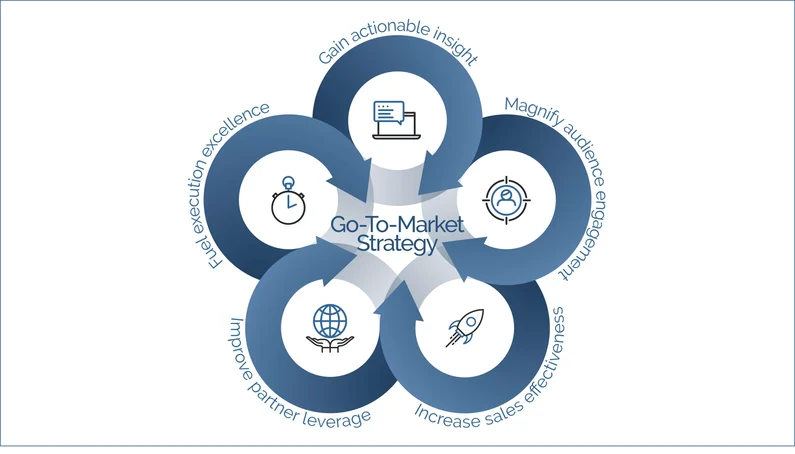
A go-to-market strategy (GTM strategy) is a cross-functional plan that defines who you're selling to, what problem you solve, how you position your product, how you price it, and which channels you use to reach and convert buyers.
It's focused on one specific outcome — getting a product launched, adopted, and generating revenue. That makes it different from a marketing strategy (which is one component within it) and a business plan (which covers the entire organization over a longer horizon).
A simple way to think about it: the product is the engine. The GTM strategy is the transmission. It converts innovation into market traction.
When Do You Need a GTM Strategy?
You need a GTM strategy in four situations:
- Launching a new product — even into an existing customer base
- Entering a new market — new geography, vertical, or buyer segment
- Repositioning an existing product — changing how it's perceived or who it's sold to
- Scaling into a new segment — moving upmarket, downmarket, or into enterprise
Who Owns GTM?
No single team does. GTM is a cross-functional effort — product defines what's being sold, marketing creates demand, sales converts it, and customer success retains and expands it. When those four functions are misaligned, even a great product goes to market quietly.
📢 Strategy Without Execution = Zero Pipeline
We take your GTM and turn it into booked meetings via LinkedIn, email & calls. Done-for-you. No guesswork. Just results.
Key Components of a Go-To-Market Strategy
Every effective go-to-market GTM strategy is built on the same core components. Miss one, and the whole system underperforms.
🎯 Target Market & ICP
This is the foundation. Not "companies in SaaS" — but the precise segment with a real, urgent problem, decision-making authority, and budget to act. In 2026, the strongest ICPs go beyond firmographics. They layer in behavioral signals, intent data, and trigger events (like funding rounds, leadership changes, or hiring spikes) to surface accounts that are ready to buy right now.
💬 Value Proposition & Positioning
Your positioning answers the question every buyer is silently asking: "Why you, over everyone else?" A strong B2B value proposition translates product features into measurable business outcomes — not a feature list. And it owns one clear, defensible space in the buyer's mind.
💰 Pricing & Packaging
Pricing isn't just a revenue decision — it determines your entire sales motion. Lower ACV products need self-serve, low-friction onboarding. Higher ACV products require a sales-led process with human touchpoints. Getting pricing wrong forces you into the wrong GTM motion.
🔄 GTM Motion
Three primary options: Product-Led Growth (PLG), Sales-Led Growth (SLG), and Hybrid. The right choice is almost entirely dictated by ACV — more on this in the framework below.
📣 Distribution & Sales Channels
This is how the product physically reaches buyers. Direct sales, channel partners, self-serve, outbound, inbound, ABM — your distribution model has to match both your GTM motion and how your ICP actually buys.

📊 Success Metrics & KPIs
CAC, LTV:CAC ratio, CAC payback period, conversion rates by funnel stage, sales cycle length, and Net Revenue Retention (NRR). If you're not tracking these from week one, you're flying blind.
GTM Strategy vs. Marketing Strategy: What's the Difference?
This is one of the most common misconceptions in B2B. A lot of teams treat "GTM strategy" and "marketing strategy" as interchangeable. They're not.
A GTM strategy encompasses pricing, sales motion, channel mix, ICP definition, and the deal-closing process. Marketing strategy is one piece within it.
A GTM strategy without a sales motion or pricing model is just a slide deck. It looks good in a board meeting and does nothing in market.
📈 Launch Faster. Scale Smarter. Close More.
$312M pipeline generated across outbound channels. We build, run, and optimize your outbound—you just close deals.
Go-To-Market Strategy Framework: 7 Steps to Build Yours in 2026
Building a GTM strategy is not a one-time exercise. It's a living system that adapts as you learn what works. Here's the step-by-step go-to-market strategy framework to build yours.
Step 1 — Define Your ICP and Target Market
Start with data, not assumptions. Pull your best existing customers and look for patterns: which accounts produce the highest LTV, shortest sales cycles, and best retention?
Build a precise ICP that includes company size, industry, tech stack, buying behavior, ACV range, and — critically — trigger events that signal intent to buy. In 2026, static personas are out. Dynamic ICP frameworks powered by intent signals and engagement data are what separates efficient GTM from expensive spray-and-pray.
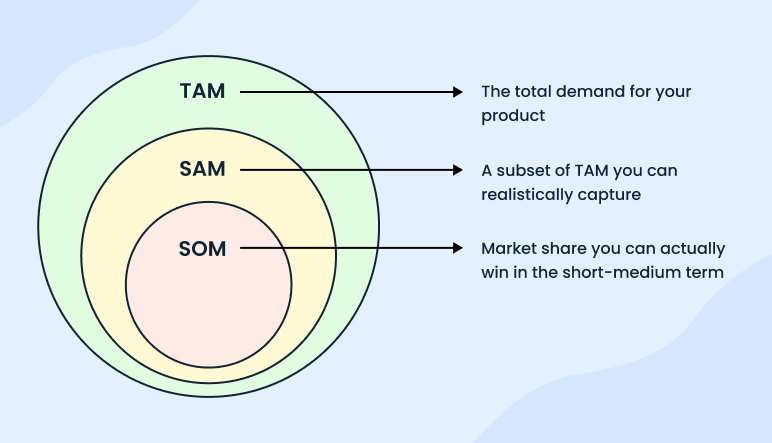
Run TAM/SAM/SOM analysis to identify the highest-value segment you can realistically reach with your current resources. Start narrow. You can always expand.
Step 2 — Craft Your Value Proposition and Positioning
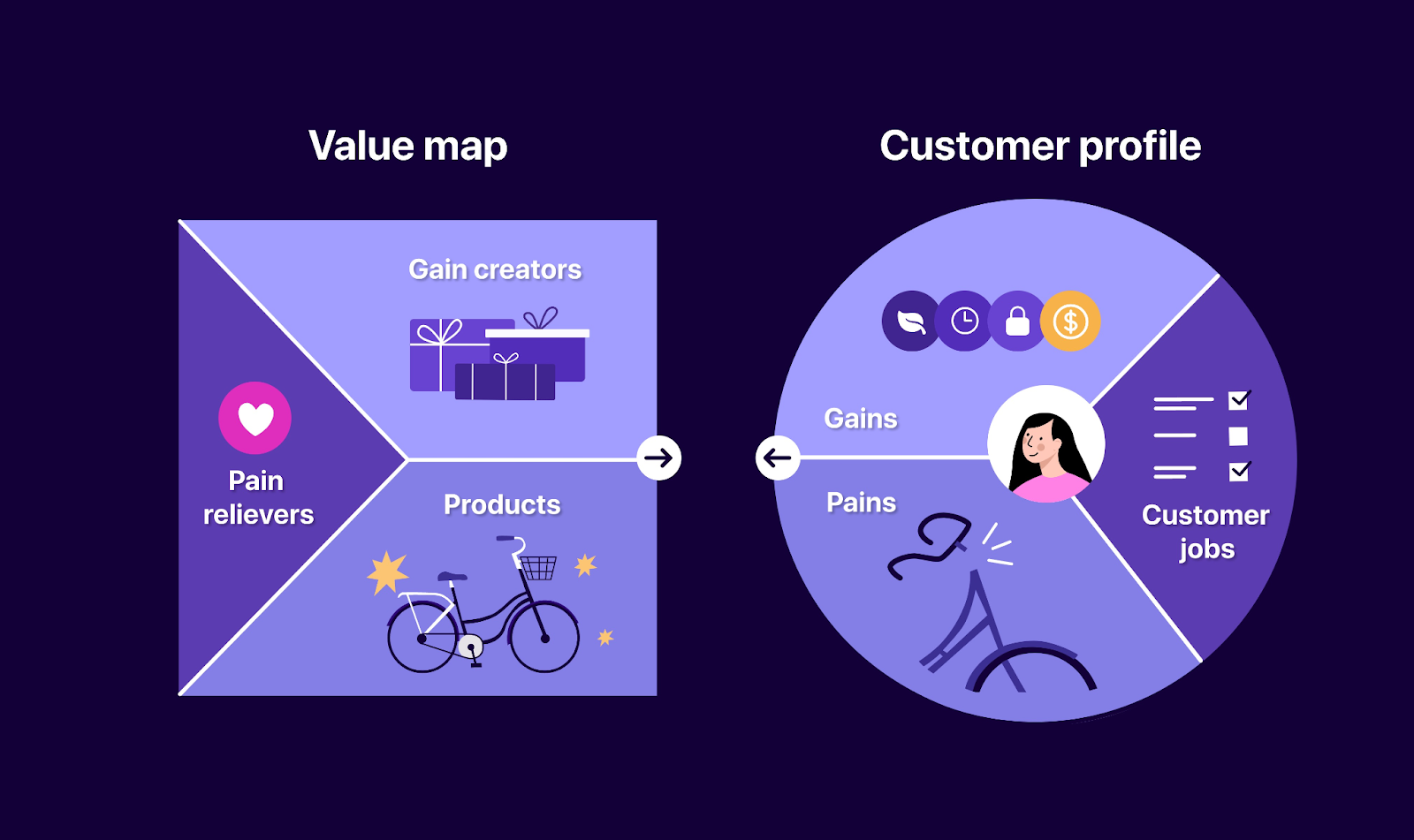
Translate features into outcomes. Not "our platform automates workflows" — but "our platform cuts your SDR ramp time from 90 days to 30, so your first hire hits quota in month two."
Identify positioning gaps: where do competitors sound identical? Where do they avoid a specific pain point? That gap is your opening.
Build persona-specific messaging for every stakeholder in the buying committee — the champion who drives internal adoption, the blocker who controls budget, the decision-maker who signs the contract. Each one needs a different message.
Use this positioning fill-in: "For [target customer] who [specific problem], [product] is a [category] that [primary benefit]."
Step 3 — Choose Your GTM Motion
Three motions. One right answer for your ACV:
- Under $5K ACV → PLG (self-serve, low-touch, viral activation loops)
- $5K–$50K ACV → Hybrid (outbound SDRs + product-led trial + sales assist)
- $50K+ ACV → Sales-led (outbound, ABM, multi-stakeholder engagement, longer cycles)
This is math, not preference. Running PLG and sales-led simultaneously from day one almost always fails — you under-resource both and win at neither.
Step 4 — Select Your Channels and Allocate Budget
Match channels to your GTM motion, ACV, and runway:
- Under 6 months runway — cold email, referrals, Google Ads (fast feedback loops, lower spend floor)
- 12+ months runway — add SEO, content marketing, LinkedIn outreach, strategic partnerships
The single biggest GTM channel mistake is spreading budget across too many channels without enough depth to win in any one of them. Pick one or two channels. Master them. Then expand.
For B2B outbound specifically, the strongest combination is LinkedIn outreach + cold email + cold calling — layered sequentially based on ICP behavior and where your buyers spend time.
Step 5 — Build Your Sales and Marketing Alignment
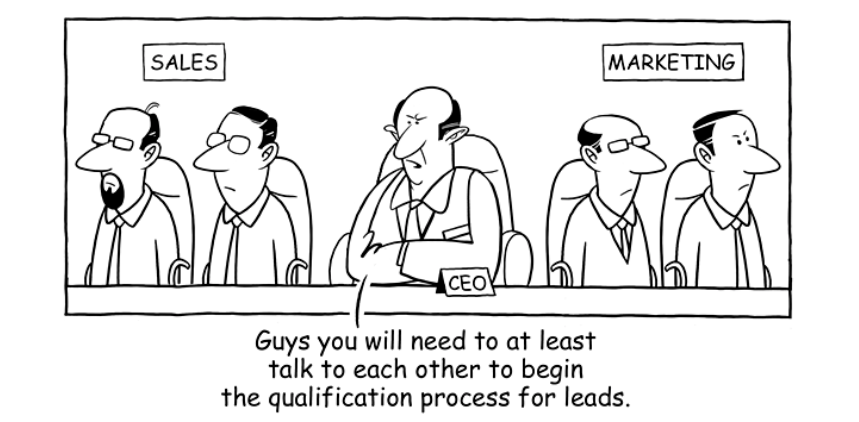
53% of US B2B marketers say at least 10% of their leads are disqualified by sales due to poor quality. That number is a symptom of misalignment — no shared ICP definition, no agreed qualification criteria, no lead handoff rules.
Fix this with three things: a shared ICP document both teams sign off on, SLAs for response times and lead quality standards, and a unified CRM so both teams work from the same source of truth. Run weekly cross-functional GTM stand-ups. Monthly pipeline reviews. Kill the silos.
Step 6 — Execute Your Launch Plan
A phased approach beats a big bang launch every time:
- Days 1–30 — Foundation. Lock in ICP, finalize messaging, set up your minimum viable GTM stack (CRM + contact data + outreach tool + analytics).
- Days 31–60 — Activation. Start founder-led or SDR-led direct outreach to your first 10–20 target accounts before scaling any channel.
- Days 61–90 — Optimization. Double down on what's generating replies and meetings. Cut anything that isn't.
One rule: always start with direct outreach to your highest-fit accounts before scaling. The feedback you get from those first 20 conversations is worth more than any A/B test.
Step 7 — Measure, Iterate, and Scale
Track these from week one:
- CAC payback period (target: under 90 days)
- LTV:CAC ratio (target: 3:1 or better)
- Sales cycle length (benchmark against your motion and ACV)
- Conversion rates by funnel stage (identify your biggest drop-off and fix that first)
GTM strategy is not a document you file after launch. It's a living system. The teams that win are the ones reviewing pipeline data weekly and reallocating budget to what's working — not the ones running the same playbook six months in regardless of results.
Go-To-Market Strategy Examples for B2B Companies
Some GTM examples show how theory translates into execution across different company types and deal sizes. Here are three that represent the most common B2B scenarios.
Example 1 — B2B SaaS Startup (PLG Motion)
ICP: Growth-stage marketing teams at SaaS companies with 15–75 employees.
Motion: Freemium with viral team invites. Users get value fast, invite teammates, and activation drives organic expansion.
Channels: SEO/content for top-of-funnel discovery, product-led onboarding, referral loops.
Key metric: Product-Qualified Leads (PQLs) and 14-day activation rate. If users hit the activation moment, they convert. If they don't, no amount of sales effort will save them.
Example 2 — Mid-Market B2B SaaS (Hybrid Motion)
ICP: VP of Sales or RevOps at Series B+ companies, $2M–$20M ARR.
Motion: Outbound SDR team for pipeline creation + inbound content for credibility + sales assist for trial users showing intent.
Channels: Cold email, LinkedIn outreach, thought leadership content, ABM for tier-one target accounts.
Key metric: Demo-to-close rate, sales cycle length, and pipeline coverage ratio. At this ACV, efficiency in the mid-funnel is the difference between hitting and missing numbers.
Example 3 — Enterprise B2B (Sales-Led + ABM Motion)
ICP: Enterprise accounts (500+ employees) with multi-stakeholder buying committees spanning IT, finance, and operations.
Motion: Account-based marketing + direct enterprise sales + multi-threaded outreach across champions, blockers, and economic buyers simultaneously.
Channels: LinkedIn outreach, cold calling, executive events, personalized content sequences per persona.
Key metric: Account penetration rate, qualified pipeline from target account list, and win rate. Typical B2B purchases now involve about 10 people, with 72% of B2B purchases involving high-complexity buying groups spanning multiple functions.
B2B SaaS Go-To-Market Strategy: What's Different in 2026
B2B SaaS GTM is structurally harder than traditional software sales for a few reasons. Recurring revenue means you need retention economics, not just acquisition. And the buyer has fundamentally changed.
67% of B2B buyers now prefer a rep-free experience, and 45% reported actively using AI during a recent purchase — not just for research, but to evaluate vendors and make decisions. That means your GTM motion has to create credibility and preference before a human ever gets involved.
PLG vs. Sales-Led in 2026
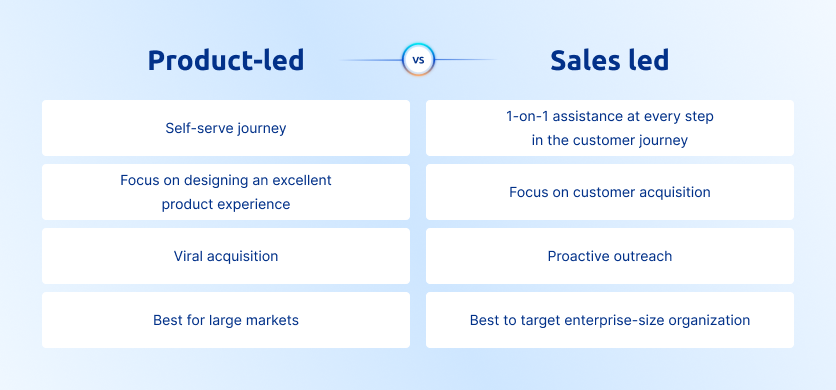
PLG achieves meaningfully lower CAC for SMB and mid-market customers, but it struggles with enterprise conversion — complex buying committees don't self-serve into $100K contracts. Sales-led wins for $50K+ ACV deals, full stop.
The 2026 shift is that the two motions are increasingly being sequenced rather than run in parallel. PLG creates product-qualified signals. Sales-led converts them. That hybrid handoff is where the most efficient B2B SaaS go-to-market strategies are being built right now.
The Role of Intent Data and AI
Static personas are a liability in 2026. The teams winning with GTM are using real-time intent signals — job changes, technology installs, content consumption, funding events — to dynamically update their ICP and prioritize which accounts to work right now.
AI-powered lead scoring, predictive pipeline modeling, and personalized outreach at scale are no longer differentiators. They're table stakes. 89% of revenue organizations now use AI, and teams using AI tools are 3.7x more likely to hit quota.
Key 2026 GTM Benchmarks for B2B SaaS
- CAC payback under 90 days
- LTV:CAC of 3:1 or better
- NRR above 100% (net revenue retention — the real health signal)
- ARR growth of 30–50% for VC-backed companies in growth stage
If you're not hitting these benchmarks, the problem is usually in one of two places: ICP clarity or outbound execution. Most of the time, it's both.
How Cleverly Helps B2B Companies Execute the Outbound Layer of Their GTM Strategy
You can write a good GTM strategy. The part that consistently breaks is execution — specifically, the outbound layer that generates qualified pipelines from a cold start.
That's exactly what Cleverly does. As a top-rated B2B lead generation agency, we build and operate the outbound execution layer of your GTM strategy — ICP-aligned list building, multi-source data enrichment and verification, and done-for-you outreach across LinkedIn, cold email, and cold calling.
Cleverly bridges the gap between GTM strategy and qualified meetings.
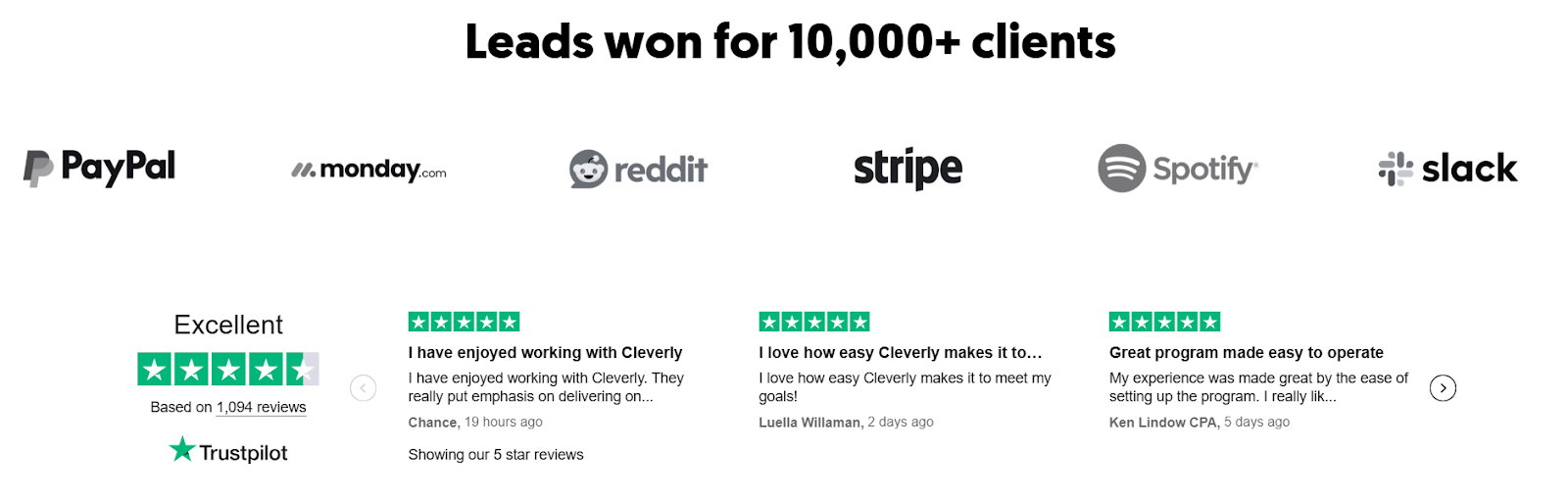
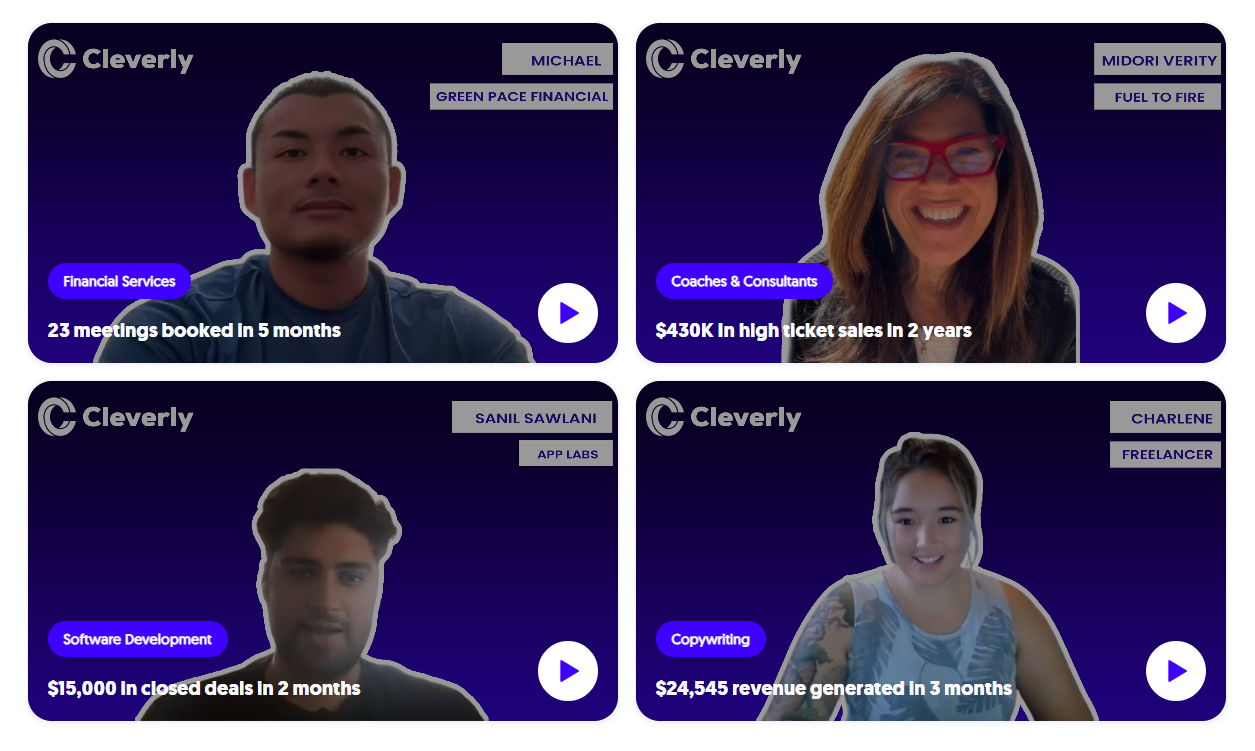
We bring verified leads matched to your exact ICP, tested outreach frameworks refined across 10,000+ client campaigns, and reply management so your internal team stays focused on closing — not prospecting.
We've generated $312M in pipeline and set 53,000+ appointments across LinkedIn, email, and cold calling.
Our model is built for flexibility: month-to-month pricing, no long-term contracts, and two cold email engagement options — a Hybrid (Retainer + Pay Per Lead) model or a flat monthly Growth retainer. LinkedIn outreach starts at $397/mo. Cold calling includes dedicated SDRs, trained and ready in two weeks, with guaranteed appointments or we replace the rep.
🤝 Ready to turn your GTM strategy into qualified B2B pipeline?
Book a strategy call with Cleverly.
Conclusion
A go-to-market strategy is not a document you create once and file. It's an operating system — one that connects product, sales, and marketing around a single goal: generating revenue from the right customers, at the right time, through the right channels.
The companies winning in 2026 are not doing everything. They're doing two or three things exceptionally well: a tight ICP, a GTM motion matched to their ACV, and relentless execution on the channels that actually reach their buyers. Get those three right, and everything else gets easier.
Frequently Asked Questions
Free Resource
How to Scale a Profitable Cold Call System
Get the complete guide — download it instantly now.
Free Ebook
Download the Free Guide
Enter your details to get instant access.
You're all set! 🎉
Your ebook is downloading now.
Click below if the download didn't start automatically.