Table of Contents
Build vs. Outsource — The Decision Before the Build
Cold Calling Team Structure: Roles and How They Work Together
How to Hire Cold Callers — What to Look for and How to Screen
How to Train and Onboard Your Cold Calling Team
How to Build Your Cold Calling Process End-to-End
The Tech Stack for a B2B Cold Calling Team
Cold Calling Team KPIs: What to Track and When to Worry
Common Mistakes When Building a Cold Calling Team
When to Consider a Cold Calling Agency Instead of Building In-House
How Cleverly Builds Cold Calling Teams That Deliver Qualified Meetings
Conclusion
Modified On :
May 18, 2026
Key Takeaways
- Cold calling works, but most teams fail because they build the team wrong, not because the channel is dead.
- The gap between average teams (2.5% dial-to-meeting) and top performers (5–8%) is entirely structural — it comes down to process, hiring criteria, and coaching consistency.
- The true cost of one in-house SDR runs $125,000+ per year when you factor in salary, benefits, tools, and management — nearly double what most companies budget for.
- A cold calling team needs five things before the first dial: a tight ICP, verified data, proven talk tracks, a multi-touch cadence, and a coaching loop that never stops.
- If speed matters more than control, outsourcing to a specialized cold calling agency gets you qualified meetings in weeks — without the ramp, the overhead, or the risk of a bad hire.
Cold calling isn't making a comeback — it never left. Over 50% of B2B leads still originate from cold outreach, and 57% of C-level executives prefer phone communication over other channels.
The phone remains one of the few channels that gives you real-time feedback, live objection handling, and the ability to compress weeks of email testing into a single afternoon.
The problem isn't the channel. The average B2B cold call-to-meeting conversion rate is 2.5%, while top performers reach 5–8%. That gap isn't talent — it's structure.
Teams that convert at 2.5% are usually missing a tight ICP, calling with bad data, using generic scripts, or running no follow-up cadence. Teams that hit 5–8% have solved all four.
This guide covers everything you need to build a cold calling team that actually converts: team structure, hiring criteria, onboarding framework, outreach process, tech stack, KPIs, and common mistakes.
We'll also cover when building in-house makes sense versus when outsourcing to a cold calling agency gets you there faster.
Build vs. Outsource — The Decision Before the Build
Before you post a job listing, you need to make a decision: are you building this in-house or outsourcing it?
Building in-house makes sense when:
- You have a validated offer that's already converting in 1:1 conversations.
- You have a consistent budget for salary, tools, and 60–90 days of ramp time.
- You want long-term institutional knowledge and a team that scales with the company.
- You have a sales manager who has actually built and coached an SDR team before.
Outsourcing makes sense when:
- You need a pipeline in weeks, not quarters.
- You're still testing ICP fit and messaging — an agency's data from thousands of campaigns de-risks validation significantly.
- The cost of your own time managing a build is higher than a monthly retainer.
- You've tried in-house before and conversions were poor — a proven playbook fixes faster than another hire.
💸 The cost reality matters here.
Building an in-house SDR team involves much more than just paying salaries. The average base salary for an SDR in the U.S. is approximately $65,000 per year — but once you add benefits, tools, management overhead, ramp-up losses, and turnover costs, the total annual cost climbs to $125,000 per SDR.
That's before you've built any infrastructure.
A hybrid approach works well for many companies: outsource first to validate the channel and sharpen messaging, then hire in-house once you have a proven playbook to hand someone.
This guide assumes you've decided to build. But the Cleverly section near the end covers exactly when outsourcing wins.
📞 Building an SDR Team Takes Months. We’re Ready Now.
Get trained callers, proven scripts & outbound systems included. 10–30 qualified meetings booked every month.
Cold Calling Team Structure: Roles and How They Work Together
A functional cold calling team structure has three roles. Every other complexity — territory splits, vertical specialization, named accounts — comes after you've nailed the basics.
For most early-stage teams, 2–4 SDRs plus one manager is the right starting point. The SDR-to-AE ratio depends on deal complexity: 1:2 for enterprise or complex sales cycles, 1:1 for high-velocity models.
The core model is an assembly line: SDRs prospect, qualify, and book. AEs run and close. Mixing those responsibilities slows both.
1) Sales Development Representatives (SDRs) / BDRs
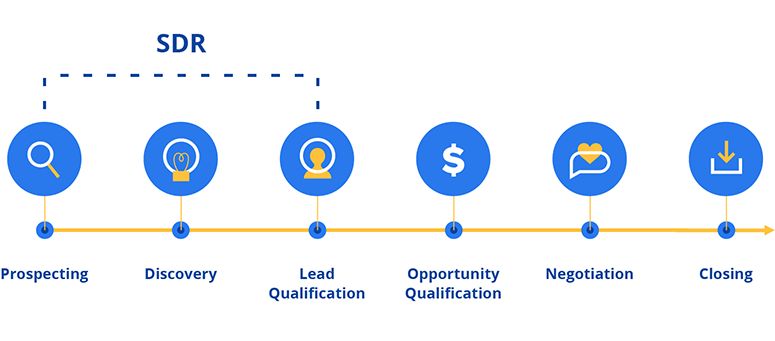
SDRs own everything at the top of the funnel — list building, outreach execution, objection handling, and meeting booking.
Day-to-day, that means building prospect lists, executing multi-touch call sequences, handling gatekeepers and objections, and handing qualified meetings to AEs with clean context.
They're measured on dials per day, connect rate, meetings booked per week, and show rate. Those four numbers tell you almost everything about whether the SDR and the process are working.
Quick distinction: BDRs are specifically outbound-focused (cold outreach to new prospects). SDRs can be inbound or outbound depending on how the company is structured. In most outbound calling team contexts, the terms are used interchangeably.
2) SDR Manager / Team Lead

The manager owns strategy, performance, and coaching. Their job is to remove blockers, review call recordings, run weekly 1:1s, iterate on scripts, and keep the team's conversion metrics moving.
One manager can effectively coach 6–8 SDRs. Beyond that, the quality of individual coaching drops significantly.
The most common hiring mistake in cold calling: promoting the best SDR to manager.
Management skills and calling skills are completely different. Your best caller loses reps time making calls and gains you an inexperienced manager who can't coach what they've never systematized.
3) Account Executives (AEs)
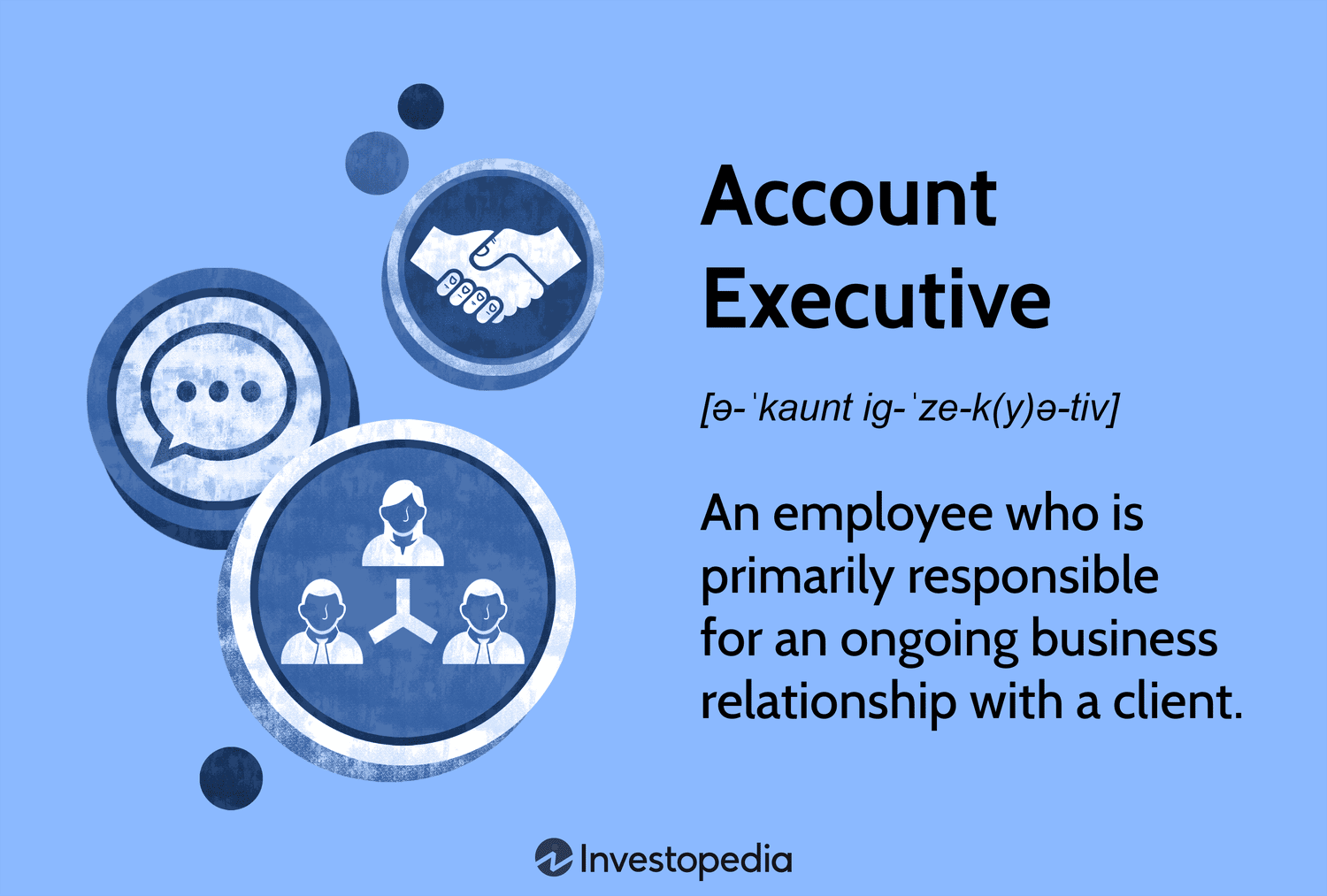
AEs take SDR handoffs and run the full sales cycle: discovery, demo, proposal, close. The quality of that handoff determines a huge amount of pipeline conversion.
A poor handoff — where the AE doesn't know why the prospect agreed to meet or what pain was surfaced — wastes the meeting. AEs should also feed back to SDRs regularly: what lead quality looks like in practice, what objections are coming up in discovery, and whether ICP targeting is hitting the right buyers.
How to Hire Cold Callers — What to Look for and How to Screen
When hiring cold callers, experience matters less than most people assume. Attitude is what predicts success. You can train someone on your product, your ICP, and your talk tracks. You cannot train resilience, coachability, or genuine curiosity about other people's businesses.

Core traits to screen for:
- Coachability — Takes feedback without getting defensive, adjusts quickly, and applies it the next day.
- Resilience — Handles cold calling rejection and difficult calls without losing motivation or going quiet on the phones.
- Curiosity — Asks real questions, cares about the prospect's situation, doesn't just pitch.
- Concise communication — Gets to the point fast, doesn't over-explain or ramble.
- Work ethic — Consistent follow-through, hits activity targets without being managed daily.
How to screen in interviews: Skip the behavioral questions. Run a live role-play. Ask them to cold call you. Give them 15 minutes to write a cold email on the spot. What you'll see in those 15 minutes tells you more than any resume or reference check.
Red flags: Can't handle mock objections without freezing or immediately pivoting to features. Gives up when pushed back on. Talks significantly more than they listen.
Compensation benchmark: SDR base salaries typically run $45K–$65K depending on market, with OTE at 1.5–2x base for consistent performers.
Where to source: LinkedIn, Indeed, referrals from your AE team, and SDR-specific communities. Your AEs often know early-career salespeople who are hungry and trainable.
🚀 Hiring SDRs Is Expensive. Bad SDRs Are Worse.
1M+ cold calls made. 53K+ appointments set. We fill your calendar—you focus on closing deals.
How to Train and Onboard Your Cold Calling Team
Skipping structured onboarding is the single biggest driver of early SDR churn.
Most teams either onboard too fast (two days of product demos and a list of prospects) or too slow (four weeks of training before a single dial). Neither works.
A proper onboarding covers six areas and takes three to four weeks before a rep goes fully live. Here's what each one needs to include.
1) Product and Value Proposition
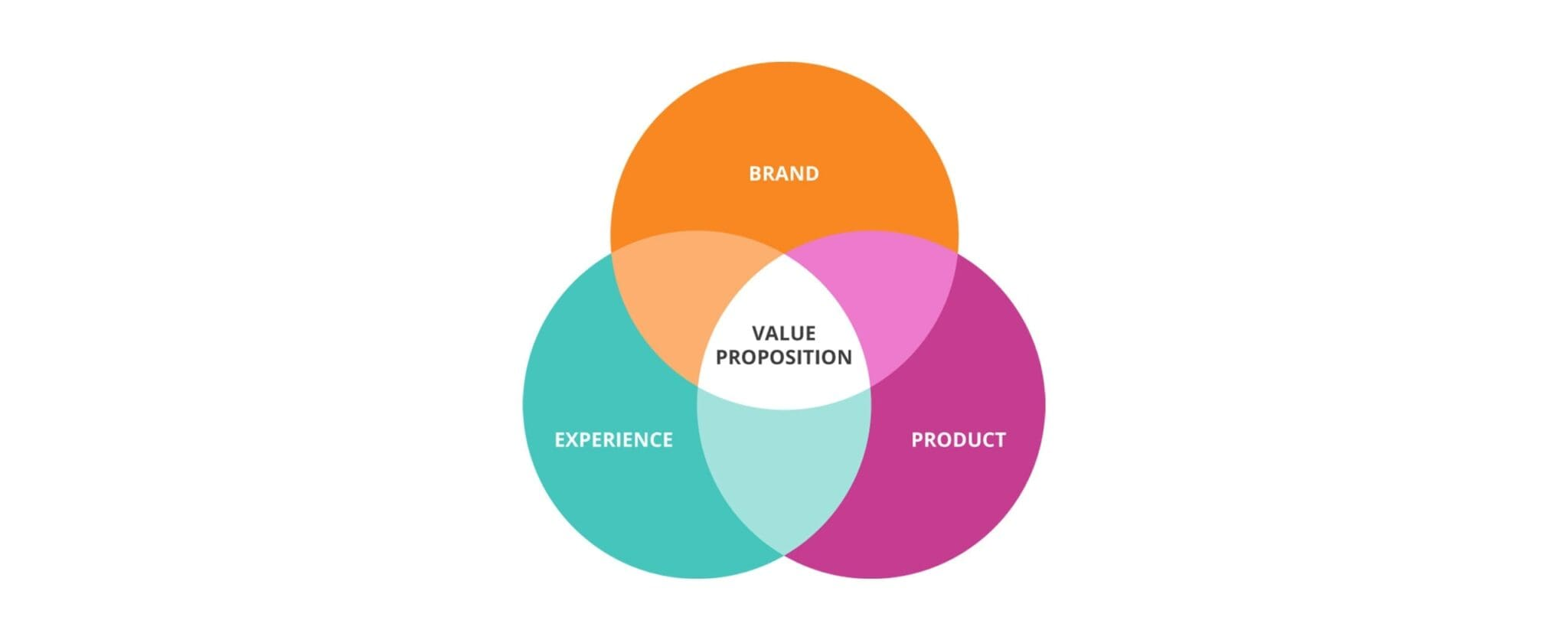
Start with the what and the why — not a full product tour. SDRs need to know: what you sell, who it's for, the top three problems it solves, and how you're differentiated from the two or three competitors that will come up on calls.
The core exercise here: "Explain what we do in 30 seconds on a cold call." Run this repeatedly until every rep can deliver it clearly and conversationally — not like they're reading from a slide.
2) ICP and Persona Training
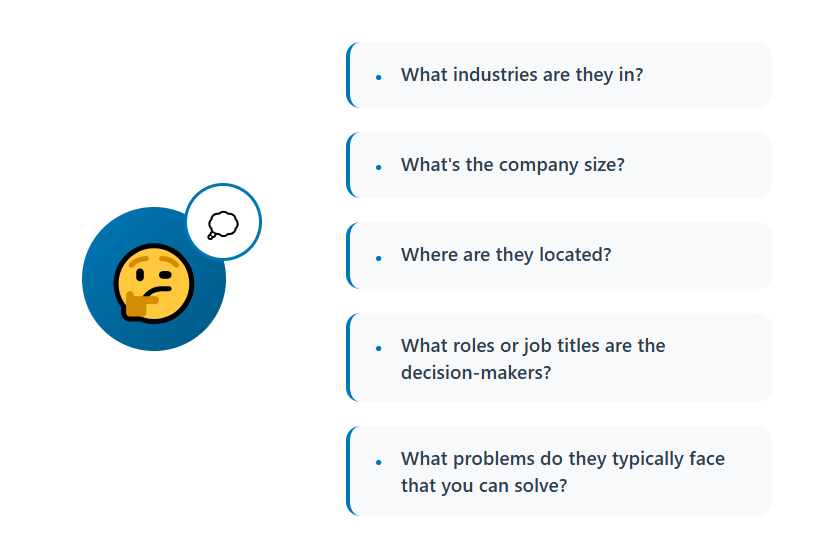
Spend real time on who to target: industry, company size, decision-maker title, and the key pain triggers that indicate a prospect is a good fit. Just as important — who NOT to target. Disqualifiers save as much time as qualifiers do.
The best ICP training sessions include real examples of great-fit versus poor-fit prospects from your actual pipeline. Pull closed-won and closed-lost deals. Show the difference.
3) Talk Tracks and Objection Handling
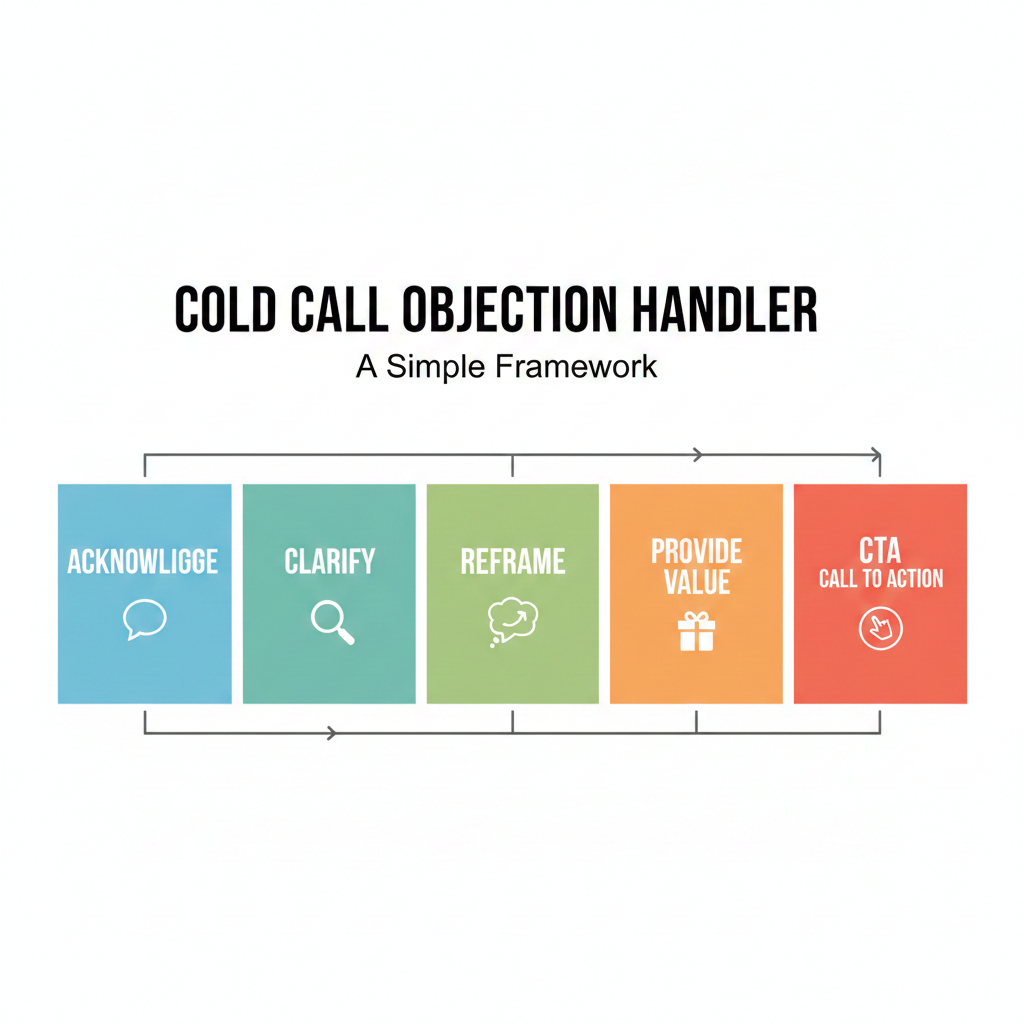
Give reps talk tracks (key points to hit), not rigid scripts. Scripts sound robotic on live calls. The goal is a rep who sounds natural and confident, not one reciting memorized lines.
Must-cover objections: "Not interested," "Send me an email," "We already have something," "Call me next quarter," and gatekeeper navigation. Practice all of these out loud. A written script feels very different the first time you hear it read back on a call recording.
4) Tool Proficiency

CRM, dialer, data tool, and sequencing platform — reps must be comfortable with all four before they go live. Every minute spent on manual logging or tool confusion is a minute not on the phones.
Set a standard from day one: if logging a call takes more than one click, the process needs fixing. Reps won't log consistently if the friction is high.
5) Call Review and Coaching Loop
Record every call from day one. Review best and worst calls as a team each week. Use a scorecard: opener quality, discovery question quality, objection handling, and how the rep closes for next steps.
Reps improve fastest when they hear themselves. Audio feedback from their own calls accelerates improvement faster than any manager feedback session.

6) Ongoing Enablement
Training does not stop after week four. Weekly coaching sessions are non-negotiable. Monthly messaging refreshes — what's working, what new objections are surfacing — keep the team sharp as the market shifts.
Top performers should share their calls. Their success patterns are your fastest and cheapest training tool.
How to Build Your Cold Calling Process End-to-End
Process beats talent in cold calling. An average rep with a great process consistently outperforms a great rep with no process.
Here's the five-stage process every outbound calling team needs.
1) Define a Tight ICP
A strong ICP includes: industry, company size, geography, decision-maker title, key pain triggers, budget range, and disqualifiers.
Include trigger events that signal near-term buying readiness: funding announcements, rapid hiring in a specific function, leadership changes, new product launches. These prospects are in motion — they're far more likely to take a meeting.
"Anyone who needs what we offer" is not an ICP. Tight targeting is the highest-leverage thing you can do before the first dial.
2) Build and Verify Contact Lists

Good data means: verified direct-dial mobile numbers, confirmed work email, accurate job title, and company size confirmation.
B2B data decays at an average of 70.3% annually. Inaccurate data can cause companies to lose up to 12% of their revenue. Reps calling disconnected numbers and hitting switchboards waste massive amounts of productive call time — and kill motivation fast.
Prioritize direct dials over office numbers. The connection rate difference is significant. Refresh lists every 90 days.
Reliable data sources: Apollo, ZoomInfo, Cognism, LinkedIn Sales Navigator.
3) Write Talk Tracks and Call Openers
You get 71% better results when you call between 4 p.m. and 5 p.m. compared to 11 a.m. to noon. But even perfect timing won't save a bad opener.
The first seven seconds determine whether the prospect keeps listening. What kills most openers: "Hi, I'm [name] from [company], we help businesses like yours..." — this triggers an immediate hang-up reflex because it sounds exactly like every other cold call.
What works: relevance-first, pattern-interrupt openers that reference something specific to the prospect or their situation.
🤝 Framework to test: Permission + Relevance + Question — "Did I catch you at a bad time? I reached out because [specific trigger]. Quick question for you..." Test three to five opener variants before settling on one. Track which holds attention to the first real response.
4) Build Multi-Touch Cadences
Single-touch cold calling has almost no chance. It takes an average of 8 call attempts to book one qualified meeting, and 44% of sales reps never make a second follow-up call after their initial outreach. That's a massive opportunity being left on the table.
Recommended cadence: 10–12 touches over three to four weeks across call, email, and LinkedIn. Each touch should add context or value — not just "did you see my last message?"
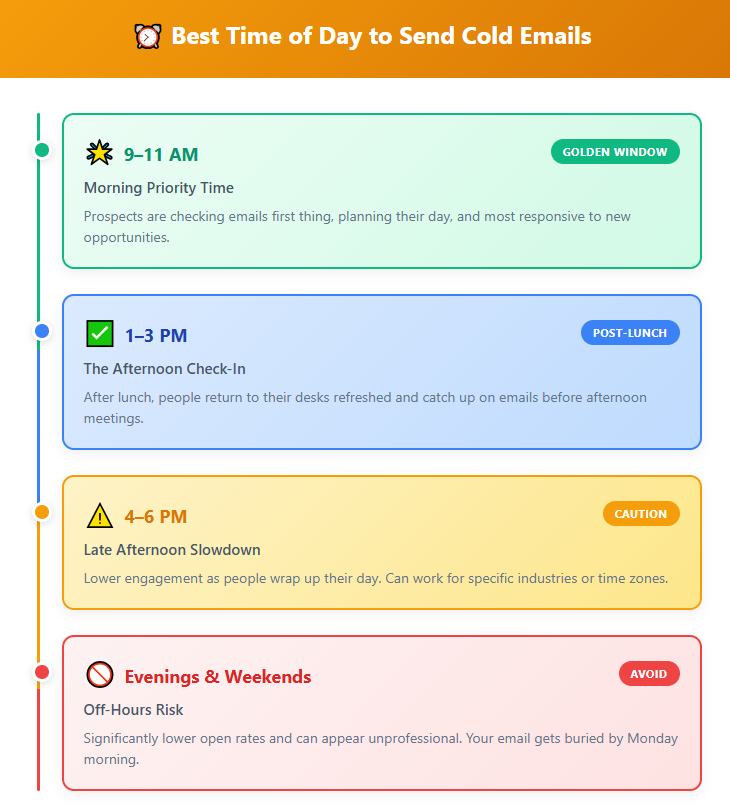
Best calling windows are 8–9 AM and 4–5 PM local to the prospect, delivering up to 47% higher connect rates versus mid-day. Best days: Wednesday and Thursday. Avoid Friday afternoons.
5) Qualify and Hand Off to AEs
Every meeting that hits an AE's calendar should meet minimum qualification criteria. Unqualified meetings waste AE time and damage the SDR-AE relationship.
Minimum bar: problem fit (they have a pain your solution addresses), authority (decision-making power or direct access to it), and timeline (active evaluation or near-term trigger).
A warm handoff beats a cold calendar invite every time. SDR sends an intro email to the AE with context: what pain was surfaced, what the prospect is hoping to learn, and how the meeting was positioned. The AE should never have to re-ask what was discussed on the first call.
The Tech Stack for a B2B Cold Calling Team
The right tools reduce admin time and give reps more time on live calls. Wrong tools do the opposite.
Disconnected tools create manual data entry, which means fewer calls per day and inconsistent CRM data.
Start lean: CRM + dialer + data tool is your minimum viable stack. Add conversation intelligence once call volume justifies the investment — typically once you have two or more SDRs running full schedules.
Cold Calling Team KPIs: What to Track and When to Worry
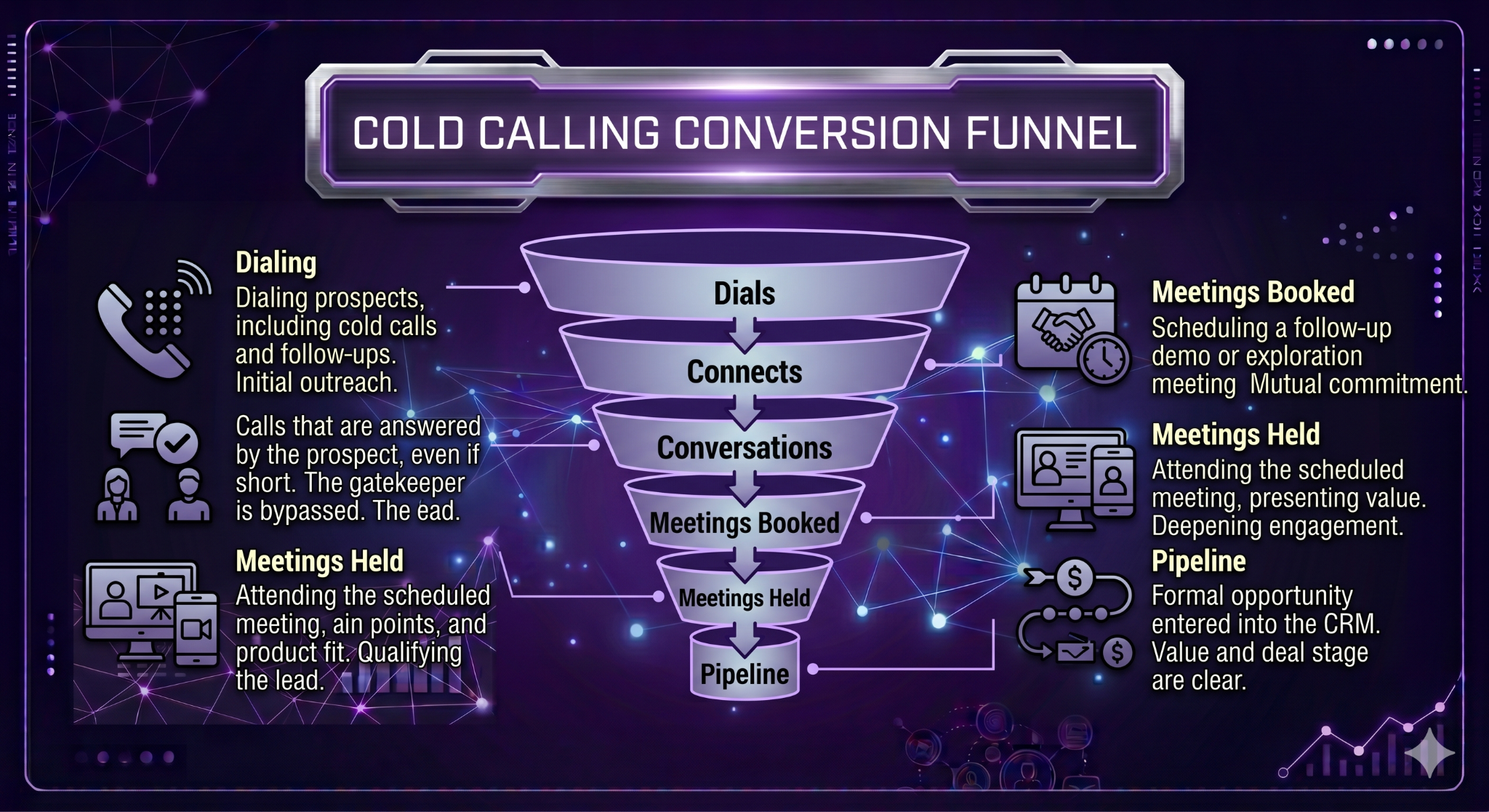
Track both activity metrics (leading indicators) and outcome metrics (lagging indicators). Activity without outcome visibility is a process problem. Outcome tracking without activity visibility makes coaching impossible.
Activity Metrics:
- Dials per day — target: 80–120 for a dedicated cold calling role
- Connect rate — target: 8–15%; below 5% signals a data or timing issue
- Talk time per rep per day — proxy for quality call volume
Outcome Metrics:
- Call-to-meeting rate — average 2.5%; good 4–5%; top performer 5–8%
- Meetings booked per week per SDR
- Meeting show rate — target 80%+; low show rate usually points to a qualification or confirmation process problem
- Pipeline generated from SDR-sourced meetings
- SDR-sourced closed-won revenue
Diagnostic framework for when things go wrong:
- Low connect rate → fix data quality and call timing
- Low call-to-meeting rate → fix opener and talk track
- Low show rate → fix qualification criteria and meeting confirmation sequence
- High meetings, low pipeline → fix ICP targeting and handoff quality
Common Mistakes When Building a Cold Calling Team
These are the mistakes that kill cold calling programs before they ever get a fair shot.
❌ Hiring before the process is defined. Reps start calling with no ICP, no talk tracks, and no data quality standards. Results are poor. Leadership blames cold calling. The real issue was the build, not the channel.
❌ Promoting the best SDR to manager. You remove your best caller and install an inexperienced manager who has no systems for coaching. The team suffers on both ends.
❌ Tracking dials, not conversion. 200 dials per day means nothing if connect rate is 2% and call-to-meeting rate is 1%. Activity metrics without conversion metrics give you false confidence.
❌ No follow-up system. The optimum number of call attempts is three, and by the fifth call, over 98% of conversations have occurred. Most teams stop at two. That means they're abandoning prospects right before the conversion window.
❌ Skipping the coaching loop. Without weekly call reviews, reps repeat the same opener mistakes indefinitely. Coaching is not optional.
❌ Using one channel only. Companies that use multi-channel outreach — calls, email, and LinkedIn — report conversions up to 37% higher than single-channel efforts.
❌ Building before validating the offer. A cold calling team scales what's already working. If the offer isn't converting in one-on-one conversations, adding headcount won't fix that.
When to Consider a Cold Calling Agency Instead of Building In-House
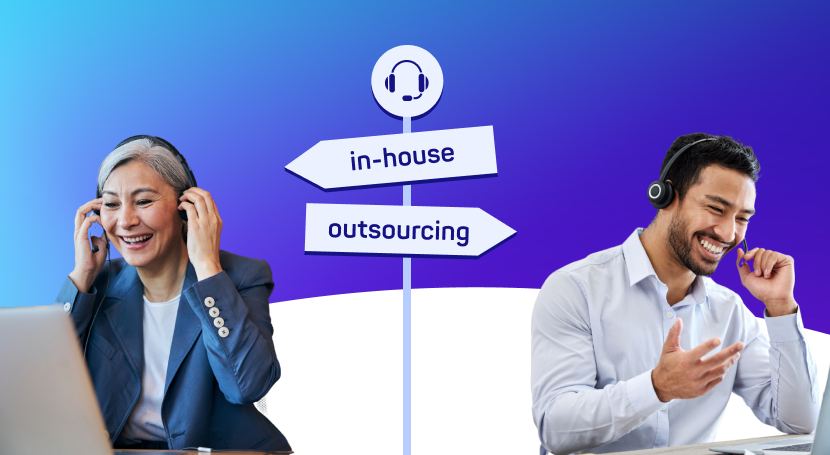
Building in-house is the right call when you have four to six months to ramp, a validated offer and ICP, and budget for the full stack — salary, tools, and management time.
Outsourcing is the better option when:
- You need a steady flow of qualified leads within weeks instead of waiting months to build momentum.
- Your messaging is still evolving — experienced agencies leverage insights from thousands of campaigns, making the validation process far less risky.
- The time and effort required to recruit and train an internal team outweigh the cost of a monthly retainer.
- Your in-house attempts haven’t delivered results — a proven external system can drive improvements faster than starting another hiring process.
The best cold calling agencies handle the full process end-to-end: ICP definition, verified list building, script development, trained callers executing at full volume, cadence management, response handling, and meeting handoff.
That's infrastructure, playbooks, and optimization loops that take most in-house teams three to six months to build from scratch — if they build them at all.
How Cleverly Builds Cold Calling Teams That Deliver Qualified Meetings
Building an in-house cold calling team is a significant investment — and getting there takes time most companies don't have.
That's why a growing number of B2B teams choose to run their cold calling through Cleverly instead.
Cleverly runs a fully done-for-you cold calling service — not dial volume, not activity metrics, but guaranteed qualified meetings. We've made 1M+ cold calls, set 53,000+ appointments, and generated over $312M in pipeline for B2B companies across industries including Amazon, Google, Uber, PayPal, Slack, and Spotify.
What we handle end-to-end:
- ICP definition and precision targeting
- Verified direct-dial list building
- Call scripting and talk track development
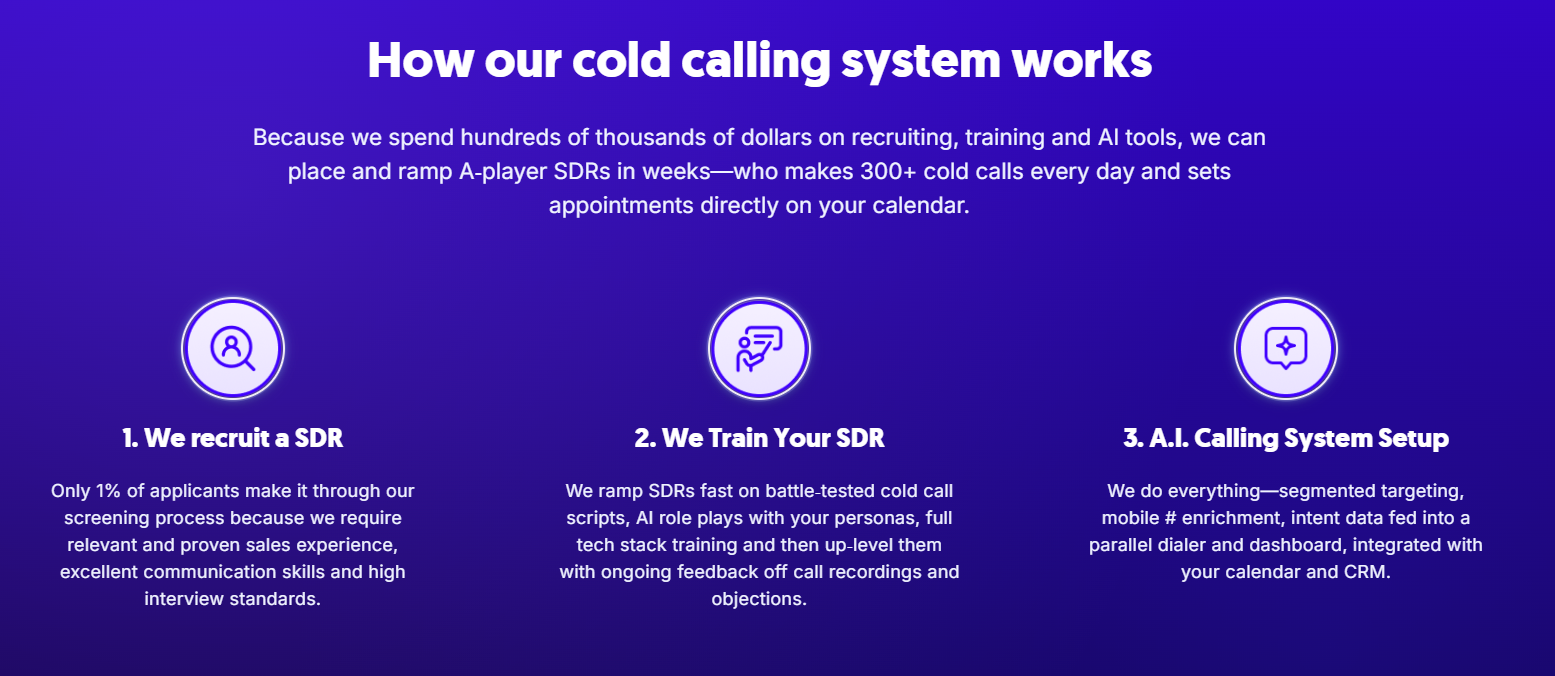
- Trained no-accent appointment setters executing 200+ dials per day
- Multi-channel sequencing across cold call, email, and LinkedIn, plus response handling and meeting handoff
Everything your in-house team would take months to build — running from day one.
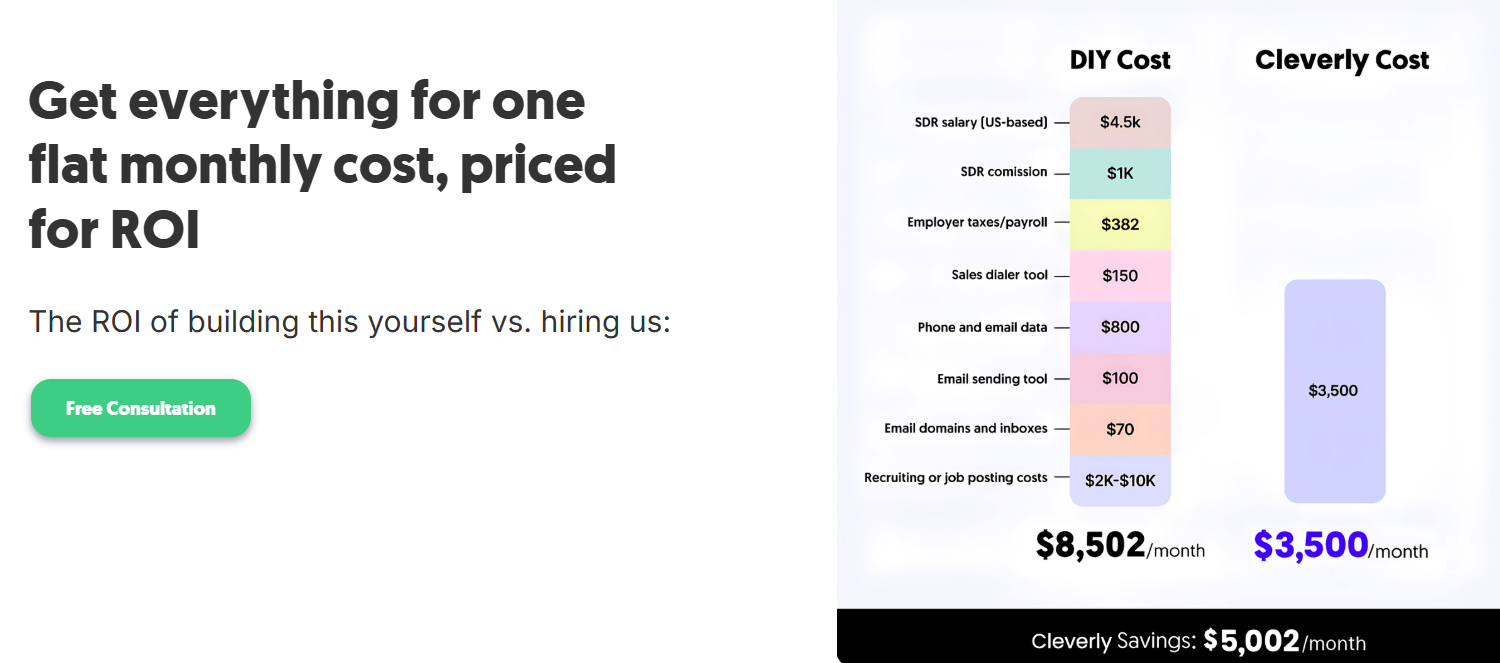
The cost comparison is stark.
Once you add salary, benefits, commissions, tools, management overhead, and turnover costs, a single in-house SDR runs $125,000 per year.
Cleverly's cold calling system is a flat $4,000 per month — roughly half the annualized cost of one fully-loaded in-house SDR, with no hiring risk, no ramp period, and no tool setup.
We guarantee 10–30 qualified sales calls per month, and if we don't deliver, we replace the SDR. You go live in two weeks.
Want a proven cold calling system running without building and managing it yourself?
🔥 Book a strategy call with Cleverly →

Conclusion
How to build a cold calling team comes down to one principle: process before headcount. The teams converting 5–8% of dials to meetings aren't operating with better natural salespeople — they have tighter ICPs, cleaner data, proven talk tracks, multi-touch cadences, and coaching loops that run every single week.
If you have the time and budget to build that infrastructure properly, in-house is a strong long-term investment.
If speed matters more than control right now — or if you want qualified meetings running while the internal playbook gets built — outsourcing to a specialist gets you there faster, at lower risk, for less than the cost of one employee.
Cold calling is a channel that compounds. The teams that commit to it consistently win accounts that every digital channel misses.
Frequently Asked Questions
Free Resource
How to Scale a Profitable Cold Call System
Get the complete guide — download it instantly now.
Free Ebook
Download the Free Guide
Enter your details to get instant access.
You're all set! 🎉
Your ebook is downloading now.
Click below if the download didn't start automatically.