Table of Contents
Why the Opening Line Matters in Cold Calling
Elements of a Great Cold Call Opener
How to Start a Cold Call (The First 30 Seconds)
The Best Cold Call Opening Lines (With Examples)
Mistakes to Avoid in Cold Call Openers
How to Test & Refine Your Cold Call Openers
Cleverly’s Cold Calling Services Can Help You Win More Conversations
Conclusion
Frequently Asked Questions
Modified On :
July 8, 2026
Key Takeaways
- The best cold call opening lines focus on earning attention in the first 15 seconds.
- Personalization, clarity, value, and tone are the four pillars of strong cold call openers.
- Permission-based, value-driven, curiosity-led, and data-backed openers consistently outperform generic intros in B2B cold calling.
- Avoid common cold call openers mistakes like sounding scripted or overly pushy.
- Testing and refining your openers with A/B tests and call-to-meeting metrics boosts success.
If you’ve ever picked up the phone to make a sales call, you know the first few seconds can make or break the conversation. That’s why finding the best cold call opening lines is very important.
In fact, research shows most prospects decide within the first 60 seconds whether they’ll keep listening or hang up.
Your opener is the door to the entire conversation. If it’s weak, the door shuts fast. But with the right approach, you can spark curiosity, earn trust, and buy yourself more time to pitch your solution.
In this guide, we’ll walk you through the best cold call openers, why they work, and real examples you can start using today.
We’ll also share how our team at Cleverly has perfected cold calling lead generation with over 1 million calls made and 53,000 appointments set, so you don’t just learn what works, you can know how we can help you!
Why the Opening Line Matters in Cold Calling
Apart from the best time to cold call, when you’re dialing a new prospect, the first words you say are everything.
Strong cold call openers set the tone for the entire conversation, while weak ones can end the call before it even begins.
Think about it, your prospect wasn’t expecting your call. In those first 10–15 seconds, their brain is deciding whether you sound like someone worth listening to or just another interruption.
The Psychology Behind It
- Attention span: People decide quickly if something is worth their time. A confident, respectful opener immediately buys you more seconds to explain why you’re calling.
- Trust building: The moment your prospect hears your voice, they’re subconsciously evaluating credibility. Sound scripted or pushy, and the wall goes up. Sound authentic, and you lower resistance.
- Tone over words: Studies show tone makes up the majority of first impressions. A calm, friendly delivery often matters more than the exact words you use.
Good vs. Bad First Impressions
- Bad opener example: “Hi, this is John from XYZ Company, can I have a minute to tell you about our product?” 👎
- Too generic, sounds like a pitch, and immediately signals “sales call.”
- Good opener example: “Hi Sarah, this is John—did I catch you at a bad time?” 👍
- Polite, respectful, and gives the prospect control, which reduces defensiveness.
The truth is, there’s no one-size-fits-all opener. But when your cold call openers show empathy, respect, and clarity, you give yourself a real shot at earning a conversation instead of a hang-up.
Also Check: Cold Calling vs Warm Calling - Which Works Better for B2B Sales?
📞 We’ve Mastered the First 15 Seconds (and Beyond)
With 1M+ cold calls made and 53K+ appointments set, our team knows exactly how to win prospects fast. Book your free cold calling consultation today.
Elements of a Great Cold Call Opener
Not all introductions are created equal. The best cold call openers share a few common traits that instantly earn attention, build trust, and keep the conversation alive.
Let’s break down the proven cold calling tips you should focus on.
Personalization
Nothing shuts a prospect down faster than a generic, robotic intro. A little personalization goes a long way.
Mention their name, company, or even their role to show you’ve done your homework.
- Example: “Hi Lisa, I noticed you’re leading operations at Acme Corp…”
- Why it works: It signals you’re not just calling off a random list—you’ve prepared for this call.
Clarity
In the first 10 seconds, the prospect should know who you are and why you’re calling. Avoid vague intros that leave people confused or suspicious.
- Example: “This is Alex from Cleverly, we help sales teams set more qualified appointments through cold calling.”
- Why it works: You’re upfront, clear, and set expectations right away.
Value Hook
Your opener should give the other person a reason to keep listening. A value hook connects what you do with something that matters to them.
- Example: “We’ve helped companies like yours cut prospecting time in half by booking qualified meetings, can I share how?”
- Why it works: You’re immediately relevant, not just selling.
Tone & Confidence
Even the strongest script falls flat if your delivery is off. The best cold call openers are delivered with the right mix of energy, pacing, and friendliness.
- Speak at a steady pace (too fast feels pushy, too slow feels unprepared).
- Smile while you talk, it naturally makes your voice warmer.
- Sound confident, but not rehearsed.
When you combine personalization, clarity, value, and confidence, you turn a cold call into a real conversation, and that’s where opportunities start.

How to Start a Cold Call (The First 30 Seconds)
Knowing which opening line to use matters. But knowing the sequence of those first 30 seconds — what order to say things, how much space to leave, when to stop talking — is what separates reps who book meetings from those who get hung up on.
Here's the structure:
1. Say your name and company clearly.Don't rush this. A lot of reps speed through it because they're nervous, and the prospect catches nothing. Two seconds of clarity here prevents three seconds of "sorry, who is this?" later.
"Hi [Name], I'm [Your Name] from [Company]."
2. Choose your opener and deliver it.Pick the opener type that fits the context (see the full list below). Whether it's permission-based, referral, or honest — deliver it calmly. Do not move faster than the prospect is comfortable with.
3. State your reason for calling in one sentence.After your opener, give them a one-sentence reason you're calling before they have to ask. A vague "I wanted to connect" triggers immediate defensiveness. Be specific: "I'm calling because we work with [company type] on [specific challenge]."
If you're running multi-channel outreach alongside cold calling, cold email response rate benchmarks give useful context for how opener performance compares across channels.
4. Ask an open-ended question.The opener's job is to create space for the prospect to talk. End your intro with a question, not a statement. "Is that relevant to what you're working on?" or "How are you currently handling [X]?" invites a response instead of demanding one.
5. Stop talking and listen.This is where most cold calls fail. Reps get nervous in the silence and fill it with more pitch. The moment your question lands, stop. The prospect's answer tells you everything about how the next 10 minutes should go.
A note on gatekeeper situations:If a receptionist or assistant answers, do not sell to them. A clean, confident "Hi, it's [Your Name] — is [Prospect Name] available?" is all you need. If they ask what it's regarding, keep it simple: "I'm following up on some outreach" or "new business" is sufficient. Save the actual opener for the decision-maker.
🚀 Open Strong, Close Stronger
Don’t just rely on great opening lines; let our experts handle the calls and fill your pipeline with qualified leads. Pay only for results and start scaling your sales now.
The Best Cold Call Opening Lines (With Examples)
Now that we’ve covered why the first 15 seconds matter and what makes a strong opener, let’s look at real-world examples of the best cold call opening lines you can use.
These aren’t one-size-fits-all, you’ll want to test and adapt based on your industry, product, and audience. But each type of opener has proven effective when used in the right context.
Permission-Based Openers
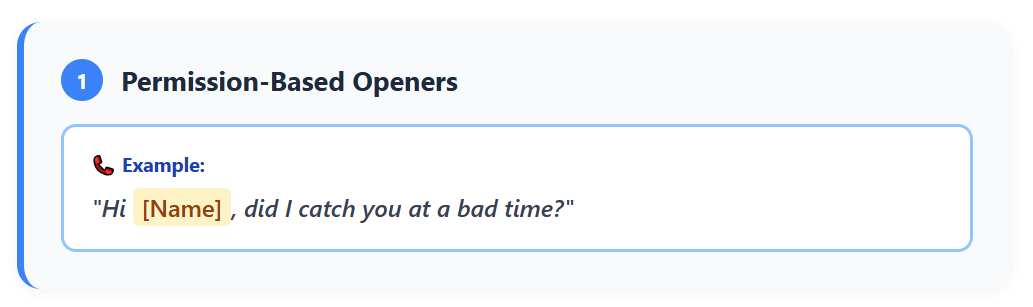
Example lines:
"Hi [Name], did I catch you at a bad time?"
"Hi [Name], I know I'm calling out of the blue — do you have 30 seconds?"
"Hi [Name], this is [Your Name] from [Company]. I'll be upfront — this is a cold call. Do you have two minutes, or should I call back at a better time?"
What to say if they say "yes, it's a bad time":Ask: "No problem — when would be a better moment?" Then book a specific callback rather than leaving it open-ended.
This is one of the most classic best opening lines for cold calling because it immediately gives control to the prospect. By asking permission, you disarm resistance and show respect for their time.
Why it works:
- Makes the call feel less pushy.
- Lets the prospect feel in charge of the conversation.
- Lowers the instinctive urge to hang up.
When to use it:
- Early in the call when speaking to busy decision-makers.
- In industries where respect and courtesy go a long way.
Value-Oriented Openers
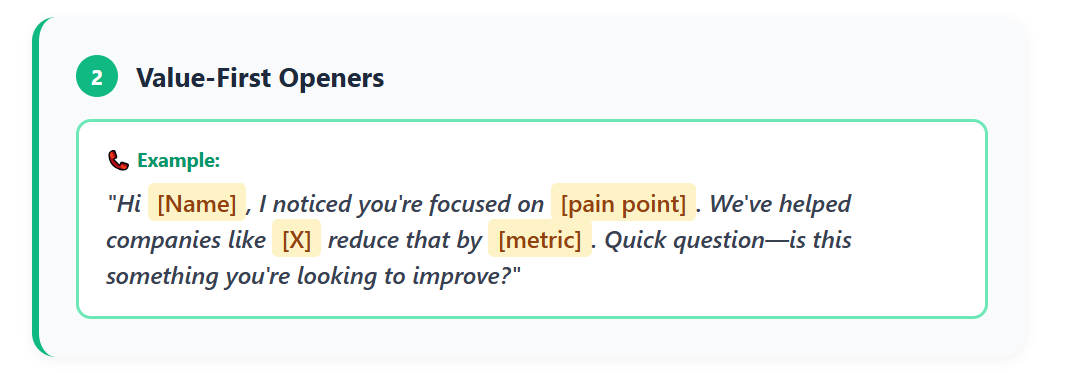
Example lines:
"Hi [Name], I'll keep this brief — we've helped [similar company type] [specific outcome, e.g., reduce prospecting time by 40%]. Worth 30 seconds to see if it applies to your team?"
"Hi [Name], I'm [Your Name] from [Company]. We work with [industry] teams on [specific challenge] — I wanted to see if that's a problem you're running into too."
"Hi [Name], this is [Your Name]. We recently helped [Company Type] [specific result]. I thought there might be a fit here — can I share one quick insight?"
This opener gets right to the point with a clear value hook. It works because it immediately suggests the call is about solving a problem, not wasting time.
Why it works:
- Quickly establishes relevance.
- Shows you’re focused on their needs, not your pitch.
- Short timeframe (“30 seconds”) makes it easier to say yes.
When to use it:
- When you know your solution directly addresses a common pain point.
- In industries where results and efficiency are highly valued.
Curiosity-Driven Openers

Example lines:
"Hi [Name], quick question — how are you currently handling [specific challenge their industry faces]?"
"Hi [Name], I've been talking to a few [industry] leaders about [challenge] — wanted to see if it's something you're dealing with too."
"Hi [Name], I came across [Company] and noticed you're [specific signal or recent activity]. I had a thought on it — is this a bad time to share it?"
Data point: According to Gong's research on cold calling, opening with "How are you?" increases call success rates by roughly 10% compared to jumping straight into a pitch. It signals that you see the prospect as a person, not a pipeline entry.
Curiosity is one of the most powerful levers in sales. With this opener, you’re not selling, you’re starting a conversation around a challenge their peers face.
Why it works:
- Builds rapport by showing you understand their industry.
- Creates an open-ended conversation instead of a yes/no response.
- Encourages them to share their perspective, which gives you insights.
When to use it:
- When you’re calling into industries with common, well-known challenges.
- When you want to position yourself as a consultant, not just a seller.
Data/Insight Openers

Example lines:
"Hi [Name], I noticed [Company] just [trigger event — e.g., raised a Series B / expanded to a new market / posted 10 SDR jobs]. We typically work with companies at exactly this stage — is now a reasonable time?"
"Hi [Name], I was doing some research on [Company] and saw [specific data point or news]. We've helped similar teams turn that into [specific outcome] — worth a quick conversation?"
"Hi [Name], I saw [Company] is hiring [relevant role]. That usually signals [growth challenge we solve]. Can I share what we're seeing work for similar teams?"
For data-backed openers to land, you need a trigger. Tools that surface company hiring signals, funding announcements, and tech stack changes make this approach scalable. See our breakdown of AI cold calling software for tools that automate this research.
These are among the best cold call opening lines because they show you’ve done your research.
By referencing something specific, like a recent funding round, hiring spree, or product launch, you prove you’re not just dialing blindly.
Why it works:
- Personalizes the call with relevant context.
- Shows you’re informed and credible.
- Naturally leads into a discussion about their current situation.
When to use it:
- When you have access to reliable data or sales intelligence tools.
- For high-value accounts where personalization is critical.
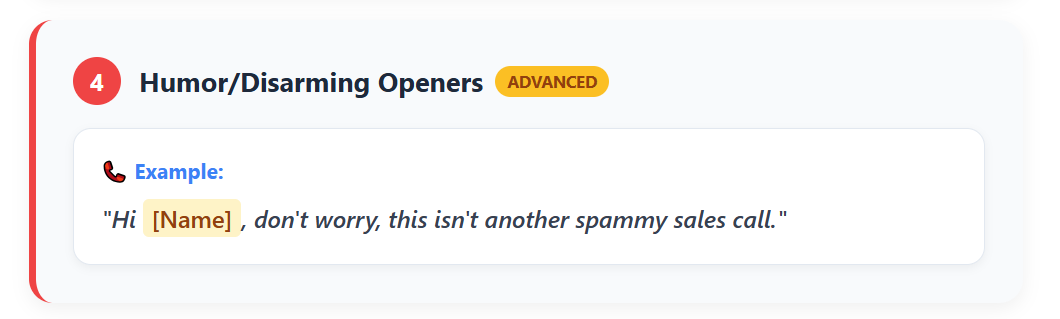
Humor/Disarming Openers (Advanced)
Example lines:
"Hi [Name], fair warning — this is a cold call. I promise I'll make it worth the next 20 seconds."
"Hi [Name], this is [Your Name] from [Company]. I know you weren't expecting this, and I wouldn't blame you for hanging up — but I've got one thing that's actually relevant to what you're working on. Can I have 30 seconds?"
"Hi [Name], I'll be honest — I rehearsed this opener three times this morning. It's still a cold call, but at least it's a well-prepared one. Can I have a minute?"
Humor is risky, but when used right, it’s incredibly effective. A light, self-aware opener can disarm prospects and make them more willing to engage.
Why it works:
- Stands out from the dozens of robotic calls they get daily.
- Humanizes you and makes the interaction feel more natural.
- Helps prospects lower their guard and lean into the conversation.
When to use it:
- When you have a naturally warm, confident delivery.
- In industries where informality and personality are welcomed.
The truth is, there’s no single script that works 100% of the time.
But by mastering these best opening lines for cold calling and knowing when to use them, you’ll dramatically increase the odds of turning cold conversations into warm opportunities.
Mistakes to Avoid in Cold Call Openers
Even the best cold call openers can backfire if they’re delivered the wrong way. A lot of sales reps fall into the same traps that instantly kill a conversation before it begins.
Let’s look at the most common cold call openers mistakes you’ll want to avoid.
❌ Sounding Too Scripted
Prospects can tell within seconds if you’re reading from a cold calling script. A robotic opener makes you sound like every other sales rep out there, and that’s an easy excuse for them to hang up.
- Instead: Use your script as a guide, but make sure your tone is natural and conversational. Practice until it feels second nature.
❌ Talking Too Much Without Listening
Some callers make the mistake of turning the opener into a mini-pitch. If you spend the first 30 seconds talking about yourself, you lose the chance to connect with the other person.
- Instead: Keep it short and open-ended. Your opener should create space for the prospect to talk.

❌ Overly Pushy or Desperate Tone
If your energy feels too aggressive, or worse, desperate, prospects sense it immediately. No one likes feeling pressured into a conversation they didn’t ask for.
- Instead: Stay calm, confident, and respectful. Prospects respond better when they feel they have a choice.
❌ Generic, Boring Introductions
“Hi, I’m calling from XYZ Company, can I tell you about our product?”—we’ve all heard this before, and it doesn’t inspire curiosity or trust. A dull introduction is just as bad as a pushy one.
- Instead: Personalize your intro, add relevance, and show you’ve done your homework.
The bottom line: avoid these cold call openers mistakes, and you’ll instantly stand out from the dozens of forgettable sales calls your prospect gets every week.
How to Test & Refine Your Cold Call Openers

Even the best cold call openers strategy won’t be perfect on the first try.
The top-performing SDRs know that cold calling is a numbers game, and the only way to improve is through consistent testing, tracking, and refinement.
Here’s how you can do it.
A/B Testing Different Openers
Don’t rely on one script and hope for the best. Instead, rotate between two or three different openers and measure which one gets better responses.
- Example: Test a permission-based opener against a value-oriented opener and see which books more meetings.
- Keep your testing periods consistent (e.g., 1–2 weeks) so the data is reliable.
Tracking Conversion Metrics
It’s not enough to track dials or conversations, you need to measure outcomes. The most important metric is your call-to-meeting ratio.
- How many calls turn into booked meetings?
- Which opener consistently moves prospects further down the funnel?
- Do certain openers work better for specific industries or titles?
By tying your best cold call openers strategy to data, you’ll know exactly what to double down on.
For benchmark data on what strong reply and conversion rates look like across outbound channels, call follow-up templates are a useful companion resource - especially when you're tracking which opener type moves prospects further down the funnel.
Role-Play and Feedback Loops
Sometimes the issue isn’t the script, it’s the delivery. Role-playing within your sales team helps reps fine-tune tone, pacing, and confidence before going live with prospects.
- Pair up reps to practice openers in a safe environment.
- Encourage peer-to-peer feedback to spot habits like rushing, sounding scripted, or talking too much.
- Record calls (with compliance in mind) to review and learn what’s actually working.
When you combine testing, tracking, and feedback, you create a repeatable process for sharpening your cold call openers.
Over time, this data-driven approach ensures you’re not just guessing, you’re constantly improving your ability to capture attention in those critical first seconds.
Cleverly’s Cold Calling Services Can Help You Win More Conversations
At the end of the day, even the best cold call openers only work if you’ve got the right process behind them. That’s where our cold calling services come in.
We’ve spent years perfecting a system that helps companies turn cold calls into real opportunities, without burning out your sales team.
Proven Scripts & Opening Lines Built for Your ICP
Every industry, company size, and buyer persona responds differently. That’s why our team doesn’t rely on generic scripts.
We research your ideal customer profile (ICP), write breakthrough call scripts, and craft tested opening lines designed to grab attention in your specific market.
Done-for-You SDR System
We don’t just hand you a script, we give you the full package:
- 100% done-for-you SDR recruitment & cold call system
- No-accent appointment setters trained to sound natural and confident
- Rigorous training to get reps live in 2 weeks
- Data, tech, and power dialer included so you never worry about setup
- Ongoing script refinement based on performance

Why Teams Choose Cleverly
Managing cold calling in-house is expensive, time-consuming, and risky.
With our cold calling services, you get a ready-to-go system at half the cost of hiring internally, plus we guarantee results.
- 1M+ cold calls made
- 53,000 appointments set
- $312M pipeline generated
- Guaranteed appointments, or we replace your SDR
By letting us handle your outbound calling, your team can stay focused on closing deals while we keep your calendar full of qualified meetings.
Ready to fill your pipeline with qualified leads? Let’s talk!
Conclusion
Mastering the best cold call opening lines is about starting conversations that matter. The first 15 seconds set the tone, and when you personalize your opener, lead with value, and deliver with confidence, you dramatically increase your chances of booking meetings.
But here’s the challenge: testing, refining, and consistently executing cold calling at scale takes time and resources most teams don’t have.
That’s exactly why we built our cold calling services at Cleverly.
From crafting proven openers to recruiting and training SDRs, to managing the entire outreach system, we help you convert more calls into real opportunities—without adding to your team’s workload!

Frequently Asked Questions
Free Resource
How to Scale a Profitable Cold Call System
Get the complete guide — download it instantly now.
Free Ebook
Download the Free Guide
Enter your details to get instant access.
You're all set! 🎉
Your ebook is downloading now.
Click below if the download didn't start automatically.