Table of Contents
Why Vetting a Cold Email Agency Is Different From Hiring Any Other Vendor
Before You Start Asking Questions: What to Check First
12 Questions to Ask a Cold Email Agency Before You Pay
Cold Email Agency Red Flags to Walk Away From
How Cleverly's Cold Email Service Holds Up to Every Question on This List
Conclusion
Frequently Asked Questions
Modified On :
June 18, 2026
Key Takeaways
- A bad cold email agency doesn't just underperform — it actively damages your sending domain, burns through your ICP, and leaves you months behind where you started.
- The biggest mistakes buyers make when evaluating agencies: skipping discovery, ignoring deliverability questions, and not asking who owns the infrastructure.
- Strong agencies welcome hard questions about list sources, copy ownership, performance benchmarks, and offboarding — weak ones deflect or go vague.
- Red flags like full send volume in week one, 6–12 month lock-ins without performance clauses, or agency-owned sending domains are non-negotiable dealbreakers.
- Use the 12-question framework in this guide before signing anything — it's the difference between a pipeline engine and a very expensive mistake.
Cold email still generates a real pipeline when it's done right. The problem is that most companies finding their way to an agency have already tried to figure out what "done right" looks like — and struggled.
Here's what nobody tells you before you write that first check: bad cold email agency experiences follow a predictable pattern. Generic sequences get sent to a poorly built list. Emails start hitting spam. Reply rates tank. The agency assures you things will pick up. Three months later you're not booking meetings — you're repairing a burned domain and fielding angry opt-outs from the same prospects you needed to reach.
In B2B, about 61% of decision-makers prefer email as the primary channel for outreach — which means the stakes of getting this wrong are high. You're not just losing marketing budget. You're burning access to the buyers you needed most.
This guide gives you a practical cold email agency vetting framework: 12 specific questions to ask before you pay, a checklist of red flags to walk away from, and a benchmark for what a strong agency's answers actually sound like.
Whether you're evaluating your first cold email service provider or recovering from a bad engagement, these questions will tell you everything you need to know.

Why Vetting a Cold Email Agency Is Different From Hiring Any Other Vendor
When you hire a designer or a copywriter, a bad hire means wasted time and a mediocre deliverable. You move on.
When you outsource cold email outreach, the stakes are different — and a lot higher.
A cold email agency operates with your brand's name, your domain's reputation, and your ICP on the line. They write emails that land in decision-makers' inboxes under your company's identity. They control the sending infrastructure. They define the first impression you make on hundreds or thousands of prospects every month. A weak agency doesn't just underperform — it actively damages the assets you need to run outbound at all.
Google, Yahoo, and Microsoft now enforce bulk sender rules that make deliverability non-negotiable — and a spam complaint rate above 0.3% (just 3 complaints per 1,000 emails) triggers enforcement actions that can block your domain from reaching Gmail inboxes entirely.
If an agency mismanages your sending setup, you don't just get fewer replies. You lose the ability to email those prospects at all, sometimes permanently.
The asymmetry here matters. A great agency fills your pipeline. A poor one sets it back by months and leaves you rebuilding from zero.
That's why rigorous cold email agency vetting — before signing — isn't optional. It's the only protection you have.
📧 Before You Pay an Agency, See What 15–30 Qualified Meetings/Month Looks Like
Most agencies talk about opens and replies. We focus on booked meetings and pipeline opportunities that your sales team can actually close.
Before You Start Asking Questions: What to Check First
Before you get on a call with any agency, do your own recon. Here's what to verify:
✅ Check for verifiable case studies. Logos on a homepage tell you nothing. Look for actual campaign results — industry, offer type, reply rate, meetings booked per month, and how long the campaign ran before results stabilized. If the case studies are vague, anonymized, or years old, that's your first signal.
✅ Look them up on Trustpilot, G2, or Clutch. Specifically read reviews that mention outcomes. "Great team to work with" means nothing. "Booked 12 meetings in 60 days for our SaaS company targeting mid-market CFOs" tells you something real.
✅ Check whether they write copy in-house. Some agencies outsource copywriting to offshore freelancers after the sale. Ask directly — and ask to see the actual team structure.
✅ Look at their own outbound presence. If a cold email agency can't execute their own outbound at a high level, why would yours be different?
✅ Insist on a discovery call before any proposal. Agencies that jump straight to pricing without understanding your offer, ICP, and sales cycle are building a one-size-fits-all campaign from day one. That's how you end up with templates with your logo on them.
12 Questions to Ask a Cold Email Agency Before You Pay
Think of these as your cold email agency questions checklist. Every question targets a specific failure point that costs clients real money.
A strong agency welcomes all of them. Evasion or vague answers are themselves answers — take them seriously.
1. Can You Show Me Case Studies From Companies With a Similar Offer and ICP?
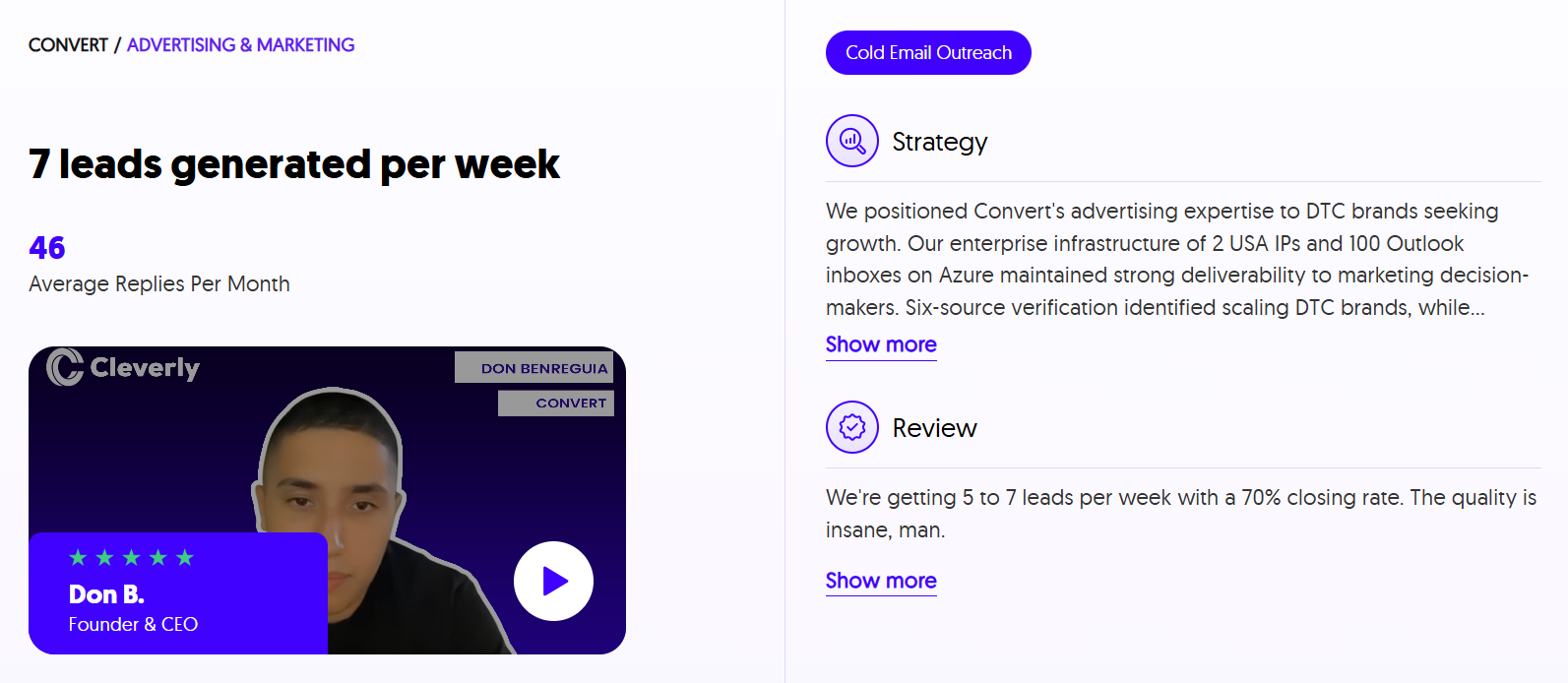
This is the first filter. Generic case studies from wildly different industries tell you almost nothing about what the agency will achieve for you.
What you want to see: results from a company with a comparable product, similar target title, and a matching sales cycle length. Ask specifically — what was the reply rate? How many meetings were booked per month? How long did it take before results stabilized?
🚩 Red flag: anonymized results with no metrics, or case studies that are more than two years old. Cold email has changed enough in the last 18 months that historical results have limited predictive value.
2. How Do You Handle Email Deliverability and Domain Warmup?
Ideally new domains should start at 5–10 emails per day and gradually increase over 4–6 weeks, maintaining predictable daily volumes to build sender reputation and achieve higher inbox placement. Any agency promising full send volume in week one is either lying or going to damage your domain
Ask them to walk you through their warmup process end-to-end: new domain setup, volume ramp schedule, inbox rotation, and how they monitor deliverability health once campaigns are live. SPF, DKIM, and DMARC authentication are now required by all three major inbox providers — Google, Yahoo, and Microsoft — and missing any of these means emails get rejected before a prospect ever sees them.
A reputable cold email service provider doesn't just know these terms — they can describe exactly how they implement and monitor each one.
3. Who Owns the Sending Domains and Email Infrastructure?
This is non-negotiable. You need to own the sending domains — full stop.
If the agency registers the domains in their name, you lose everything when you leave: domain reputation, historical sending data, the ability to continue outreach without starting from zero.
Ask whether the domains are registered in your name, whether you have direct account access, and whether they're sending from dedicated outreach domains or (much worse) your primary business domain.
When you outsource cold email outreach, the email infrastructure they build should be yours to keep. Get this confirmed in writing before you sign anything.
4. How Do You Build and Verify Prospect Lists?
List quality is the single biggest driver of reply rate. If 7.5% of your emails bounce, your domain reputation degrades fast — verified data refreshed regularly, not monthly, is often the difference between inbox and spam folder.
Ask where their data comes from (Apollo, ZoomInfo, Clay, or a combination), what their verification process looks like, and what bounce rate they typically see across campaigns. Also ask how they map your ICP to a list — are they using firmographic and technographic filters or just industry plus title? The difference in lead quality is enormous.
Request a sample list before full build. Spot-check titles, company fit, and data freshness. If they push back on this, that's a signal.
5. Who Writes the Copy — and Can I See Samples for My Industry?
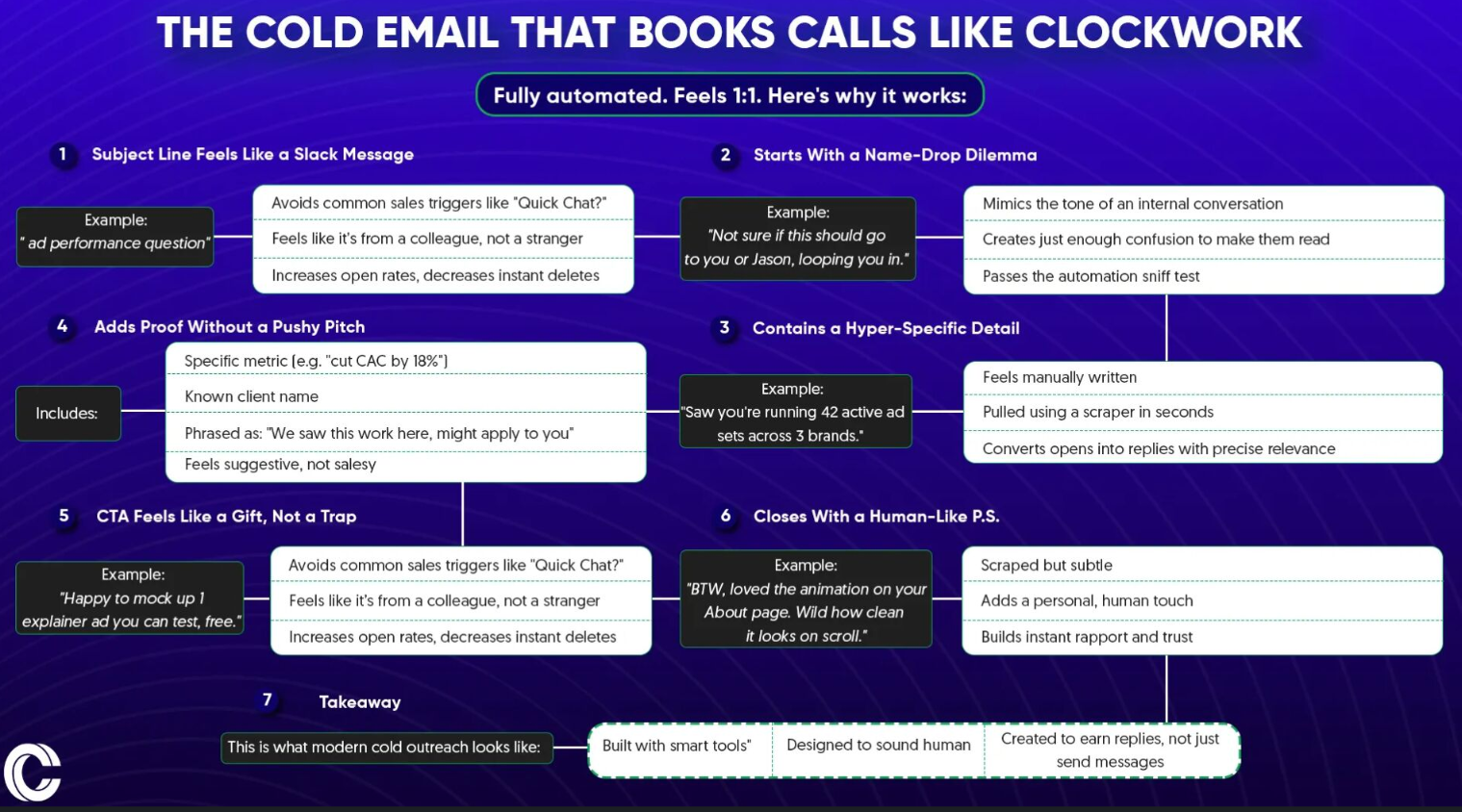
Ask directly: does a dedicated copywriter or strategist write your sequences, or are they pulled from a template library? These are very different things — and most buyers don't think to ask until they see the first draft.
Request actual campaign copy sent to similar buyers. Not polished examples from their website. Real sequences. Look at the opening email, the follow-ups, and how personalization actually works in their workflow.
True cold email personalization means the email reads like it was written for one person. Variable placeholders (Hi [First Name], I saw you work at [Company]) are not personalization.
Also ask: how fast can they iterate when copy isn't converting? The answer tells you a lot about how their optimization loop actually works.
6. What Does Your Onboarding Process Look Like?

Onboarding defines how accurately the campaign represents your offer, your ICP, and your brand voice from day one.
Ask for the full onboarding timeline: discovery session, ICP brief, list build, copy development, approval rounds, technical setup, and launch — with actual milestones and timelines. Who leads the process? Is there one dedicated person or does the work flow through a shared team?
Rushed onboarding that skips the brief-building phase leads to campaigns that sound nothing like your company. This is where most bad campaigns are born — not in execution, but in setup.
7. What Metrics Do You Track and How Often Do You Report?
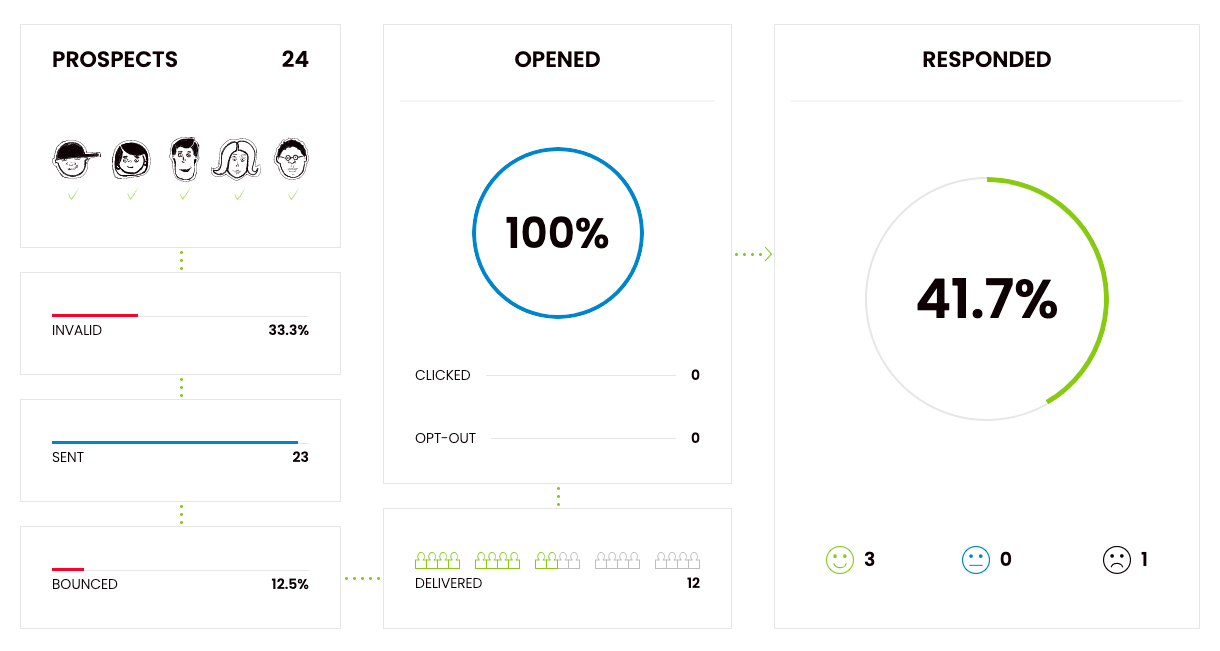
The metrics that actually matter: emails delivered, reply rate, positive reply rate, meetings booked, show rate, and cost per meeting. If an agency leads with open rate as their primary success metric, stop them.
Open rate tracking has been inflated since 2022 by Apple's Mail Privacy Protection, which pre-loads tracking pixels for Apple Mail users — making open rate data structurally unreliable. A strong agency knows this and tracks reply rate and booked meetings instead.
Ask how you'll receive reports — live dashboard, weekly updates, or a monthly PDF. Ask how they separate positive replies from unsubscribes and objections. The agencies that only report volume, not reply quality, are the ones hiding poor performance behind activity metrics.
8. How Do You Diagnose and Fix Underperforming Campaigns?
Ask this question directly: what happens when reply rate falls below benchmark?
A strong agency has a documented optimization loop — weekly performance review, clear hypothesis on what's underperforming (list quality, copy, offer, targeting mismatch), A/B test, and tracked iteration. They should be able to walk you through what that process looks like in practice.
Red flag: agencies that keep running the same campaign month after month regardless of results because the contract still has time left. This happens more than you'd think. Ask specifically how they communicate performance issues — proactively, or only when you bring it up first.
9. What Are the Contract Terms and Minimum Commitment?
Month-to-month agreements signal confidence in results. Six-to-twelve month locked contracts protect agencies from their own poor performance.
Ask upfront: what's the minimum commitment, what are the exit terms, and what performance benchmarks — if any — are written into the contract? Are there setup fees separate from the monthly retainer? If an agency can't tell you what benchmarks they're accountable to, that's a problem.
Walk away from any cold email agency comparison where the contract has a long lock-in with no performance clauses, no exit triggers, and vague language around fees.
10. Who Is My Point of Contact and What Does Communication Look Like?
Ask specifically who your account manager will be, how many clients they manage simultaneously, and what their communication cadence looks like. Weekly check-ins? Bi-weekly reviews? Async only?
Also ask: if something goes wrong — deliverability issue, list problem, copy that's generating negative replies — who do you contact, and what's the expected response time?
Red flag: "you can always email support" as the escalation path. High account manager-to-client ratios are a sign that your campaign gets periodic attention, not ongoing management.
11. What Tools and Sending Methods Do You Use?
Ask whether they use manual outreach, automation tools (Instantly, Smartlead, Lemlist, etc.), or a hybrid — and what the implications are for your sending volume and domain safety. Different tools have different deliverability profiles and personalization limits.
What SMTP providers do they use, and how do they rotate inboxes? How do they protect sending reputation at scale?
Also ask: do they have direct access to your sending accounts, or do they operate through their own infrastructure? And what happens to your data and campaign settings if you leave?
12. What Happens to My Data, Lists, and Copy When I Cancel?
Everything built during your engagement — prospect lists, copy, email sequences, campaign assets — should belong to you. Confirm this in writing before signing.
Specifically ask: who owns the prospect lists, who owns the copy, and what does the offboarding process look like? How long after you give notice before you have access to all your data?
Red flag: agencies that retain data ownership, require 60-day notice windows, or give you a vague non-answer to this question. If they can't tell you clearly in the sales process, you can expect the same in offboarding.
🚀 Don't Spend $3,000–$10,000/Month Guessing
See the cold email system that's helped generate $312M+ in pipeline and booked meetings for 10,000+ businesses before signing a long-term agency contract.
Cold Email Agency Red Flags to Walk Away From
These are the dealbreakers. Any single one of these is reason enough to keep looking:
🚩 Guaranteed reply rates or meeting volumes. Performance benchmarks are reasonable and appropriate. Guarantees are a sales tactic. No agency can guarantee how human beings respond to cold email.
🚩 Full send volume in week one. A 14–21 day warmup is a bare minimum; 4–6 weeks is a safer ramp for stable inbox placement at scale. Any agency skipping warmup is putting your domain at risk from day one.
🚩 No ICP discovery before quoting. Agencies that price your campaign before they understand your offer are building a generic campaign from day one.
🚩 They own your sending domains. Non-negotiable. Walk away.
🚩 Vague answers to direct questions. If you can't get a straight answer about copy ownership, list sources, or what happens to your infrastructure when you leave, that vagueness becomes your problem after you sign.
🚩 Pressure to sign fast. Urgency tactics from a service provider selling a multi-month engagement are a manipulation tactic, not a reason to rush.
🚩 No case studies from your vertical. "We work with everyone" usually means they've optimized for nobody.
How Cleverly's Cold Email Service Holds Up to Every Question on This List
We built our cold email service around one goal: run campaigns our clients are proud to have their name on, and produce pipeline that actually converts.
On deliverability, we set up dedicated sending domains for every client, handle full domain warmup before a single cold email goes out, use inbox rotation, and monitor domain health on an ongoing basis. Your primary domain is never touched.
On list building, we build ICP-matched prospect lists from verified data sources, reviewed and validated before outreach begins. Bounce rates are monitored continuously — not reviewed after the damage is done.
On copy, dedicated strategists write personalized sequences around your specific offer, your ICP's pain points, and your proof points. Not template libraries. Actual sequences built for your buyers. On reporting, clients have access to real-time dashboards tracking reply rate, positive reply rate, and meetings booked — because those are the numbers that move pipeline.
On ownership, your domains, your lists, your copy. Everything we build during your engagement belongs to you — whether you stay with us or not. That's how it should work.
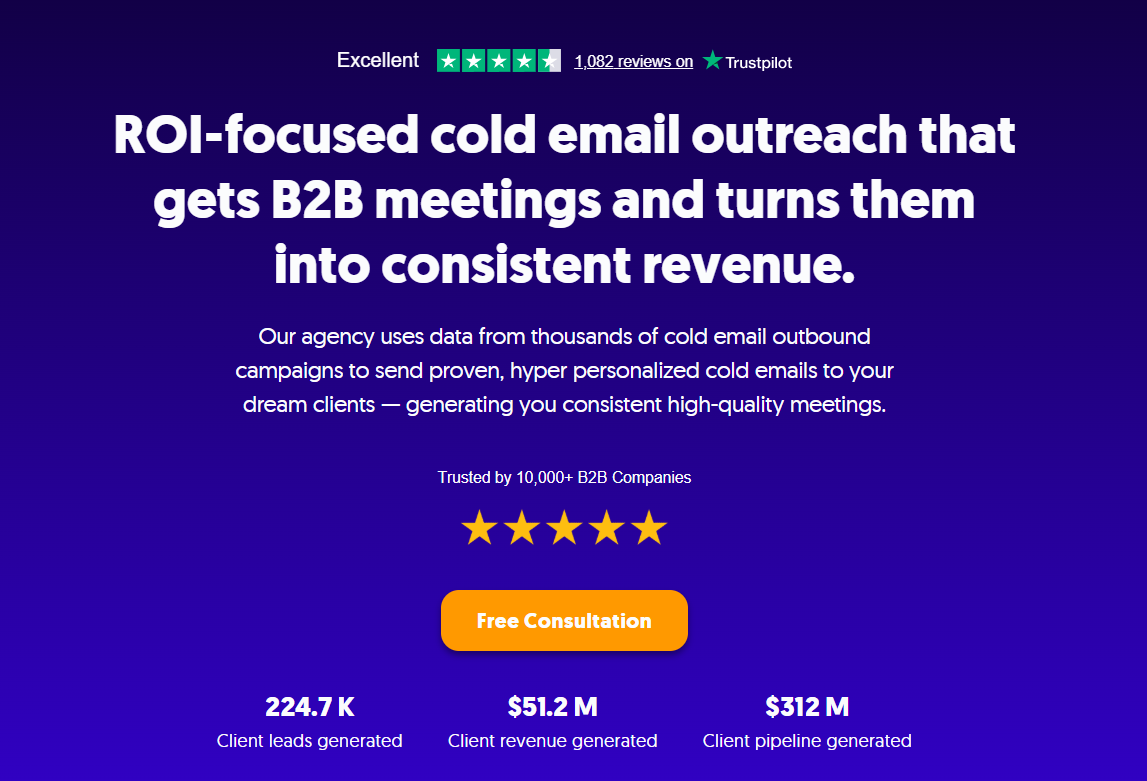
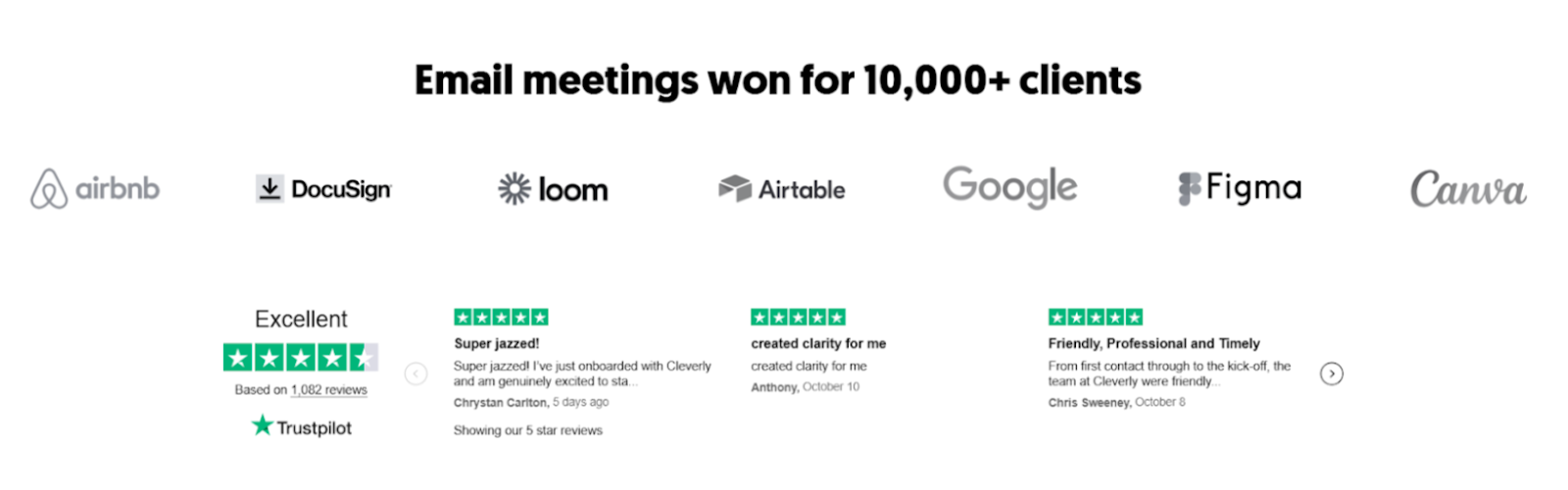
We've helped 10,000+ clients generate leads and book meetings, generating $51.2M in closed revenue and $312M in client pipeline across companies including eBay, Airbnb, DocuSign, Loom, and Airtable.
Our cold email service is fully done-for-you, month-to-month, with no long-term lock-in — because we're confident in what we deliver.
Want to see how we answer every question on this list in a live conversation? Book a strategy call and we'll walk you through our full process — no pressure, no vague answers.
Conclusion
The right cold email agency doesn't just send emails — they protect your infrastructure, represent your brand accurately, and build the kind of pipeline that actually converts. Every question in this guide exists because a real company somewhere lost time, money, or domain reputation by skipping it.
Use this framework before you sign anything. Strong agencies welcome the scrutiny — because scrutiny is exactly how they demonstrate they're worth trusting with your outbound.
Frequently Asked Questions
Free Resource
How to Scale a Profitable Cold Call System
Get the complete guide — download it instantly now.
Free Ebook
Download the Free Guide
Enter your details to get instant access.
You're all set! 🎉
Your ebook is downloading now.
Click below if the download didn't start automatically.