

Table of Contents
The Real Difference Between Cognism and ZoomInfo
What Is ZoomInfo?
What Is Cognism?
Cognism vs ZoomInfo: Side-by-Side Comparison
Data Accuracy and Compliance: What Reddit and G2 Users Actually Say
Cognism vs ZoomInfo Pricing: What Does Each Actually Cost?
Cognism vs ZoomInfo Features Compared
Where Cleverly Fits: Turning B2B Data Into Booked Meetings
Conclusion
Frequently Asked Questions
Modified On :
July 31, 2026
Key Takeaways
- Geography decides this, not features. Cognism wins for EU/UK cold calling and GDPR compliance. ZoomInfo wins for US-focused enterprise outbound at scale.
- Accuracy complaints are almost always a geography mismatch. Most "Cognism data is bad" reviews come from US teams who bought a EU-first tool. Most "ZoomInfo data is bad" reviews come from teams calling outside North America.
- Neither company publishes real pricing. Every number you see online, including in this article, comes from buyer reports and negotiated deals, not a pricing page.
- A verified contact isn't a booked meeting. Both platforms hand you a name and number. Neither one dials, writes copy, or follows up for you.
- Test before you commit to the top tier. Run a paid pilot against your actual target list in your actual target region before signing a 12-month contract on either platform.
Guess what a bad data provider actually costs you? It's not just the subscription fee. It's the SDR hours burned dialing disconnected numbers, the deliverability damage from bouncing emails, and, if you're calling into the UK or EU, the compliance exposure from contacting people who should've been on a do-not-call list.
Cognism and ZoomInfo are two of the most-searched names in B2B data for a reason. Both show up in nearly every "best sales intelligence tool" list. But they weren't built for the same buyer.
ZoomInfo built its business on North American scale, with 260M+ profiles and 100M+ companies. Cognism built its business on European compliance and phone-verified mobile numbers, branded as Diamond Data.
This guide breaks down what each platform actually does, how they stack up side by side, what data accuracy and compliance really look like in practice, current pricing (as close as you can get without a live demo call), what Reddit and G2 users are actually saying, and how to pick the right one for your team.
If you're RevOps, a sales leader, or a marketer shopping for a B2B contact data provider in 2026, this is written for you.
The Real Difference Between Cognism and ZoomInfo
This isn't a feature-for-feature tie. The real split is geographic strength and data verification philosophy.
ZoomInfo is built for North American enterprise and mid-market outbound at massive scale. It bundles contact data with intent signals, technographics, conversation intelligence, and workflow automation into one platform.
Cognism is built narrower and sharper. It leans on Diamond Data, phone numbers that are manually verified by a human research team, and a compliance stack covering GDPR, CCPA, and do-not-call screening across 15 countries.
Quick verdict before you read further: ZoomInfo wins for US-focused teams with a real enterprise budget. Cognism wins for EU/UK cold calling teams that need GDPR-safe data. If you're under 10 reps or your data budget is under $20K a year, you might not need either one at full price.
🚀 More Market Share Starts With More Conversations
Our LinkedIn, cold email, and cold calling campaigns generate 15–30 qualified meetings every month with your ideal buyers.
What Is ZoomInfo?
ZoomInfo is the incumbent enterprise sales intelligence platform, built around its SalesOS product. Its live site advertises coverage in the hundreds of millions of contacts and companies, with by far its deepest data in North America.
Coverage: 260M+ professional profiles and 100M+ companies, with the strongest density in the US and Canada.
Features:
- Verified contact and company data
- Buyer intent signals
- Technographic intelligence (what tech stack a company runs)
- Conversation intelligence through Chorus
- Workflow automation across your outbound stack
Pricing model: ZoomInfo uses a universal credit system. Revealing a phone number, exporting a list, and enriching a CRM record all draw from the same shared credit pool, which means heavy usage in one area can drain credits you needed elsewhere.
Best for: US-focused enterprise or mid-market organizations with roughly $25K+ a year to spend and a need for the largest possible North American database.
What Is Cognism?
Cognism is a B2B data platform built around two things: compliance and phone-verified mobile data.
Signature feature: Diamond Data. These are mobile numbers that Cognism's human research team manually calls and confirms before they get tagged "verified." Third-party coverage widely cites Diamond Data connect rates in the high 80s to high 90s percent range, well above what most automated databases deliver.
Compliance: GDPR and CCPA compliant, SOC 2 accredited, with TPS/DNC screening across 15 countries. If your team is cold calling into the UK or EU, this compliance layer is the actual product, not a nice add-on.
Pricing model: Cognism often allows unrestricted list viewing, with credits consumed mainly when you export contacts rather than every time you search.
Best for: EMEA-focused cold calling teams and any company that treats GDPR-safe outbound as non-negotiable.
📈 From AI Automation to 53,000+ Meetings Booked
See why 10,000+ businesses trust Cleverly to combine automation with human-led outreach to build a predictable B2B pipeline.
Cognism vs ZoomInfo: Side-by-Side Comparison
Think of this as a decision matrix, not a sales pitch. Neither column "wins" outright.
Data Accuracy and Compliance: What Reddit and G2 Users Actually Say
This is where most comparison articles get lazy. They post a chart showing "Cognism: 85% accurate" next to "ZoomInfo: 93% accurate" and call it a day. That's not useful, and it's not even honest.
Comparisons that fixate on a small percentage gap in contact accuracy miss the point, since that framing has cost companies real money in wasted software spend.
Here's the pattern that actually shows up across Reddit threads, G2 reviews, and Cognism's own customer quotes:
Cognism sentiment is geography-driven, not universal. The recurring theme is "great in the EU, rough in the US." A notable share of the negative Cognism reviews come from US-first GTM teams who bought the platform on price without realizing it's built for a different region.
In a US context, common complaints include outdated contacts for people who've left their company, emails that look machine-generated, and phone numbers that route to a front-desk gatekeeper instead of a direct line.
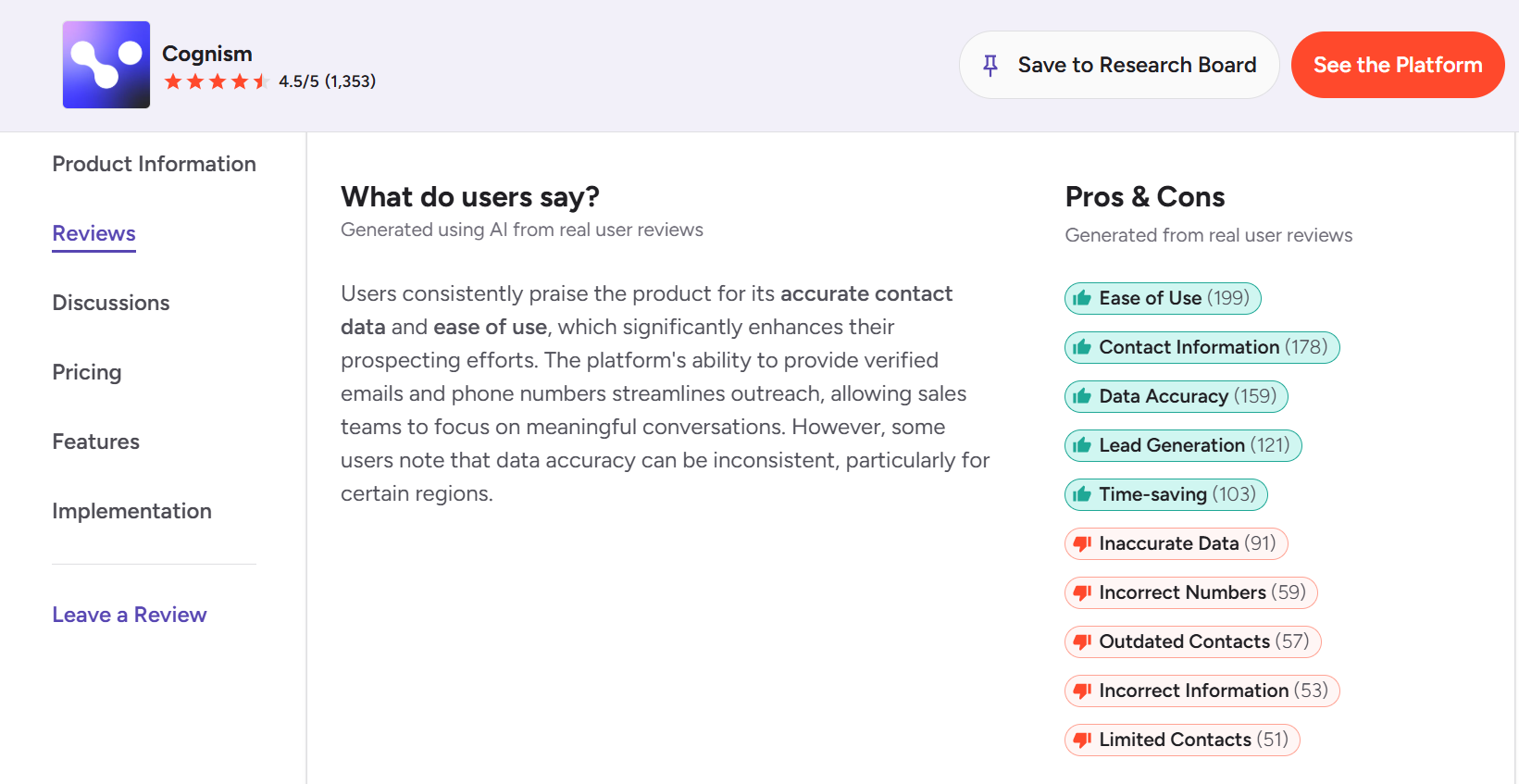
One Cognism customer, quoted in the company's own comparison page, put it directly: a team that had previously used ZoomInfo reported contact accuracy around 50%, and found accuracy closer to 85% when they evaluated Cognism instead.
That's a real data point, but remember it's Cognism-sourced, so treat it as one input, not the final word.
Diamond-verified data is the real dividing line, not "Cognism vs ZoomInfo." The bigger accuracy gap sits between Cognism's Diamond-verified numbers and its own non-Diamond data, more than between Cognism overall and ZoomInfo overall.
ZoomInfo's own reviewers flag real gaps too. On G2, ZoomInfo's operations and marketing product lines both list outdated info and occasional delays in data syncing as recurring complaints, even among users who otherwise rate the platform highly for automation and integrations. And on the enrichment side, users report that data accuracy can vary, with occasional outdated information affecting outreach efforts.
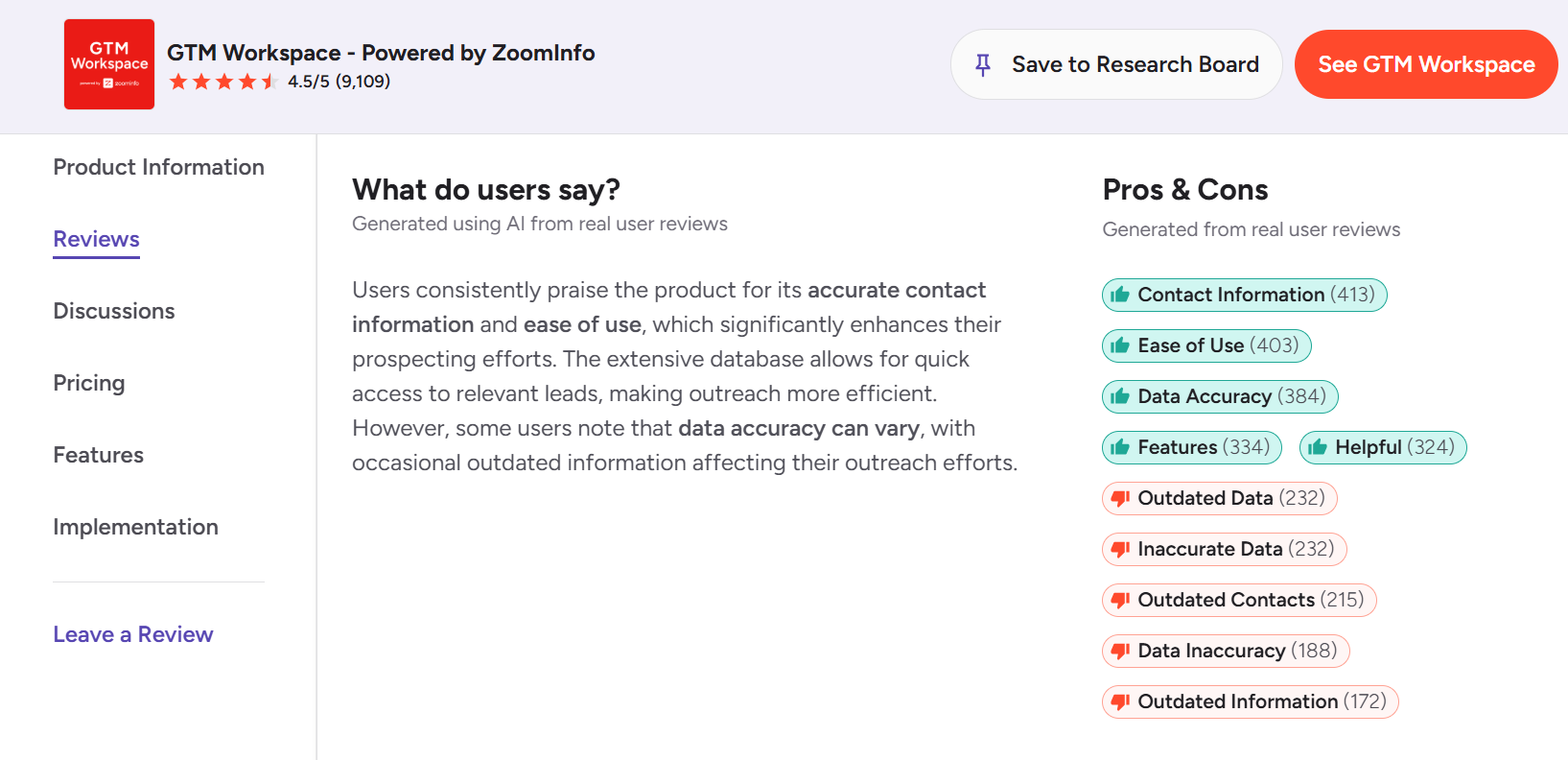
G2 rating context matters more than the star number. Cognism's roughly 4.6-star G2 rating is weighted heavily toward European reviewers. A US-only sample would likely score lower. Meanwhile, one Cognism user review put actual field accuracy in a more modest range, noting the data was roughly 70 to 80 percent accurate in day-to-day prospecting, even while calling it easy to use.
See, accuracy sentiment depends heavily on which market you're calling into. Don't trust a star rating. Run both platforms, or at minimum a trial list from both, against your actual target region before you commit to an annual contract.
Cognism vs ZoomInfo Pricing: What Does Each Actually Cost?
Neither vendor publishes pricing. Every number below comes from third-party buyer research, Vendr benchmark data, and user-reported quotes, not an official pricing page.
ZoomInfo:
- Professional: roughly $14,995/year for 3 seats and 5,000 bulk credits.
- Advanced: roughly $24,995–$30,000/year with 10,000 credits and intent data unlocked.
- Elite: roughly $39,995+/year for the full feature set.
Additional users typically run $1,425–$2,500 per seat per year depending on tier, and the median real-world ZoomInfo contract lands around $31,875/year once seats and add-ons are factored in.
Cognism:
- Grow (formerly Platinum): roughly $15,000/year platform fee plus $1,500/user/year.
- Elevate (formerly Diamond): roughly $25,000/year platform fee plus $2,500/user/year.
A solo user on Grow lands around $16,500/year. A 5-person team on Elevate runs closer to $37,500/year, and Diamond Data specifically tends to add 20–40% on top of the base platform fee.
The pricing philosophy differs more than the raw numbers do. ZoomInfo pools reveal, export, and enrichment credits together, so heavy use in one area can leave you short elsewhere. Cognism more often allows unrestricted browsing, with credits mainly consumed on exports.
Both vendors require annual contracts, both have auto-renewal clauses with a 60-to-90-day cancellation window, and both are known for quotes that climb once you're a few calls deep with sales.
Cognism vs ZoomInfo Features Compared
Intent Data and Signals
ZoomInfo's intent data is more mature. It's layered directly into SalesOS with technographic and buying-signal intelligence built out over years. Cognism offers intent data too, blended with Bombora, but it's a lighter feature set by comparison and clearly not the platform's main focus.
Data Verification Approach
ZoomInfo leans on algorithmic scanning combined with crowd-sourced data from its user community, operating at massive scale. Cognism leans on Diamond Data, its human-researched, manually phone-verified mobile numbers, at a smaller but more targeted scale.

Integrations and Workflow
Both connect natively to the major CRMs, including Salesforce and HubSpot, and to common sales engagement platforms. ZoomInfo has the broader native integration ecosystem simply because of its larger market footprint and longer time in the enterprise space.
Which Platform Should You Choose?
Match the platform to your target market and budget, not the biggest feature list on the comparison page.
Choose ZoomInfo If…
- You're a North America-focused enterprise or mid-market team.
- You have a real budget of $25K+ a year.
- You need the largest possible database and mature intent data.
- Your outbound motion and compliance needs are US-centric.
Choose Cognism If…
- You're cold calling into the UK or EU and need GDPR/DNC-compliant data.
- Phone-verified mobile numbers matter more to you than raw database size.
- You want a smaller, more compliance-safe dataset built for cold calling.
- Your budget sits below ZoomInfo's enterprise tiers.
Where Cleverly Fits: Turning B2B Data Into Booked Meetings

Cognism and ZoomInfo both solve the same core problem: getting you accurate names, numbers, and company data. What neither one does is turn that list into a conversation.
Even a perfectly verified contact still needs the right targeting strategy, the right messaging, and consistent multi-channel follow-up to actually convert into a meeting.
That's the gap Cleverly fills.
We run B2B lead generation across LinkedIn outreach, cold email, and cold calling, and we're built to work with whatever data source you already have, whether that's Cognism, ZoomInfo, or sourcing we handle ourselves. Instead of paying for a data platform and then hiring, training, and managing an in-house outreach team on top of it, you get a fully managed campaign running on data you already trust.
Our cold calling service places a dedicated, no-accent appointment setter on your account, trained and live within two weeks, using custom scripts and a power dialer built specifically for your ICP.
On the outreach side, we've helped generate 224,700+ leads and $312 million in client pipeline across LinkedIn and cold email campaigns for companies like Airbnb, DocuSign, and Loom. If you already have the data and just need the meetings, that's the part we specialize in.
Already have a Cognism or ZoomInfo subscription sitting there? Book a strategy call with Cleverly and we'll show you what an actual outreach engine looks like running on top of it.
Conclusion
Neither Cognism nor ZoomInfo is universally "better." The right pick comes down to geography, budget, and whether phone-verified accuracy or raw database scale matters more to your team.
ZoomInfo makes sense for US-focused enterprise teams with bigger budgets who need scale and mature intent data. Cognism makes sense for EU and UK-focused cold calling teams that put compliance and phone-verified data first.
Whichever one you land on, don't take the accuracy numbers on faith. Test both platforms against your specific target market before you sign a top-tier annual contract, because the same tool that performs great for one team's ICP can flop for another's, and the difference usually isn't the platform. It's the geography you're calling into.
Frequently Asked Questions
Free Resource
How to Scale a Profitable Cold Call System
Get the complete guide — download it instantly now.
Free Ebook
Download the Free Guide
Enter your details to get instant access.
You're all set! 🎉
Your ebook is downloading now.
Click below if the download didn't start automatically.


