Table of Contents
What AI Is Already Doing in Call Centers in 2026
What the 2026 Data Actually Says About AI and Call Center Jobs
Where AI Falls Short — What Human Agents Still Do Better
Which Call Center Roles Are Changing vs. Which Are at Risk
The Hybrid Model — How Leading Companies Are Using AI and Human Agents Together
What This Means Specifically for B2B Outbound Cold Calling
Why the Best B2B Cold Calling Operations Combine Human Skill With AI Infrastructure
Conclusion
Frequently Asked Questions
Modified On :
September 8, 2026
Key Takeaways
- AI is restructuring call centers, not eliminating them — it's automating the routine, predictable tier of work while human agents shift toward higher-complexity, higher-value conversations.
- The calls AI handles reliably (FAQs, routing, appointment booking, order status) and the calls humans handle best (complex disputes, sales conversations, emotionally charged issues) are distinct categories — and knowing the difference is what separates effective AI deployment from expensive disappointment.
- The hybrid model — AI for volume and structure, humans for judgment and relationships — is the architecture that currently produces the best outcomes across cost, customer experience, and conversion metrics.
- B2B cold calling is where the case for AI replacement is weakest. The persuasion, real-time objection handling, and rapport-building that drives pipeline in outbound sales still requires a human on the call.
- AI is most valuable in B2B outbound not as the caller, but as the infrastructure behind the caller — parallel dialers, real-time conversation guidance, and automated post-call logging that give human SDRs more live conversations per day without sacrificing quality.
The question has been circulating in boardrooms and on contact center floors for years: will AI replace call center agents? In 2026, with AI voice agents handling millions of calls daily and the call center AI market reaching approximately $2.98 billion, the answer is no longer theoretical — but it's also not what the headlines suggest.
The short answer is no. The full answer is more complicated.
According to Gartner, 30% of customer service interactions will be handled solely by AI agents by 2026. That sounds dramatic until you flip it: 70% of interactions still involve a human at some point in the conversation. And 79% of Americans strongly prefer interacting with a human over an AI agent — a preference that doesn't disappear just because automation improves.
What's actually happening is a restructuring, not an elimination. The types of calls agents handle, the tools they work with, and the skills that determine their value are all shifting.
Call centers that understand exactly where AI adds value — and where human judgment is irreplaceable — are pulling ahead. The ones betting on full replacement are hitting limits they didn't anticipate.
This guide covers what AI is actually doing in call centers today, what the 2026 data shows about job displacement, where AI falls short, how leading companies are building hybrid models, and what all of this means specifically for B2B outbound cold calling.
What AI Is Already Doing in Call Centers in 2026
AI in call centers isn't one technology. It's a category of tools operating at different layers of the contact center stack, each solving a different problem.
Conversational AI and Voice Agents
AI voice agents now handle inbound calls autonomously — routing, FAQs, appointment scheduling, payment processing, order status checks, and simple troubleshooting — without a human in the loop. These are the structured, high-volume, low-complexity interactions that previously required someone on the line regardless of how simple the request was.
60–80% of call volume is repetitive, and that's exactly the territory where AI is being deployed at scale in 2026. Password resets, balance inquiries, booking changes, standard complaint resolution — AI handles these consistently, without hold times, 24/7.
Real-Time Agent Assist
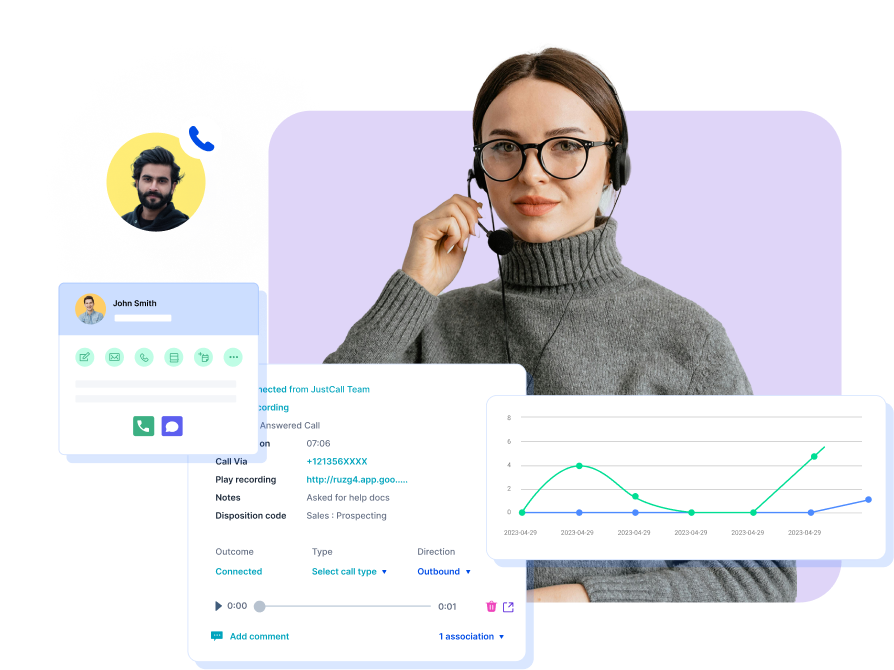
This is one of the fastest-growing AI applications in contact centers right now. Tools that listen to live calls and surface relevant information — suggested responses, compliance prompts, customer history, next-best-action recommendations — in real time, while the human agent is still on the call.
40% of support units have introduced agent assist, making it the leading AI-powered application in customer service. Organizations using it saw a 27% reduction in average handle time. The agent is still the one talking. AI is just making them significantly more effective.
Post-Call Automation
AI auto-generates call summaries, updates CRM records, and schedules follow-ups — agents can move on to the next customer instead of drowning in data entry. In high-volume environments, this alone saves meaningful hours per rep per week.
Predictive Analytics and Intelligent Routing
AI now predicts caller intent before the call is answered — routing to the optimal agent or automated flow based on customer history, sentiment signals, and request type. The result is faster resolution and fewer transfers.
The scope of what's being automated in 2026 is clear: structured, predictable call types. The remaining 30–40% of call volume — complex disputes, emotionally sensitive conversations, multi-system troubleshooting, relationship-driven interactions — still routes primarily to human agents.
📞 AI Can Make Calls. Humans Still Close Deals.
Our SDRs combine technology, training, and real conversations to book qualified meetings that automated systems often miss.
What the 2026 Data Actually Says About AI and Call Center Jobs
The data on AI replacing call centers is more nuanced than most coverage suggests. A few numbers worth sitting with:
Gartner projects conversational AI will reduce contact center labor costs by $80 billion in 2026 — but the same data shows that only one in 10 agent interactions will be fully automated. The savings come not from mass layoffs but from AI absorbing the repetitive, high-volume tasks that burn agents out.
Gartner predicts organizations will replace 20–30% of service agents with generative AI by 2026. However, 50% of organizations that planned workforce reductions are expected to abandon those plans, and 95% of customer service leaders plan to retain human agents.
That last stat matters. 95% retention isn't a transitional position — it reflects what organizations are discovering when they actually try to automate complex call types at scale. The tradeoffs become visible fast.
Estimates project a 20–30% net reduction in call center headcount by 2030, with the bulk of losses in tier-1 support roles. However, new roles are being created simultaneously — AI trainers, conversation designers, quality analysts, and AI supervisors.
Forrester predicts that 30% of enterprises will create parallel AI functions by end of 2026 — AI agent managers, AI operations specialists, escalation specialists, and conversation designers — roles that didn't exist two years ago.
The bottom line from the data: AI is reducing headcount growth and automating routine work, but it is not replacing experienced agents at scale. The organizations betting on full replacement are discovering the limits faster than the proponents predicted.
Where AI Falls Short — What Human Agents Still Do Better
Understanding whether call center agents will be replaced by AI requires being honest about where AI breaks down. And it breaks down in specific, predictable places.
Complex, Multi-Issue Calls
When a customer's problem requires judgment across multiple systems, policies, and contextual factors simultaneously, AI agents fail. They can execute defined paths — they cannot improvise across ambiguous situations the way a trained human can. The more layers a problem has, the wider the gap.
Emotionally Charged Conversations
AI can detect frustration in a caller's tone. It cannot match the judgment of an experienced agent who knows when to bend a policy, when to escalate quietly, and when to simply listen without offering a solution.
Trust and Relationship-Building

In B2B cold calling specifically, a conversation between two professionals carries relationship context — the caller's history with the company, the nuance of a long sales cycle, the subtext of an objection — that AI voice agents cannot read or respond to with the sophistication a senior rep brings to the call.
Persuasion and Negotiation
AI can follow a script. It cannot read buying signals, pivot mid-conversation based on tone and hesitation, or adapt a value proposition in real time based on what a prospect reveals about their situation. Human persuasion — the kind that moves a complex B2B sale forward — still requires a human.
Edge Cases and Gray Areas
Consumers feel that humans are better at solving complex issues, multiple issues, billing concerns, and technical problems. AI is trained on patterns. It fails at situations outside the pattern: complex disputes, regulatory edge cases, cultural nuances, and situations where "the right answer" requires judgment beyond the training data.
63% of customers don't believe AI could ever replace human beings in customer service roles. That sentiment reflects real experience with what AI does and doesn't handle well.
🚀 1M+ Cold Calls. 53,000+ Appointments.
See why companies still trust experienced sales reps when revenue—not just efficiency—is the goal.
Which Call Center Roles Are Changing vs. Which Are at Risk
Not all call center roles face the same level of disruption. The picture is more segmented than "AI replaces agents."
1. Roles at highest risk of automation: Tier-1 inbound support for structured, predictable queries — order status, basic troubleshooting, appointment booking, FAQ-type interactions. These are the calls where AI performs comparably to a human and the ROI on automation is clearest. Tier-1 call center tasks have been automated by AI as of 2026 at increasing rates — up from roughly 15% in 2023.
2. Roles transforming rather than disappearing: Outbound sales, complex account management, B2B relationship calling, and escalated support. These require human judgment, persuasion, and emotional intelligence that AI can't reliably replicate. Agents in these roles are shifting from handling volume to handling complexity — and becoming more valuable in the process.
3. The agent-assist opportunity: Agents who work alongside AI tools — using real-time suggestions, automated post-call logging, and AI-generated prep briefs — are becoming significantly more productive. Agents using AI copilot tools handle more cases per hour with higher customer satisfaction scores. A human augmented by AI outperforms either alone on the call types that require both speed and judgment.
4. New roles being created: Call center AI is generating demand for conversation designers who build and optimize AI call flows, AI quality analysts who review transcripts for failures and edge cases, and human escalation specialists who handle the calls AI couldn't resolve. Many former tier-1 agents are moving into these roles. Those QA-focused roles run on structured evaluation criteria, which is why most teams start from a proven call center agent scorecard rather than building review forms from scratch.
The skills that appreciate in value as routine work automates: judgment, empathy, adaptability, and domain expertise. Agents who develop these are more valuable in an AI-augmented contact center, not less.
The Hybrid Model — How Leading Companies Are Using AI and Human Agents Together

The hybrid model isn't a compromise or an interim measure. It's the architecture that currently produces the best outcomes across cost, customer experience, and conversion metrics.
Hybrid AI-human models outperform pure AI by a significant margin, achieving higher resolution rates and customer satisfaction when AI handles routine tasks while humans manage complexity.
How the division of labor works in practice: AI handles the first tier — routing, FAQs, structured requests, data capture. Humans handle the second tier — complex issues, sales conversations, relationship management, escalations. The handoff between AI and human is the critical design point. Done well, it's invisible to the caller. Done poorly, it's the most frustrating moment in the entire interaction.
AI Handles High-Volume, Structured Calls
The economics are clear for structured call types. AI voice agents cost $0.07–$0.15 per minute versus $29–$42 per hour for a U.S.-based human agent. Most contact centers see 30–50% cost reduction on the call types they automate.
What this frees up is significant. When routine calls are handled by AI, human agents stop spending the majority of their day on low-complexity, repetitive interactions. They concentrate on the conversations where their judgment, relationship skills, and persuasion actually matter.
Two metrics tell you whether your AI automation is working: containment rate (percentage of calls fully resolved by AI without escalation) and customer satisfaction on AI-handled calls. If containment is high but satisfaction is low, you're routing dissatisfied customers to a longer queue — not solving the problem.

Humans Handle Complex, Relationship-Driven, and Outbound Conversations
The calls that remain human in the hybrid model are the ones with the highest consequence: large account disputes, B2B sales conversations, complex negotiations, emotionally sensitive support — situations where getting it wrong is expensive.
Outbound calling is a particularly human-dominated domain. Cold calling, prospect qualification, and consultative sales require the ability to listen for subtext, adapt to objections in real time, and build enough trust across a cold conversation to get to a second one. AI can approximate aspects of this, but not at the level that drives conversion in high-ACV B2B contexts.
The output difference shows up in the data: human agents on complex calls close at higher rates, generate larger deal sizes, and produce better satisfaction scores than AI on equivalent conversations. The ROI of human agents in these contexts remains strong, which is why the data shows retention, not replacement.
AI Augments Human Agents in Real Time
The fastest-growing AI application in call centers isn't replacing agents — it's making them better while they're on the call. Real-time transcription, suggested responses, objection handling prompts, compliance alerts, and customer history surfaced automatically during the conversation.
An agent picks up a complex escalation call. AI immediately surfaces the customer's full interaction history, the category of issue, the recommended resolution path, and relevant policy language.
The agent spends the call solving the problem — not hunting for the information. Organizations pairing agents with AI handle 7.7% more simultaneous interactions and see an average of $4.3 million in staffing cost savings.
What This Means Specifically for B2B Outbound Cold Calling
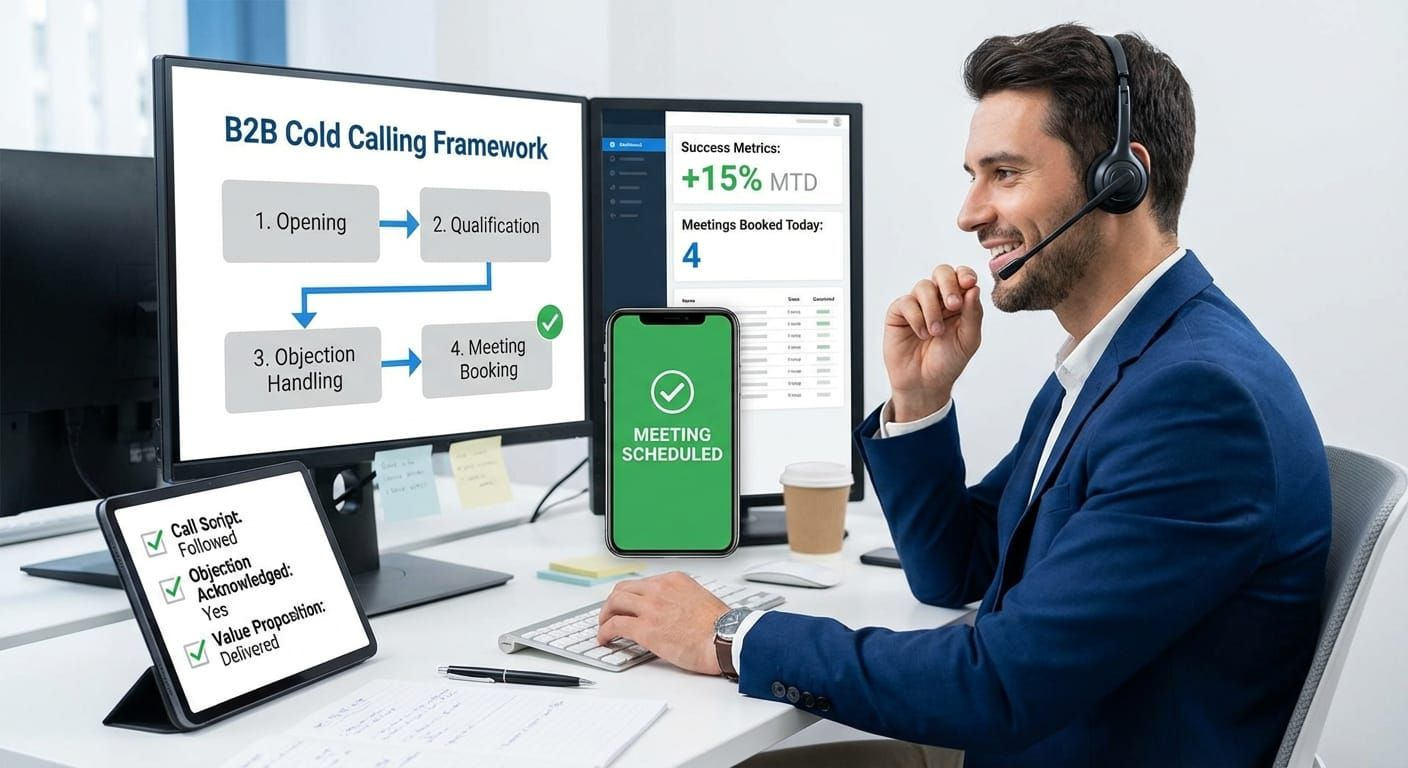
B2B cold calling is the domain where the "AI replacement" argument is weakest — and the data reflects this clearly.
The skills that drive conversion in B2B outbound are precisely the ones where human agents hold the largest advantage over current AI: reading buying signals, adapting the pitch to what a prospect reveals mid-call, handling sophisticated objections, and building enough rapport in three minutes to earn a second conversation. These aren't automatable in any meaningful sense at the performance level B2B deals require.
AI is being used in B2B cold calling as infrastructure, not as the caller. Parallel dialers powered by AI that connect reps only to live humans — eliminating dead time on voicemails and disconnected numbers.
AI role-play training that simulates prospect objections before reps dial. Real-time conversation frameworks that surface relevant talking points without scripting the call. Post-call AI summaries that update the CRM automatically.
The productivity math is real: a human SDR using AI-assisted parallel dialer infrastructure has 3–4x more live conversations per day than a rep using manual single-line dialing — without any reduction in conversation quality. The human is still on the call. AI is eliminating the dead time between conversations.
AI voice agents conducting B2B cold calls currently convert at significantly lower rates than trained human SDRs on equivalent prospects. The nuance required to navigate a cold B2B conversation — the listening, the adaptation, the real-time judgment — still favors the human, and the ROI of human-led cold calling in the B2B context remains strong.
Where AI will eventually close the gap: high-volume, low-complexity B2B outreach — basic qualification calls, appointment confirmations, reactivation of dormant leads with simple scripts. Not the consultative, complex sales conversations that drive pipeline for high-ACV B2B products.
Why the Best B2B Cold Calling Operations Combine Human Skill With AI Infrastructure
At Cleverly, we've built exactly this model — and it's what separates consistent pipeline generation from the kind of AI-first cold calling experiments that produce mediocre conversion rates at scale.
We deploy dedicated human SDRs who handle the conversation — the persuasion, the objection handling, the reading of buying signals, the rapport-building that converts a cold prospect into a booked meeting.
AI handles the infrastructure: an AI-powered parallel dialer that connects SDRs to 200–300 decision-maker conversations per day, role-play training that sharpens objection responses before reps go live, real-time conversation frameworks that guide the call without scripting it, and automated post-call CRM updates that eliminate manual logging entirely.
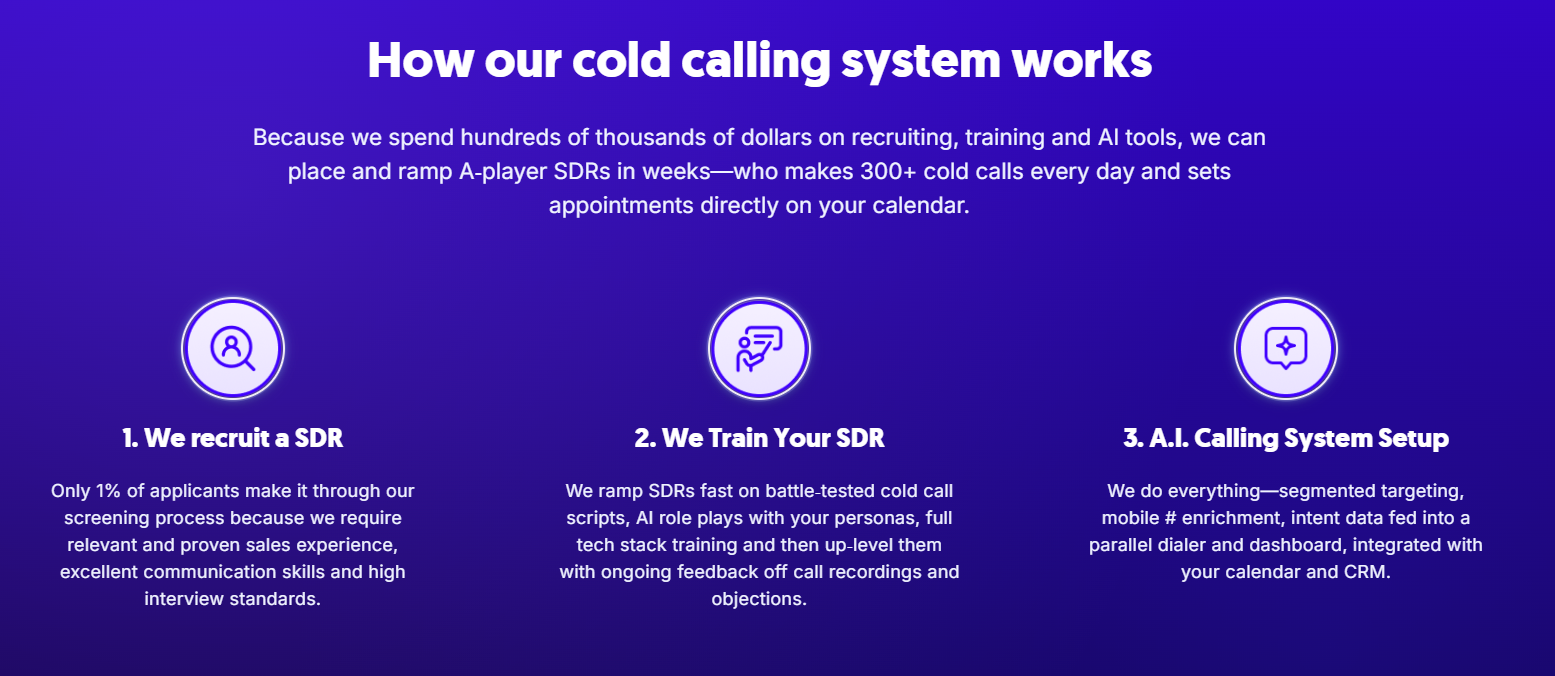
Every conversation at Cleverly is human. That's not a positioning statement — it's why our clients get 10–40 booked appointments per month. Qualified human SDRs are having real conversations with real decision-makers. The AI makes those humans dramatically more productive. It does not replace them.
Our clients include eBay, Airbnb, DocuSign, Loom, and Airtable. Across 10,000+ clients, we've generated $312M in pipeline and $51.2M in closed revenue — results built on human-led outbound execution, not AI voice agents running at scale.
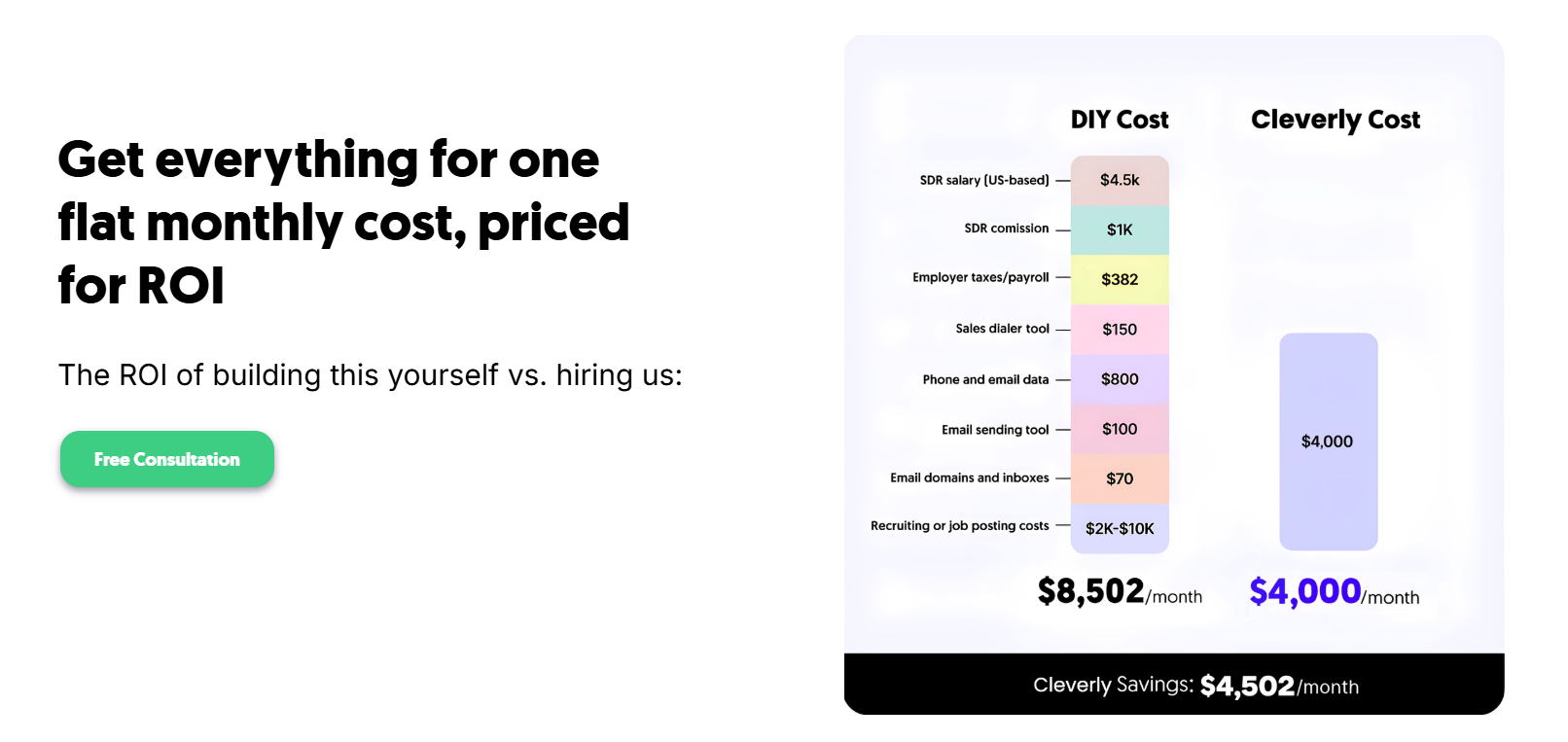
Our cold calling services is priced at flat $4000/month, covering 10–40 qualified appointments per month with a dedicated SDR, parallel dialer, call recordings, and a guaranteed free SDR replacement if targets aren't met. We're rated 4.6/5 on Trustpilot across 1,136+ reviews.
If you want to see what human-led, AI-assisted cold calling produces for a B2B pipeline, book a strategy call with Cleverly and see the model in action.
Conclusion
The data in 2026 gives a clear answer: AI will not replace call center agents wholesale. It will absorb the routine, structured portion of call center work while transforming the role of agents who handle everything else. That's a meaningful shift — but it's not the replacement story the headlines have been telling.
The organizations getting this right aren't asking "AI or humans?" They're asking which calls AI should own, which calls humans should own, and how to use AI to make human agents more effective on the calls that require them.
For B2B outbound cold calling specifically, the human advantage in complex sales conversations remains significant — and the smartest use of AI in this context is as infrastructure that gives human SDRs more live conversations per day, not as a replacement for the person doing the talking.
Frequently Asked Questions
Free Resource
How to Scale a Profitable Cold Call System
Get the complete guide — download it instantly now.
Free Ebook
Download the Free Guide
Enter your details to get instant access.
You're all set! 🎉
Your ebook is downloading now.
Click below if the download didn't start automatically.