Table of Contents
What Is Saleshandy?
Saleshandy Features Breakdown
Saleshandy Pricing: What Does It Actually Cost?
Saleshandy Pros and Cons
What Real Users Are Saying About Saleshandy in 2026
Saleshandy Alternatives Worth Considering
How Cleverly Approaches Cold Email Differently
Conclusion
Frequently Asked Questions
Modified On :
May 13, 2026
Key Takeaways
- Saleshandy's biggest differentiator is unlimited email account connections on every plan — a structural advantage for agencies and high-volume senders that competitors charge extra for.
- The advertised $25/month Starter price climbs to $83+/month once you add Lead Finder and Inbox Placement Testing — budget for that from day one.
- CRM integrations (HubSpot, Salesforce, Pipedrive) are locked behind the Pro plan at $74/month, making Starter effectively non-functional for teams that need CRM sync.
- Warm-up runs through TrulyInbox, a separate product — 54 G2 mentions flag warm-up reliability as an ongoing concern, particularly around scores not reflecting real inbox placement.
- Saleshandy is email-only with no native LinkedIn or calling steps — teams running multi-channel outbound will need additional tools or a different solution entirely
Cold email tools have never been more crowded. And Saleshandy has managed to carve out a real position in that space — more than 2,600 reviews across G2, Trustpilot, and Capterra don't happen by accident.
The platform holds a 4.6 out of 5 rating on G2 from 747 verified reviews and a 4.7 on Trustpilot from over 700 reviews.
The core appeal is clear: unlimited email account connections, affordable entry pricing, and a built-in B2B lead database that lets you prospect and sequence from one place.
But aggregate ratings hide a lot. The frustrations that show up in the reviews — warm-up reliability, UI complexity at scale, CRM access gated behind higher tiers, and an add-on cost model that stacks up fast — are worth understanding before you commit to a platform you'll be running live campaigns through.
This review breaks down every Saleshandy feature, the real cost of a functional setup, honest pros and cons based on what 2,600+ users actually say, the best alternatives in 2026, and a clear verdict on who Saleshandy is actually right for.

What Is Saleshandy?
Saleshandy started as a basic Gmail tracking extension. It's grown into a full cold email platform built specifically for outbound sales teams.
Founded in 2015 by Dhruv Patel and entirely bootstrapped with zero external funding, Saleshandy has attracted over 200,000 registered users worldwide.
The positioning is outbound-first: automated email sequences, multi-sender rotation across unlimited connected accounts, built-in email verification, reply management through a unified inbox, and a native B2B lead finder.
The pitch is doing all of that from a single platform without paying Apollo or ZoomInfo prices on top.
The platform covers the full outbound workflow — automated sequences, multi-sender rotation, a unified inbox for reply management, built-in email verification, and a native lead finder with 700M+ contacts.
Who uses it most: solo founders doing light outreach, SDR teams running high-volume campaigns across multiple mailboxes, cold email agencies managing multiple clients, and growth marketers who want prospecting and sending in one place.
📩 Saleshandy Sends Emails. We Book You Meetings.
Skip setup, warmup, and campaign management headaches. You only pay for qualified meetings we deliver.
Saleshandy Features Breakdown
Here's every core feature reviewed on what it does, how well it works, and where the real limitations are.
Cold Email Sequence Automation
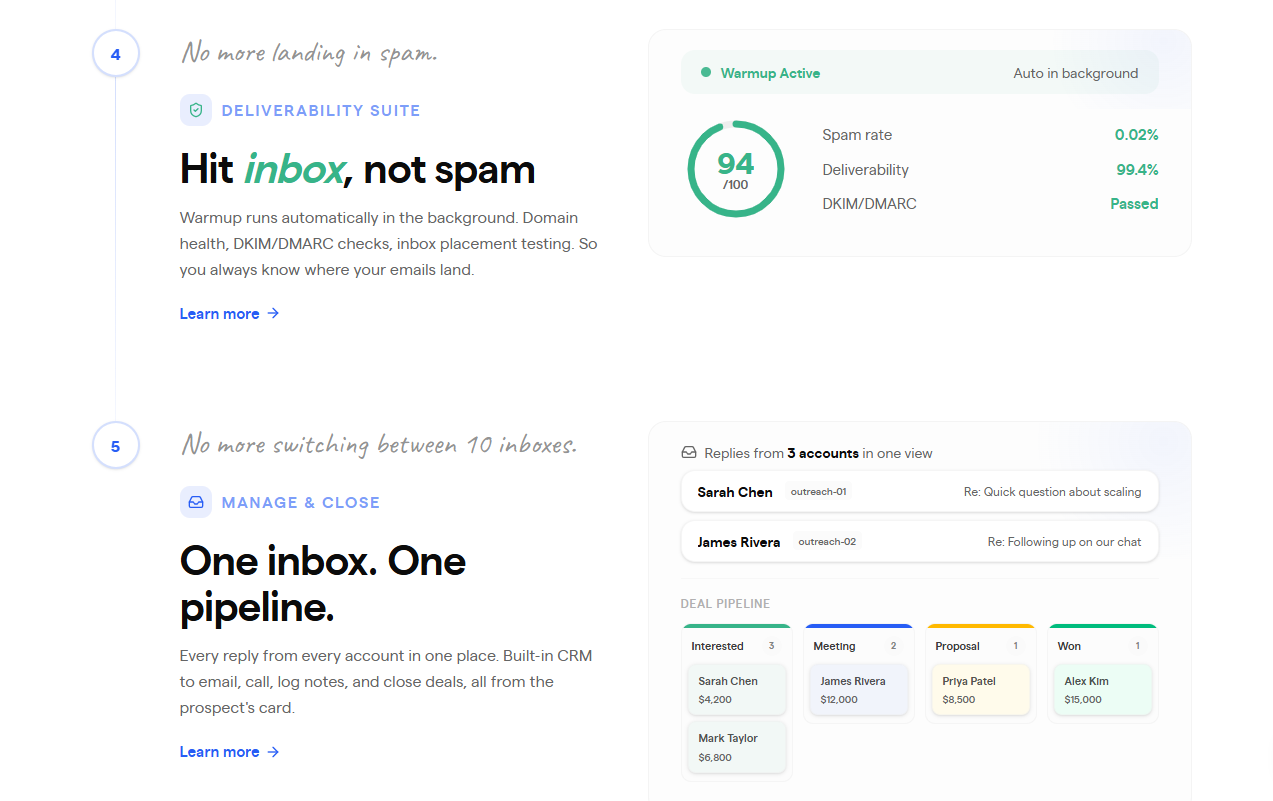
The sequence builder is where most users spend most of their time, and it's genuinely solid for the price point.
You get multi-step sequences with automated follow-up logic, conditional branching based on opens, clicks, or replies, Spintax support for message variation at scale, and A/Z testing. A/Z testing is available on Pro and higher plans and supports up to 26 variants for subject lines, content, and CTAs — more testing flexibility than most tools at this price offer.
Schedule-based and time-zone-aware sending helps keep delivery timing reasonable across geographies. The AI Sequence Copilot auto-generates subject lines and follow-ups to speed up campaign setup, though quality varies.
The hard limitation: Saleshandy is email-only. There are no native LinkedIn steps, no calling tasks that auto-execute, and no SMS. You can add manual tasks for other channels inside sequences, but nothing runs automatically. If multi-channel sequences are part of your outbound motion, you'll need a separate tool for LinkedIn and calling.
Unlimited Email Account Connections + Sender Rotation

This is Saleshandy's most defensible advantage and the feature that drives most of the agency adoption.
Every plan — including the $25/month Starter — includes unlimited connected email accounts. Most competitors either cap inbox connections or charge per mailbox added. For operations running 10+ sending domains, this eliminates per-account fees that competitors charge.
Sender rotation automatically distributes sends across connected mailboxes to stay within per-inbox limits and protect domain reputation. It mimics human sending patterns to avoid getting flagged. If one email gets flagged, your entire campaign still runs.
Supports Gmail, Outlook, and any SMTP/IMAP provider.
Limitation: Managing a large number of inboxes within the UI becomes unwieldy. I've seen setups with 20+ sending accounts rotating automatically — something that would cost significantly more on Instantly or Lemlist — but the interface wasn't built for that level of inbox management at scale.
Email Warm-Up (Powered by TrulyInbox)
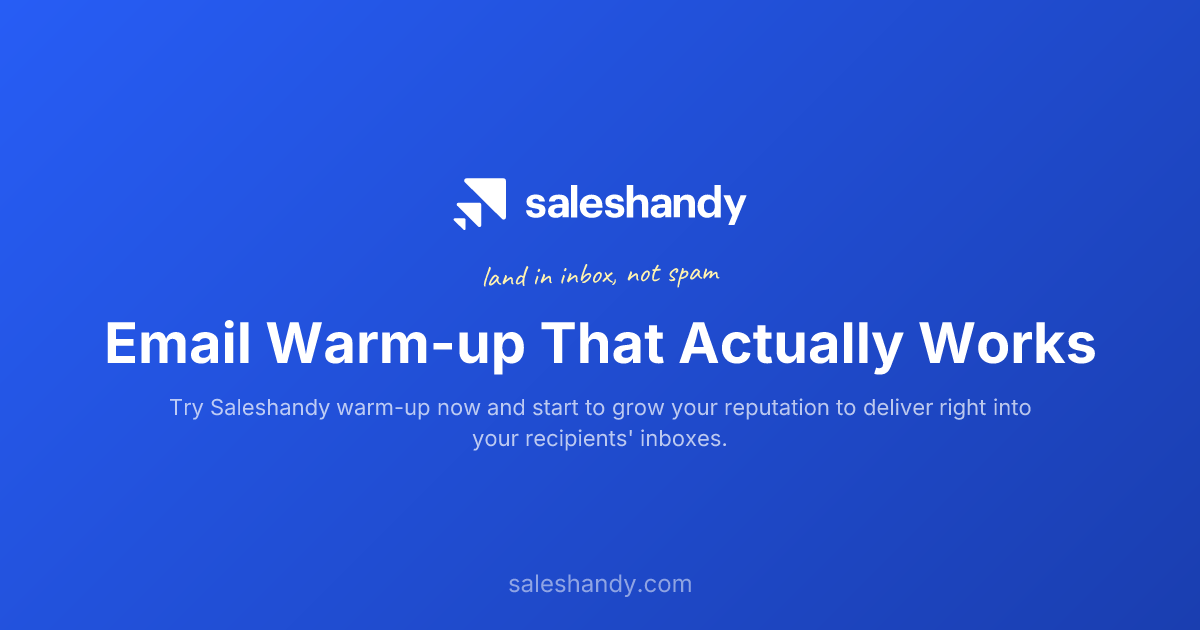
Saleshandy markets itself as all-in-one, but warm-up runs through TrulyInbox — a separate platform requiring a separate login.
The warm-up itself is automated inbox-to-inbox engagement designed to build sender reputation before campaigns launch. For beginners, the set-and-forget interface works. For teams that want tight control over warm-up settings and a single dashboard for everything, the TrulyInbox dependency is a real friction point.
The more important issue is accuracy. G2 shows 54 warm-up-related complaints, and the consensus on r/coldemail is that warm-up scores don't reflect real inbox placement — more of a bait-and-switch for users expecting an integrated platform.
TrulyInbox warm-up is included but isn't as established as Instantly's network. Email deliverability monitoring is basic — bounces, opens, replies — without inbox placement testing or detailed reputation dashboards.
If deliverability is your top priority, this is the area where Saleshandy shows the most risk.
Lead Finder (B2B Contact Database)

Saleshandy's Lead Finder gives you access to a database of 700M+ professional contacts and 60M+ company profiles with real-time email verification. Filters cover role, industry, company size, location, and technology used. You can export to CSV or push directly into email sequences without leaving the platform.
That all-in-one prospecting flow is genuinely useful for teams that would otherwise pay separately for Apollo or ZoomInfo.
What to know about data quality: US and European contacts are reasonably accurate. Other regions are hit-or-miss. Always verify emails before sending — don't trust the database blindly.
What to know about pricing: Lead Finder credits let you reveal verified contact information. You are not charged credits unless Saleshandy can find verified contact information, and unused credits roll over. That rollover policy is a genuine user-friendly move. But the Lead Finder subscription is a separate add-on starting at $49/month annual — not included in your base outreach plan.
Unified Inbox for Reply Management

The unified inbox aggregates replies from all connected sending accounts into one view. Smart filters sort by sentiment: interested, not interested, out of office, referral. AI categorizes responses automatically, helping you stay organized across high-volume campaigns.
AI-assisted reply suggestions are available on higher tiers.
Limitation: UI for managing replies across a large volume of accounts at scale has been flagged as confusing. The platform tries to do a lot — email sequences, lead finder, email tracker, document tracking — and the interface can feel busy. The unified inbox works well at moderate volume; it gets messy fast as account count grows.
Email Tracking
Real-time tracking for email opens, link clicks, and document engagement. The document tracking feature — knowing when a prospect opens a proposal or case study — is genuinely useful for timing follow-ups.
Works across Gmail and Outlook via Chrome extension for one-off tracked emails outside sequences.
Limitation: Open rate data is increasingly unreliable as a standalone metric. Apple Mail Privacy Protection and similar privacy changes have made open rate signals noisier across the board. Saleshandy's tracking isn't unique in facing this challenge, but teams relying on opens as their primary engagement signal will run into problems regardless of platform.
Email Verification
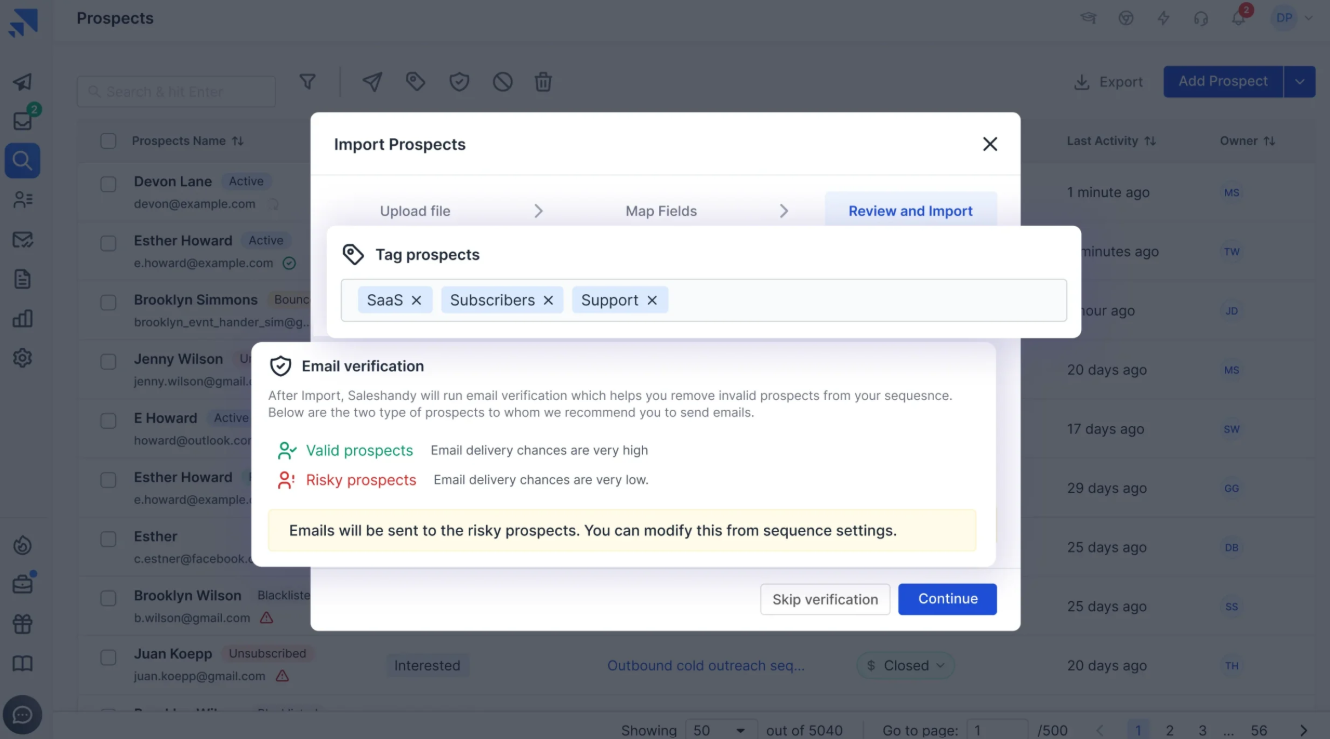
Built-in email verification is included with paid plans. You are not charged credits unless Saleshandy can find verified contact information.
It reduces bounce rates and protects sender domain reputation before campaigns launch. Heavy users will consume credits quickly and need to purchase additional verification credits beyond base plan pricing.
Analytics and Reporting

Campaign-level analytics cover open rate, click rate, reply rate, bounce rate, and unsubscribe rate. Sequence-level and step-level breakdowns let you identify which touchpoint is losing prospects.
The analytics dashboard has been called "alarmingly basic" with no deep customization or cross-channel reporting. Reporting is focused on email metrics without deeper pipeline attribution. There's no revenue attribution — you can't connect email engagement to closed deals without a separate CRM integration.
For agencies managing multiple clients, there's no native client-facing reporting dashboard. You're exporting CSVs and building your own reports.
Inbox Placement Testing

Inbox placement testing shows you where your emails actually land — Primary, Promotions, or Spam — in real time by sending test emails to real B2B email accounts. A forever-free plan lets you run 2 tests per month. Paid plans start at $34/month and include 120 tests.
Checks SPF, DKIM, DMARC, and domain and IP reputation against blacklists. Valuable for teams serious about deliverability.
The add-on model means many users skip it entirely and run campaigns without visibility into where their emails are actually landing.
CRM Integrations

Native CRM integrations with Salesforce, HubSpot, Pipedrive, and Zoho are only available on the Pro plan at $69/month and above. The Starter plan has zero integrations — no API, no webhooks, no CRM sync.
This is one of the most-cited complaints in user reviews. Teams that built their evaluation around a $25/month tool that connects to their CRM will find out the hard way that the real entry point for CRM functionality is $74/month.
Saleshandy Pricing: What Does It Actually Cost?
Saleshandy updated their pricing recently. Let’s understand everything in detail
Saleshandy New Core Plans (Annual Billing)
Saleshandy's pricing tiers are: Starter at $25/month, Pro at $69/month, Scale at $139/month, and Scale Plus at $169/month. All plans include unlimited email account connections.
A few things worth flagging before you read those numbers at face value:
Every outreach plan includes free Lead Finder credits — 100 on Starter, 500 on Pro, and 1,000 on Scale. These let you pull verified contacts directly from Saleshandy's 700M+ database without needing a separate Lead Finder subscription to get started. That said, 100 credits disappears fast in a real prospecting session. Teams running volume outreach will need the standalone Lead Finder plan (billed separately) to maintain a consistent prospecting workflow.
The "unlimited prospects" language in Saleshandy's docs refers to total imports, not active sequences. Every plan lets you hold up to 30x your active prospect limit in your account — so Starter's 2,000 active cap means you can store 60,000 total contacts, but only 2,000 can be running in live sequences at any given time.
Email verification credits are one-time credits included at signup. They do not renew monthly. Once you burn through them, you purchase additional credits separately.
CRM integrations — Pipedrive, Zoho, Salesforce, Zapier, and Webhooks — are not available on the Starter plan. They unlock at Pro.
The Starter plan also limits the Unified Inbox to the last 15 conversations only, with no reply or forward functions. For any real reply management, Pro is the practical floor.

Lead Finder — Separate Subscription (For Higher Volume)
The free credits included with each outreach plan give you a starting point. But if your team is prospecting consistently at volume, you'll need the standalone Lead Finder subscription on top of your outreach plan:
Credit usage: 1 email reveal = 1 credit. Email + phone = 7 credits. 50% of unused credits roll over each billing cycle. Credits are only deducted when verified contact details are actually found — if an email comes back invalid, credits are refunded automatically.
That's a genuinely user-friendly policy that most competitors don't match.
What a Functional Setup Actually Costs
The $25/month Starter plan is real. It's also limited enough that most outbound programs will outgrow it within the first campaign — the 6,000 emails/month ceiling, 2,000 active prospect cap, no CRM sync, and restricted Unified Inbox make it genuinely entry-level.
Here's what a realistic monthly cost looks like for a small team running cold email at actual volume:
- Outreach Pro (annual): $69/month
- Lead Finder — Lead Starter (annual): $49/month
- Inbox Placement Testing: $34/month
- Verification credits top-up: Variable, budget $20–40/month at moderate volume
Realistic functional cost: ~$172–$192/month before infrastructure and AI credit usage.
That's not a knock on the platform — most cold email tools at this feature depth cost more. But teams budgeting against the $25 Starter headline will find a real gap between what they expected to spend and what a properly configured outreach program actually requires.
For agencies: the Outreach Scale plan ($139/month annual) unlocks white-label features and expands sender rotation up to 1,000 email accounts per sequence — which is where Saleshandy's unlimited-inbox model starts generating meaningful cost savings versus per-inbox competitors.
🚀 Tools Create Activity. Outbound Creates Revenue.
We run cold email end-to-end—targeting, copy, sending & optimization. More replies. More calls. Zero busywork.
Saleshandy Pros and Cons

Pros
- Unlimited email account connections on every plan — best-in-class for volume senders and agencies.
- Affordable entry pricing at $25/month — significantly undercuts per-seat competitors.
- A/Z testing with up to 26 variants — more testing flexibility than most tools at this price.
- 700M+ contact database with Lead Finder — prospecting and outreach in one platform without paying Apollo prices.
- Sender rotation built-in — protects deliverability at scale without manual configuration.
- Ease of use is the single most-cited positive attribute on G2 — mentioned 239 times across reviews. New users can reportedly master the interface in about 15 minutes.
- Bounce Guard automatically pauses sequences when bounce spikes are detected, protecting domain reputation in real time.
- Agency-friendly flat-rate pricing — unlimited clients included at higher tiers, no per-client surcharges.
Cons
- CRM integrations locked behind Pro ($74/month) — Starter users get no CRM sync, no API, no webhooks.
- Warm-up analytics unreliable — warm-up scores through TrulyInbox don't consistently reflect real inbox placement.
- UI/UX complexity at scale — 115 G2 mentions flag interface issues as the most frequent complaint.
- Email-only platform — no native LinkedIn, calling, or SMS steps in sequences.
- Lead data quality inconsistent — especially outside US and European markets.
- Deliverability can degrade at high volumes — one G2 reviewer reported open rates dropping to 25% with domain reputation damaged.
- Reporting lacks depth — no pipeline attribution, cohort analysis, or agency-ready client dashboards.
- Add-on cost model stacks up fast — true functional cost is 2-3x the advertised base plan price
What Real Users Are Saying About Saleshandy in 2026
Saleshany G2 Reviews Summary

On the positive side, G2's AI summary quantifies the praise: ease of use leads with 259 mentions, followed by deliverability-related praise at 195 mentions and customer support quality at 117 mentions. People find the platform intuitive to set up and appreciate the support team when things go sideways.
The complaints tell a different story. UI/UX issues are the most frequently cited con theme on G2 at 115 mentions, followed by missing features at 88 mentions, warm-up issues at 54 mentions, and pricing/credits frustrations at 44 mentions. That's a significant complaint volume for a tool that touches live campaigns.
Saleshany Trustpilot Reviews Summary
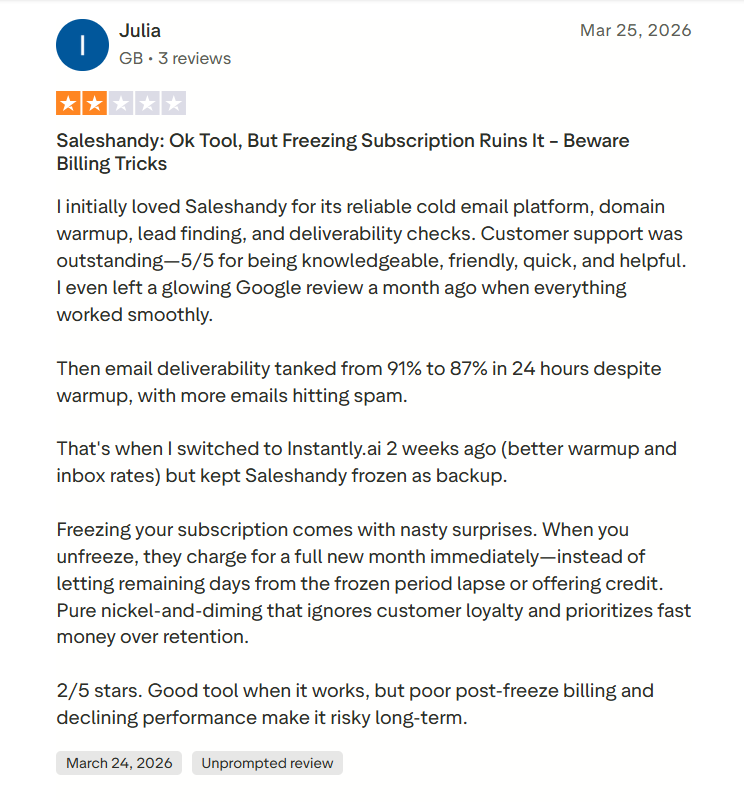
On Trustpilot, negative reviews cluster around bugs impacting live campaigns — emails sent in incorrect formats after UX updates and placeholder variables breaking mid-sequence. That's not a minor UX gripe. Broken variables mid-campaign mean prospects receive malformed emails, which directly damages reply rates and domain reputation.
Saleshandy Reviews on Reddit
Reddit sentiment is more nuanced. Users praise Saleshandy for its scalability, agency features, and email deliverability. The warm-up dependency on TrulyInbox comes up repeatedly as a friction point, particularly for teams that expect everything in one place.
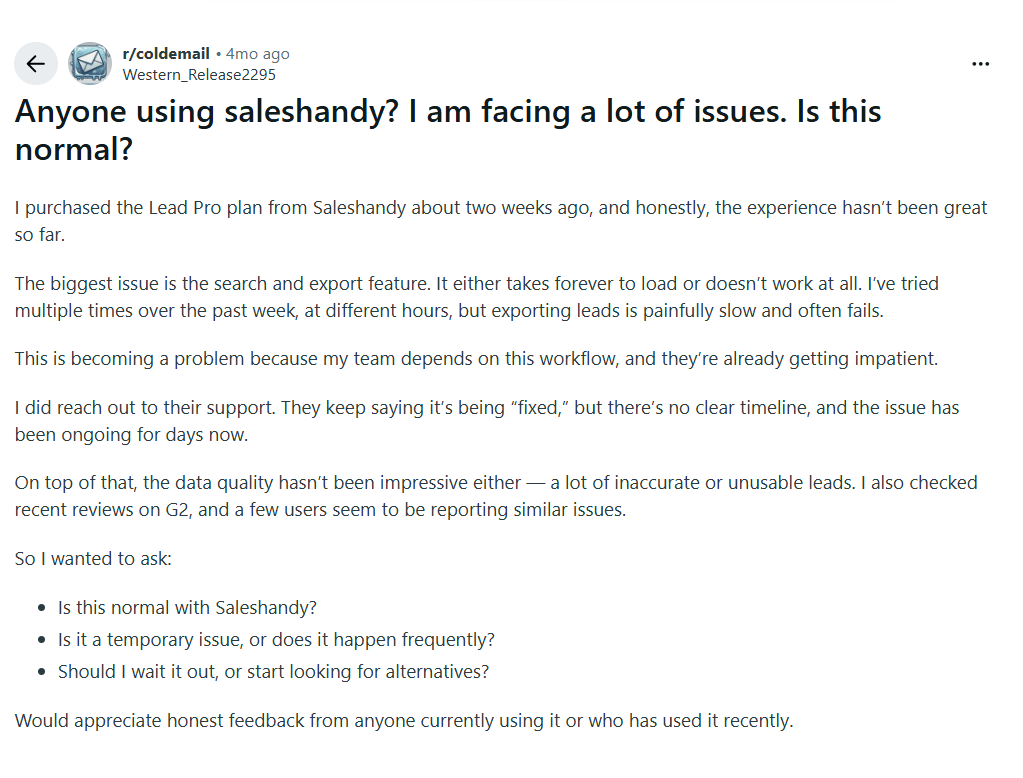
The pattern is consistent across platforms: Saleshandy scores well on initial setup and cost. The frustrations emerge at scale — when deliverability precision, data quality outside English-speaking markets, and reporting depth become critical to campaign performance.
Saleshandy Alternatives Worth Considering
1. Instantly.ai

Instantly is the closest all-in-one competitor. Unlimited sending accounts, a larger warm-up network, AI sequence builder, and Unibox reply management.
Instantly's advantage is its warm-up network (included free) and its slightly cleaner UI. The deliverability tooling is more reliable at scale than Saleshandy's TrulyInbox setup.
Add-on pricing structure is similar — true cost requires stacking plans. Better UI and client-reporting features than Saleshandy; weaker value at the base pricing tier.
Best fit: Teams that want a more polished experience with stronger warm-up infrastructure and can absorb higher cost at scale.
2. Smartlead

Strong alternative for high-volume senders. Unlimited accounts, inbox rotation, and behavioral follow-up logic across all plans. Smartlead charges $29/month per additional client — a real cost for agencies compared to Saleshandy's unlimited-client model on higher tiers.
More flexible pricing tiers with fewer gaps between sending volumes. Better multi-client management for agencies at the backend workflow level.
Best fit: Agencies running outreach for multiple clients who prioritize deliverability controls and don't need the Lead Finder integration.
3. Lemlist

Best for personalization-heavy outbound. Dynamic images, video thumbnails, and liquid syntax personalization go significantly further than Saleshandy's merge tags and Spintax. Multi-channel: cold email + LinkedIn + cold calling sequences in one workflow.
Stronger brand recognition and community. Per-user pricing model gets expensive fast for growing teams.
Best fit: Teams whose outreach relies heavily on personalization and native multi-channel sequences.
4. GMass

Built directly inside Gmail. Zero platform switching. Ideal for high-volume Gmail senders who want maximum simplicity.
Lacks the advanced sequence logic, warm-up tools, and database features Saleshandy offers. Not suitable for teams running multi-inbox rotation or agency-scale operations.
Best fit: Solo senders or very small teams who want no-frills Gmail-native cold email at scale.
If you're evaluating these tools and wondering whether managing cold email in-house is the right call at all — that's a different conversation. See how Cleverly handles it end-to-end.
How Cleverly Approaches Cold Email Differently
Running cold email in-house with any tool — Saleshandy included — requires real expertise across copywriting, deliverability, data sourcing, sequence optimization, and ongoing campaign management.
The platform is just the infrastructure. Everything that makes cold email actually work lives outside the software.
At Cleverly, we build and run complete cold email systems for B2B companies — from ICP targeting and verified list building to copy, sequencing, inbox management, and reply handling.
The difference is that we bring strategy, execution, and optimization, not just platform access. No warm-up troubleshooting, no sequence debugging, no credits management on your plate.
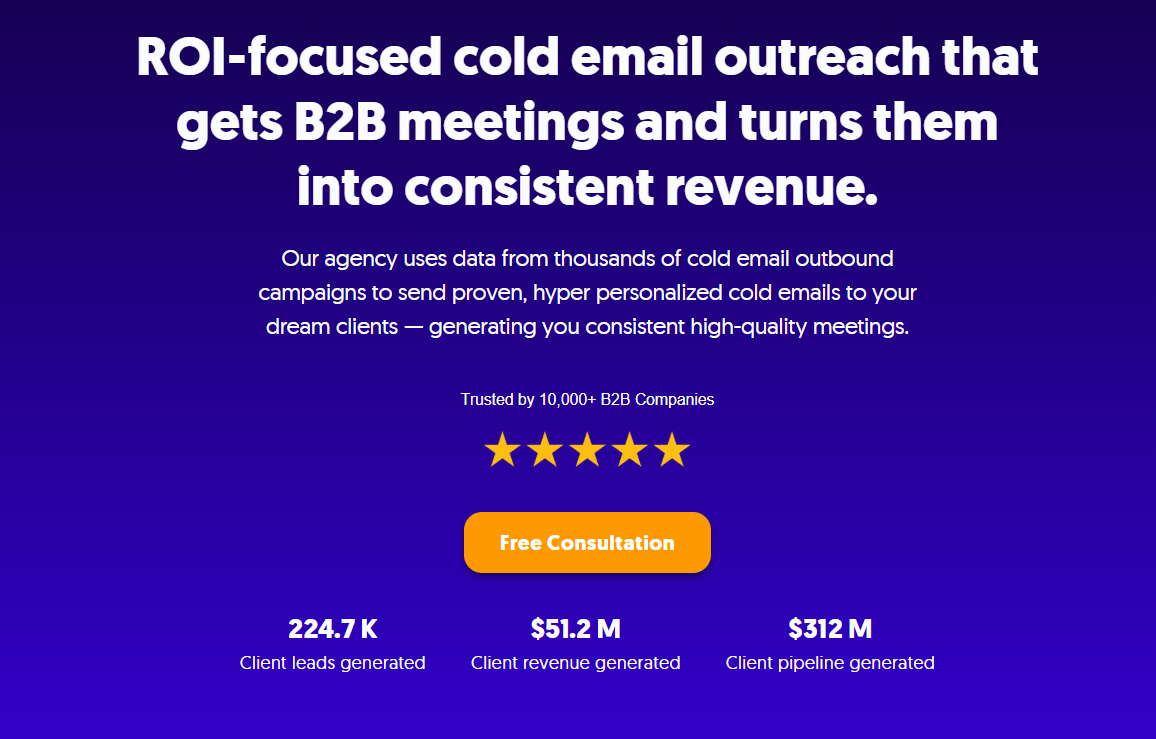
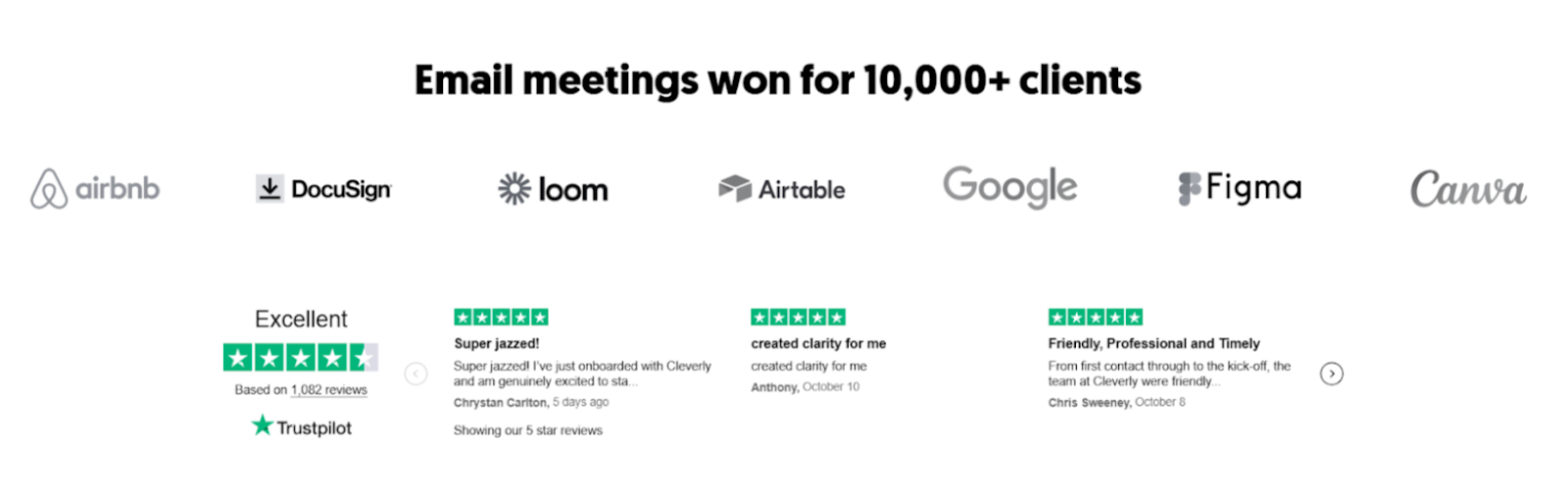
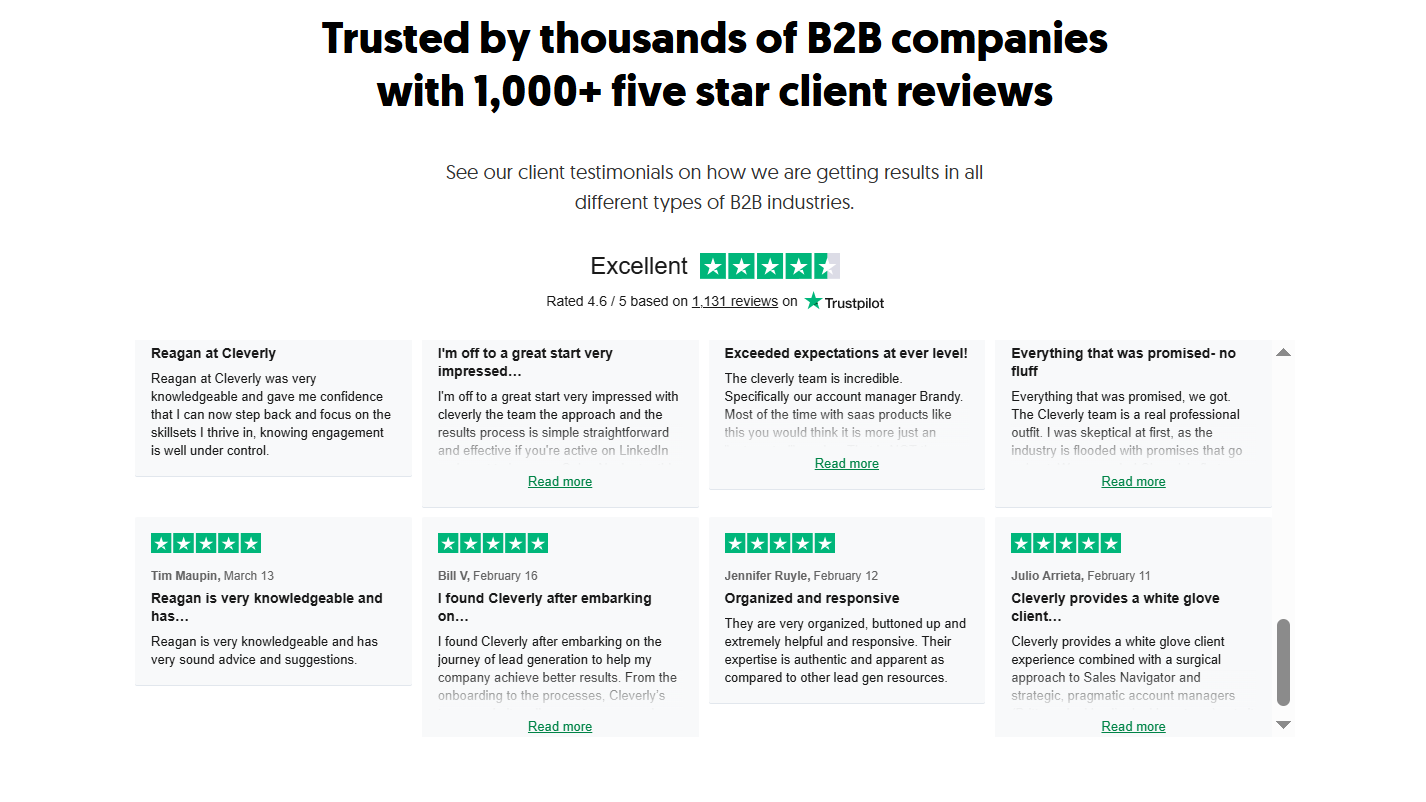
We've worked with 10,000+ clients across companies like Amazon, Google, Uber, PayPal, Slack, and Spotify — generating $312M in pipeline revenue and $51.2M in closed revenue.
Our cold email model is performance-driven: you only pay for meeting-ready leads we send you. That's a fundamentally different risk profile than managing a Saleshandy subscription, lead finder add-on, inbox placement testing, and verification credits on your own while hoping the sequence converts.
For B2B companies that have tried tools like Saleshandy, know their offer works, and want a reliable pipeline system without the execution overhead — this is what done-for-you cold email outreach actually looks like.
Want cold email handled end-to-end by a team that lives in this space?
Book a strategy call with Cleverly.
Conclusion
Saleshandy is a genuinely solid cold email platform. The unlimited email account connections, affordable entry pricing, A/Z testing depth, and all-in-one prospecting-to-sequence workflow make it one of the better-value options in the market for the right buyer.
The right buyer is a solo sender, small SDR team, or early-stage company that needs to run cold email at volume on a tight budget, doesn't yet need reliable multi-channel outreach, and can tolerate some warm-up friction and reporting limitations.
Choose Saleshandy if: You're doing email-only outbound at moderate volume, want unlimited mailboxes without per-inbox charges, and are comfortable managing the add-on stack.
Consider an alternative if: You're running outreach for multiple clients and need strong reporting, you need LinkedIn or calling in the same workflow, you're on Outlook and need reliable deliverability, or you expect CRM sync without upgrading from the base plan.
The value equation in 2026 is real but narrower than the marketing suggests. As cold email tool competition intensifies, Saleshandy's add-on cost model and warm-up reliability gaps are increasingly difficult to ignore for outbound programs that need consistent pipeline — not just email volume.
Frequently Asked Questions
Free Resource
How to Scale a Profitable Cold Call System
Get the complete guide — download it instantly now.
Free Ebook
Download the Free Guide
Enter your details to get instant access.
You're all set! 🎉
Your ebook is downloading now.
Click below if the download didn't start automatically.