

Table of Contents
What Outbound Actually Costs
The Formula: How to Calculate Outbound ROI
Worked Examples at Different Deal Sizes
What Changes the Math in Your Favor
What Makes the Math Worse
What to Do If Your Deal Size Is Too Small
How Cleverly Approaches Outbound Economics
Conclusion
Frequently Asked Questions
Modified On :
September 23, 2026
Key Takeaways
- Outbound isn't a channel you either believe in or don't. It's a math problem, and the math depends almost entirely on how much a closed deal is worth to you.
- The number that decides profitability isn't cost per meeting. It's cost per closed deal, measured against margin-adjusted contract value.
- Deal size alone doesn't save a bad outbound program, and a small deal size doesn't automatically kill a good one, recurring revenue changes the entire equation.
- Tight targeting that improves your close rate usually moves the needle more than shaving dollars off cost per meeting ever will.
- If the math doesn't work at your current deal size, the fix is rarely "try harder." It's raising ACV, adding recurring revenue, or picking a cheaper channel.
Outbound doesn't fail because the messaging was weak or the list was bad. It fails because nobody ran the numbers before signing the contract or making the hire.
The real question was never “does outbound work”. It's “does outbound work at your deal size?”. And that answer changes completely depending on your numbers.
A fully loaded SDR now costs somewhere between $98,000 and $173,000 a year once you count benefits, tools, management, and ramp time, not the $55,000 salary.
Layer in the fact that the average quota attainment for B2B sales organizations is only 47%, according to Forrester, and it's clear why so many outbound programs look profitable on a spreadsheet and lose money in real life.
This guide gives you the punchline first: outbound lead generation ROI gets genuinely hard below roughly $10K in annual contract value, and comfortable above $25K.
Below, we'll walk through the real cost inputs, the formula for calculating outbound ROI, worked examples across deal sizes, what tilts the math in your favor, and what to do if you're under the line.
This is for founders, revenue leaders, and anyone about to hire SDRs or sign an agency contract. If you're also deciding what to actually sell through cold outreach, our companion piece on which products and services perform best through cold email is worth reading alongside this one.
What Outbound Actually Costs
Most outbound customer acquisition cost conversations start and end with one number: salary or retainer. That's the mistake. The real cost stack has layers most teams never budget for, and those layers are exactly why deal size matters so much.
In-House SDR Costs
Hiring in-house feels like the "default" option, but the sticker price is nowhere near the real price.
- Salary and OTE. Base pay for an SDR sits around $55,000 to $60,000, with total on-target earnings landing between $83,000 and $85,000 the average SDR salary in 2026 lands roughly: base salary around $55,000 to $60,000, while total SDR on-target earnings land between $83,000 and $85,000.
- Benefits, taxes, and overhead. Add roughly 25% on top of comp for benefits, payroll tax, and general overhead.
- Tooling. Data providers, a sequencer, a dialer, verification, and CRM seats all stack on top, easily $3,000 to $9,000 per rep per year.
- Infrastructure. Domains, inboxes, and warming aren't free, and they need ongoing maintenance to protect deliverability.
- Management and ramp. A new SDR isn't productive on day one. Ramp typically eats several months, and someone has to coach them the whole way.
- Attrition. SDR roles run 34% to 40% annual turnover with median tenure under two years median SDR tenure is 1.9 years, and annual turnover runs 34-40%, so you're rarely done paying to fill the seat.
Put it together and the fully loaded cost of one in-house SDR routinely lands between $100,000 and $150,000+ a year, sometimes higher in competitive metros.
Agency and Outsourced Costs
Agencies and outsourced SDR providers price differently, usually retainer, per-meeting, or a hybrid of both. The appeal is obvious: no hiring, no ramp, no infrastructure build. You're paying for output, not for a seat.
What agencies don't cover is everything downstream of the meeting. Closing, nurture, and follow-through almost always stay with your own team. That's not a knock on the model, it's just something to plan for when you're comparing true cost per closed deal, not just cost per meeting.
The Cost Everyone Forgets
Even a perfectly efficient outbound engine has hidden costs that never show up in a vendor quote:
- AE or founder time spent on meetings that were never going to convert.
- No-show rates, which quietly inflate your true cost per held meeting.
- The opportunity cost of the channel you didn't fund instead.
None of this makes outbound a bad idea. It just means the honest cost per meeting is always higher than the number on the invoice.
📈 Make Outbound Pay Off
Cleverly helps 10,000+ businesses build qualified pipeline through done-for-you LinkedIn, cold email, and cold calling.
The Formula: How to Calculate Outbound ROI
Here's the simplest way to think about calculating outbound ROI:
Cost per closed deal = cost per qualified meeting ÷ (show rate × meeting-to-close rate)
Once you have that number, run it through one test: does cost per closed deal sit comfortably below your gross-margin-adjusted ACV, or first-year contract value?
That "gross-margin-adjusted" part matters more than people give it credit for. Revenue isn't the number to compare against, margin is. A $50,000 contract at 40% margin only gives you $20,000 to work with. Compare CAC against revenue and you'll think you're profitable. Compare it against margin and you might find you're barely breaking even.
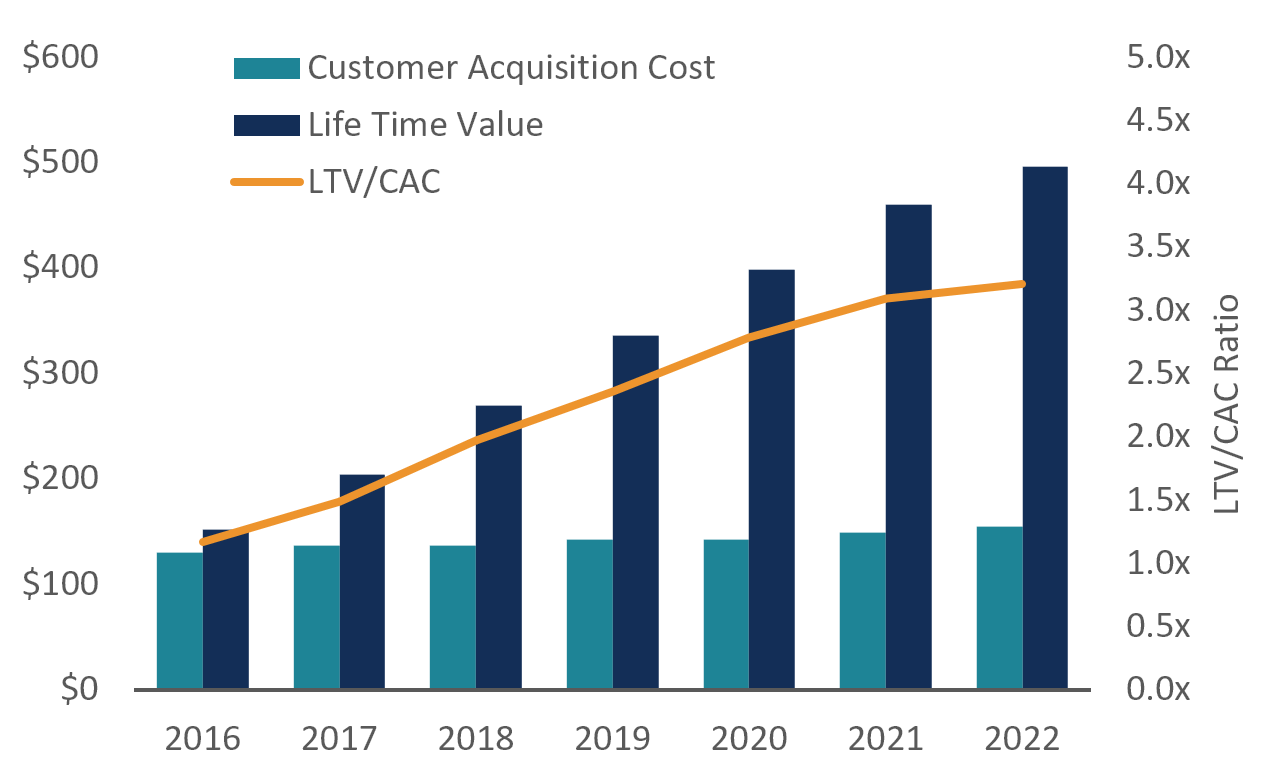
Two ratios decide whether the whole thing is actually sustainable long term:
- LTV:CAC. A ratio of roughly 3:1 is the widely accepted floor, with the median across B2B SaaS sitting around 3.2:1 the median B2B SaaS LTV:CAC ratio is 3.2:1, with healthy companies at 3:1 to 5:1.
- CAC payback period. Under twelve months is generally considered healthy, and B2B businesses tend to run slower paybacks than B2C, averaging 8.6 months versus 4.2 the median SaaS CAC payback is 6.8 months; B2B takes 8.6 versus 4.2 for B2C, and 76% of SaaS companies have a healthy CAC payback under 12 months.
Payback period matters more than most founders expect. Bessemer's efficiency bar pairs LTV:CAC above 3:1 with payback under 18 months, and the reasoning is simple: a strong ratio built on a slow payback is a cash-flow trap for anyone who isn't sitting on a large war chest Bessemer's 2026 efficiency bar: LTV:CAC above 3:1 and payback under 18 months, and a 5:1 LTV:CAC with 24-month payback is worse than 3:1 with 8-month payback because cash recovery speed wins.
If you're cash-constrained, weight payback over ratio every time. A great ratio that takes eighteen months to repay can still sink you before it pays off.
Build this as a simple table you can update monthly. It doesn't need to be complicated, it just needs real numbers instead of assumptions.
Worked Examples at Different Deal Sizes
Numbers make this concrete faster than theory does. Here's a conservative model using clearly labeled assumptions, swap in your own close rate and cost per meeting to check your situation.
A few things worth pulling out of that table:
The $3,000 row is a dead end on paper. Cost per close equals the entire deal value before you've spent a dollar on delivery, support, or anything else. There's no margin left to work with.
The $10,000 row is where most of the real debate happens. This is your minimum deal size for outbound in a one-time-revenue world, and it's genuinely marginal. It only clears the bar if there's strong retention or expansion revenue behind it. A $10K one-time deal is a bad bet. A $10K annual contract that renews for three years is a completely different story, because the lifetime value, not the first invoice, is what CAC needs to beat.
Recurring revenue rescues borderline cases that one-time deals never can. This is the single biggest lever in the whole table, and it's the reason two businesses with identical ACV can have completely different outbound economics.
Enterprise lead generation costs more per meeting, but the ratio actually improves. At $75,000 ACV, cost per meeting nearly doubles versus the $10,000 row, but cost per close barely registers against deal value. Bigger deals tolerate sloppier unit economics simply because there's more room.
These numbers are illustrative on purpose. Plug in your own close rate, show rate, and cost per meeting before you make a decision based on someone else's math.
🚀 Turn Spend Into Pipeline
With 224.7K+ leads generated, 53,000+ meetings booked, and $312M+ pipeline, Cleverly helps B2B teams scale outbound with measurable results.
What Changes the Math in Your Favor
Deal size gets all the attention, but it's rarely the only lever, and often not even the biggest one. Here's what actually shifts profitable outbound sales economics in your direction:
- Recurring revenue and retention. A marginal ACV on paper can become a clearly viable one once you account for multi-year LTV instead of a single contract.
- Expansion revenue. Upsells and cross-sells lower your effective CAC across the full customer lifetime, not just the first sale.
- Tight ICP targeting. This is the biggest lever most teams ignore. A higher close rate from better targeting improves cost per closed deal more than almost anything else on this list.
- Show rate improvements. No-shows quietly inflate your true cost per held meeting. Fixing reminders and confirmation flows is cheap and effective.
- Shorter sales cycles. A faster path from meeting to close pulls your payback period forward, which matters even more than the ratio itself.
- Gross margin. A high-margin service can absorb far more CAC than a thin-margin one, this is why the same ACV means different things in different businesses.
- Referrals and word of mouth. Customers acquired through outbound often generate their own pipeline later, which lowers blended CAC across the whole funnel.
- Compounding improvements. Messaging and data quality tend to get better over the first few quarters as you learn what actually resonates.
What Makes the Math Worse
The flip side matters just as much, because these are the patterns that quietly turn a workable channel into a money pit:
- Low deal size paired with one-time revenue and no expansion path.
- Broad targeting, which drives up cost per qualified meeting while dragging close rates down.
- Long sales cycles that push payback past what your cash flow can actually absorb.
- High churn, which destroys LTV no matter how efficient your acquisition looks on paper.
- Thin gross margins that leave no room to spend on acquisition at all.
- A weak or undifferentiated offer, which caps reply and close rates regardless of how well the outreach is executed.
- Bad contact data, which wastes spend before the messaging even has a chance to work.
- Quitting early. Outbound sales economics genuinely improve over quarters as targeting and messaging get sharper, and abandoning a program at month three almost guarantees a bad return simply because you never got past the ramp.
What to Do If Your Deal Size Is Too Small
If your numbers land you below the line, outbound isn't automatically off the table, but it does mean the plan needs to change. Here's what's worth trying, roughly in order of how much control you have over it:
- Raise the deal size. Bundle products, move upmarket, or reprice around outcomes instead of features.
- Add recurring or retainer components. Turning a one-time sale into ongoing revenue is often the single fastest way to fix a marginal average contract value.
- Target a higher-ACV segment inside the same market. You don't always need a new market, sometimes you just need a better slice of the one you're already in.
- Switch channels for the smaller deals. Inbound, content, and partnerships carry lower CAC for lower-ticket products, and they're often a better fit than forcing outbound where it doesn't belong.
- Try a lighter version of outbound. Founder-led, low-volume, high-personalization outreach can work at price points a full SDR function never will.
- Run a small paid pilot first. Buy real data before you commit to headcount or a long contract. A month of evidence beats a quarter of guessing.
Sometimes the honest answer is that outbound is simply the wrong channel for your business. Knowing that early is worth more than finding out after a year of bad unit economics.
How Cleverly Approaches Outbound Economics
Everything above is the conversation worth having before anyone signs a contract or makes a hire, deal size, close rate, and margin decide whether outbound makes sense at all, and we'd rather have that conversation upfront than sign a client into a program that was never going to work.
At Cleverly, we run outbound end to end: ICP definition, verified list building, LinkedIn outreach, cold email, cold calling, and reply handling all the way through to booked meetings. Because it's fully outsourced, there's no ramp period, no hiring risk, and no fixed headcount cost while you're still validating whether the channel fits your economics.
The lever we lean on hardest is the one most teams underweight: tight ICP targeting. It moves close rate more than trimming cost per meeting ever does, and close rate is what actually decides your cost per closed deal.
We report on qualified meetings held, not just booked, because that's the honest input you need to run this calculation for yourself. Across our client base, that approach has generated 224.7K leads, $51.2M in revenue, and $312M in pipeline for the companies we work with.
Want to know if outbound works at your deal size? Get a free consultation and we'll run the numbers with you before you commit to anything.
Conclusion
In practice, the threshold looks like this: outbound is hard below roughly $10K ACV, workable in the mid five figures, and comfortable above $25K. But that number alone doesn't tell the whole story.
Recurring revenue and retention matter just as much as headline deal size, and cost per meeting, the number everyone quotes, isn't the number that decides profitability. Cost per closed deal is.
The practical next step is simple. Plug your own ACV, close rate, show rate, and margin into the formula above before you spend a dollar on outbound. If the math doesn't work, fix the deal size or change the channel. Don't run outbound harder and hope the numbers catch up on their own.
Frequently Asked Questions
Free Resource
How to Scale a Profitable Cold Call System
Get the complete guide — download it instantly now.
Free Ebook
Download the Free Guide
Enter your details to get instant access.
You're all set! 🎉
Your ebook is downloading now.
Click below if the download didn't start automatically.


