

Table of Contents
Why Enterprise Is Harder Without a Network
Narrow Your Target Before You Scale Anything
Build Credibility Before You Ask for Anything
The Outbound Motion That Works Cold
Multi-Thread the Account From Day One
Set Realistic Expectations and Fund the Runway
Metrics That Tell You It's Working
How Cleverly Builds Enterprise Pipeline for New Entrants
Conclusion
Frequently Asked Questions
Modified On :
September 22, 2026
Key Takeaways
- Without a network, precision has to replace relationships. Narrow targeting and deep account research are your only real substitute for warm intros.
- Credibility can be built or borrowed faster than most founders think, but it has to happen before you send a single message, not after.
- Single-threaded outreach is the fastest way to lose a deal you never knew you were in. Reach the whole committee early, not just your champion.
- Closed revenue tells you almost nothing in year one. Track account penetration and committee coverage instead, or you'll course-correct too late.
- The biggest failure mode isn't a bad list. It's giving up on a beachhead segment around month three, right before the compounding starts.
Most advice on enterprise lead generation in the US assumes you already have something to work with: a warm intro, a recognizable logo, a founder who knows people. If you're reading this, you probably don't have any of that yet, and the advice hasn't been much help.
Here's what the data says about the world you're walking into. The average B2B buying committee has grown from roughly 5.4 stakeholders in 2020 to 11.2 people for deals over $50,000, up from 9.7 in 2024. Enterprise deals routinely run 90 to 180 days or longer, with committees of 6.8 stakeholders or more involved before a contract gets signed.
And 73% of B2B buyers actively avoid vendors who send irrelevant outreach, which means a generic list and a generic sequence will get you ignored faster than ever.
None of that is a reason to skip US B2B lead generation. It's a reason to run it differently. This guide covers why enterprise is harder without a network, how to pick a beachhead, how to build credibility before you ask for anything, the outbound motion that actually works cold, multi-threading the account, and the metrics that tell you if any of it is working.
It's written for founders, first sales hires, and teams entering the US enterprise market with no name recognition to lean on.
Why Enterprise Is Harder Without a Network
Enterprise buying isn't one person deciding. It's a committee, and the committee has gotten bigger every year.
Gartner's research puts the average enterprise buying committee at 6 to 10 people, each performing separate information-gathering tasks, spanning end users, champions, technical evaluators, security, IT, finance, procurement, and one or more executives.
One champion in your corner isn't enough anymore. They can love your product and still lose the internal argument.
The cycle length compounds the problem. Enterprise deals in the $100,000 to $500,000 range typically run 6 to 9 months, and strategic deals above $500,000 can take 9 to 18 months. That's a long runway to fund without a single signed logo, and it punishes teams that expected a quarter-long sales motion.
Then there's procurement. Security reviews, vendor risk assessments, and legal review all exist to protect the buyer from picking wrong, and every one of those steps quietly favors the vendor everyone's already heard of. Without referrals, you don't get a trust transfer. Every conversation starts from zero, every time.
The thing is, you can't out-spend or out-brand an incumbent with a decade of case studies and a marketing budget you don't have. So you out-target them instead. Precision becomes your leverage.
🎯 Break Into Enterprise Accounts
Cleverly helps 10,000+ businesses reach high-value decision-makers through done-for-you LinkedIn, cold email, and cold calling.
Narrow Your Target Before You Scale Anything
The most common mistake new entrants make is going broad because the total addressable market looks big on a slide. A big TAM feels like an opportunity. In practice, it's a way to spread your limited credibility across too many accounts to build any of it convincingly.
Pick a beachhead first. One industry. One use case. One buyer role you can credibly claim to understand better than a generalist vendor would. This isn't a permanent choice, it's a starting point that lets you go deep instead of wide.
From there, build a named account list, not a filtered database export. Enterprise lead generation at this stage is an account game, not a volume game.
A list of 40,000 leads from a data tool is worthless if you can't research any of them properly. A list of 50 named accounts you actually understand is worth more.
Size the list to what your team can genuinely work:
- Dozens of accounts, not thousands
- Prioritized by any real thread you have, even a thin one: an investor connection, an advisor who knows someone there, a former colleague, a customer in an adjacent space
- Layered with trigger signals like recent hiring activity, leadership changes, new funding, or new tooling adoption, which help you decide who to approach first
The payoff is straightforward. A narrow list makes deep research affordable. And deep research is the thing that stands in for the network you don't have.
Build Credibility Before You Ask for Anything
This is the part most enterprise advice skips, and it's the part that actually separates the founders who break in from the ones who send a hundred emails into silence. If a buyer checks you out and finds nothing solid, the outreach never had a chance regardless of how good the copy was.
Make Yourself Findable and Legitimate
Before anyone replies to your message, they're going to look you up. Your website, your LinkedIn, whatever reviews exist. Make sure all three hold up to a five-minute look.
At this stage, founder and team LinkedIn profiles carry more weight than the company page. Nobody expects a two-person startup to have a polished corporate site. They do expect the founder's profile to look like someone who knows the space. Fix the obvious gaps first: no case studies, no security documentation, unclear pricing. Each one is a reason to close the tab.
Borrow Credibility You Don't Have Yet
You don't need your own track record if you can borrow someone else's. Advisors, investors, and even a couple of notable early customers transfer trust in a way that no amount of copywriting can replicate.
Design partner arrangements are underrated here. They convert into real logos and case studies faster than a normal sales process would, because you're trading product input for the right to use the relationship as proof. Analyst mentions, podcast appearances, and guest content do the same job without needing a brand budget behind them.
Publish Proof, Not Marketing
A specific, named outcome beats a capability claim every time. "We help companies improve efficiency" convinces nobody. "We cut onboarding time from six weeks to nine days for a 200-person logistics company" gets read twice.
Security and compliance documentation removes a real procurement blocker before it ever becomes one. And role-specific content, something written for the security reviewer, something else for the finance stakeholder, gives every person on that big committee something relevant to actually find when they go looking.
Check Out Cleverly’s Case Studies
Warm the Account Before Outreach
Engage with your target buyers' content before you ever message them. Comment on the post, share the take, show up on their radar in a low-pressure way.
Founder-led thought leadership does the heaviest lifting here, because it makes the first direct touch feel recognizable instead of cold. The goal isn't to have spoken to them before. It's to be someone they've already seen.
🚀 Build Your US Pipeline
With 224.7K+ leads generated, 53,000+ meetings booked, and $312M+ pipeline, Cleverly helps B2B teams create enterprise opportunities from the ground up.
The Outbound Motion That Works Cold
Enterprise outbound doesn't look like SMB outbound. SMB rewards volume. Enterprise punishes it. This motion is research-heavy and deliberately low-volume, because every message is going to a specific person on a specific committee, not a segment.
Run it multichannel by default. Email, LinkedIn, and calling coordinated on the same accounts, timed together rather than fired off independently. A prospect who sees the same specific, researched point show up twice across two channels reads it as considered. The same point sent five times on one channel reads as spam.
Lead with a specific observation about their business, not a value proposition. "We noticed you just opened a second distribution center in Ohio" gets read. "We help logistics companies scale efficiently" does not.
Make the first ask small. A conversation. A question. Never a demo request on message one, that's a big ask from a stranger and it reads as presumptuous at this stage.
Plan for depth, not speed. Most replies come after several touches, and most deals close after considerably more. 73% of B2B buyers actively avoid suppliers who send irrelevant outreach, so relevance in every touch matters more than the number of touches.
Use trigger events to time your entry instead of a fixed drip schedule. A leadership change, a funding round, a new hire in a relevant role, these are moments where a specific, timely message lands differently than a cold one.
And while you can, send it from the founder. Founder-sent outreach consistently outperforms rep-sent outreach at this stage, because a founder reaching out personally still reads as a real signal, not a sequence.
Multi-Thread the Account From Day One
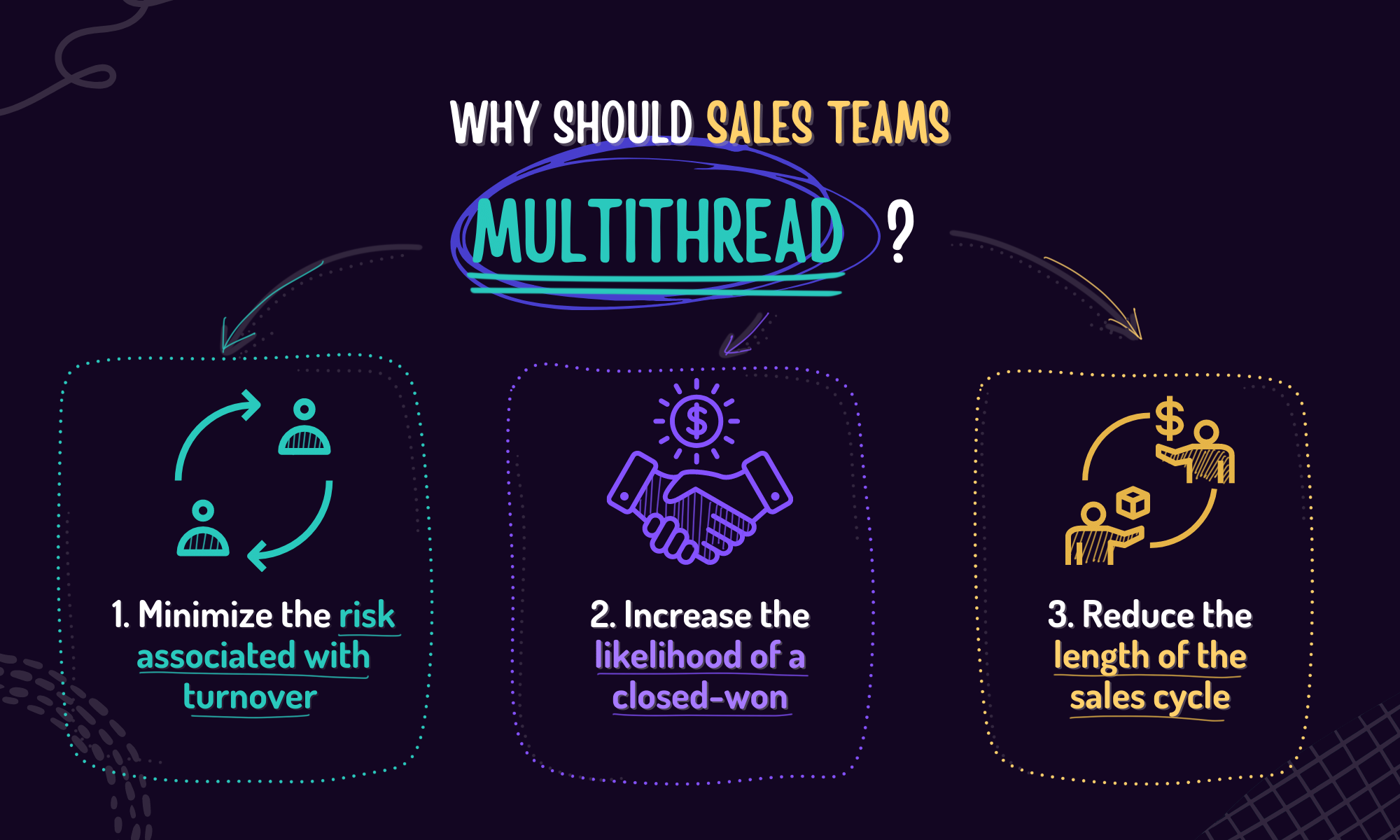
Here's the failure mode that kills more early enterprise deals than bad targeting ever does: single-threading. You find one champion, they love it, they go quiet for three weeks, and you find out later they changed teams.
The deal didn't die because your product was wrong. It died because you had exactly one person carrying it internally.
Reach several stakeholders in the same account early. Give each one a role-specific angle instead of the same generic pitch copied across contacts.
Map the committee as best you can from the outside:
The CFO and the practitioner using the product day to day care about completely different things. Sending them the same message wastes the touch on both of them.
Coordinate the outreach so it reads as one considered approach to the account, not three reps independently spamming the same company. And once you have a champion, ask them directly who else needs to be involved. Guessing the org chart from LinkedIn is a distant second choice to just asking.
Multi-threading is, frankly, the single highest-leverage habit available to a team with no brand behind them. It doesn't cost more money. It costs more discipline.
Set Realistic Expectations and Fund the Runway
Enterprise pipeline takes quarters to convert, not weeks, so the plan has to survive a slow start without anyone panicking and pulling the plug.
Track leading indicators instead of waiting on closed revenue: meetings booked, committee coverage growing inside target accounts, and deals actually progressing stages rather than sitting still. Closed revenue in month two tells you nothing useful. It's a lagging indicator on a sales cycle that runs half a year or more.
Consider running a shorter sales cycle motion in parallel, whether that's a smaller segment or a lighter product tier, so the business isn't entirely dependent on one long bet while enterprise pipeline builds.
Budget for the costs that don't show up on the first spreadsheet: security reviews, pilot periods, legal review, and the labor cost of a long cycle that doesn't pay off for months. And know when a beachhead isn't working. If a segment isn't producing after a genuinely fair trial, move. Don't confuse patience with sitting still.
The most common and most avoidable failure here is abandoning enterprise outbound around month three, right before the account research and multi-threading actually start to compound. Enterprise motion is slow to start and faster to build once it's rolling. Quitting at the slowest part of the curve is an expensive mistake.
Metrics That Tell You It's Working
Closed revenue is the metric everyone watches and the one that's least useful for course-correcting in year one, because by the time it moves, you've already spent months on a strategy you couldn't validate earlier.
Committee coverage is the one most teams don't track, and it's arguably the most predictive number on this list. A deal with three stakeholders engaged behaves completely differently than a deal with one, even at the same pipeline stage.
Benchmark against your own trend over time rather than external enterprise benchmarks. Cycle length and conversion rates vary wildly by segment, industry, and deal size, so a published average is a sanity check, not a target to hit.
How Cleverly Builds Enterprise Pipeline for New Entrants
Everything above is the right strategy. Executing it is the hard part. Named account research, multichannel sequencing across email, LinkedIn, and calling, and consistent follow-up over multiple quarters is a full-time operation, and it's exactly the kind of work a small team can't sustain while also building the product and running the deals that are already in motion.
Building that function in-house takes time you don't have. Hiring, training, and ramping an enterprise SDR function realistically takes a couple of quarters before it produces anything, and a new entrant usually needs meetings well before that investment pays for itself.
This is the gap we work in. We run ICP and named account list building, verified contact data, LinkedIn outreach, cold email, and cold calling as one coordinated motion, with reply handling that turns conversations into booked meetings rather than just replies in an inbox.
For a reader in this exact position, the relevant part is multi-threaded outreach across the buying committee from the start, not single-contact sequences that die when one person goes quiet.
We've run these messaging frameworks across thousands of campaigns, which shortens the trial-and-error phase that most new entrants end up paying for themselves in wasted quarters.
Our clients have generated $312 million in pipeline through this model, and we optimize for qualified meetings with real decision-makers, not activity volume dressed up as progress.
Breaking into enterprise without a network is genuinely hard, but it's a solvable problem with the right targeting and execution behind it. Get a free consultation and we'll map the account strategy with you.
Conclusion
Without a network, precision replaces relationships. Narrow targeting and real account research are the entire advantage you have over a competitor with a bigger name and a smaller effort behind each account. Credibility can be built or borrowed faster than most founders assume, but it has to come before the first message goes out, not after the first reply doesn't come.
If there's one habit to take from this: multi-thread from day one. It's the single highest-leverage move available to a vendor nobody's heard of yet. Pick one beachhead segment, build a list of 50 named accounts, and multi-thread the first ten of them properly before you touch the rest.
The teams that actually break into enterprise lead generation in the US cold aren't the loudest ones in the room. They're the most specific, and they're the ones still running the motion in month four when everyone else already quit.
Frequently Asked Questions
Free Resource
How to Scale a Profitable Cold Call System
Get the complete guide — download it instantly now.
Free Ebook
Download the Free Guide
Enter your details to get instant access.
You're all set! 🎉
Your ebook is downloading now.
Click below if the download didn't start automatically.


