

Table of Contents
The Real Truth About LinkedIn vs. YouTube for B2B Growth
What Is LinkedIn Good For in B2B Growth?
What Is YouTube Good For in B2B Growth?
LinkedIn vs. YouTube — Side-by-Side Comparison
Choose LinkedIn If…
Choose YouTube If…
Common Mistakes When Choosing Between LinkedIn and YouTube
Where Cleverly Fits Across LinkedIn and YouTube Growth Strategies
Conclusion
Frequently Asked Questions
Modified On :
August 21, 2026
Key Takeaways
- LinkedIn vs YouTube isn't a competition with one winner. It's a question of what stage of the buyer journey you're trying to influence.
- LinkedIn works through interruption. It puts your content in front of people who weren't actively looking for you, which makes it a stronger fit for direct lead generation and outreach.
- YouTube works through intent. People find your videos because they're already searching for a solution, which makes it a better long-term fit for building authority that keeps paying off.
- The format decision matters as much as the platform decision. Short, native video wins on LinkedIn. Long-form, search-optimized video wins on YouTube. Copying one format onto the other platform usually falls flat.
- Most B2B teams that get real traction eventually run both, just for different jobs. LinkedIn drives faster pipeline. YouTube compounds research-stage trust over time.
Picture two sales teams. One spends their week posting on LinkedIn, sliding into DMs, and booking calls off the back of it. The other spends that same week scripting, filming, and editing a 7-minute video that answers one very specific question their buyers keep asking. Both are doing "content marketing." Neither is doing the same thing.
That's really what the LinkedIn vs YouTube debate comes down to. LinkedIn generates roughly 80% of all B2B social media leads, with a visitor-to-lead conversion rate of 2.74%, nearly three times higher than other social platforms.
Meanwhile, 59% of executives say they'd rather watch a video than read text when evaluating a product or vendor.
Neither number cancels the other out. They're describing two different jobs.
This guide breaks down what each platform actually does well for B2B growth, what the real data says when you put them side by side, and how to figure out where your team should be spending its time and budget over the next 6 to 12 months.
If you're a marketing leader, founder, or content team trying to decide where to focus, this is built for you.
The Real Truth About LinkedIn vs. YouTube for B2B Growth
Most people frame this as "which platform is better," and that's the wrong question. The right question is: which platform is better for what you're trying to do right now.
LinkedIn wins on interruption-based reach and lead generation. It's a feed. People aren't searching for you, but your content shows up while they're scrolling, and that's exactly why it converts so well.
YouTube wins on intent-based search and long-form authority. It's the second-largest search engine in the world, and B2B buyers are using it that way. 62% of B2B decision-makers watch YouTube weekly specifically while researching purchases.
They're not being interrupted. They're actively looking, which means the content you put there needs to actually answer their question, not just catch their eye.
A quick version before we go deeper: LinkedIn fits active demand generation and network-driven relationships. YouTube fits capturing search-driven research intent with evergreen content that keeps working long after you publish it.
Where you should focus first depends on whether you need a pipeline this quarter or trust that compounds over the next two years.
🎯 Views Are Nice. Qualified Meetings Are Better.
Our LinkedIn outreach campaigns generate 15–30 qualified meetings every month by connecting B2B businesses with the right decision-makers.
What Is LinkedIn Good For in B2B Growth?
LinkedIn's role is simple to describe: it's a professional network where your content interrupts the scroll and puts you in front of a specific audience, usually people you've deliberately targeted by title, industry, or company.
That's not a niche use case anymore.
97% of B2B marketers already use LinkedIn for content marketing. It's not an experiment teams are testing. It's the default channel, the one you're expected to be on before anyone asks why.
Video moves faster than everything else on the platform. Native video posts get roughly 5.3x more organic reach than posts with an outbound link, and short videos under 30 seconds tend to see noticeably higher completion rates than longer clips. If you're posting a link and wondering why reach is flat, that's usually why.
LinkedIn is strongest for:
- Personal brand building — founder and exec content consistently outperforms company page posts.
- Relationship-driven selling — you're building familiarity before you ever send a pitch.
- Direct lead generation — native tools like InMail and connection requests let you move from a scroll to a conversation without leaving the platform.
- Reaching decision-makers where they already are — professionally, not casually.
Pro tip: if your content strategy is "post occasionally and hope it lands," that's the opposite of how LinkedIn actually rewards behavior. The platform favors frequency over production value. A founder posting three times a week with a phone camera will usually outperform a company posting once a month with a polished video.
What Is YouTube Good For in B2B Growth?
YouTube plays a completely different role. It's a search-driven platform, which means people find your content because they went looking for it, not because it interrupted them mid-scroll. That single difference changes everything about how you should approach it.
59% of executives say they'd rather watch a video than read text when they're researching a product or service. That's a meaningful shift in buyer behavior, and it means the written whitepaper you spent three weeks on might be getting skimmed instead of read.
YouTube is also deeply integrated with Google search, which means a well-optimized video can show up directly in search results. Your discoverability effectively doubles, because you're not just relying on YouTube's internal search, you're also competing for space on Google itself.
YouTube is strongest for:
- Capturing active research intent — the buyer is already looking for an answer, and you're providing it.
- Building evergreen, long-form authority content — a good video keeps generating views long after publish day.
- Reaching buyers already searching for a solution — not people you have to convince to pay attention.
The tradeoff is production effort. A 5-10 minute educational video takes real planning, filming, and editing. But that investment has a longer shelf life than almost anything you'll post on LinkedIn.
🚀 Build Your Audience. Then Build Your Pipeline.
With 224.7K+ leads generated and 53,000+ meetings booked, Cleverly helps 10,000+ businesses turn LinkedIn into a predictable B2B lead generation channel.
LinkedIn vs. YouTube — Side-by-Side Comparison
Here's the decision matrix, not a sales pitch. Use this to figure out where your resources should actually go.
Choose LinkedIn If…
If your priority is pipeline in the next few months and you can commit to showing up consistently, LinkedIn is where you should be putting your energy first.
You Need Direct Lead Generation, Not Just Awareness
LinkedIn's native outreach tools, InMail and connection requests, let you move straight from a post someone engaged with to a direct conversation.
You're not waiting for someone to find a contact form. You can go from visibility to a booked call without ever leaving the platform. That matters most when the goal is a pipeline you can point to this quarter, not just brand presence you hope pays off eventually.
Your Buyers Are Reachable Through Personal Networks
Most B2B decision-makers, whatever niche you're in, are on LinkedIn professionally. That makes it far easier to reach specific roles and titles directly instead of hoping the right person stumbles onto your content.
And personal brand content from a founder or exec tends to significantly outperform anything posted from a company page, because people connect with people, not logos.
You Can Sustain a Consistent Posting Cadence
LinkedIn rewards frequency more than it rewards polish. A consistent short-form posting habit, even filmed on a phone, will typically outperform occasional high-production content that goes up once a month. That's actually good news for lean teams. The production barrier is low enough that a real posting habit is realistic without a video team.
Choose YouTube If…
If your buyers do real research before they ever talk to sales, and you have the bandwidth for fewer, higher-quality pieces of content, YouTube is worth the investment.
Your Buyers Actively Search for Solutions
If your ICP researches problems by searching rather than scrolling a feed, YouTube's discovery model matches that behavior directly. This is especially true for technical or considered-purchase products, where buyers want real depth before they're willing to book a call with sales.
You Want Evergreen Content That Compounds Over Time
A well-optimized video can keep generating views and leads years after you publish it. That's the opposite of LinkedIn's shelf life, where a post's visibility mostly fades within days. If you're weighing a bigger production investment, factor in that longevity. The math often works out better than it looks on day one.

You Have the Resources for Long-Form Production
A 5-10 minute educational video takes real planning, filming, and editing, more than a LinkedIn post ever will. YouTube tends to suit teams that can commit to fewer, higher-quality videos rather than teams trying to post constantly. If you're stretched thin, it's better to do YouTube well and infrequently than to rush it.
Common Mistakes When Choosing Between LinkedIn and YouTube
❌ Treating this as either/or
Most mature B2B content strategies eventually use both, just for different funnel stages. Picking one forever usually means leaving a stage of the buyer journey uncovered.
❌ Copying the same content format across both platforms
A LinkedIn-style 30-second clip won't hold up as a YouTube search result, and a 10-minute YouTube video dropped straight onto LinkedIn will get scrolled past. Adapt the length and style to how each platform is actually consumed.
❌ Judging YouTube too fast
Its value compounds over months and years, not weeks. If you're expecting LinkedIn-speed feedback from YouTube, you'll pull the plug before it's had a chance to work.
❌ Underinvesting in LinkedIn's outreach tools
Some teams treat LinkedIn purely as a content channel and skip the direct outreach side entirely, missing the platform's biggest strength: the ability to turn a post into a conversation without leaving the app.
Where Cleverly Fits Across LinkedIn and YouTube Growth Strategies
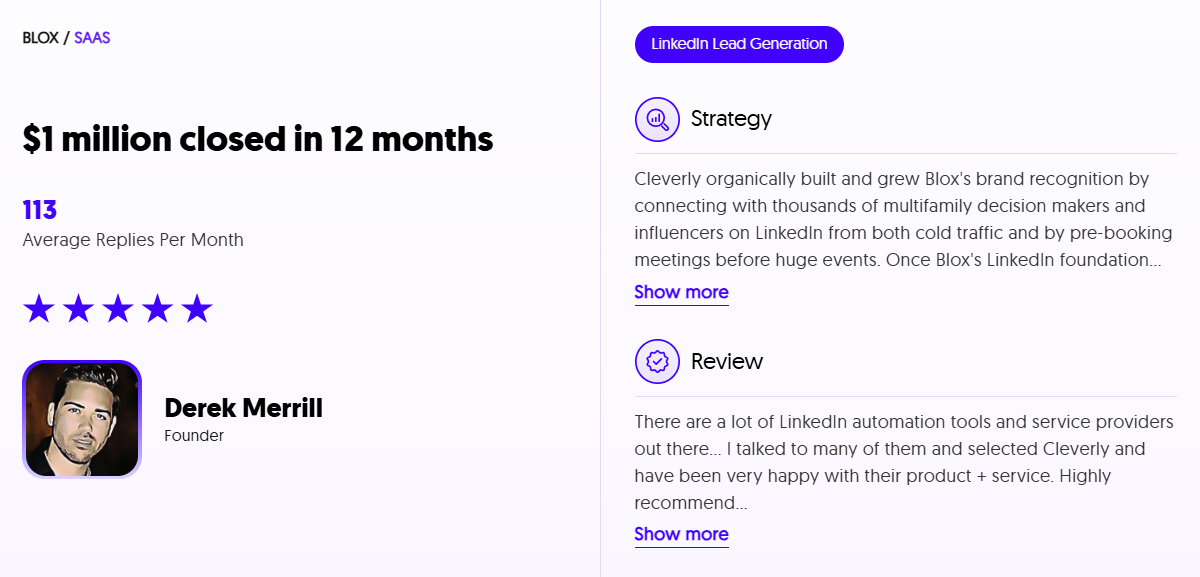
Both platforms are good at building visibility. Neither one guarantees that visibility turns into an actual sales conversation. That's a separate, deliberate process, and it's usually the piece that gets skipped.
We run targeted LinkedIn outreach that takes the visibility you've already built, whether that came from LinkedIn content or awareness driven by a YouTube channel, and turns it into direct, qualified conversations.
Content builds the audience and the trust. Outreach is what actually turns that audience into meetings on your calendar on a predictable timeline, instead of hoping the right person reaches out on their own.
Our campaigns are LinkedIn-native and built to complement whatever content engine is already driving your awareness.
We've helped 10,000+ clients across industries turn platform visibility into real pipeline, generating $312M in pipeline revenue for the businesses we work with.
If you're already investing in LinkedIn or YouTube content and want a dedicated motion converting that visibility into booked calls, that's exactly where this fits.
Building visibility on LinkedIn or YouTube but need it converting into meetings? Book a strategy call with Cleverly!
Conclusion
LinkedIn wins when you need direct lead generation and a way to reach buyers through network-driven, interruption-based content. YouTube wins when the goal is capturing active search intent and building evergreen authority that keeps compounding long after publish day.
Most mature B2B strategies end up running both, matched to different stages of the funnel instead of betting everything on one platform.
The real decision isn't LinkedIn or YouTube. It's whether your immediate priority is faster pipeline this quarter or long-term, compounding influence at the research stage. Once you know which one you need first, the platform choice mostly makes itself.
Frequently Asked Questions
Free Resource
How to Scale a Profitable Cold Call System
Get the complete guide — download it instantly now.
Free Ebook
Download the Free Guide
Enter your details to get instant access.
You're all set! 🎉
Your ebook is downloading now.
Click below if the download didn't start automatically.


