Table of Contents
What Is Cold Call Conversion Rate?
Cold Call Conversion Rate Formula (And the Full Funnel to Track)
Average Cold Call Conversion Rate in 2026 — Benchmarks by Stage
Why Most Cold Calling Teams Underperform
8 Proven Ways to Increase Your Cold Call Conversion Rate
How Cleverly's Cold Calling Agency Helps B2B Teams Hit Top-Performer Rates
Conclusion
Frequently Asked Questions
Modified On :
May 13, 2026
Key Takeaways
- The average cold call conversion rate sits at 2.5% (1 meeting per 40 dials), but top performers consistently hit 5–8%+. The gap is a systems problem, not a talent problem.
- Tracking only dials and talk time tells you how hard your team is working — not how well. The full funnel (dial-to-connect, connect-to-conversation, conversation-to-meeting) is where the real signal lives.
- Verified direct-dial numbers, pre-call research, and optimized timing windows are the three highest-leverage improvements most teams can make before touching their scripts.
- Calls with 11–14 discovery questions achieve a 70%+ success rate. Reps who pitch first and discover second consistently underperform.
- 93% of leads that eventually convert are contacted on the 6th attempt or later. Persistence, paired with multi-channel sequencing, is the most underutilized lever in B2B cold calling.
57% of C-level executives say they prefer being contacted by phone over other channels — yet the average B2B sales team has no real visibility into why their calls aren't converting.
They track dials. They track talk time. But they have no idea where the funnel is actually breaking.
That blind spot is expensive.
The problem isn't cold calling. The problem is that most teams run cold calling like it's 2015 — generic scripts, no pre-call research, zero funnel visibility.
When results disappoint, the answer is usually "dial more," which just multiplies the same broken activity.
This guide covers exactly what cold call conversion rate means, how to calculate it, what the 2026 benchmarks look like at every funnel stage, why most teams underperform, and 8 specific strategies to move your numbers.
What Is Cold Call Conversion Rate?
Cold call conversion rate is the percentage of dials that result in a desired outcome — most commonly a booked meeting or a qualified conversation.
It's the single clearest indicator of cold calling effectiveness because it captures the combined impact of your data quality, your messaging, your timing, and your reps' skill in one number.
The problem is that most teams confuse activity metrics with conversion metrics. Dials made and talk time tell you how hard your team is working.
Conversion rate tells you how well it's working. You can have a team hitting 80 dials a day with terrible conversion — and your reporting will look active while your pipeline quietly stagnates.
The bigger issue: a surprising number of B2B teams have never actually calculated their cold calling conversion rate. They know they made X calls last month. They know they booked Y meetings. But they've never divided the two and compared the result to a benchmark. That single calculation is often the first moment a sales leader realizes how much room there is to improve.
For any team serious about outbound, conversion rate should be the primary cold calling KPI — not dials, not talk time, and certainly not "calls attempted."
📞 More Dials Mean Nothing Without Conversions
1M+ calls made. 53K+ appointments set. We handle calling end-to-end so your calendar stays full.
Cold Call Conversion Rate Formula (And the Full Funnel to Track)
The core formula is simple:

So if your team books 5 meetings from 200 dials, your cold call conversion rate formula gives you 2.5%.
That's useful as a headline number. But on its own, it hides where the funnel is actually leaking.
A team with a 2.5% conversion rate could be struggling at completely different stages — and the fix is totally different depending on where the problem lives.
Full cold calling funnel to track:
Why does this matter in practice?
- If your dial-to-connect rate is low, no amount of script optimization will fix it — the problem is data quality or call timing.
- If your connect-to-conversation rate is low, your opener is losing people in the first seven seconds. If your conversation-to-meeting rate is low, your discovery is weak or you're pitching too early.
Conflating these stages leads to the wrong intervention every single time. Most teams over-invest in scripting when their real problem is stale data. Or they change their ICP when the issue is actually timing. Breaking out each stage kills that guesswork.
Average Cold Call Conversion Rate in 2026 — Benchmarks by Stage
Before you can improve your numbers, you need to know what "good" actually looks like. Here's where the 2026 benchmarks sit:
Dial-to-Meeting (Overall Conversion Rate)
The average B2B cold call-to-meeting conversion is roughly 2.5% — about 1 meeting per 40 dials — while top performers book meetings at a 5–8% rate. Elite teams hitting 9%+ are outliers, but they exist in markets with strong ICP definition and verified data.
Dial-to-Connect Rate
Gong Labs analyzed 300M+ cold calls and found the average connect rate is 5.4%, while top-quartile reps hit 13.3%. If you're below 5%, data quality is almost certainly the issue before anything else.
Connect-to-Meeting (Set Rate)
On set rate — meetings booked per conversation — the gap is even wider: 4.6% average versus 16.7% for top reps. That's a 3x+ difference driven by execution, better targeting, and cleaner data.
By Lead Temperature
Conversion varies sharply by lead source: cold list 1.5–2%, marketing-qualified 4–6%, and warm intro/referral 15–25%.
What's a good B2B cold calling conversion rate for your team?
It depends on your market, deal size, and ICP accessibility. A 4% conversion rate selling to VP-level buyers in a niche vertical is excellent. The same rate selling to SMB owners on a well-worn contact list is probably average.
The key takeaway: if your team is sitting below 2%, the problem isn't cold calling. It's the execution layer. If you're above 5%, the focus shifts to maintaining quality as volume scales.
🚀 Your Team Should Close Deals—Not Chase Prospects
1M+ calls made. 53K+ appointments set. We handle calling end-to-end so your calendar stays full.
Why Most Cold Calling Teams Underperform
Here's a frank breakdown of where most teams lose the funnel — and why.
Poor data quality
B2B data becomes outdated at roughly 2.1% per month, which adds up to 22.5% annually. Sales reps lose 27.3% of their time because of bad contact data. Calling wrong numbers and stale office lines tanks your connect rate before any conversation ever happens.

No pre-call research
Reps dialing without context are pitching blind. The most common opener failure isn't a weak script — it's generic irrelevance. The 3x3 research method — spending 3 minutes finding 3 relevant facts before each dial — increases conversion by 82% vs. unresearched calls.
A weak opening line
As also mentioned in the intro, 57% of C-suite executives still prefer initial contact via phone — but that preference evaporates instantly if the opener sounds like a template.
Prospects decide in the first seven seconds whether to keep listening. "Hi, this is [Name] from [Company], we help companies like yours..." is the fastest way to get hung up on.

Pitching instead of discovering
Gong's cold call research found that asking 11–14 questions per call achieves a 70%+ success rate — the sweet spot for discovery depth. Reps who lead with a pitch consistently underperform reps who lead with questions.
Giving up too early
80% of prospects say "no" four times before saying "yes”. Only 8% of salespeople make it to the fifth follow-up attempt. The math is clear — most reps quit just before the conversion window opens.
Calling at the wrong times

Best calling windows of 8–9 AM and 4–5 PM local time deliver connect rates up to 47% higher than other windows. Calling during the mid-morning meeting block or post-lunch slump wastes dials and demoralizes reps.
No coaching loop
Effective coaching can boost conversion rates by 38% and revenue per rep by 50%. Without structured call review, reps repeat the same mistakes indefinitely while managers assume the problem is activity volume.
Treating cold calling as a standalone channel
Companies that use multi-channel outreach — calls plus email plus LinkedIn — report conversions up to 37% higher than single-channel efforts. A completely cold dial is a harder ask than a call where the prospect has already seen your name in their inbox.
8 Proven Ways to Increase Your Cold Call Conversion Rate
These are the highest-leverage improvements across the full funnel — ordered from foundational to advanced. Tackle them in sequence, not all at once.
1. Start with Better Data — Verified Direct Dials Over Volume
Your B2B cold calling conversion rate is capped by your data quality. No amount of scripting fixes calls that never connect.
Timing and list quality matter more than ever. Verified direct dials, consistent list cleaning, and clear ICP definitions can add several points to connect rate and cut dials-per-meeting dramatically. It's not an admin task — it's revenue infrastructure.
Meritt tripled their connect rate to 20–25% after switching to verified mobile data, with pipeline jumping from $100K to $300K per week. That kind of result doesn't come from a new script. It comes from finally reaching actual humans.
When building or auditing your contact list, prioritize verified mobile numbers over company switchboards, confirm employment status is current, and validate role fit against your ICP before a single dial. Tools like Apollo, ZoomInfo, Cognism, and Lusha all offer direct dial verification — prioritize accuracy over database size.
Quick win: run your current list through a verification pass and separate out the direct mobiles. Call those first for a week and track your connect rate. The difference will be immediate.

2. Research Prospects Before Every Call (The 3x3 Method)
Cold calling without research is just interruption at scale. The 3x3 method changes that: spend three minutes finding three relevant facts about the prospect before you dial.
What to look for: recent company news, a LinkedIn post they shared, a job title change in the last 90 days, a funding round, a product launch, or an industry trigger relevant to your offer. Any one of those turns your opener from generic to relevant.
This simple habit — 3 facts in 3 minutes before each dial — nearly doubles cold call conversion rates. The mechanism is straightforward: when a prospect hears something specific to their situation in the first sentence, they stay on the line. When they hear a pitch that could apply to anyone, they don't. Optifai
The scalable version of this is building a pre-call research checklist and integrating it into your CRM workflow. Give reps a standardized list of three to five things to look up before each call block, and track whether research quality correlates with conversion in your call reviews. It will.

3. Rewrite Your Opening Line — Win the First 7 Seconds
The opener is the highest-leverage part of any cold call. Everything else in the conversation depends on whether you earn the next 60 seconds — and prospects make that decision almost immediately.
What kills most openers: starting with "Hi, my name is X from Y company, we help companies like yours with Z." That sentence signals a sales call, triggers an automatic hang-up reflex, and gives the prospect zero reason to stay on.
What works instead is a relevance-first, pattern-interrupt opener that references something specific to the prospect. A simple framework:

Something like: "Did I catch you at a bad time? [pause] — I reached out because I noticed [specific trigger]. Wanted to ask you one quick question."
That structure does three things: it shows respect for their time, establishes immediate relevance, and opens with curiosity rather than a pitch.
Test three to five opener variations using call recording software and track which format holds attention the longest before the prospect's first response. That data point — how long before they interrupt or disengage — tells you more than conversion rate alone.
4. Ask More Questions, Pitch Less
The pitch-first instinct is the single most common SDR mistake. Prospects who feel heard are far more likely to book a meeting than those who feel sold to.
Gong's cold call research found that asking 11–14 questions per call achieves a 70%+ success rate — the sweet spot between too few (which sounds scripted) and too many (which sounds like an interrogation).
A practical question framework for cold calls: open with context questions ("How are you currently handling X?"), move to problem and pain questions ("What's working? What isn't?"), and close with urgency questions ("Is that something you're actively looking to fix this year?").
The shift in mindset: replace "We help companies with X" with "I'm curious — how are you currently handling X?" That single change in sentence construction moves you from broadcasting to discovering, and it fundamentally changes how prospects experience the call.
The goal of discovery on a cold call isn't to close the deal in four minutes. It's to find one real pain, validate fit, and create a reason to meet. That's all. Keep that as your north star and you'll stop over-explaining and start over-converting.
5. Call at the Right Time — Timing Is a Free 47% Lift
Timing is one of the easiest conversion levers to pull, and most teams completely ignore it.
Best calling windows of 8–9 AM and 4–5 PM local time deliver connect rates up to 47% higher than other windows. Wednesday and Thursday outperform Monday and Friday by 15%.
The best time of day to cold call — between 4:00 and 5:00 PM — has 71% more conversations than the mid-morning window. Friday afternoons are the worst performing window of the week.
The middle of the day kills connect rates: 11 AM to 2 PM is when prospects are in meetings, heading to lunch, or in the post-lunch slow. Don't dial into that window if you can avoid it.
Practical implementation: block your SDRs' calendars to protect the 8–9 AM and 4–5 PM windows. Avoid scheduling internal meetings, team standups, or admin tasks during those hours. Those windows are pipeline — treat them accordingly.
One more thing: always dial in the prospect's local time, not yours. An 8 AM call to a prospect in a different time zone where it's 6 AM isn't persistence — it's noise.
6. Follow Up More Than You Think You Need To
The data on follow-up persistence is one of the most cited and most ignored findings in all of cold calling.
Making 6 or more calls can boost contact rates by 70%. Yet 44% of sales reps never make a second follow-up call after their initial outreach. That gap — between what the data recommends and what reps actually do — is where a huge amount of pipeline dies silently.
Not hearing back after two calls isn't a "no." It's silence. Decision-makers are busy, they screen unknown numbers, and they're not waiting for your call. Most prospects need six to eight touches before they pick up and engage, which means the reps stopping at two are giving up right before the conversion window opens.
What a persistence-driven cold calling cadence looks like: an 8–12 touch multi-channel sequence over three to four weeks, with call attempts at touches 1, 3, 5, and 8, interspersed with email and LinkedIn. Build it into your CRM so follow-up happens automatically, not based on rep motivation.
Tool support: auto-dialers with built-in retry logic — Aircall, Orum, ConnectAndSell — take the manual tracking out of persistence and let reps focus on the conversations instead of the scheduling.
7. Pair Cold Calling with Multi-Channel Sequences
Cold calling alone is harder than it needs to be. A prospect who has seen your name in their LinkedIn inbox or read your email before you call is not a cold call — it's a semi-warm introduction. That difference is measurable.
Multi-channel outreach yields 37% more conversions than single-channel approaches. When you combine calling with email and LinkedIn, you're not just adding touchpoints — you're building context. By the time your call comes in, the prospect has some frame of reference for who you are and why you're reaching out.
A recommended multi-channel sequence structure:
- Day 1: LinkedIn connection request
- Day 2: Cold email
- Day 3: Cold call (reference the email in your opener)
- Day 5: Email follow-up
- Day 7: Second call
- Day 10: Final LinkedIn message
The call should almost never be the first touchpoint in a high-value campaign. The email and LinkedIn touches do the warming — the call does the converting. Build the sequence around that logic and your connect-to-meeting rate will climb without changing a word in your script.

8. Build a Coaching Loop Around Call Recording
This is the highest-leverage investment a sales manager can make for their team's cold calling conversion rate — and the most consistently underdone one.
Effective coaching can boost conversion rates by 38% and revenue per rep by 50%. That's not incremental. That's transformational on a team of five SDRs. Cleverly
What most teams do wrong: they coach on feelings and impressions ("that call felt off") rather than data ("your opener gets cut off 70% of the time before the prospect's first response"). The former is opinion. The latter is something you can actually fix.
What a good coaching loop looks like: weekly call review sessions that cover losses as much as wins, rep self-scoring before manager feedback, and pattern identification across multiple reps — not just one outlier call. When you find a failure pattern that shows up in 60% of your reps' calls, you've found a training opportunity that will move the whole team's numbers, not just one rep's.
Conversation intelligence tools that make this scalable: Gong, Chorus, and Orum all flag specific moments in calls — objection points, opener dropoffs, talk ratio outliers — for coaching without managers having to listen to every recording in full.
The compounding effect is real: a team that improves conversion by even 0.5% per month doubles its pipeline output inside a year.
How Cleverly's Cold Calling Agency Helps B2B Teams Hit Top-Performer Rates
Getting cold calling right requires excellence across multiple disciplines simultaneously. You need verified data, sharp messaging, optimized timing, persistent follow-up, and consistent coaching — all working together.
Most in-house teams can execute one or two of those well. Sustaining all of them alongside existing sales responsibilities is a different challenge entirely.
That's exactly the problem Cleverly was built to solve.
As a fully done-for-you cold calling agency, we handle everything from ICP targeting and list building to call execution, appointment setting, and meeting handoff.

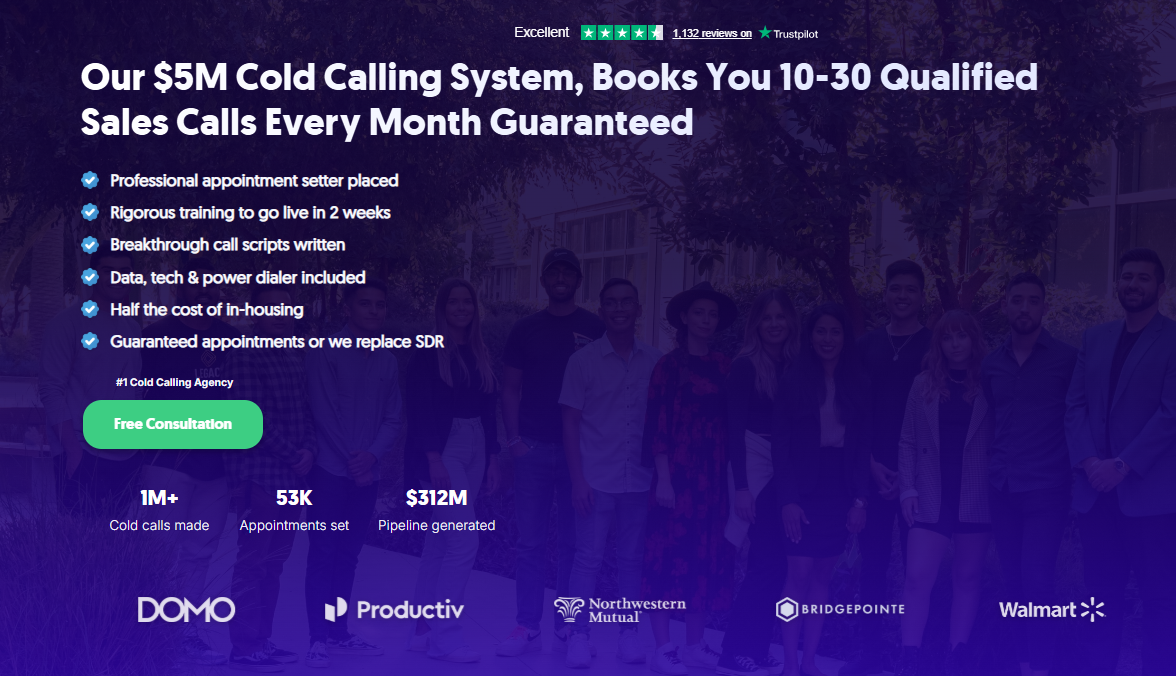
Our $5M Cold Calling System books 10–30 qualified sales calls per month for B2B clients — with a dedicated no-accent appointment setter, custom call scripts, verified direct-dial data, power dialer, and a coaching infrastructure already built into the service.
What makes this different from managing cold calling in-house?
We've made over 1 million cold calls and set 53,000+ appointments. The process, the data sourcing, the script testing, the timing optimization, the follow-up cadencing — all of it is already proven. You're not building that from scratch or waiting for a new SDR to ramp. You're plugging into a system that runs on day one.
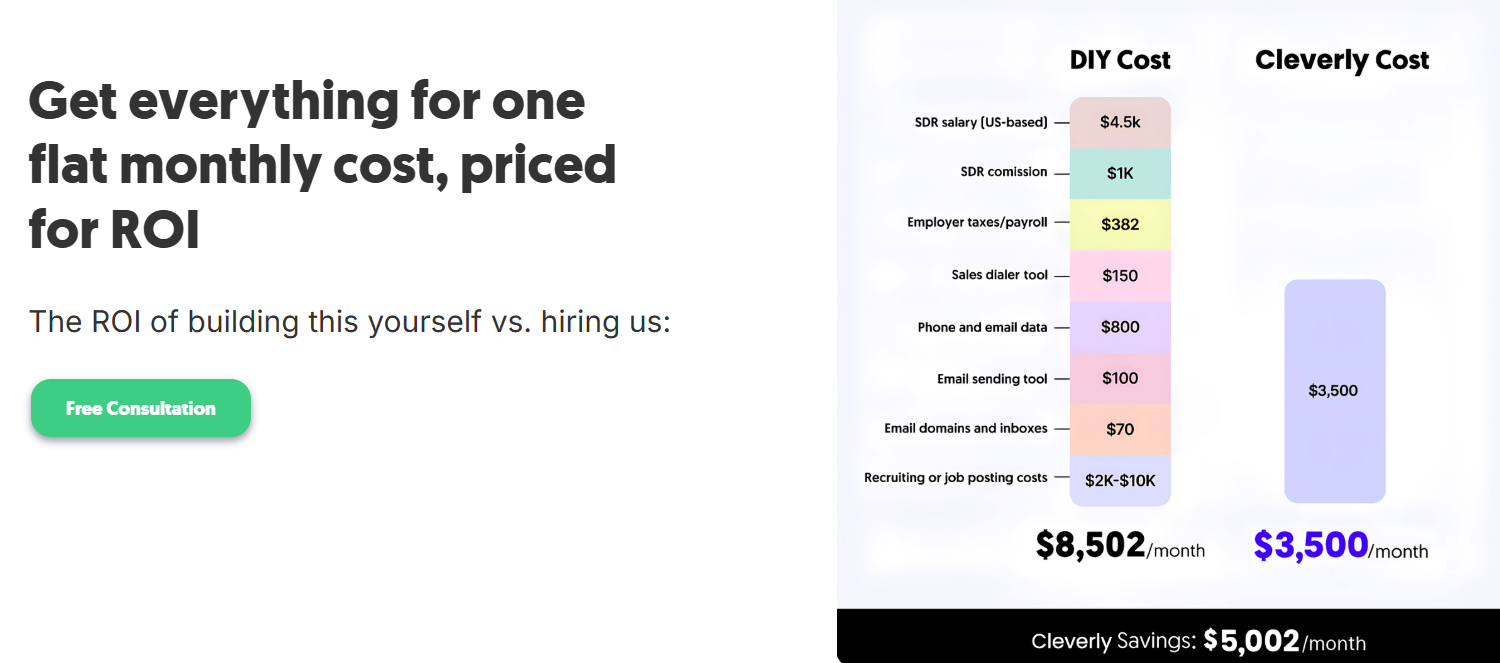
It's also half the cost of building internally, and we back it with a guarantee: qualified appointments or we replace the SDR. No long-term contracts.
If your team knows cold calling works for your market, has a validated offer, and wants qualified meetings with decision-makers without the overhead of building an in-house calling program, this is what we do.
🔥 Book a strategy call with Cleverly to see if it's a fit for your pipeline goals.
Conclusion
Cold calling remains one of the highest-ROI outbound channels in B2B — when the execution is right. The 2026 benchmarks make the opportunity clear: the average team converts 2.5% of dials to meetings, while top performers convert 5–8%+. That gap is not talent. It's a measurable, fixable set of systems and habits.
The 8 strategies in this guide — better data, pre-call research, stronger openers, discovery-first conversations, optimized timing, persistent follow-up, multi-channel integration, and coaching loops — are the specific levers that separate average from elite.
The fastest wins usually come from the most unsexy places: clean data and consistent follow-up account for more conversion improvement than any script rewrite.
Stop optimizing dials. Start optimizing conversion at each stage of the funnel, and your pipeline will grow even with the same activity level.
Frequently Asked Questions
Free Resource
How to Scale a Profitable Cold Call System
Get the complete guide — download it instantly now.
Free Ebook
Download the Free Guide
Enter your details to get instant access.
You're all set! 🎉
Your ebook is downloading now.
Click below if the download didn't start automatically.