Table of Contents
Why Outsourcing LinkedIn Outreach Makes Sense (When Done Right)
What LinkedIn Lead Generation Services Actually Include
How to Evaluate a LinkedIn Lead Generation Agency: A Step-by-Step Framework
LinkedIn Agency Red Flags to Watch For
Questions to Ask a LinkedIn Lead Generation Agency Before Signing
How Cleverly Stands Up to These Evaluation Criteria
Conclusion
Frequently Asked Questions
Modified On :
June 15, 2026
Key Takeaways
- The wrong LinkedIn agency generates volume without revenue — vetting upfront saves months of wasted spend and a burned ICP.
- A legitimate agency should clearly explain their targeting methodology, copywriting process, outreach execution model, and what happens to your data when the contract ends.
- Red flags include guaranteed lead volumes, vague process descriptions, no verifiable case studies, and pressure to sign fast.
- Before signing, ask for sample sequences, benchmark performance data, and a case study from a company with a similar ICP and deal size.
- Cleverly's done-for-you LinkedIn outreach is built specifically for B2B companies that want meetings booked — not just connection requests sent.
Signing a contract with the wrong LinkedIn lead generation agency is an expensive mistake. Not because LinkedIn doesn't work — it does.
LinkedIn generates 277% more leads compared to Facebook and Twitter combined, and 89% of B2B marketers use LinkedIn for lead generation. The channel is legitimately one of the best sources of qualified B2B pipeline available today.
The problem is the market for LinkedIn outreach agencies is flooded with vendors who understand how to sell the service better than they understand how to deliver it.
The difference between a reliable partner and an expensive disappointment almost always comes down to a handful of questions that most buyers skip before signing.
This guide breaks down exactly how to evaluate a LinkedIn lead generation agency — from targeting methodology to contract terms — so you make a decision you won't regret 60 days in.
This is for founders, sales leaders, and marketing teams either considering outsourcing LinkedIn outreach for the first time or switching agencies after a bad experience.
Why Outsourcing LinkedIn Outreach Makes Sense (When Done Right)
Outsourcing LinkedIn outreach isn't a shortcut. It's a legitimate strategic decision for B2B teams that understand what the channel requires.
Running LinkedIn outreach in-house sounds simple until you're actually doing it. You need a clean ICP, a strong Sales Navigator filter setup, profile optimization that doesn't look like a pitch deck, connection request copy that gets accepted, multi-touch follow-up sequences that don't annoy people, and someone actually managing replies and booking meetings.
That's a part-time job before you've sent a single message.
What a good agency handles: ICP definition, prospect list building, profile optimization, connection request and follow-up copywriting, sending cadence management, and reply handling. That's the full stack. Most in-house teams can execute two or three of those competently. Few do all of them consistently.
The real upside of outsourcing is speed to pipeline and specialist expertise — getting campaigns built and running in days instead of months, with messaging frameworks that have been tested across hundreds of campaigns.
The caveat, and it's an important one: the wrong agency can damage your LinkedIn profile, burn through your ICP with generic outreach, and leave you with months of low-quality data and nothing to show for it. That's the outcome this guide is designed to help you avoid.
🚀 10,000+ Clients Chose Us for a Reason
Most agencies sell activity metrics. We focus on outcomes. $312M pipeline generated through LinkedIn outreach.
What LinkedIn Lead Generation Services Actually Include
Not all LinkedIn lead generation services are the same, and a lot of buyers find this out after they've already signed.
Here's what a legitimate, full-service agency should deliver:
- ICP definition and refinement — not just a questionnaire, but a proper conversation about firmographics, title seniority, buying triggers, and disqualifiers.
- Prospect list building via Sales Navigator — filters built around your ICP, with data enrichment to improve accuracy.
- Profile optimization — your profile needs to convert when a prospect clicks it. That means headline, about section, and featured content all aligned to your offer.
- Connection request copywriting — the first message is the only one that matters if it doesn't land.
- Multi-touch follow-up sequences — typically 3-5 touchpoints with different angles and value props.
- Reply management — someone qualifying responses, booking calls, and keeping warm conversations from going cold.
What's often not included — and what you should ask about before signing:
- A/B testing frameworks
- CRM integration
- Reporting cadence and access
- Dedicated account manager vs. shared support queue
The clearest line between a legitimate agency and a tool vendor: a vendor gives you software and a seat. An agency gives you a system, a strategy, and a team running it.
"We send connection requests" is not a strategy. Connection requests are the mechanic. What matters is who they're sent to, what they say, what happens after they're accepted, and how the campaign evolves based on what's working.
How to Evaluate a LinkedIn Lead Generation Agency: A Step-by-Step Framework
This isn't a sales checklist. It's a due diligence process. Use it like one.
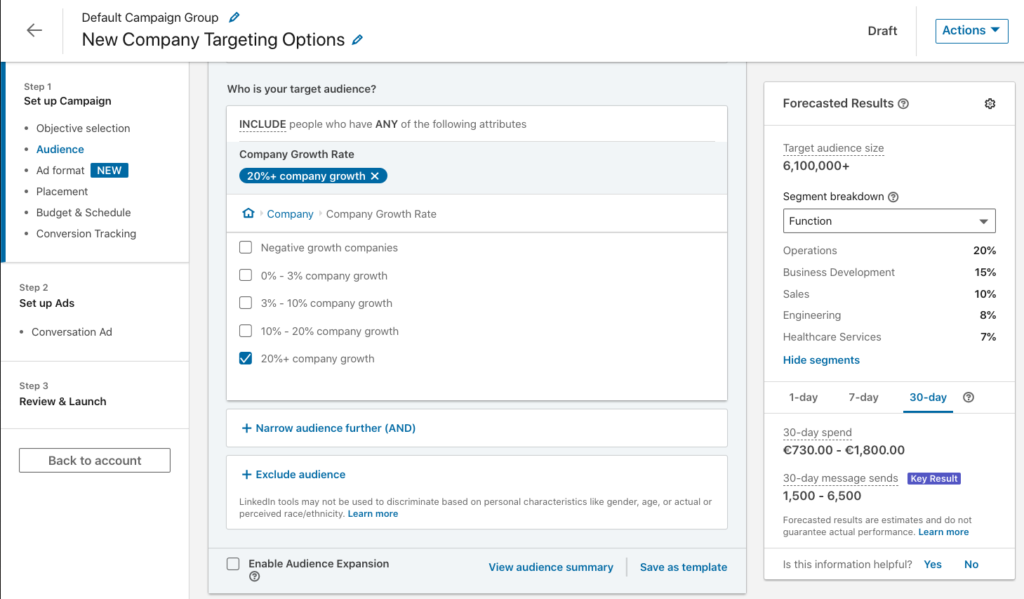
Step 1 — Assess Their Targeting Methodology
Targeting is where most agencies cut corners, and it's the root cause of most underperforming campaigns.
Ask specifically: how do they define your ICP? Do they ask about firmographics, technographics, buying triggers, and role seniority — or do they hand you a form asking for company size and industry and call it a day?
A strong agency uses Sales Navigator filters plus data enrichment, not just basic LinkedIn search. They should also have a clear approach to TAM sizing — especially if your audience is niche and you can't afford to burn through prospects with a generic sequence.
Before you sign anything, ask if they can show you a sample target list. Good agencies build one. Lazy ones say they'll get started after you pay.
Red flag: an agency that starts building lists before spending real time understanding your ICP. If they haven't asked about buying triggers, technographics, or what a bad-fit prospect looks like, they're guessing.
Step 2 — Evaluate Their Messaging and Copywriting Process
The wrong agency generates volume without revenue — and the most common reason is copy that doesn't resonate.
Ask who actually writes the outreach copy. Is it a dedicated strategist who understands your offer and your ICP? Or is it a template library with your company name swapped in?
Ask to see sample connection requests and follow-up sequences for companies similar to yours. If they can't show you examples that feel like they were written for a specific person at a specific company — not just "Hi [First Name], I noticed you work in [Industry]" — that's a problem.
Ask about the approval process. How do you review copy before it goes out? How fast can they iterate based on performance? The best agencies treat copywriting as an ongoing optimization loop, not a one-time deliverable.
Red flag: agencies that hand you a generic sequence and say "this works for everyone." Nothing works for everyone. That sentence should end every evaluation conversation.
Step 3 — Understand Their Outreach Execution Model
The question of how they actually send outreach matters more than most buyers realize.
There are two models: manual outreach and automation-assisted outreach. Here's the honest breakdown:
What you need to know: LinkedIn actively restricts accounts showing unusual activity patterns. If the agency you hire is running full automation without safeguards, your profile is at risk — not theirs.
Ask directly: do they use your LinkedIn account or a managed profile? If they're using yours, what volume limits do they respect? What tools are in their stack? How have they handled account restrictions in the past?
Red flag: agencies that are vague about their sending method or refuse to name their tools. Transparency here is non-negotiable.
Step 4 — Review Their Reporting and Metrics
You can't optimize what you don't measure — and you can't trust an agency that doesn't show you the numbers.
Here's what a legitimate agency should track and report on:
- Connection acceptance rate — industry benchmark is roughly 20-40% depending on ICP and messaging
- Reply rate — total replies as a percentage of accepted connections
- Positive reply rate — the number that actually matters; this means interest, not just responses
- Meetings booked — the outcome the whole campaign exists to produce
- Cost per meeting — essential context for evaluating ROI
Ask how often they report — weekly, monthly, or only when you ask. Ask whether you get access to a live dashboard or just PDFs after the fact. Ask what their diagnostic process looks like when a campaign underperforms.
Top-tier agencies achieve 12-25% InMail response rates and 60-85% connection acceptance rates — if the agency you're evaluating can't tell you their own benchmarks across recent campaigns, that's a serious problem.
Red flag: agencies that can't give you their average connection rate or reply rate. If they don't know those numbers, they're not running a serious operation.

Step 5 — Check Their Industry and ICP Experience
Generic lead generation experience is not the same as experience with your ICP.
Messaging that converts SaaS founders looks nothing like messaging that converts enterprise procurement teams or CFOs at mid-market manufacturing companies. The angles, the tone, the proof points, and the call to action are all different.
Ask directly: what campaigns have they run in your space? What were the results? Can they show a case study from a company with a comparable offer, deal size, and target audience?
Anonymized data is fine. Zero proof is not.
Red flag: agencies that claim to work with every industry but can't show relevant proof. "We've worked in SaaS, professional services, manufacturing, and healthcare" means nothing without campaign data to back it up.
Step 6 — Clarify Contract Terms and Client Ownership
This conversation happens at the end of most evaluations, but it should happen near the beginning.
Key questions:
- Who owns the prospect lists, copy, and campaign data when the contract ends?
- What's the minimum commitment — month-to-month, quarterly, or annual?
- What are the exit terms if performance stays below agreed benchmarks?
- Are there setup fees or onboarding charges not reflected in the headline price?
Month-to-month pricing exists. It's standard at well-run agencies. Long lock-in contracts with no performance benchmarks are a tell.
Red flag: agencies that require 6-12 month commitments with no clearly defined performance thresholds or exit clauses. That structure protects them, not you.
📈 Starting at $397/mo. Not $5,000+
Get a fully managed LinkedIn lead generation campaign. Targeting, outreach, follow-ups & booked meetings included.
LinkedIn Agency Red Flags to Watch For
Beyond the step-by-step framework, here are the patterns that should stop an evaluation in its tracks.
🚩 Guaranteed lead volumes
Legitimate agencies set expectations based on benchmarks from comparable campaigns. They do not guarantee 30 leads a month before they've seen your ICP, your offer, or your target market. Anyone who does is either lying or doesn't understand what they're selling.
🚩 No discovery call before pricing
If you get a quote without a real conversation about your ICP, offer, deal size, and target market, the agency doesn't understand what they're agreeing to deliver.
🚩 Vague process descriptions
If you can't get a clear answer about how targeting, copywriting, and sending work — after asking directly — it means they either don't have a defined process or they're hiding something. Neither is good.
🚩 No verifiable results
Case studies don't need to name clients. But zero proof — no data, no testimonials, no results of any kind — is not acceptable from an agency asking for a monthly retainer.
🚩 Automation-only outreach without safeguards
Fully automated LinkedIn outreach without volume controls and safety protocols puts your profile and your ICP at risk. If the agency can't explain how they protect your account, they probably aren't.
🚩 No account manager or single point of contact
When campaigns underperform or need rapid iteration, you need someone to call. If you're escalating to a support ticket queue, you've already lost.
🚩 Pressure to sign fast
Any agency using urgency tactics on a 3-6 month service contract is more focused on closing the deal than on delivering results. Slow down and pressure-test harder.
Questions to Ask a LinkedIn Lead Generation Agency Before Signing
Use these in your evaluation call. The quality of the answers tells you almost everything.
- "Can you walk me through exactly how you'll build my target list?" — Listen for specifics: Sales Navigator filters, enrichment tools, ICP validation steps.
- "Who writes the copy and what does the approval process look like?" — You want a dedicated strategist and a clear review cycle, not a template sent the day before launch.
- "What's your average connection acceptance rate and reply rate across recent campaigns?" — Benchmark numbers should be ready. Hesitation or vagueness here is a red flag.
- "Can you show me a case study from a company with a similar ICP or offer?" — Relevant proof. Not general case studies. Similar industry, similar deal size, similar target buyer.
- "How do you handle underperforming campaigns — what's your optimization process?" — What you're looking for: a structured testing and iteration loop, not "we'll keep trying."
- "What does the first 30 days look like and what are the onboarding milestones?" — Good agencies have a defined onboarding timeline. Vague answers suggest an ad-hoc operation.
- "Who is my main point of contact and how often will we speak?" — You want a named account manager and a set cadence, not shared inboxes.
- "What happens to my data and lists if I end the contract?" — The answer should be immediate and clear. Any hesitation warrants follow-up.
How Cleverly Stands Up to These Evaluation Criteria
We built Cleverly specifically for LinkedIn outreach. It's not a generalist lead generation agency applying a generic framework to a specialized channel — LinkedIn is what we do, and we've been doing it for thousands of B2B companies across every major industry.
When you work with us, you get ICP-aligned targeting built through Sales Navigator, profile optimization that actually converts, done-for-you connection and follow-up copy reviewed and approved by you before a single message goes out, and transparent performance reporting with a dedicated account manager who owns your campaign results.
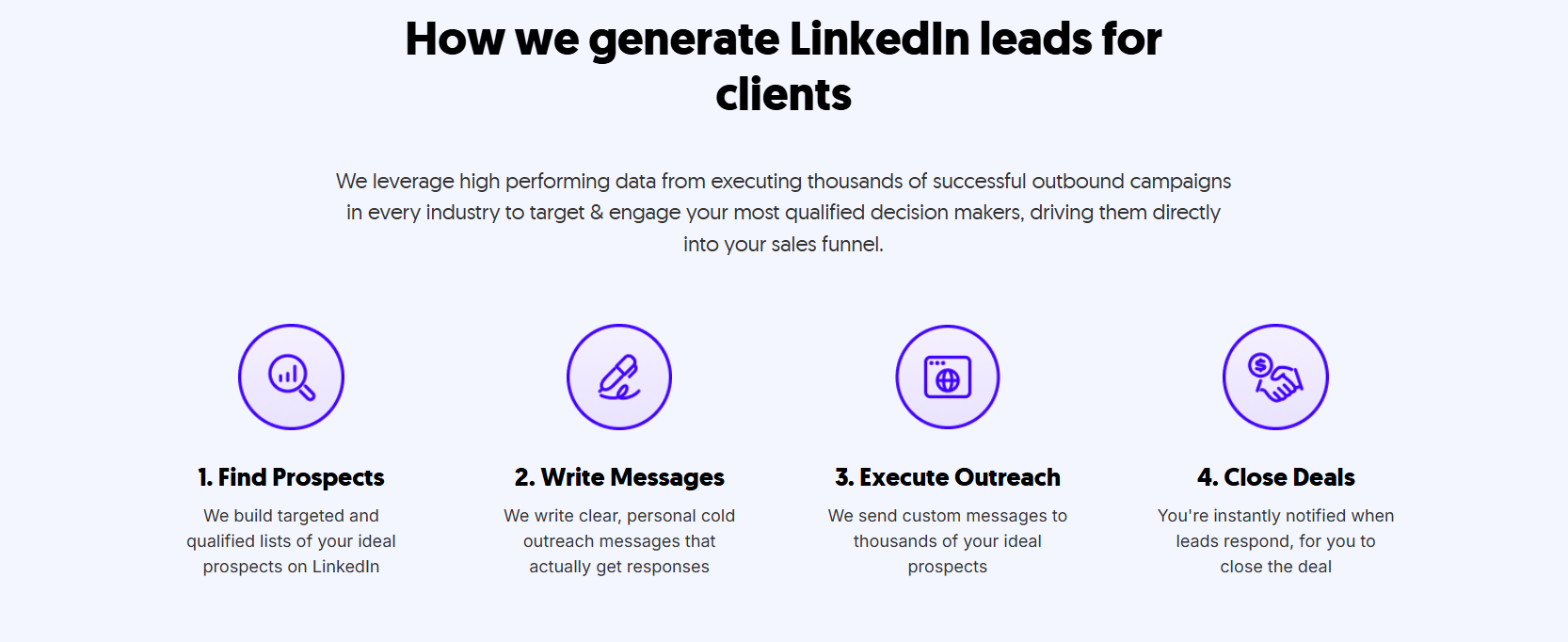
Onboarding follows a defined milestone structure — you know exactly what's happening in week one, week two, and at launch. There are no long-term lock-in contracts because we operate on a month-to-month model.
We hold campaigns to real performance benchmarks and have an active optimization loop when results need improvement. Our clients stay because we're booking consistent meetings — not just sending connection requests.
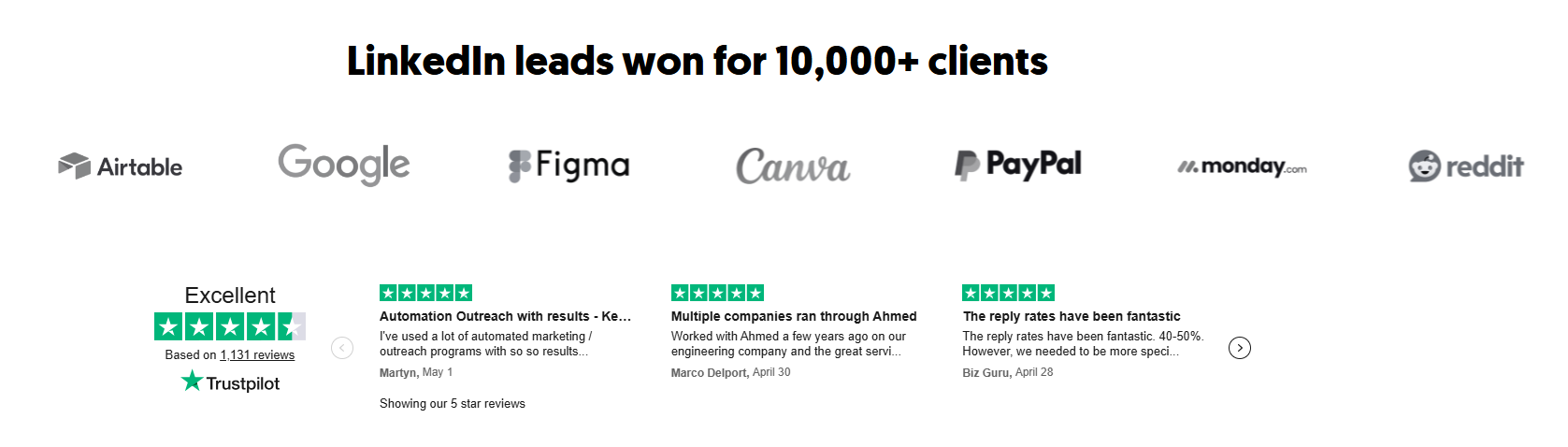
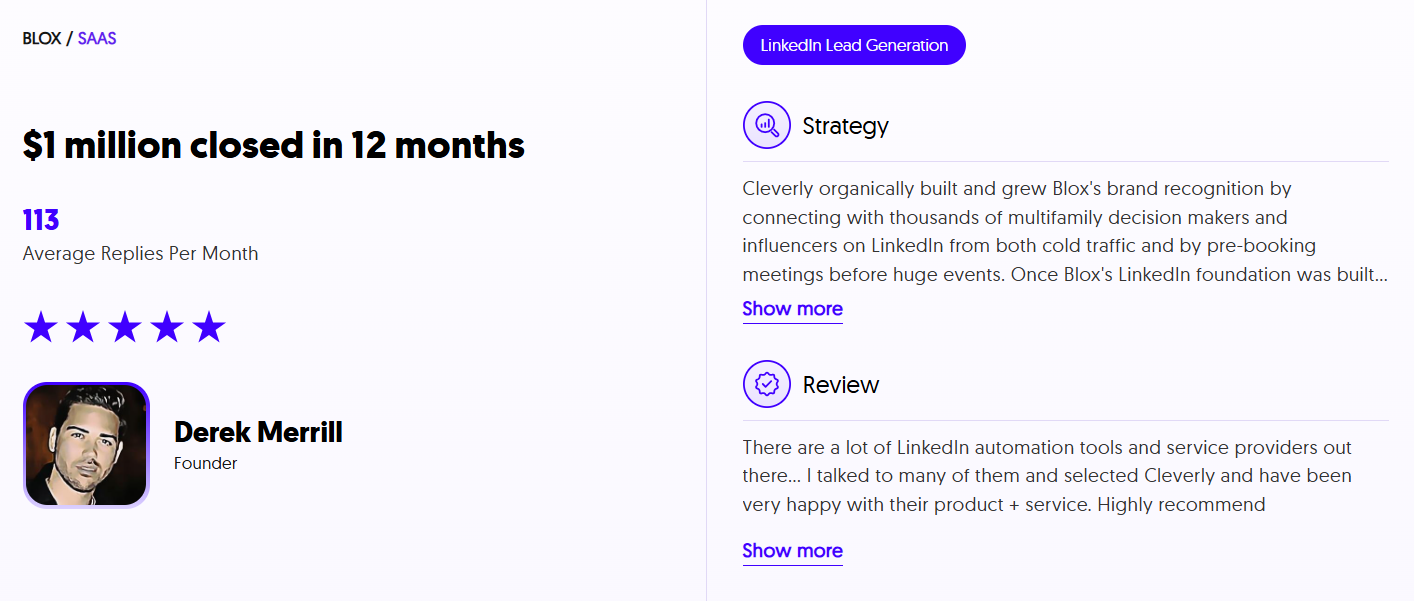
We've helped over 10,000 B2B companies run LinkedIn outreach, and we've generated over $51.2M in closed revenue for our clients across the process. LinkedIn services start at $397/month.
Ready to evaluate Cleverly against your criteria? Book a strategy call and we'll show you exactly how we'd approach your campaign!
Conclusion
The right LinkedIn lead generation agency acts like an extension of your sales team — not a vendor you hand a brief to and hope for the best.
A thorough evaluation upfront is what separates a partnership that produces pipeline from one that wastes three months and leaves you starting over.
Use the framework in this guide to pressure-test any agency before signing. Ask the hard questions, look for clear answers, and pay attention to the red flags. The agencies worth working with will welcome the scrutiny.
Frequently Asked Questions
Free Resource
How to Scale a Profitable Cold Call System
Get the complete guide — download it instantly now.
Free Ebook
Download the Free Guide
Enter your details to get instant access.
You're all set! 🎉
Your ebook is downloading now.
Click below if the download didn't start automatically.