Table of Contents
What Is DIY LinkedIn Outreach?
What Is Done-for-You (DFY) LinkedIn Outreach?
The Real Cost of DIY LinkedIn Outreach
The Real Cost of Done-for-You LinkedIn Outreach
DIY vs. DFY LinkedIn Outreach — Results Compared
What Most Companies Get Wrong with DIY LinkedIn Outreach
What Most Companies Get Wrong with Done-for-You LinkedIn Outreach
How to Decide: Is DIY or DFY Right for Your Business?
How Cleverly's Done-for-You LinkedIn Outreach Drives Qualified Pipeline
Conclusion
Frequently Asked Questions
Modified On :
May 7, 2026
Key Takeaways
- DIY LinkedIn outreach looks cheap upfront but carries hidden costs in time, tools, account risk, and a 3–6 month learning curve that most teams underestimate.
- Done-for-you outreach typically delivers faster time-to-first-meeting (30–60 days vs. 60–90 for DIY) and better meeting quality when the agency uses a tested, ICP-aligned process.
- The math usually tips toward DFY once your average deal size clears $5K — one additional closed deal per quarter covers most agency fees.
- The biggest DIY failure isn't the tools — it's lack of strategy: generic messaging, no structured follow-up cadence, and misjudging LinkedIn's automation limits.
- The biggest DFY failure is choosing on price over process. A bad agency burns budget and delivers connection counts, not pipeline.
Teams that try LinkedIn outreach land in one of two camps. They go DIY, spend months tweaking messaging and tools, get inconsistent results, and quietly abandon the channel. Or they hire an agency, see underwhelming results in the first 30 days, and assume LinkedIn doesn't work for their business.
Neither outcome is inevitable.
But both happen constantly — because most teams start with the wrong question. The question isn't "DIY or DFY?" It's "which model fits my deal size, team bandwidth, and growth stage?"
LinkedIn generates 80% of all B2B leads from social media, making it the highest-leverage outbound channel for most B2B companies. Yet most teams treat it like an afterthought, cycling through tools and templates with no real system behind them.
Personalized connection request messages boost reply rates to 9.36% compared to just 5.44% without a message — nearly double. That gap doesn't come from the tool you use. It comes from the quality of your targeting and copy, which is exactly where DIY campaigns most often fall short.
This guide breaks down the real costs, expected results, and most common failure modes for both approaches — so you can make the right call for your business.
What Is DIY LinkedIn Outreach?
DIY LinkedIn outreach means managing the entire outbound function in-house. Your team handles everything: ICP research, list building, connection requests, follow-up sequences, reply management, and LinkedIn profile optimization.
What It Actually Involves
Most people underestimate how many moving parts there are. A functional DIY LinkedIn outreach system requires:
- Defining and refining your ICP
- Building and verifying prospect lists (typically via Sales Navigator)
- Writing and testing LinkedIn message copy
- Structuring multi-touch follow-up sequences (5+ messages minimum)
- Managing replies and qualifying interested prospects
- Monitoring LinkedIn account health and staying within weekly limits
- Optimizing your sender's profile so prospects actually accept your requests
That's a full function, not a side task.
Common Tools
The typical DIY stack includes Sales Navigator ($99–199/month) for list building, plus an automation layer. Here’s a list of LinkedIn automation tools you can review.
Who Goes DIY
Early-stage founders validating an offer. Lean sales teams with one person wearing multiple hats. Companies exploring LinkedIn as a new channel before committing budget. DIY makes sense in these contexts — but it carries more cost than most people account for.
🚀 Your SDR’s Salary ≠ Guaranteed Meetings
Cleverly runs LinkedIn outreach fully done-for-you. You get qualified calls—without hiring, training, or managing.
What Is Done-for-You (DFY) LinkedIn Outreach?
Done-for-you LinkedIn outreach means outsourcing the full outbound function to a specialist agency. The agency owns execution from ICP definition to reply handling. You focus on closing conversations that land in your inbox.
What the Agency Handles
A quality DFY agency manages:
- ICP definition and prospect targeting
- LinkedIn profile positioning
- Connection request copy and multi-touch follow-up sequences
- A/B testing and ongoing optimization
- Reply management through to meeting booking
- Reporting on pipeline metrics (not vanity metrics)
Your Role as the Client
Strategy alignment and offer clarity. Handling warm conversations when qualified prospects express interest. Closing deals.
Who Goes DFY
Growth-stage companies that need predictable pipeline and can't afford to wait 3–6 months to figure out LinkedIn. Teams where no one can own outreach full-time. Companies with a proven offer and average deal sizes that justify the investment.
The Real Cost of DIY LinkedIn Outreach
This is where most teams get surprised.
Hard Tool Costs
Sales Navigator runs $99–199/month. Add an automation tool at $50–150/month. You're at $150–350/month in hard costs before anyone has typed a single message.
The Account Risk
Testing data from a 2026 study across 50 LinkedIn accounts showed 23% faced restrictions within 90 days using automation tools, and LinkedIn's detection rates increased 340% from 2023 to 2025. If your account gets restricted, your outreach stops cold — and you lose whatever connection momentum you've built.
The final two quarters of 2025 saw a surge in mandatory identity verification checks, with LinkedIn's updates targeting synthetic accounts and inauthentic outreach behavior.
This isn't a theoretical risk. It's a real business cost that most DIY budgets don't account for.
The Hidden Time Cost
Here's what the tool cost doesn't show: someone on your team still needs to build the lists, write the copy, manage the sequences, handle replies, and iterate when results are weak. That's realistically 15–20 hours per week for anyone doing it seriously.
If that's a founder at $200/hour in opportunity cost, you're spending $3,000–4,000/month before you see a single meeting.
The Learning Curve
Expect 3–6 months before your targeting and messaging are dialed in enough to produce consistent results. That's not pessimistic — that's the realistic timeline for iterating ICP fit, testing copy angles, and building a follow-up cadence that actually works.
The True Cost Reality
Add it up: $350/month in tools, $3,000+ in time, 3–6 months to optimize, and a non-trivial account risk. "Cheap" DIY is often the most expensive path to closed revenue once you factor in cost-per-meeting and time-to-close.
💼 DIY Outreach Costs More Than You Think
Tools, SDRs, training, management—it adds up fast. We book meetings starting at just $397/mo.
The Real Cost of Done-for-You LinkedIn Outreach
DFY pricing varies by agency tier and scope.
- Boutique agencies: $1,500–5,000/month
- Enterprise appointment-setting firms: $5,000–15,000/month
- Cleverly's LinkedIn outreach: starts at $397/month
What's Included
A quality DFY engagement covers strategy, targeting, copywriting, execution, A/B testing, ongoing optimization, and reporting. You're not buying a tool — you're buying a team and a proven system.
The Cost-Per-Meeting Math
Consider a $3,500/month DFY engagement that consistently books 8 qualified meetings per month. That's $437 per meeting.
Compare that against your fully loaded DIY cost (tools + time + learning curve + account risk), and the DFY math often wins — particularly when meeting quality is higher.
The Deal Size Threshold
If your average deal size is $5,000 or more, a single additional closed deal per quarter covers most agency fees. Once you cross $10K average deal size, the ROI math becomes almost impossible to argue against.
When DFY Clearly Wins
- Your team is spending 10+ hours per week on prospecting
- You have a proven offer but no repeatable outreach system
- You've tried DIY and hit a plateau you can't get past internally
DIY vs. DFY LinkedIn Outreach — Results Compared
Highly personalized LinkedIn campaigns can achieve response rates up to 25%, while average outreach sits around 10.3% — and companies that engage with prospect profiles before messaging see reply rates 3x higher than cold outreach alone.
That level of targeting and pre-engagement rigor is hard to execute consistently in-house. It requires dedicated time, proven playbooks, and the discipline to iterate — all of which a quality DFY agency brings from day one.
Sequenced follow-up messages spaced 2–5 business days apart improve conversions by 49% over one-off outreach attempts. Most DIY campaigns never build that cadence. They send one or two messages and move on.
What Most Companies Get Wrong with DIY LinkedIn Outreach
These aren't edge cases. These are the mistakes that kill the majority of DIY efforts.
Using Automation Without Strategy
Sending volume is easy. Sending the right message to the right person is hard. Most DIY campaigns fire up an automation tool, upload a list, and push a generic sequence. The result: low reply rates, wasted connection limits, and a damaged sender reputation.
Pitching in the Connection Request
LinkedIn is a relationship-first platform. Sending a product pitch in your first message — before you've even connected — is the fastest way to get ignored. The connection request should open a conversation, not close a deal.
Weak LinkedIn Profiles
Before a prospect replies, they check your profile. If your headline is vague, your experience section is thin, or your profile photo looks unprofessional, they won't respond — regardless of how good your message is.
No Structured Follow-Up Cadence
Most meetings don't come from a single LinkedIn message — they result from orchestrated touches across multiple steps. DIY campaigns routinely stop at one or two messages. Most qualified prospects need five or more touchpoints before they engage.
Misreading LinkedIn's Limits
LinkedIn's current safe limits in 2025 include 10–20 connection requests per day depending on account type, and 50–100 messages per day. Pushing past these limits — especially with automation tools — triggers restrictions that can sideline your entire outreach effort.
Treating LinkedIn Like Email
LinkedIn outreach requires a fundamentally different approach than cold email. Shorter messages. Softer asks. More relationship-building before the pitch. Teams that port their email sequences directly to LinkedIn without adapting them get predictably bad results.
What Most Companies Get Wrong with Done-for-You LinkedIn Outreach
DFY isn't a guarantee either. Here's what goes wrong.
Choosing on Price, Not Process
The cheapest LinkedIn lead generation agency option rarely has the methodology, team depth, or track record to deliver consistent results. Ask how they build targeting lists. Ask how they A/B test copy. Ask what their average client tenure is. Agencies with low retention are telling you something important.
Not Vetting the Fundamentals
Does the agency personalize at the individual level, or are they running the same sequence for every client? Do they A/B test connection copy and follow-ups? Do they align messaging to your specific ICP, or do they use generic B2B frameworks? These questions separate quality agencies from budget-mill operators.
Expecting Immediate Results
Most DFY LinkedIn outreach services take 60–90 days to fully optimize. Connection rates, reply rates, and meeting volume improve as the agency tests angles and refines targeting. Teams that judge a program at the 30-day mark and pull the plug are leaving real pipeline on the table.
Being Too Hands-Off
The best DFY results require close alignment between client and agency — especially on offer clarity and ICP definition. If you're vague about who you're targeting and why they should care, no agency can fix that through copy alone.
Measuring the Wrong Metrics
Connections and profile views don't pay salaries. The only metrics that matter are qualified meetings booked, pipeline created, and cost-per-closed-deal. Any agency that leads with connection counts in their reporting should raise a flag.
How to Decide: Is DIY or DFY Right for Your Business?
Here's a practical decision framework.
The Deal Size Rule
- Average deal $5K+: DFY math almost always wins. One additional closed deal per quarter covers the agency fee.
- Average deal $2K–5K: DFY can still work, but requires tighter cost-per-meeting discipline.
- Average deal under $2K: DIY may be more defensible. The economics are harder to justify with most agency pricing.
TAM and ICP Size
Micro-niche ICPs with tight targeting (100–500 prospects) can work well with a highly personalized DIY approach. Medium-to-large TAMs with thousands of qualified prospects scale better and faster with DFY infrastructure.
Internal Bandwidth
Do you have someone who can own this full-time, stay consistent week-over-week, and iterate based on data? If yes, DIY is viable. If that person is you, the founder, ask what your opportunity cost actually is.
Stage of Business
How Cleverly's Done-for-You LinkedIn Outreach Drives Qualified Pipeline
You might not have a LinkedIn problem. It is just an execution problem.
The strategy is simple: reach the right people, say the right thing, follow up consistently. The hard part is doing it well enough, consistently enough, to generate predictable pipeline — while managing everything else on your plate.
That's exactly what we've built at Cleverly.
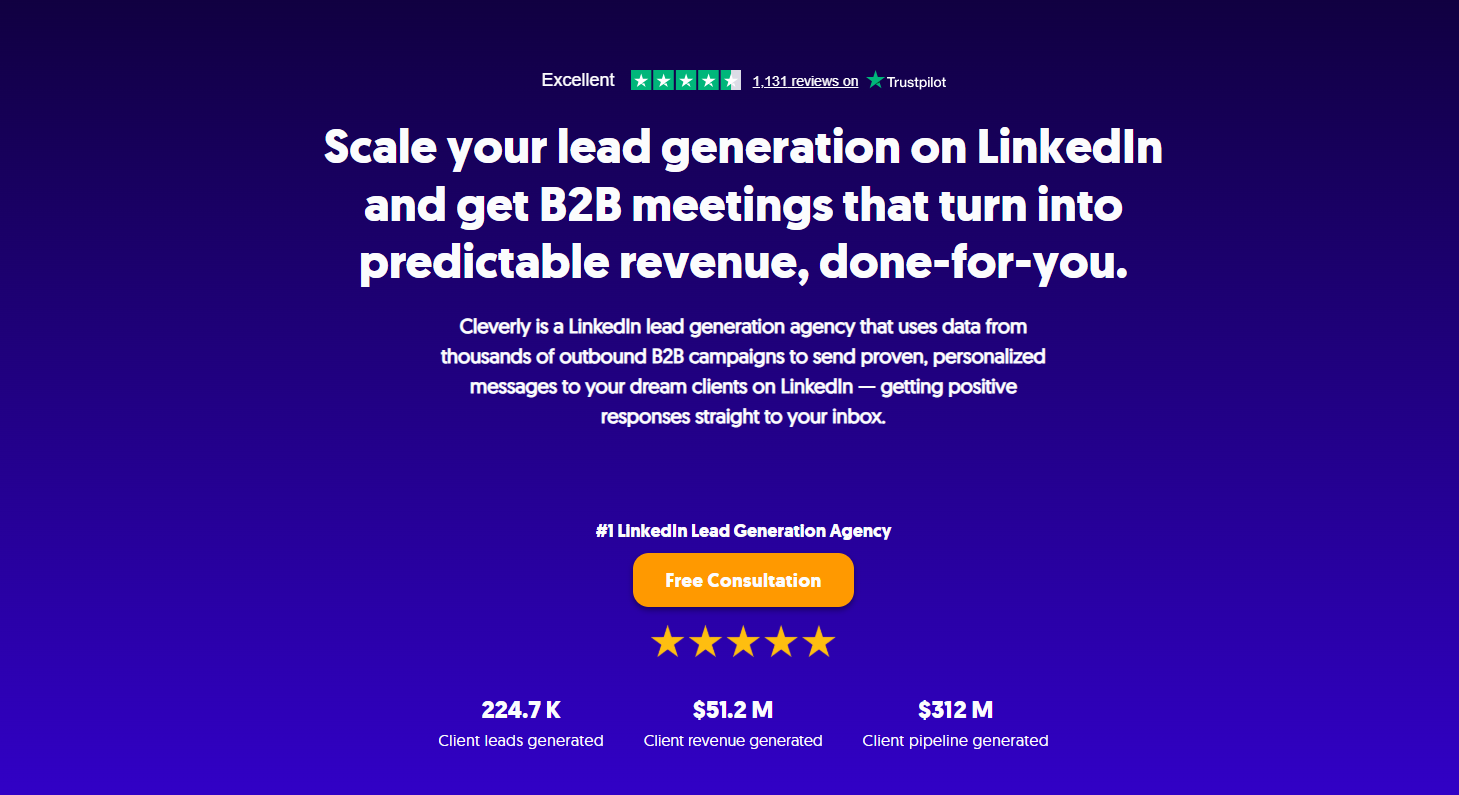
Our done-for-you LinkedIn lead gen service handles the full function: ICP targeting, verified prospect lists, connection copy, multi-touch follow-up sequences, A/B testing, and reply management up to meeting booking.
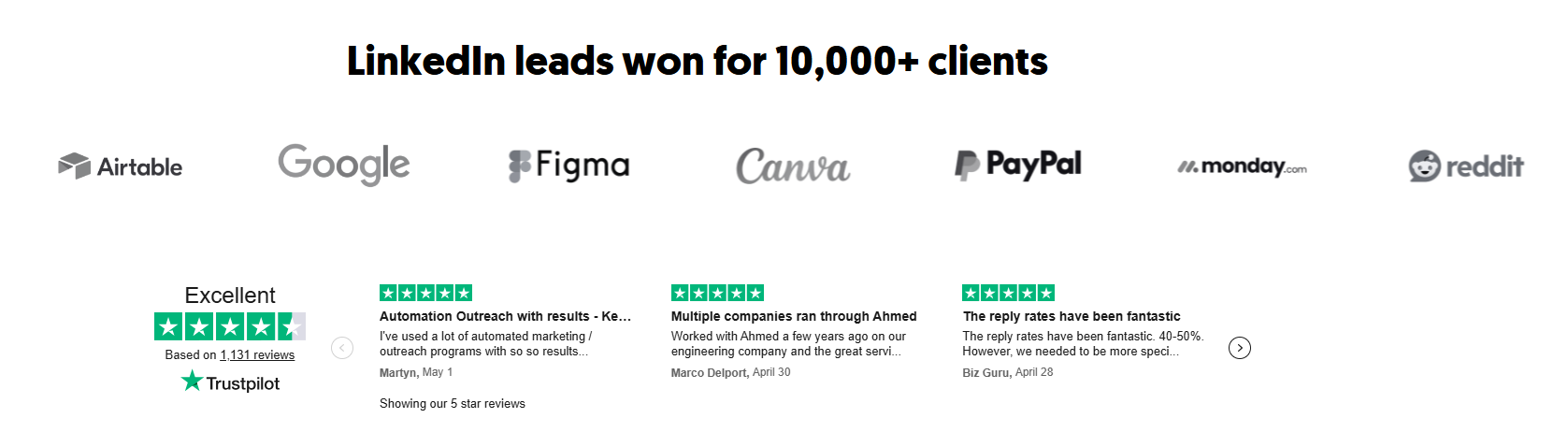
Everything is built on playbooks refined across 10,000+ client campaigns — including work with teams at Google, PayPal, Slack, Spotify, and hundreds of fast-growing B2B companies you've heard of.
The results speak for themselves. We've generated $312M in pipeline revenue and $51.2M in closed revenue for our clients through LinkedIn outreach alone.
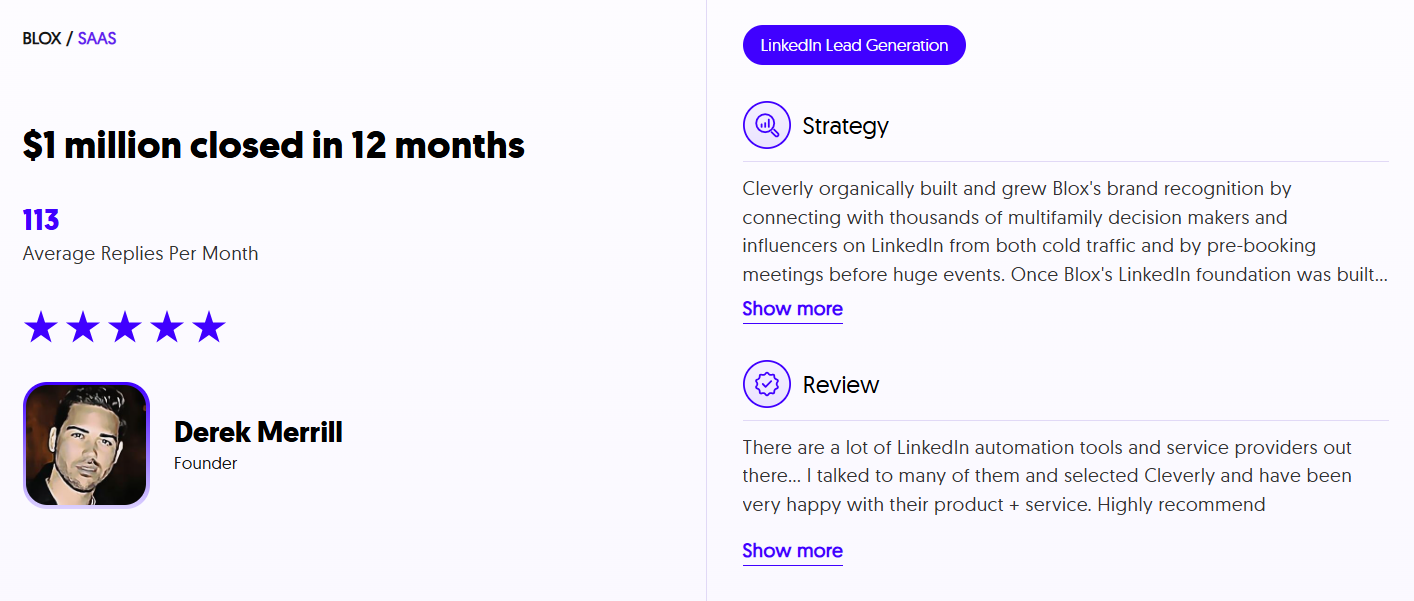
Our programs start at $397/month — no long-term contracts, no lock-in. Month-to-month, with full accountability on meetings booked and pipeline created.
If you're tired of rebuilding your outreach system every quarter, or if you've never had a consistent outbound motion to begin with, Cleverly gives you a repeatable pipeline engine without the internal overhead.
Book your free strategy call today and we'll show you exactly what a campaign looks like for your ICP.
Conclusion
The DIY vs. done-for-you LinkedIn outreach debate isn't really about which approach is better. It's about which one fits your actual situation — your deal size, your team, your growth stage, and how much you can afford to invest in learning versus execution.
What's clear is this: DIY is never truly cheap, and DFY is never automatically good. The companies that win on LinkedIn are the ones that treat outreach like a real system — with the right targeting, tested messaging, consistent follow-up, and someone accountable for results.
Whatever path you choose, those fundamentals are non-negotiable.
Frequently Asked Questions
Free Resource
How to Scale a Profitable Cold Call System
Get the complete guide — download it instantly now.
Free Ebook
Download the Free Guide
Enter your details to get instant access.
You're all set! 🎉
Your ebook is downloading now.
Click below if the download didn't start automatically.