

Table of Contents
What Each Approach Actually Is
Claude Code vs AI SDRs: Side-by-Side
What Actually Changes in Outbound (And What Doesn't)
Cost and Time: The Honest Numbers
When Building With Claude Code Makes Sense
When an AI SDR Makes More Sense
The Hybrid Approach Most Teams Land On
How Cleverly Fits Into the Build-vs-Buy Decision
Conclusion
Frequently Asked Questions
Modified On :
October 1, 2026
Key Takeaways
- The real choice isn't tool vs tool, it's build vs rent. Claude Code is something you assemble; AI SDRs are something you configure and go.
- Neither removes the human judgment that converts replies into meetings. Objections, multi-stakeholder deals, and reply triage still need a person.
- What genuinely improves is research depth and iteration speed, not the floor on deal size or ICP quality needed to make outbound work.
- The flexibility-vs-maintenance tradeoff decides which path fits you, more than price does on paper.
- Most teams that do this well end up hybrid, using automation for the commoditized layer and keeping humans on anything that touches a real account.
Two paths have opened up for automating outbound, and most teams are picking one without ever really comparing them side by side.
On one side, you've got Claude Code, Anthropic's agentic command-line tool that can connect to your CRM, enrichment sources, and sending platforms through MCP integrations and do whatever you tell it to do with that data.
On the other, you've got AI SDR platforms, packaged products that prospect, personalize, send, and qualify replies out of the box.
Here's the thing worth clarifying right away: this isn't really a product-vs-product comparison. It's a build-vs-buy decision wearing an AI costume. Adoption backs that up. Enterprise B2B teams running an AI SDR in production jumped from roughly 12% to 41% in about a year, and the market has ballooned past $4 billion with pricing all over the map, from a few hundred dollars a month to five figures.
So the real question isn't which tool is smarter. It's whether you want to assemble your own outbound engine or rent one that's already built. Neither path, by the way, removes the human work that actually closes deals, and anyone telling you otherwise is selling you something.
This guide covers how each approach works, a direct comparison, the real cost and time numbers, when each one wins, and what neither one fixes no matter how good the model gets.
What Each Approach Actually Is
Claude Code as an Outbound Build Tool
Claude Code is an agentic CLI tool. You install it, point it at your terminal, and it reads files, runs commands, and connects to external systems through MCP (Model Context Protocol) integrations, an open standard that lets it talk to your CRM, data providers, and sending tools without custom glue code for each one.
What teams actually build with it for outbound:
- ICP definition files that encode exactly who counts as a good-fit account.
- Prospect research workflows that pull signals from multiple sources at once.
- Enrichment chains that layer firmographic and intent data together.
- Sequence writing that adapts tone and angle per segment.
- CRM updates that keep records clean without someone doing it by hand.
You define the logic, and Claude Code executes and adapts inside the rules you give it. That's the core distinction: it doesn't come with an opinion about how outbound should work. You supply that. Which also means this is a build, not a signup. It takes someone comfortable with configuration, APIs, and debugging when something doesn't connect the way you expected.
AI SDRs as Packaged Products
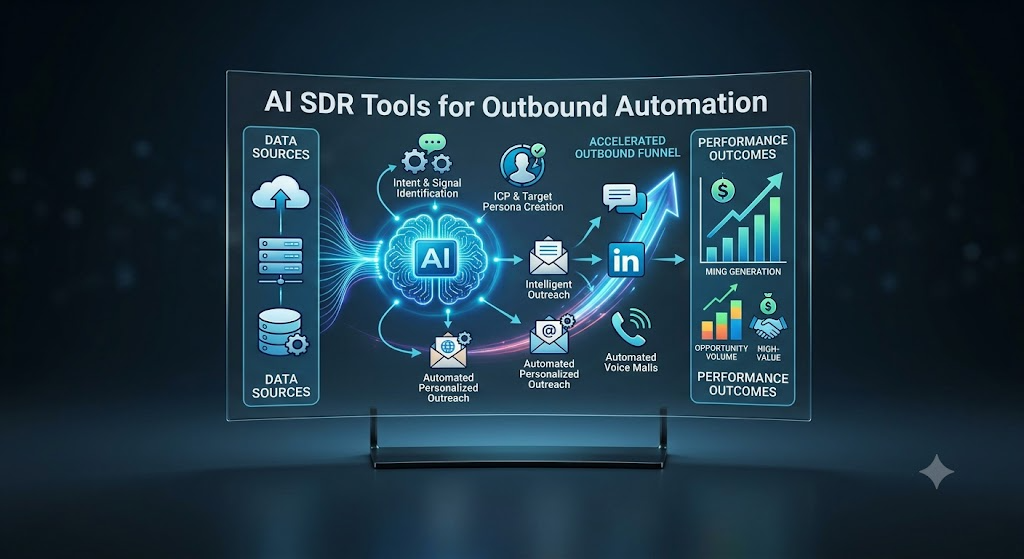
AI SDR platforms take the opposite approach. They're purpose-built systems that prospect, personalize, send, qualify replies, and book meetings, usually with their own bundled contact database and sequencing engine baked in.
You don't build these, you configure them. That's the appeal: live in weeks instead of quarters. In exchange for that speed, you accept the vendor's logic and workflow as the default way outbound runs in your business. If their qualification model doesn't match how your buyers actually behave, you're working around the platform instead of with it.
Why the Comparison Matters Now
This comparison would have barely made sense two years ago. A few things changed that:
- MCP made general-purpose agents genuinely capable of outbound work. Before MCP, connecting an agent to your CRM and data stack meant custom integration work for every tool. Now it's closer to plug and play.
- AI SDR pricing climbed while autonomy claims got tested in production. Platforms that promised to replace entry-level reps have had a year of real deployments, and the results are more nuanced than the demos.
- The gap between build and buy is now a real budget line, not a theoretical debate between engineering and sales ops.
🤖 AI Is Only Half the Equation
Cleverly combines AI with human-led strategy to help 10,000+ businesses generate qualified B2B leads across LinkedIn, cold email, and cold calling.
Claude Code vs AI SDRs: Side-by-Side
Here's the comparison most vendors won't show you, because neither side wins across the board.
Read the rows in two groups. The top half (time, technical requirement, cost) tells you what it takes to get started. The bottom half (ownership, maintenance, flexibility) tells you what it's like to live with your choice a year in. That second half is the one that actually matters, because almost everyone underweights it at decision time.
The flexibility-versus-maintenance row is the whole decision in miniature. Claude Code gives you a workflow that fits your business exactly, but every bug, every API change, every edge case your prospects hit is yours to fix. An AI SDR gives you a workflow that fits most businesses reasonably well, and someone else fixes it when it breaks.
And here's the honest asymmetry worth sitting with: build looks cheaper on a subscription line, and it rarely is once you count the engineering hours spent debugging a scoring model at 11pm instead of shipping something else.
What Actually Changes in Outbound (And What Doesn't)
This is the part most comparisons skip, and it's the part that actually matters if you're trying to decide where to put your money.
What Genuinely Changes
- Research and enrichment at list scale. Pulling five data points per prospect across thousands of accounts was never practical by hand. Now it is.
- Personalization depth without proportional time cost. You can write genuinely specific openers for 500 prospects without 500 hours of work.
- Speed to act on signals. A funding round or a job change used to take days to surface and act on. Now it's hours.
- Cheap iteration on messaging. Testing ten angles costs almost nothing when a model is writing the variants.
- Admin and CRM hygiene. This quietly ate a huge share of SDR time, and it's one of the easiest things to automate well.
What Doesn't Change
- A weak ICP still produces a bad list. It just produces it faster now.
- Bad data still caps everything downstream. Garbage in, garbage out hasn't gotten old.
- Deliverability still decides whether your email lands anywhere at all.
- Offer differentiation still drives reply rates more than copy polish does.
- Complex objections and multi-stakeholder deals still need a person who can read a room.
- The economics still depend on deal size. Automation lowers your cost per touch, not the minimum deal size that makes outbound worth running at all.
The Claim to Be Skeptical Of
Both paths get marketed as autonomous, and neither one is. Someone still owns research QA, inbox health, routing, and reply triage, whether that someone is you, your team, or a vendor's ops staff you never see.
The real risk in this category isn't the technology failing outright. It's the gap between a polished demo and what your week-six operating reality actually looks like once the novelty wears off and the edge cases start showing up.
🚀 Turn AI Into Pipeline
With 224.7K+ leads generated, 53,000+ meetings booked, and $312M+ pipeline, Cleverly helps B2B teams turn smarter outbound into real sales opportunities.
Cost and Time: The Honest Numbers

AI SDR tools sit in the low-to-mid four figures monthly at the serious end of the market, often billed annually. Published ranges vary widely by vendor tier and capability depth.
The Claude Code path costs differently. You're paying for the tool itself, data and enrichment subscriptions, sending infrastructure, and engineering time, which is the cost almost everyone forgets to model. The maintenance line is the one that quietly adds up: when an integration changes or a workflow breaks, someone on your team is fixing it instead of doing something else.
Time to reliable output matters more than time to first send. Anyone can get a first campaign live in days with either path. Getting one that reliably performs without constant babysitting takes longer, and that gap is usually bigger on the build side.
There's also an opportunity cost nobody puts in the spreadsheet. Engineering hours spent on outbound tooling are hours not spent on your product. For a startup with three engineers, that tradeoff is a lot more expensive than the subscription fee suggests.
Before committing to either path, model twelve months of total cost, including internal time, not just the subscription line.
If you want the deeper version of that math, including what deal size actually makes outbound profitable in the first place, we've broken that down separately because it gates both paths equally.
When Building With Claude Code Makes Sense
Building makes sense when most of these are true for you:
- You have in-house technical capacity that isn't already fully committed elsewhere.
- Your workflow is genuinely unusual, with niche data sources, custom scoring, or non-standard qualification steps.
- You want to own the logic rather than rent a vendor's opinion of how outbound should work.
- You already have data and sending infrastructure and only need the orchestration layer on top.
- You're operating at a scale where per-seat platform pricing has become uneconomic.
- You want to test many messaging variants quickly without hitting platform constraints.
- You're planning for a longer horizon rather than needing a pipeline this quarter.
If most of that doesn't describe you, building is probably solving a problem you don't have yet.

When an AI SDR Makes More Sense
This side deserves equal weight, because a lopsided comparison won't hold up to anyone who's actually in the decision.
- You need output in weeks and can't wait on a build cycle.
- You have no engineering resource to spare, or none at all.
- Your motion is standard: a defined ICP, conventional sequences, normal lead qualification steps.
- You'd rather have bundled contact data than assemble your own stack from scratch.
- You want the vendor to own deliverability and ongoing maintenance, not your team.
- Your volume is modest enough that platform pricing beats what a build would cost you.
- You want a support contract and someone to call when something breaks at 9am on a Monday.
The Hybrid Approach Most Teams Land On
In practice, most teams don't pick one path and stay there. The common setup that actually works: packaged tools for execution, custom agents for research and enrichment.
Use Claude Code for the parts that are genuinely bespoke to your business, signal detection, scoring logic, account research briefs that need your specific context. Use a platform for the commoditized parts, sending infrastructure, deliverability, and the reply inbox. Keep humans on objections, qualification calls, and anything aimed at a named account you can't afford to get wrong.
Start with whichever path answers your most immediate constraint, then extend from there instead of replatforming later. One warning worth keeping in mind: stacking both without deciding who owns what creates a system nobody actually maintains. Pick an owner before you add a second tool, not after.
How Cleverly Fits Into the Build-vs-Buy Decision
See, both paths still leave you owning the piece that actually decides your results. Data quality, deliverability, and the human judgment on replies and objections don't go away whether you build or buy.
There's a third option worth naming honestly: don't build it and don't buy software for it. Have it run for you.
That's what Cleverly does end to end, ICP definition and verified list building, LinkedIn outreach, cold email, cold calling, and reply handling all the way through to booked meetings on your calendar.
What makes this relevant for a reader weighing Claude Code against an AI SDR specifically: Cleverly already runs automation and AI across the repetitive layer these tools are built to target, with trained people handling the parts neither one does well, data quality verification, deliverability management, and the judgment calls that come up mid-conversation. Both the build and buy paths are only as good as the data feeding them, and that's exactly where a done-for-you team earns its keep.
No engineering time, no platform contract to negotiate, no maintenance burden sitting on your roadmap, and pipeline moving in weeks instead of quarters. Cleverly optimizes for qualified meetings actually held, not send volume or how much of the workflow is automated.
Weighing build against buy? Get a free consultation and we'll show you what a managed outbound program delivers instead.
Conclusion
The real comparison here was never Claude Code against AI SDRs. It's whether you want to own the system or rent it.
Build wins on flexibility and ownership, letting you shape outbound exactly around your business. Buy wins on speed and maintenance, getting you moving without the debugging cycles.
Either way, ICP clarity, data quality, and deliverability still decide the outcome, no matter which box you check.
If you're genuinely stuck between the two, model twelve months of total cost including your team's internal time, not just the subscription line, then pick based on your actual technical capacity and how soon you need the pipeline moving.
What's actually changed in outbound this year is the cost of research and iteration, not the need for judgment where judgment still matters most.
Frequently Asked Questions
Free Resource
How to Scale a Profitable Cold Call System
Get the complete guide — download it instantly now.
Free Ebook
Download the Free Guide
Enter your details to get instant access.
You're all set! 🎉
Your ebook is downloading now.
Click below if the download didn't start automatically.

