Table of Contents
What Is a Power Dialer?
What Is a Predictive Dialer?
Power Dialer vs. Predictive Dialer: Side-by-Side Comparison
Compliance Reality: Why Predictive Dialers Are a Risk for B2B Teams in 2026
Conversion Quality: Why Power Dialers Win for B2B
Which Dialer Is Right for Your B2B Team?
How Cleverly's Cold Calling Agency Handles Dialer Strategy for B2B Clients
Conclusion
Frequently Asked Questions
Modified On :
June 5, 2026
Key Takeaways
- Power dialers dial one number per agent at a time with zero abandoned calls — the right fit for most B2B teams under 8 reps with cold, high-value leads.
- Predictive dialers maximize raw volume at 150–300 calls/hour but require 8+ agents to stay within the FTC's 3% abandoned call threshold.
- The 2026 compliance landscape — including Florida FTSA and Oklahoma OTSA — makes predictive dialing legally precarious for B2B outbound, where most contact numbers are mobile.
- Parallel dialers are the fastest-growing middle option for B2B: multi-line volume without the abandoned call exposure that predictive dialers create.
- The dialer is just infrastructure — list quality, script, objection handling, and rep coaching are what actually determine pipeline output.
Picking the wrong dialer doesn't just slow your team down. It can generate TCPA violations at $500–$1,500 per call, tank your connect-to-meeting rate, and leave your reps sounding like they just woke up when they connect with a decision-maker.
The power dialer vs. predictive dialer debate sounds like a feature comparison. It's actually a strategic decision that touches rep performance, conversation quality, legal compliance, and pipeline output — all at once.
The predictive dialer market hit $3.2B in 2024 and is growing at 42.3% CAGR through 2030. And yet most B2B teams that invest in predictive technology see worse conversion outcomes than teams running well-configured power dialers.
For most outbound B2B sales teams, a power dialer — which calls one contact at a time, always keeps a live agent on standby, and stays TCPA-compliant — is the right call.
This guide breaks down how each dialer works, where each one wins and fails, the real compliance picture in 2026, and a decision framework for choosing the right one for your B2B team.
The Real Truth About B2B Dialer Technology in 2026
The biggest misconception in dialer selection is that more dials always mean more pipeline. That logic holds in B2C call centers with standardized scripts. In B2B, it's backwards.
A rep who connects with context — who can reference the prospect's company, role, and CRM history in the first 10 seconds — will outperform a rep cold-connected with zero information every single time. The dialer that maximizes call volume at the expense of that preparation is actively working against you in a complex B2B sale.
The second issue is compliance. If your system can dial without a human pressing a button for each call, you are in TCPA territory and consent rules apply. That definition now catches far more dialer configurations than most sales leaders realize — and the enforcement environment in 2026 is meaningfully stricter than it was even two years ago.
The regulatory landscape tightened significantly in 2025–2026. As of April 2025, consumers can now revoke consent by "any reasonable means" — a voicemail, an email, a reply text. State-level mini-TCPAs are expanding to fill gaps that federal law leaves open.
Florida's FTSA and Oklahoma's OTSA both effectively restrict predictive dialing on cell phones without prior express consent.
Here's the quick verdict before we go deep: for the majority of B2B sales teams in 2026, power dialers — or parallel dialers for teams that need higher volume — are the right choice over predictive dialers, on both conversion quality and compliance grounds.
🎯 Your Dream Clients Won’t Reach Out First
We help you systematically engage high-value accounts at scale. LinkedIn, cold email & calling — fully done for you.
What Is a Power Dialer?
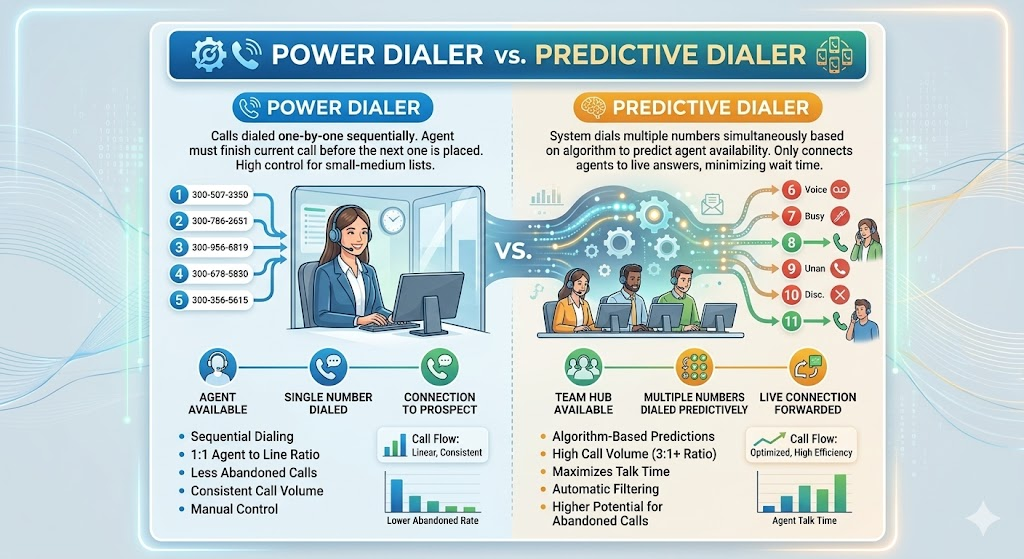
A power dialer automatically places the next call the moment a rep finishes the previous one — no manual dialing, no idle time between calls. But unlike predictive dialers, it only calls one number at a time per agent.
The agent sees the contact record on screen while the call connects. Because the system only calls when an agent is ready, there are no dropped or abandoned calls.
The agent has a few seconds to review CRM notes before the contact picks up — and that prep time matters when the lead is a decision-maker at a target account and the first 10 seconds of the call determine whether it continues.
How it works in practice:
- Rep finishes a call and logs the disposition
- Dialer immediately pulls the next contact from the queue
- Contact record populates while the line rings
- Rep answers informed, not scrambling
Key specs:
- Call output: 80–120 calls per hour per rep
- Abandoned calls: zero
- Minimum team size: 1 rep (scales to 3–8 comfortably)
- Compliance risk: low
Top power dialer tools: PhoneBurner, Kixie, Aloware, JustCall, Revenue.io
In complex B2B sales environments with extended sales cycles and high-value transactions, power dialers enable the preparation and relationship focus critical for success.
What Is a Predictive Dialer?
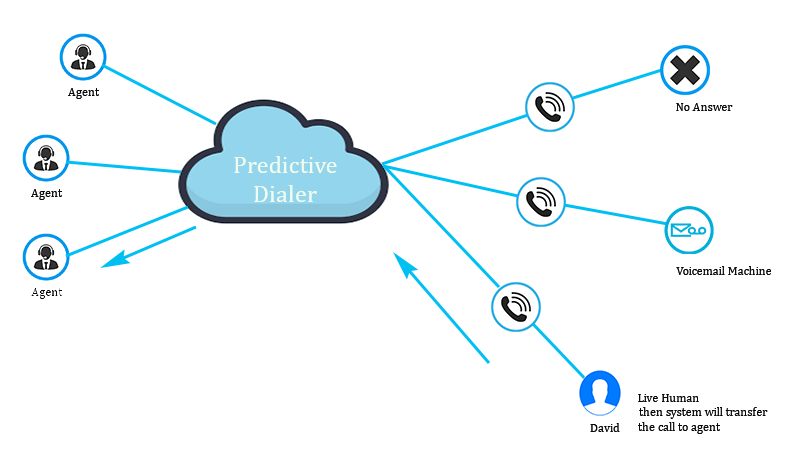
A predictive dialer uses an algorithm to simultaneously dial multiple numbers before agents are even available. The system predicts when reps will finish their current calls and pre-dials to minimize idle time between connections. When a call is answered, it gets routed to the next available agent.
The volume output is real: 150–300 calls per hour per rep, compared to 80–120 with a power dialer. That's a meaningful gap on paper.
The catch: when more lines connect than agents are available, those calls get abandoned. The person on the other end picks up and hears silence — or gets routed to a pre-recorded message.
The TSR's abandoned call rules limit how many calls your predictive dialer can drop to no more than 3% of answered calls per campaign per 30-day period. Violations carry penalties of up to $50,120 per incident.
Key specs:
- Call output: 150–300 calls per hour per rep
- Abandoned calls: yes — rate must stay under 3% (TCPA/TSR)
- Minimum team size: 8+ agents running simultaneously
- Compliance risk: high, especially for B2B mobile numbers
Top predictive dialer tools: Five9, NICE CXone, Genesys, Talkdesk
The problem is that 8+ agents running simultaneously is the starting requirement just to keep abandoned call rates within legal limits.
Most B2B SDR teams never reach that threshold — which means predictive dialing creates compliance exposure the moment a rep disconnects or goes on break.
🚀 Targeting the Right 100 Companies Changes Everything
We identify, contact, and book meetings with your ideal prospects. You focus on closing deals while we fill the pipeline.
Power Dialer vs. Predictive Dialer: Side-by-Side Comparison
Here's the full decision matrix so you can see exactly where each dialer wins and where it fails.
At 5 agents, a predictive dialer produces twice the connections of a power dialer per hour. But with fewer than 8 agents, abandoned call rates will likely exceed the 3% TCPA threshold. For most B2B teams, that math doesn't work.
Compliance Reality: Why Predictive Dialers Are a Risk for B2B Teams in 2026
This is the part most dialer vendors gloss over in their comparison pages. Let's be direct about it.
TCPA violations carry $500 to $1,500 fines per call. Those fines apply per call — not per campaign, not per recipient. Class actions have resulted in $10M+ settlements against solar, insurance, and debt collection companies using auto-dialers without consent. Volume gains disappear fast when compliance penalties hit.
The deeper problem for B2B in 2026: 97% of US adults own a smartphone. The decision-makers your SDRs are calling carry their phone everywhere — to meetings, to lunch, to airports. Cold calling cell phones isn't optional in 2026; it's the default.
And here's where predictive dialing becomes a real legal problem: the federal TCPA was written in 1991 to protect consumers from intrusive cell phone calls, and it treats every wireless number as residential, regardless of business use.
Your prospect's mobile number — even if it's listed on their LinkedIn profile as a business contact — can trigger full consumer protection rules under TCPA when dialed with an automated system.
Florida FTSA and Oklahoma OTSA effectively ban predictive dialing on cell phones without prior consent. Since most B2B numbers in 2026 are mobile, this catches most use cases.
What "prior express consent" means in practice: a cold B2B outreach list almost never meets this standard. These are contacts your team sourced from databases, LinkedIn, or intent data platforms — not contacts who opted in to receive calls from your company specifically.
Every call should have a live agent ready before the dialer connects the prospect. Predictive dialers that call multiple numbers simultaneously and route the first answer to a waiting rep create connection delays that trigger both TCPA scrutiny and iOS screening flags.
Power dialers — where the system dials one number at a time and only places the next call when the rep is ready — are a safer choice for both compliance and call quality.
Important: nothing in this guide constitutes legal advice. Consult qualified legal counsel for compliance guidance specific to your team, geography, and outreach type.
Conversion Quality: Why Power Dialers Win for B2B
Raw call volume means nothing if the conversations don't convert. In B2B, a single closed deal can be worth anywhere from $10,000 to seven figures — which means conversation quality is your primary metric, not calls-per-hour.
Power dialers win on conversion for one fundamental reason: reps arrive prepared.
When your SDR can see the contact's company, title, previous call notes, and LinkedIn context in the CRM before the call connects, they're leading the conversation from the first word. When a predictive dialer cold-connects a rep to a VP of Engineering at a 500-person company, that rep is reacting — and the prospect can tell.
The average B2B cold call conversion sits at 2.3–2.5% — roughly 1 meeting per 40 dials. That number swings significantly based on how personalized and prepared the opening is.
A rep who references something specific in the first 10 seconds consistently outperforms a rep who leads with a generic opener every time.
The volume advantage of a predictive dialer over a parallel dialer is marginal — 10–20% more dials per hour at best. The legal risk is order-of-magnitude higher.
For B2B, where a single deal can make a quarter, optimizing for 20% more dials at the cost of conversation quality and compliance exposure is a bad trade.
Where predictive dialers still win: standardized, script-driven B2C campaigns where call content is consistent, the offer is simple, and volume is your only variable. That's not most B2B sales teams.
Which Dialer Is Right for Your B2B Team?
Answer these four questions before you buy anything:
- How many SDRs or closers are making outbound calls simultaneously?
- Are your contacts cold — with no prior consent to be called?
- Is your offer complex or consultative, requiring informed conversation?
- Does your compliance team have appetite for abandoned call risk?
Choose a Power Dialer If…
- Your team has fewer than 8 SDRs making outbound calls at the same time.
- You're calling cold B2B lists with no prior express consent.
- Your offer is high-ticket, complex, or requires a real conversation to move forward.
- Rep preparation and personalization are driving your conversion rate.
- You want zero abandoned calls and full CRM context on every connect.
- You're building an outbound system for the first time and need something manageable and compliant.
Choose a Predictive Dialer If…
- You run a large call center with 8+ agents working the phones simultaneously.
- Your contacts have given prior express consent — inbound leads, opted-in lists, confirmed business relationships.
- Your sales motion is script-driven with minimal variation between calls.
- You operate in B2C or high-frequency outbound environments like appointment reminders, debt collection, or consumer services.
- Your compliance team has specifically reviewed and approved predictive dialing for your geography and contact type.
Consider a Parallel Dialer as a Third Option
Parallel dialers dial multiple lines simultaneously but connect the first answered call to the rep and drop the rest — no abandoned call exposure. It's the best of both worlds for B2B teams that want volume above what a standard power dialer produces, without the compliance risk that comes with predictive dialing.
A parallel dialer gives you 90% of the volume benefit of a predictive dialer at a fraction of the risk. The math isn't close. For B2B SDR teams in 2026 that need to scale call activity without scaling headcount, this is increasingly the recommended default.
Top parallel dialer tools: Nooks, Orum, Salesfinity
How Cleverly's Cold Calling Agency Handles Dialer Strategy for B2B Clients
Choosing the right dialer is one decision. But most B2B teams that invest in dialer technology still struggle to produce consistent meetings — because the infrastructure is right and the execution is wrong.
The list has the wrong contacts. The script doesn't convert. The rep doesn't know how to handle the three most common objections. The manager doesn't have time to QA calls.
That's the gap a cold calling agency fills.
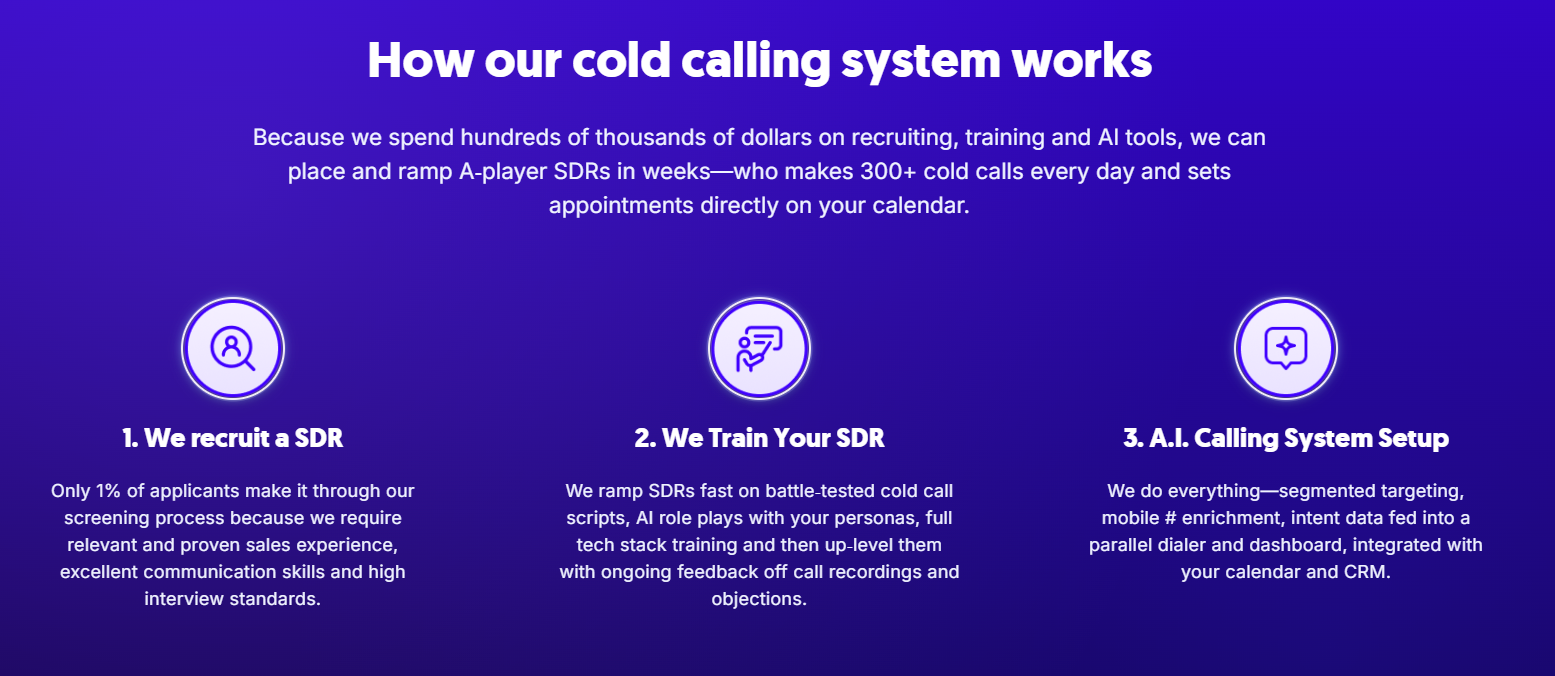
At Cleverly, we build and run done-for-you cold calling campaigns for B2B companies from the ground up. That means verified contact data sourced and scrubbed before anyone dials, dialer selection matched to your team size and lead type, call scripts tested and refined against real objections, and dedicated appointment setters managed and coached on your behalf.
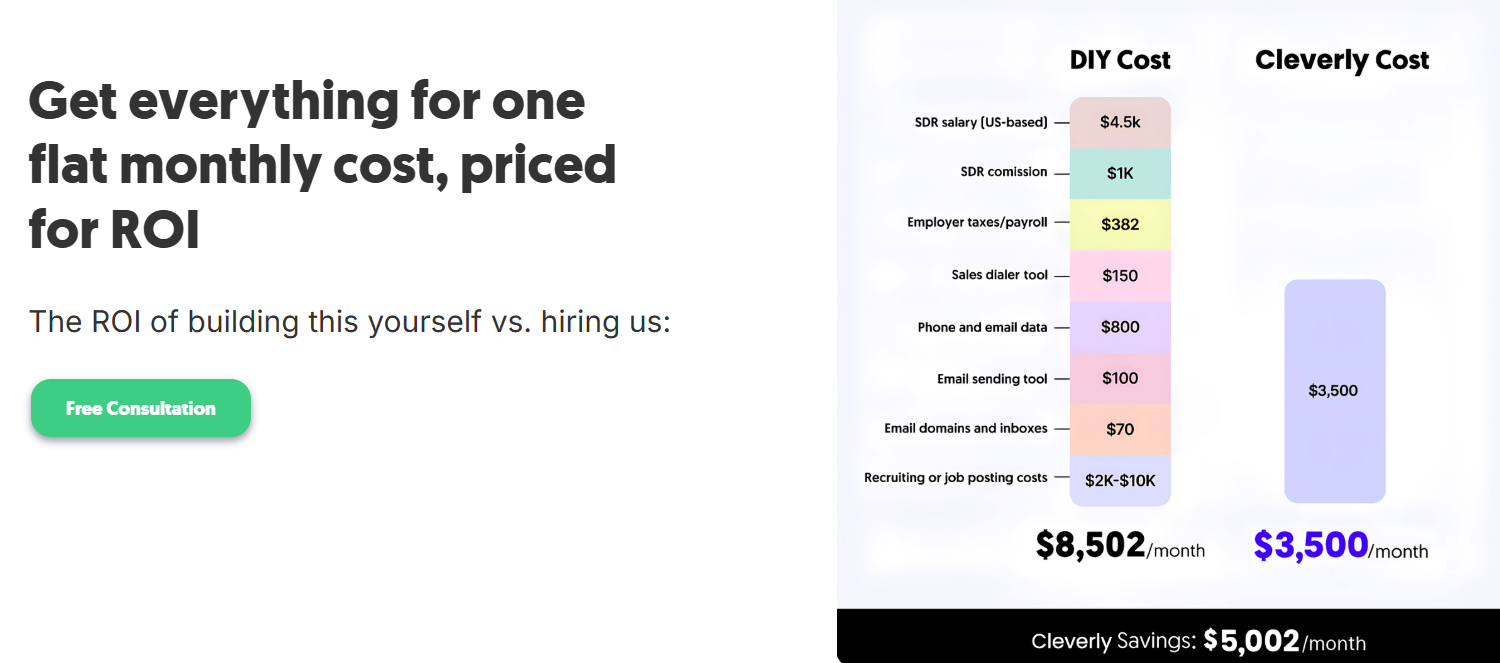
You get qualified meetings booked directly into your calendar — without managing SDRs, dialers, compliance checks, or call quality in-house.
Our $5M Cold Calling System books 10–30 qualified sales calls per month, guaranteed. We've made 1M+ cold calls, set 53K appointments, and generated $312M in pipeline across our client base.
If you're serious about cold outbound and don't want to spend six months figuring out dialer selection, list building, and script optimization while your pipeline stalls — that's exactly what we're built for.
Book a strategy call with Cleverly and we'll show you what a fully managed cold calling system looks like in your market.
Conclusion
For most B2B teams in 2026, the choice is clear: power dialers for teams under 8 reps, parallel dialers for teams that need to push volume, and predictive dialers essentially nowhere in the B2B outbound picture.
The compliance risk predictive dialing creates in a mobile-first contact environment — where your prospect's personal cell phone is their primary business number — is too significant for most teams to absorb. And the conversion quality trade-off rarely makes sense when deal sizes are high and conversations need to be earned, not ambushed.
Match your dialer to your actual team size, sales motion, lead type, and compliance reality. The right dialer isn't the one with the biggest number on a vendor's feature sheet. It's the one that fits how your team actually sells.
Frequently Asked Questions
Free Resource
How to Scale a Profitable Cold Call System
Get the complete guide — download it instantly now.
Free Ebook
Download the Free Guide
Enter your details to get instant access.
You're all set! 🎉
Your ebook is downloading now.
Click below if the download didn't start automatically.