Table of Contents
The Real Question Isn't the Dialer — It's the Model
How Single-Line Cold Calling Works — and Where the Time Actually Goes
How Parallel Dialing Changes the Outbound Math
The ROI Comparison: Cost Per Qualified Meeting Across Both Models
When Parallel Dialing Delivers the Strongest ROI
When Single-Line Dialing Is the Right Operational Choice
The Operational Variables That Determine Which Model Wins
How to Build a Dialing Strategy That Maximizes Meetings Per Dollar
Why Most Outbound Teams Get This Decision Wrong
How Cleverly's Cold Calling Service Uses Parallel Dialing to Book 10–40 Meetings Per Month
Conclusion
Frequently Asked Questions
Modified On :
June 22, 2026
Key Takeaways
- Single-line cold calling produces 5–8 live conversations per rep per day; a 4-line parallel dialer produces 15–25 — that's a 3x output difference at the same headcount cost.
- The right dialing model depends on your ICP breadth, data quality, and rep experience — not which software has the best feature list.
- Parallel dialing vs cold calling ROI comes down to cost per qualified meeting: parallel dialing consistently hits $156–$278 vs. $385–$833 for single-line on the same rep cost.
- Data quality determines whether parallel dialing delivers its promised ROI — verified mobile direct-dial data (18–22% connect rate) compounds the volume advantage dramatically.
- Teams that capture the full ROI redirect freed ring-and-voicemail time into pre-call preparation and post-call follow-up, not just dial more numbers.
An average SDR spends less than 30% of their day in actual live conversations. The rest goes to rings, voicemails, disconnected numbers, and manual dialing overhead that adds up to hours of dead time every week.
That's not a motivation problem or a training problem — it's a structural one.
The debate around parallel dialing vs cold calling mostly focuses on the wrong thing. Teams argue about software features, compliance risk, or whether parallel dialing feels "too aggressive."
The real question is simpler: which dialing model produces the most qualified meetings for the budget and headcount you're spending?
The numbers are stark. A well-run single-line operation produces 5–8 live conversations per rep per day. A 4-line parallel dialer in the same seat produces 15–25. That's not a marginal improvement — it's a fundamentally different operational model with a different cost per meeting, a different volume ceiling, and different requirements for it to work.
But parallel dialing is not a universal upgrade. The model that produces the best outbound calling ROI depends on your ICP, your data coverage, your rep skill level, and whether your motion is high-volume or account-based.
This guide breaks down how the math actually works for both models, where each one wins, and what variables determine the right choice for your specific outbound program.
The Real Question Isn't the Dialer — It's the Model
A dialer is infrastructure. The model is strategy. You can run an efficient parallel dialing setup on a broken ICP and produce faster list burn, not more meetings. You can run disciplined single-line dialing with a well-defined ICP and verified data and get solid results. The tool doesn't determine the outcome — the model does.
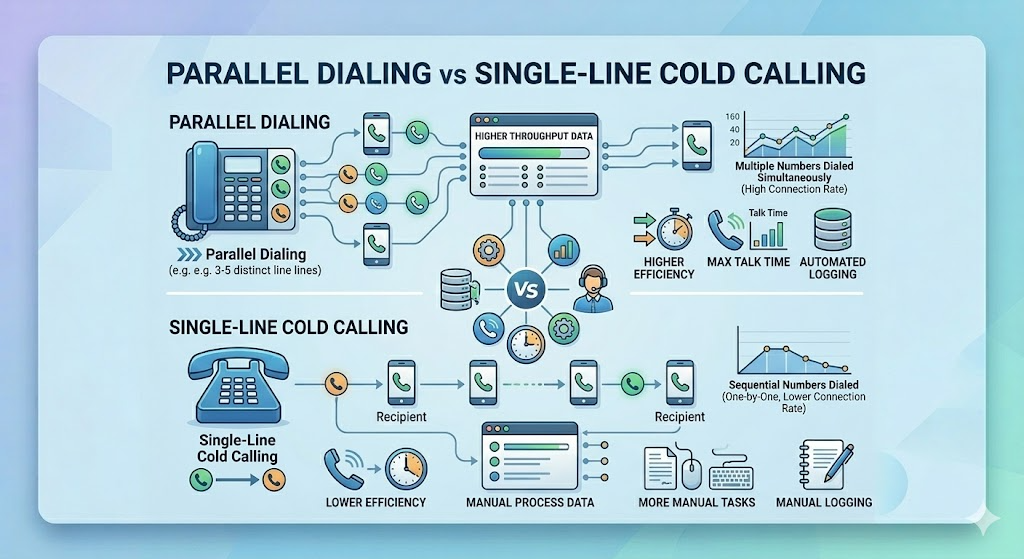
The two approaches differ fundamentally in where rep time gets concentrated.
Single-line dialing puts time into pre-call preparation and individual conversation quality. There's space between calls for research, CRM updates, and mental reset. Parallel dialing puts time into live conversation volume and post-call execution speed. The rep connects immediately to a live person, handles the conversation, and transitions directly to the next one.
Neither model is inherently better. Each is optimized for a different outbound motion.
If your primary constraint is live conversation volume — you have a broad ICP, tens of thousands of prospects, and a need for scale — parallel dialing solves the right problem. If your primary constraint is conversation quality — account-based selling where 15 minutes of pre-call research changes the outcome — single-line dialing protects the right investment.
The only metric that actually matters when evaluating outbound calling ROI isn't dials per day or raw connect rate. It's cost per qualified meeting booked — which captures the full economics of each model including rep time, data cost, and the meeting-to-opportunity conversion rate on the other end.
📞 Want 2–5x More Live Conversations Without Hiring More Reps?
Our cold calling specialists use proven dialing systems, targeting, and call frameworks to maximize conversations, appointments, and pipeline from every campaign.
How Single-Line Cold Calling Works — and Where the Time Actually Goes
In a single-line model, a rep manually dials one number, waits through rings, gets a voicemail or disconnect, and moves to the next number. It sounds simple. But the time math reveals where the real cost sits.
The average cold calling connect rate on generic data is 8–12%. That means a rep makes 88–92 dials before reaching 10 live people. At 30–45 seconds per unanswered call — ring time plus voicemail — that's 40–65 minutes per day spent purely on calls that went nowhere. In an 8-hour day, that's nearly 15% of total work time just on dead air.
What a well-run single-line operation actually produces: 5–8 live conversations per rep per day, and roughly 1 booked meeting per 15–25 live conversations depending on ICP quality and script performance.
The cost math: at a fully loaded SDR cost of $250–$300 per day, single-line dialing produces a cold calling cost per meeting somewhere between $300 and $600 depending on data quality and conversion rate. At the high end of that range, it becomes difficult to justify the model against alternatives.
That said, single-line dialing is not obsolete. It wins in specific situations:
- Account-based enterprise motions where each prospect gets 15–20 minutes of pre-call research and personalization meaningfully changes conversion.
- Small, high-value target lists where the total addressable market is under 200–300 accounts.
- Markets where relationship context matters before the call — financial services, legal, healthcare — where cultural norms around cold outreach reward a thoughtful, prepared approach over volume.
The mistake is running single-line dialing as a default without asking whether the motion actually requires it.
How Parallel Dialing Changes the Outbound Math
A parallel dialer launches 2–5 calls simultaneously from a single rep's seat. The moment one person picks up, the other lines drop before the recipient hears anything. The rep connects instantly to a live conversation — no ring time, no voicemail, no manual next-dial.
What this eliminates is every second of dead time between live conversations. Ring time, disconnected numbers, full voicemail boxes, manual CRM navigation to the next number — all of it disappears from the rep's day.
The volume shift is significant. A 4-line parallel dialer B2B setup produces 15–25 live conversations per rep per day. That's roughly 3x the output of single-line dialing at the exact same headcount cost.
The cost impact compounds from there. With the same fully loaded SDR cost, parallel dialing software collapses cost per booked meeting from $300–$600 down to $100–$200 — a 2–3x improvement in pipeline output per dollar spent.
On the compliance question: parallel dialers are TCPA compliant for B2B cold calling because no rep was ever expected to handle the dropped lines. This is a critical distinction from predictive dialers, which do create abandoned call compliance risk. B2B parallel dialing doesn't carry the same regulatory exposure.
There's also a compounding benefit teams often miss. The 1–2 hours per day freed from unanswered calls doesn't have to disappear into downtime.
Teams that redirect that time into pre-call research blocks and post-call follow-up capture a secondary lift in live-to-meeting conversion rate on top of the primary volume advantage.
🚀 Skip the Tech Stack. Get the Meetings.
Instead of investing in dialers, SDR hiring, training, and management, leverage a fully managed outbound team that handles prospecting, cold calling, and appointment setting for you.
The ROI Comparison: Cost Per Qualified Meeting Across Both Models
Let's run the same baseline through both models so the comparison is apples-to-apples.
Shared baseline: one SDR, fully loaded cost of $250/day, 20 working days per month — $5,000/month in rep cost before tools or data.
The cold calling cost per meeting improvement from parallel dialing is consistent across team sizes. At a 5-SDR team, the math scales linearly — the cost-per-meeting advantage remains, and the total pipeline output difference becomes substantial.
One important nuance: the qualified meeting layer. A broader ICP in a parallel dialing model may produce more total meetings but a lower qualified meeting rate if the targeting isn't sharp. The ROI calculation only holds if the ICP is defined tightly enough that most booked meetings are worth AE time. Volume without precision produces a calendar full of low-fit calls — which is a different kind of expensive.
Payback on parallel dialing infrastructure: most parallel dialing software runs $100–$500/month per seat. At the incremental meeting improvement — even conservatively — most teams see full payback within 30–60 days of switching.
When Parallel Dialing Delivers the Strongest ROI
Parallel dialer B2B deployments produce the best results in specific conditions. These are not edge cases — they describe most high-volume outbound programs.
✅ High-volume outbound with a broad ICP. If your target market has tens of thousands of prospects and your motion is largely transactional — shorter sales cycles, lower to mid ACV — parallel dialing's volume advantage drives consistent ROI. The list is large enough that speed through it doesn't create burnout risk.
✅ SDR teams targeting 60+ dials per day. Above 60 dials per day, parallel dialing pays back within weeks. Below that threshold, the volume advantage shrinks and the infrastructure cost may not justify the switch.
✅ Teams with verified direct-dial data. Connect rates on verified mobile direct-dial numbers run 18–22% vs. 8–12% on generic data. Parallel dialing compounds this advantage — every additional line produces more live connections when the underlying data can support it.
✅ Outbound-first sales motions. Companies where pipeline is driven primarily by outbound prospecting rather than inbound or partner channels get the most consistent ROI from parallel dialing because the volume advantage applies across the entire pipeline generation model, not just a subset of activity.
✅ Cold calling agencies and managed SDR services. Parallel dialing is standard infrastructure for professional outbound operations because it maximizes live conversation output per SDR seat. The same economics that make it work for an in-house team apply at scale for outsourced operations — which is why serious cold calling agencies run it by default.
When Single-Line Dialing Is the Right Operational Choice
The cold call answer rate reality in 2026 hasn't changed the fundamental calculus for certain outbound motions. Single-line dialing still wins in these situations.
✅ Account-based enterprise selling. If each prospect requires 15–20 minutes of pre-call research to personalize the conversation meaningfully, the bottleneck is preparation depth — not dial volume. Parallel dialing doesn't solve a preparation problem. Connecting faster to a prospect you haven't researched doesn't improve conversion; it just burns the contact faster.
✅ Small, high-value target lists. If your total addressable market is 200–300 accounts, parallel dialing's speed advantage becomes a risk. Every prospect on the list is high-value. Burning through the list faster doesn't help when each call requires careful handling and multi-touch sequencing over time.
✅ Markets where relationship context matters significantly before the call. Certain industries — financial services, legal, healthcare — have cultural norms around unsolicited calls that reward a thoughtful, prepared approach. In these markets, volume-first dialing can actively damage reply quality and brand perception with the exact accounts you most need to land.
✅ Early-stage teams still building the playbook. Before you have established what messages convert and which ICP segments respond, running at high volume with parallel dialing accelerates the burn through the list before the playbook is ready. Single-line dialing produces better learning at lower cost during the playbook-building phase. Graduate to parallel dialing once the message and ICP are validated.
The Operational Variables That Determine Which Model Wins
These four variables are what actually determine whether parallel dialing or single-line dialing produces a better cost per qualified meeting for your specific team and motion. Run through each one honestly before making the infrastructure decision.
Data Quality and Direct-Dial Coverage

Parallel dialing's ROI depends on connect rate. If your data is generic work numbers at 8% connect rate, running 4 lines in parallel still produces a meaningful lift over single-line. But if your data is verified mobile direct-dial at 18–22% connect rate, the parallel dialing advantage compounds dramatically — you're getting 3–4x the live conversations from already-strong data.
Verified direct-dial data costs $100–$300 per user per month from providers like ZoomInfo, Cognism, or Apollo. The connect rate improvement typically pays back the data cost within the first week of additional live conversations — it's one of the best-returning investments in an outbound stack.
The rule: invest in data quality before adding dialing lines. A parallel dialer running on bad data produces more unanswered calls faster. It doesn't fix a data problem — it amplifies it.
Rep Skill Level and Preparation Depth

Parallel dialing rewards reps who can transition immediately and confidently into a live conversation. The call connects instantly. There's zero lag time to pull up notes, recall context, or collect thoughts. Experienced reps who can cold-open fluently and handle objections without preparation cues perform well in this environment.
New or developing reps who need 30 seconds of mental preparation before each call perform noticeably worse under parallel dialing conditions. The speed that creates the volume advantage also eliminates the buffer time developing reps rely on.
The fix: teams that capture the full ROI of parallel dialing use the freed time — 1–2 hours per day from eliminated dead calls — to front-load preparation in focused blocks before dialing sessions. Pre-call research happens in dedicated preparation windows, not between individual calls.
ICP Breadth and Volume Requirements
Parallel dialing is optimized for ICP breadth. It works best when there are enough qualified prospects in the target list to sustain high-volume dialing without exhausting the market within weeks.
The threshold: teams with a total addressable list below 500 prospects should run single-line with a structured multi-touch cadence. Above 2,000 qualified prospects, parallel dialing's ROI advantage is consistent. Between 500 and 2,000, the right model depends on sales cycle length and whether multi-touch sequencing across the same list is part of the motion.
Power dialer vs parallel dialer is a related decision: power dialers auto-dial one number at a time without requiring rep input between calls — they reduce manual dialing overhead but don't produce the same live conversation lift as a true parallel setup. For teams above 60 dials per day with a broad ICP, parallel dialing outperforms power dialing on cost per meeting.
Compliance and Market Context
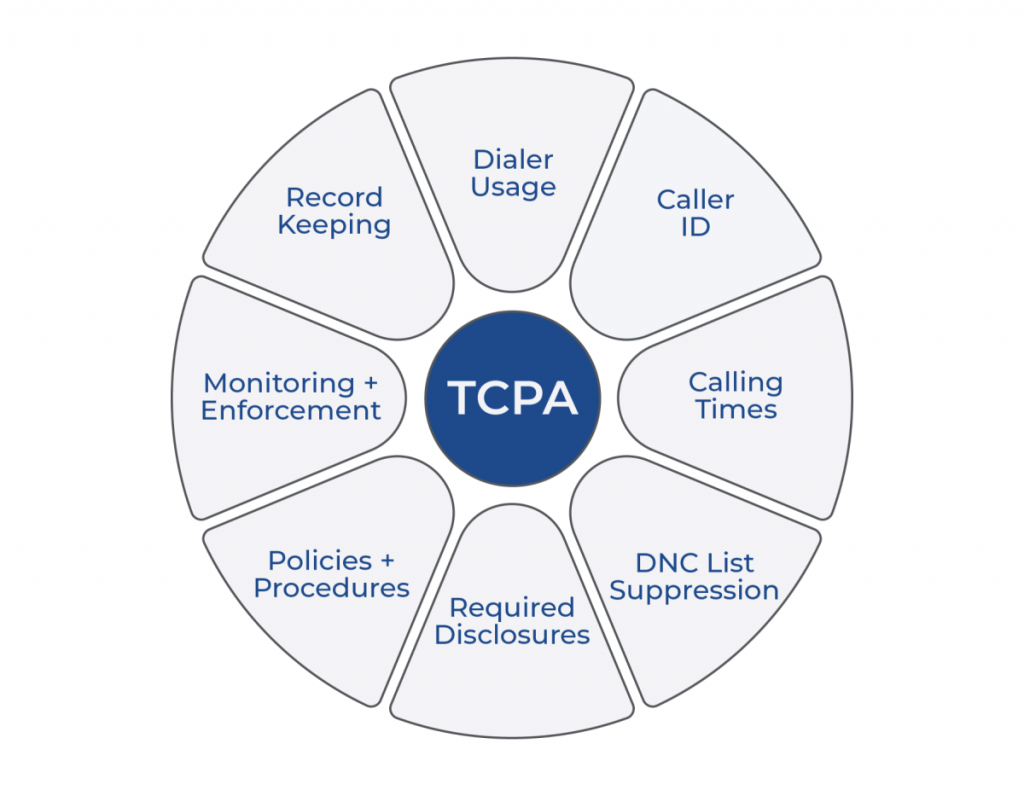
B2B parallel dialing is TCPA compliant because the dropped lines are never answered — no abandoned call in the regulatory sense. This is the critical distinction from predictive dialers, which dial ahead of rep availability and do create abandoned call risk under FTC regulations.
State-level regulations add complexity. Some states have additional rules around business-to-business calling — verify compliance requirements for your specific target geographies before deploying any dialing infrastructure at scale.
International markets have their own frameworks. GDPR in the EU, CASL in Canada, and equivalent regulations in other markets impose different constraints on outbound calling that affect both model choice and operational execution. If you're calling into multiple geographies, build compliance review into your infrastructure setup, not as an afterthought.
How to Build a Dialing Strategy That Maximizes Meetings Per Dollar
This is a four-step process: measure current performance, identify the real constraint, match the model to the motion, and optimize the freed capacity.
Step 1 — Calculate Your Current Cost Per Qualified Meeting
Start with actuals. Total monthly SDR cost — salary plus benefits plus tools — divided by qualified meetings booked in the same period.
A qualified meeting is one where the prospect matches the ICP, showed up to the call, and was deemed a genuine opportunity by the AE. Not a calendar hold. Not a no-show. Not a meeting that the AE immediately marked as out of ICP. The actual meeting that moved forward.
If your cold calling cost per meeting is above $500, you have a significant efficiency gap somewhere — in volume (dialing model problem), in data quality, in ICP precision, or in conversion rate from meeting to opportunity. Identifying which one it is determines the fix.
More Here: Just Hired Your First SDR? Here's the Exact 30-60-90 Day Outbound Plan
Step 2 — Identify Where the Time Is Being Lost
Run a one-week time audit at the task level. Track: dials attempted, time on unanswered calls, time on live conversations, time on admin and CRM, time on preparation.
If more than 40% of dialing time is going to unanswered calls and voicemails, parallel dialing solves the right constraint. The model switch will produce immediate improvement.
If live conversation quality is low — high connect rate but low conversion to meetings — the constraint is script, ICP, or offer. Switching to a parallel dialer in this situation produces more conversations that don't convert. Fix the script and ICP first.
Step 3 — Match the Model to the Motion
High-volume ICP, 60+ dials per day target, broad market: run parallel dialing with 3–4 lines, verified direct-dial data, and experienced reps who can cold-open without preparation context.
Account-based enterprise motion, 20–40 dials per day, tight list: run single-line with a structured multi-touch cadence, deep pre-call prep protocols, and CRM-integrated follow-up sequences built for the long touch sequence.
Hybrid motion: segment the list. Run parallel dialing on your broad ICP tier and single-line on strategic enterprise accounts. Not every account needs the same treatment, and the cost of treating them the same is either burning high-value contacts or leaving volume on the table with scalable segments.
Step 4 — Redirect Time Savings Into Preparation and Follow-Up
Teams that only capture the volume lift from parallel dialing — without reinvesting the freed time — get roughly half the available ROI improvement.
The compound effect: 2 hours of saved ring-and-voicemail time per rep per day, redirected into pre-call research and post-call follow-up, produces a secondary lift in live-to-meeting conversion rate that multiplies on top of the primary volume advantage.
Practical structure: run parallel dialing in focused 90-minute blocks. Use the gaps between blocks for preparation, CRM hygiene, and follow-up sequence management. Not casual downtime — disciplined execution on the inputs that improve conversation quality in the next block.
Why Most Outbound Teams Get This Decision Wrong
Choosing a dialer based on features rather than motion. The dialer with the best integrations or cleanest UI isn't necessarily the one that produces the best cost per meeting for your ICP and volume profile. Start with the model decision, then find the tool that supports it — not the other way around.
Adding parallel dialing on top of a broken ICP. Volume amplification accelerates both good outcomes and bad ones. Running parallel dialing against a broad, poorly-defined ICP produces more ignored calls and a burned list faster — not more meetings. Validate the ICP and script before scaling the volume.
Not accounting for data quality in the ROI projection. Parallel dialing ROI projections built on generic data benchmarks don't hold when the actual list has 50% mobile coverage. Validate data quality — specifically direct-dial mobile coverage — before projecting cost-per-meeting improvements from a model switch.
Treating the model decision as permanent. Outbound programs evolve. A team that should start on single-line to build the playbook may be ready for parallel dialing at month three once ICP and script are validated. Revisit the model decision as the program matures. The right model at month one is not necessarily the right model at month six.
How Cleverly's Cold Calling Service Uses Parallel Dialing to Book 10–40 Meetings Per Month
Building a parallel dialing operation in-house means sourcing the dialer, procuring and verifying direct-dial data, hiring and ramping SDRs, writing call scripts, training on objection handling, setting up CRM integrations, and managing ongoing performance — before booking a single meeting. For most B2B teams, that's 60–90 days of setup and a significant distraction from the core business.
At Cleverly, we run all of that as a done-for-you cold calling service. Dedicated SDRs cold call 200–300 decision-makers daily using a parallel dialer setup, verified mobile direct-dial data from our proprietary data stack, and breakthrough call scripts written specifically for each client's ICP and offer. Volume is backed by precision — not just speed.
The full operational stack we bring includes: parallel dialer infrastructure, AI role-play SDR training, live call monitoring, call transcripts and recordings, objection handling protocols, CRM updates after every call, appointment confirmation follow-ups, and pipeline tracking. You show up to qualified calls. We handle everything behind them.
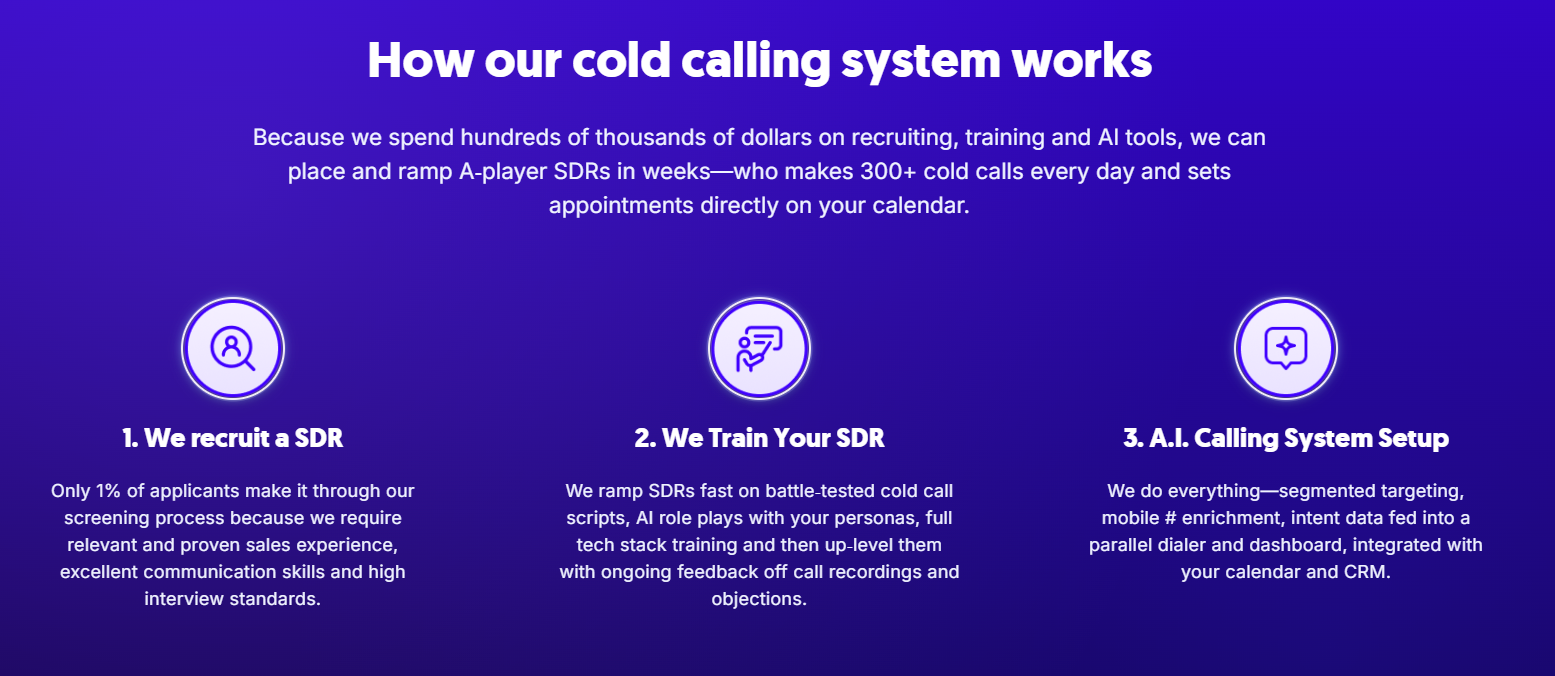
What clients stop managing: SDR hiring and ramp time, dialer procurement and configuration, data sourcing and verification, script development and testing, and the performance management overhead of an in-house outbound team.
We've generated $312M in pipeline and set 53,000+ appointments across 10,000+ clients — including eBay, Airbnb, DocuSign, Loom, and Airtable. Rated 4.6/5 on Trustpilot across 1,136+ reviews.
Cold Calling services pricing is flat $4,000/month (half the cost of hiring in-house).
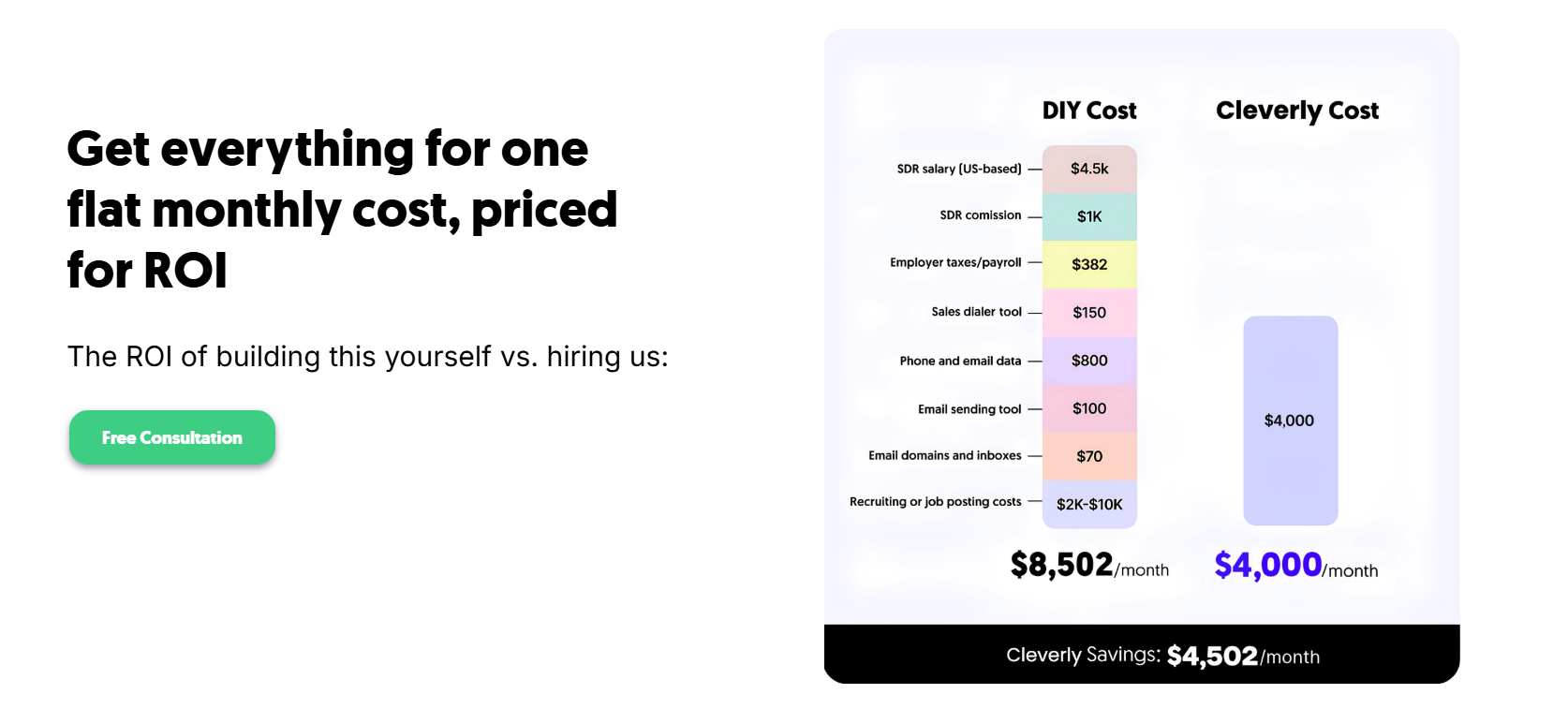
Book a strategy call with Cleverly and see what a managed parallel dialing operation actually costs per qualified meeting.
Conclusion
The parallel dialing vs cold calling decision isn't a software question — it's an operational strategy question. The right model is the one that produces the lowest cost per qualified meeting for your specific ICP, data stack, and sales motion.
For high-volume B2B outbound with a validated ICP and verified direct-dial data, parallel dialing delivers a consistent 2–3x improvement in cost per meeting at the same headcount.
Match the model to the motion, invest in data quality before scaling volume, and redirect the freed time into preparation and follow-up.
Frequently Asked Questions
Free Resource
How to Scale a Profitable Cold Call System
Get the complete guide — download it instantly now.
Free Ebook
Download the Free Guide
Enter your details to get instant access.
You're all set! 🎉
Your ebook is downloading now.
Click below if the download didn't start automatically.