Table of Contents
What Does It Mean to Outsource Email Marketing?
Signs It's Time to Outsource Your Email Marketing
What a B2B Email Marketing Agency Should Actually Handle
How to Successfully Outsource Your Email Marketing
Common Email Marketing Outsourcing Mistakes to Avoid
How Cleverly Runs B2B Cold Email Outreach as a Done-For-You Service
Conclusion
Modified On :
June 18, 2026
Key Takeaways
- Outsourcing email marketing works when you treat it as a structured partnership — not a simple handoff. Clear goals, a strong brief, and active involvement drive results.
- A qualified B2B email marketing agency handles far more than sending emails — it owns deliverability infrastructure, ICP-matched list building, copy, testing, and reporting.
- The biggest outsourcing failures share a common thread: vague briefs, no defined KPIs, and zero involvement after onboarding.
- Before signing with any agency, confirm data ownership, exit terms, and performance benchmarks in writing — not just verbally.
- Done-for-you outbound services like Cleverly remove the operational overhead entirely, handling everything from prospecting to reply management so your team focuses on closing.
Email marketing stats keep improving — 73% of B2B buyers say email is their preferred channel for hearing from sellers. The channel isn't broken. But for a lot of B2B teams, the program running it is.
The wall most teams hit isn't strategic — it's operational. Email clearly works. Email delivers an average ROI of $36 for every $1 spent, making it one of the highest-returning digital channels in existence. But running it well requires deliverability expertise, consistent copy, proper technical infrastructure, and time that most internal teams just don't have.
That's where outsourcing comes in. And done right, it's one of the highest-leverage moves a B2B company can make. Done wrong, it's an expensive way to burn your sending domains and frustrate your prospects.
This guide covers exactly what outsourcing email marketing actually means, when it makes sense, how to find and vet the right cold email agency, and what to protect before you sign anything.
Whether you're exploring it for the first time or recovering from a bad first experience, this is the framework to do it properly.

What Does It Mean to Outsource Email Marketing?
Email marketing outsourcing means handing some or all of your email program to an external agency or specialist — strategy, copywriting, list building, technical setup, sending, and reporting included.
The spectrum is wide. Some companies outsource the full program end-to-end. Others keep strategy in-house and outsource execution.
Others hand off one specific function — cold outreach, deliverability management, or a reactivation campaign — while keeping everything else internal. There's no single right answer. What matters is that the scope is defined clearly before you start.
B2B email outsourcing isn't the same as B2C
B2C email is about promotional campaigns, newsletter opens, and purchase triggers.
B2B email is about booking meetings, generating pipeline, and driving sales conversations. The targeting is tighter, the messaging is more specific, and the measurement priorities are completely different. A reply rate and meetings booked matter far more than aggregate open rate.
What stays in-house: Brand voice, offer definition, product positioning, and final approval on messaging. A good cold email agency builds from these inputs — it doesn't invent them. If you can't tell an agency what makes your offer compelling to your ICP, the campaign will default to generic messaging that performs like it.
The goal of outsourcing isn't to hand off and forget. It's to bring in specialists who can run a better program than your internal team could with the same time and budget.
📧 Turn Email Marketing Into a Predictable Source of Pipeline
Whether you need outbound cold email campaigns or full-funnel email execution, our team manages strategy, copy, targeting, and optimization for measurable results.
Signs It's Time to Outsource Your Email Marketing
Outsource email marketing services when you recognize yourself in any of these:
Bandwidth is the bottleneck, not strategy.
Email is on the roadmap. Everyone agrees it should be a priority. But campaigns get delayed, sequences go untested, and the channel underperforms because nobody on the team has the capacity to run it consistently. That's not a strategy failure — that's an execution gap outsourcing was built to solve.
Deliverability is declining and nobody knows why.
Open rates drop. Bounce rates creep up. Emails start landing in spam. The internal team doesn't have the diagnostic depth to identify whether the issue is authentication, list quality, sending reputation, or something else entirely — and guessing costs more than it fixes.

The technical infrastructure was set up once and never touched since.
SPF, DKIM, DMARC, inbox warmup, domain rotation — these aren't one-time configurations. They require ongoing maintenance. If nobody on your team owns this, your deliverability is degrading whether you know it or not.
You're sending blasts, not running sequences.
Reactive one-off campaigns aren't an email program. A structured, sequenced outreach cadence — with follow-ups, variant testing, and audience segmentation — takes time your team doesn't have. Outsourcing builds that structure from scratch.
A competitor is getting visible results from email and you're not.
The question has shifted from "should we do email?" to "why isn't ours working as well?" That shift in framing is usually the clearest signal it's time to bring in outside expertise.
What a B2B Email Marketing Agency Should Actually Handle
Hiring a B2B email marketing agency isn't just buying someone to press "send." If that's all they're doing, you're paying for execution without infrastructure — and the results will reflect it.
Here's what a capable agency should own:
✅ Strategy and segmentation. Defining which audiences receive which messages, in what order, and at what frequency. Not just "we'll send your list an email sequence," but a thought-out ICP segmentation plan with distinct messaging paths for different buyer profiles.
✅ Copywriting. Writing sequences that reflect your ICP's specific pain points, proof points, and value proposition. Not a template library with your company name swapped in. The copy should sound like it was written specifically for the person receiving it — because in the best campaigns, it essentially was.
✅ Technical infrastructure. Domain setup, SPF/DKIM/DMARC configuration, inbox warmup, rotation across sending accounts, and ongoing email deliverability monitoring. This is the unglamorous part that determines whether your emails land in inbox or spam. SPF/DKIM/DMARC authentication and sub-0.1% spam complaint rates are now baseline requirements, not optional extras.
✅ List building and hygiene. ICP-matched prospect sourcing, email verification, segmentation, and ongoing list maintenance. A one-time import of 5,000 unverified contacts is not a list. A properly built, maintained prospect pool is.
✅ A/B testing and optimization. Systematic testing of subject lines, opening lines, CTAs, and offer angles — with documented results and clear iteration cycles. If an agency can't show you what they tested and what they learned, they're not optimizing.
✅ Reporting that reflects pipeline metrics. Reply rate, positive reply rate, meetings booked, and deliverability health — not vanity metrics like impressions or aggregate send volume. If the only metrics in their monthly report are things that can't be tied to revenue, that's by design.
✅ Clarify in scope upfront: Who handles replies? Who owns the sending accounts? What's the escalation path when a campaign underperforms? These should be answered before the contract is signed, not discovered during month three.
🚀 Get More Meetings Without Hiring More Marketers
From list building and campaign management to deliverability and appointment setting, we help businesses create consistent opportunities without expanding internal headcount.
How to Successfully Outsource Your Email Marketing
The companies that get the most from outsourcing email marketing aren't the ones with the biggest budgets. They're the ones who approach the engagement with structure from day one. Here's the step-by-step process.
Step 1: Define Your Goals and KPIs Before Approaching Any Agency
Clear, measurable objectives are the foundation of a successful email marketing outsourcing engagement. Agencies can only optimize toward goals that are defined upfront.
Start by defining what success actually looks like. Is the goal meetings booked? Pipeline generated? Positive reply rate above a specific threshold? A vague goal like "more engagement" produces vague campaigns. "10 qualified meetings per month with VP-level buyers at 50–500 person SaaS companies" gives an agency something to engineer toward.
Set benchmarks using whatever historical data you have. Current open rate, reply rate, bounce rate, meetings booked per month — even imperfect data gives the agency a baseline to measure against. If you have no historical data, say so. It sets the right expectations for the first 60 days.
Decide what's in scope before your first agency call. Full-program management? Cold outreach specifically? A single campaign type like reactivation or prospecting? A defined scope prevents scope creep and the misaligned expectations that follow.
Output: a one-page brief covering your current state, target outcomes, and success metrics. This should exist before your first agency conversation, not after it.
Step 2: Know the Different Types of Email Marketing Services

Not all email agencies are built for the same job. Matching the wrong type of agency to your goal produces the wrong results — regardless of how good they are at what they do.
Here's the breakdown:
Cold email outreach agencies focus on prospecting — building ICP-matched lists, writing outreach sequences, managing deliverability, and booking meetings directly onto your AEs' calendars. This is what most B2B teams are looking for when they want to outsource email marketing services.
Nurture and lifecycle agencies focus on existing contacts — onboarding sequences, re-engagement campaigns, retention flows, and event-triggered automations. They're built for CRM-based programs, not new prospect outreach.
Full-service email marketing agencies handle the entire email program across prospecting, nurture, and transactional. Typically a fit for larger teams with complex, multi-stage programs.
Deliverability specialists focus specifically on technical infrastructure — authentication, warmup, inbox placement, and reputation recovery. You hire them when your existing program is technically broken, not when you're starting from scratch.
A lifecycle email agency running your cold outreach campaign isn't a bad agency — it's a mismatched one. Verify the fit before you sign.
Step 3: Evaluate Agencies Against These Specific Criteria
Evaluating email marketing outsourcing companies on surface-level factors — client logos, slick proposals, low prices — is how you end up with a disappointing engagement. Here's what actually matters:
Industry and ICP experience. Have they worked with companies targeting your buyer profile, at your deal size, in your space? Generic case studies from unrelated verticals aren't proof of fit. Ask for campaign examples from a similar ICP.
Technical competency. Ask them to walk you through their deliverability setup — authentication protocol, warmup approach, domain structure, inbox rotation. An agency that can't answer these questions clearly isn't managing them well.
Copy quality. Request sample sequences written for a similar offer and audience. Not polished showcase examples from their website — actual campaign copy sent to real prospects. Read it critically. Does it sound like a real conversation or a template?
Reporting transparency. Ask what metrics they report on, how often, and in what format. Agencies that hedge on this don't want to be held accountable to results.
Contract terms. Minimum commitment length, exit clause, performance benchmarks, and data ownership — all in writing before you sign.
Responsiveness during the sales process. How an agency communicates while they're trying to win your business is almost always how they'll communicate once they have it. Slow, vague responses pre-contract are a preview, not an anomaly.
Step 4: Build a Strong Onboarding Brief
The brief is the document that determines whether the agency's first campaign sounds like you or sounds like a template. The more specific it is, the faster the campaign reaches quality output.
Include: company overview and offer, ICP definition with titles, firmographics, buying triggers, and negative filters, value proposition and proof points, tone and voice guidance, messaging to avoid, and past campaign data if you have it.
Don't just send the brief as a PDF. Run it through a live strategy session with the agency. The questions they ask during that review reveal whether they actually read it — and how well they understand your business.
Update the brief as the campaign evolves. After the first 30 days, you'll have early data on what's resonating. The brief should reflect those learnings, not sit frozen at the version from day one.
Step 5: Establish Reporting Cadence and Review Process
Define the reporting rhythm before the campaign launches. Weekly or bi-weekly performance reviews are standard for active prospecting campaigns. Monthly may be sufficient for nurture programs.
What to review in each session: deliverability health, bounce and complaint rates, open rate trend, reply rate, positive reply rate, meetings booked, and what the agency is testing next and why. If those last two items — meetings booked and what's being tested — aren't in the review, the agency is reporting activity, not performance.
Request access to a live dashboard rather than PDF reports. Real-time visibility means you catch issues as they develop, not after they've already damaged your sender reputation.
Close the loop on meeting quality. Your feedback on whether booked meetings actually match your ICP is as valuable to the agency as their performance data is to you. The best-performing outsourcing relationships run as two-way feedback loops, not one-way reporting chains.
Step 6: Protect Your Data and Exit Terms Before You Sign
This step gets skipped more than any other — and it causes the most pain when things go wrong.
Data ownership. Confirm in writing that you own all prospect lists, copy, campaign assets, and sending domains built during the engagement. These should transfer immediately on exit — not after a 30- or 60-day hold period.
Exit terms. Know the notice period, what happens to active campaigns when you give notice, and whether there are early termination fees. Don't discover these details when you're already trying to leave.
Performance clauses. The best agencies put benchmarks in writing and tie continued engagement to meeting them. Agencies that resist this are agencies that don't expect to hit the benchmarks.
Access credentials. Ensure you have direct access to all sending accounts, dashboards, and campaign tools. Never allow an agency to be the sole gatekeeper to your own sending infrastructure.
Common Email Marketing Outsourcing Mistakes to Avoid
Email marketing outsourcing fails in predictable ways. Most of them are preventable.
❌ Choosing on price alone. The cheapest provider almost always cuts corners on data quality, deliverability setup, or copy quality. Any one of those produces worse results than running the program in-house.
❌ Handing over a vague brief and expecting the agency to figure it out. When agencies don't have specific inputs on ICP, offer, and positioning, they default to their own assumptions. Those assumptions are almost never right. The output sounds generic because the input was generic.
❌ Going dark after onboarding. Outsourcing doesn't mean abdicating involvement. The best results come from companies that stay engaged — reviewing copy, giving feedback on meeting quality, and keeping the agency updated on product and positioning changes. The companies that disappear after kickoff get the worst results, not the best.
❌ Not verifying technical setup before launch. Before the first email goes out, ask for confirmation that SPF, DKIM, and DMARC are configured and passing, and that sending domains are being warmed properly. Don't assume it's been handled.
❌ Measuring too early. Give any new cold email campaign 60–90 days before drawing conclusions. The first 30 days of a cold email campaign are calibration — most campaigns need multiple rounds of copy and targeting adjustments before performance stabilizes. Making major decisions before that window closes leads to premature pivots that kill campaigns before they find their stride.
How Cleverly Runs B2B Cold Email Outreach as a Done-For-You Service
For B2B teams that want to outsource email marketing services without managing the complexity of running an external agency, Cleverly handles the entire cold email outreach engine end-to-end.
We manage everything from day one: dedicated sending domain setup with full authentication, inbox warmup and rotation, ICP-matched prospect list building, personalized multi-touch sequences written specifically around your offer, campaign launch and ongoing optimization, and response handling so your sales team only sees qualified, interested leads on their calendar.
What makes this different from hiring an agency and hoping for the best is the structure behind the execution. Our dedicated account managers lead the strategy session, build the ICP brief collaboratively, and make sure the campaign actually reflects your value proposition before the first email goes out. We don't send templates with your logo on them. The copy, the targeting, the testing — all of it is built around your specific market.
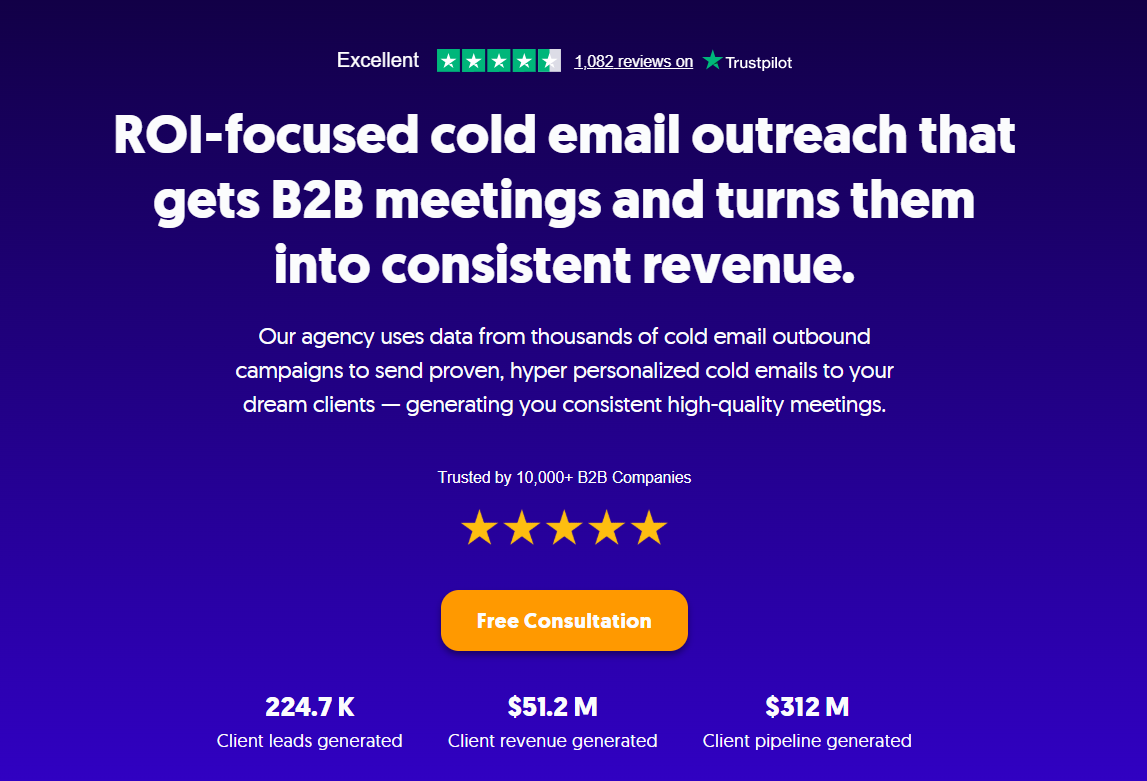
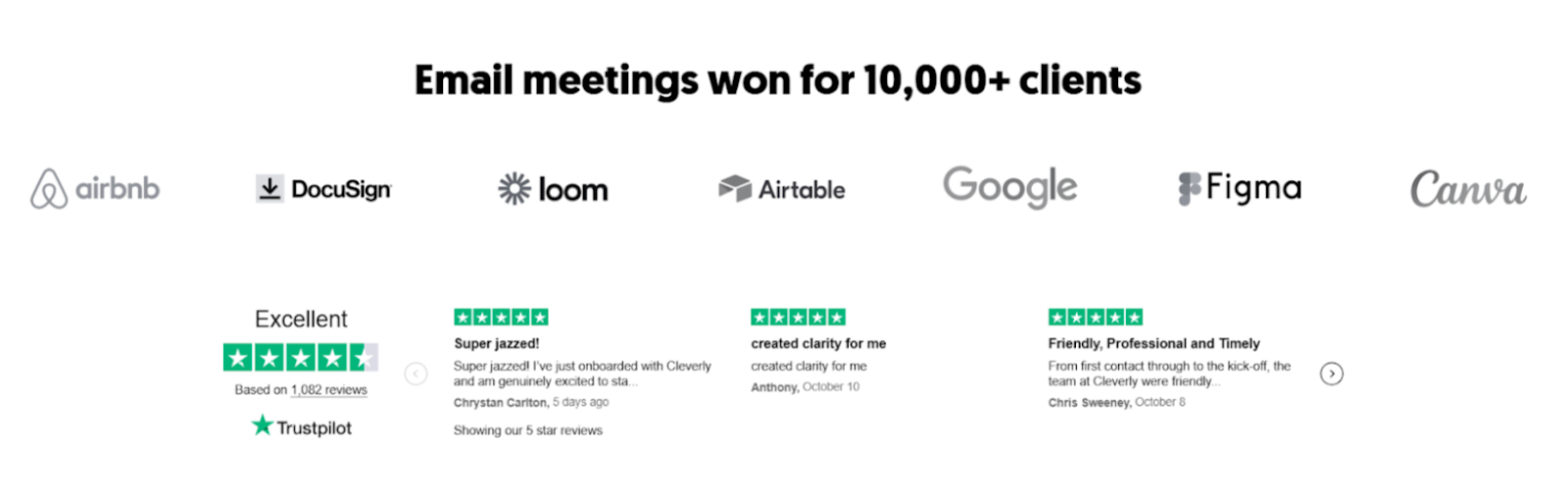
As a B2B cold email agency rated 4.6/5 on Trustpilot across 1,136+ reviews, we've generated 224.7K leads, $312M in pipeline, and $51.2M in closed revenue for over 10,000 clients — including eBay, Airbnb, DocuSign, Loom, and Airtable. Companies come to us because they know the channel works and want a team that runs it better than they could internally, without the overhead.
Ready to outsource your cold email outreach to a team that handles everything? Book a strategy call with Cleverly and see exactly how we'd run your program.
Conclusion
Outsourcing email marketing works when you treat it as a real partnership — clear goals, a strong brief, active involvement, and the right contractual protections in place from the start. Those fundamentals are what separate high-performing outsourcing engagements from expensive disappointments.
The agencies worth working with welcome accountability. They put benchmarks in writing. They communicate proactively. Use the framework in this guide to find them before you sign — and once you do, stay engaged. The companies that get the most from outsourced email marketing are the ones that show up to every review call, close the loop on meeting quality, and keep their agency updated as their business evolves.
Get the foundation right, and outsourced email marketing becomes one of the highest-ROI decisions your team makes this year.
Frequently Asked Questions
Free Resource
How to Scale a Profitable Cold Call System
Get the complete guide — download it instantly now.

Free Ebook
Download the Free Guide
Enter your details to get instant access.
You're all set! 🎉
Your ebook is downloading now.
Click below if the download didn't start automatically.