Table of Contents
What to Look for in Business Development Tools
Quick Comparison Table: 10 Best Business Development Tools
10 Best Business Development Tools for 2026 (Ranked and Reviewed)
How to Choose the Right Business Development Tools for Your Team
Tools Support Business Development, Cleverly Executes It
Conclusion
Frequently Asked Questions
Modified On :
August 14, 2026
Key Takeaways
- A single tool rarely covers business development end to end. Prospecting, tracking, networking, and outreach usually need different tools working together, not one platform trying to do everything.
- AI has changed what these tools actually do. The real question isn't whether a tool has AI, it's whether that AI drafts, prioritizes, or surfaces signals you'd otherwise miss, or just repackages old features with new branding.
- Data accuracy matters more than database size. A tool with fewer contacts but higher match rates saves you more time than one with millions of stale records.
- Stacking five or more overlapping subscriptions is the most common BD budget mistake. Most teams only need two or three tools that actually fit their bottleneck.
- Tools organize and speed up the work. They don't replace the outreach conversations that turn a well-built stack into an actual pipeline.
Business development touches four jobs that rarely live in one tool: finding the right accounts, tracking where deals stand, staying on top of relationships, and running the outreach that turns a name on a list into a meeting on the calendar.
Most teams end up bolting together two or three tools just to cover that ground, and figuring out which two or three is where most BD hiring managers and founders lose a week they don't have.
The category has also shifted fast. Apollo.io alone now sits on a database of 230 million-plus contacts, and AI has moved from a marketing checkbox to something that actually does work: drafting outreach, flagging buying signals, and summarizing accounts before a rep opens the record. At the same time, pricing has fragmented.
Some categories, like enterprise contact data, still require a sales call and a five-figure contract. Others, like outreach and CRM tools, now offer real free tiers you can run a small pipeline on.
This guide ranks and reviews 10 of the best business development tools for 2026 across prospecting, data enrichment, tracking, and networking. You'll get what each one does well, where it falls short, and current pricing so you're not guessing.
It's written for founders, BD reps, and sales or marketing leaders who are either building a stack from scratch or auditing one that's grown messier than it should be.
What to Look for in Business Development Tools
Before you add anything to your stack, get clear on which bottleneck you're actually solving. Buying a new tool to fix a process problem just adds a new subscription on top of the old friction.
✅ Coverage of your actual bottleneck. If your problem is finding the right contacts, a tracking tool won't fix that, and vice versa. Match the tool to the specific gap, not to a "best BD tools" list.
✅ Data accuracy and freshness. Any tool touching contact or company data degrades over time. Job changes, company moves, and email churn mean a database that hasn't been refreshed recently will waste your team's time on bounced emails and outdated titles.
✅ Real AI depth, not AI as a label. Ask what the AI specifically does. Does it draft personalized messages using account-specific context? Does it flag a buying signal you'd have missed? Or is it a chatbot bolted onto an old interface? The difference shows up fast once you're using the tool daily.
✅ Integration with your existing stack. A prospecting tool that doesn't sync cleanly with your CRM creates manual export-import work, which defeats the purpose of buying it.
✅ Free tier or trial availability. You want to validate fit on your actual use case before signing an annual contract, especially in a category where several tools now gate pricing behind a sales call.
✅ Team adoption. The most feature-rich platform is worthless if your reps default back to spreadsheets because the learning curve was too steep. Weigh ease of use as heavily as feature depth.
🚀 The Right Tools. The Right Buyers. More Meetings.
Our LinkedIn, cold email, and cold calling campaigns generate 15–30 qualified meetings every month.
Quick Comparison Table: 10 Best Business Development Tools
10 Best Business Development Tools for 2026 (Ranked and Reviewed)
Each tool below is reviewed on Best For, Key Features, Limitations, and Pricing, based on the most current information available on each vendor's site and independent pricing research.
1) HubSpot
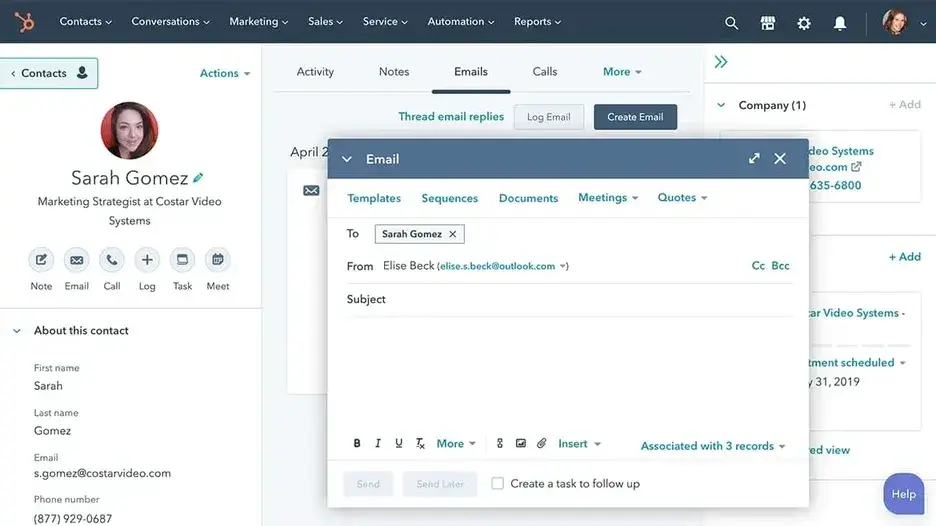
HubSpot has grown from an inbound marketing tool into a full CRM platform that BD teams use to centralize prospecting, pipeline tracking, and outreach in one place. For a lean team that doesn't want to stitch together three separate logins just to run a BD motion, it's still one of the most complete single-platform options.
Best For: Lean BD teams wanting to prospect, enrich, sequence, and run meetings without stitching together multiple tools.
Key Features:
- Centralizes contact data, pipeline tracking, and outreach automation in one governed platform.
- AI-assisted workflows layered across the CRM (drafting, summarization, lead scoring).
- Broad integration ecosystem across marketing, sales, and support tools.
Limitations:
- Professional and Enterprise tiers carry mandatory one-time onboarding fees, which aren't always visible until checkout.
- Can feel like more platform than a very small team actually needs.
Pricing: HubSpot's free plan gives access to basic CRM, email marketing, forms, and limited reporting, with no workflow automation. Starter runs $20 per seat per month on monthly billing, or $15 per seat annually. Professional and Enterprise scale up substantially from there depending on the Hub and contact volume.
2) Apollo.io

Apollo has become one of the default starting points for SMB and mid-market prospecting, largely because it bundles a sizable contact database with sequencing tools most teams would otherwise buy separately.
Best For: SMB and mid-market teams needing AI-assisted prospecting plus outreach in one platform.
Key Features:
- Large B2B contact database with email, phone, and firmographic data.
- AI-assisted prospecting and sequencing built into the core workflow.
- Free plan includes 900 credits per seat per year, granted monthly, enough to test the platform on real accounts.
Limitations:
- Data accuracy varies by region and industry, with North American coverage generally stronger than international data.
- Credit consumption adds complexity: a 4x credit increase between tiers doesn't always translate to 4x the usable contacts once you factor in enrichment costs.
Pricing: Apollo runs a free tier, then Basic at $49/user/month, Professional at $79/user/month, and Organization at $119/user/month, all on annual billing (roughly 20–25% higher month to month).
3) Clay
Clay isn't a CRM or an outreach tool on its own. It's an enrichment layer that pulls data from more than a hundred providers to build cleaner, more complete prospect lists before you ever send an outreach message.
Best For: Teams wanting to enrich prospect and account data before outreach, especially on complex or niche ICPs.
Key Features:
- Waterfalls across 150+ data providers to maximize contact match rates.
- Flexible workflow-style automation for combining multiple data sources into one clean table.
- Popular as a layer that sits alongside dedicated outreach and CRM tools, not a replacement for them.
Limitations:
- Not a standalone outreach or CRM tool, so it needs to be paired with other platforms.
- You're charged credits for failed lookups too, so messy input lists can burn through your allotment faster than expected.
Pricing: Clay's free plan includes 100 Data Credits and 500 Actions per month. Paid plans start at Launch ($185/month, or roughly $167 annually) and Growth ($495/month, or roughly $446 annually), both usage-based rather than seat-based. Enterprise pricing is custom, with reported deals ranging widely by volume.
4) Warmly
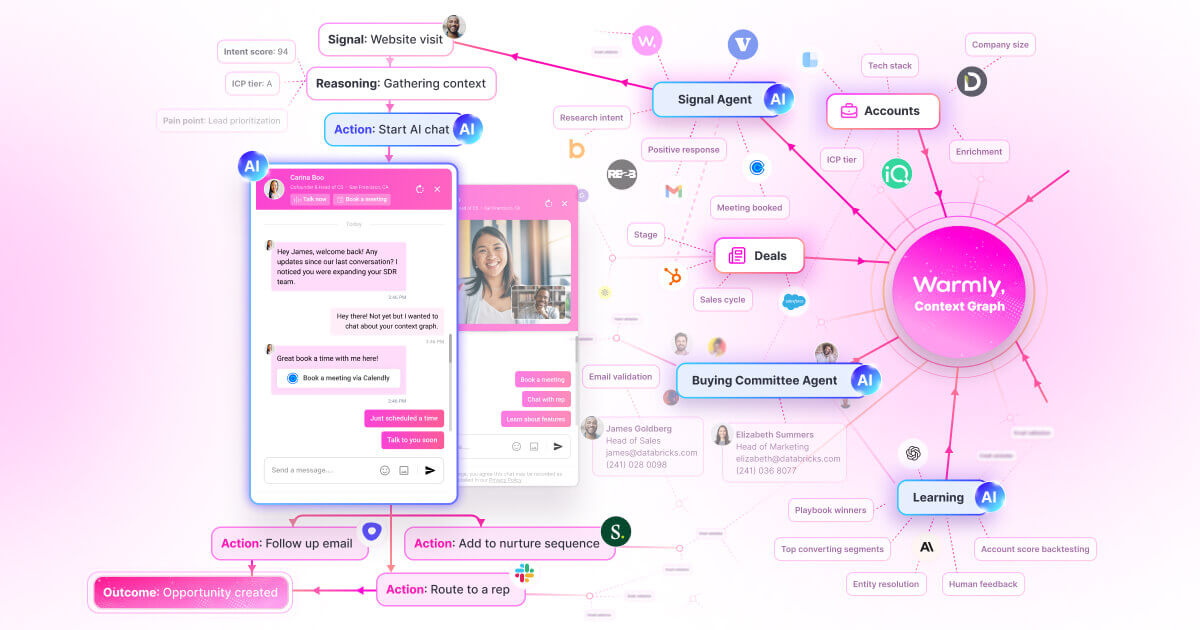
Warmly identifies which companies (and, to a lesser degree, which individuals) are visiting your website, then helps you act on that signal before the visitor forgets you exist.
Best For: BD teams wanting to identify and act on companies showing buying intent by visiting their site.
Key Features:
- Surfaces which companies are visiting your website in near real time.
- Signal-based alerts to prioritize warm outbound targets over cold ones.
- Combines first-party web behavior with firmographic and technographic enrichment to score visitors.
Limitations:
- Company-level identification is far more reliable than person-level identification, so treat individual name matches as a bonus, not a guarantee.
- Only as useful as your existing traffic volume, and works best paired with an outreach tool to act on what it surfaces.
Pricing: Pricing sources conflict here more than any other tool in this list. Some report Warmly's paid plans starting around $700–900/month, while Warmly's own component-based pricing describes tiers starting closer to $10,000/year for its AI Data Agent product. Given this discrepancy, confirm current pricing directly at warmly.ai before budgeting.
5) Snov.io
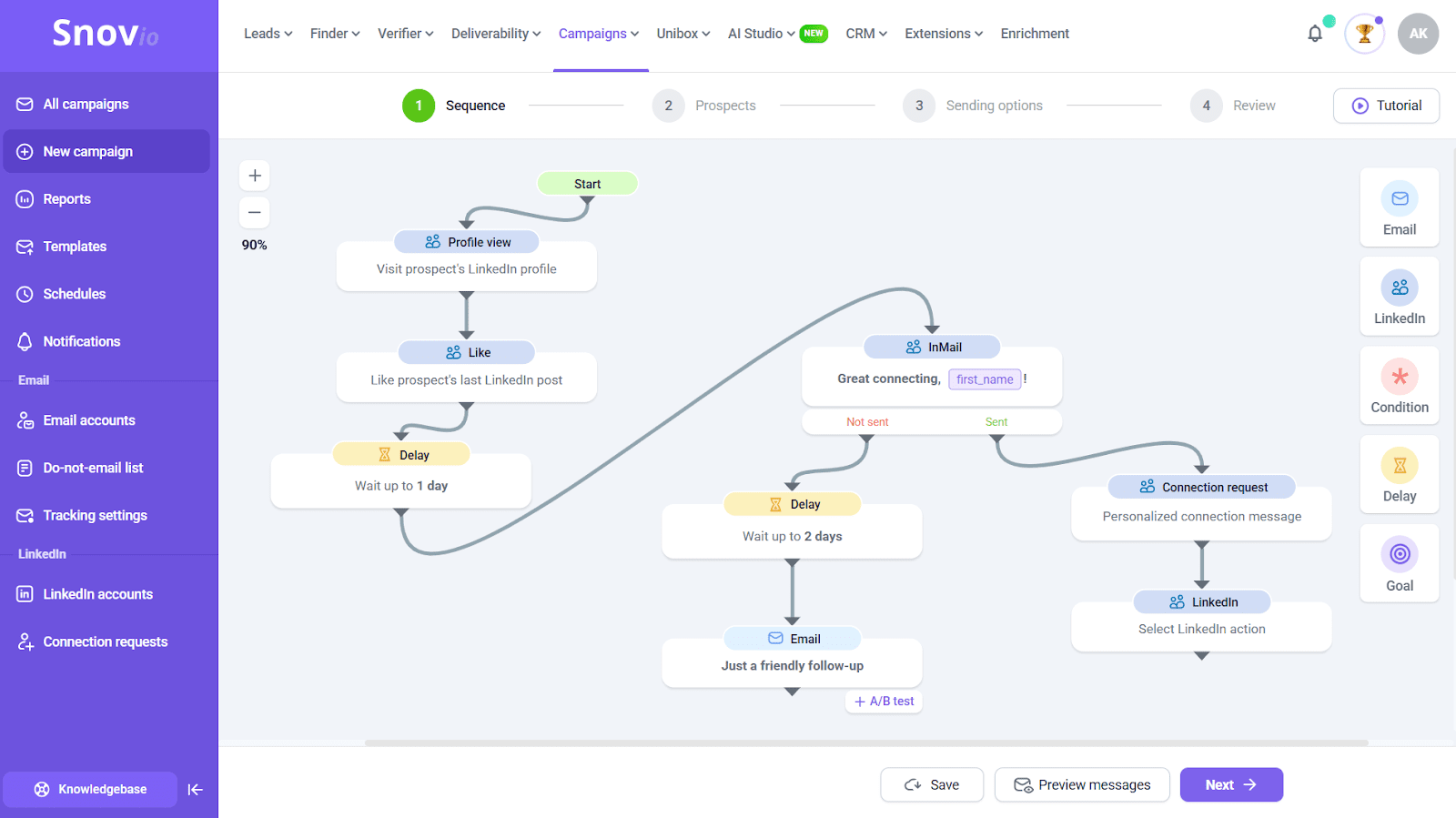
Snov.io bundles email finding, verification, outreach sequencing, and basic deal tracking into one account, which makes it a reasonable starting point for teams that don't want to pay for four separate tools yet.
Best For: Teams wanting outreach, CRM, and deal tracking without committing to expensive software immediately.
Key Features:
- Free plan available with 50 credits per month, no credit card required to start.
- AI sentiment analysis layered into deal and campaign tracking.
- Native LinkedIn outreach automation built into the same sequence builder as email.
Limitations:
- LinkedIn automation is a separate add-on, not included in the base plan, adding $69 or more per month per slot.
- Less enterprise depth than dedicated intent or contact-data platforms.
Pricing: Snov.io's free plan includes 50 credits and 100 recipients. Starter runs $39/month with 1,000 credits and 5,000 recipients. Pro S starts at $99/month, scaling up through Pro M and Pro L depending on volume. Annual billing generally saves around 25%.
6) ZoomInfo Copilot
ZoomInfo remains the enterprise standard for contact and intent data, and Copilot layers AI on top to surface buying signals and generate account summaries automatically.
Best For: Enterprise teams wanting AI-surfaced buying signals layered on top of a large B2B database.
Key Features:
- Synthesizes thousands of data points into custom account summaries, combining ZoomInfo's data with your own CRM data.
- Delivers actionable alerts on account, contact, and intent changes, plus recommended next actions.
- Large, particularly strong North American contact and company database.
Limitations:
- Pricing is entirely custom and quote-based, which makes upfront budgeting difficult without a sales call.
- Overlaps significantly with other data tools if it isn't your organization's primary data source.
Pricing: Entry-level ZoomInfo Professional pricing typically starts around $15,000/year, with Copilot Advanced running $22,000–$30,000/year and Copilot Enterprise landing at $35,000-plus per year, though actual contracts vary widely based on seats and add-ons.
7) Cognism
Cognism built its reputation on compliance and phone-verified mobile data, which makes it a common pick for teams doing serious cold calling into European markets.
Best For: Teams needing GDPR and DNC-compliant contact data, especially for EU or UK outbound.
Key Features:
- Phone-verified mobile data, branded as Diamond Data internally.
- Strong compliance tooling covering GDPR, CCPA, SOC 2, and DNC screening.
- Sales intelligence layered directly on top of verified contact records.
Limitations:
- Cognism publishes no pricing and requires a sales call before you see a number.
- Stronger fit for EMEA-focused teams than for North America-first outbound.
Pricing: Real-world contracts for a small team typically land in the $15,000–$25,000-plus per year range, billed annually, with per-seat licensing added on top of a platform fee. No free trial is offered.
8) monday CRM
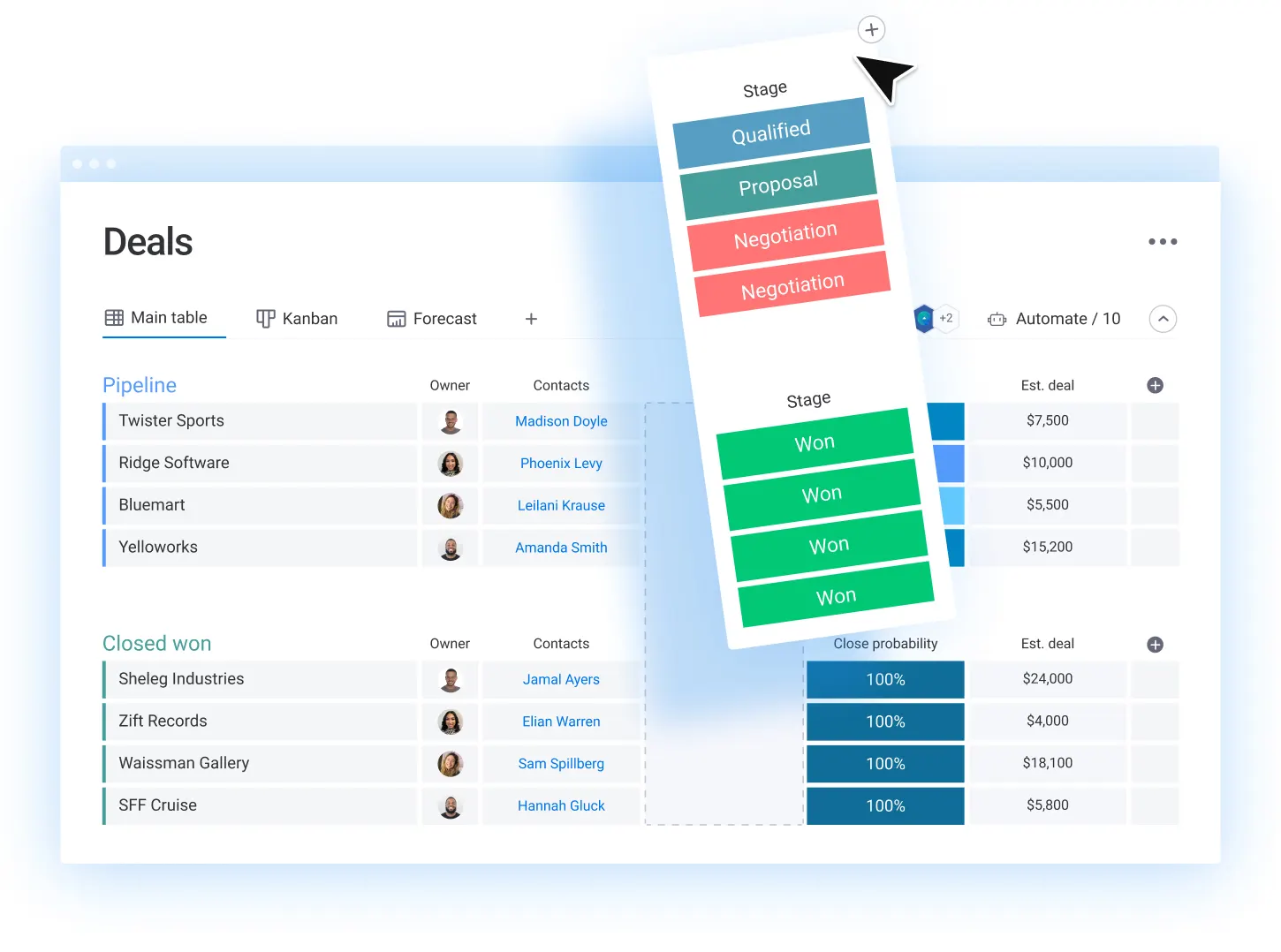
monday CRM brings the visual, no-code workspace style of monday.com's broader platform into a dedicated sales pipeline tool, which appeals to teams that already use monday for other work.
Best For: Teams wanting a visual, no-code-friendly workspace unifying lead gen, pipeline, and communication.
Key Features:
- AI-powered automation layered across a highly visual, drag-and-drop workspace.
- No-code customization that's genuinely accessible to non-technical BD teams.
- Unifies lead generation, pipeline management, and internal communication in one board-based system.
Limitations:
- Less specialized than dedicated prospecting or contact-data tools.
- No AI lead scoring on any plan, unlike some competing CRMs.
Pricing: monday CRM runs Basic at $15/month ($12/month billed annually, 3-seat minimum), Standard at $20/month ($17 annually), and Pro at $33/month ($28 annually), with Enterprise custom-quoted.
9) PhantomBuster
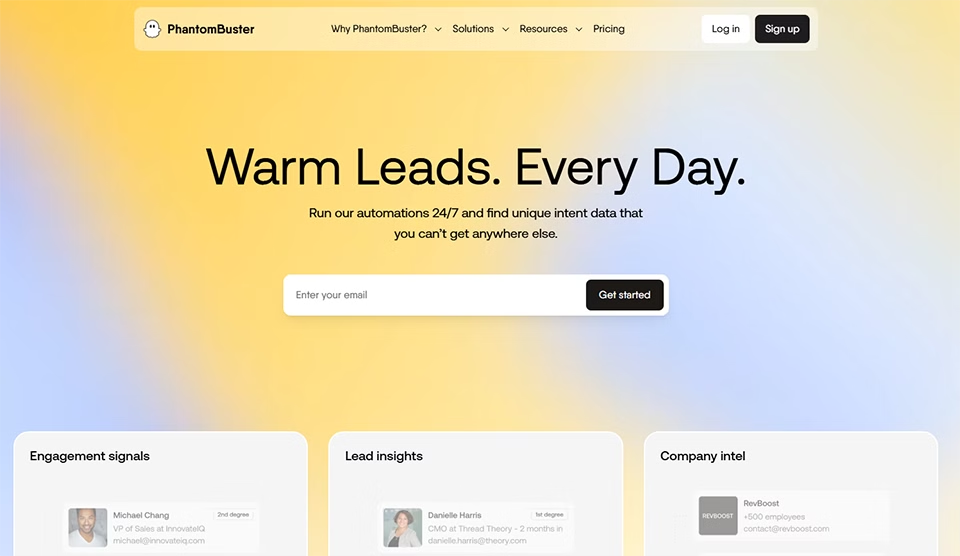
PhantomBuster automates repetitive prospecting and scraping tasks across LinkedIn and other platforms using prebuilt automations it calls "Phantoms."
Best For: BD teams wanting to automate repetitive prospecting and data-gathering tasks.
Key Features:
- Automation "Phantoms" for scraping and syncing data from LinkedIn and other platforms.
- Flexible automation building without needing engineering resources.
- Workspace model lets multiple users share one subscription, with up to 100 LinkedIn accounts linkable to a single workspace.
Limitations:
- LinkedIn automations run on stored session cookies, which carries account-ban risk if used aggressively.
- Unused execution hours, email credits, and AI credits expire monthly with no rollover.
Pricing: PhantomBuster's Starter plan runs $59/month with 20 hours of execution time, 5 Phantom slots, and 500 emails. Pro runs $139/month with 15 slots and 80 hours. Team runs $399/month with the highest execution ceiling. Annual billing brings meaningful savings across all tiers.
10) Folk
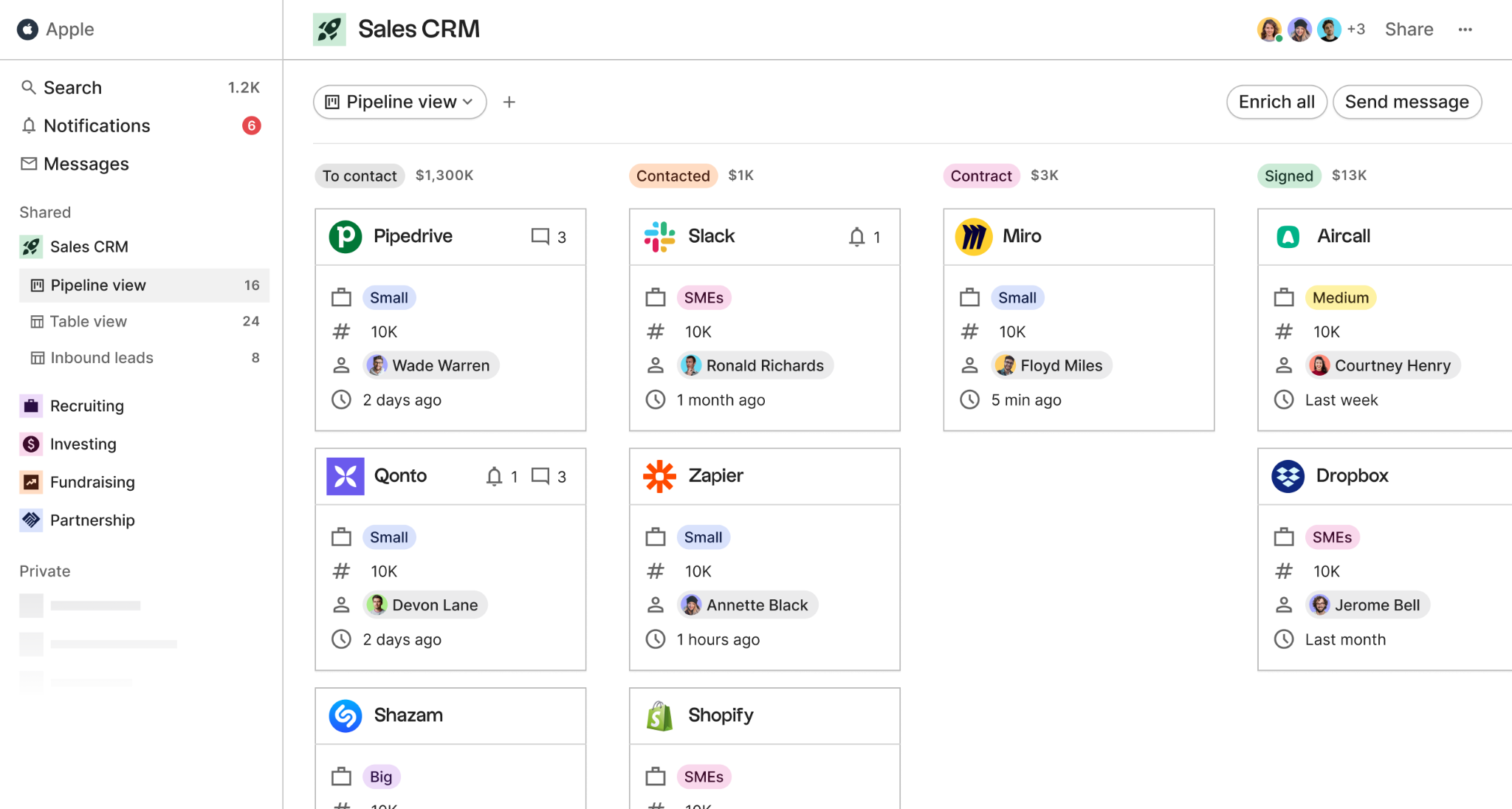
Folk takes a different approach from the traditional sales CRM: it's built around personal relationships and networking rather than transactional deal pipelines, which makes it a favorite for BD professionals whose work runs on warm introductions as much as cold outreach.
Best For: BD professionals and founders who rely heavily on relationship-driven networking, not just cold outbound.
Key Features:
- Lightweight personal CRM designed around relationships, not just deal stages.
- folkX Chrome extension for capturing contacts directly from LinkedIn.
- Simpler and more relationship-focused than traditional sales CRMs, with AI-assisted data enrichment built in.
Limitations:
- No permanent free plan, only a 14-day trial.
- Core sales features like deal management and email sequences are locked behind the Premium tier, which roughly doubles the price.
Pricing: Folk's Standard plan runs $30/month or $24/month annually per user, and Premium runs $48/month annually, with Custom plans starting higher for larger teams.
📈 53,000+ Meetings. $312M+ Pipeline.
Cleverly helps 10,000+ businesses turn better targeting and outbound execution into predictable B2B growth.
How to Choose the Right Business Development Tools for Your Team
Start by naming your actual bottleneck instead of shopping by feature list. Is it finding contacts, tracking deals, staying on top of relationships, or acting on buying signals? Each of those points to a different category above, and buying outside your bottleneck just adds cost without solving the problem.
Resist the urge to stack five-plus overlapping subscriptions. Most BD teams genuinely need two or three tools that fit their stage and budget, not a sprawling stack where three tools all claim to do "prospecting."
Prioritize tools with free tiers or trials so you can validate fit on your real workflow before committing budget, especially given how many tools in this category (ZoomInfo, Cognism, Warmly) now require a sales call just to see pricing.
Finally, check integration before you buy. A prospecting tool that doesn't sync cleanly with your CRM just creates manual export-import work, which is the opposite of the efficiency you're paying for.
Tools Support Business Development, Cleverly Executes It
Every tool on this list organizes, enriches, or surfaces data faster than a spreadsheet ever could. But none of them makes the calls, sends the messages, or handles the back-and-forth that turns a well-targeted list into a booked meeting. That part still takes a person, or a team of people, running consistent outreach week after week.
This is where Cleverly fits into a BD stack that already has its data and tracking sorted out.
As a B2B lead generation agency, we run LinkedIn outreach, cold email, and cold calling campaigns that take the targeting your BD tools support and turn it into actual conversations with decision-makers.
We've helped generate 224.7K leads, $51.2M in client revenue, and $312M in pipeline across the accounts we work with, using the same kind of ICP targeting your tool stack is built to identify.
A well-organized BD stack with no consistent outreach behind it still produces flat results. Tools accelerate the process, but they don't replace the execution, and most in-house teams underestimate how much ongoing tuning it takes to keep reply rates and meeting volume from decaying month over month. That's the gap done-for-you outbound is built to close.
If you already have the tools and just need a team running consistent outreach on top of them, book a strategy call with Cleverly and we'll walk through what that could look like for your pipeline.
Conclusion
The best business development stack in 2026 isn't the one with the most tools. It's a handful of well-integrated ones that actually cover your bottleneck without overlapping each other.
AI has genuinely upgraded prospecting, enrichment, and intent tracking this year, but adoption and integration still decide whether that upgrade pays off or just becomes another line item nobody uses.
Free tiers on tools like Apollo.io and Snov.io make it easy to test before you commit real budget, so there's little reason to buy blind in this category anymore.
At the end of the day, tools organize and accelerate business development. They don't replace the outreach and relationship-building that actually turns a well-built stack into closed revenue.
Frequently Asked Questions
Free Resource
How to Scale a Profitable Cold Call System
Get the complete guide — download it instantly now.
Free Ebook
Download the Free Guide
Enter your details to get instant access.
You're all set! 🎉
Your ebook is downloading now.
Click below if the download didn't start automatically.