Table of Contents
What AI Sales Roleplay Actually Is
Why Practising on Live Prospects Is Expensive
What AI Roleplay Genuinely Improves
Where AI Roleplay Falls Short
How to Run AI Roleplay Properly
Tools for AI Sales Roleplay
How to Measure Whether It Is Working
How Cleverly Removes the Ramp Problem Entirely
Conclusion
Frequently Asked Questions
Modified On :
November 2, 2026
Key Takeaways
- Live prospects are the most expensive place to practice. In a finite market, a burned account rarely comes back.
- AI sales roleplay builds fluency through repetition. Judgment still comes from live calls and manager coaching.
- The AI buyer is only useful if it is hard to talk to. A friendly simulated prospect trains reps for buyers who do not exist.
- Good setups start with real personas, a written scoring rubric, short frequent sessions, and managers who review sessions, not just scores.
- Judge the program by ramp time and live-call results. Roleplay scores alone can rise while real performance stays flat.
Every SDR you hire will make their worst cold call in the first month. The only question is who picks up.
The Bridge Group puts average SDR ramp at about 3.2 months. Average tenure sits around 1.8 years, and annual SDR turnover runs near 34%. That means a big slice of each rep’s time with you is spent learning on your target accounts.
In a finite TAM, those accounts do not come back. A poor first conversation can close a door for good.
AI sales roleplay changes where that learning happens. Reps rehearse openers, objections, and discovery against a simulated buyer as many times as they need, before anyone real answers.
It has limits. It does not replace manager coaching, and AI buyers are usually easier than real ones unless you make them difficult.
This guide covers how it works, what it improves, where it falls short, how to run it, which tools to look at, and how to measure it.
What AI Sales Roleplay Actually Is
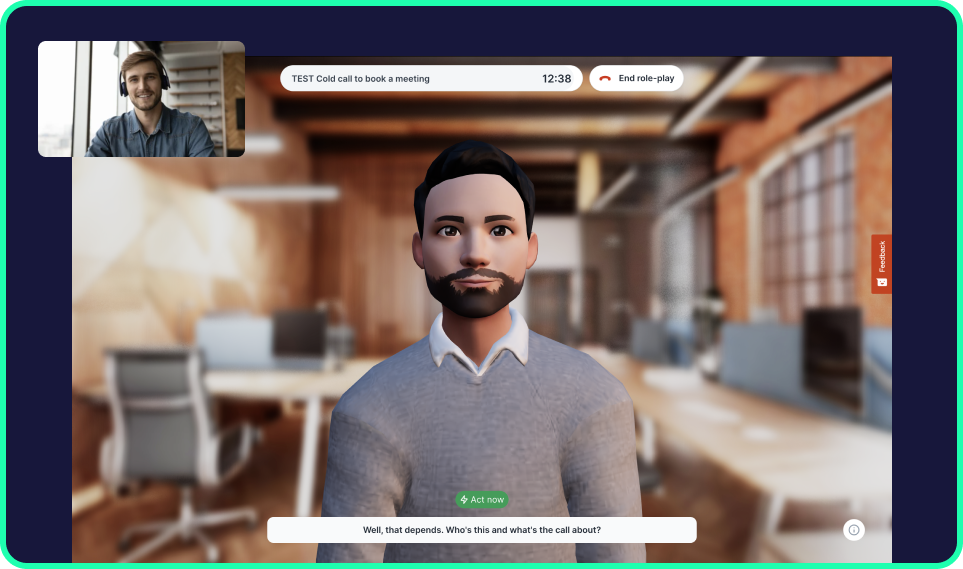
AI sales roleplay means a rep practices a sales conversation against an AI that plays a buyer persona. The conversation happens by voice or text. Feedback arrives afterward.
You will see two formats in the wild:
- Dedicated platforms. These ship with scenario libraries, voice simulation, and scoring built in.
- General-purpose AI with a good prompt. You write the persona, the scenario, and the scoring instructions yourself.
A typical session has four parts: a defined persona, a scenario, the conversation itself, and a scored debrief.
How it differs from traditional roleplay
Peer roleplay depends on who is free that afternoon. AI is available on demand, repeats as often as needed, and plays the same persona the same way for every rep. That consistency matters when you hire several people at once.
How it differs from call review
Call review analyzes a conversation that already happened with a real prospect. By then, the account has already been spent. A sales roleplay simulator works before the call, not after.
The core appeal fits in one line: reps get their first fifty bad conversations out of the way before any of them cost you an account.
🎯 Practice the Pitch. Perfect the Outreach.
AI roleplay prepares SDRs for real conversations. Cleverly helps you reach more prospects with targeted cold calling, LinkedIn, and cold email.
Why Practising on Live Prospects Is Expensive
This is the argument that justifies the whole category, so let’s keep it specific.
Accounts are finite
In B2B, your serious targets might number a few hundred or a few thousand. A new rep who fumbles a first call on one of them has not just lost a meeting. They have often lost that account for months, sometimes for good. You can reopen a cold lead. You cannot easily undo a bad impression with a buyer who now remembers your company as the one that wasted their time.
Ramp is the hidden cost
Reps improve slowly when feedback arrives weekly and conversations are scarce. A new SDR might make 60 dials a day, but only a handful become real conversations. That means very few chances to learn per day, each one on a real account.
Manager time does not scale
Coaching capacity rarely grows with headcount. When you hire three reps at once, each one gets less attention exactly when they need the most.
Peer roleplay has a ceiling
Colleagues are too forgiving. They also know your pitch too well. A teammate playing a buyer will politely let the rep finish. A real buyer will not.
What it really costs
Price AI roleplay against the real number. Add up three things:
- Account burn. Targets damaged while reps were still learning.
- Extended ramp. Months of partial output at full salary.
- Manager hours. Time spent on basics that practice could have covered.
For a team replacing a third of its SDRs every year, that cost repeats every cycle.
What AI Roleplay Genuinely Improves
Here is where AI roleplay for sales training earns its place.
Repetition volume
A rep can run an opener thirty times in an afternoon. No human roleplay schedule allows that. Volume alone fixes a lot of early problems like filler words, rushed pacing, and weak first sentences.
Objection drilling
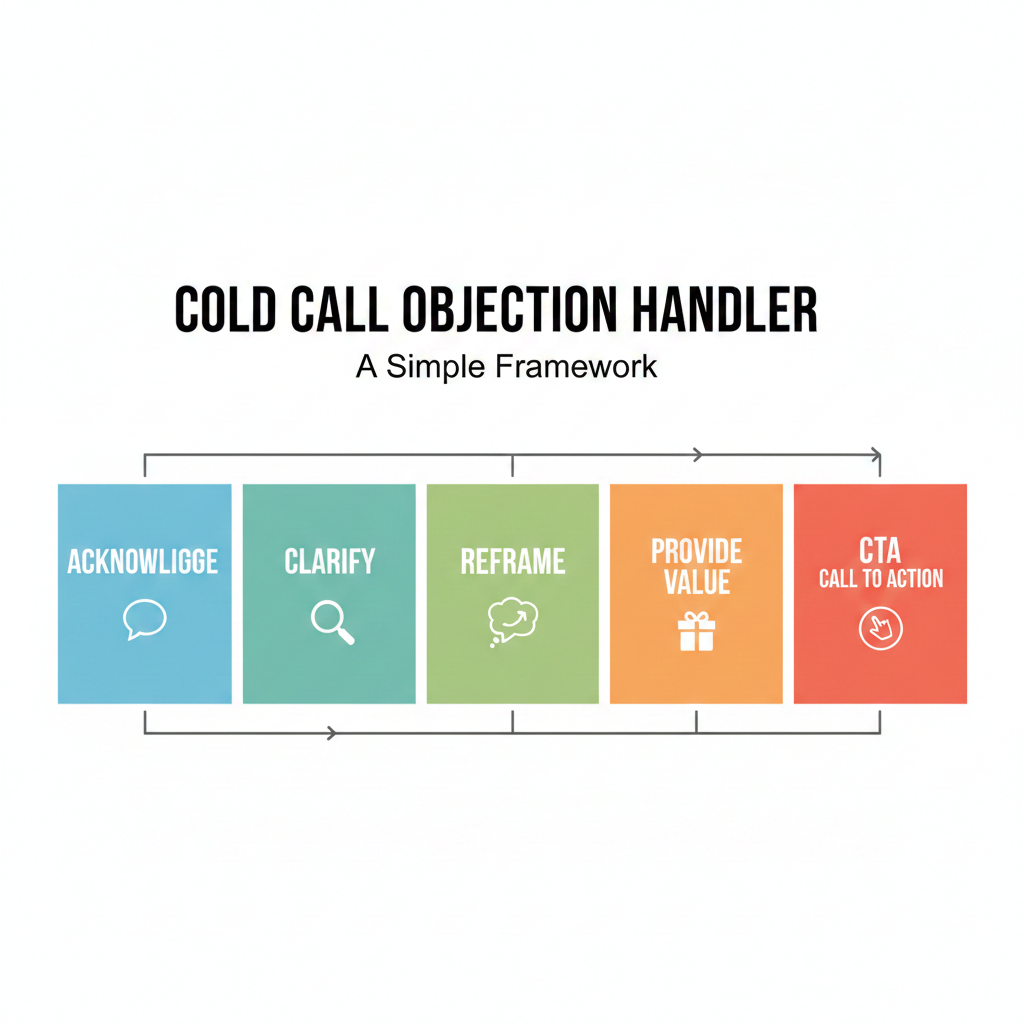
Take “we already have a vendor” or “send me an email.” A rep can practice the same response until it stops sounding rehearsed. That takes dozens of repetitions, which is hard to get from a busy manager or a polite peer.
Consistency across reps
Every new hire trains against the same personas and scenarios. That standardizes your baseline. You stop wondering whether one rep is weaker or just got an easier practice partner.
Speed to first real call
Reps arrive at live conversations having already made their obvious mistakes. Vendor case studies report ramp reductions of 40% to 60%. Hyperbound, for example, cites Vanta cutting ramp from 210 days to 72. Treat those as vendor-reported numbers, not benchmarks, and measure your own.
Safe failure
Reps will try things in practice that they would never risk on a real account. A new angle, a bolder ask, a different tone. Practice is where they find out what works.
Onboarding scale
This matters most when you hire in batches. Ten reps can practice at once without ten managers.
Measurable progression
Scored sessions create a visible improvement curve. Peer roleplay leaves nothing to chart.
🚀 Ready to Beat Your Outbound Targets?
Stop guessing which channel will deliver. Let Cleverly run targeted LinkedIn, cold email, and cold calling campaigns.
Where AI Roleplay Falls Short
We give this equal weight because it is what makes the rest credible.
AI buyers are too cooperative
They answer questions real prospects dodge. They stay on the call when a real buyer would hang up. A rep can finish a perfect-looking discovery with an AI that a human would have ended at minute one.
Unpredictability is hard to simulate
Real prospects go off-script in ways that matter. They ask about a competitor you did not expect. They go silent. They answer a different question. Handling that is the skill reps most need, and it is the hardest to simulate.
No emotional stakes
The sting of a real rejection is part of what builds resilience. Practice cannot manufacture it.
Feedback quality varies
Scoring against a rubric is not the same as a manager noticing why one specific moment went wrong. A score can tell a rep that their objection handling was a 6. A manager can tell them they sounded defensive in the third sentence.
It teaches delivery, not judgment
AI roleplay cannot teach product knowledge or market judgment. It will not tell a rep which accounts to prioritize or when to walk away from a bad-fit lead.
Over-practice makes reps sound scripted
A rep who runs the same script fifty times can start sounding like they are reading it. Prospects notice.
The honest framing is simple. AI roleplay builds fluency. Live calls and manager coaching build judgment.
How to Run AI Roleplay Properly
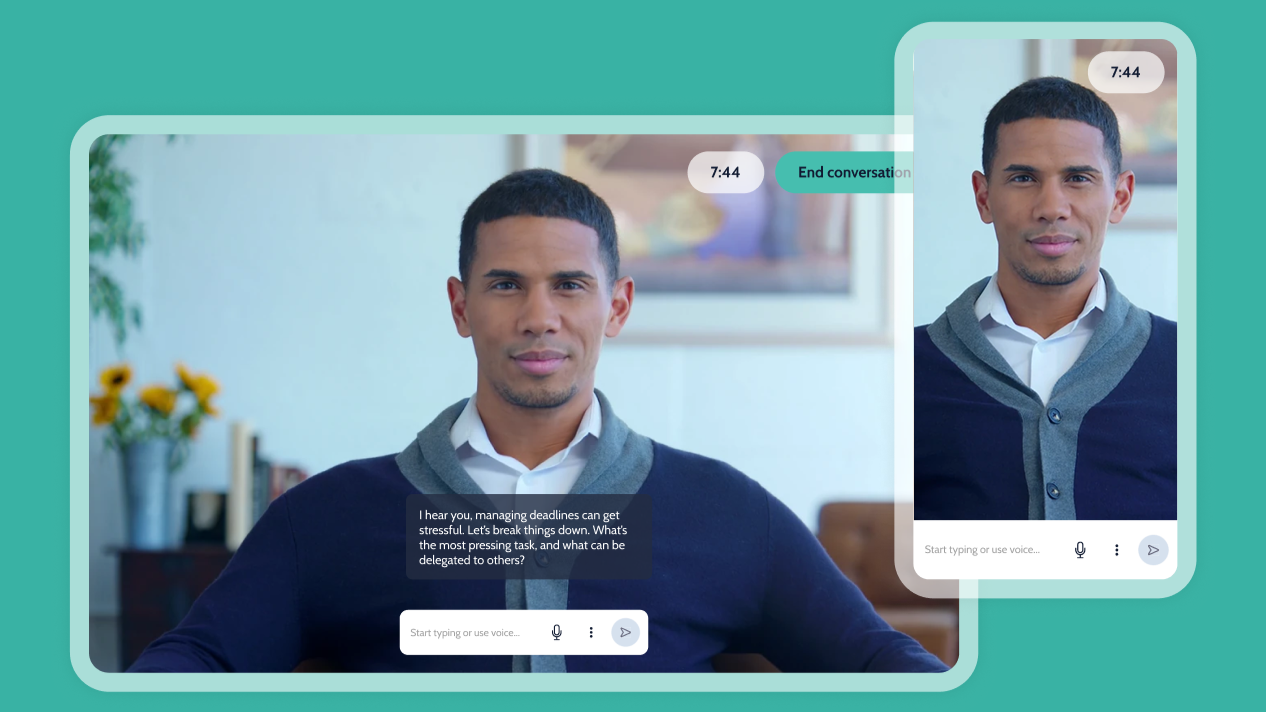
Most of the value comes from setup. Here is the order we would follow.
Build Personas From Real Prospects
Base your personas on accounts you actually sell to. Use their language and their priorities.
- Pull objections from real call recordings, not from imagination.
- Segment by role. A practitioner and an economic buyer behave very differently.
- Update personas quarterly as your market and messaging change.
Make the AI Difficult on Purpose
This is the single most important configuration choice, and the one most teams skip.
Set personas to be distracted, skeptical, rushed, or hostile. Tell them to dodge questions, give short answers, and end calls early.
If you use a general-purpose assistant, a prompt like this works as a starting shape:
You are a VP of Operations at a 200-person logistics company. You are busy and a little annoyed. You do not know who the caller is. Give short answers. Do not volunteer information. If the rep pitches before asking a good question, push back. If the opener is generic, end the call within 30 seconds. Only warm up if the rep earns it with something specific to your business.
Pro tip: Write one persona from a recent call that went badly. Real losses make the best training material.
Define What Good Looks Like Before Scoring
Write the rubric first. Tie it to the moments that decide your call:
- Did the opener earn the next 30 seconds?
- Did the rep ask a real question before pitching?
- Did they handle the first objection without getting defensive?
- Did they ask for a specific next step?
Score the same way every time so progress is measurable.
Set a Practice Cadence
Short, frequent sessions beat occasional long ones. Fifteen minutes a day does more than a two-hour block on Friday.
Tie practice to the skill a rep is currently being coached on. If their weak spot is objections, that week’s sessions are all objections. For a full weekly structure, see our sales coaching plan guide.
Keep a Human in the Loop
Managers should review a sample of sessions, not just scores. Listen to the recording. Use roleplay to prepare for coaching conversations, not to skip them.
Graduate Reps Deliberately
Define the standard a rep must hit before calling real accounts. For example, completing the hostile persona three times without losing the call.
Then start them on lower-value segments, not priority targets. Let them earn the best accounts.
Tools for AI Sales Roleplay
This market is new and moving quickly, so we are covering categories, not ranking products.
What to evaluate
- Voice realism. Does it feel like a call, or a chatbot?
- Persona control. Can you make the buyer hostile, rushed, or distracted?
- Scoring quality. Does the feedback point to specific moments?
- Scenario depth. Are there enough situations to avoid repetition?
- Team reporting. Can a manager see progress across reps?
Dedicated roleplay platforms
Hyperbound
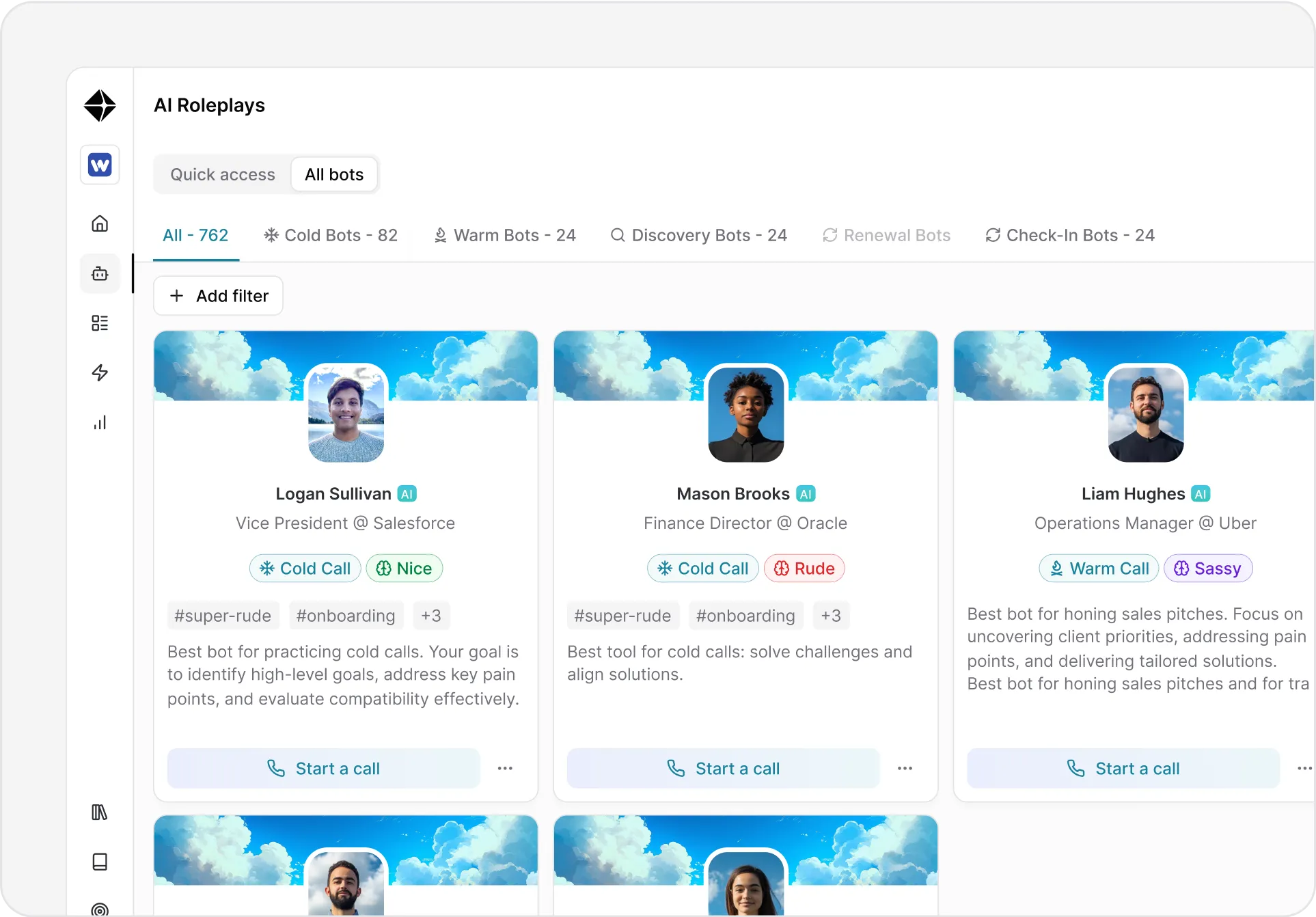
Hyperbound is built around AI sales roleplay. Reps practice against AI buyer bots by voice and get scored feedback afterward. Its Practice product covers outbound, inbound, objection handling, and competitive positioning scenarios. A second product, Perform, adds scoring on real calls. A free tier lets you test prebuilt bots before talking to sales.
- Prebuilt roleplay packs for outbound, objection handling, inbound, and competitive positioning.
- AI Buyer Bot Builder and a variation builder for custom personas.
- Custom AI scorecards plus an analytics dashboard and reports builder.
- LinkedIn Chrome extension and resume-call scenarios.
- Perform tier adds real call scoring, deal coaching, and CRM and call recorder integrations.
Pricing: Free includes 45 prebuilt AI roleplays and example scorecards. Practice and Perform are both listed as Enterprise plans, priced per user, with no published figure. Hyperbound says it offers volume discounts and multi-year savings, so you will need to book a demo for a quote.
Exec
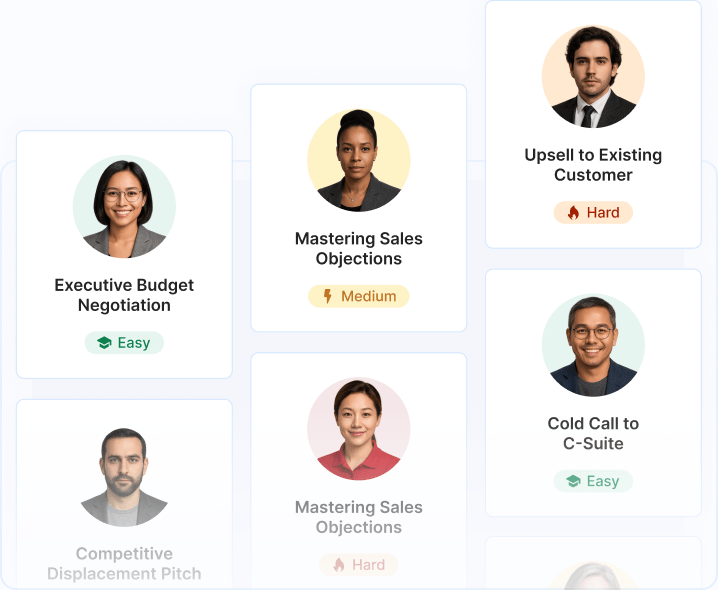
Exec is a conversation training platform with voice-based AI roleplay at its core. You build a scenario from your own playbook and get graded against scorecards you control. It also scores real calls and offers courses and certifications. Of the tools here, it has the clearest self-serve pricing.
- Scenario Studio for building custom roleplays graded on your own criteria.
- Unlimited roleplay sessions on paid plans.
- AI Coach on Professional, which lets reps re-drill the exact moment they missed.
- Certifications with pass criteria you define, plus skill analytics.
- Screen sharing in roleplays for demo practice (Professional and up).
- Call scoring on every plan, billed by usage.
Pricing: Free is $0 (5 roleplay sessions per year, 2 custom scenarios, 1 admin plus 3 basic seats). Starter is $120/month or $1,200/year for up to 50 seats. Professional is $7,020/year for up to 200 seats. Enterprise is custom. Exec’s launch post says paid plans include a 14-day free trial.
Outdoo AI
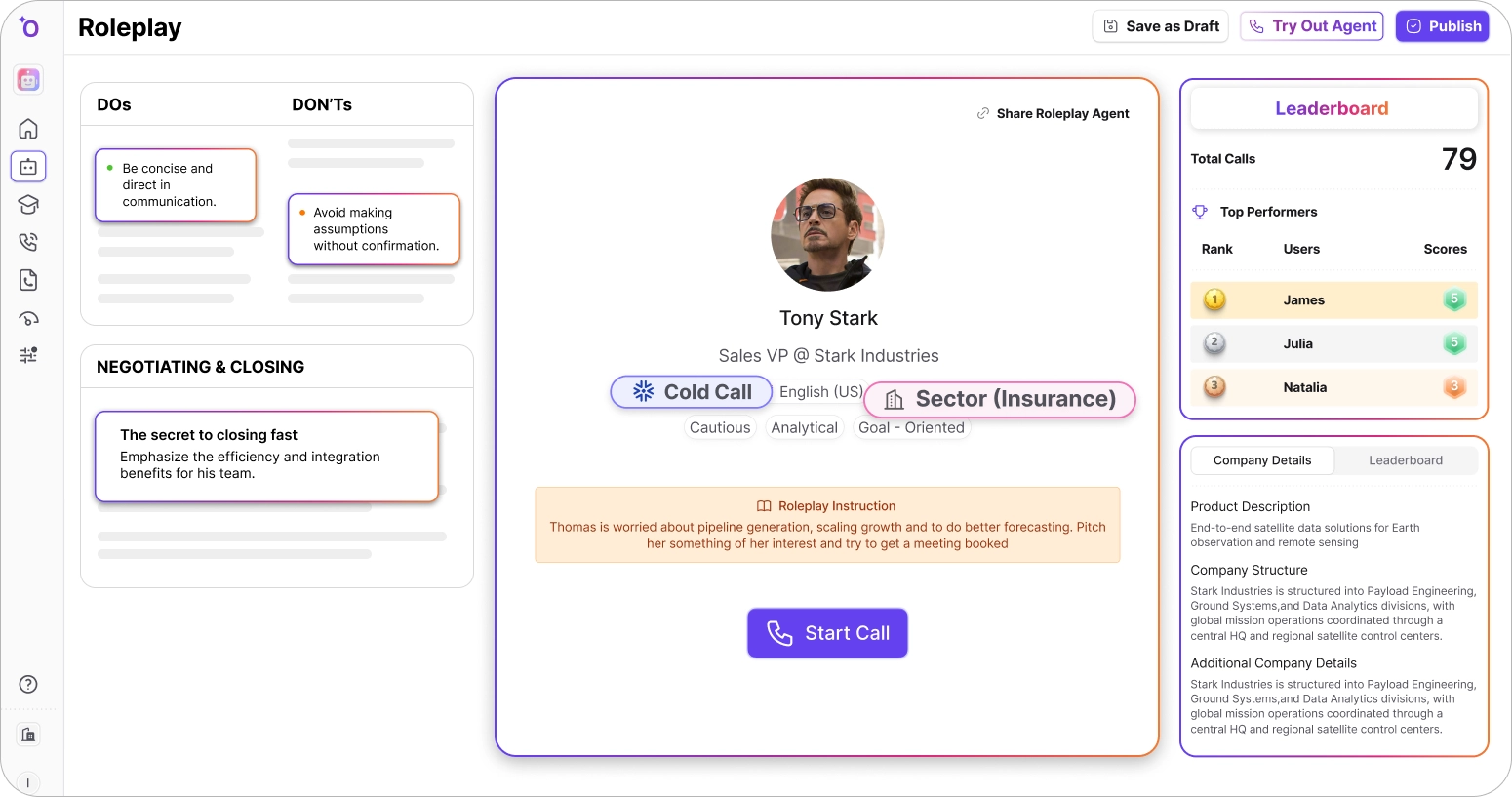
Outdoo combines AI roleplay with real-call scoring and coaching. Its main idea is that practice should come from your actual deals. You can generate a roleplay agent in one click from a real call, a prompt, or a template. That makes it useful for teams that want practice built from real lost calls.
- One-click roleplay agents built from calls, prompts, and templates.
- Voice, chat, video, and in-person modes with video AI avatars.
- Multi-persona roleplays and gatekeeper simulation for cold call drills.
- Pre-built and custom AI scorecards, plus real-call scoring.
- 140+ integrations included in the license.
Pricing: The Free plan includes 60 minutes of roleplay credits with no credit card. Growth and Enterprise are custom quotes based on team size and use case. Outdoo notes annual contracts are standard.
Second Nature
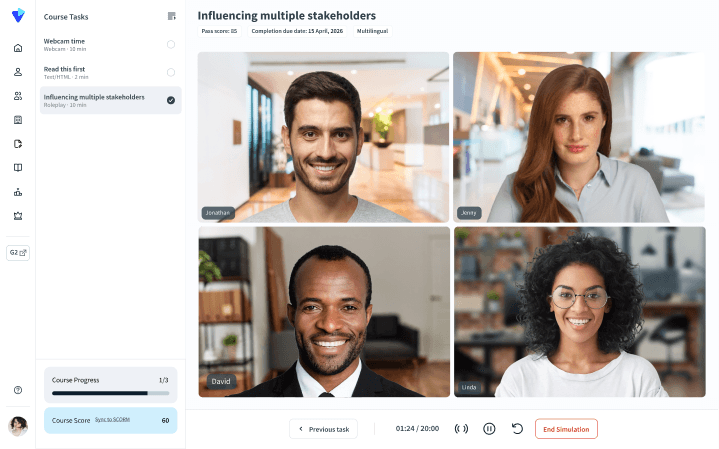
Second Nature is an enterprise AI roleplay and certification platform. Reps talk with AI personas, get scored, and repeat until they improve. You can import your own content and have its AI assistant build roleplay libraries quickly. It leans toward larger teams that want roleplay inside a formal training program.
- Conversational AI personas for sales, support, and call center practice.
- Rapid roleplay creation from imported content using an AI assistant.
- Objective AI scoring after each session.
- Free ready-made demos for cold calling, discovery, and objection handling.
- Industry pages for insurance, banking, telco, and tech.
Pricing: Not published on Second Nature’s site. Pricing runs through a demo request. For context, G2’s vendor-supplied listing says the minimum average deal starts at $20K USD (last updated November 2025), so treat that as a rough guide only.
Enablement suites with roleplay added
Mindtickle
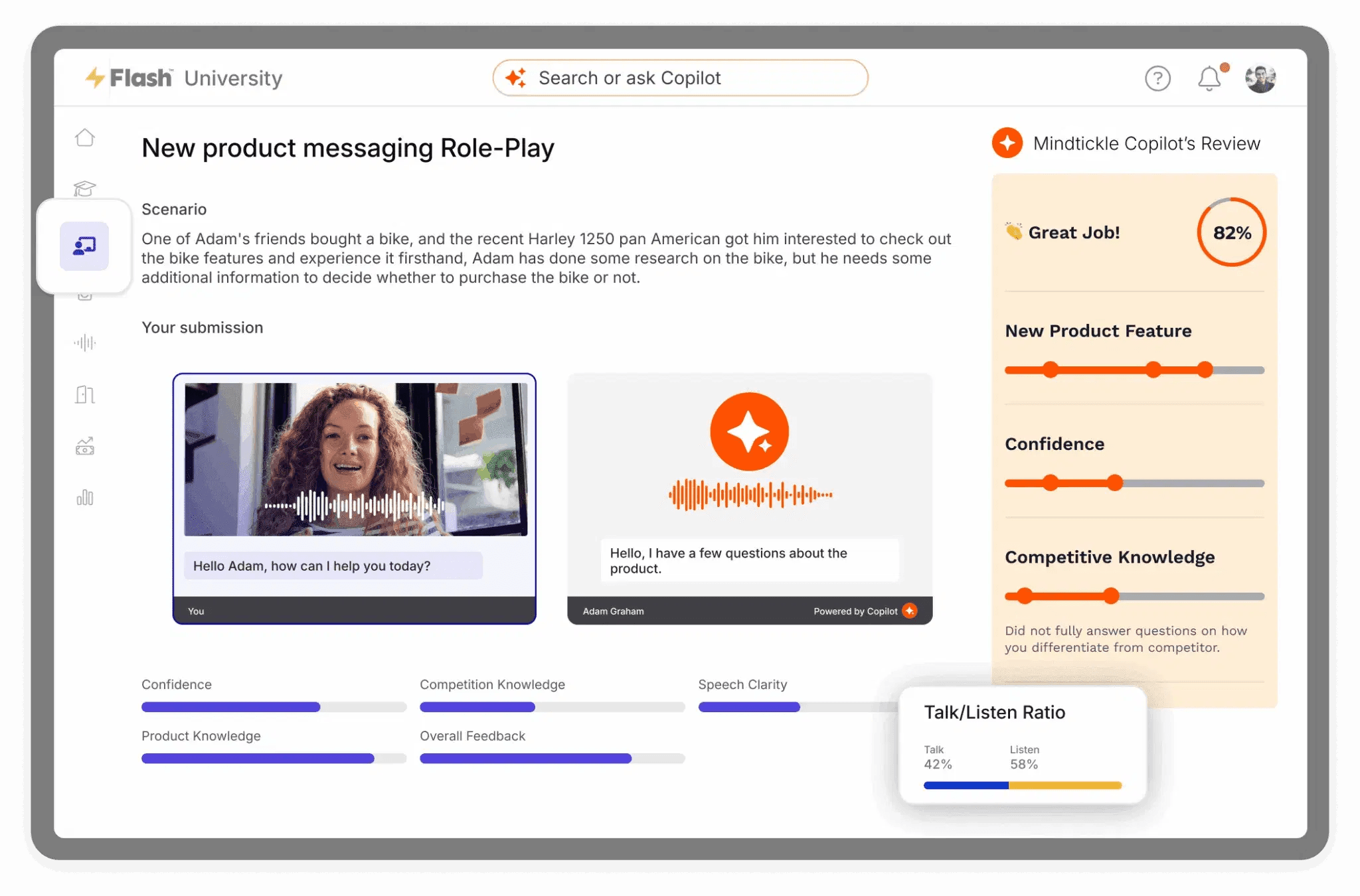
Mindtickle is a full revenue enablement platform. AI roleplay is one module inside a larger system of training, coaching, and readiness tracking. It fits teams that already run structured enablement and want practice tied to certifications and rep readiness scores.
- One-way AI role play (video pitches, presentations, demos, emails) with AI grading, included in Readiness, Enable, and Transform packages.
- Two-way interactive AI role play, including screen share, available when specified in an order.
- Certifications, courses, and a Readiness Index.
- Coaching rooms and analytics.
- Call AI for recorded call analysis in the Transform package.
Pricing: Mindtickle does not publish prices. Its site lists the Readiness, Enable, and Transform packages without a dollar figure, so you need a quote. Check whether two-way roleplay is included in the package you are quoted.
General-purpose AI
ChatGPT
A general assistant works as a starting point for AI cold call practice. You write a persona prompt, set the scenario, and tell it to stay difficult. Then you ask for feedback after the call. It will not give you team dashboards or consistent scoring, but it is a low-risk way to test the idea.
- Fully custom personas using the prompt approach from earlier in this guide.
- Voice and text practice.
- Feedback on demand, based on a rubric you paste in.
- No setup time, no sales call.
- No built-in reporting, so you track progress manually.
Pricing: Plus is listed at $20/month. Business is $20 per user per month billed annually, or $25 monthly, with a two-user minimum. These come from third-party pricing roundups, not OpenAI’s page, so please check openai.com/chatgpt/pricing before publishing.
The budget point
A well-written prompt in a general assistant delivers much of the value for small teams. Dedicated platforms earn their cost at scale, when you need consistent scoring and reporting across many reps. If you are hiring two SDRs, start with a prompt or a free tier. If you are hiring twenty, a paid platform is easier to justify.
How to Measure Whether It Is Working
Track the signals that connect practice to the pipeline.
The comparison that matters
Measure ramp time before and after you introduce roleplay. It is the clearest signal. Benchmark against your own prior cohorts, not published averages, since your sales cycle and ICP are unique.
The failure mode to watch
If roleplay scores keep rising but live-call performance stays flat, your reps are learning to pass the simulation. That usually means the personas are too easy or the rubric rewards the wrong things. Tighten both. Good AI sales coaching shows up in live metrics, not just practice scores.
How Cleverly Removes the Ramp Problem Entirely
AI roleplay shortens ramp. It does not erase it. New hires still take months to reach full productivity, and that gap sits in your pipeline whether or not you train well.
That is the tension for a growing team. You need meetings now. Building the internal capability to produce them takes quarters of hiring, training, and coaching.
This is where an outsourced SDR model helps. At Cleverly, we run the full motion for you: ICP definition, verified list building, LinkedIn outreach, cold email, cold calling, reply handling, and meetings booked straight onto your calendar.
Our SDRs are already trained and already running this daily, so you absorb no ramp period. Your target accounts are not where anyone learns the job.
We have generated $312M in pipeline for clients and set 53K appointments across more than 1M cold calls.
It also works alongside an internal team. Outsourced capacity can cover the pipeline while your new hires ramp properly, instead of pushing them onto live accounts too early. We optimize for one thing: qualified meetings held with real decision-makers.
Need a pipeline while your new reps get up to speed? See how an outsourced SDR team fills the gap. Talk to Cleverly.
Conclusion
The strongest case for AI sales roleplay is not training quality. It is that your real accounts stop being the practice ground. Reps build fluency through repetition, but judgment still comes from live calls and manager coaching. Configure personas to be difficult, or your team will practice against buyers who do not exist.
Here is a practical next step. Write one realistic persona from a recent lost call, make it hostile, and have every new rep run it ten times before dialing anything real. Then measure ramp time, not roleplay scores. A rep who passes the simulation and freezes on a live call has learned the wrong thing.
Frequently Asked Questions
Free Resource
How to Scale a Profitable Cold Call System
Get the complete guide — download it instantly now.
Free Ebook
Download the Free Guide
Enter your details to get instant access.
You're all set! 🎉
Your ebook is downloading now.
Click below if the download didn't start automatically.