Table of Contents
What to Look for in Revenue Enablement Software
Quick Comparison: 10 Best Revenue Enablement Software Platforms
The 10 Best Revenue Enablement Platforms in 2026
How to Choose the Right Revenue Enablement Platform
Revenue Enablement Software Works Best with a Full Pipeline
Conclusion
Frequently Asked Questions
Modified On :
July 22, 2026
Key Takeaways
- Revenue enablement platforms now blend content management, coaching, and conversation intelligence into one system, so the real evaluation question isn't "does it have features" but "which category of problem am I actually solving."
- The market just went through its biggest consolidation wave yet. Picking a platform in 2026 means understanding who owns who, and whether that ownership changes your renewal leverage.
- Fit matters more than feature count. An enterprise platform built for 500-rep organizations will frustrate a 20-person team, and a lightweight tool built for SMBs will buckle under enterprise governance needs.
- The best-enabled sales team still needs enough qualified meetings to put those skills to work. Enablement software sharpens what happens inside a deal, it doesn't create the deal.
- Start your shortlist by naming your single biggest bottleneck (content chaos, slow ramp, inconsistent calls, or low buyer engagement), not by browsing every platform on the market.
Sales enablement software just went through the fastest consolidation stretch anyone in this space has seen. In February 2026, Highspot and Seismic announced they had signed a definitive agreement to merge, combining two of the biggest players in sales and revenue enablement software.
Months earlier, Vector Capital completed its acquisition of Showpad and combined it with Bigtincan, creating a global powerhouse under the Showpad brand. And in February 2026, Gong launched Mission Andromeda, adding Gong Enable AI coaching to move directly onto the enablement category's turf.
If you're trying to buy a revenue enablement platform right now, the ground is shifting under you. Add in that Gartner published its inaugural Magic Quadrant for Revenue Enablement Platforms in November 2025, and there's finally a credible third-party lens on who's actually leading versus who's coasting on brand recognition.
We work in B2B pipeline generation every day at Cleverly, and we see firsthand how enablement tooling and outbound execution have to work together.
Today we break down the 10 best revenue enablement software platforms in 2026, ranked by real use case fit, not just feature checklists.
What to Look for in Revenue Enablement Software
Most buyers get lost comparing feature lists instead of asking what problem they're actually solving. Here's what actually separates a good fit from a wasted contract.
AI Coaching and Call Intelligence
Four capabilities matter more than anything else in 2026: AI coaching, call scoring, practice/role-play functionality, and deal-level intelligence. If a platform can't tell you what a top performer does differently on a call, and can't help a struggling rep close that gap, it's a content library wearing an enablement costume.
Content Management Depth
Ask yourself honestly: can your reps find the right asset at the right deal stage in under 30 seconds, or does your content sit in a folder structure nobody remembers how to navigate? Revenue enablement platforms live or die on this.
CRM Integration
If your enablement data doesn't sync with Salesforce or HubSpot, you end up with two disconnected pictures: what your reps are doing, and what's actually happening in the pipeline. Those need to be the same picture.
Training and Onboarding Structure
There's a real difference between "we have a content library" and "we have a structured 30-60-90 day ramp path." New reps need the second one.
Analytics That Actually Tie to Revenue
Pro tip: before buying, ask the vendor for one thing: can you show which content correlates with faster deal velocity, and which reps need coaching intervention this week? If they can't answer in the demo, the analytics are probably vanity metrics.
Team Size Fit
Enterprise-grade revenue enablement tools like Seismic and Mindtickle need dedicated ops resources to implement well. If you're a 20-person sales team, that overhead will eat you alive before you see ROI. Lighter platforms exist for a reason.
🚀 Software Helps. Conversations Close Deals.
Pair the right platform with outbound campaigns that generate 15–30 qualified meetings every month.
Quick Comparison: 10 Best Revenue Enablement Software Platforms
The 10 Best Revenue Enablement Platforms in 2026
1. Seismic

Seismic is the most established enterprise revenue enablement platform on the market. It's built for large organizations that need serious content governance: version control, personalized content assembly (reps can customize templates without going off-brand), buyer engagement analytics, and 150+ integrations.
The big 2026 development: Highspot and Seismic announced a definitive agreement to merge in February 2026, with the combined company operating under the Seismic name and led by Seismic CEO Rob Tarkoff. As of this writing, the deal has not closed and both platforms continue to operate independently while it awaits regulatory approval.
If you're evaluating Seismic today, ask directly about the merger timeline and what happens to your contract terms once it closes.
Best for: Enterprise organizations with 500+ reps, dedicated enablement teams, and complex content governance needs.
Pricing: Enterprise custom pricing, typically six-figure annual contracts for large deployments.
2. Highspot

Highspot's differentiator is methodology orchestration. It helps sales teams apply and enforce standard sales frameworks (MEDDPICC, Challenger, SPIN) consistently, rather than leaving methodology as a slide deck nobody references after training day.
Highspot was named a Leader in the inaugural 2025 Gartner Magic Quadrant for Revenue Enablement, positioned highest for Ability to Execute, and customers report a 50 percent increase in GTM efficiency. As covered above, Highspot is now part of the pending Seismic merger, but continues to run its own roadmap and customer base until the deal closes.
Best for: Mid-market to enterprise teams running a formal sales methodology that needs enforcement at the deal level, not just documentation in a binder nobody opens.
Pricing: Roughly $91K/year on average, with enterprise custom quotes for larger deployments.
3. Mindtickle

Mindtickle is widely considered the strongest all-in-one platform in the category. It combines sales training, content management, AI coaching, conversation intelligence, and deal intelligence in a single system.
The differentiator is depth on the readiness side. Mindtickle's AI-powered role-play and practice simulations, plus adaptive learning paths that identify individual skill gaps, make it a genuine ramp accelerator rather than just a content hub with a training module bolted on.
Best for: Organizations that want training, content, coaching, and conversation intelligence in one platform, especially teams scaling a large rep base that need consistent ramp outcomes.
Pricing: Custom enterprise pricing, request a demo for a quote.
4. Gong

Gong built its reputation on conversation intelligence: recording, transcribing, and analyzing sales calls to surface coaching moments and reveal what top performers actually do differently.
In 2026, Gong moved further into enablement territory. Gong launched Mission Andromeda in February 2026, introducing Gong Enable, an AI-powered revenue enablement solution with new capabilities for conversational guidance and unified account management.
Worth flagging before you sign: Gong's pricing has shifted from a bundled model to a modular, add-on structure, with the platform fee rising from around $10,000 to roughly $50,000 per year, and features that used to be included now cost extra.
Best for: Sales teams that want deep call-level intelligence and AI coaching grounded in real conversation data, the strongest option on this list for improving what actually happens on live calls.
Pricing: Around $50,000/year platform fee plus per-seat AI credits, mid-to-enterprise budget territory.
5. Showpad

Showpad's differentiator is the buyer-facing experience. Reps share curated, trackable content with prospects through branded digital rooms, and you can see exactly when and how long a buyer engages with what you sent.
Following Vector Capital's acquisitions of Bigtincan (April 2025) and Showpad (completed October 2025), the two companies now operate as a combined AI-native revenue effectiveness platform under the Showpad brand, serving more than 2,000 customers across 50 countries.
That means the "Bigtincan" name is largely retired going into 2026. If a vendor pitches you Bigtincan separately, ask what's changed.
Best for: Field and channel sales teams where rep-to-buyer content sharing and engagement tracking are the primary use case.
Pricing: Custom enterprise pricing, contact for quote.
6. Allego

Allego leans hard into video-based learning, peer coaching, and rep certification. Instead of text-heavy training modules, reps record practice pitches and get peer and manager feedback on video.
Allego was positioned by Gartner as a Leader in the Magic Quadrant for Revenue Enablement Platforms, and ranked #1 in Onboarding & Continuous Learning and #1 in Direct B2B Selling use cases in Gartner's accompanying Critical Capabilities report.
If video-first ramp and certification is your priority over pure content management, Allego is a strong fit.
Best for: Organizations that prioritize rep readiness and certification at scale, especially teams that want video coaching instead of relying entirely on live manager sessions.
Pricing: Custom enterprise pricing, request a demo for a quote.
7. SalesHood

SalesHood is built around peer-driven learning. The idea: surface what your top performers actually do, then scale those behaviors across the team through structured peer coaching instead of top-down training decks.
Reps record video pitch submissions, get structured peer feedback, and managers get visibility without having to sit in on every single practice session. That model reduces the coaching burden without losing the knowledge transfer.
Best for: Mid-market B2B teams that want to operationalize peer knowledge-sharing without requiring constant manager bandwidth.
Pricing: Starts around $40–50/user/month for entry-tier plans, more accessible than enterprise platforms, with custom pricing for larger deployments.
8. Spekit

Spekit's whole pitch is solving the "nobody opens the enablement platform" problem. It delivers content and training directly inside tools reps already use, like Salesforce, Gmail, LinkedIn, and Outreach, so the right info shows up in the moment a rep needs it.
The tradeoff: pricing is fully custom and negotiated per deal, so benchmarking cost ahead of a sales call is genuinely hard. Teams have reported costs scaling from a few thousand dollars a year at small seat counts into the $12K-$24K range as they grow past 100 seats.
Best for: Organizations where standalone platform adoption is historically low, and teams with complex Salesforce workflows that need field-level guidance in real time.
Pricing: Custom, typically $10K–$40K/year depending on team size and feature scope.
9. Dock

Dock is purpose-built for mid-market SaaS companies with 5-200 sellers. It combines digital sales rooms (shared buyer-seller workspaces), mutual action plan tracking, and content management in a lighter, more focused platform than the enterprise names on this list.
The key differentiator is simplicity. Dock does fewer things than Seismic or Mindtickle, but it does them well without the multi-month implementation cycle enterprise platforms require. It also charges flat-rate pricing for internal users while external buyer collaborators stay free, which matters if you're inviting a lot of stakeholders into a deal room.
Best for: Growth-stage and mid-market SaaS teams that want buyer-facing digital rooms and content management without enterprise cost or complexity.
Pricing: Starts around $350/month for the Standard plan (flat-rate, not per-seat), with higher tiers and enterprise pricing available.
10. Guru
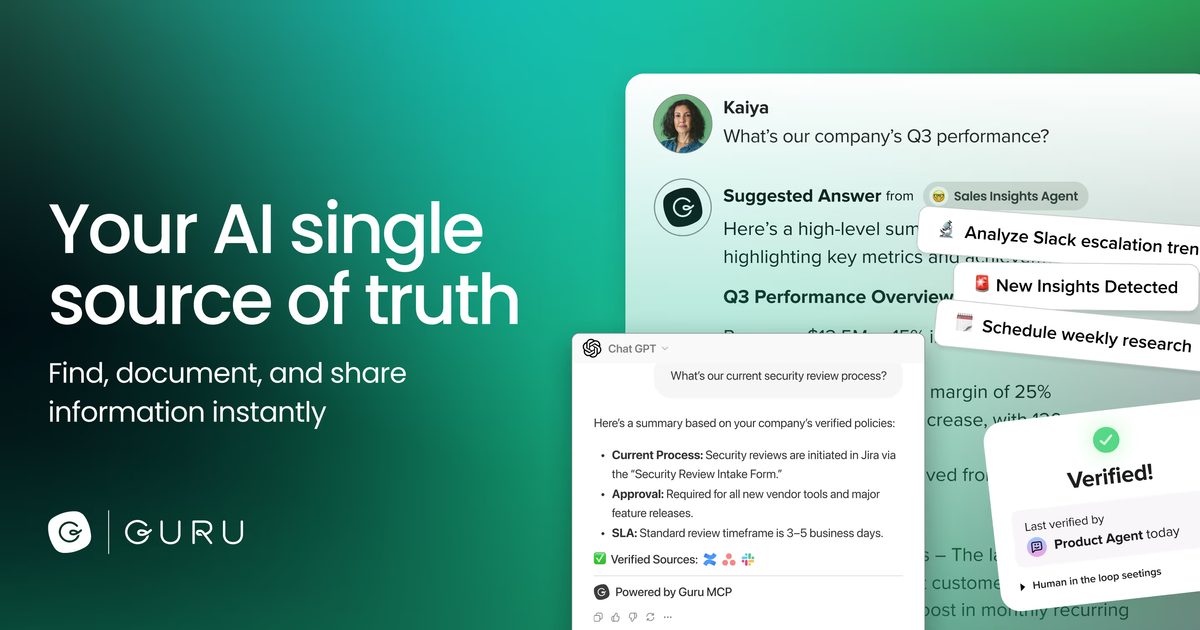
Guru is a knowledge management platform, not a full enablement suite. It makes company knowledge (product info, competitive battlecards, process docs, objection responses) searchable and accessible inside Slack, Gmail, Salesforce, and Chrome through a browser extension.
The differentiator is a verification layer. Guru's Trust Score system flags whether a piece of knowledge is current or stale, which solves a real problem: reps confidently repeating outdated information because nobody flagged it.
Best for: Teams that already have training and content tools but struggle with reps finding accurate, current information fast, and organizations that want one searchable source of truth across sales, support, and CS.
Pricing: Paid plans start around $25/seat/month, with a free trial available.
📈 Build a Revenue Engine—Not Just a Tech Stack
With 53,000+ meetings booked and $312M+ in pipeline generated, Cleverly helps 10,000+ businesses turn technology into predictable revenue.
How to Choose the Right Revenue Enablement Platform
Match the platform to your actual bottleneck, not to whichever brand you've heard the most:
- Enterprise content management at scale → Seismic
- Sales methodology enforcement → Highspot
- All-in-one training, coaching, content, and conversation intelligence → Mindtickle
- Call intelligence and deal-level coaching → Gong
- Buyer-facing content sharing and engagement tracking → Showpad or Allego
- Peer-driven learning and alignment → SalesHood
- Just-in-time, in-workflow enablement → Spekit
- Mid-market digital sales rooms → Dock
- Knowledge management and in-context answers → Guru
A few practical notes before you commit:
Team size changes the math more than most buyers expect. Seismic, Mindtickle, and Gong are genuinely built for 200+ rep organizations with dedicated ops support. Dock and SalesHood scale far better for 10-100 rep teams that don't have a full-time enablement admin.
Implementation reality matters too. Enterprise platforms often take 3-6 months to fully roll out, and that admin overhead doesn't disappear after launch. Factor that time and cost into your decision, not just the license price.
Start with a demo, and actually test it with a small cohort of reps before rolling out company-wide. Most platforms on this list offer one. And before you sign anything, confirm Salesforce or HubSpot integration depth directly, since enablement data that doesn't flow into your CRM just creates a second, disconnected view of what's happening in your pipeline.
Revenue Enablement Software Works Best with a Full Pipeline
Here's the part most enablement conversations skip. These platforms make your sales team sharper at converting the pipeline you already have. They don't manufacture pipeline that doesn't exist. Even the best-coached, best-certified rep on the best-implemented platform still needs a steady flow of qualified conversations to apply those skills against
.
That's the gap we fill at Cleverly. We're a B2B lead generation agency built around LinkedIn outreach, cold email, and cold calling, and our job is filling the top of your funnel with real conversations, not just names on a spreadsheet.

We've generated $312M in pipeline and $51.2M in closed revenue for clients across industries, working with companies like eBay, Airbnb, and DocuSign along the way.
Think of it as two halves of the same system. Your enablement platform improves what happens once a deal starts. Cleverly makes sure there's a deal to start in the first place.
Companies that pair strong enablement tooling with consistent outbound execution tend to close more, faster, because reps spend their sharpened skills on real conversations instead of waiting for the pipeline to fill itself.
If your team is enabled but your calendar isn't full, book a strategy call and let's talk about what a real pipeline looks like.
Conclusion
Revenue enablement software in 2026 has consolidated hard and split into much clearer use case lanes. The platform that makes sense for a 500-rep enterprise with a dedicated ops team looks nothing like the right fit for a 20-person mid-market SaaS team, and pretending otherwise is how budgets get wasted on unused seats.
Use Gartner's newly published Magic Quadrant alongside this guide to sanity-check your shortlist, but don't stop there. Name your actual bottleneck first, whether that's messy content, slow ramp time, inconsistent call quality, or low buyer engagement, and let that bottleneck point you to 2-3 platforms worth a real demo.
And once your team is enabled, make sure there's enough qualified pipeline coming in the door to put that enablement to work.
Frequently Asked Questions
Free Resource
How to Scale a Profitable Cold Call System
Get the complete guide — download it instantly now.
Free Ebook
Download the Free Guide
Enter your details to get instant access.
You're all set! 🎉
Your ebook is downloading now.
Click below if the download didn't start automatically.