Table of Contents
What Are Growth Navigate Startup Tools & How Do They Work?
Benefits of Using Growth Navigate Startup Software
What to Look for in the Best Growth Navigate Startup Tools
Quick Comparison: Best Startup Growth Navigation Tools at a Glance
10 Best Startup Growth Navigation Tools in 2026
How to Choose the Right Growth Navigate Tool for Your Startup Stage
Common Mistakes to Avoid When Choosing Growth Navigate Software
How Cleverly Fits Into Your Startup Growth Stack
Conclusion
Frequently Asked Questions
Modified On :
July 28, 2026
Key Takeaways
- The right tool depends on where your startup actually gets stuck: sourcing investors, prioritizing leads, or executing outreach at volume, not on which platform has the flashiest feature list.
- Growth navigate tools work best as a stack, not a single purchase. Most founders end up pairing one data or research tool with one execution layer.
- Automation surfaces data faster, but it doesn't replace strategy. A tool can hand you 500 target accounts and still leave you with zero booked meetings if the messaging is off.
- Buying ahead of your stage (enterprise features you won't touch for a year) wastes budget that's better spent proving your GTM motion works at all.
- Data quality and integration fit matter more than a long feature list. A tool that syncs cleanly with your CRM and stays current beats one that looks powerful in a demo.
Every startup hits the same wall eventually. You've got a list of target accounts in one tab, a CRM that's half-updated, and a founder trying to remember which investor asked for a follow-up three weeks ago. That's not a discipline problem. It's a tooling gap.
Growth navigate startup tools exist to close that gap, and the category has gotten crowded fast. Sales teams are now juggling an average of 10+ point solutions just to run a single outbound motion, which is exactly the kind of sprawl early-stage teams can't afford.
On the flip side, Salesforce's State of Sales data has repeatedly shown that reps spend more time on admin and research than on actual selling when the right tools aren't in place.
For a startup, that math is brutal. You don't have a dozen reps to absorb the inefficiency. You have a founder, maybe two GTM hires, and a runway clock.
This guide breaks down the 10 best startup growth navigation tools in 2026, what each one is actually built for, what they cost, and how to pick the right combination for your stage instead of buying everything at once.
What Are Growth Navigate Startup Tools & How Do They Work?
Growth navigate software is a broad label for platforms that help startups track opportunities and map a path to expansion. That includes finding leads, finding investors, finding partners, or just keeping everyone aligned on where growth is actually coming from.
Think of it as a startup's compass. It doesn't drive the car, but it tells you which direction to point it.
Who actually uses these tools:
- Founders doing early fundraising or closing the first handful of customers themselves.
- Sales reps who need a prioritized list instead of a spreadsheet of guesses.
- Marketers trying to keep campaigns aligned with what sales is actually chasing.
- Ops and RevOps teams cleaning up data so the rest of the org can trust it.
What they typically help with:
- Finding investors, partners, or acquisition targets.
- Prioritizing which leads or accounts are worth a rep's time.
- Aligning marketing spend with actual pipeline movement.
- Cleaning and enriching messy contact data.
- Automating parts of outreach so a small team can act like a bigger one.
🚀 The Right Tools Help. The Right Outbound System Scales.
Our LinkedIn, cold email, and cold calling campaigns generate 15–30 qualified meetings every month for growing B2B startups. Let’s get started!
Benefits of Using Growth Navigate Startup Software
The case for these tools isn't theoretical. It shows up in hours saved and pipeline that actually closes.
- Faster lead and investor identification. Manual research eats hours every week that a founder could spend on product or customers instead.
- Better targeting means better conversion. HubSpot's research consistently shows that companies with clearly defined ideal customer profiles see meaningfully higher win rates than those prospecting broadly.
- Automated workflows cut busywork. Data enrichment, list building, and basic sequencing no longer need a human doing it row by row.
- Clearer strategic insight. You see where growth is actually coming from instead of guessing based on gut feel.
- Cross-team alignment. Sales, marketing, and ops working off the same data means fewer dropped handoffs and duplicated outreach.
What to Look for in the Best Growth Navigate Startup Tools
Not every tool on a "best of" list will fit your startup. Here's what actually separates a good pick from a wasted subscription.
- Data accuracy and freshness. Stale contact data or outdated funding info makes every downstream decision worse.
- Automated, personalized outreach capability. Automation without personalization just gets you flagged as spam.
- Lead or account scoring. You need a way to know who's actually worth a rep's time.
- CRM and email/marketing integrations. A tool that doesn't sync cleanly creates more manual work, not less.
- Ease of use and adoption speed. If your team needs two weeks of training to send a sequence, that's a cost too.
- Scalability. Pick something that can grow with you for the next year, not just the next quarter.
- AI-driven insights. Predictive scoring and target account generation are becoming table stakes, not nice-to-haves.
- Support and onboarding quality. Early-stage teams don't have a dedicated admin to troubleshoot a broken integration.
📈 Don't Just Buy More Software—Build More Pipeline
With 53,000+ meetings booked and $312M+ in pipeline generated, Cleverly helps 10,000+ businesses turn the right tools into predictable growth.
Quick Comparison: Best Startup Growth Navigation Tools at a Glance
This is a quick scan, not the full picture. The breakdown on each tool follows right after.
10 Best Startup Growth Navigation Tools in 2026
1. Crunchbase
Best for: investor and market intelligence research.
For a startup, growth navigation often starts before you write a single line of outreach copy. It starts with knowing who's raising, who's hiring, and which investors are actually active in your space right now.
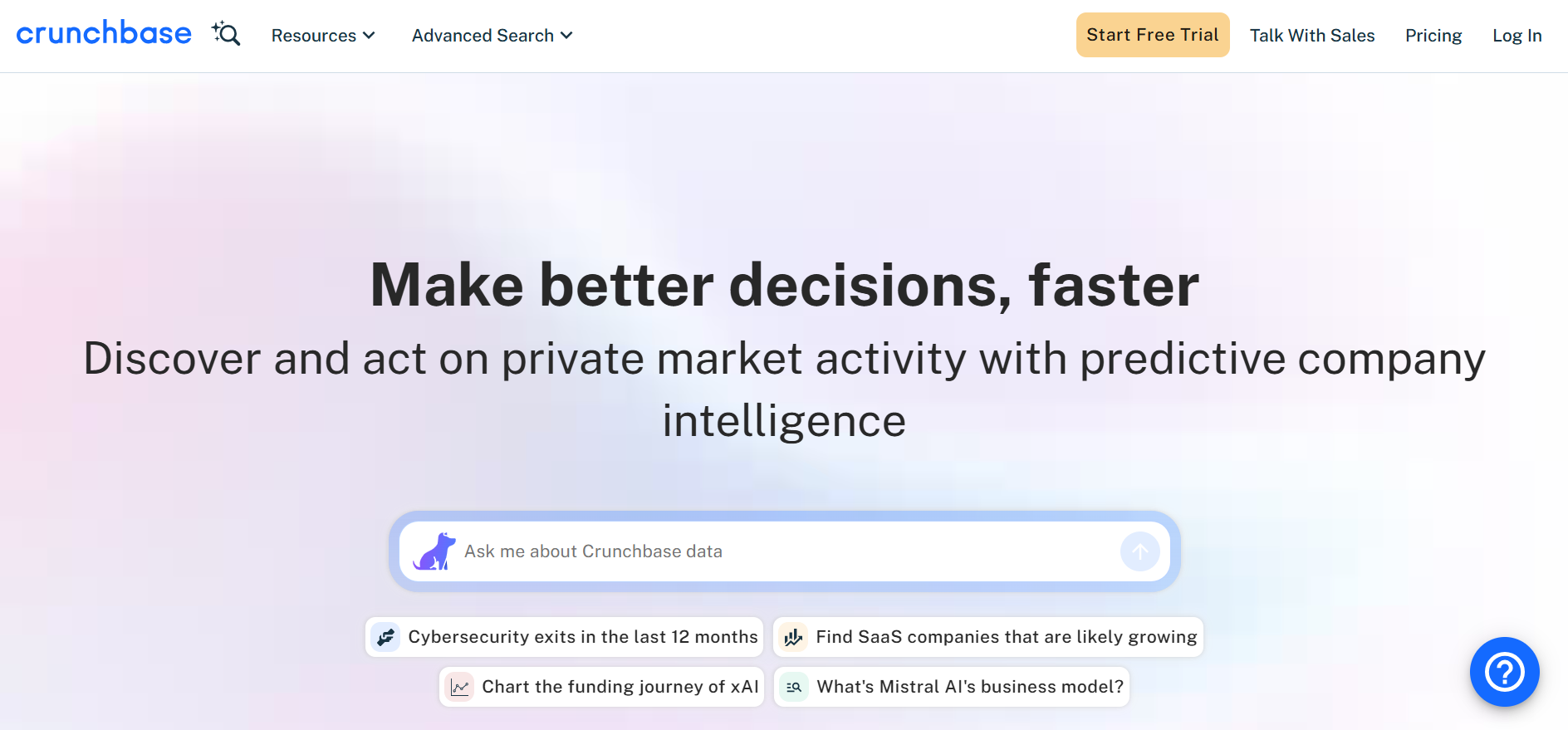
Crunchbase is built for exactly that layer of the journey. It tracks funding rounds, acquisitions, and executive moves across millions of private companies, which makes it the tool most founders reach for during fundraising prep, competitive research, or market mapping before a launch.
What sets it apart for early-stage teams specifically is how fast it surfaces emerging companies and funding signals, well before those companies show up on institutional-grade platforms built for later-stage deal sourcing.
Standout features:
- Predictive company intelligence that flags growth signals before they're widely known.
- Real-time alerts on funding rounds, executive changes, and acquisition activity, so you can time outreach to strategic windows.
- Advanced filtering by funding stage, investor type, technology category, and geography.
- Curated startup lists and saved searches you can share across a founding team.
- Private market activity discovery for spotting under-the-radar competitors or partners.
- CRM integrations and bulk exports on higher tiers for teams ready to scale research into pipeline.
Pricing: Pro plans run around $49/month billed annually (or $99/month billed monthly), with Business and Enterprise API tiers priced higher for teams that need CRM sync and bulk exports.
Limitation: Crunchbase tells you who to target. It doesn't help you reach them. You'll still need a separate tool, or a done-for-you outreach partner, to turn that research into actual conversations.
2. Dealroom.co
Best for: fundraising and global startup ecosystem mapping.
Where Crunchbase is the everyday research tool, Dealroom.co is built for teams that need to understand an entire ecosystem, not just individual companies. It's the platform VCs, corporate development teams, and later-stage startups use to benchmark against regional and sector-wide trends, which makes it more of a strategic navigation tool than a day-to-day prospecting one.
If your growth strategy depends on positioning against a broader market (say, showing investors how your traction compares to peers in your category and region) this is the kind of depth Crunchbase alone doesn't provide.
Standout features:
- Coverage of 2M+ startups and scaleups globally, with 100+ data points per company.
- Ecosystem benchmarking that compares your traction against regional and sector peers.
- Predictive intelligence tracking companies across the full startup lifecycle, not just at funding events.
- API-first architecture for teams that want to pull Dealroom data into their own dashboards.
- Curated reports and rankings by industry and geography, useful for investor decks and market sizing.
- CRM integration and bulk data exports on Premium Plus tiers.
Pricing: Starter plans begin around €12,000 to €12,600 per year for up to 3 seats, scaling to €17,000+ for Premium Plus and custom Enterprise pricing above that.
Limitation: the seat minimums and annual-only billing put this out of reach for most early-stage teams. This is a tool for startups that are already raising at scale or sit inside a larger investment or corporate development function, not a first purchase for a two-person GTM team.
3. Attio
Best for: lightweight, AI-native CRM for small sales teams.
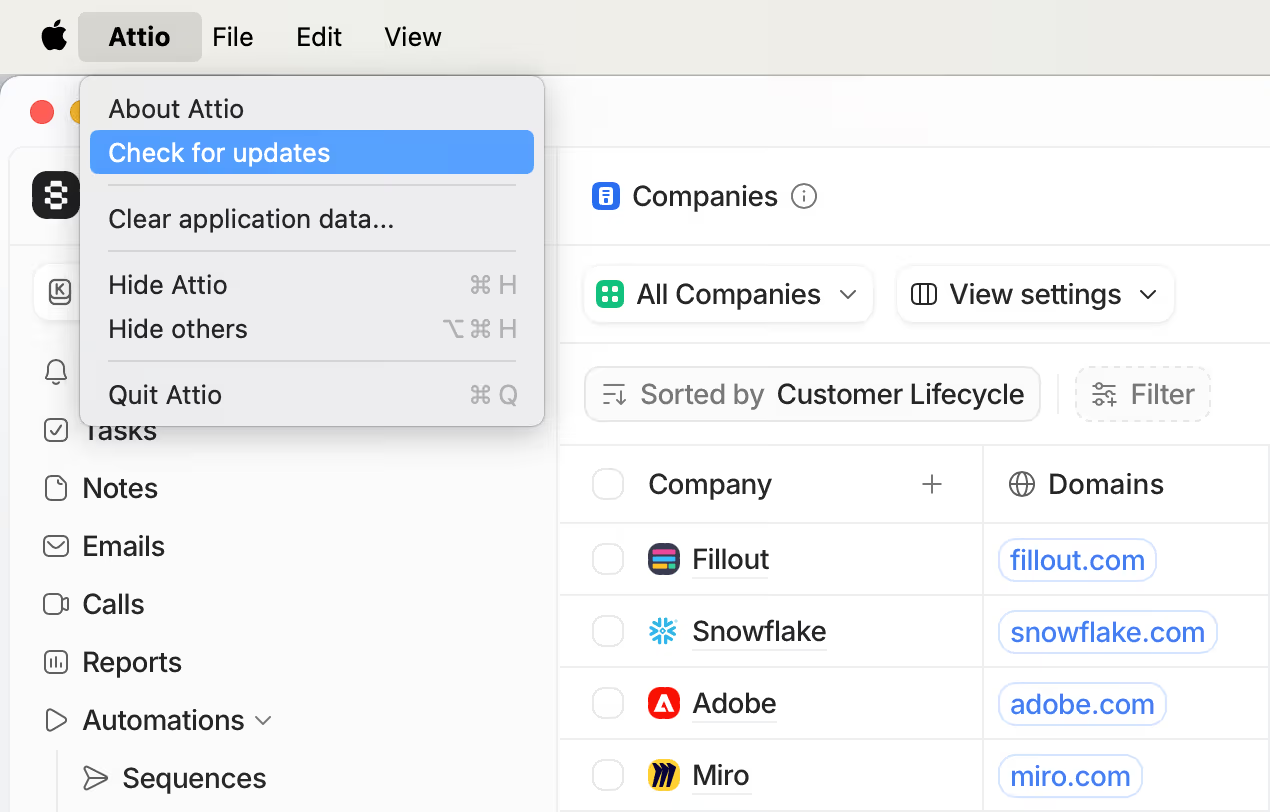
Most CRMs force you to bend your business into their schema. Attio flips that. It's built around custom objects and attributes, so a startup with a non-standard sales motion (say, tracking partnership deals alongside customer deals) can model the pipeline the way it actually works, not the way a legacy CRM assumes it should.
For growth navigation specifically, that flexibility matters early, because your ideal customer profile and deal stages are still evolving, and a rigid CRM forces premature structure on a process that isn't stable yet.
Standout features:
- Fully custom objects, attributes, and relationship types instead of a fixed contacts-and-deals schema.
- Real-time data sync across the workspace, so every team member works off the same live pipeline.
- Automatic enrichment on new records, reducing manual data entry.
- AI-native features including call intelligence, sequencing, and AI-assisted record creation (Pro tier).
- Private lists and advanced permissions for teams that need to segment access.
- Native integrations with common sales and marketing tools, plus API access for custom workflows.
Pricing: Plus starts around $29/user/month billed annually ($36/month billed monthly), and Pro runs about $69/user/month annually. A free tier covers up to 3 seats.
Limitation: Attio is a CRM, not an outreach engine. Email sequences, LinkedIn outreach, and cold calling all require additional tooling layered on top.
4. Closely

Best for: LinkedIn and email outreach automation.
If Attio is where your data lives, Closely is where your outreach actually runs. It's built specifically for founders and small teams who need to execute LinkedIn and email campaigns without hiring a dedicated SDR on day one.
The AI personalization is the differentiator worth calling out: instead of generic name-insertion templates, Closely's icebreakers pull from a prospect's recent posts, activity, and company news, which is the difference between a message that gets ignored and one that gets a reply.
Standout features:
- Multi-account LinkedIn sequencing (1 to 50+ accounts) run entirely in the cloud, no Chrome extension required.
- Built-in 600M+ contact database with a credit-based query system.
- AI-personalized icebreakers pulled from live profile activity, not static templates.
- Multichannel campaigns combining LinkedIn connection requests, InMails, and email in a single sequence.
- CRM integrations with HubSpot, Salesforce, and Pipedrive.
- Safety-focused sending limits designed to reduce LinkedIn account restriction risk.
Pricing: Starter plans begin at $49/month, scaling through Growth, Essential, and Custom tiers based on LinkedIn account volume and monthly credits.
Limitation: the built-in contact database doesn't publish hit-rate data, so data quality can be inconsistent compared to dedicated enrichment platforms. This is an execution tool, not a data-quality one.
5. Ability AI

Best for: turning manual ops workflows into AI agents at scale.
This is the odd one out on this list, and intentionally so. Ability AI isn't about finding leads or investors. It's about the operational drag that quietly slows down growth: the support tickets, the repetitive client-facing tasks, the manual processes that don't scale as headcount stays flat.
For a startup, that matters because growth navigation isn't just external. A team that's drowning in ops busywork has less bandwidth to actually execute the outbound and fundraising motions the other tools on this list are built for.
Standout features:
- AI agents that execute operational workflows autonomously, from customer support to content generation.
- Encodes specific business playbooks and logic into the system, so automation follows your rules, not a generic template.
- Native integration with existing tools like Slack, WhatsApp, and your CRM, no new interface to learn.
- Automated FAQ generation and context-aware email auto-responders for scaling support without headcount.
- Continuous learning that improves agent performance over time based on real operations.
- Configurable to run within your existing infrastructure or on Ability AI's secure hosted environment.
Pricing: custom, quoted directly through sales based on scope and workflow complexity.
Limitation: this isn't a plug-and-play lead gen tool. The value depends heavily on how well-defined your internal processes already are, and setup takes real configuration time.
6. Tactic

Best for: GTM data automation and account insights.
Tactic sits between research tools like Crunchbase and execution tools like Closely. Instead of handing you a broad company database to filter yourself, it automates the research process across the web, job postings, annual reports, and your own CRM, then generates account lists scored specifically against your ICP.
Teams like Adobe Workfront and GoCardless have used it to cut research time dramatically per rep, which is the exact kind of leverage a lean startup team needs when nobody has a dedicated research analyst.
Standout features:
- Automated data collection across Google, LinkedIn, job postings, annual reports, and third-party sources.
- Real-time account scoring based on intent signals and market trends, not static firmographic filters.
- No-code custom AI builder for creating personalized target lists without an engineering team.
- Smart company tags for hyper-specific account categorization matched to your ICP.
- Direct CRM integration (including Salesforce) to keep target lists and pipeline in sync.
- A data marketplace for supplementing your own research with additional third-party data.
Pricing: custom, based on data volume and scope, quoted through sales.
Limitation: pricing tends to run high for smaller teams, and the platform is built for businesses with genuinely robust outbound data needs, not a founder running a handful of manual campaigns.
7. Sales Compass

Best for: sales strategy and personalized outreach at scale.
Where most tools on this list solve either the data problem or the execution problem, Sales Compass leans into the strategy layer in between: helping teams figure out which GTM approach actually fits their market before automating outreach around it.
That's a real gap for early-stage startups, since a lot of failed outbound motions come down to targeting and messaging strategy that was never right in the first place, not the automation layer itself.
Standout features:
- Tailored GTM strategy recommendations based on your market and offer.
- AI-driven lead scoring that prioritizes accounts by fit and intent.
- Automated smart replies that keep conversations moving without manual follow-up.
- Outreach personalization built around a defined sales strategy, not generic sequencing.
- Ongoing optimization recommendations as campaign data comes in.
- Support for multi-channel outreach execution once a strategy is set.
Pricing: custom, quoted through sales based on team size and scope.
Limitation: the strategy-first positioning means less public transparency on raw pricing and feature scope compared to fully self-serve platforms, so expect a longer sales cycle before you can evaluate fit.
8. Cargo
Best for: revenue orchestration on top of your existing data warehouse.
Cargo is built for a specific kind of startup pain: a GTM stack held together by five disconnected tools and a lot of manual Zapier stitching. Instead of replacing your stack, it sits on top of it as an orchestration layer, running AI agents that research, qualify, and engage leads automatically based on signals like job changes, funding rounds, or CRM activity.
Companies like Descript have reported major pipeline lifts and significant time savings after implementing it, which reflects what it's actually built to solve: coordination, not just automation.
Standout features:
- Four core AI agent types (research, qualification, SDR/engagement, and CRM hygiene) available across every plan.
- Signal-based outbound that automatically launches campaigns when target accounts hit funding or hiring triggers.
- Multi-agent workflows built as reusable "Plays," so a workflow you design once runs continuously.
- Direct connection to your data warehouse instead of requiring separate data imports.
- 100+ integrations, including partnerships with Workato and Clay.
- SOC 2 Type II certification, relevant for startups selling into security-conscious buyers.
Pricing: usage-based, starting around $0.14 per credit with a 20,000-credit minimum, which puts real-world spend closer to $500 to $2,000+/month for active teams.
Limitation: this is built for GTM engineers and RevOps-savvy teams. If nobody on your team is comfortable building multi-agent workflows, the learning curve will eat into the time savings.
9. ActiveCampaign
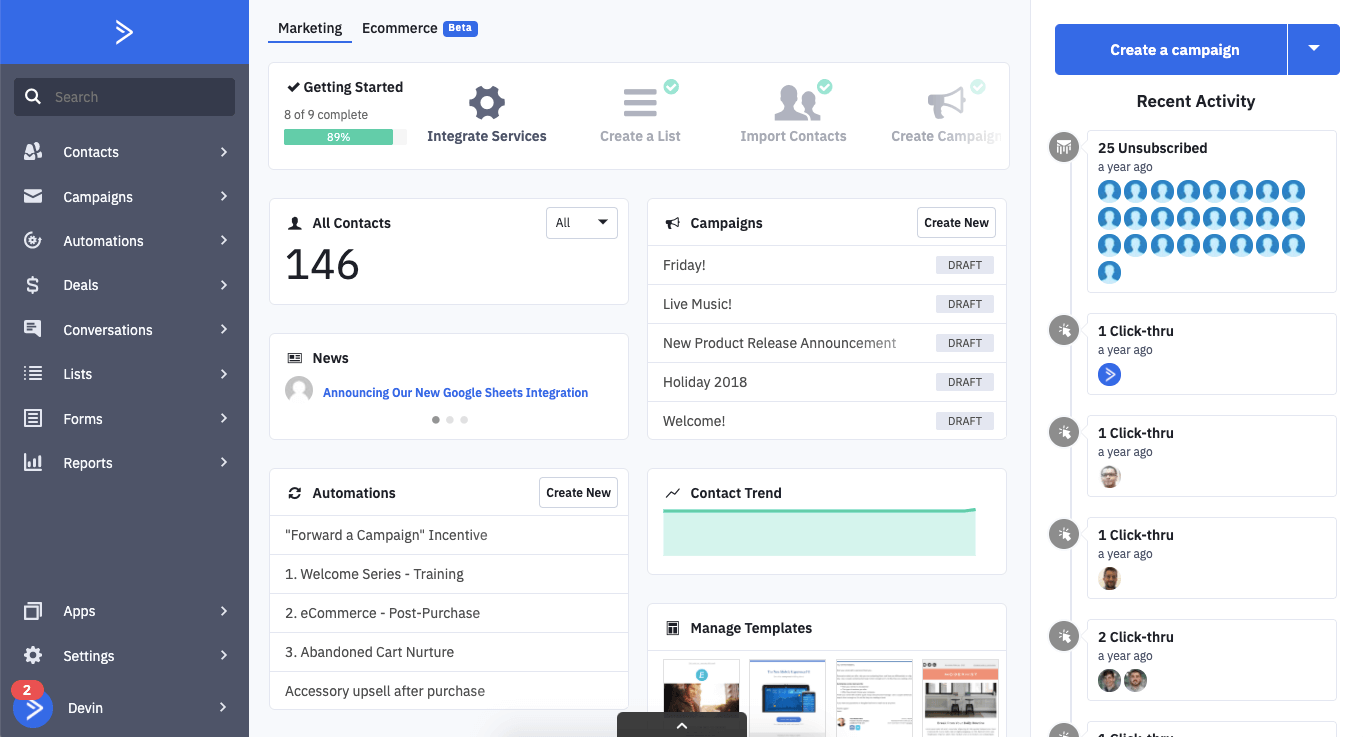
Best for: marketing automation and customer journey management.
ActiveCampaign is the most mature platform on this list, and for startups it plays a specific role: keeping marketing and lead nurturing aligned as your growth motion scales beyond pure outbound.
Its Active Intelligence engine adds AI-driven automation on top of a platform that's been refined over more than a decade, which means fewer rough edges than newer entrants, at the cost of pricing that climbs quickly as your contact list grows.
Standout features:
- AI-powered automation through Active Intelligence, including predictive content and generative AI tools.
- Visual automation builder for multi-step customer journeys across email and other channels.
- CRM functionality on Pro and Enterprise tiers, including deal pipelines and conversion attribution.
- E-commerce integrations (Shopify, WooCommerce, BigCommerce) for startups with a transactional component.
- Landing page builder and omnichannel messaging in one platform.
- Advanced segmentation and conditional content for tailoring nurture sequences by audience.
Pricing: Starter plans begin around $15 to $19/month billed annually for 1,000 contacts, scaling through Plus, Professional, and Enterprise as contact volume and feature needs grow.
Limitation: pricing is contact-based, so costs climb fast as your list grows, even if your actual feature usage hasn't changed. Budget for that scaling curve, not just the entry price.
10. CoFounderLab

Best for: finding cofounders, mentors, and early-stage investors.
This one solves a different problem than everything else on this list, and it belongs here because growth navigation for a startup often starts before the company itself is fully formed.
CoFounderLab is a community platform built specifically to help solo founders find a complementary cofounder, connect with mentors, and get in front of angel investors, using AI matching based on skills, interests, and location rather than a generic networking feed.
Standout features:
- AI-powered matchmaking based on skills, interests, and location, not just keyword search.
- Access to a global network of 700,000+ entrepreneurs across 200+ cities.
- Ability to qualify and pitch directly to angel investors through the platform.
- A structured learning center with 15+ modules covering early startup fundamentals.
- Quarterly in-person events and Q&A sessions with experienced entrepreneurs and investors.
- Partner perks with tools like HubSpot, Unbounce, and Slidebean for members building out their stack.
Pricing: free community access is available, with a premium subscription unlocking unlimited messaging, investor pitch access, and expanded resources.
Limitation: it has real value pre-launch or in the earliest team-building phase, but nothing to offer once your growth priority shifts to customer acquisition and pipeline execution.
How to Choose the Right Growth Navigate Tool for Your Startup Stage
✅ Team size. Lighter tools like Attio and Closely work well for a founder or a two-person GTM team. Platforms like Tactic or Ability AI make more sense once you have dedicated ops or growth headcount.
✅ Budget. Most tools offer tiered pricing. Start small, validate the workflow, and scale spend once you see results, not before.
✅ Integration fit. Match the tool to the CRM and email stack you already use. A tool that doesn't sync cleanly creates more work, not less.
✅ Ease of adoption. A growth tool should speed up your week. If it adds friction or requires heavy training, it's the wrong fit for a small team.
✅ Plan for the next 12 months, not just today. Avoid buying something you'll outgrow in two quarters, but also avoid paying for enterprise headroom you won't use for a year.

Common Mistakes to Avoid When Choosing Growth Navigate Software
❌ Buying for features you won't use at your current stage. Enterprise-tier capabilities sound impressive in a demo and sit unused for months.
❌ Skipping onboarding or training. This is one of the most common reasons adoption stalls, even with a genuinely good tool.
❌ Choosing a tool with no CRM or email integration. You'll end up manually copying data between systems, which defeats the purpose.
❌ Underestimating setup and ramp-up time. Some tools take weeks to configure properly, not hours.
❌ Committing to an annual plan before a free trial. Validate fit first. Annual lock-in on an unvalidated tool is one of the most common ways startups waste SaaS budget.
How Cleverly Fits Into Your Startup Growth Stack
Tools like Crunchbase, Tactic, and Cargo are genuinely good at what they do: surfacing the right data. Investors, target accounts, growth signals. That part of the problem is largely solved in 2026.
The part that still trips startups up is execution. Automated sequences can send messages, but they can't write the messaging that actually gets a reply, and they can't handle the follow-up conversations that turn a reply into a meeting. That's where a lot of founders end up stuck with a full list and an empty calendar.
Cleverly runs done-for-you B2B lead generation across LinkedIn outreach, cold email, and cold calling, and it's built specifically to turn the data these tools surface into booked conversations.
We've worked with 10,000+ clients, including companies like Amazon, Google, Uber, PayPal, Slack, and Spotify, generating $312M in client pipeline and $51.2M in closed revenue along the way.

If you're already using a tool like Crunchbase for research or Tactic for target account generation, Cleverly is the execution layer that turns that targeting into real conversations with your ideal buyers, without you having to build an outbound team from scratch.
Have the data, need the meetings? Book a strategy call with Cleverly and we'll map out where outreach fits into your current stack.
Conclusion
There's no single growth navigate startup tool that solves every problem. The right pick depends on your stage, your team size, and which part of growth (investors, leads, outreach, or clean CRM data) is causing the most friction right now.
Most startups end up combining two or three tools from this list rather than betting everything on one platform. Start with a free trial, check that it actually fits how your team works day to day, and scale your spend only once you can see the results holding up.
Frequently Asked Questions
Free Resource
How to Scale a Profitable Cold Call System
Get the complete guide — download it instantly now.

Free Ebook
Download the Free Guide
Enter your details to get instant access.
You're all set! 🎉
Your ebook is downloading now.
Click below if the download didn't start automatically.