Table of Contents
Qualified Sales Meeting vs. Booked Meeting — What's the Real Difference?
The Core Criteria for a Qualified Sales Meeting
Examples of Qualified vs. Unqualified Sales Meetings
Why Teams Disagree on What Counts as Qualified
How to Track and Improve Your Qualified Meeting Rate
How Cleverly Builds Meetings That Actually Qualify
Conclusion
Frequently Asked Questions
Modified On :
August 19, 2026
Key Takeaways
- A qualified sales meeting requires five things: ICP fit, a real need, decision-making authority, some timeline, and an actual show-up. A calendar slot alone doesn't count.
- "Booked" and "qualified" are two different numbers. Booked just means someone accepted an invite. Qualified means an AE looked at it and said this is a real pipeline.
- Most disagreements between SDRs and AEs come down to incentives, not effort. SDRs get paid on volume, AEs get judged on quality, and without a shared definition both sides are right by their own math.
- Track booked, held, and qualified as three separate metrics. Blending them into one number hides exactly where your pipeline is leaking.
- Fixing qualification at the point of booking always beats trying to filter out bad meetings after the fact. Bolt-on qualification never fully makes up for weak targeting.
A sales team can book 40 meetings a month and still miss quota. That's not a hypothetical. It happens because a qualified sales meeting and a meeting that just shows up on a calendar are not the same thing, and most teams still treat them as interchangeable.
The numbers back this up. Meeting-to-opportunity conversion on outbound programs typically lands somewhere between 10% and 30%, while inbound and ABM motions often clear 30% to 60% because the buyer showed up already wanting something.
On top of that, cold outbound show rates generally run 70% to 80%, meaning a fifth to a third of "booked" meetings never even happen. Stack a weak show rate on top of a loose qualification bar, and a booking report that looks healthy can be masking a pipeline that's actually thin.
This guide breaks down the real criteria for a qualified meeting, walks through concrete examples of what qualifies and what doesn't, and explains why SDRs and AEs keep arguing about whose numbers are real.
If you're a sales leader, work in RevOps, or sit on either side of the SDR/AE handoff, this is the shared definition your team is probably missing.
Qualified Sales Meeting vs. Booked Meeting — What's the Real Difference?
A booked meeting is just a time slot. Someone accepted a calendar invite. That's it. It says nothing about whether the prospect is a fit, whether they have a real problem, or whether they'll even show up.
A qualified sales meeting is different. Two things have to be true:
- The AE reviewed it and accepted it as a legitimate opportunity.
- The prospect actually showed up.
Miss either one and the meeting doesn't count, no matter how good it looked when it landed on the calendar. A no-show is not a qualified meeting. A meeting the AE bounces back because the prospect clearly isn't a fit is not a qualified meeting either, even though it was technically "booked."
This distinction matters more than most teams realize. A rep who books 30 meetings but only gets 12 accepted by AEs and 9 of those actually held is not performing at the level their booking number suggests.
Leaning on booked meeting vs qualified meeting as one blended stat lets a weak pipeline hide behind an impressive-looking calendar.
🎯 Booked Is Good. Qualified Is Better.
Our LinkedIn, cold email, and cold calling campaigns generate 15–30 qualified meetings every month with prospects that fit your ICP.
The Core Criteria for a Qualified Sales Meeting
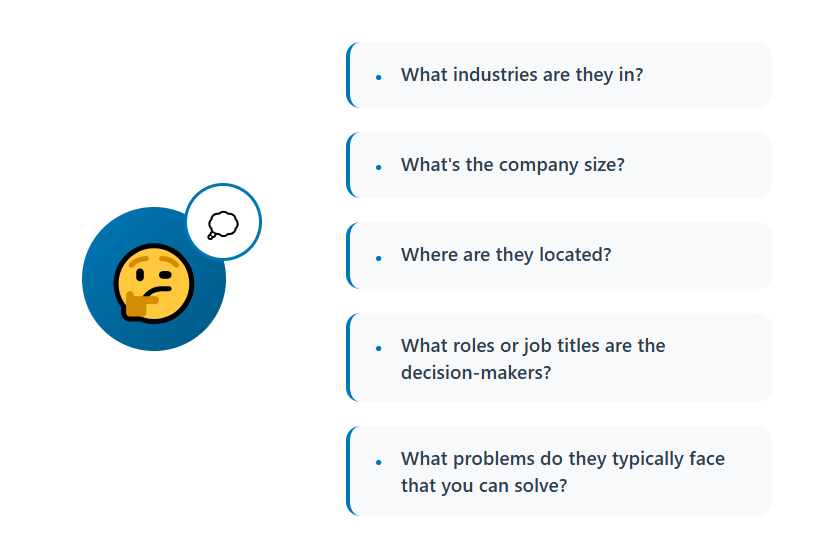
Most teams that get this right use some version of BANT (Budget, Authority, Need, Timeline) or a close variant. The exact framework matters less than having one everyone agrees on. Here's the version we see work consistently in B2B outbound.
Fit — The Prospect Matches the ICP
Company size, industry, and role need to line up with the ideal customer profile you actually sell to. A great conversation with someone outside your ICP still rarely converts, no matter how engaged they seemed on the call. Fit is the first filter, and it's the one most often skipped when a team is chasing volume.
Need — There's a Real, Identified Problem
The prospect has to acknowledge a specific pain point that your product or service actually solves. "That sounds interesting" is not need. A stated problem, even a small one, is. This is usually the difference between a meeting that goes somewhere and one that fizzles out after the first ten minutes.
Authority — The Right Person (or Access to Them) Is in the Room
You need a decision-maker, an influencer, or someone with a clear path to whoever signs off. Meetings booked with someone who has zero say in the purchase decision rarely move forward, even when the rest of the conversation checks out.

Timeline — There's Some Sense of Urgency or Buying Window
It doesn't need to be exact. "This quarter" or "next budget cycle" is enough to signal real intent instead of idle curiosity. No timeline at all is one of the most common reasons an AE rejects a meeting that was technically booked.
Show-Up — The Meeting Actually Happens
None of the above matters if the prospect doesn't show. A qualified meeting criteria checklist only counts once the meeting is held, not just scheduled. Outbound show rates typically run 75% to 80%. If yours consistently drops below 70%, that's usually a sign of a confirmation or expectation-setting problem, not just flaky prospects.
Examples of Qualified vs. Unqualified Sales Meetings
Abstract criteria are easier to apply when you see them side by side.
Example: Qualified Meeting
A VP of Sales at a 150-person SaaS company books a call. She fits the ICP. She states her team is missing quota because of weak outbound, which is a real, identified need. She has budget approval authority. She wants a fix before next quarter starts, which gives you a timeline. She shows up. That's a sales qualified meeting by every measure.
Example: Unqualified (But "Booked") Meeting
A junior marketing coordinator at a company outside your target industry agrees to a call "just to learn more." No stated problem. No timeline. No decision-making influence. It shows up as a booked meeting on the calendar. An AE should reasonably reject it as pipeline, because it isn't.
🚀 Fill Your Calendar With Opportunities, Not Just Calls.
With 53,000+ meetings booked and $312M+ in pipeline generated, Cleverly helps 10,000+ businesses build a predictable flow of qualified sales opportunities.
Why Teams Disagree on What Counts as Qualified
This is where most of the internal friction actually comes from. SDRs are incentivized on booking volume. AEs are judged on deal quality. Those two incentives point in slightly different directions, and that tension is the root of almost every "is this a real meeting" argument.
Without a written, shared definition, "qualified" becomes subjective. One SDR's idea of a strong lead is another AE's instant reject. The fix isn't more effort, it's documentation.
A checklist like the one above, agreed to by both sides before a meeting counts toward pipeline, removes most of the guesswork.
It also helps to review rejected meetings together on a regular basis, not just argue about them in the moment. Walking through why an AE bounced a meeting closes the gap between what SDRs think qualifies and what AEs will actually accept, and that gap tends to shrink fast once both sides are looking at the same examples.
How to Track and Improve Your Qualified Meeting Rate

Treat booked meetings, held meetings, and AE-accepted meetings as three separate numbers. Blending them into one metric is the fastest way to lose visibility into where your pipeline is actually breaking down.
A useful reference point: outbound SDR teams generally aim for 8 to 15 qualified appointments per rep per month, with top performers landing at the higher end. But volume alone doesn't tell the story. Fifteen meetings at a 70% acceptance rate will outperform 25 meetings at 30% acceptance almost every time, because the second number is mostly noise.
When show or acceptance rates are low, the root cause is usually upstream. Weak targeting or poor expectation-setting during the booking conversation are the two most common culprits. Fixing the input, not chasing more volume, is what actually moves the qualified rate.
How Cleverly Builds Meetings That Actually Qualify
A high volume of booked meetings doesn't mean much if most of them get rejected by AEs or never show up. The fit, need, authority, and timeline criteria above have to be built into the booking process itself, not applied as a filter after the fact.
As a B2B lead generation agency, we qualify prospects against ICP fit, need, and authority before a meeting ever lands on the calendar, instead of filling slots with whoever happens to respond. Pipeline quality gets set at the point of booking. Trying to fix a weak qualification process after meetings are already scheduled is a much harder problem to solve than getting it right upfront.
That approach is part of why we've generated $312M in client pipeline and $51.2M in client revenue across 10,000+ B2B companies. Every campaign includes ICP-aligned targeting, qualification built directly into the outreach conversation, and meetings booked only once fit and intent are confirmed.
If your team is tired of high meeting counts that don't translate into real pipeline, that's exactly the gap we close. Book a strategy call with Cleverly to see what that looks like for your outbound.
Conclusion
A qualified sales meeting isn't just a slot on the calendar. It requires fit, need, authority, timeline, and an actual show-up, and dropping any one of those turns a "booked" meeting into noise.
Tracking booked and qualified as separate numbers, instead of one blended metric, is usually what reveals where a team's pipeline is quietly breaking down.
None of this gets fixed by arguing harder in the SDR-to-AE handoff. It gets fixed by writing the definition down once, getting both sides to agree to it, and building qualification into the booking process itself instead of trying to filter out bad meetings after they've already happened.
Frequently Asked Questions
Free Resource
How to Scale a Profitable Cold Call System
Get the complete guide — download it instantly now.
Free Ebook
Download the Free Guide
Enter your details to get instant access.
You're all set! 🎉
Your ebook is downloading now.
Click below if the download didn't start automatically.