Table of Contents
What a Postscript Is and Why It Still Gets Used
When a P.S. Helps and When It Hurts
How to Write a Postscript That Works
25 P.S. Examples by Use Case
P.S. Mistakes That Cost You Replies
How to Test Whether Your P.S. Is Actually Working
How Cleverly Writes and Tests Cold Email Copy at Scale
Conclusion
Frequently Asked Questions
Modified On :
October 12, 2026
Key Takeaways
- A P.S. works when it carries one idea that does not belong in the body. If you can delete it and the email loses nothing, delete it.
- Skimmers drift to the bottom of a message, so a short, separate line gives you one extra chance to be read.
- A P.S. should never compete with your main ask. Two calls to action split attention and usually cost you the reply.
- Short cold emails rarely need one. Longer emails, follow-ups, and deadline sends are where it earns its spot.
- No reliable public data proves P.S. performance. Treat it as a hypothesis, split test it, and judge by replies.
Every sales email template you have ever copied seems to end with a postscript in email form. Usually it comes with the claim that the P.S. is the most-read line after the subject. You have probably read that in a dozen blog posts. We have not found a solid source for it, and we would rather say that upfront than repeat it.
The useful version of the idea is simpler. People skim, and a short line set apart from the body is easy to catch. That makes it a good home for one specific thing.
The context matters too. Average cold email reply rate at 3.43%, and the best campaigns in that data kept emails under 80 words. A typical sender earns one reply per 135 contacts. With numbers like that, every line has to earn its place.
In this guide, we cover what a P.S. is for, when it helps, when it hurts, formatting rules, 25 examples by use case, and how to test it. It is written for founders, SDRs, marketers, and anyone sending outreach. It has a point of view, so it is not a swipe file.

What a Postscript Is and Why It Still Gets Used
A postscript in an email is a short line after your sign-off, marked P.S., that holds one idea sitting outside the main message. That is the whole definition. It is not a second email. It is one extra thought.
Where It Came From
The term comes from the Latin post scriptum, meaning “written after.” In paper letters, you could not easily edit a page once the ink dried. If you remembered something after signing, you added it below your name.
Email lets you edit freely, so the original reason is gone. The habit stayed because the visual effect still works. A line below the signature stands apart from the paragraphs above it.
Why Copywriters Still Like It
There are three reasons the postscript in an email survives:
- Visual separation. It does not blend into the body.
- Brevity. It forces you to say one thing in a line or two.
- Placement. Skimmers often land at the bottom of a message, so it catches them there.
What It Carries Well, and What It Does Not
A P.S. is good at holding:
- A second small ask
- A piece of social proof
- A deadline
- A useful resource
- A human note
It is a bad place to repeat your pitch. It is also a bad place to sneak in a second call to action that fights the first one.
Here is the frame for the rest of this guide. A P.S. works when it earns its line, and most do not.
Your P.S. Could Be the Best Part
A great postscript can earn one more look. Cleverly’s cold email experts craft personalized messages that give B2B prospects a reason to reply.
When a P.S. Helps and When It Hurts
This is where we take a position. A P.S. is not a rule, and it is not a trick. It is a tool with a few good uses and a few bad ones.
Where a P.S. Genuinely Earns Its Place
- Longer emails. Newsletters, nurture sends, and announcements give skimmers nowhere to land. A P.S. gives them a spot.
- Follow-ups. You can add a new angle without rewriting the whole message. The first email made the case. The P.S. adds one more fact.
- Event and deadline emails. The time-sensitive detail can sit in the P.S. so it does not get buried.
- Relationship emails and reply-to-reply threads. This is where a P.S. can hold a real human aside, like a note about their trip or a quick congratulations.
Where It Tends to Backfire
- Very short cold emails. Strong performers usually stay under roughly 80 words with one clear ask. A P.S. can add length without adding value.
- Emails with a competing call to action. If the body asks for a call and the P.S. asks for a reply to a survey, you have given the reader a choice. Choices slow replies.
- Emails to senior buyers. A bolted-on P.S. can read like a template. Executives tend to spot templates fast.
- Emails where it repeats the pitch. Saying the same thing louder is not a second idea.
The Rule to Give Readers
Use one test every time. Does the P.S. hold something that genuinely does not belong in the body? If the answer is no, cut it.
Pro tip: Delete the P.S. and reread the email. If nothing is missing, the P.S. was decoration.
How to Write a Postscript That Works
The Content Rules
If you are wondering how to write a postscript in an email, start with the content, not the formatting.
- Keep it to one or two lines. Length defeats the purpose.
- Carry one idea only. Never a list.
- Make it specific. A vague P.S. is worse than none. “Happy to help anytime!” tells the reader nothing.
- Do not restate your main call to action. And avoid giving the reader two asks to choose between.
- Match your voice. If your email is casual, the P.S. should be casual. If it feels pasted on, it will read that way.
The Format Rules
- Place it after your sign-off with a clear line break.
- Writing P.S. with periods is the standard convention. PS without periods is also accepted. Consistency inside one message matters more than which you pick.
- Skip P.P.S. lines in business email. Stacking them reads as a hard sell.
Weak vs. Strong: A Quick Comparison
One Last Line. One More Reply.
Don’t leave your follow-up to chance. Let Cleverly handle your targeting, email copy, and campaign optimization to turn cold prospects into real sales conversations.
25 P.S. Examples by Use Case
Every line below is a starting shape. Swap the brackets for real details. A P.S. with placeholders left in is worse than no P.S., and a generic one is only slightly better.
Each example is one or two lines, with a note on when it fits. This is the p.s. postscript example section you can steal from.
Social Proof and Credibility (5 examples)
These work best when the body made a claim and the P.S. quietly backs it up.
- “P.S. [Similar Company] runs the same setup. They went from [X] to [Y] in [timeframe].”
Fits when: you named a result in the body and want a real example behind it. - “P.S. Three other [industry] teams in [region] use this, including [recognizable name].”
Fits when: the buyer cares about peers, such as in regulated or conservative industries. - “P.S. The [X%] drop in [metric] showed up in the first 60 days, not the first year.”
Fits when: the main objection is time to value. - “P.S. [Customer] was skeptical too. Their note after month two: ‘[short quote].’”
Fits when: you have a real, permissioned quote. Never invent one. - “P.S. [Publication] covered how [Customer] solved [problem]. Link if you want it: [url].”
Fits when: you have credible third-party coverage that backs your main claim.
Low-Pressure Secondary Offers (5 examples)
Use these when the main ask is a meeting and you want a softer alternative. The goal is a lighter version of the same conversation, not a competing one.
- “P.S. If a call feels like too much, I can send a three-bullet teardown of your [onboarding email] instead. No call needed.”
Fits when: your audience is busy and a meeting feels expensive. - “P.S. We pulled reply rates for [industry] teams last quarter. Reply ‘benchmark’ and I’ll send the one-pager.”
Fits when: you have real data worth sharing. - “P.S. Attached the [renewal email] template we use. Keep it even if we never talk.”
Fits when: you want to give value first. - “P.S. I wrote a short guide on [topic] for [role]s: [link]. No signup.”
Fits when: the resource directly matches their current problem. - “P.S. Not ready to talk? I’ll record a two-minute Loom on your [LinkedIn profile] and send it over.”
Fits when: you want to show effort and expertise without asking for time.
Urgency and Timing (4 examples)
These are only credible when the deadline is real. A fake date is worse than no date.
- “P.S. Our [November] onboarding slots close [Oct 28]. The next start date is [Jan 6].”
Fits when: your capacity is actually limited. - “P.S. [Event] is on [Nov 12]. I’m booking meetings for the two days before it.”
Fits when: the buyer will be at the same event. - “P.S. The [early renewal] rate ends [Friday]. After that it moves to [$X].”
Fits when: the price change is real and you can show it. - “P.S. Budget planning for [Q1] usually locks mid-November. Easier to talk now than in December.”
Fits when: your buyers run on annual budget cycles.
Personal and Human Notes (4 examples)
This is the hardest category to do at scale and the most effective when it is genuine.
- “P.S. Loved your post on [topic]. The point about [specific detail] is one we kept getting wrong.”
Fits when: you actually read the post and have a real reaction. - “P.S. Congrats on the [Series A / new office / award]. [One line on why it caught your eye.]”
Fits when: the news is recent and public. - “P.S. [Mutual connection] mentioned you’re working on [project]. Said to say hi.”
Fits when: the connection is real and would be happy to be named. - “P.S. Noticed you host [podcast]. The episode with [guest] on [topic] was sharp.”
Fits when: you listened to it. Cite a detail so it is obvious.
Objection Handling (4 examples)
These get ahead of the most common reason people do not reply. They work well on follow-ups, where silence suggests a specific hesitation.
- “P.S. If you already work with an agency, this is not a replacement pitch. We can run alongside them for a trial period.”
Fits when: the common objection is “we already have someone.” - “P.S. If budget is the blocker, tell me the range. I would rather say ‘not a fit’ than send a quote you will ignore.”
Fits when: price is the likely reason for silence. - “P.S. If [Q1] is more realistic, say so. I’ll check back then instead of every week.”
Fits when: timing is the most likely objection. - “P.S. You will not need to write copy or set anything up. Your part is about [20 minutes].”
Fits when: the fear is workload.
Follow-Up and Re-Engagement (3 examples)
These often produce replies precisely because the pressure is removed.
- “P.S. I’ll stop here so I don’t clog your inbox. If [problem] comes up later, you know where I am.”
Fits when: it is your final touch in a sequence. - “P.S. Should I close the loop on this? A simple ‘no’ is completely fine.”
Fits when: you want a clear answer in either direction. - “P.S. If I have the wrong person, point me to whoever owns [outbound] and I’ll leave you alone.”
Fits when: you are unsure you reached the right buyer.
P.S. Mistakes That Cost You Replies
Most bad P.S. lines fail in one of three ways. They split attention, they waste space, or they feel fake.
Mistakes That Split Attention
- Repeating the call to action in different words. The reader sees the same ask twice and treats it as noise.
- Adding a second ask. “Book a call” in the body and “Take our survey” in the P.S. gives the reader a reason to do neither.
- Hiding important information. If it matters, it belongs in the body. A P.S. is for extras.
Mistakes of Length and Placement
- Writing a P.S. longer than the email body. That is a second email.
- Adding one to an already short cold email. It only adds length.
- Stacking P.P.S. lines. One is a note. Three is a hard sell.
Mistakes of Honesty and Effort
- Fake urgency. Readers can see through it, and it hurts trust.
- Generic lines. If the P.S. could have been sent to anyone, it adds nothing.
- Treating it as a mandatory template field. A P.S. should be a choice, not a habit.
How to Test Whether Your P.S. Is Actually Working
Start by Being Honest About the Data
There is no reliable public data on P.S. performance. Anyone quoting a precise lift is probably guessing. Treat the P.S. as a hypothesis to test, not a proven tactic.
Run a Clean Split
- Write one email.
- Make two identical versions. One has a P.S., one does not.
- Send both to similar audiences at the same time.
- Change nothing else, including the subject line, offer, and send time.
Measure the Right Thing
Track reply rate, not open rate. Open tracking is unreliable now because of privacy features that auto-load tracking pixels. Better still, track positive replies, since a reply that says “remove me” is not a win.
Give It Enough Volume
Small samples lie. As a rough guide, if your baseline reply rate is around 3%, spotting a lift to 4.5% takes a few thousand contacts per variant. Do not call a winner after 100 sends. And test one P.S. type at a time, instead of changing the category and the wording together.
Watch for the Failure Mode That Looks Like Success
Sometimes the P.S. gets more replies, but they answer the P.S. and ignore your main ask. You get replies like “Send the template” instead of “Let’s talk Tuesday.” If meetings do not follow, the P.S. is pulling attention away from your real goal.
Keep What Wins, Then Retest
What works for one audience may flop for another. When your audience changes, retest.
How Cleverly Writes and Tests Cold Email Copy at Scale
Most teams never get a clean read on a copy change. Volume is too low, or too many variables move at once. A single sender running a few hundred emails a week cannot tell a real result from noise.
We see this constantly. The line you agonize over, whether it is a P.S. or a subject line, usually moves reply rates less than three other things: targeting, offer clarity, and whether the message reaches the inbox at all. Fix those first, then fine-tune the copy.
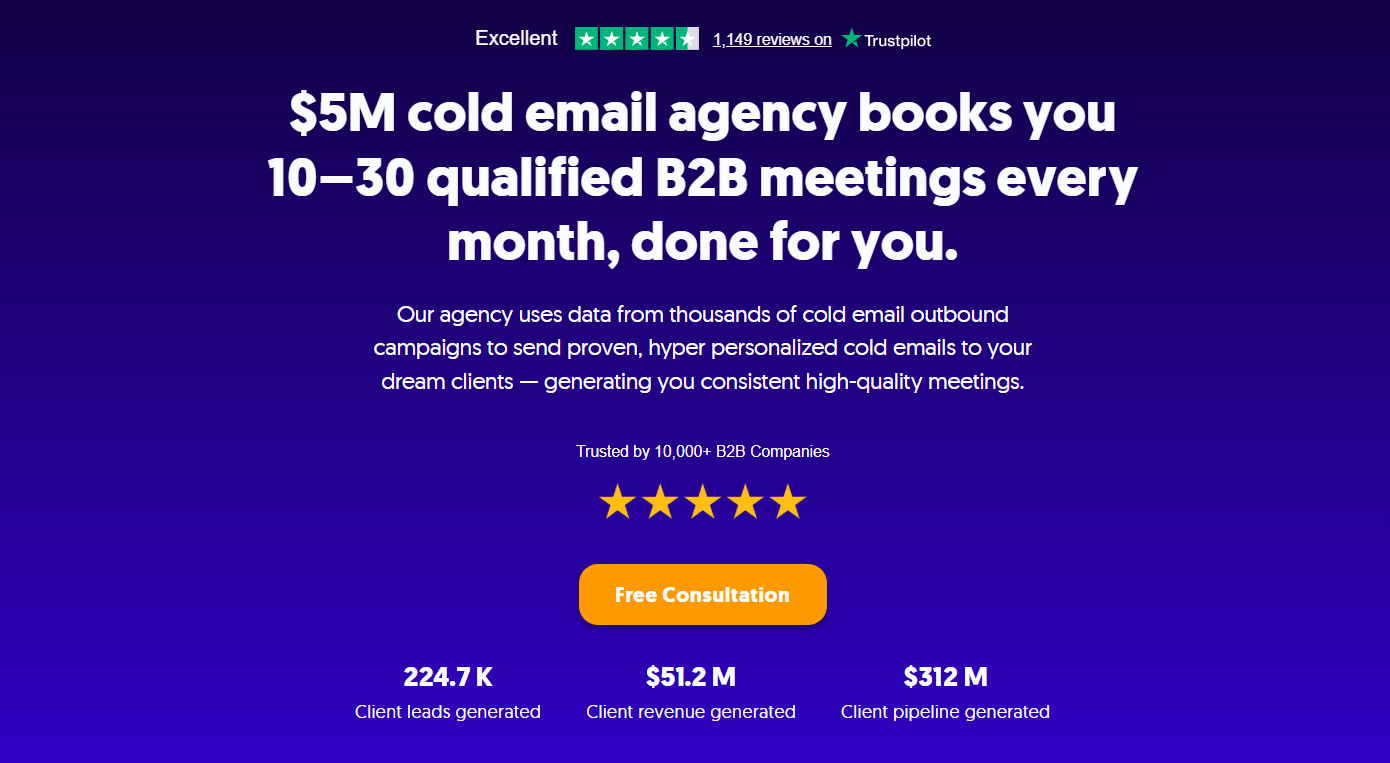
That is what we run end to end as a cold email agency. We define your ICP, build verified multi-source lists, and set up your domains and inboxes. Then we write the sequences, split test them, and handle replies through to booked meetings.
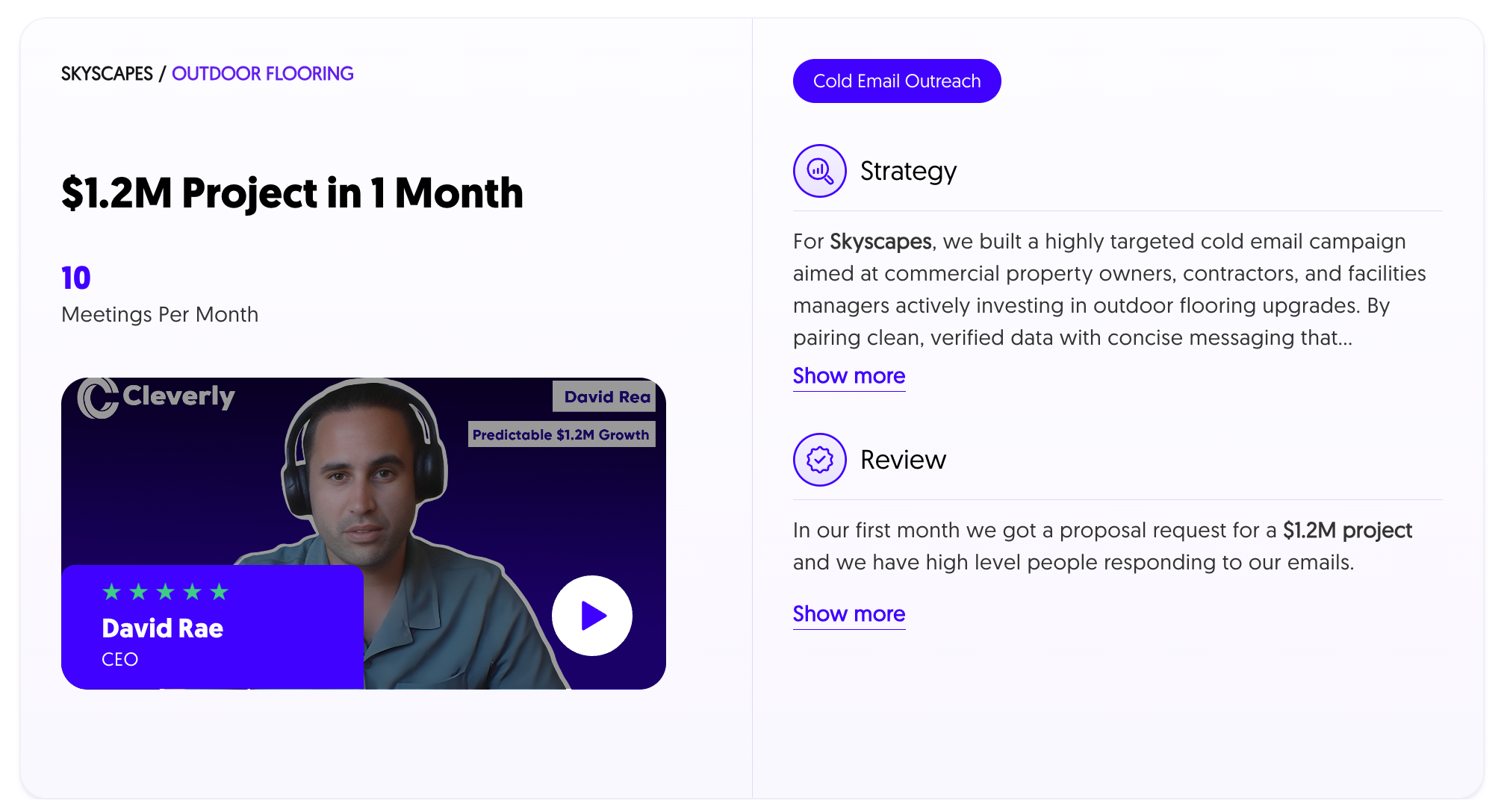
Our copy frameworks come from thousands of campaigns, so testing starts from a tested baseline instead of a blank page. We have generated $312M in pipeline for clients, and that volume is what lets us separate signal from noise.
We optimize for qualified replies and booked meetings, not opens. You can choose between pay-per-lead and a flat monthly retainer, with no long-term contract. Learn more about our cold email outreach service.
Tired of guessing which lines work? Cleverly runs the campaigns and the testing for you. Book a call to see how.
Conclusion
A postscript in email is a tool, not a rule. The claim that it is the second most-read line is repeated far more often than it is evidenced. It earns its place when it carries something that genuinely does not fit the body.
In short cold emails, it often adds length without adding value, so leave it out unless it does a job.
For a next step, pick one P.S. type from the list above, split test it against no P.S., and judge it on replies. And keep the bigger picture in mind. The line itself matters far less than who you are emailing and whether your offer is relevant to them.
Frequently Asked Questions
Free Resource
How to Scale a Profitable Cold Call System
Get the complete guide — download it instantly now.

Free Ebook
Download the Free Guide
Enter your details to get instant access.
You're all set! 🎉
Your ebook is downloading now.
Click below if the download didn't start automatically.