Table of Contents
What Is a Professional Partnership Request Email?
When to Use a Partnership Email Template
How to Write a Partnership Email That Gets Replies
Professional Partnership Email Templates
10 Partnership Email Subject Lines That Increase Open Rates
Common Mistakes in Partnership Outreach Emails
How to Scale Partnership Outreach
How Cleverly Helps Scale Partnership Outreach
Conclusion
Frequently Asked Questions
Modified On :
March 30, 2026
Key Takeaways
- Partnership emails work best when they focus on starting a conversation, not closing a deal.
- Personalization, even just one specific detail, meaningfully increases reply rates.
- Short emails under 150 words consistently outperform long, detailed ones in cold outreach.
- A strong subject line is half the battle. Make it specific, not clever.
- Templates give you structure, but every email should be adjusted for the person you're sending it to.
- Multi-touch outreach combining LinkedIn and email opens more doors than a single channel alone.
Partnerships are one of the most underrated growth channels in B2B. When done right, they open doors to new audiences, new revenue streams, and long-term business relationships that compound over time.
But you know why most partnership emails never even get a reply? It's not because partnerships are a bad idea. It's because the emails themselves are the problem.
They're too generic, too salesy, or just painfully vague. The person on the other end reads it and thinks, "okay, but what do you actually want?" and moves on.
That's exactly why we put this guide together.
Whether you're reaching out for a co-marketing campaign, a referral deal, or a product integration, you need a professional partnership request email template that actually works.
In this guide, you'll get:
- 10 proven partnership email templates you can use right now
- Real examples across different partnership types
- Best practices for writing emails that get replies, not ignored
Let's get into it.

What Is a Professional Partnership Request Email?
A professional partnership outreach email template is a structured, targeted email you send to another business or professional when you want to explore working together.
It's not a sales pitch. It's not a cold introduction with a hidden agenda. It's a straightforward, well-thought-out message that says, "Hey, I think there's something here for both of us — want to talk?"
These emails are used across a ton of different situations in B2B:
- Collaborations — teaming up on a project, a webinar, or a joint piece of content
- Co-marketing — running campaigns together to reach each other's audiences
- Integrations — connecting two products or platforms so customers get a better experience
- Referral partnerships — setting up a mutual referral system where both sides send business each other's way
The one thing all of these have in common?
The goal is never to close a deal in the first email. The goal is to start a conversation. You're planting a seed, not harvesting a crop.
A great professional partnership outreach email template gets the other person curious enough to reply and get on a call — that's it. Everything else comes after.
Also Check: Cold Email Strategy for B2B SaaS
🤝 Turn Cold Emails Into Real Partnerships
Cleverly runs cold email campaigns that land you meeting-ready leads and conversations with decision-makers. You only pay for qualified meetings we book.
When to Use a Partnership Email Template
Knowing when to send a partnership email template is just as important as knowing how to write one. Not every situation calls for the same approach, and understanding your context makes your outreach a lot sharper.
Most common use cases where a well-crafted partnership email makes sense:
- Business collaborations — You want to work with another company on something that benefits both sides. Maybe it's a joint event, a shared resource, or a co-developed product. The partnership email opens that door.
- Affiliate partnerships — You have a product or service that another brand's audience would love, and you want to set up a commission-based relationship. The email is how you pitch the idea without making it weird.
- SaaS integrations — Two tools that serve overlapping users can do a lot more together than apart. If your product integrates well with another platform, a clean partnership email to their team can kick off a technical and go-to-market collaboration.
- Agency partnerships — Agencies frequently partner with complementary service providers. If you run a content agency and you're reaching out to a web design firm, a solid partnership email template is your first move.
- Co-marketing campaigns — You want to run a campaign together — think webinars, case studies, newsletters, or social content — where both brands benefit from the shared exposure. The partnership email is how you propose the idea without it sounding like you're asking for a favor.
Each of these scenarios needs a slightly different angle, which is why having the right template for the right situation matters. We'll cover all of them below.

How to Write a Partnership Email That Gets Replies
One honest truth about professional partnership email templates for sales — most of them fail because they're written with the sender in mind, not the recipient. The fix is pretty simple: flip that around. Write your email as if you're the one receiving it, and ask yourself, "Would I reply to this?"
If the answer is no, keep editing. Here's the framework we use:
Step 1: Personalize the Opening
Skip the "Hope this email finds you well." Nobody reads that. Instead, open with something specific to them — a recent post they published, a campaign they ran, a product launch you noticed, something that shows you actually paid attention.
It doesn't need to be long. One sentence that proves you did your homework is worth more than three paragraphs of pleasantries. Something like:
"Saw your team just launched [X] — really liked how you approached [specific thing]."
That's it. Now they're reading.
Step 2: Explain Why You're Reaching Out
Be direct. Tell them exactly why you're emailing, in plain English. Don't bury the lead under a bunch of background about your company. Get to the point fast.
What are you proposing? A referral deal? A co-marketing campaign? An integration discussion? Say it clearly in one or two sentences. The faster they understand what you're asking, the faster they can decide whether to engage.
Step 3: Highlight Mutual Value
This is where most partnership emails drop the ball. They talk about what they want — more leads, more reach, more customers — without explaining what's in it for the other person. That's a one-way street, and people can smell it immediately.
Instead, frame the value from both sides. What does your partner get out of this? More specifically:
- Access to your audience or network
- A solution that complements their existing offer
- Revenue share or referral commission
- Content, data, or resources they don't currently have
Make it obvious that you've thought about their side of the equation, not just yours.

Step 4: Keep It Short and Clear
A partnership email is not a proposal document. You don't need to explain your entire business model, share five case studies, or attach a deck. Keep the email to 100-150 words max. Short emails get read. Long emails get skimmed and closed.
If they're interested, they'll get on a call. That's when the details come out. Your only job in the email is to get them curious enough to reply.
Step 5: Add a Simple Call to Action
End with one clear, low-friction ask. Not "Let me know if you're interested in exploring a potential strategic partnership opportunity." That's exhausting to read.
Try something like:
- "Would a quick 20-minute call this week work?"
- "Open to a short call next week to see if this makes sense?"
- "Does this sound like something worth a quick chat about?"
One question. One next step. Easy to say yes to.
Know More: How to Write Cold Emails That Get Replies (Complete Guide)
🚀 Start Conversations With the Right Buyers
Reach decision-makers at companies like Amazon, Google, Uber, PayPal & more with Cleverly’s LinkedIn outreach. Plans start at just $397/mo.
Professional Partnership Email Templates
Below are 10 professional partnership request email templates — each one built for a specific situation. No fluff, no filler. Just emails that are short, clear, and easy to say yes to.
Template 1: General Partnership Outreach
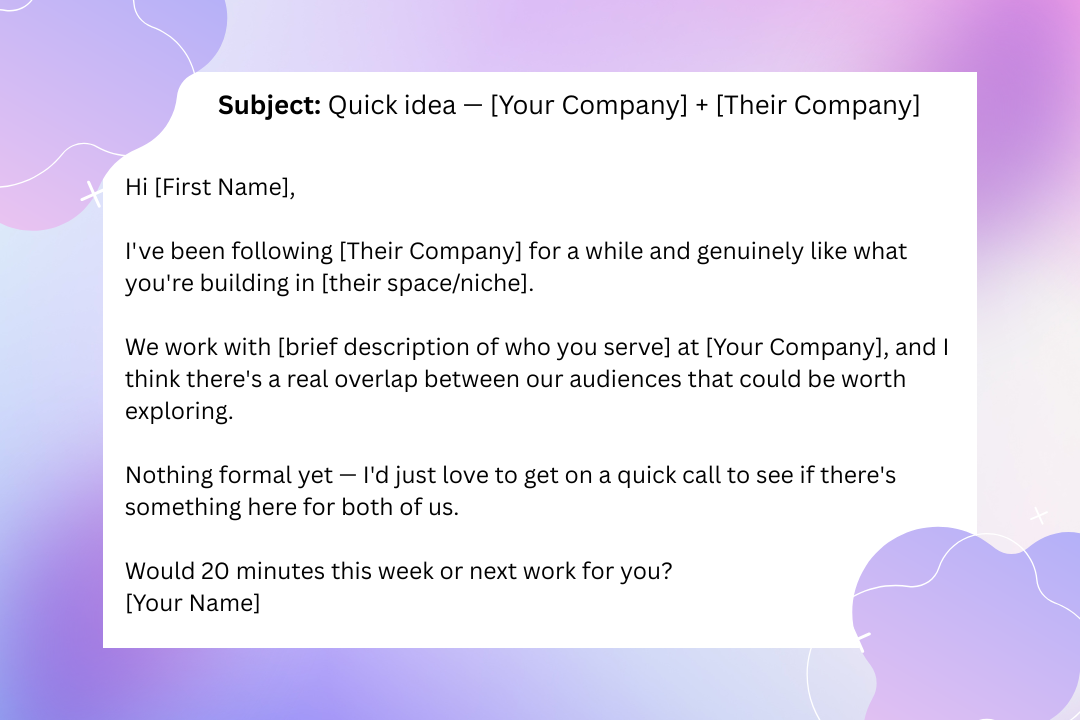
Why it works: It's specific without being heavy. You're not pitching a deal — you're pitching a conversation. The subject line creates curiosity without being clickbait, and the email respects their time by keeping it under 80 words.
Template 2: Strategic Partnership Discussion Email
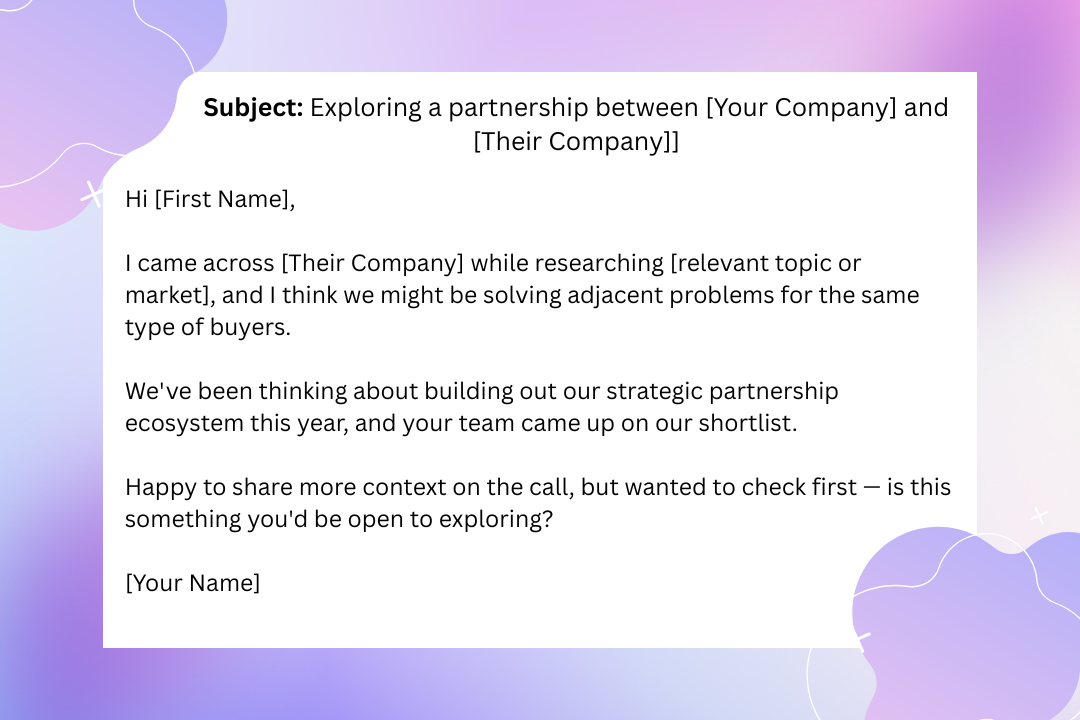
Why it works: This strategic partnership discussion email template works because it positions the outreach as intentional and research-backed. Saying "your team came up on our shortlist" signals that this isn't a mass blast — it's a targeted ask. That alone increases reply rates.
Template 3: B2B Sales Partnership Email
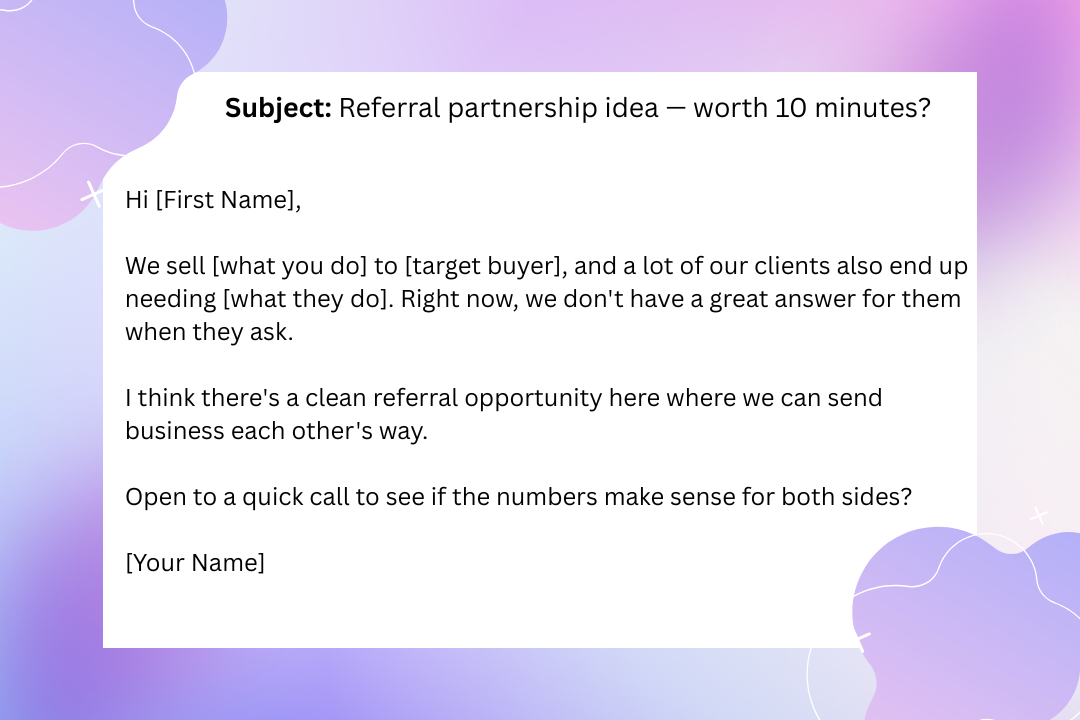
Why it works: This professional partnership email template for sales is built around a natural, obvious fit. You're not manufacturing a reason to connect — you're pointing out a gap that already exists. That honesty makes it feel real, and real gets replies.
Template 4: Co-Marketing Collaboration Email
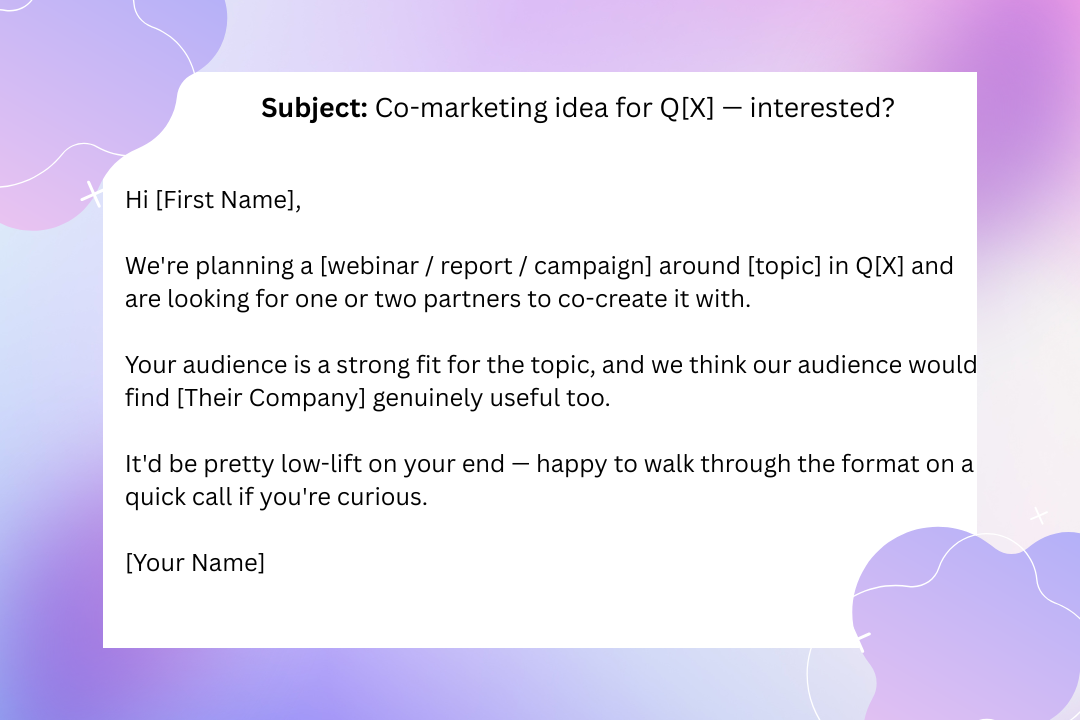
Why it works: "Low-lift" does a lot of heavy lifting here. Co-marketing can feel like a big commitment, so addressing that upfront removes the main objection before they even think it. Mentioning a specific quarter also makes it feel timely, not vague.
Template 5: Affiliate Partnership Email
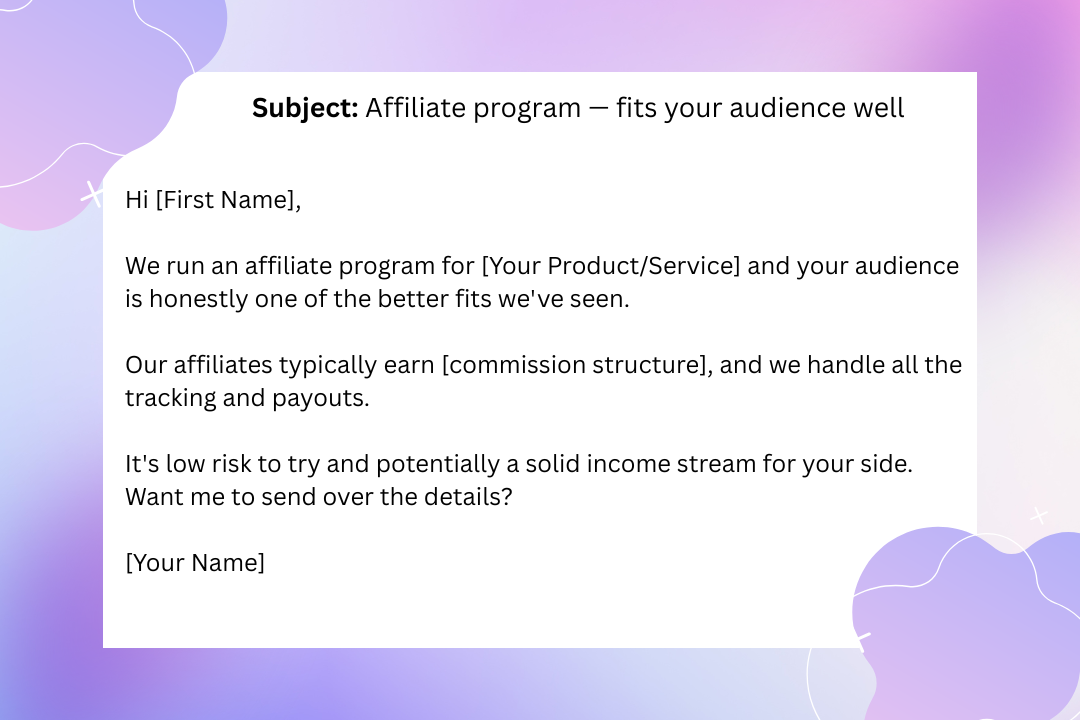
Why it works: Most affiliate outreach emails talk about the product. This one talks about the earning potential and makes it frictionless to say yes. Asking "Want me to send over the details?" is a softer CTA than "Let's hop on a call" — and that matters for affiliate pitches.
Template 6: SaaS Integration Partnership Email
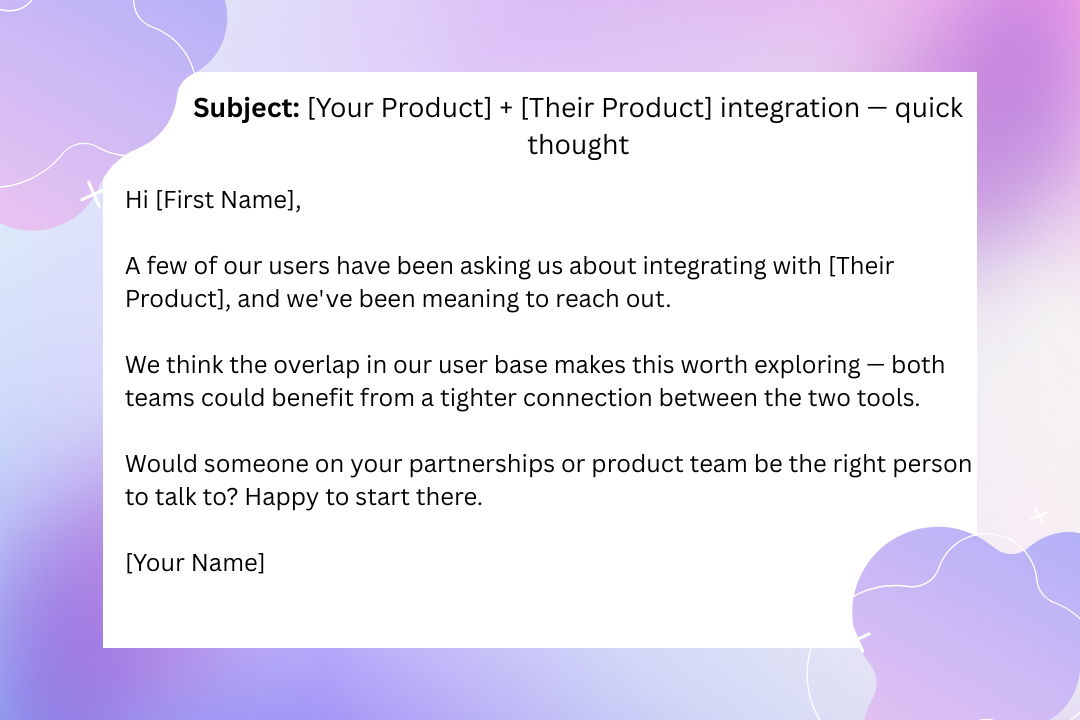
Why it works: Starting with "our users have been asking" is powerful — it shows demand already exists. You're not asking them to take a bet on an integration, you're telling them their own customers want it. It also asks a simple directional question, which is easy to answer.
Template 7: Agency Partnership Email
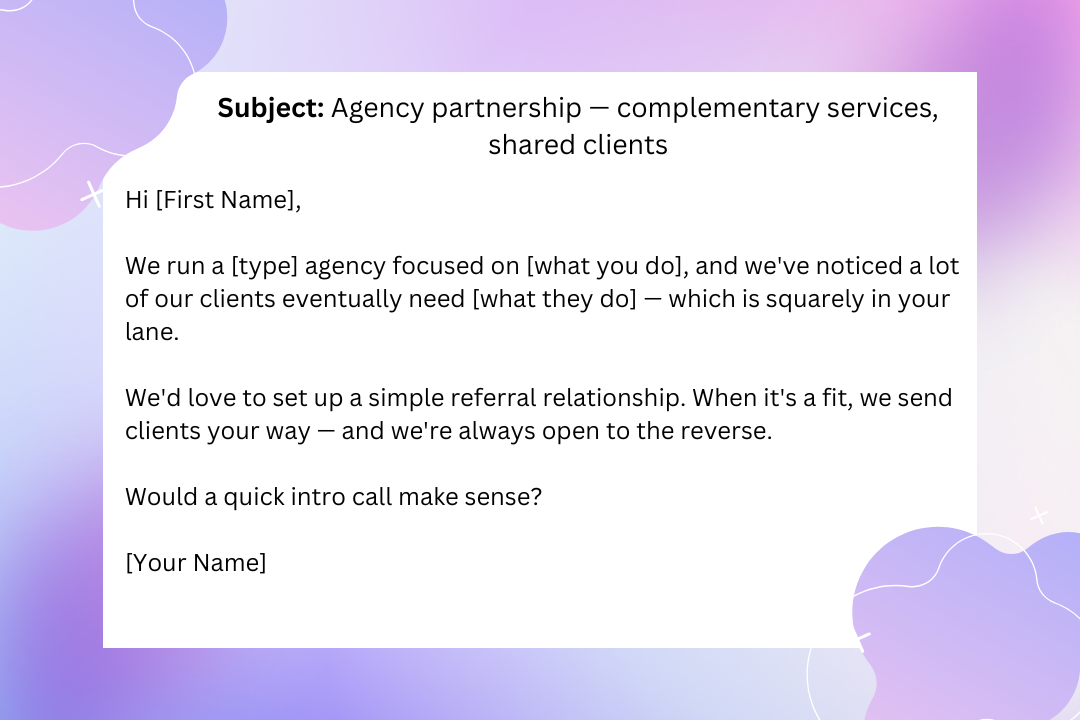
Why it works: Agency partnerships live and die on trust and fit, and this email establishes both immediately. You're not overselling — you're being practical. "Squarely in your lane" sounds natural and direct, not formal.
Template 8: Follow-Up Partnership Email
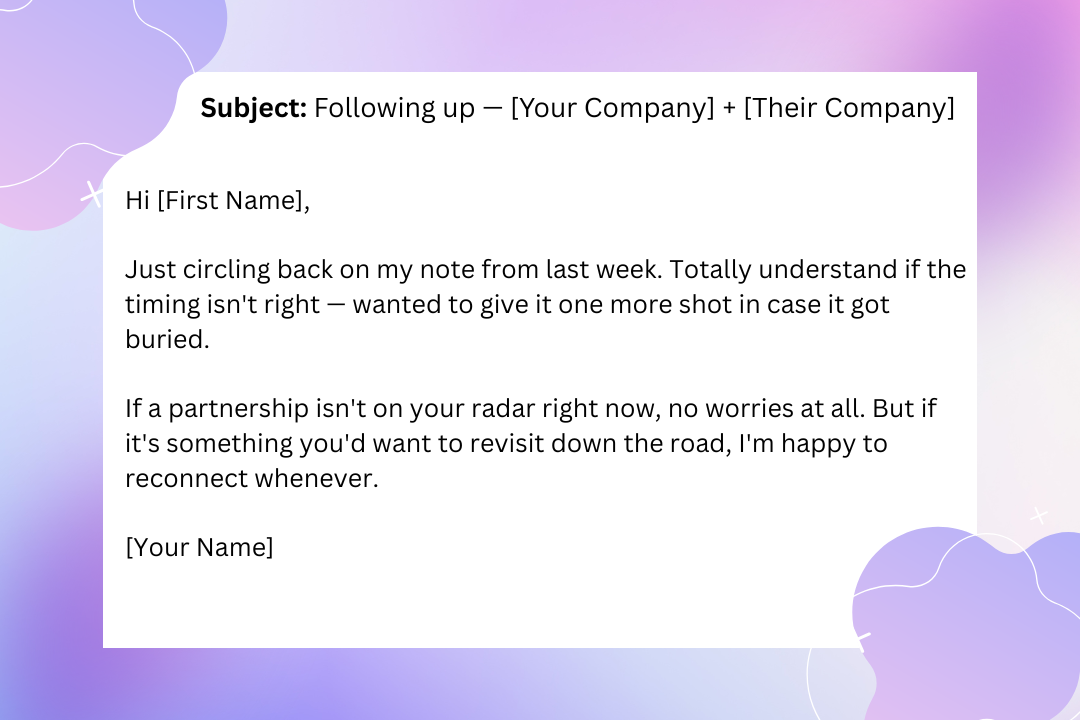
Why it works: This follow-up doesn't repeat the full pitch or guilt-trip them for not replying. It's low-pressure, leaves the door open, and gives them an easy out — which paradoxically makes people more likely to respond. It's also just respectful, and people remember that.
Template 9: LinkedIn + Email Partnership Combo
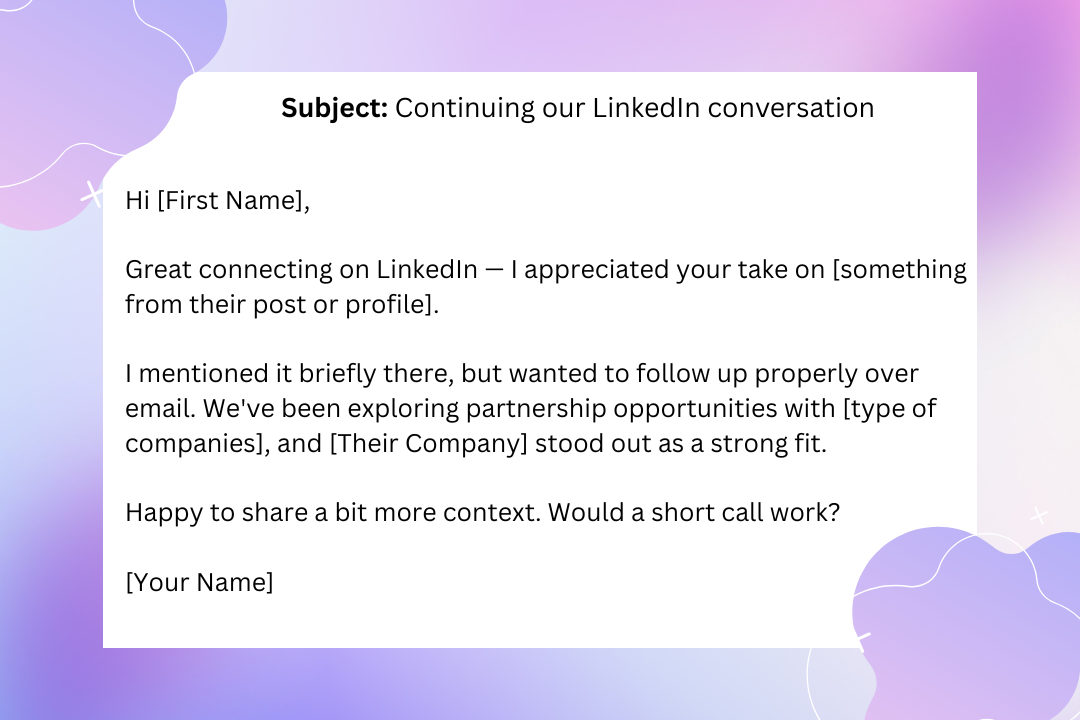
Why it works: Referencing a real LinkedIn interaction makes this feel like a warm intro, not cold outreach. The phrase "follow up properly" signals respect for their time and creates a distinction between a LinkedIn DM and a real business conversation. This combo approach consistently outperforms either channel alone.
Template 10: Cold Partnership Outreach Email
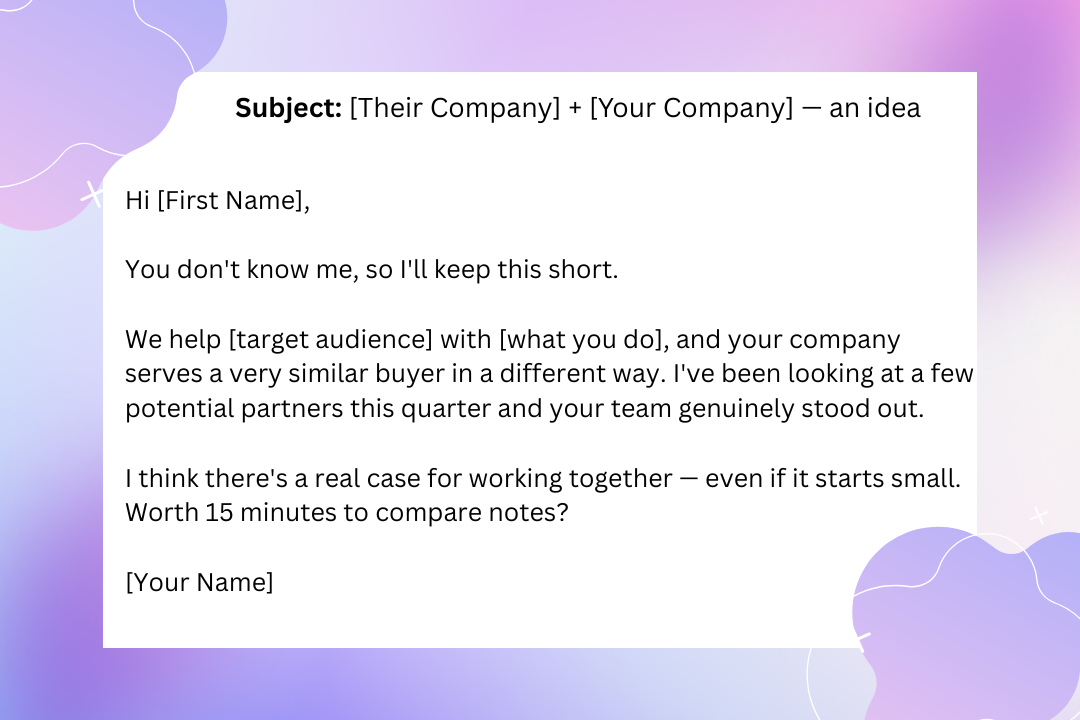
Why it works: Opening with "You don't know me" is disarming. It's honest, it's refreshing, and it immediately separates this email from every other cold partnership email template in their inbox. The rest is tight, specific, and ends with the lowest-friction CTA possible.
Dive Deeper Into: How to Send an Email to Multiple Recipients Individually
10 Partnership Email Subject Lines That Increase Open Rates
You can have the best partnership email template in the world, but if the subject line doesn't land, nobody's reading it.
The inbox is crowded, attention spans are short, and most subject lines sound exactly the same. Here are 10 that actually work — and why.
1. "Quick idea — [Your Company] + [Their Company]"
This one works because it's direct and personal. You're not being vague about what the email is about, and putting both company names in the subject line makes it feel intentional, not mass-blasted.
2. "Had a thought after seeing your [post/product/campaign]"
Curiosity does the heavy lifting here. They want to know what you thought, and the reference to something specific tells them you actually paid attention. It doesn't feel like outreach — it feels like a follow-up to something that already happened.
3. "We share a lot of the same clients"
This stops people mid-scroll. It's unexpected, it's relevant, and it immediately makes them want to know who you're talking about. It works especially well for referral and agency partnership outreach.
4. "Worth a 15-minute call?"
Simple, honest, low-pressure. No buildup, no mystery — just a straightforward ask. People appreciate when you don't waste their time, and this subject line signals exactly that from the first word.
5. "[Their Company] came up in a conversation — wanted to follow up"
This creates a sense of social proof without being specific about it. Someone mentioned them? Who? In what context? The ambiguity makes them open it. Works great for warm outreach or when you have a mutual connection.
6. "An idea for Q[X] — curious what you think"
Anchoring to a specific quarter makes this feel timely rather than vague. Asking for their opinion rather than their business makes it feel collaborative. This one works particularly well for co-marketing pitches.
7. "Not a pitch — just a quick question"
People are so used to being pitched that this breaks the pattern immediately. It sets a low expectation, which makes them more likely to open and engage. Just make sure your email actually delivers on that promise.
8. "Two audiences, one opportunity"
Short, clean, intriguing. It implies there's value on both sides without spelling it out, which is exactly what a good subject line should do. Works well when you genuinely have strong audience overlap.
9. "Re: [Topic they care about]"
Using "Re:" implies there's an ongoing conversation, even if this is the first email. Pair it with a topic that's relevant to their business and it feels like a continuation, not a cold open. Use this one carefully — it works, but only when the topic is genuinely relevant to them.
10. "Saw you're expanding into [market/area] — had an idea"
This shows you did your homework. If they recently announced a new market, launched a new product, or made a public hire, referencing it makes the email feel timely and specific. Generic subject lines get deleted. This kind doesn't.
Common Mistakes in Partnership Outreach Emails

Even with a solid partnership email template in hand, it's easy to slip into habits that kill your reply rate. Here are the most common ones we see — and they're all fixable.
❌ Being too salesy
If your email reads like a pitch deck, it's going to get ignored. Partnership outreach is about starting a conversation, not closing a deal. The moment your email sounds like a sales email, the other person mentally checks out. Keep the tone conversational and the ask simple.
❌ Lack of personalization
"Hi there" or "Dear Sir/Madam" is an immediate red flag. If you didn't take two minutes to find their name and reference something relevant to their business, why would they take time to reply? Even one line of genuine personalization makes a significant difference.
❌ Unclear value proposition
A lot of partnership emails talk a lot without actually saying anything. If someone reads your email and still can't figure out what you're proposing or what they get out of it, you've lost them. Be specific. What's the actual value for them?
❌ Long emails
Nobody's reading a five-paragraph email from someone they've never met. If your email needs to be scrolled, it's too long. Keep it under 150 words. Everything else goes on the call.
❌ Generic messaging
Copying and pasting the same email to 50 companies with only the name swapped out is not a strategy. People can tell. If nothing in your email is specific to their company, their industry, or their situation, it reads as lazy — and lazy outreach doesn't get replies.
How to Scale Partnership Outreach
Once you have a professional partnership outreach email template that works, the next step is doing it at volume without losing the quality that made it work in the first place. Here's how to approach it.
Use the right email tools
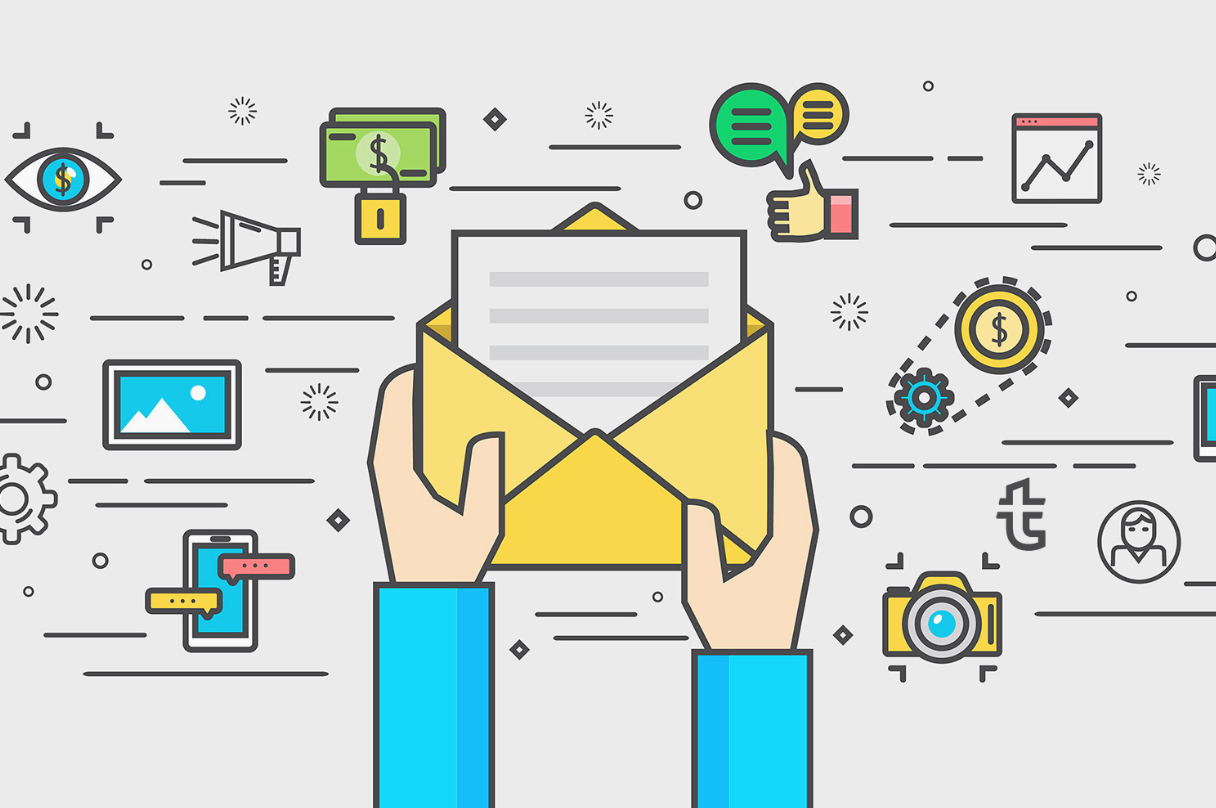
Email Tools like Instantly, Apollo, or Smartlead let you automate sending, track opens and replies, and manage follow-up sequences without doing it manually. The goal isn't to remove the human element — it's to handle the logistics so you can focus on the conversations.
Segment your outreach

Don't send the same email to an affiliate partner and a SaaS integration lead. Break your email list into clear segments by:
- Partnership type (referral, co-marketing, integration)
- Industry or niche
- Company size
- Stage of relationship (cold, warm, already connected on LinkedIn)
Each segment should have its own template and messaging angle. The more relevant the email, the better the response rate.
Personalization at scale
This sounds like a contradiction but it's not. You don't need to write every email from scratch. What you need is a solid base template with a few dynamic fields — their company name, a reference to something specific about their business, and a value hook that speaks to their situation. That combination makes the email feel personal even when it's part of a larger sequence.
More on This: Cold Email Personalization Framework That Gets 20%+ Replies
Multi-touch outreach (LinkedIn + email)
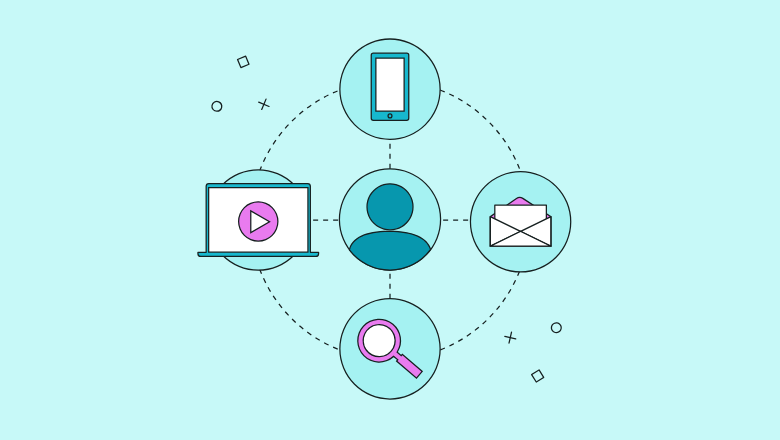
The strongest partnership outreach doesn't rely on email alone. A simple sequence looks like this:
- Connect or engage with them on LinkedIn first
- Send a short LinkedIn message referencing a shared interest or their content
- Follow up with a more detailed email a day or two later
- Use your email sequence for follow-ups if they don't reply
This approach warms up the contact before the email lands, which means it's no longer fully cold by the time they see it. That alone can meaningfully lift your reply rates.
How Cleverly Helps Scale Partnership Outreach
If you're serious about outreach, doing all of this manually isn't realistic for most teams. That's where working with a cold email outreach agency like Cleverly comes in.
We're the highest-rated, 100% done-for-you B2B lead generation agency, and we've run thousands of cold email campaigns across virtually every industry.
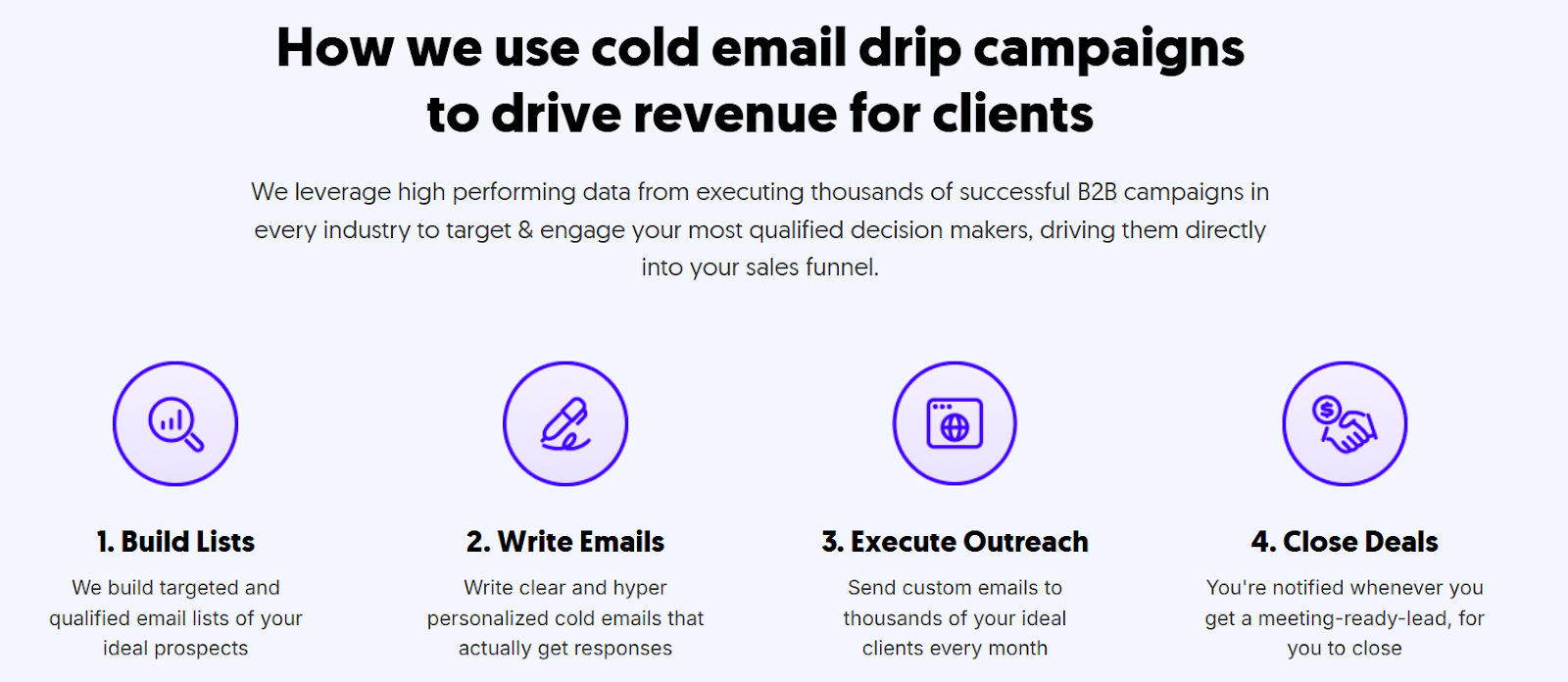
Our clients have generated over $51.2M in revenue and $312M in pipeline directly from our outreach campaigns. Over 10,000 B2B companies trust us to run their outreach — and we operate on a Pay Per Performance model with no long-term contracts.
If you want outreach that actually drives results, book a call with us and let's talk about what that looks like for your business.
Conclusion
Partnership emails work. But only when they're written with the other person in mind.
A strong professional partnership request email template gives you the structure to move fast, but the emails that actually get replies are the ones you take time to customize. The goal is simple: be specific, be relevant, and make it easy for them to say yes.
A few things to keep in mind as you start reaching out:
- Personalization and clear value are what separate a reply from a delete.
- Templates are a starting point, not a finished product — always adjust for the specific person and situation.
- Short, direct messaging consistently outperforms long, detailed emails in cold outreach.
- Structured, multi-touch outreach (LinkedIn + email) opens more doors than a single email ever will.
The partnerships that drive real business growth don't happen by accident. They start with one well-written email.
Frequently Asked Questions
Free Resource
How to Scale a Profitable Cold Call System
Get the complete guide — download it instantly now.
Free Ebook
Download the Free Guide
Enter your details to get instant access.
You're all set! 🎉
Your ebook is downloading now.
Click below if the download didn't start automatically.