Table of Contents
What Is a Marketing Orchestration Platform?
What to Evaluate Before You Buy
Quick Glance
The 7 Best Marketing Orchestration Platforms in 2026
Pricing Realities and Hidden Costs
How to Choose the Right Platform
What Orchestration Platforms Can't Do
How Cleverly Fills the Top of the Funnel
Conclusion
Frequently Asked Questions
Modified On :
September 25, 2026
Key Takeaways
- Marketing orchestration platforms solve a coordination problem, not a channel problem. Buying one won't fix a demand generation gap.
- The category overlaps heavily with marketing automation, ABM platforms, and CDPs. Knowing what makes orchestration distinct (decisioning, not just execution) is the difference between the right purchase and an expensive redundancy.
- Integration depth with your CRM predicts your outcome more reliably than any feature on a vendor's website.
- List prices rarely reflect real cost. Data modules, implementation, and internal admin headcount routinely double or triple the quoted number.
- Orchestration multiplies demand you already have. If your pipeline is thin, the platform will just measure that thinness more precisely.
You've got a CRM, an email tool, an ad platform, a chat widget, and three point solutions nobody remembers approving.
Gartner's 2025 martech survey put utilization at 49%, the lowest in five straight years of measurement.That's not a tooling problem. It's a coordination problem, and it's why marketing orchestration platforms have become one of the most searched categories in B2B martech this year.
The trouble is that the term gets used loosely. Vendors selling marketing automation, ABM, and CDPs all lean on "orchestration" in their positioning, which makes the buying decision harder than it should be.
This guide breaks down what orchestration actually means, what to check before you sign a contract, seven platforms worth evaluating, what they really cost, and how to tell if you need one at all.
What Is a Marketing Orchestration Platform?
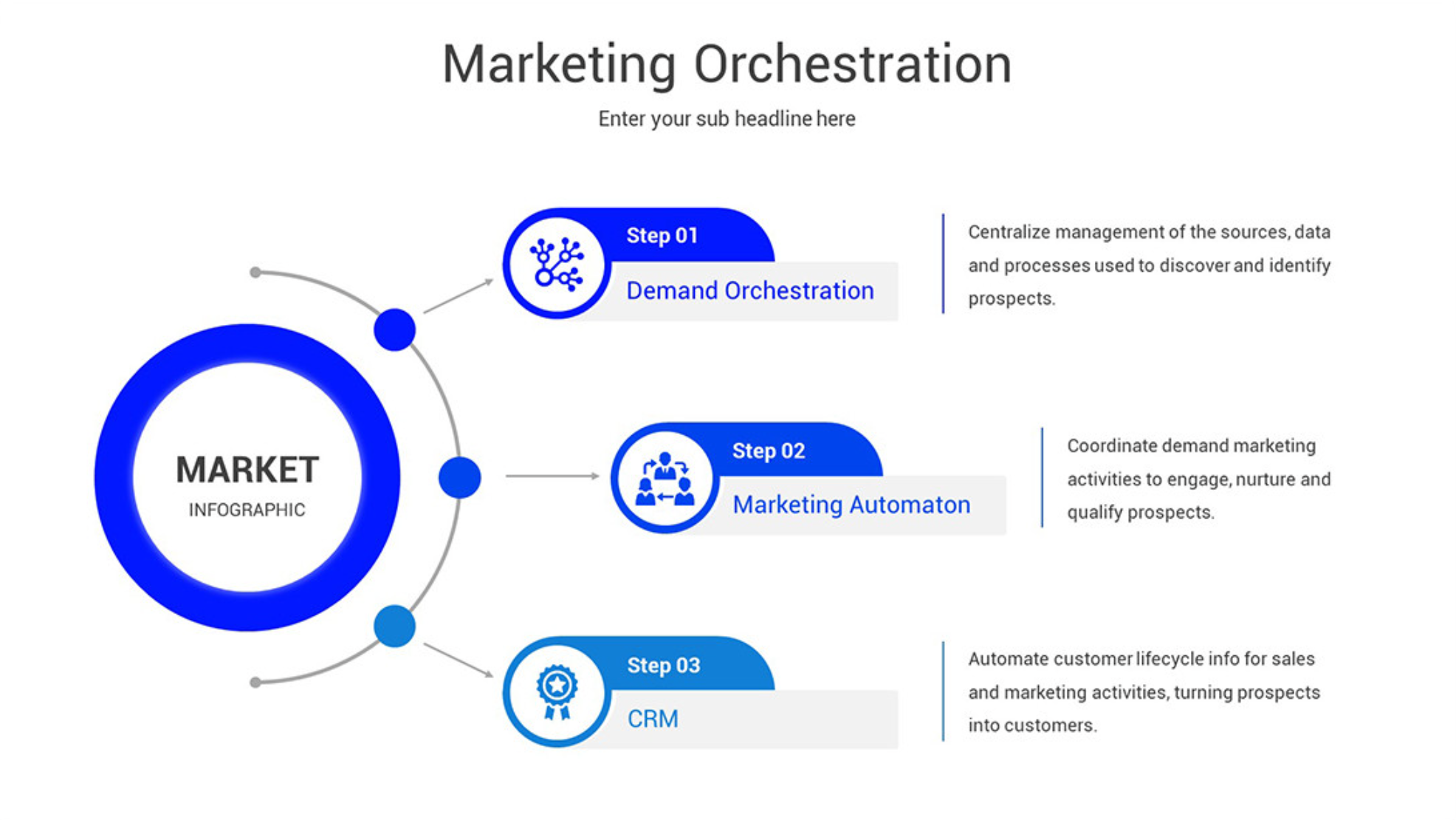
A marketing orchestration platform coordinates campaigns, signals, and channels around accounts, rather than running each channel as its own island. Instead of your email tool, ad platform, and sales team each operating on separate logic, orchestration software decides what should happen next for a given account and where that action should happen.
The Six Capabilities That Define the Category
- Unified account data — resolving contacts and companies into one account record across sources.
- Multi-source signal detection — intent data, website behavior, firmographic and technographic changes.
- AI-led decisioning — determining the next best action per account, not just the next scheduled email.
- Cross-channel execution — email, ads, web personalization, and sales tasks triggered from one layer.
- Sales coordination — surfacing signals and next steps directly to reps, not just marketing dashboards.
- Account-level measurement — reporting on the account's full journey, not isolated channel metrics.
How Orchestration Differs From Adjacent Categories
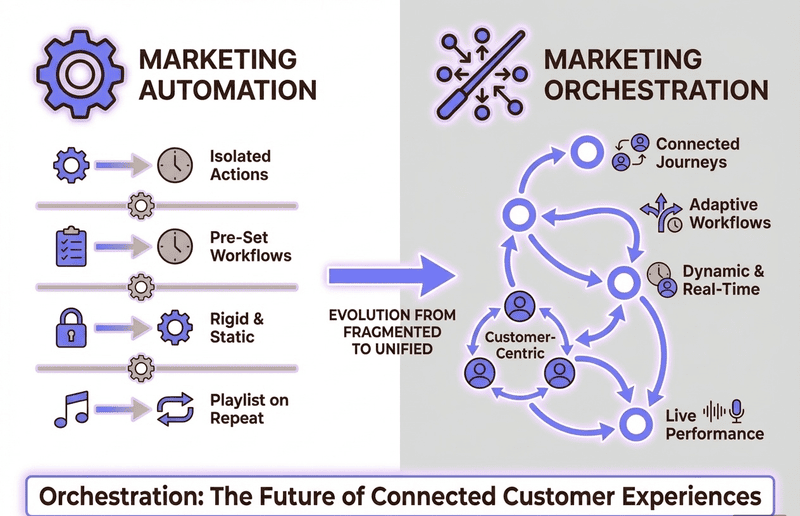
Marketing automation executes sequences you've already designed. Orchestration decides what should happen next and where, based on live signals. Automation is the engine; orchestration is closer to the driver.
A CDP unifies your data into one customer or account view. Orchestration takes that unified data and acts on it across channels. Several vendors in this list bundle both functions, which is part of why the category gets confusing.
ABM platforms overlap the most with orchestration, since both organize marketing around target accounts. The difference is scope: ABM tools tend to focus on account targeting and advertising, while orchestration spans the full journey from first signal to closed deal, including sales handoff.
What's out of scope here: standalone email senders, social schedulers, and single-channel tools. If a platform only does one job well, it's not orchestration, however good it is at that one job.
🎯Orchestrate More Leads
Cleverly helps 10,000+ businesses generate qualified B2B leads through done-for-you LinkedIn, cold email, and cold calling.
What to Evaluate Before You Buy
Marketing workflow orchestration platforms for enterprises carry real switching costs, so the evaluation matters more than usual. Here's what actually predicts whether the purchase works out.
Integration depth with your CRM. This decides more of your outcome than any feature list. A platform with a shallow, one-way CRM sync will fight you every week. Ask for a live technical demo against your actual CRM instance, not a generic sandbox.
Data unification. Can it reliably resolve accounts and contacts across your CRM, marketing automation, and any product-usage data? Ask how it handles duplicate accounts and stale records, since that's where most implementations quietly break down.
Signal sources, native versus sold separately. Intent data is frequently a separate line item even on platforms that market it as core to the product. Get this in writing before you sign.
Cross-channel execution reach, including coordination across search marketing, paid social, email, web personalization, and sales tasks. Check which channels are natively built versus stitched together through a third-party integration, since native channels tend to be more reliable and easier to debug.
Attribution and reporting model. Does it report at the account level, or does it just roll up lead-level metrics with a nicer dashboard? Account-level reporting is the whole point of the category.
Sales-side usability. Orchestration fails quietly when reps ignore the outputs. If the sales team won't open the tool, the signals never turn into calls.
Implementation time and consultant dependency. Ask directly whether you'll need an outside implementation partner, and get a realistic timeline in writing, not the sales team's best case.
Total cost of ownership. Platform fee, data modules, add-on seats, advertising spend if applicable, and the internal headcount needed to run it.
Contract structure. Term length, database-size pricing bands, and renewal escalation clauses. Multi-year commitments with auto-renewal are the norm in this category, not the exception.
Quick Glance
🚀 Turn Campaigns Into Pipeline
With 224.7K+ leads generated, 53,000+ meetings booked, and $312M+ pipeline, Cleverly helps B2B teams turn coordinated outreach into sales opportunities.
The 7 Best Marketing Orchestration Platforms in 2026
This is a shortlist organized by use case, not a strict ranking. The right platform for a Salesforce-native enterprise looks nothing like the right platform for a mid-market team that just wants usable automation.
1) Adobe Marketo Engage

Marketo Engage has been the default choice for complex B2B nurture programs for over a decade, and Adobe's 2018 acquisition folded it into the broader Experience Cloud. It handles lead scoring, multi-step nurture, and account-based orchestration at a depth that few competitors match, which is exactly why it's also known for a steep learning curve. This is a platform built for teams with dedicated marketing operations headcount, not for a lean team hoping to self-serve their way to results.
Best for: enterprise B2B with complex, long buying cycles
Standout capabilities:
- Advanced lead scoring and nurture logic across long sales cycles.
- Account-based orchestration built into the core platform.
- Multi-touch attribution reporting.
- Deep customization through APIs and custom objects.
- Native integration across the Adobe Experience Cloud stack.
- Sales intelligence and engagement tools for rep-facing signals.
Integrations: Salesforce, Microsoft Dynamics, the Adobe Experience Cloud suite, and a large partner ecosystem.
Pricing: Adobe does not publish list prices. Marketo Engage sells across four editions (Growth, Select, Prime, Ultimate) priced by database size and edition, and third-party estimates put entry packages around $1,200 to $1,500 per month, scaling into low five figures monthly for larger enterprise deployments. Every quote requires a sales conversation.
Limitation: the learning curve is real, and most teams underestimate the ongoing admin overhead required to keep the platform running well.
2) 6sense
6sense built its reputation on predictive intent data, using AI to flag accounts that are actively researching a solution before they ever fill out a form. It bundles that intelligence with orchestration workflows, so the same platform that tells you an account is in-market can also trigger the outreach. That combination is the pitch, and it's a strong one if you trust the predictive model behind it.
Best for: teams that want intent data and orchestration in one platform
Standout capabilities:
- Predictive account intelligence and in-market scoring.
- Third-party intent data processed across a large signal set.
- Signal-triggered, cross-channel engagement workflows.
- AI-driven agent layer (RevvyAI) for automated next-best actions.
- Waterfall data enrichment from multiple third-party sources.
- Native CRM two-way sync.
Integrations: Salesforce, HubSpot, major ad platforms, and Bombora, G2, and other intent data partners.
Pricing: there's a free tier limited to 50 monthly credits, useful only for testing data quality. Paid plans are entirely custom-quoted. Procurement data from Vendr shows a median annual contract around $55,000 to $63,000, with a realistic range from roughly $11,500 to $175,000+ depending on modules and team size.
Limitation: it's expensive relative to most of this list, and a meaningful part of the value proposition rests on trusting a predictive model you can't fully audit.
3) Demandbase
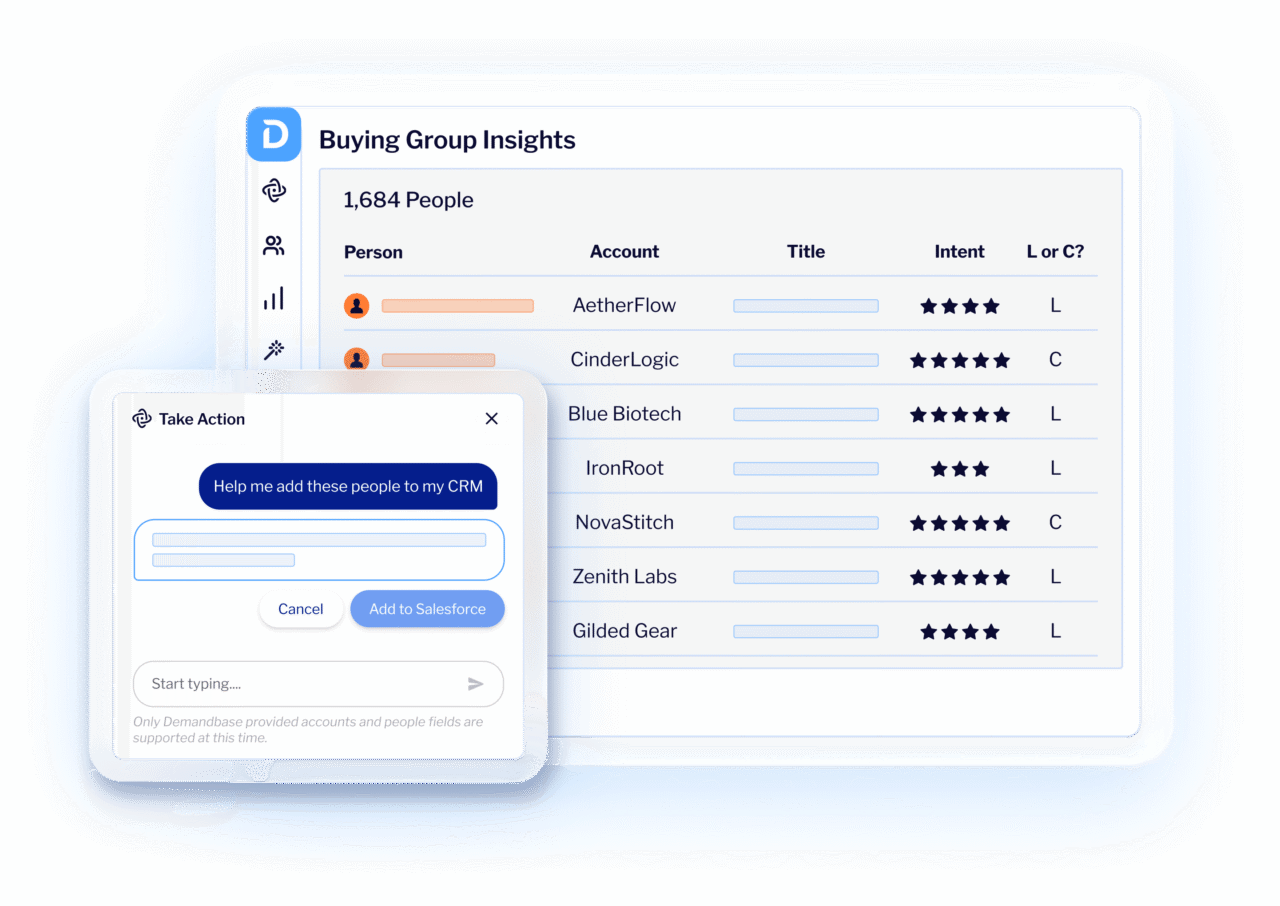
Demandbase is ABM-first, and it shows. Where some platforms treat advertising as an add-on, Demandbase built its own demand-side platform natively into the product, so account identification, ad targeting, and the unified account journey view all live in one place. That makes it strong for teams running ABM as the primary motion, less so for teams that need broad demand generation alongside it.
Best for: ABM-led orchestration with advertising built in
Standout capabilities:
- Native account identification and technographic data.
- Built-in B2B advertising (DSP) without a third-party ad tool.
- Unified account journey view across marketing and sales.
- Sales Intelligence layer for rep-facing account signals.
- Personalization module for web experience by account.
- Data 360 integration for broader customer data unification.
Integrations: Salesforce, HubSpot, Microsoft Dynamics, Marketo, and major ad networks
Pricing: no public pricing. Demandbase quotes a platform fee plus a flat per-user fee, and Vendr's transaction data puts the median annual contract around $65,000 to $70,000, with individual deals ranging from roughly $24,000 to $165,000+. Advertising spend and per-seat fees sit on top of the base platform cost.
Limitation: it's strongest specifically for ABM. Teams whose demand generation is broader than a defined target account list often find it more platform than they need.
4) HubSpot Marketing Hub
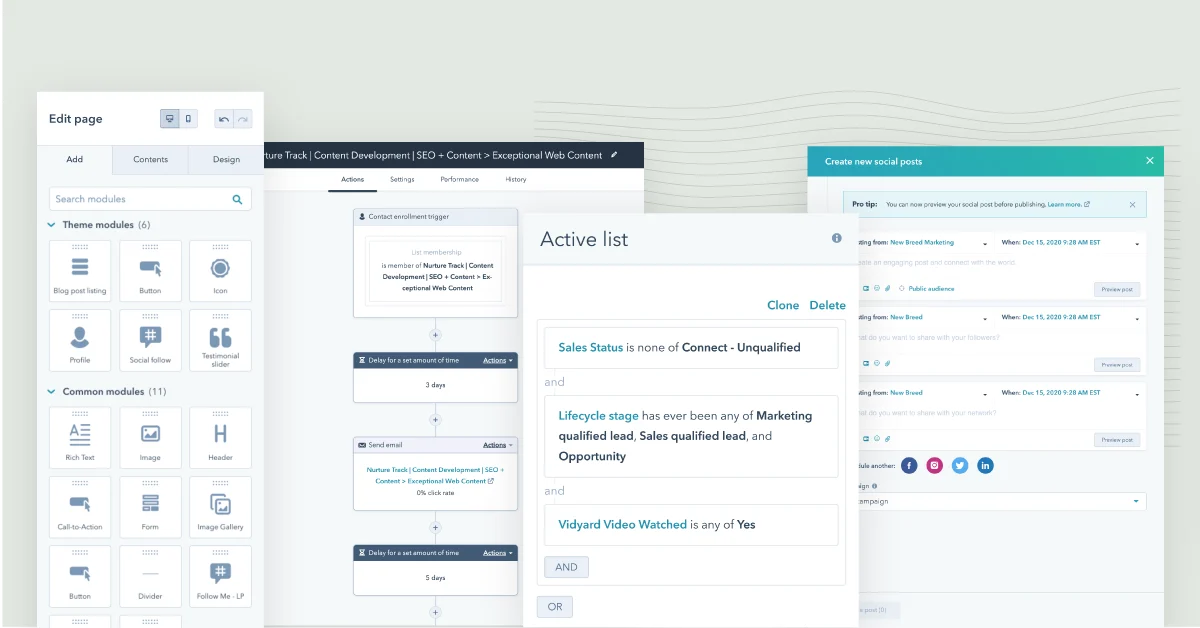
HubSpot is the platform most mid-market teams already know, and Marketing Hub extends that familiarity into orchestration-adjacent territory: workflow automation, native CRM, and reporting that a generalist marketer can actually run without a dedicated ops hire. It won't match the account-based depth of the enterprise platforms on this list, but for teams that don't need that depth, the usability gap is significant.
Best for: mid-market teams wanting orchestration without enterprise complexity
Standout capabilities:
- Native CRM with no separate data unification project required.
- Visual workflow builder usable by non-specialists.
- Custom reporting and dashboards built for marketers, not just analysts.
- AI-assisted content and campaign tools (Breeze AI).
- Tight integration across Sales, Service, and Content Hubs.
- Straightforward contact-tier pricing model.
Integrations: native Sales Hub and Service Hub, plus a large App Marketplace covering ad platforms, e-commerce, and data tools.
Pricing: Free tier available; Starter from $20 per seat per month; Professional around $890 per month (3 seats, 2,000 contacts) plus a mandatory $3,000 onboarding fee; Enterprise around $3,600 per month (5 seats, 10,000 contacts) plus a $6,000 to $7,000 onboarding fee. Contact-tier overages apply as your list grows past plan limits.
Limitation: it's genuinely easier to use, but that ease comes at the cost of depth. Complex, multi-stakeholder orchestration at true enterprise scale is not where HubSpot competes best.
5) Salesforce Marketing Cloud
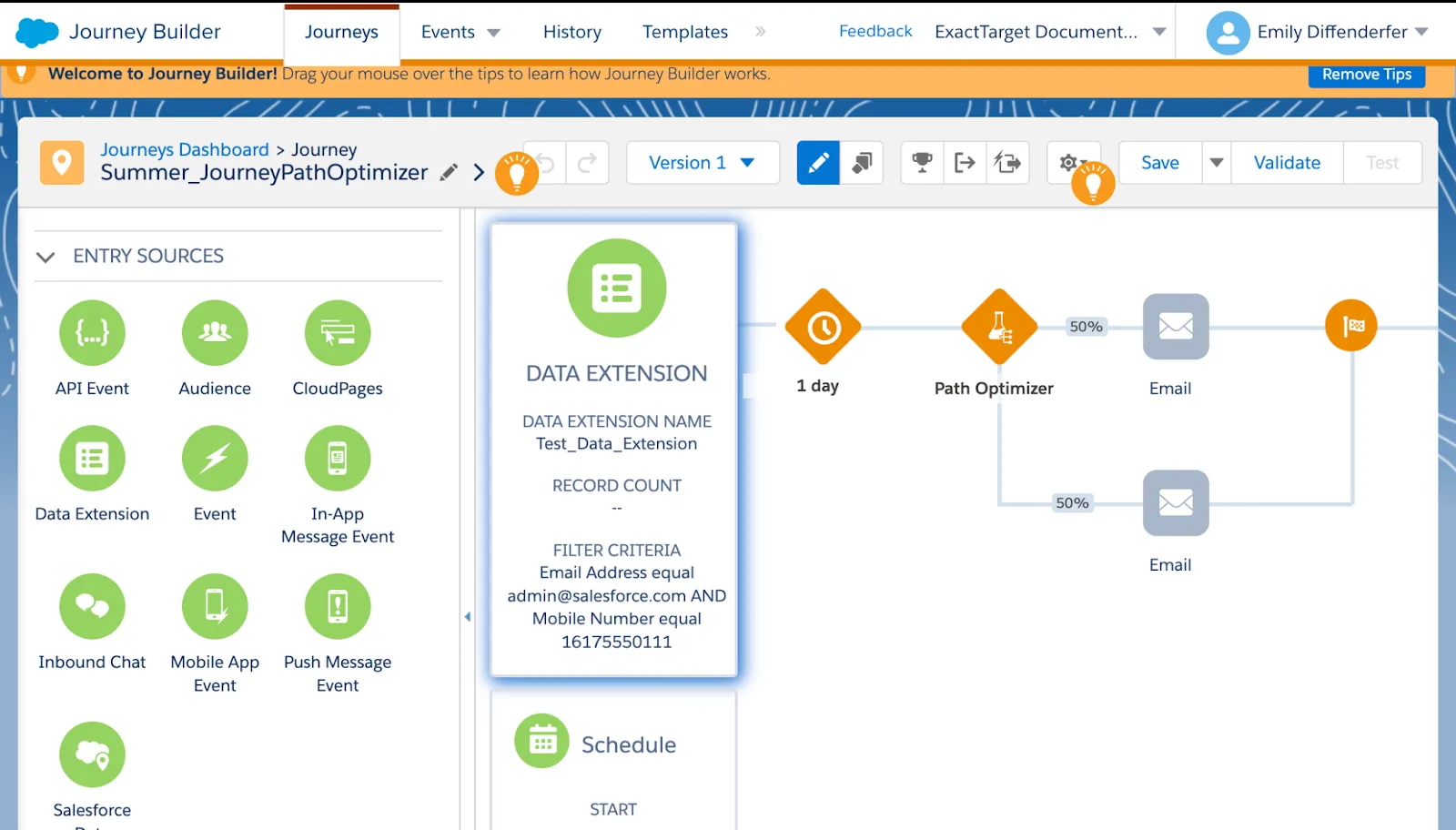
If your company already runs on Salesforce, Marketing Cloud's biggest advantage is that it isn't a separate system fighting your CRM for the truth. Journey Builder handles cross-channel sequencing, and the deep native tie to Sales Cloud means marketing and sales coordination doesn't depend on a third-party sync staying healthy. Salesforce restructured its Marketing Cloud packaging in 2025 into "Marketing Cloud Next" editions alongside its legacy Engagement products, so expect some naming overlap during a sales conversation.
Best for: organizations already standardized on Salesforce
Standout capabilities:
- Journey Builder for visual, cross-channel sequencing.
- Deep native integration with Sales Cloud and Service Cloud.
- Einstein AI features for send-time optimization and scoring.
- Account Engagement (formerly Pardot) for B2B-specific lead nurture.
- Multi-business unit support for complex org structures.
- Strong ecosystem of certified implementation partners.
Integrations: native across the full Salesforce ecosystem, plus AppExchange partners for ads, data, and analytics
Pricing: published entry pricing includes Marketing Cloud Next Growth Edition at $1,500 per organization per month and Advanced Edition at $3,250 per organization per month. Legacy Engagement editions list Pro around $1,250 per month and Corporate around $3,750 per month, with Enterprise custom-quoted. Full enterprise stacks with additional business units, Personalization, or Marketing Intelligence commonly land well into five and six figures annually.
Limitation: complexity and cost climb fast once you go beyond the entry tier, and most implementations lean on outside consultants to get live.
6) Oracle Eloqua
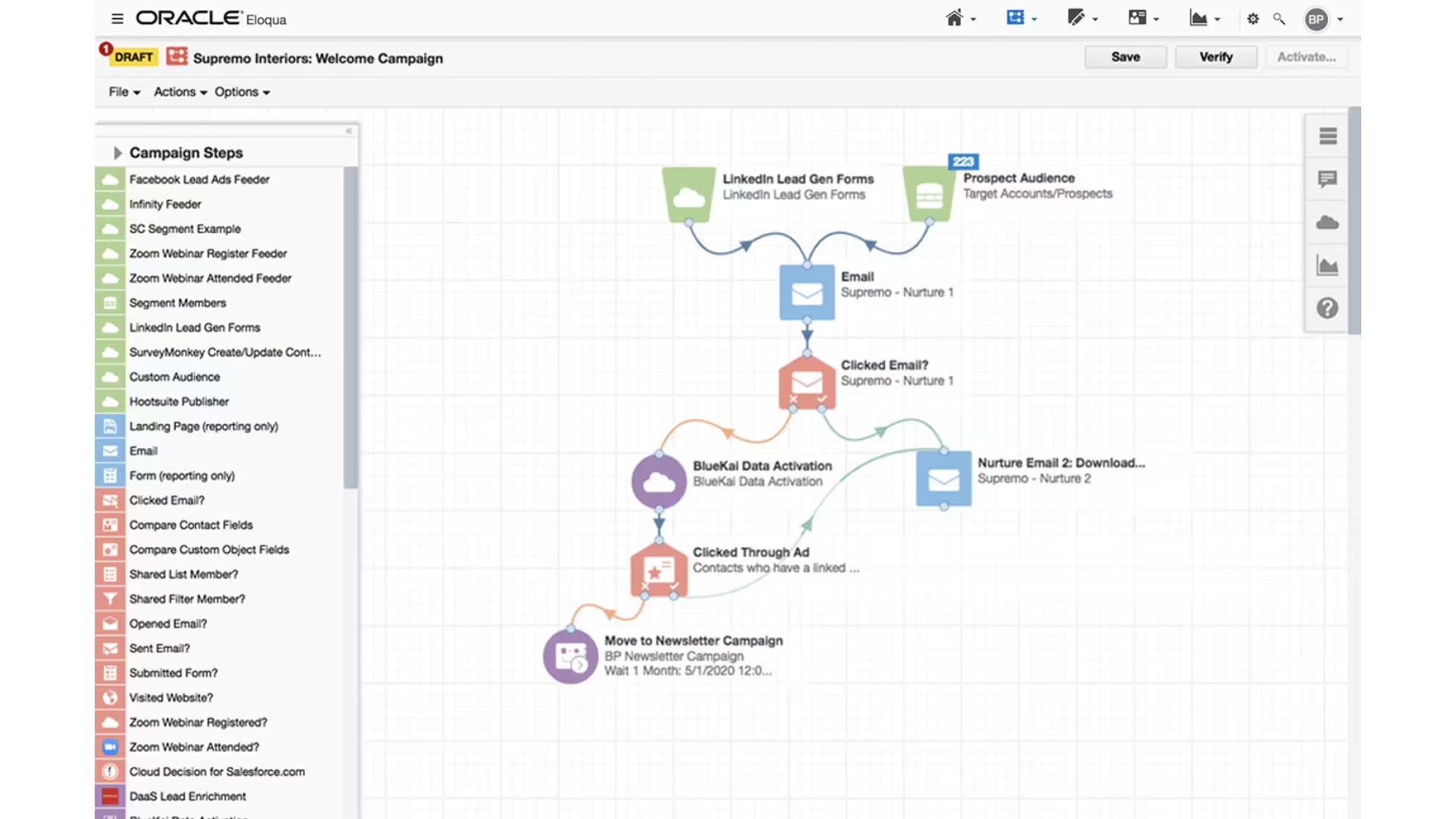
Eloqua is one of the older names in this category, and it's built for exactly the kind of enterprise that needs granular segmentation, multi-region compliance, and mature governance more than it needs a modern interface. Oracle prices it on a contact-meter model, meaning your bill tracks database size rather than how much you actually market to those contacts, which catches a lot of buyers off guard at renewal.
Best for: large enterprises with complex compliance and multi-region needs
Standout capabilities:
- Granular segmentation for complex org structures.
- Mature governance and compliance controls for regulated industries.
- Campaign orchestration at scale across large contact databases.
- Account-based marketing tools at the top tier.
- API access for custom integrations.
- Established partner network for global implementations.
Integrations: Salesforce, Microsoft Dynamics, Google Analytics, and a broad Oracle CX ecosystem.
Pricing: Oracle doesn't publish transparent pricing, and quotes are built on a combination of edition and marketable contact tier. Entry packages commonly start around $2,000 to $4,000 per month for smaller contact volumes, with most real-world deployments landing between $6,000 and $15,000 per month once add-ons and contact growth are factored in. Enterprise deployments with advanced ABM tooling run considerably higher.
Limitation: the interface feels dated next to newer entrants, and the contact-meter pricing model means unmanaged database growth can push you into a higher tier without any change in campaign activity.
7) Iterable
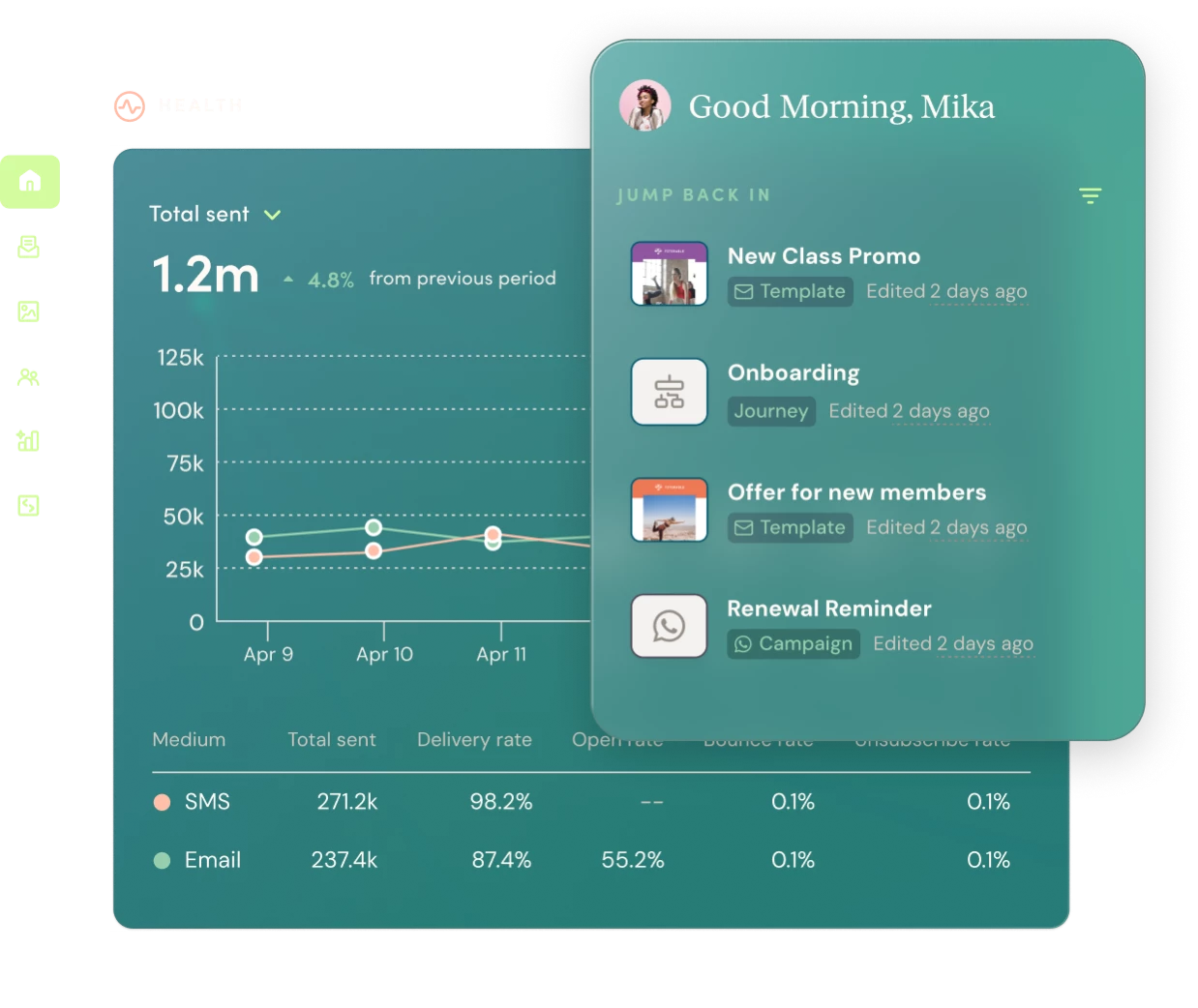
Iterable is the outlier on this list in one important way: it's stronger in B2C and hybrid consumer models than it is B2B-native. Its flexible data model and visual workflow builder handle high-volume, multi-channel journeys well, which is why it shows up on B2B shortlists at companies with a large user base or freemium product motion, even though the ABM-focused platforms above it are more purpose-built for classic B2B account-based orchestration.
Best for: high-volume cross-channel journey orchestration, strongest in B2C and hybrid models
Standout capabilities:
- Flexible data model that adapts to varied event and user schemas.
- Visual, drag-and-drop workflow builder.
- Multi-channel messaging across email, push, SMS, and in-app.
- Nova Intelligence AI layer for segmentation and send-time decisions.
- Smart Ingest for reverse-ETL data activation from your warehouse.
- Command Center for goal-based, cross-campaign performance views.
Integrations: Segment, Snowflake, major data warehouses, and a broad partner ecosystem for e-commerce and product analytics tools
Pricing: no public pricing. Iterable quotes by tier (Growth, Premier, Enterprise) based on monthly active users and channel mix. Vendr data shows small deployments starting around $3,000 to $6,000 per month, with mid-market contracts commonly falling between $50,000 and $200,000 annually, and mature enterprise deployments reaching $240,000 to $400,000+ per year. Implementation fees of $5,000 to $20,000 are typical on top of the platform cost.
Limitation: it's less B2B-native than the ABM-focused platforms on this list, and its pricing model rewards consumer-scale user volumes more than typical B2B contact counts.
A quick note: intent data inclusion and attribution depth are exactly where quoted prices diverge most from real cost. A platform that looks moderately priced on its homepage can end up in "very high" territory once you add the intent data module, the advertising spend, or the account-level attribution add-on that wasn't in the base quote.
Pricing Realities and Hidden Costs
Entry pricing almost never reflects what you'll actually pay. Here's where the gap comes from.
Database-size pricing means your bill grows whether or not results do. Several platforms on this list, Eloqua especially, price primarily on contact volume. A list that grows from conference imports or old campaign data can push you into a higher band without a corresponding lift in pipeline.
Intent data is frequently a separate purchase. Platforms that market intent as core to the pitch, like 6sense and Demandbase, often gate the full data set behind an add-on module. Get this itemized before you sign, not after.
Implementation and consulting fees add up fast. Enterprise deployments across this category commonly run $10,000 to $50,000+ in one-time implementation costs, on top of the recurring platform fee.
Internal headcount is a real cost, even though it's never on the invoice. Most enterprise platforms need at least one dedicated marketing operations admin to run well. Budget that salary against the platform decision, not separately from it.
Contract terms compound the problem. Multi-year commitments with 3% to 10% annual renewal escalators are standard across nearly every vendor here. A 20% renewal jump at year two is common enough to plan for rather than be surprised by.
The practical fix: model three-year total cost, including data modules, implementation, and internal headcount, rather than comparing year-one list prices side by side.
How to Choose the Right Platform
Start from your CRM. The platform that integrates natively with your existing CRM will usually win on total cost, even if its sticker price looks higher, because you avoid building and maintaining a custom sync.
Match to company size honestly. Enterprise platforms punish teams without dedicated ops headcount. If you don't have someone whose job is to run the platform, an enterprise tier will underperform its own feature list.
If intent data is the reason you're buying, prioritize native inclusion. Don't pay enterprise prices for a platform's brand name and then discover the actual intent data you wanted is a separate line item.
If usability and speed matter more than depth, don't over-buy. A mid-market team forcing itself onto an enterprise platform because it "looks more serious" usually ends up under-using 60% of what they paid for.
Run a scoped pilot before signing a multi-year term. Most vendors will negotiate a paid pilot for a qualified deal, even without a formal free trial. Use it.
Ask for reference customers at your size, in your industry. Not their flagship enterprise logo. A 5,000-employee case study tells you nothing about how the platform performs for a 200-person team.
The honest question worth sitting with before you sign anything: is coordination genuinely your constraint right now, or is it demand? A marketing orchestration platform solves the first problem. It does nothing for the second.
What Orchestration Platforms Can't Do
They coordinate and measure demand. They don't create it.
No amount of signal detection or cross-channel sequencing fixes a weak offer, an undifferentiated message, or an ICP that's too broad to target well. If your top-of-funnel volume is thin, a sophisticated platform just measures that thinness more precisely, with better dashboards.
Attribution clarity is genuinely valuable, but it doesn't increase pipeline. It tells you where the pipeline you already have came from. And because implementation timelines on most of these platforms run one to two quarters, the value of your investment often arrives well after the spend starts.
The sequencing that actually works: prove you can generate demand reliably before investing heavily in coordinating it. Buying orchestration to fix a pipeline problem is one of the more expensive mistakes a marketing team can make in 2026.
How Cleverly Fills the Top of the Funnel
Orchestration platforms earn their cost when there's enough demand flowing through them to coordinate. A lot of teams buy one anyway to solve what's actually a pipeline problem, and that's where the math falls apart.
Cleverly isn't a martech platform. It's the demand layer that feeds one. We run outbound end to end: defining your ICP, building verified prospect lists, and executing outreach across LinkedIn, cold email, and cold calling through to booked meetings.
That outbound activity is exactly the account engagement your orchestration platform is built to coordinate and measure. The two aren't competing purchases, they're sequential ones.
The practical difference is speed. Outbound produces pipeline in weeks. Platform implementation typically takes quarters. We optimize for one outcome specifically: qualified meetings held with in-ICP decision-makers, the kind of consistent signal that makes your orchestration investment worth coordinating in the first place.
Across our client base, that approach has generated $312 million in pipeline for the B2B companies we work with.
If you're investing in orchestration but short on pipeline to actually orchestrate, book a strategy call with Cleverly and let's talk about fixing that first.
Conclusion
The best platform on this list is the one that fits your CRM, your team's actual operational capacity, and the specific reason you're buying in the first place.
Intent data inclusion and attribution depth are where real cost diverges most sharply from the number on the pricing page, so model three-year total cost and run a pilot before you commit to a multi-year term.
And keep the sequencing in mind before you sign anything: orchestration multiplies demand you already have. Make sure you have it first.
Frequently Asked Questions
Free Resource
How to Scale a Profitable Cold Call System
Get the complete guide — download it instantly now.
Free Ebook
Download the Free Guide
Enter your details to get instant access.
You're all set! 🎉
Your ebook is downloading now.
Click below if the download didn't start automatically.