

Table of Contents
Why Lead Generation for Flooring Contractors Requires a Specific Approach
The Foundation: What Every Flooring Contractor Needs Before Investing in Any Strategy
7 Lead Generation Strategies for Flooring Contractors in 2026
How to Measure Flooring Lead Generation Performance
How Cleverly Helps Flooring Contractors Build Commercial Pipelines Through Outbound Lead Generation
Conclusion
Frequently Asked Questions
Modified On :
June 29, 2026
Key Takeaways
- Lead generation for flooring contractors requires different strategies for residential and commercial clients — inbound channels like local SEO and Google Ads capture homeowner demand, while commercial pipeline comes from proactive outbound outreach to property managers and developers.
- Before investing in any channel, flooring contractors need three things in place: a conversion-ready online presence, a minimum of 15–20 Google reviews above 4.5 stars, and a fast lead response system — without these, incoming leads don't convert.
- Responding to a lead inquiry within the first hour increases conversion rates up to 7x — speed-to-response is the single highest-impact conversion variable in flooring lead generation.
- The 7 strategies that generate consistent flooring leads in 2026 are: local SEO, Google Ads and LSAs, referral programs, trade partnerships, social media, email nurturing, and outbound outreach to commercial prospects.
- Flooring contractors who depend on a single channel — typically referrals or a single ad platform — are one algorithm change or slow season away from an empty pipeline; a diversified, multi-channel approach is what builds a resilient, year-round pipeline
Flooring is a $24 billion industry in the US, and yet most flooring contractors are still running their pipelines like it's 2015 — relying on referrals, word-of-mouth, and the occasional Angi lead. That worked when competition was thinner. It doesn't work now.
The challenge in 2026 isn't that lead generation options don't exist. It's knowing which ones are actually worth the time and money for a flooring business specifically. The flooring industry hit some real headwinds — total sales dropped to $23.95 billion in 2024, down 4.6% from the year prior — which means more contractors are competing for the same pool of projects.
In that environment, the contractors building consistent pipelines are the ones with a real system, not just a Facebook page and a prayer.
Lead generation for flooring contractors is different from other home services. Flooring is a high-ticket, high-consideration purchase. Buyers compare, deliberate, and take weeks or months to decide. The strategies that work have to match that buying behavior. And the residential and commercial markets require completely different approaches.
This guide covers why flooring lead generation requires a specific playbook, what foundation every contractor needs before spending a dollar on marketing, and 7 proven lead generation strategies for flooring contractors that are building real pipelines in 2026 — from local SEO to outbound outreach targeting commercial clients who never show up on Google.
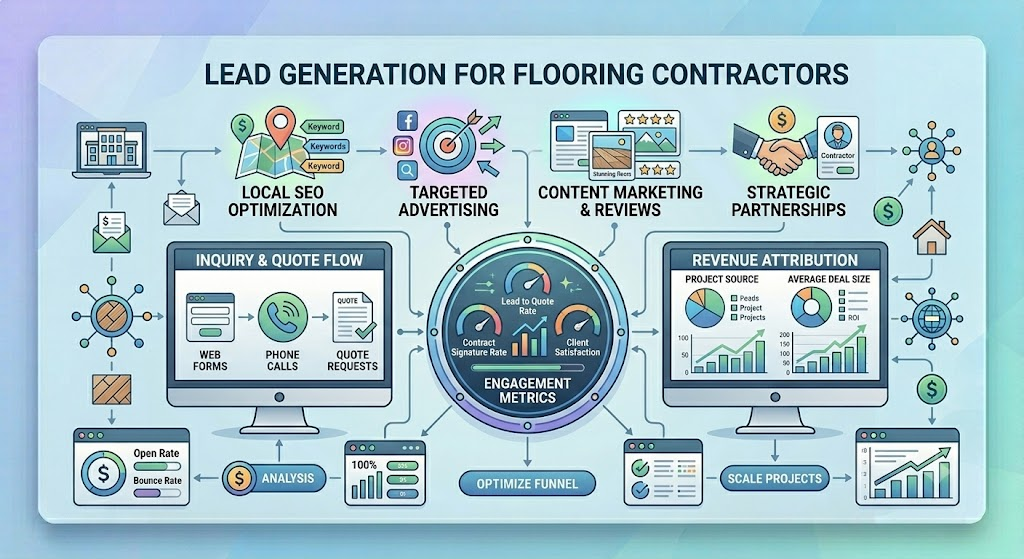
Why Lead Generation for Flooring Contractors Requires a Specific Approach
Not all home services are created equal from a lead generation standpoint. Flooring lead generation has specific dynamics that shape which channels work and how they need to be executed.
It's a high-consideration purchase. Homeowners don't pick a flooring contractor the way they pick a plumber for an emergency fix. They research materials, compare quotes, look at portfolios, read reviews, and often sit on a decision for weeks. Lead generation strategies have to account for a longer evaluation window — which means nurture matters as much as capture.
The trust bar is higher than most services. Flooring is permanent and visible. A bad installation lives in the home for years. Prospects need more social proof and credibility before they convert than they do for lower-stakes services. Reviews, portfolio photos, and referrals carry disproportionate weight in this category.
Residential and commercial are completely different games. Residential leads come from search, referrals, and social media — higher volume, lower average job value, shorter decision cycle. Commercial leads — from property managers, developers, facility managers — come from outbound outreach and relationship-based selling. Lower volume, much higher contract value, longer sales cycle. The best flooring lead generation systems address both.
Seasonality creates volatility. Flooring demand peaks in spring and fall. Contractors who depend on a single channel with seasonal patterns face real revenue swings. A diversified approach across multiple channels is what smooths the pipeline through slower months.
🚀 Need 15–30 More Qualified Appointments Every Month?
We help service businesses generate consistent sales opportunities through LinkedIn, cold email, and outbound prospecting.
The Foundation: What Every Flooring Contractor Needs Before Investing in Any Strategy
Spend money on ads or SEO before this foundation is in place, and you'll generate leads that don't convert. The investment goes to waste. These three elements need to be locked in first.
A Credible, Conversion-Ready Online Presence
The first thing any prospect does after hearing about a flooring contractor — from any source — is look them up online. A weak website, missing reviews, or an incomplete Google Business Profile kills conversions before the conversation starts.
The minimum viable online presence for lead generation for flooring contractors includes: a website with clear service descriptions, geographic coverage, before-and-after project photos, and a prominent contact form or call button; a fully completed Google Business Profile with photos, business hours, service areas, and responses to every review; and a minimum of 15–20 Google reviews averaging above 4.5 stars.
Businesses with optimized Google profiles receive about 70% more customer inquiries than those without. That stat alone should tell you how much is being left on the table by an incomplete profile.
A contractor with 50 reviews and a 4.8 average will consistently convert more incoming leads than one with 5 reviews and a 4.2 average — regardless of which channel generated the lead in the first place.

A System for Responding to Leads Fast
Studies show that responding to a homeowner within the first hour can increase conversion rates up to 7x compared to waiting a day or more. Why? Because homeowners requesting quotes typically contact multiple contractors at the same time. The first one to respond frames the entire comparison.
The response system needs: immediate lead notifications (text or app alert, not just email), a defined protocol for each channel (web form, phone call, Google message), and a follow-up sequence for leads that don't respond to the first contact.
A basic CRM — even something as simple as Jobber or HubSpot Starter — that logs every lead, tracks response status, and triggers follow-up reminders is the infrastructure that makes every other lead generation strategy for flooring contractors actually work. Without it, leads arrive and disappear.
7 Lead Generation Strategies for Flooring Contractors in 2026
These 7 strategies cover both inbound and outbound channels. The most effective flooring lead generation systems combine both — inbound builds consistent residential volume, outbound drives high-value commercial contracts. Use them together for a pipeline that doesn't depend on any single source.
Strategy 1 — Local SEO and Google Business Profile Optimization

Local SEO is the highest-ROI long-term lead generation channel for flooring contractors — full stop. It captures demand that already exists. Homeowners searching "hardwood flooring installer near me" or "vinyl plank flooring [city]" are ready to buy. They just need to find the right contractor.
When homeowners need new flooring installed, repaired, or replaced, they search Google — and the businesses at the top of those search results get most of the calls, estimate requests, and booked jobs.
The most important local SEO action is claiming, completing, and actively managing the Google Business Profile. 42% of searchers click on Google Map Pack results — that's prime real estate for your flooring business. Photos, service descriptions, correct categories, hours, and responses to every review all contribute to both ranking and conversion.
Keyword targets for flooring lead generation through SEO include local intent keywords ("flooring contractor [city]," "floor installation near me"), material-specific searches ("hardwood flooring installer," "LVP installation"), and room-specific searches ("kitchen flooring replacement," "bathroom tile installation"). These represent the bulk of high-intent flooring search traffic.
Timeline expectation: flooring contractors investing in local SEO typically see meaningful organic lead volume by month 4–6. It's a long-term investment with compounding returns — but it eventually produces the lowest cost-per-lead of any channel on this list.
Strategy 2 — Google Ads and Local Service Ads (LSAs)
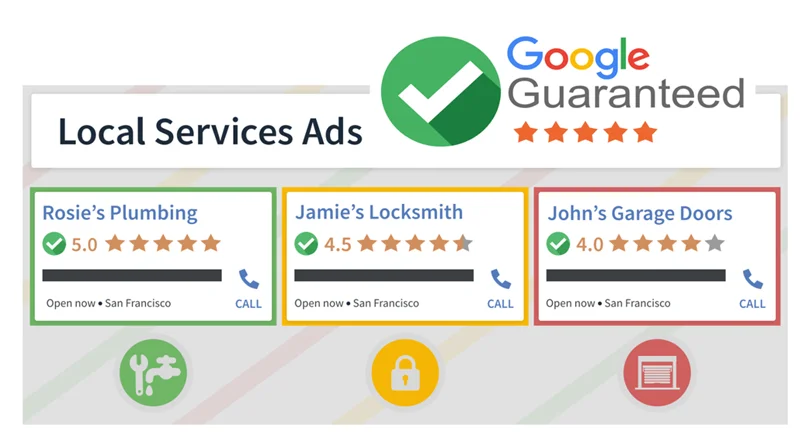
Google Ads and Local Service Ads generate leads immediately. Unlike SEO, there's no ramp-up period. For flooring contractors who need pipeline now while building long-term organic presence, paid search is the fastest way to appear in front of in-market buyers.
Google Local Services Ads are especially powerful for flooring contractors because they show verified businesses at the top of search results and are based on leads, not clicks — making them cost-efficient for high-ticket jobs
Google Ads targeting for flooring should focus budget on high-intent keywords ("flooring installation quote," "flooring contractor near me," "hardwood floor refinishing"), a tight geographic radius matching the actual service area, and negative keywords that filter out job seekers and DIY queries.
The landing page matters as much as the ad. Paid traffic only converts well if it lands on a page with a specific offer, a clear CTA (free estimate or free consultation), and social proof. Sending Google Ads traffic to a generic homepage is one of the most common flooring contractor advertising mistakes. Dedicated landing pages per service type — hardwood, LVP, tile, refinishing — produce significantly lower lead costs.
Strategy 3 — Referral Program

Referral leads convert 30% higher than other marketing channels because they arrive with pre-built trust from someone the prospect already knows. For most flooring contractors, referrals are already the highest-converting lead source. The problem: they happen by accident rather than by design.
A structured referral program turns an unpredictable lead source into a reliable one. Define the referral ask clearly (who to refer, what to say), make it easy (a simple text or link the customer can share), and reward it consistently — a cash payment, discount, or gift card per referred job that converts.
Timing the ask is everything. The best moment is immediately after a successful installation, when the customer is at peak satisfaction. Build the referral ask into your post-project follow-up process rather than leaving it to individual rep judgment or hoping it happens naturally.
Don't overlook the commercial referral angle. 29% of contractors cite referrals as their best lead source in industry surveys. Satisfied commercial clients — property managers, office managers — manage multiple properties and interact regularly with other decision-makers in their industry. A single commercial referral can produce multiple contract opportunities from a tight-knit professional network.
Strategy 4 — Strategic Partnerships With Adjacent Trades and Businesses

Strategic partnerships generate warm, pre-qualified leads because they come through a trusted intermediary who already has a relationship with the prospect. You enter the conversation with borrowed credibility.
The highest-value partnership categories for how flooring companies generate leads through referrals include:
- Interior designers and architects — who specify flooring for projects and need a reliable contractor to execute.
- Real estate agents and property managers — who need flooring refreshed or replaced before listing or leasing.
- General contractors and home builders — who include flooring as part of larger renovation or construction packages.
- Building material suppliers — local flooring showrooms and big-box retailers that refer customers who purchase materials but need a professional installer.
Building these partnerships isn't complicated. Identify the highest-value adjacent businesses in your local market. Reach out with a specific value proposition — fast turnaround, warranty, installer quality. Offer to do a small project at a preferred rate to demonstrate the work. Then formalize the referral arrangement with a clear process and mutual accountability.
The commercial partnership angle is particularly valuable: a single partnership with a property management firm that oversees multiple buildings can produce 10–20 flooring contracts per year from one relationship.
Strategy 5 — Social Media Marketing With Before-and-After Content

Social media is one of the most effective flooring lead generation channels specifically because flooring is a visual product. Before-and-after transformation photos drive organic engagement, direct inquiries, and referrals from the contractor's network — all without ad spend.
What content converts for flooring businesses:
- Before-and-after project photos — the transformation is the most compelling content format in home services
- Short video walkthroughs of completed projects, especially timelapse installs
- Material comparison posts ("Hardwood vs. LVP: which is right for your home?")
- Customer testimonials on camera — filmed in the finished space, with the floors visible
Platform focus: Instagram and Facebook for residential homeowner audiences (visual content, neighborhood groups, retargeting ads); LinkedIn for commercial targeting (property managers, facility managers, developers — more on that in Strategy 7).
The neighborhood group strategy deserves its own callout. Active participation in local Facebook groups and Nextdoor communities — answering flooring questions, sharing project photos, being a visible local resource — produces organic lead flow with zero advertising spend.
Flooring contractors who become the trusted voice in local home improvement groups consistently generate inquiries from neighbors who see the transformation photos and ask for a quote.
Consistency is the requirement: social media lead generation needs 3–5 posts per week minimum to maintain algorithm reach. Build a posting schedule around project completions — every finished job produces at least one piece of content. That keeps the feed active without requiring separate content creation time on top of everything else.
Strategy 6 — Email Marketing and Lead Nurturing

Email marketing generates an average $44 return for every $1 invested. For flooring contractors, the highest-value applications are nurturing leads who requested a quote but didn't convert immediately, and staying top of mind with past customers for repeat and referral business.
The quote follow-up sequence: Most flooring prospects request multiple quotes and take weeks to decide. A structured email follow-up sequence — initial thank you, project inspiration content, a case study from a comparable project, a limited-time offer — keeps your name in front of the prospect through the decision window. Without a follow-up sequence, leads who didn't respond immediately disappear and get booked by whoever followed up.
Past customer nurture: Flooring needs change over time. A customer who got hardwood installed three years ago may now be considering bathroom tile or a basement floor. A quarterly email to past customers with relevant project inspiration, seasonal maintenance tips, and a referral invitation keeps the relationship active and generates both repeat business and referrals from the same base.
Seasonal campaigns: Send targeted emails in late winter (pre-spring renovation season) and late summer (pre-fall season) to both prospects and past customers with a specific offer tied to scheduling — "Book your spring installation by March 15 and get priority scheduling" creates urgency that converts leads who were already interested but hadn't committed.
Strategy 7 — Outbound Outreach to Commercial Prospects

Commercial flooring contracts — office buildings, retail spaces, apartment complexes, hotels, schools — are the highest-value jobs in the flooring industry. A single commercial contract can be worth 5–20x a residential job. The challenge: commercial clients don't find flooring contractors through Google the way homeowners do. They need to be reached proactively.
The commercial ICP for flooring lead generation outreach includes:
- Property managers — who oversee multiple buildings and need flooring replaced or maintained on a recurring cycle.
- Commercial real estate developers — who need flooring specified and installed for new builds and major renovations.
- Facility managers at corporate offices — who handle interior maintenance and periodic refresh projects.
- Hotel operations managers — who oversee large-scale flooring renovation projects across multiple rooms and common areas.
How to reach them: a targeted outbound sequence — LinkedIn connection requests with a specific message about commercial flooring capacity, cold email to property management companies with a project portfolio and a low-friction ask (a site visit or capacity conversation), and cold calling to follow up on email outreach. Run consistently, this produces a reliable pipeline of commercial inquiries that doesn't depend on inbound search volume at all.
The U.S. commercial flooring market reported around $7.019 billion in sales in 2025, with asset classes like healthcare, education, and hospitality holding up particularly well. Flooring contractors who proactively reach the decision-makers in these segments aren't competing against every other contractor who showed up in a Google search — they're the first conversation, which shapes the evaluation before the prospect starts comparing alternatives.
What to include in commercial outreach: specific project examples from comparable commercial properties, a clear description of commercial capacity (crew size, timeline per square foot, minimum project size), a reference from an existing commercial client if available, and a single low-friction ask to start the conversation.
📈 10,000+ Businesses Have Scaled With Cleverly
Our outbound lead generation system builds a predictable pipeline—so your team spends more time closing deals and less time chasing leads.
How to Measure Flooring Lead Generation Performance
Generating leads is half the job. Knowing which leads are coming from where — and what they're costing you — is what lets you optimize the system over time.
1. Lead volume by channel, tracked weekly. How many leads came from Google organic, Google Ads, referrals, social media, partnerships, email, and outbound outreach? This tells you which channels are producing and which are consuming budget without results.
2. Cost per lead by channel. Divide total spend on each channel — including time value for organic and social — by the number of leads it produced. This is what tells you where to invest more and where to pull back.
3. Lead-to-estimate conversion rate. What percentage of leads become a submitted estimate? A rate below 50% typically indicates either the leads are unqualified for your service area or price point, or the response speed and follow-up process is losing leads before the estimate is booked.
4. Estimate-to-close rate. What percentage of submitted estimates become signed contracts? Industry benchmarks for flooring range from 25–40%. Below 25% typically indicates a pricing, presentation, or competitor comparison problem — not a lead generation problem.
5. Revenue by source. Track which lead sources produce the highest-value contracts over time. Referrals and partnerships often produce higher-ACV jobs than paid ads. That difference should drive investment decisions even when raw lead volume is lower.
How Cleverly Helps Flooring Contractors Build Commercial Pipelines Through Outbound Lead Generation

The residential flooring market is competitive and heavily dependent on local search. The commercial flooring market is a different story — most contractors are waiting for commercial clients to find them rather than going out and building relationships with the decision-makers who commission large-scale flooring projects.
That gap is exactly where outbound outreach creates an advantage.
We run done-for-you B2B lead generation campaigns across LinkedIn, cold email, and cold calling — targeting the specific commercial decision-makers who commission flooring projects: property managers overseeing multiple buildings, real estate developers managing new construction and renovation cycles, and facility managers responsible for ongoing interior maintenance.
These are the buyers who never show up in your Google Analytics but represent the highest-value contracts in your market.
Here's how it works in practice: we build ICP-matched prospect lists of commercial property and facilities decision-makers in your geographic market, write personalized multi-touch outreach sequences that lead with your commercial project portfolio and capacity, and handle the outreach execution from start to finish — so qualified commercial conversations land directly on your calendar without your team spending hours prospecting.
Flooring contractors working with us don't have to compete on Google Ads for the same residential leads as every other contractor in their market. They build a separate, parallel commercial pipeline from proactive outreach to buyers who manage multiple properties and commission projects throughout the year.
We've generated 224.7K leads, $51.2M in client revenue, and $312M in pipeline for 10,000+ clients — rated 4.6/5 on Trustpilot across 1,136+ reviews.
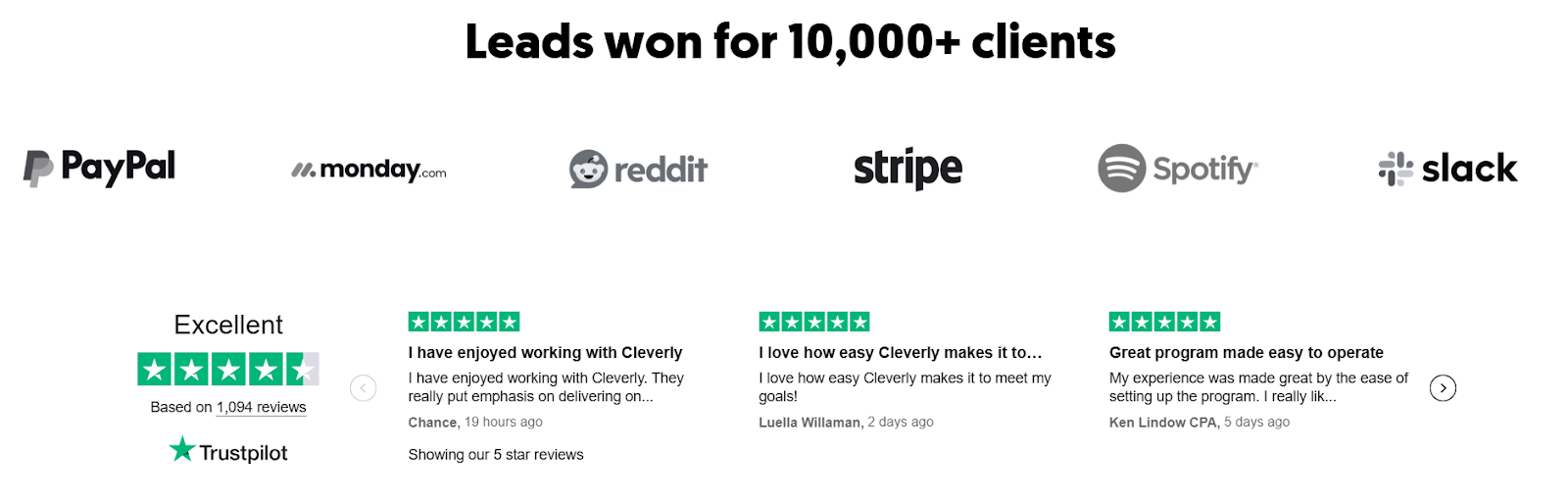
Ready to add a commercial flooring pipeline that doesn't depend on Google? Book a strategy call with Cleverly and see exactly how we'd build your outbound outreach to property managers and developers in your market.
Conclusion
Flooring contractors who depend on a single lead source are one algorithm change or one slow season away from an empty calendar. The contractors growing consistently in 2026 are running multiple channels at once — local SEO for long-term inbound, Google Ads for immediate volume, referrals for trust-based conversions, partnerships for warm introductions, social media for visibility, email for nurture, and outbound outreach for commercial pipeline.
Start with the foundation first. Get the Google Business Profile complete, build the review count above 15, and put a fast response system in place. Then add channels in order of ROI for your specific market and customer mix. Measure by cost per lead and revenue per source. Invest more in what's working, and stop funding what isn't.
The residential and commercial markets need different approaches — combining inbound for homeowners with outbound for commercial clients is what gives a flooring business the most diversified, resilient pipeline in any market condition.
Frequently Asked Questions
Free Resource
How to Scale a Profitable Cold Call System
Get the complete guide — download it instantly now.
Free Ebook
Download the Free Guide
Enter your details to get instant access.
You're all set! 🎉
Your ebook is downloading now.
Click below if the download didn't start automatically.


