Table of Contents
What to Look For in an AI Sales Roleplay Tool
The Three Tiers of AI Roleplay Tools
7 Best AI Sales Roleplay Tools
Quick Comparison of AI Roleplay Tools
Pricing Realities in This Category
How to Choose the Right Tool for Your Team
Where Training Tools Stop and Capacity Starts
Conclusion
Frequently Asked Questions
Modified On :
November 2, 2026
Key Takeaways
- The tier you buy matters more than the brand. Pick it from team size and budget before you compare vendors.
- Persona difficulty decides whether practice helps. A cooperative AI buyer trains reps to expect an easy call.
- A well-written prompt in a general AI assistant delivers a real share of the value for small teams, so test that first.
- Pricing in this category is mostly quote-only and published figures conflict. Verify on the vendor’s own site and ask about contract terms.
- Measure ramp time and live call results. Session counts and simulation scores prove very little.
Every new SDR makes a few hundred bad calls before they sound like a pro. Without practice, those calls land on real accounts, and in a finite market those accounts do not come back. That is the reason AI sales roleplay tools exist.
The numbers show why it matters. The Bridge Group’s 2025 research puts average SDR ramp time at 3.0 months. Belkins’ analysis of 175,000+ dials found that roughly one in ten calls connects. Cognism’s 2026 data puts the average cold calling success rate at 2.7%, up from 2.3% in 2025. You get a few live shots, so each one has to count.
These tools split into three tiers, and team size and budget matter far more than feature lists. There is also an option vendors rarely mention: a good persona prompt in a general AI assistant gives small teams real value at no cost.
Below, we cover what to evaluate, the tiers, the seven options, pricing realities, and how to choose.
What to Look For in an AI Sales Roleplay Tool
Most buyers start with the demo video and a feature grid. That is backwards. With sales roleplay software, a few factors decide whether reps improve, and most of them are invisible on a pricing page.
The factors that decide whether practice works
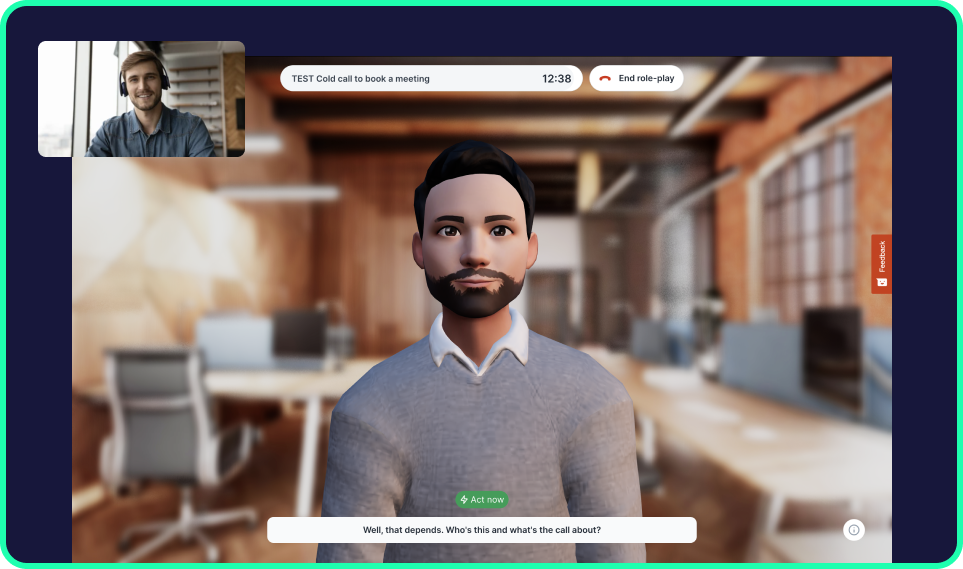
- Persona configurability. This matters more than anything else. AI buyers default to being cooperative and polite. Useful practice needs hostile, distracted, and skeptical buyers.
- Voice quality and realism. For cold call practice, tone and interruptions matter. A buyer who waits politely for your whole pitch teaches the wrong habits.
- Scoring and rubric control. Can you define what a good call looks like for your offer, or are you stuck with a generic rubric?
- Scenario library versus build effort. A big prebuilt library saves time. Custom scenarios make practice relevant. You want both, in the right ratio for your team.
The factors that decide whether the tool survives
- Team reporting. Managers need to see progression over weeks, not just individual session scores.
- CRM and conversation intelligence integration. This matters if you want roleplay scores next to live call data.
- Onboarding effort. Tools that need weeks of scenario building often go unused.
- Pricing model. It ranges from per-seat monthly plans to quote-only annual contracts.
The practical filter
A tool your managers will not administer is worse than a good prompt in a general assistant. Before any demo, name the person who will own it. If you cannot, the feature list does not matter.
Pro tip: In every trial, configure the hardest buyer the tool allows and run your own opener against it. If the AI folds after one decent question, you have learned what you needed to know.
🎯 Train for Real Calls. Then Book More of Them.
AI roleplay builds SDR confidence before the first call. Cleverly helps B2B teams turn targeted cold calling into qualified meetings.
The Three Tiers of AI Roleplay Tools
Frame the buying decision before the list. The price range in this category runs from free to quote-only enterprise contracts. A team of three SDRs and a 2,000-rep field force are not shopping for the same thing, even though both search for AI sales training software.
Tier One: General AI With a Persona Prompt
This costs nothing beyond an existing subscription. It works surprisingly well for text and basic voice practice. It suits small teams, founders, and anyone testing whether roleplay helps before they buy anything.
Tier Two: Dedicated Roleplay Platforms
These tools offer purpose-built personas, voice simulation, scoring, and team reporting. Pricing runs from monthly per-seat plans to quoted annual deals. They suit teams with several SDRs and a manager who will run the program.
Tier Three: Enterprise Training and Certification Platforms
These add structured certification paths, system integrations, security reviews, and audit-friendly reporting. Pricing is quote-based, and you should ask about term length and minimums early. Third-party buyer reports put team deployments in the five figures per year. We could not confirm that on any vendor’s site, so treat it as a planning guess, not a quote. They suit large organizations with a formal enablement function.
How to Pick Your Tier
- Below a handful of reps, tier one usually delivers most of the value.
- Tier two earns its cost when you have a manager who will run it weekly.
- The jump to tier three is justified by certification and reporting requirements, not by practice quality.
7 Best AI Sales Roleplay Tools
These are the best AI sales roleplay tools for SDR training, ordered by where they sit from SDR-specific to broad enterprise. Details come from each vendor’s own website, checked in November 2026. Pricing in this category changes often, so confirm before you budget.
1) Hyperbound
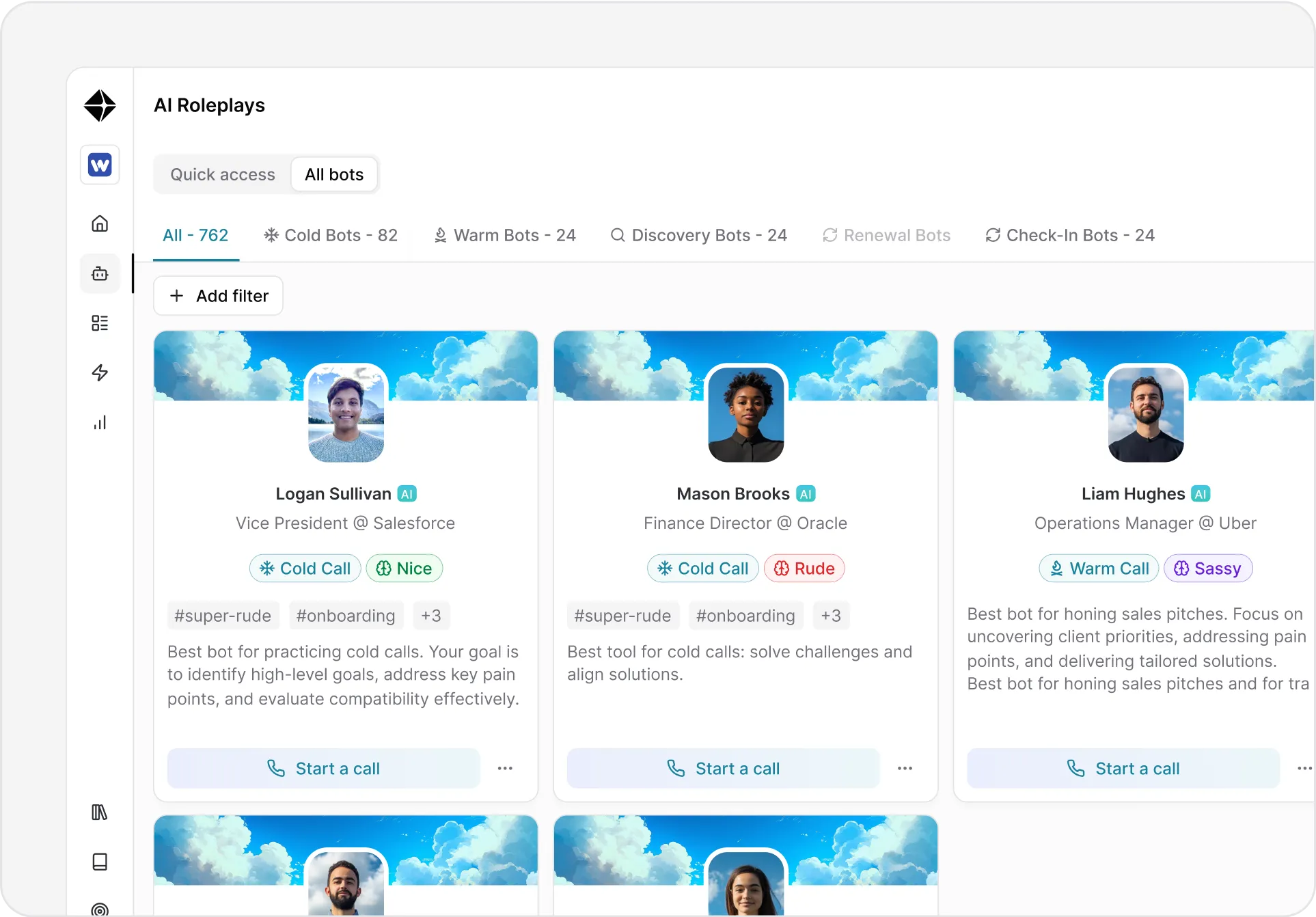
Hyperbound is built around AI buyer bots that reps practice calls against. It launched in January 2024. The free plan gives you 45 prebuilt AI roleplays and example scorecards, so you can test it with no budget conversation. Paid plans add buyer bot customization, custom scorecards, and reporting. A higher tier layers real call scoring on top of the practice. It is the most SDR-specific option on this list.
Best for: cold call and SDR-specific practice.
Standout capabilities:
- Free packs for outbound, objection handling, and inbound scenarios.
- AI buyer bot builder and variation builder on paid plans.
- LinkedIn Chrome extension on paid plans.
- Analytics dashboard and report builder.
- Higher “Perform” tier adds real call scoring, deal coaching, and CRM and call recorder integrations (including Salesforce, HubSpot, and Gong).
Pricing: Free tier available. Practice and Perform are enterprise plans, priced per user with volume discounts. No figures are published, so you book a demo for a quote.
Limitation: The jump from free to paid is steep, and paid pricing is opaque and aimed at larger teams. Note that some third-party directories still list an older free tier of 9 bots. Hyperbound’s own page now says 45.
2) Second Nature
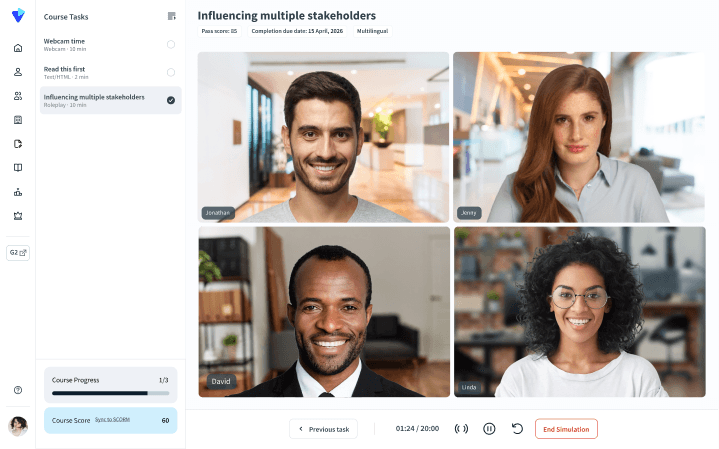
Second Nature is an enterprise AI roleplay platform. Its personas act like real buyers across 1:1, group, and chat scenarios. You describe a scenario in plain text or upload content, and the AI builds a full roleplay in minutes. After every session, AI scores the rep and managers can track progress and knowledge gaps. It also supports courses that mix videos, decks, and quizzes with practice. It covers sales but also customer support, HR, and call center use cases.
Best for: enterprise certification programs.
Standout capabilities:
- Structured courses that combine training content with AI practice.
- AI-scored feedback and certifications.
- Manager dashboards for scores, trends, and knowledge gaps.
- 30+ languages and mobile browser access with no app download.
- SOC 2 Type II, ISO 27001, GDPR, and HIPAA compliance listed on its site.
Pricing: Not published. You book a demo. Ask about term length and minimums early, because we could not find them stated publicly.
Limitation: It is heavier than most SDR teams need, and it is priced accordingly. A free sample roleplay on its site lets you judge realism before you talk to sales.
3) Quantified
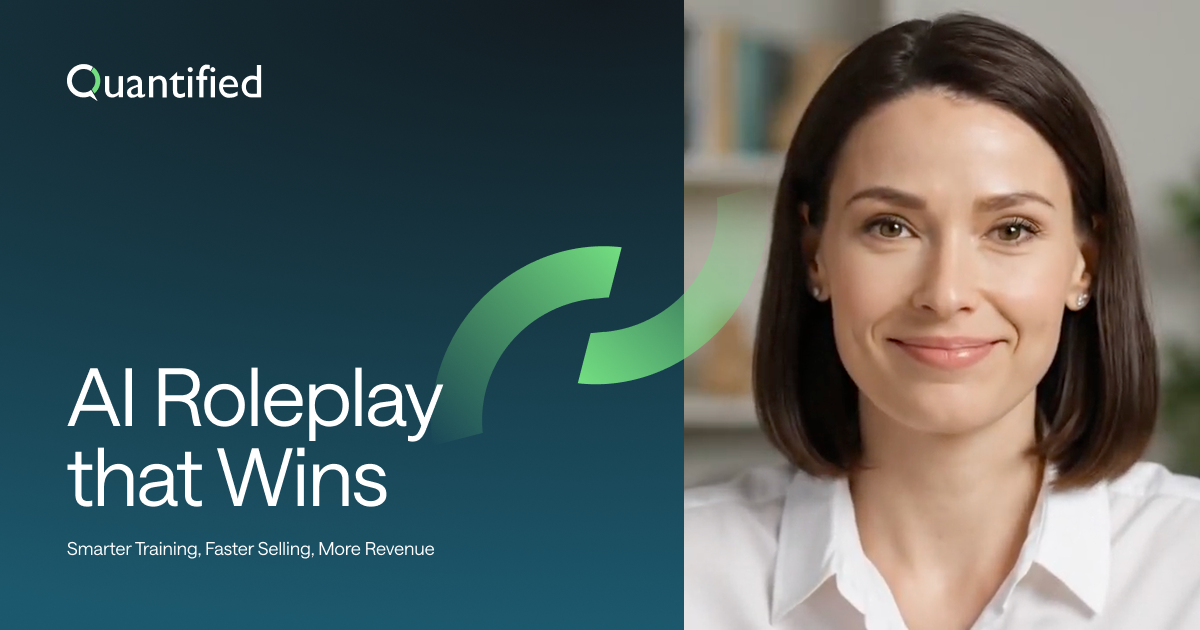
Quantified positions itself as an AI sales coaching and roleplay platform. Its roleplay personas are tuned to your ICP and scored against your own approved criteria, not a generic rubric. The wider platform adds readiness certification, field coaching, compliance scoring, and self-authoring. It is built for life sciences and regulated industries, and its customer list leans heavily toward pharma.
Best for: regulated or enterprise teams that need certification and compliance records alongside practice.
Standout capabilities:
- Scoring against your own approved messaging and criteria.
- Multi-persona roleplays for buying committee meetings.
- 40+ languages.
- Integrations with Salesforce, Veeva, Microsoft Dynamics, Workday, and major LMS platforms.
- SOC 2 Type II and audit-ready session records.
Pricing: Quote-based. Its pricing page says pricing is quoted for each organization rather than published as a rate card. Practice is not metered and there are no overage charges. Two packages exist: Base (roleplay) and Standard (full platform).
Limitation: Its focus is regulated field teams. A small SDR team drilling cold calls will pay for a lot it does not use.
4) Yoodli
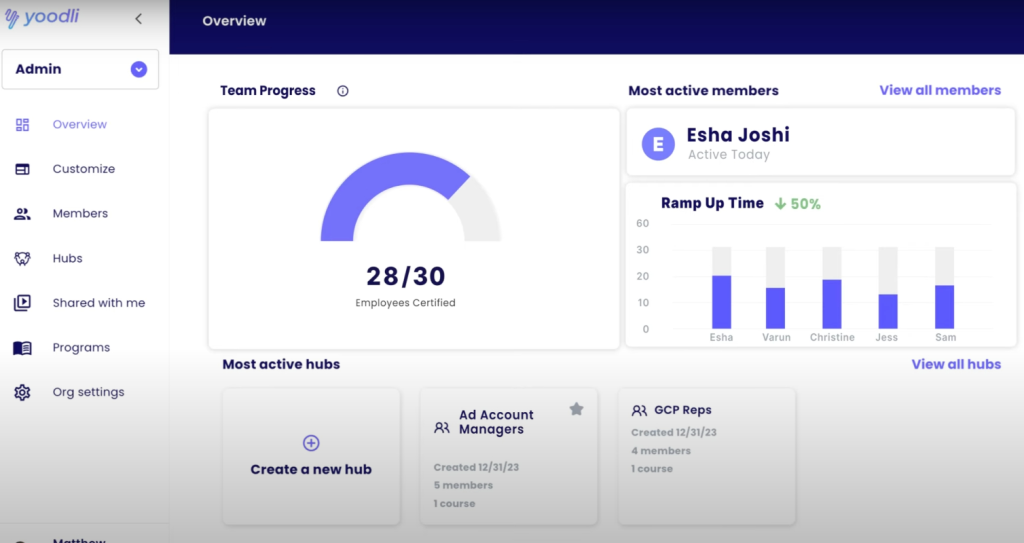
Yoodli started in communication coaching and now sells to individuals and organizations. It covers sales roleplays, objection handling, interview and pitch practice, and feedback on uploaded call recordings. It is the only tool here with real published individual pricing. That makes it an easy way for a single rep to start.
Best for: individual reps on a budget.
Standout capabilities:
- Free Starter plan with 5 lifetime sessions.
- Pro and Advanced plans for regular practice.
- Feedback on uploaded recordings of your own calls.
- Business plan with custom rubrics, Measure dashboards, and LMS, CRM, and SSO integrations.
- SOC 2 Type 2 certified.
Pricing: Pro is $8 per month and Advanced is $20 per month, both billed annually. Annual billing saves about 40% against monthly. Business pricing is per seat, billed annually, and requires a demo.
Limitation: The cheap prices apply to individuals only, and team pricing is quote-only. It also covers many use cases beyond sales, so check how deep its SDR scenarios go in a trial. One caution: session data on Starter and Pro plans may be used to improve the platform. Do not paste real pricing or competitor details into those tiers.
5) PitchMonster
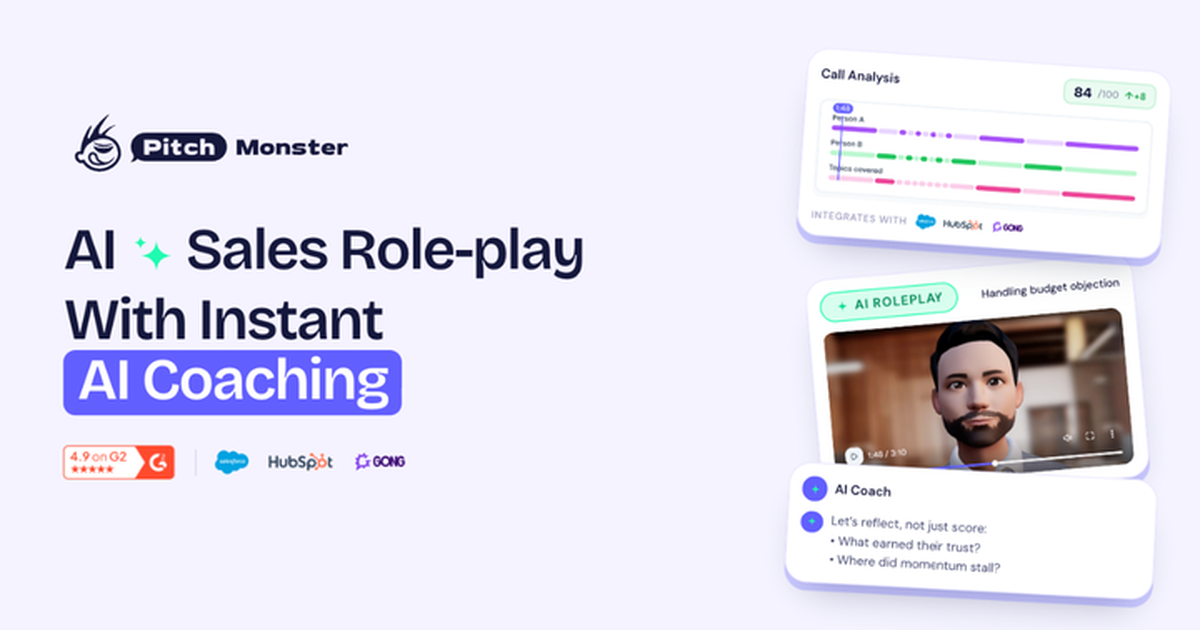
PitchMonster is a dedicated roleplay platform with a wide scenario range. Roleplays run by phone, avatar, and screensharing, across cold, warm, discovery, and demo calls. It includes multi-persona and gatekeeper roleplays, difficulty levels, and buyer persona configuration. You can build roleplays from transcripts, documents, and call recordings. Its site says reps run their first roleplays within a week.
Best for: teams that want scenario variety without going full enterprise.
Standout capabilities:
- Role-play editor with 40+ customizations.
- Gatekeeper, multi-persona, and difficulty-level options.
- Custom scorecards or frameworks such as MEDDIC, SPIN, and Sandler.
- Certifications and leaderboards.
- Higher plan adds call analysis, an AI Coach, Gong integration, and LMS integration.
Pricing: Quote-based, priced per seat with volume discounts. Two plans exist. Seats are swappable between reps, and onboarding is included. Standard contracts run 12 months, with 3 and 6 month options.
Limitation: No published price, a 12-month standard term, and most teams start at 5 or more seats. Third-party directories list per-seat figures that its own site does not confirm.
6) Luster
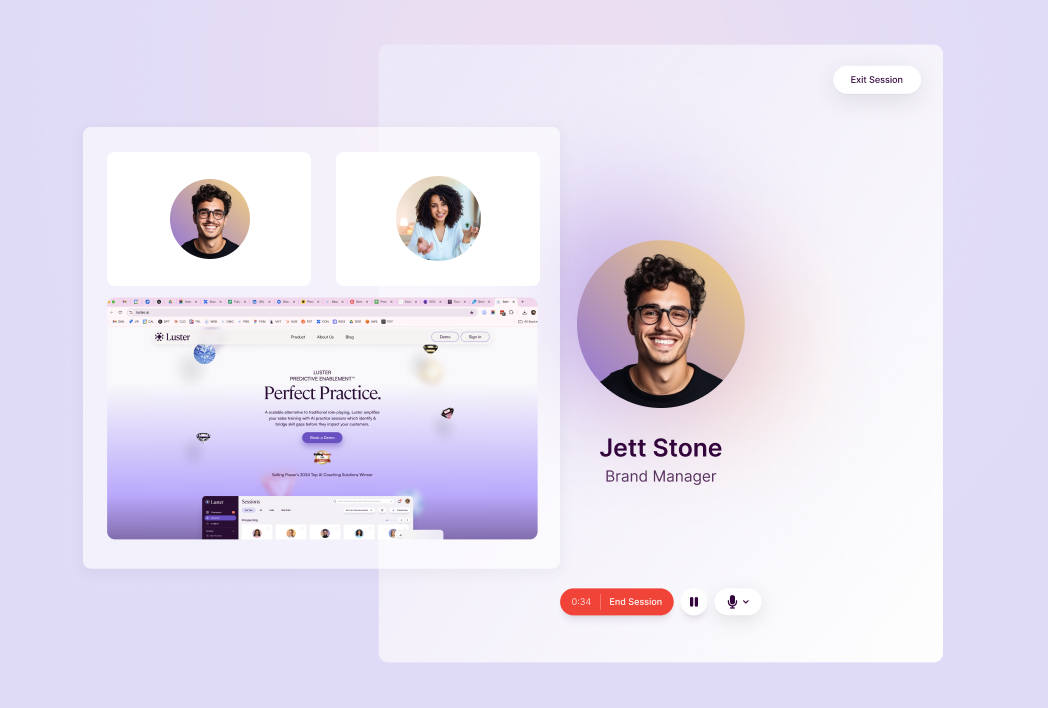
Luster calls its approach predictive enablement. It diagnoses skill gaps, predicts readiness risk, and prescribes personalized practice before customer conversations happen. The platform combines AI roleplay, real-time call insights, and personalized coaching, so practice targets what each rep is weak at instead of running generic scenarios. It also handles certification and hiring assessments.
Best for: teams that want practice tied to identified skill gaps.
Standout capabilities:
- Skill-gap diagnosis and predictive insights dashboards.
- Recommended training and automatic readiness certification.
- AI roleplay for high-stakes scenarios with targeted feedback.
- Hiring assessments and onboarding aligned to your curriculum.
- Manager coaching tools.
Pricing: Not published on the pages we reviewed. You contact the team for a quote.
Limitation: It is a newer entrant. It launched in June 2024 and raised a $3M seed round in October 2025. Expect a shorter track record, and ask what data it needs from your real calls to work well.
7) General AI Assistants With a Persona Prompt
Claude, ChatGPT, and Gemini can all play a difficult buyer if you write the prompt properly. Most people do not. A vague “act as a prospect” prompt gets you a friendly assistant who lets you pitch for two minutes. A prompt with rules, resistance, and a scoring step gets you something closer to a real call.
Best for: small teams, founders, and anyone testing the concept before buying.
Standout capabilities:
- No additional cost beyond a subscription you likely already have.
- Fully configurable personas.
- Genuinely difficult buyers if you write the prompt well.
- Voice mode available in most major assistants.
Pricing: Your existing subscription.
Limitation: No built-in scoring, no team reporting, and voice realism depends on the assistant. You paste in your own rubric after the call, and consistency is on you.
Try this prompt today:
For more ways to use an assistant in outbound, see our Claude for sales prospecting guide.
🚀 Your SDRs Practice. We Build Your Pipeline.
Give your team more time to focus on selling. Cleverly handles prospecting and outreach across LinkedIn, cold email, and cold calling.
Quick Comparison of AI Roleplay Tools
Use this table to narrow the list to two or three. It uses tier indicators instead of dollar figures, since those date quickly. Many AI SDR coaching platform options look identical in a table, so treat it as a starting filter only.
Pricing Realities in This Category
Pricing is where this category gets frustrating. Here is what to expect when you shop for AI sales coaching tools.
Why comparing prices is hard
- Most serious tools are quote-only. Of the seven here, only Yoodli’s individual plans and a general assistant have published prices.
- Published third-party figures contradict each other. PitchMonster is a good example. Some directories list $39 per user per month. Another source says it starts at $1,200 per quarter. PitchMonster’s own page lists no price at all. Yoodli shows the same problem, with directories quoting $8, $10, $20, and $25 for different plans.
- Directories lag. Hyperbound’s free tier is listed in many places as 9 bots. Its own site now lists 45 prebuilt roleplays.
Costs that never show up on an invoice
- Annual minimums and terms. PitchMonster’s standard contract is 12 months, and most teams start at 5 or more seats. That rules out the smallest teams regardless of per-seat cost.
- Implementation and scenario building. Some vendors include onboarding. Even then, someone on your side has to write scenarios, tune rubrics, and run sessions. That time is a real cost.
The comparison worth modeling
Compare cost per rep per month against the value of shortening ramp by a few weeks. Here is a rough way to size it, using assumptions you should replace with your own:
- The Bridge Group’s 2025 report puts median SDR on-target earnings at $80,000, which is about $1,540 a week.
- Assume a ramping rep produces about half of full output. Each week you shave off ramp then recovers about $770 of value.
- Cut ramp by three weeks and you recover roughly $2,300 per hire. That counts only salary cost, so it understates the pipeline impact.
If a tool costs more per rep than that, the case has to rest on certification, compliance, or reporting, not practice alone.
The honest test before you buy
Run a month of structured practice using a general AI assistant. Buy a platform only if the constraint turns out to be scoring and reporting rather than practice itself. If reps did not practice, a platform will not fix that.
How to Choose the Right Tool for Your Team
Work through this in order. Each step narrows the list.
Start from team size and use case
- Fewer than five reps: tier one, plus Hyperbound’s free tier or Yoodli’s individual plans if you want a second option.
- Five to fifty reps with a manager who will run it: tier two. Hyperbound, PitchMonster, and Luster are the realistic shortlist.
- Formal enablement team, certification, or audit needs: tier three. Second Nature and Quantified live here.
If cold calling is the use case
Prioritize voice realism and interruption handling over scenario breadth. A hundred scenarios do not help if the buyer is polite. Check that the tool supports gatekeepers, since a cold call often fails before you reach the prospect.
If certification and audit trails matter
You are in enterprise territory, and the other tiers will not satisfy it. Ask for the compliance documentation and security reports before you ask for a demo.
Check who will administer it
A tool with no internal owner produces nothing, regardless of capability. Name the owner before you buy.
Test persona difficulty during the trial
Configure a hostile buyer and see whether the AI actually holds the line. Try this sequence in any trial:
- Set the buyer to maximum resistance.
- Give a weak opener and a feature-dump pitch.
- Watch whether the buyer interrupts, objects, or hangs up.
If the AI agrees to a meeting after a bad pitch, you have an expensive flattery machine.
Pilot first, and measure ramp time
Pilot with one team before rolling out. Measure ramp time and live outcomes, not usage. A rep who passes the simulation and freezes on a live call has learned the wrong thing.
See our AI sales roleplay guide for how to configure and measure sessions.
Where Training Tools Stop and Capacity Starts
Every tool above improves the reps you already have. None of them book meetings while those reps are still learning. That gap is real. Ramp takes months even with good training, and your pipeline feels every week of it.
This is where an outsourced SDR team fits. We run the full motion: ICP definition, verified list building, LinkedIn outreach, cold email, cold calling, reply handling, and meetings booked straight onto your calendar.
Our cold calling SDRs are trained before they touch your list, including through AI roleplays built around your personas, so you absorb no ramp period.
We have set 53K appointments, and in our own comparison, sourcing and ramping an in-house SDR to KPI takes about four months versus one month with us.
It also supports the argument of this article. Experienced callers working your list means your best target accounts are not where somebody practices. New hires train properly in simulation, and outsourced capacity covers the pipeline in the meantime.
We optimize for one thing: qualified meetings held with real decision-makers.
Training the team but need meetings in the meantime? Find out what an outsourced SDR team can cover. Book a strategy call with Cleverly.
Conclusion
When you compare AI sales roleplay tools, the tier matters more than the brand, and most teams below a handful of reps do not need a platform at all. Persona difficulty is the feature that decides whether practice is useful, and it is the one least visible on a pricing page. Verify pricing directly with each vendor, since this category is young and published figures are unreliable.
Your next step is small. Write one hostile persona, run it in a general AI assistant for two weeks, and buy a platform only if scoring and reporting turn out to be the gap. Then measure ramp time, not practice volume.
Frequently Asked Questions
Free Resource
How to Scale a Profitable Cold Call System
Get the complete guide — download it instantly now.
Free Ebook
Download the Free Guide
Enter your details to get instant access.
You're all set! 🎉
Your ebook is downloading now.
Click below if the download didn't start automatically.