Table of Contents
What to Look for in AI Sales Tools
Quick Comparison Table: 10 Best AI Sales Tools
10 Best AI Sales Tools for B2B Teams (Ranked and Reviewed)
How to Choose the Right AI Sales Tools for Your Team
AI Sales Tools Support the Process, Cleverly Runs the Outreach
Conclusion
Frequently Asked Questions
Modified On :
August 31, 2026
Key Takeaways
- The real question isn't "should we use AI sales tools," it's which bottleneck you're actually trying to fix, because prospecting, forecasting, and coaching each need a different tool, not one that claims to do everything.
- Most B2B teams get more value from 4-6 well-integrated AI sales tools than from a dozen overlapping subscriptions competing for the same rep's attention.
- Free tiers and trials exist for a reason. Validate fit on Apollo.io or a base CRM tier before you commit to enterprise pricing on platforms like 6sense or Gong.
- Sophisticated AI sales tools sharpen forecasting, coaching, and targeting, but none of them generate the actual outbound conversations that fill the pipeline they're analyzing.
- Check for overlap before buying. Two platforms in the same category, like Clari's forecasting and Salesloft's engagement layer (now under the same roof after their late-2025 merger), often solve more of the same problem than vendors let on.
One uncomfortable part about AI sales tools in 2026: almost everyone has them, and most teams still can't tell you what's actually working.
Gartner's 2025 Sales Technology Report puts AI adoption at 89% of revenue organizations, up from just 34% in 2023. That's not a slow trend line. That's a category that went mainstream in under three years.
But adoption isn't the same as advantage. Teams using AI tools are 3.7x more likely to hit quota than teams that aren't, which tells you the gap between "we have AI" and "we use AI well" is where deals actually get won or lost.
And the pressure isn't easing up.
Gartner projects AI agents will outnumber human sellers 10 to 1 by 2028, which means the tools you pick now aren't just this year's stack, they're the foundation you'll be building on for the next few years.
This guide ranks and reviews the 10 best AI sales tools for B2B teams in 2026, broken down by category, features, pricing, and where each one actually falls short. We'll also cover what these tools can't do for you, and where that gap needs to be filled by actual outbound execution.

What to Look for in AI Sales Tools
Before you add another line item to your tech stack, get honest about what you're solving for. Most teams buy AI tools for sales teams based on a demo that looked impressive, not a bottleneck they could actually name.
Here's what matters more than the sales pitch:
- Clarity on the actual bottleneck. Is it prospecting volume, call coaching, forecast accuracy, or account targeting? Buying a forecasting tool when your problem is empty pipeline just gives you a more accurate view of a number you don't like.
- Real AI depth, not a marketing label. Plenty of tools bolted "AI-powered" onto a feature that was already there. Ask what the model actually does differently, not just what it's called.
- Integration with your existing stack. If a new tool means duplicate data entry or manual syncing with your CRM, you've added friction, not efficiency.
- A free tier or real trial. You should be able to validate fit before a team-wide rollout, not just a slide deck's worth of promises.
- Adoption friction. The most capable tool in the world delivers zero value if your reps quietly stop opening it after week two.
🤖 AI Speeds Up Sales. Strategy Drives Results.
Our LinkedIn, cold email, and cold calling campaigns generate 15–30 qualified meetings every month with AI-powered targeting and outreach.
Quick Comparison Table: 10 Best AI Sales Tools
10 Best AI Sales Tools for B2B Teams (Ranked and Reviewed)
Each entry below covers what the tool actually does well, who it's best for, and where it falls short. We pulled pricing from vendor sites and verified buyer data, but nearly every tool on this list uses custom, quote-based pricing, so treat these as planning ranges, not quotes.
1) Gong
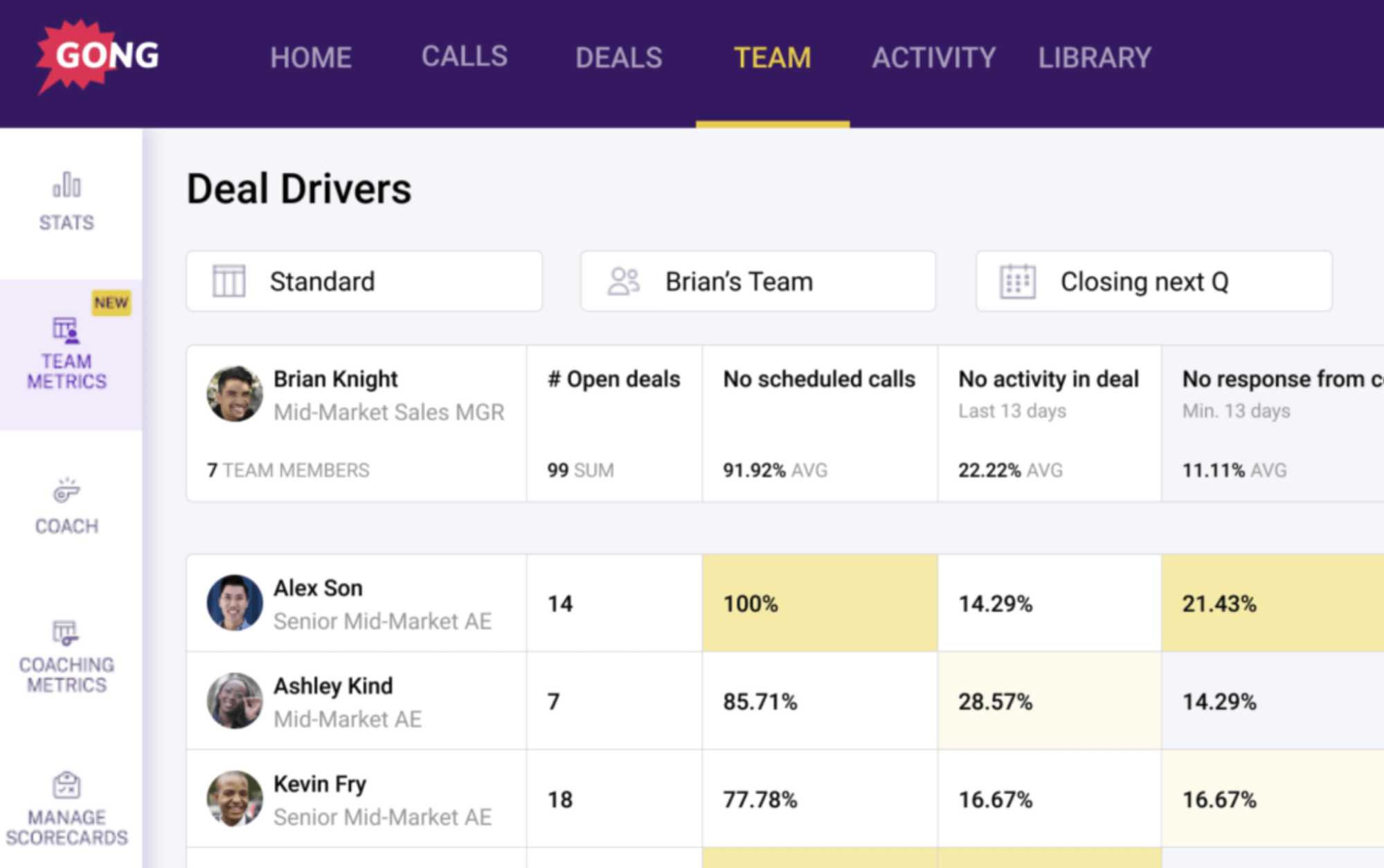
Gong is the name most sales leaders think of first when they hear "conversation intelligence," and for good reason. It records, transcribes, and analyzes sales calls at scale, then surfaces patterns that separate won deals from lost ones. The platform has become a category leader partly because it doesn't just tell you what happened on a call, it tells you what happened across thousands of calls and where the pattern breaks down.
Best For: Sales teams wanting AI-driven call analysis to coach reps and surface deal risk before it's too late.
Key Features:
- Automatic call recording, transcription, and analysis at scale.
- Talk-track patterns correlated with won versus lost deals.
- Deal risk flags based on actual conversation signals, not just CRM stage changes.
Limitations:
- Pricing is genuinely complex. Gong doesn't publish it, and buyers report a base platform fee plus per-user costs that scale up fast with add-on modules.
- Value depends heavily on consistent call volume; low-volume teams won't see the same pattern recognition.
Pricing: Foundations licenses run roughly $1,300–$1,600 per user per year, plus a platform fee commonly reported between $5,000 and $50,000 annually.
2) Clari + Salesloft
Here's something that changed the landscape mid-year: Clari and Salesloft completed their merger in December 2025, combining Clari's forecasting depth with Salesloft's sales engagement and conversation intelligence under one company. If you were evaluating these as two separate tools, know that they're now part of the same "Predictive Revenue System" positioning, though the products themselves are still in active integration with separate interfaces.
Best For: RevOps and sales leadership needing more accurate, AI-assisted pipeline forecasting, now paired with engagement execution under the same vendor.
Key Features:
- AI-driven forecasting with deal-level risk insights via Clari Copilot.
- Combines forecasting, conversation intelligence, and sales engagement data in a widening product suite.
- Reduces reliance on rep-reported, subjective forecast updates.
Limitations:
- The combined platform now has some real overlap between Copilot and Salesloft's own conversation intelligence, and between Groove and Salesloft's engagement tools.
- No unified roadmap has been published yet, so buying in mid-integration carries some uncertainty.
- Multiple modules are priced separately, and costs compound quickly once you add more than the core.
Pricing: Core forecasting runs roughly $100–120/user/month, with Copilot adding another $60–160/user/month depending on tier. The full combined stack can land at $200–310+/user/month.
3) 6sense
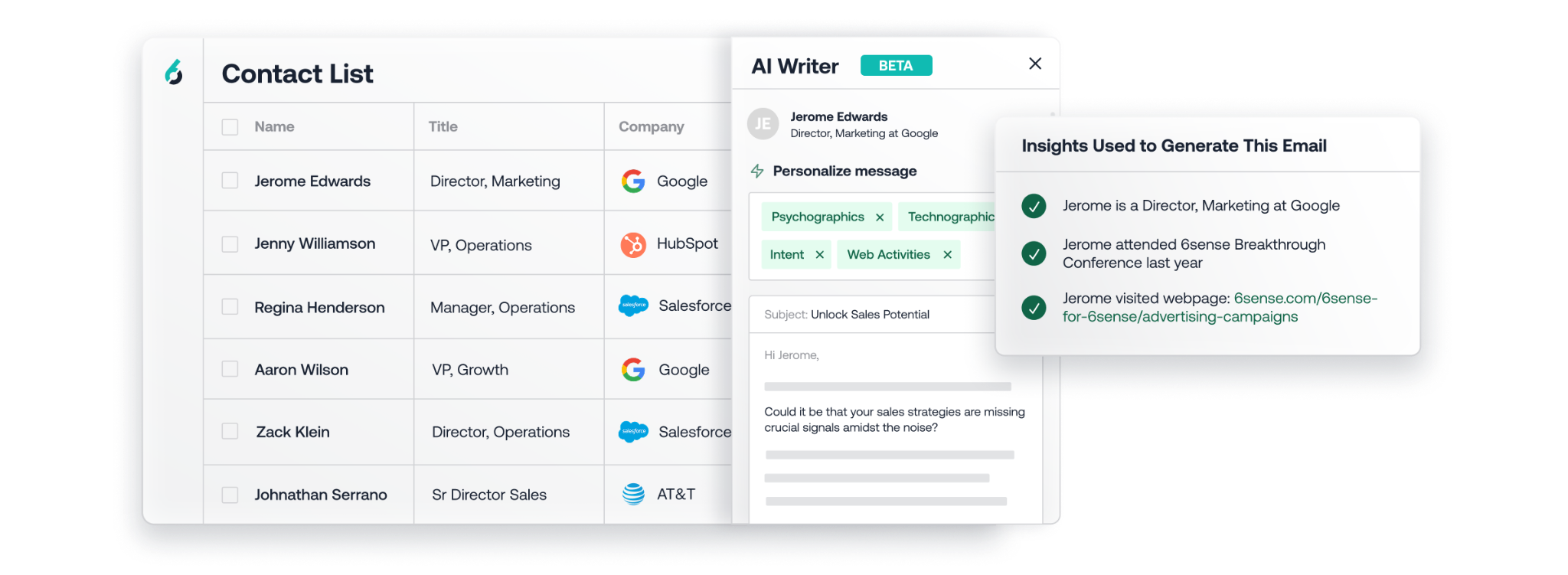
6sense built its reputation on solving a specific, painful problem: most of your best-fit accounts are researching you anonymously, and by the time someone fills out a form, you've missed weeks of buying signal. It predicts which accounts are actively in-market before they raise their hand, and identifies the buying committee within those accounts.
Best For: ABM-focused B2B teams that need to identify in-market accounts and buying committees before competitors do.
Key Features:
- Predictive analytics on buyer behavior to surface accounts actively shopping.
- Identifies multiple buying committee members within target accounts.
- Strong fit for aligning sales and marketing around the same account signals.
Limitations:
- Full-featured plans get expensive fast, and the free tier is genuinely limited to light prospecting.
- Requires a reasonably mature ABM motion and dedicated RevOps support to get full value; teams without that structure tend to underutilize it.
Pricing: 6sense now offers a free plan with limited credits. Paid plans typically start around $25,000-$50,000/year and scale to $100,000-$200,000+/year for full enterprise packages with predictive AI and data credits.
4) Salesforce Einstein
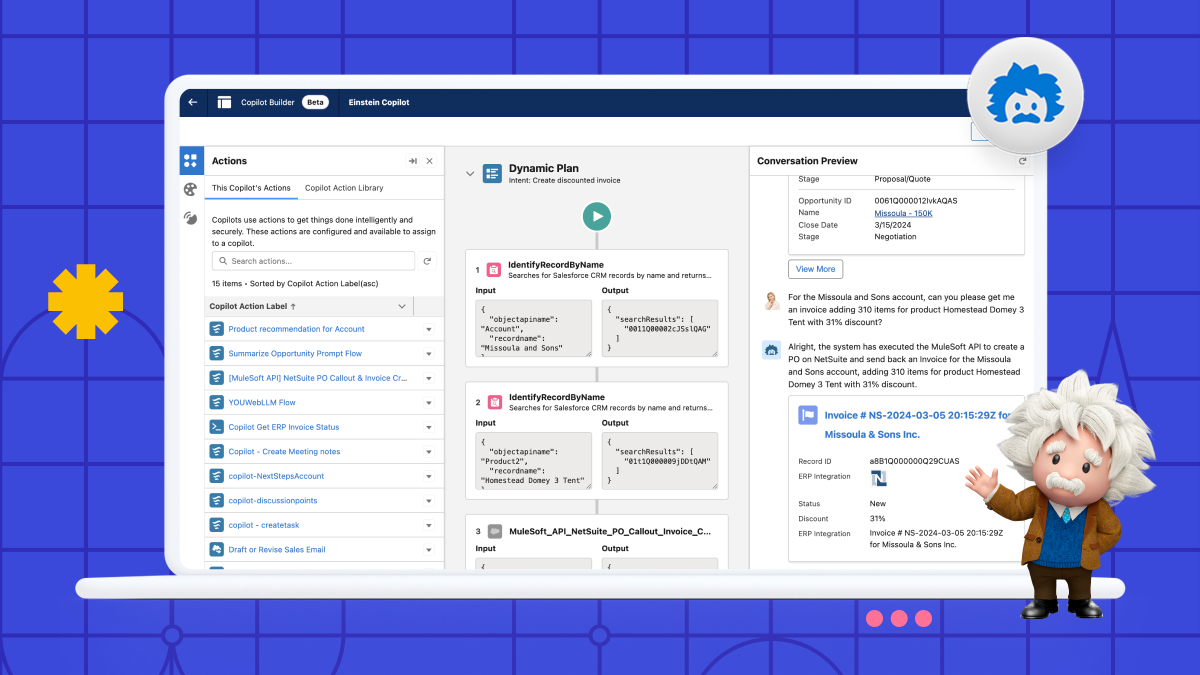
If your team already lives inside Salesforce, Einstein is the path of least resistance into AI. It's baked directly into the CRM you're already using, which means no new login, no separate data sync, and no change management around "yet another tool."
Best For: Teams already standardized on Salesforce who want built-in AI forecasting without adding another platform.
Key Features:
- AI-driven forecasting and opportunity insights inside existing Salesforce workflows.
- No separate tool or data migration required for teams already on the platform.
- Continually expanding feature set as Salesforce rolls out more Agentforce capabilities.
Limitations:
- Only genuinely valuable if you're committed to the Salesforce ecosystem long-term.
- Less specialized than dedicated conversation intelligence or forecasting-only tools.
Pricing: Roughly $25–75/user/month as part of premium CRM tiers. Confirm exact tier pricing at salesforce.com, since Salesforce packages AI features differently depending on your Sales Cloud edition.
5) HubSpot Breeze
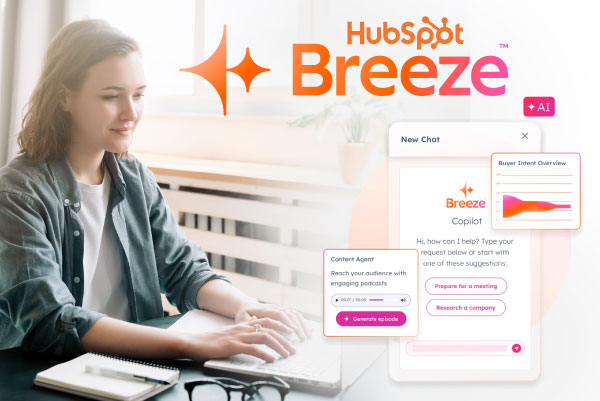
HubSpot Breeze has gone through a real pricing shift this year that's worth knowing before you evaluate it. As of April 2026, HubSpot moved its Customer Agent and Prospecting Agent to outcome-based pricing: you now pay per resolved conversation or per recommended lead, rather than a flat usage fee. That's a meaningful change if you compared Breeze pricing last year and wrote it off.
Best For: HubSpot CRM users who want AI agents embedded across marketing, sales, and service without adding a separate platform.
Key Features:
- Multiple AI agents including a Prospecting Agent and Customer Agent, now priced by outcome rather than usage.
- Native integration with existing HubSpot contact and deal data.
- Spans marketing, sales, and service rather than solving one narrow use case.
Limitations:
- Full value requires combining multiple HubSpot hubs, which raises total cost quickly.
- Less useful if HubSpot isn't already your core CRM, since Breeze can only reference HubSpot-hosted content.
Pricing: Customer Agent costs $0.50 per resolved conversation; Prospecting Agent costs $1 per recommended lead. These sit on top of Sales Hub or Service Hub Professional/Enterprise seats, which run roughly $90+/seat/month.
6) Apollo.io
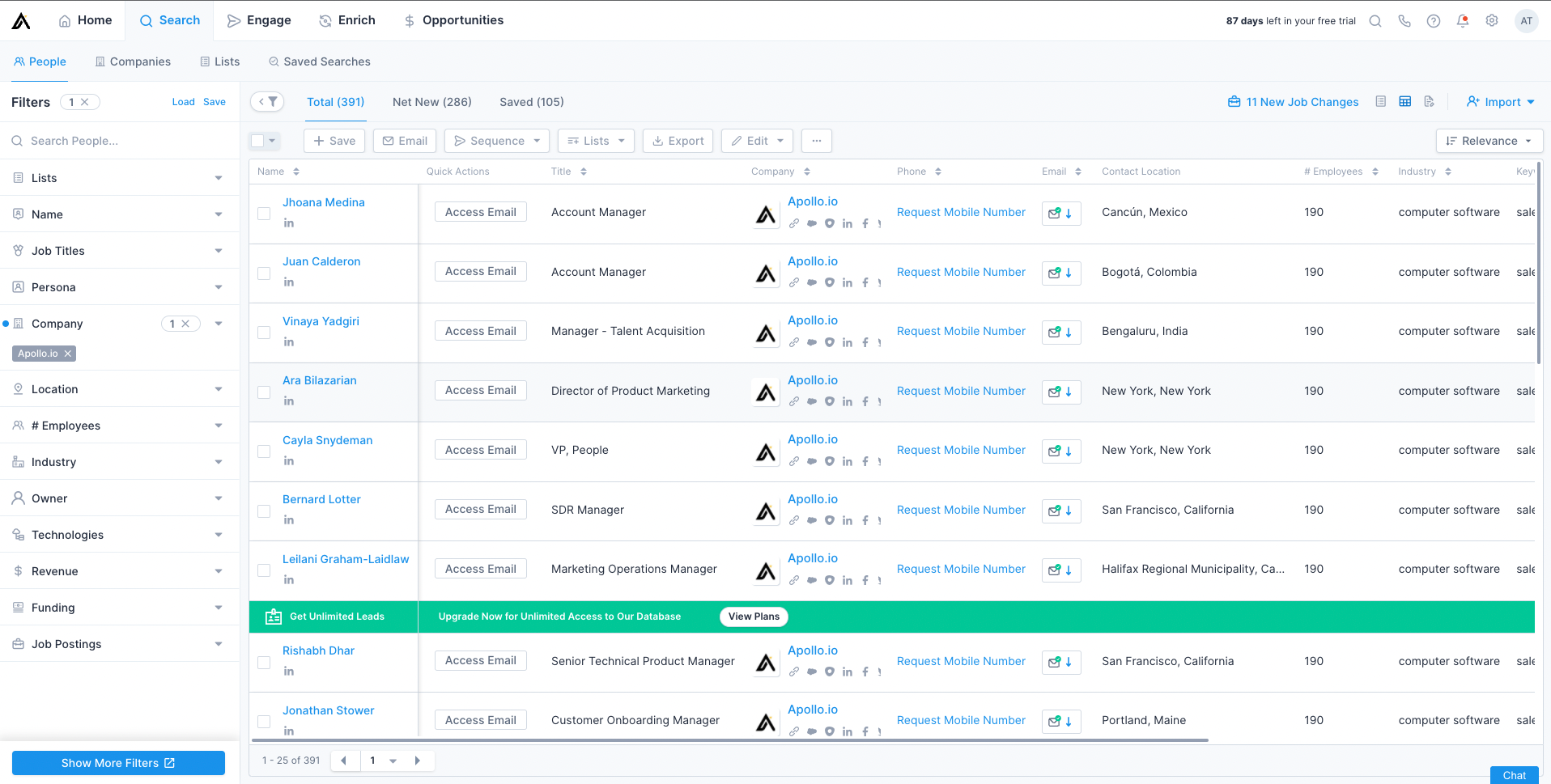
Apollo has become the default starting point for a lot of outbound teams, and the free tier is a real reason why. You get access to a large contact database plus basic sequencing without pulling out a credit card, which makes it an easy tool to test before you commit a budget elsewhere.
Best For: SMB and mid-market teams that need AI-assisted prospecting and outreach in one platform without a steep buy-in cost.
Key Features:
- Large B2B contact database combined with AI-assisted sequencing.
- Genuinely usable free tier for smaller-scale prospecting.
- Reduces tool sprawl by combining data and outreach execution in one place.
Limitations:
- Data accuracy varies noticeably by region and industry.
- Credit limits on lower tiers get restrictive fast if you're doing volume prospecting rather than light, targeted outreach.
Pricing: Free plan available. Paid tiers run roughly $49–$149/user/month depending on billing cycle and plan, with an Organization tier requiring a multi-seat minimum.
7) Outreach.io
Outreach remains the platform most enterprise sales orgs think of for high-volume, multi-touch sequencing across email and calls. It's built for teams running structured cadences with real sales ops support behind them, not solo reps looking for something lightweight.
Best For: Sales teams managing high-volume, multi-touch sequences that need deep engagement analytics tied to deal outcomes.
Key Features:
- AI-assisted sequence optimization and send-time recommendations.
- Deep engagement analytics connected to actual deal outcomes, not just open rates.
- Strong fit for larger SDR and AE teams running structured, repeatable cadences.
Limitations:
- Pricing is quote-based and requires a sales conversation, with no public list pricing.
- More platform than very small teams typically need, both in cost and in onboarding complexity.
Pricing: Reported buyer data puts Engage around $100-140/user/month, with Enterprise/Unlimited tiers running $160+/user/month once you add deal management and forecasting modules.
8) Mutiny
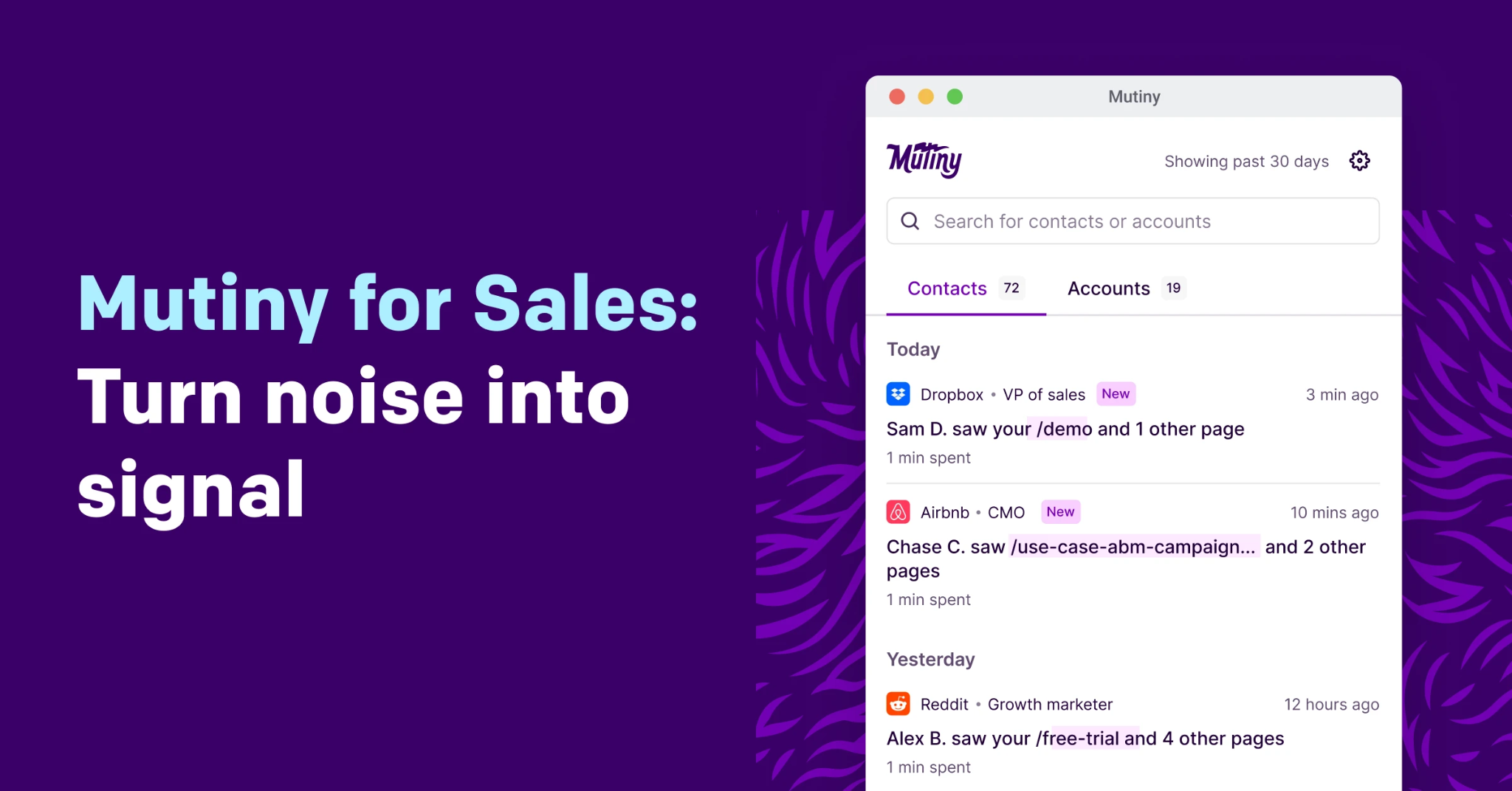
Mutiny is worth a second look if you evaluated it a while ago and wrote it off as enterprise-only. It's repositioned significantly in 2026, moving from a narrow web personalization tool into a broader AI GTM assistant that generates personalized decks, landing pages, and follow-up content, and it now has a genuine free tier.
Best For: Teams wanting account-specific content and web experiences generated automatically for target buyers, without a six-figure entry point.
Key Features:
- AI-generated, personalized content and landing pages tailored to specific accounts.
- Now includes a self-serve free tier, a change from its earlier demo-only model.
- Strongest fit for account-based, high-value deal motions where personalization moves the needle.
Limitations:
- The Enterprise tier still runs into serious money for full account-based personalization at scale.
- Narrower use case than general-purpose sales engagement tools; best value requires a defined ABM motion already in place.
Pricing: Free plan available. Business tier starts around $50/month, with Enterprise plans starting around $40,000/year for full account-based personalization.
9) Chorus (by ZoomInfo)
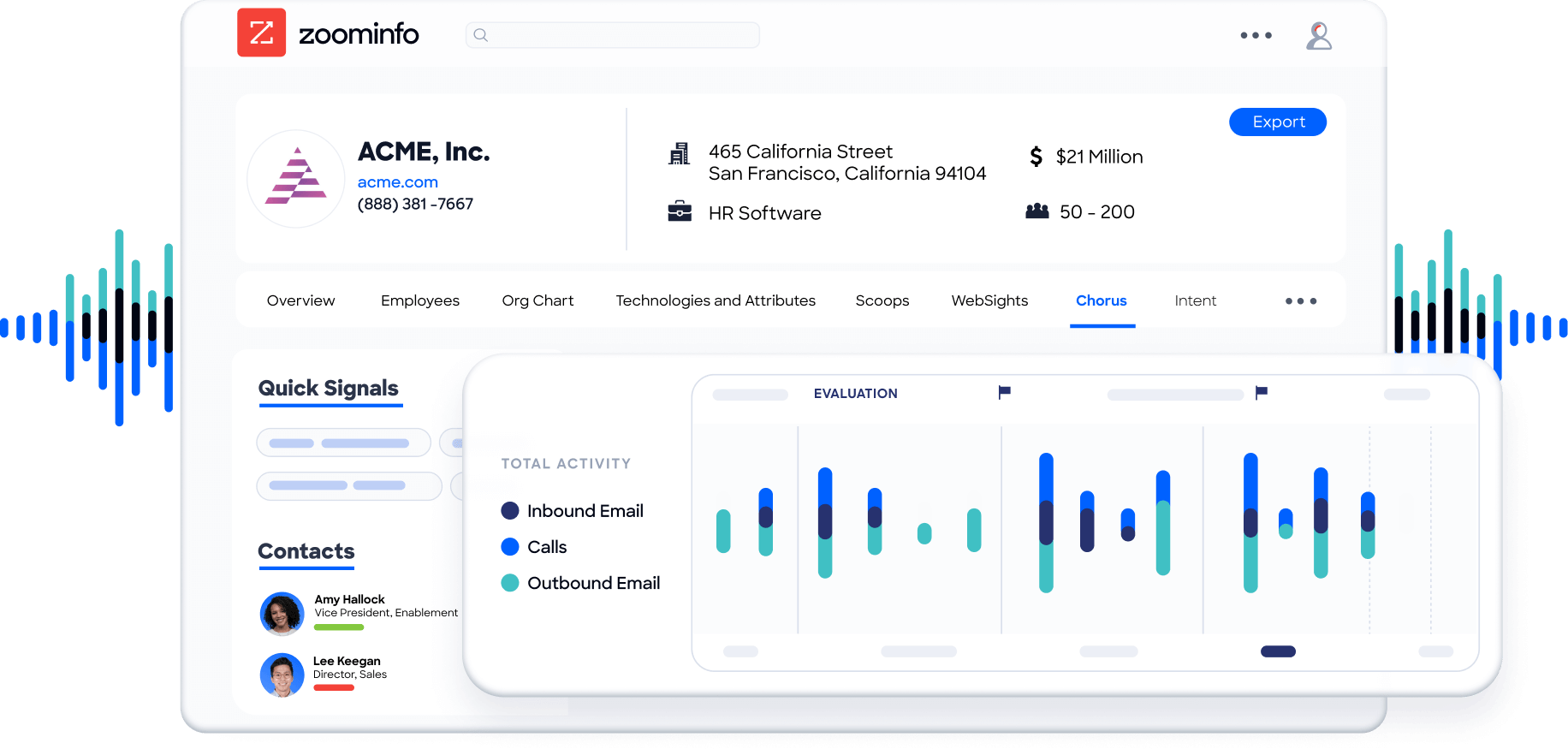
Chorus is the conversation intelligence option most often positioned as the ZoomInfo-native alternative to Gong. If your team already runs on ZoomInfo for contact and account data, Chorus plugs conversation-level signals into that same ecosystem instead of adding a separate vendor relationship.
Best For: Teams already using ZoomInfo who want conversation intelligence natively integrated with their existing contact and company data.
Key Features:
- Call recording, transcription, and coaching insights tied directly to ZoomInfo account data.
- Combines contact and company data with conversation-level signals in one ecosystem.
- Generally priced lower than Gong for comparable core functionality.
Limitations:
- Most valuable specifically for teams already inside the ZoomInfo ecosystem; standalone value is weaker.
- ZoomInfo's sales team tends to push bundled packages, so getting standalone pricing requires explicitly asking for it.
Pricing: Reported at roughly $8,000/year base for 3 seats, plus around $1,200 per additional seat annually for standalone conversation intelligence. Bundled ZoomInfo packages typically add $15,000–$40,000/year.
10) Clay
Clay has become the tool every RevOps person on LinkedIn seems to be building workflows in this year, and the hype is mostly earned. It's not a database and it's not a sequencer. It's a workflow layer that sits on top of 100+ data providers, letting you chain enrichment steps together, like "find the CTO, check if they use Salesforce, pull their latest funding round, then draft a personalized opener," all inside one spreadsheet-style interface.
Best For: RevOps-minded teams running data-heavy outbound motions who want to replace 3-4 separate enrichment and research subscriptions with one orchestration layer.
Key Features:
- Chains enrichment, AI research, and scoring across 100+ data providers in a single workflow.
- Claygent, Clay's AI research agent, autonomously browses the web to fill in personalization fields you'd otherwise research by hand.
- Native CRM sync with Salesforce and HubSpot on higher tiers, plus webhook support to plug into nearly any existing tool.
Limitations:
- It's a data and workflow tool, not a full sales engagement platform. You still need a separate sequencer like Smartlead or Instantly to actually send outreach.
- Real learning curve. Clay rewards people who think in workflows and data logic, and teams without that mindset tend to underuse it.
- Credit consumption is charged per enrichment attempt regardless of whether a result comes back, which makes monthly cost harder to predict than a flat per-seat tool.
Pricing: Launch starts at $185/month ($167/month annual), and Growth runs $495/month ($446/month annual) after Clay's March 2026 pricing restructure, which cut data costs 50-90% and split usage into separate Data Credits and Actions. Confirm current tiers at clay.com, since this is one of the more actively evolving pricing models on this list.
Teams that want to get more out of Clay without building complex workflows and integrations internally can also work with a Clay agency to handle enrichment logic, automation, CRM integrations, and workflow.
🚀 Smarter AI. Stronger Pipeline.
With 53,000+ meetings booked and $312M+ in pipeline generated, Cleverly helps 10,000+ businesses turn AI-powered outbound into predictable growth.
How to Choose the Right AI Sales Tools for Your Team
With this many categories and this much overlap between vendors, the choice usually comes down to discipline more than research. A few principles that hold up regardless of your stack size:
✅ Identify the actual bottleneck first. Is it prospecting volume, call coaching, forecast accuracy, or account targeting? Most teams skip this step and buy the tool with the best demo instead of the tool that fixes the specific gap costing them pipeline.
✅ Avoid adopting every category at once. Most teams get real value from 4-6 well-integrated tools, not a dozen overlapping subscriptions that all claim to do "AI-powered everything."
✅ Prioritize free tiers and trials before enterprise commitments. Apollo.io, base HubSpot CRM tiers, and Mutiny's new free plan all let you validate fit before you sign anything resembling a five- or six-figure contract with 6sense or Gong.
✅ Check for overlap before buying. Outreach and Salesloft largely solve the same sales engagement problem, and Gong and Chorus compete directly on conversation intelligence. Buying both rarely doubles your value.
AI Sales Tools Support the Process, Cleverly Runs the Outreach
What none of these tools do: have the actual conversation. Gong tells you what happened on the call after it's over. Clari tells you whether your forecast is realistic. 6sense tells you which accounts are worth chasing. All of that is genuinely useful, and none of it puts a qualified prospect on your calendar by itself.
That's the gap Cleverly fills. As a B2B lead generation agency, we run the LinkedIn outreach, cold email, and cold calling campaigns that actually generate the pipeline volume your AI sales stack is built to analyze and forecast. A sophisticated AI layer sitting on top of an empty funnel is still an empty funnel, just with better dashboards.
We've helped 10,000+ clients generate leads with companies like Amazon, Google, Uber, PayPal, Slack, and Spotify, resulting in $312M in client pipeline and $51.2M in closed client revenue.
If you already have, or are building, an AI-enabled sales stack and need a team consistently feeding it qualified conversations rather than cold data, that's exactly where done-for-you outbound earns its keep.
Book a strategy call with Cleverly and see what a fully staffed outbound engine looks like next to your existing tools.

Conclusion
The best AI sales stack in 2026 isn't the biggest one. It's a handful of category-specific tools chosen for actual bottlenecks, not a collection of overlapping subscriptions fighting for the same rep's attention.
Conversation intelligence, forecasting, account intelligence, and engagement each solve a different problem, and the tools on this list mostly do one of those things well rather than all of them adequately.
Free tiers make it easier than ever to validate fit before committing to enterprise pricing on platforms like 6sense or Gong. But no matter how sharp your AI sales tools get at analyzing, forecasting, and personalizing, they don't replace the outbound pipeline generation that gives them something to work with in the first place.
Frequently Asked Questions
Free Resource
How to Scale a Profitable Cold Call System
Get the complete guide — download it instantly now.
Free Ebook
Download the Free Guide
Enter your details to get instant access.
You're all set! 🎉
Your ebook is downloading now.
Click below if the download didn't start automatically.