Table of Contents
The Real Difference Between Drip and Nurture Campaigns
What Is a Drip Campaign?
What Is a Nurture Campaign?
Drip Campaign vs Nurture Campaign — Side-by-Side Comparison
When to Use a Drip Campaign vs a Nurture Campaign
Common Mistakes When Choosing Between Drip and Nurture
How Cleverly Builds Nurture Sequences Into B2B Outbound Campaigns
Conclusion
Frequently Asked Questions
Modified On :
August 14, 2026
Key Takeaways
- A drip campaign runs on a fixed calendar. A nurture campaign runs on subscriber behavior. That's the real split, not just the name.
- Drips are built for predictable moments like onboarding or welcome flows, where every new contact should see the same thing in the same order.
- Nurtures react to what someone actually does, which makes them better suited for buying decisions and re-engagement.
- The strongest programs don't pick one. They start subscribers on a drip, then "graduate" them into a nurture once real intent shows up.
- Measuring both the same way is a mistake. Drips succeed on consistency and opens. Nurtures succeed on conversion and revenue.
Marketers throw around "drip" and "nurture" like they mean the same thing. They don't. One runs on a calendar.
The other runs on behavior. And picking the wrong one for the job usually means one of two outcomes: you annoy people with poorly timed messages, or you miss the moment a lead was actually ready to buy.
The stakes here are real. Drip campaigns generate open rates roughly 80% higher than single-send emails, with click-through rates about three times higher.
Meanwhile, lead generation nurture emails get roughly 10 times more responses than generic, one-size-fits-all emails. Different mechanics, different strengths.
This guide breaks down what each campaign type actually is, where they diverge, when to use each one, and how to combine them so you're not leaving performance on the table. If you're a marketer, founder, or RevOps lead building out email and lead nurturing programs, this is the difference that actually moves your numbers.
The Real Difference Between Drip and Nurture Campaigns
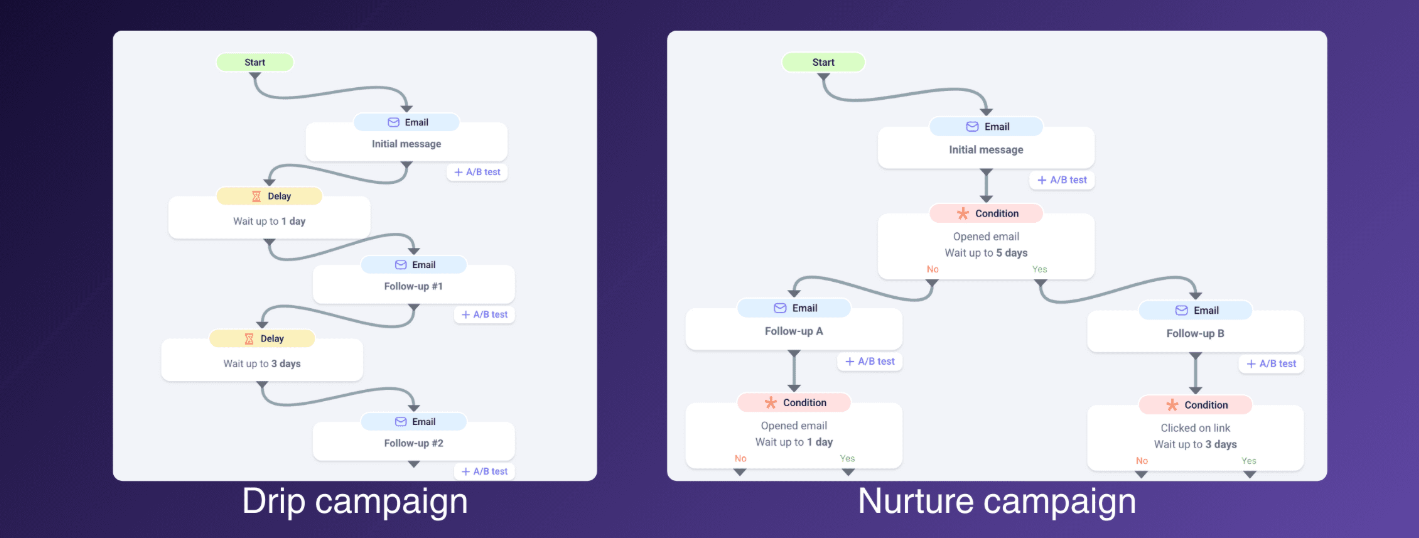
Here's the part most explanations skip: this isn't a naming quirk. It comes down to one question. What triggers the email? A calendar, or a behavior.
A drip campaign fires on a schedule. Someone joins a list, and from that point forward, they get the same sequence, in the same order, on the same timeline as everyone else who joined.
A nurture campaign fires on action. It uses conditional logic and branching paths based on what the subscriber actually does, whether that's clicking a specific link, visiting a pricing page, or going quiet for two weeks.
Quick verdict: drips win when the timing is predictable, like onboarding or a welcome series. Nurtures win when you need to respond to a buying signal in real time.
📧 Automate the Follow-Up. Accelerate the Pipeline.
Our cold email campaigns generate 15–30 qualified meetings every month with targeted, personalized outreach.
What Is a Drip Campaign?
An email drip campaign is a set sequence of emails sent on a fixed, pre-determined schedule. It doesn't care what the subscriber does after they join. Everyone entering the sequence gets the same emails, in the same order, spaced by the same intervals you set up front.
Where drips work best
- Welcome series — introducing a new subscriber to your brand
- Onboarding sequences — walking a new customer through setup
- Event countdowns — building anticipation on a known timeline
Why they perform
The predictability is the point. You're not guessing when to send or what to send next. That consistency shows up in the numbers: drip sequences see notably higher open rates than single-send emails, largely because of the consistency and expectation-setting built into them.
Once someone opts into a welcome series, they expect the next email. That expectation alone lifts engagement.
What Is a Nurture Campaign?
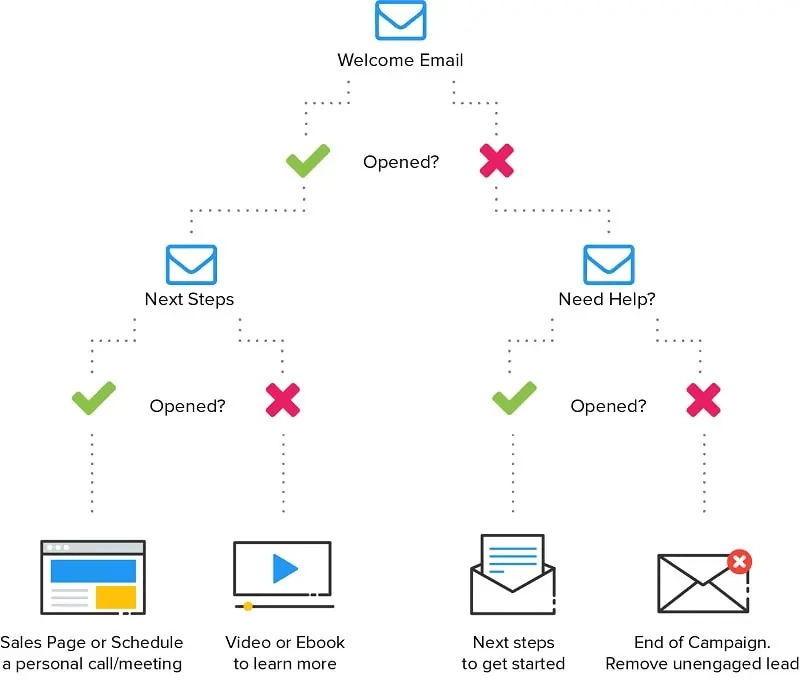
A lead nurture campaign is an email sequence shaped by what the subscriber does, not by the calendar. Instead of one linear path, it uses conditional logic and branching. Different actions send people down different tracks.
Where nurtures work best
- Post-demo lead nurturing — following up based on what a prospect engaged with
- Re-engagement after inactivity — reacting to a lead going cold
- Post-content-download follow-up — building on specific interest
Why they perform
Because a nurture reacts to a real signal instead of a guess, it tends to land better. Lead generation nurture emails get about 10 times more responses than generic, one-size-fits-all emails, simply because they're responding to something the subscriber actually did, not just a date on a calendar.
🚀 More Follow-Ups. More Conversations. More Pipeline.
With 53,0 00+ meetings booked and $312M+ in pipeline generated, Cleverly helps 10,000+ businesses turn outbound email into predictable growth.
Drip Campaign vs Nurture Campaign — Side-by-Side Comparison
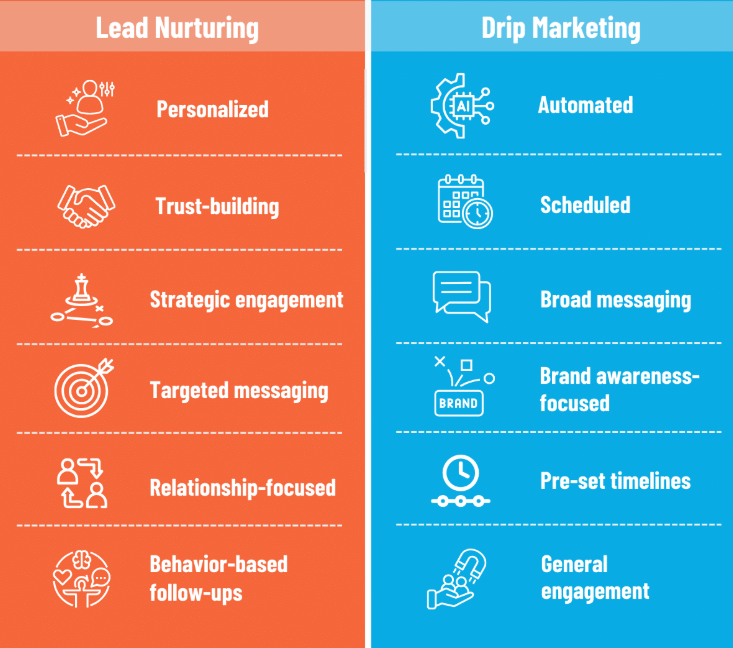
Think of this less as a scorecard and more as a decision matrix. Neither column is "better." They're built for different jobs.
When to Use a Drip Campaign vs a Nurture Campaign
The decision usually comes down to one thing: is the timing predictable, or does it depend on what someone does?
Use a drip campaign when:
- The message sequence and timing should be the same regardless of who the subscriber is.
- You're running a welcome series, onboarding flow, or event countdown.
- You want something you can build once and let run.
Use a nurture campaign when:
- You need to react to real behavior, not a fixed date.
- A lead is browsing specific pages, clicking pricing links, or showing intent.
- A previously engaged lead has gone cold and needs a different approach than "day 14 of the sequence".
The graduation model
You don't have to choose the moment someone signs up. Many programs start every new subscriber in a drip welcome sequence, then automatically move them into a behavior-based nurture flow once they show a real intent signal, like clicking a pricing link or downloading a case study.
The drip does the predictable groundwork. The nurture takes over once there's something worth reacting to.
Most effective programs run both at once: a time-based foundation with behavior-based branches layered on top.
Common Mistakes When Choosing Between Drip and Nurture
Even experienced teams get this wrong. Here's where it usually breaks down:
❌ Running a drip for a job that needs a nurture. Sales lead follow-up is a common one. A fixed sequence ignores what the prospect actually did, and the result is generic, poorly timed messages that feel out of touch.
❌ Overbuilding a nurture before validating a simpler drip. Complex branching logic sounds impressive, but if a basic drip performs fine, you've added maintenance for no real lift.
❌ Never combining the two. Skipping the graduation step means you lose the moment a welcome-flow subscriber shows buying intent and could shift into a more responsive track.
❌ Treating either as "set and forget." Nurture campaigns especially need ongoing refinement as behavioral data rolls in. A branch that made sense six months ago might be sending people down the wrong path now.
❌ Measuring both the same way. Drip success shows up in open rates and consistency. Nurture success shows up in conversion and revenue. Judging a nurture on open rate alone misses the point of building it.
How Cleverly Builds Nurture Sequences Into B2B Outbound Campaigns

Cold outbound follow-up is really a nurture problem, even though most teams don't think of it that way. What a prospect does after your first touch, whether they open, reply, click, or go silent, should shape what they get next. A calendar alone can't account for that.
As a cold email agency, this is exactly where we spend most of our engineering effort. We build multi-touch sequences that combine scheduled follow-up cadences with behavior-based branching, reacting to opens, replies, and engagement signals as they happen instead of pushing everyone through the same fixed script.
A rigid, drip-only follow-up in cold outbound wastes the moments where a prospect actually shows interest.
Every engagement includes sequence design, behavior-based follow-up logic, and ongoing optimization based on real reply data, not assumptions. This is the same logic that makes nurture campaigns outperform static drips, applied directly to outbound.
If you want outbound follow-up that reacts to real engagement instead of just counting down days on a calendar, book a strategy call with Cleverly.
Conclusion
Drip and nurture campaigns aren't competing strategies. They solve different problems. One gives you consistent timing. The other gives you responsive personalization. Neither replaces the other, and the best programs treat them as complementary layers rather than a choice you make once and live with forever.
Pick based on the use case, not habit. Predictable onboarding and welcome moments call for a drip. Anything tied to a buying decision or re-engagement calls for a nurture.
The graduation model, starting subscribers on a time-based track and shifting them to behavior-based once intent shows up, captures the strength of both without forcing you to pick a side.
Frequently Asked Questions
Free Resource
How to Scale a Profitable Cold Call System
Get the complete guide — download it instantly now.

Free Ebook
Download the Free Guide
Enter your details to get instant access.
You're all set! 🎉
Your ebook is downloading now.
Click below if the download didn't start automatically.