Table of Contents
Why Recruitment Sales Calls Are Different
Who to Call and When
The Structure of a Recruitment BD Call That Works
10 Recruitment Cold Calling Scripts
Handling the Objections You'll Hear Every Day
Follow-Up That Wins the Second Call
Metrics to Track
How Cleverly's Cold Calling Service Wins Job Orders for Agencies
Conclusion
Frequently Asked Questions
Modified On :
September 23, 2026
Key Takeaways
- The hiring manager on the other end has already heard from three other agencies this month, so your opener has to earn the next ten seconds, not sell the whole call.
- Live vacancies and reposted roles are the strongest calling triggers you have. Call on signals, not on a random list.
- "We already have an agency" is a timing objection, not a rejection. Your real goal on most calls is becoming the second supplier.
- Job orders, not conversations, are the metric that pays your bills. Track fill rate alongside your call numbers or you'll win orders you can't deliver on.
- Most job orders come from the third or fourth touch, not the first call, so a defined follow-up cadence matters more than any single script.
Cold calling still wins client business in recruitment, and the data backs that up. The average B2B connect rate is somewhere between 8% and 12% on generic data, but Gong's larger dataset of 300 million cold calls shows top-quartile reps hitting a 13.3% connect rate against a 5.4% average. The gap between average and elite comes down to targeting and timing, not talent.
That gap matters even more in staffing. The average time-to-fill sits at 44 days across US industries, and 74% of employers report ongoing talent shortages. Every hiring manager you call is feeling that pressure right now, whether or not they'll admit it in the first thirty seconds.
This guide is about recruitment cold calling scripts for client-side calls to hiring managers who own open job orders. It's not about candidate sourcing calls.
You'll get the reasoning behind what works, ten ready-to-use scripts, an objection-handling table, a follow-up plan, and the metrics that actually predict revenue.
This is written for agency owners, BD leads, 360 recruiters, and staffing sales teams who are tired of pitching into voicemail.
Why Recruitment Sales Calls Are Different
Hiring managers get called constantly. If your opener sounds like every other agency's opener, you've already lost the call before you've said anything useful.
Here's the part most reps miss: almost every prospect you call already has a supplier relationship.
Your job on the first call is rarely to replace that agency. It's to become the second call they make when the first one doesn't deliver. That's a much easier sale to make, and it's the realistic entry point for most recruitment sales calls.
A few things work in your favor that don't exist in most B2B sales motions:
- Timing beats persuasion. A live vacancy changes everything about how receptive someone is. The same pitch that gets hung up on in a quiet month gets a real conversation when there's an open req burning a hole in someone's team.
- You have real leverage. Market data, salary benchmarks, and candidate availability are things hiring managers actually want, and you can lead with them instead of a pitch.
- The deal value compounds. Most agency revenue comes from repeat business, not one-off placements. A single job order today can turn into years of recurring fills if you handle it well. That's worth playing the long game for.
📞 Book More Staffing Clients
Cleverly’s done-for-you cold calling helps B2B teams generate 10–30 qualified sales calls every month with targeted prospects.
Who to Call and When
Not every title is worth your dial time, and not every week is worth calling.
Who to target: hiring managers, talent acquisition leads, HR managers, and department heads at SMB and mid-market companies. Skip the generic HR inbox when you can. The line manager who's short-staffed feels the pain of an open role far more acutely than an HR generalist juggling twenty requisitions.
What to watch for cold calling hiring managers:
- Active job postings on LinkedIn, Indeed, and company career pages. These tell you exactly who's hiring today.
- Roles that have been reposted, which usually means the current sourcing approach isn't working.
- Multiple openings in the same function, which signals a team under real pressure.
- A vacancy that's been open longer than typical for that role or market.
When to call: early morning and late afternoon land best, and Tuesday through Thursday consistently outperforms Monday and Friday across most cold calling benchmarks. Speed matters here too. Call within days of a posting going live, before five other agencies have already been through.
Before you dial, spend a few minutes on research, not more. You need the role, the team, and one specific observation you can use in your opener. Anything beyond that is wasted prep time you could be spending on the next dial.
The Structure of a Recruitment BD Call That Works
Every good call follows roughly the same shape, even though the words change:
- Opener. Your name, your agency, and one specific reason tied to their hiring. Not a capability pitch.
- Hook. A piece of market intelligence they'd actually want, like a salary benchmark, a candidate availability insight, or a note on who else in their sector is hiring.
- Qualification. How they're filling the role right now, and what isn't working about that.
- The ask. A short market-intel conversation, not a partnership pitch or a meeting about your services.
- Close. A specific next step with a time attached to it.
Keep the call under a few minutes unless the hiring manager opens it up further. The principle underneath all of this: you're selling the conversation, not the agency. Recruitment business development works better when the first call feels low-stakes.
🚀 Turn Calls Into Pipeline
With 1M+ cold calls, 53,000+ meetings booked, and $312M+ pipeline generated, Cleverly helps 10,000+ businesses scale outbound.
10 Recruitment Cold Calling Scripts
Use whichever one matches your trigger. Don't read these word for word, use them as a starting shape and let your own voice come through.
1) The Live Vacancy Script
When to use: You saw a specific role posted in the last few days.
"Hey [Name], it's [Your Name], I recruit for [industry/role] companies here in [location]. Saw you guys have a [Job Title] opening up, how's that search going so far?"
Why it works: You're not pitching anything yet, you're just asking a question a helpful person would ask. That's an easy thing to answer, even for someone who's busy.
2) The Market Intelligence Script
When to use: Nothing's posted yet, but you've got sector data worth sharing.
"Hey [Name], [Your Name] here, I work with a few [industry] companies on their hiring. Not sure if you're looking right now, but we just pulled some comp data for [role] in [location] and it's moved more than people think. Want me to just send it over, no strings attached?"
Why it works: You're giving something away before you ask for anything. Most hiring managers will take free market data even if they have zero interest in an agency.
3) The Candidate-Led Script
When to use: You have a real candidate who fits their world.
"Hey [Name], quick one, I've actually got someone on my desk right now, [role] with [specific background], who made me think of a team like yours. Nothing formal posted that I saw, but figured it's worth a two minute conversation. That's a fair ask?"
Why it works: This is the strongest opener on the list because it's specific and true. Never fake a candidate to get someone on the phone, they can tell, and it burns the relationship before it starts.
4) The Competitor Hiring Script
When to use: Similar companies in their space are hiring for the same roles.
"Hey [Name], [Your Name] from [Agency]. I've been noticing a bunch of companies like yours in [location] hiring for [role] lately. No idea if that's on your radar too, but figured I'd flag it."
Why it works: Nobody likes finding out later that their competitors were quietly staffing up while they weren't paying attention. It's a nudge, not a pitch.
5) The Hard-to-Fill Role Script
When to use: The role has been open a while or reposted more than once.
"Hey [Name], I noticed the [role] posting's been up for a bit now. Those ones usually need something a little different than just reposting on the job boards. Mind if I ask what's been the bottleneck so far?"
Why it works: You're not saying "your process is broken," you're just asking a question that lets them say it themselves if it's true.
6) The Second Supplier Script
When to use: You're pretty sure they already work with an agency.
"Hey [Name], I'm guessing you've probably already got someone helping with recruiting, so I'm not calling to steal that away. Honestly I'd just love to be the person you call if something stalls out. Fair enough?"
Why it works: You've already answered the objection before they had to raise it. That takes the defensiveness out of the call almost immediately.
7) The Reposted Role Script
When to use: A posting has clearly gone back up.
"Hey [Name], saw the [role] posting go back up again. Sometimes that just means the pipeline needs a fresh source. Is that something you're open to talking through, or are you all set on that front?"
Why it works: It says "your current approach might not be working" without you ever having to say it directly. Let them fill in the blank.
8) The Growth Signal Script
When to use: You saw funding news, a new office, or a leadership hire.
"Hey [Name], congrats on [the funding round / new office / hire], that's a big deal. Usually when that happens hiring picks up fast right behind it. Wanted to say hi now before that hits, rather than calling you in the middle of the chaos."
Why it works: You're in front of them before there's even a job order to fight over, which means no competition yet.
9) The Gatekeeper Script
When to use: Reception or HR picks up first.
"Hey there, quick question, who handles the [role] search on your end? Just want to make sure I'm not bugging the wrong person."
Why it works: You're asking for help, not trying to sneak past someone. Gatekeepers respond a lot better to that than to being talked over.
10) The Voicemail Script
When to use: It goes to voicemail.
"Hey [Name], it's [Your Name], calling about the [role] opening. I'll try you again in a couple days, but my number's [number], again that's [number], talk soon."
Why it works: Short, one reason, number said twice so they don't have to replay it. Think of it as planting the seed for call two, not a full pitch.
Handling the Objections You'll Hear Every Day
An objection is a request for a better reason to keep talking, not a door closing.
Hiring managers respond to directness. Scripted rebuttals tend to shut the conversation down faster than the original objection did. And the PSL objection specifically is a timing question, not a rejection. Note when their list comes up for review and time your next call to that window.
Follow-Up That Wins the Second Call
Most job orders don't come from the first call. Build your process around that reality, not against it.
- Send something useful after every call: a salary benchmark, a market update, or a relevant candidate profile.
- Keep a defined cadence rather than only calling when you happen to have a vacancy to fill.
- Track PSL review windows and time your outreach to land right before them.
- Pair calls with LinkedIn and email touches so your name is already familiar before the next dial.
- Log every conversation. Recruitment BD is a long game, and memory isn't a system.
- Know when to move a prospect into long-term nurture instead of active weekly calling.
Metrics to Track
Job orders, not meetings, are the real conversion event in staffing BD. And the fill rate deserves just as much attention as your win rate.
Taking on roles you can't fill damages the relationship you just spent weeks building. Track attempts-to-connect too, so your calling cadence is built on data instead of guesswork.
How Cleverly's Cold Calling Service Wins Job Orders for Agencies
Recruiters who bill are also the recruiters expected to prospect, and that math rarely works out. Every hour spent on BD calls is an hour not spent filling a role, which is usually why BD is the first thing that gets dropped when things get busy. That's exactly why agency pipelines end up lumpy instead of predictable.
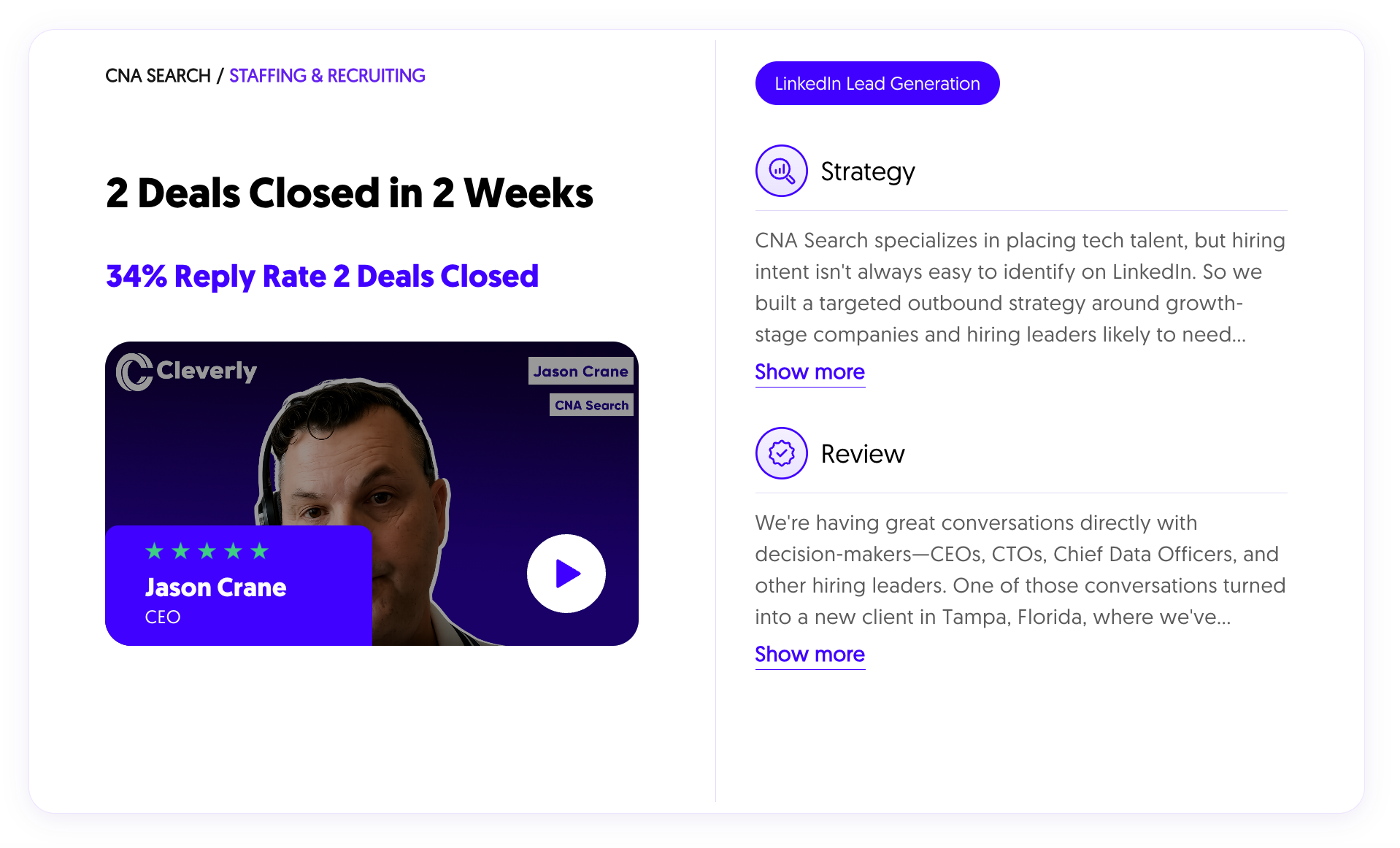
We run cold calling as an end-to-end system for staffing and recruitment agencies. That means verified direct-dial contact data for hiring managers, ICP-aligned target lists, trained SDRs, and tested call frameworks, with booked appointments landing straight on your calendar instead of buried in a call log. Direct dials matter here specifically because they mean your calls reach the hiring manager, not a general HR line that never returns a message.
Our objection handling has been refined across thousands of live calls, with SDRs coached on call recordings rather than left to improvise on the fly. We optimize for qualified conversations that turn into job orders, not raw dial counts.
If BD keeps losing to billing on your calendar, that's worth a conversation. Book a strategy call and we'll handle the calling for you.
Conclusion
Recruitment cold calling works when it leads with market insight and a specific reason to call, not an agency pitch. Live vacancies and reposted roles are the strongest triggers you have, so call on signals instead of working down a flat list.
"We already have an agency" is a timing question more than anything else, and becoming the second supplier is the realistic first step for most new client relationships.
Pick ten companies with open roles in your niche and call them this week using the live vacancy script. Consistency compounds in staffing BD, and most job orders come from the third conversation, not the first.
Frequently Asked Questions
Free Resource
How to Scale a Profitable Cold Call System
Get the complete guide — download it instantly now.

Free Ebook
Download the Free Guide
Enter your details to get instant access.
You're all set! 🎉
Your ebook is downloading now.
Click below if the download didn't start automatically.