

Table of Contents
Where AI Adoption in Financial Services Actually Sits
10 AI Use Cases in Banking and Financial Services
What Actually Gates AI Deployment in Financial Institutions
How Financial Institutions Actually Buy AI
Where the Open Opportunities Are for Vendors
How Cleverly Helps Vendors Reach Financial Services Buyers
Conclusion
Frequently Asked Questions
Modified On :
October 26, 2026
Key Takeaways
- Adoption of AI in financial services is concentrated in internal operations, where regulatory exposure is lowest.
- Fraud detection, AML, and credit risk are the most established use cases. Customer-facing and decisioning use cases move slowest.
- Deployment is gated by model risk governance, explainability, fair lending, vendor oversight, and data privacy. Your answers to these are part of your product.
- Governance maturity lags adoption, so the open opportunity is in helping institutions monitor and supervise AI they have already bought.
- Selling here means long cycles and large buying committees. Pipeline has to be built long before the budget exists.
Financial services talks about AI in banking and finance more than almost any sector. It also deploys it more carefully than almost any sector. If you sell into this market, you need to hold both facts at once.
The Bank of England and FCA surveyed 118 UK firms and found that 75% already use AI, with another 10% planning to within three years. Yet only about a third said they fully understand the AI they run, and a third of all use cases are third-party implementations, up from 17% in 2022. Adoption is wide. Control is thin.
That gap decides what gets bought. Internal operations lead because the regulatory burden is light. Customer-facing and decisioning use cases lag because it is heavy.
This guide covers AI use cases in financial services, how mature each one is, what gates it, and how institutions actually buy. It is written for fintech founders, product teams, and vendors selling into banks, insurers, and asset managers.
A note on sourcing: much of the published data on AI adoption comes from vendor marketing. We lean on regulator and research sources and label anything weaker.

Where AI Adoption in Financial Services Actually Sits
Start with the pattern. It explains every buying decision that follows.
The headline: wide adoption, shallow control
Credible surveys agree on three things:
- Most institutions have adopted AI somewhere.
- Far fewer run it at scale.
- Governance maturity trails adoption by a wide margin.
The Bank of England and FCA data is the best public regulator dataset we have. It is UK data from 2024, so treat it as directional for US institutions. It found foundation models make up 17% of use cases. It also found the highest perceived benefits in data analytics, AML and fraud, and cybersecurity.
Where AI lives inside the institution
Adoption stacks up in layers:
- Internal operations lead. Process automation, data management, and software engineering are furthest along.
- Risk and compliance follow. Fraud detection and credit risk modeling are the most established.
- Customer-facing and decisioning move slowest. They attract the most regulatory scrutiny, so they take the longest.
The vendor gap most people miss
A meaningful share of AI use cases in banks are third-party implementations. That makes vendor oversight part of the buying process. Your buyer’s examiner will ask how they supervise you.
The plain implication: if your product touches a regulated decision, your sales cycle is governed by model risk review, not by the buyer’s enthusiasm. A champion who loves your demo cannot override a validation queue.
🤖 AI Is Changing Finance. Is Your Pipeline Keeping Up?
Cleverly helps B2B fintech companies reach decision-makers through targeted LinkedIn, cold email, and cold calling.
10 AI Use Cases in Banking and Financial Services
Each entry covers what it does, where adoption sits, and what gates it. They run roughly from the most established buying category to the newest. That is not the same as the adoption rate. Software engineering sits last because it is the newest category, even though its adoption is among the highest.
1) Fraud Detection and Transaction Monitoring
This is the oldest use case on the list, with a long history before generative AI.
- What it does: scores transactions in real time and flags suspicious patterns across cards, payments, and accounts.
- Where adoption sits: mature buyers, a crowded vendor market, and a clear ROI story.
- What gates it: false positive rates and explainability to investigators. An analyst has to understand why a transaction was flagged.
Vendor note: you will not win on “better detection” alone. Incumbents have years of tuning behind them. Win on measurable false positive reduction.

2) Anti-Money Laundering and Transaction Screening
AML teams are buried in alerts. That makes this one of the strongest appetites in the sector.
- What it does: triages alerts and cuts false positives on legacy rules-based systems.
- Where adoption sits: strong demand, careful rollout.
- What gates it: regulator comfort with anything that suppresses alerts. Suppression is where the risk lives.
Pro tip: frame your product as prioritization, not suppression. “We rank alerts for your analysts” clears review far faster than “we close alerts for you.”
3) Credit Risk Modeling and Underwriting
Credit models are well established. Credit decisioning is heavily governed.
- What it does: estimates default risk and supports approval and pricing decisions.
- What gates it: fair lending and disparate impact exposure, plus explainability requirements. Adverse action reasons have to be specific and understandable.
Vendor note for EU sales: credit scoring of individuals is classified as high-risk under the EU AI Act. The high-risk deadline for standalone Annex III systems was originally August 2, 2026. The Digital Omnibus moved it to December 2, 2027. That is headroom, not relief. Buyers are still mapping their systems now.
4) Document Processing and Onboarding
- What it does: extracts and verifies data across KYC files, loan packages, and account opening.
- Where adoption sits: high, because the risk profile is operational, not decisioning.
- What gates it: accuracy thresholds and audit trail requirements. Every extracted field needs to trace back to a source document.
5) Internal Process Automation
This is the single largest category of live deployment.
- What it does: automates back-office workflows, reconciliation, and reporting.
- What gates it: less than almost any other use case. That is exactly why adoption leads here.
Honest note: this is the easiest category to sell and the least glamorous to pitch. The ROI is cost and cycle time, not a headline.
6) Customer Service and Virtual Assistants
- What it does: handles chat and voice for routine servicing queries.
- Where adoption sits: widely piloted, more cautiously scaled.
- What gates it: complaint handling obligations and the consequences of a wrong answer about someone’s money. One bad answer about a fee or a balance becomes a complaint file.

7) Knowledge Management and Internal Copilots
- What it does: policy lookup, procedure search, and research assistance for staff.
- Where adoption sits: fast-growing, because it keeps the model away from customers and decisions.
- What gates it: data access controls and information leakage. Buyers ask hard questions about who can retrieve what.
8) Personalization and Next Best Action
- What it does: recommends products and targets customer engagement.
- Where adoption sits: commercially attractive, regulatorily sensitive.
- What gates it: suitability obligations and treating-customers-fairly expectations. A recommendation that nudges the wrong customer toward the wrong product is a conduct problem.
9) Regulatory Reporting and Compliance Monitoring
- What it does: tracks obligations, tests controls, and prepares reporting.
- Where adoption sits: growing interest, driven by the cost of compliance.
- What gates it: the irony that compliance tooling faces heavy compliance scrutiny. Expect your own product to be examined like a regulated process.
10) Software Engineering and Data Work
- What it does: code generation, testing, and data pipeline work inside the institution.
- Where adoption sits: among the highest adoption rates and the lowest external visibility.
- What gates it: source code and data handling policies, not financial regulation.
What Actually Gates AI Deployment in Financial Institutions
This is the section that makes this guide useful to a vendor instead of another use case list. When buyers ask how AI is used in finance, the real answer is “wherever the gates allow.”
Model risk governance
Models used in decisions sit under formal validation, documentation, and monitoring requirements. US guidance changed this year. On April 17, 2026, the Fed, OCC, and FDIC issued SR 26-2, replacing the 2011 guidance (SR 11-7). It uses a materiality-based approach.
Two details matter to vendors:
- It is most relevant to banks with more than $30 billion in assets. Smaller institutions with traditional profiles are generally excluded.
- It explicitly places generative and agentic AI outside its scope, and the agencies have signaled a request for information on AI model risk is coming.
Do not read that exclusion as permission. Buyers still govern these tools under their own policies, and the rules are unsettled. Expect them to ask conservative questions.
The rest of the gates
Two points worth underlining
Outcomes matter more than intent. A model that produces different results across protected groups is a problem regardless of what inputs it uses.
Buying AI from a vendor does not transfer responsibility. Institutions are examined on how they oversee suppliers. Few have real-time drift monitoring either, which makes it a live objection, not a theoretical one.
The practical takeaway: your answer to these questions is part of your product, not a legal afterthought. Build the documentation pack before the first security review.
🚀 Find Your Next High-Value Client
Let Cleverly handle outbound and bring qualified prospects to your sales team.
How Financial Institutions Actually Buy AI
If you plan to sell AI in banking, this is the part most vendors learn the hard way.
The buying process has many gates
Expect a sequence, and sometimes they run in parallel:
- Business sponsor
- Procurement
- Security review
- Model risk
- Legal and compliance, often separately
The buying committee is larger than in most B2B categories. The blockers are rarely the people who wanted the product. Your sponsor may be in lending while your blocker sits in risk and has never heard of you.
What moves a deal forward
- Understand pilot-to-production. Pilots are common and often go nowhere. Ask early what moving from pilot to production requires at that institution.
- Bring evidence, not anecdotes. Case studies from comparable institutions matter more than feature depth.
- Be ready for paperwork. Security questionnaires, audit rights, and exit provisions are standard. Having them ready shortens cycles meaningfully.
- Respect incumbency. Replacing an existing system is harder than adding a new capability. Position as additive where you can.
The practical implication: nothing about this sale is fast. The pipeline has to be built long before the budget exists. If the first conversation happens when the RFP lands, you are already behind the vendor who showed up eighteen months earlier.
Where the Open Opportunities Are for Vendors
The crowded categories
Fraud detection and customer service chat are crowded. Incumbents are entrenched and differentiation is hard. If you are entering here, you need a sharp wedge, not a broader platform.
The open categories
The open space sits around governance:
- Governance tooling
- Model monitoring and drift detection
- Anything that helps institutions supervise AI they have already bought
The structural reason is simple. Governance maturity lags adoption, so institutions have deployed systems they cannot fully monitor. That gap is a product category.
Other angles worth a look
- Mid-market institutions and credit unions. They are under-served relative to tier-one banks and often have simpler buying processes. Under SR 26-2, many sit below the $30 billion line, which changes what their reviews look like.
- Use cases that keep the model away from customer decisions. These face far lower adoption friction. Choosing them is a positioning decision as much as a product one.
The honest note: the easiest use cases to sell are the ones with the least glamorous ROI story. Plenty of strong companies are built on back-office work nobody puts on a conference slide.
How Cleverly Helps Vendors Reach Financial Services Buyers
Knowing where the opportunity sits only helps if you can get in front of the people who own the budget. That is harder than it sounds in this market.
Financial services buyers are heavily gatekept and rarely respond to generic outreach. The buying committee spans business, risk, and procurement. That makes this a named-account, multi-threaded outbound problem, not an inbound one.
At Cleverly, we run that end to end. We define your ICP, build verified lists, and run LinkedIn outreach, cold email, and cold calling, then handle replies through to booked meetings. We reach the whole committee, not a single contact. That matters when your sponsor and your blocker are different people.
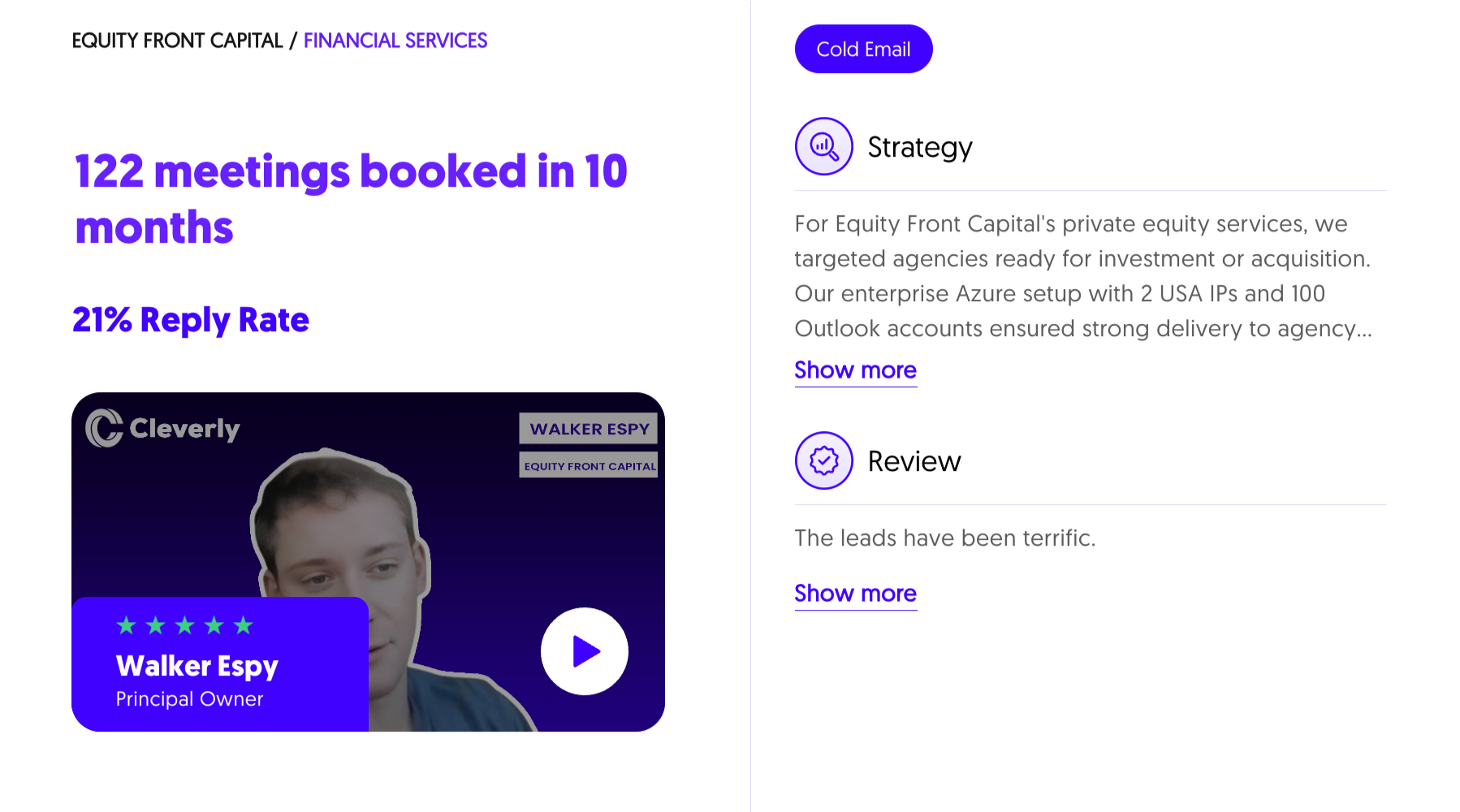
One of our clients, Kunai, assigned a single Fortune 100 banking target to each rep and sourced $3.25 million in pipeline this way.
Long cycles make steady pipeline building more important here, not less. We optimize for qualified meetings held with real decision-makers, and across all our work we have generated $312 million in client pipeline.
Selling AI into financial services? Cleverly books meetings with the people who own the budget. Book a strategy call today.
Conclusion
Adoption in financial services is concentrated where regulatory exposure is lowest. That tells you more about the market than any capability list. The gates are governance, explainability, fair outcomes, and vendor oversight, and your answers to them are part of the product. The open opportunity is in helping institutions govern and monitor what they have already deployed.
Your next step is practical. Map your use case against the gates above and decide whether you are selling an operational tool or a regulated one, because those are different businesses. And be careful with the adoption statistics circulating in this space. Much of it is vendor-authored, and in a sector this evidence-driven, citing a weak number costs you the room.
Frequently Asked Questions
Free Resource
How to Scale a Profitable Cold Call System
Get the complete guide — download it instantly now.

Free Ebook
Download the Free Guide
Enter your details to get instant access.
You're all set! 🎉
Your ebook is downloading now.
Click below if the download didn't start automatically.


