Table of Contents
What Is Call Transcription Software?
Why Sales Teams Use AI Call Transcription Software
How We Evaluated the Best Call Transcription Software
Best AI Call Transcription Software for Sales Teams (Comparison Table)
9 Best AI Call Transcription Software for Sales Teams
How Sales Teams Use Call Transcription to Improve Performance
How Cleverly Uses Call Insights to Improve Cold Calling
Conclusion
Frequently Asked Questions
Modified On :
October 6, 2026
Key Takeaways
- AI call transcription software automatically converts sales calls into searchable transcripts, eliminating manual note-taking.
- The best tools go beyond transcription to offer conversation intelligence, deal signals, and coaching insights.
- CRM integration keeps your pipeline data accurate and updated without extra admin work.
- Objection tracking and talk ratio analysis help sales teams refine scripts and improve rep performance.
- Transcription accuracy varies by tool, with most delivering 85–95% under good audio conditions.
- Free options like Fathom and Otter.ai are solid starting points before investing in an enterprise platform.
Sales runs on conversations. Whether your team is cold calling prospects or closing deals, what happens on those calls determines your revenue.
For a long time, capturing those insights meant scribbling notes mid-conversation or relying on memory after the fact. Neither works well at scale.
That's where call transcription software changes things.
It automatically converts your sales calls into searchable, reviewable transcripts so nothing gets missed.
Pair that with AI, and you're not just recording words. You're pulling out patterns, objections, deal signals, and coaching moments from every single call.
In this guide, we break down the best AI call transcription software options for sales teams in 2026 so you can pick the one that fits how your team actually works.

What Is Call Transcription Software?
Call transcription software records spoken conversations and converts them into written text in real time or after the call ends.
At its core, it replaces manual note-taking with an accurate, searchable log of every conversation.
But not all transcription tools are built the same. The key difference:
- Basic transcription tools convert speech to text. That's it. They're useful for records but don't offer much beyond that.
- AI sales conversation intelligence tools go further. They analyze the transcript, flag key moments, track talk ratios, identify objections, and surface coaching insights.
For sales teams, the second category is where the real value is. These tools plug directly into your sales workflow, connect to your CRM, and give managers and reps actionable data from every call, not just a wall of text.
Also Check: AI Calling Benefits for Cold Outreach
📞 AI Transcripts Are Useless Without Calls
Cleverly’s $5M cold calling system books 10–30 qualified sales meetings every month with trained appointment setters.
Why Sales Teams Use AI Call Transcription Software
The reason AI call transcription software has taken off with sales teams isn't just convenience. It solves real problems that hurt pipeline and rep performance.
Here's what it actually helps with:
1. Automatic call documentation: Every call gets logged without reps having to write anything up. No missed details, no post-call admin drain.
2. Sales coaching insights: Managers can review transcripts and recordings to give specific, evidence-based feedback instead of guessing what went wrong on a call.
3. Objection tracking: When you can see how often certain cold call objections come up and how reps handle them, you can build better scripts and train more effectively.
4. CRM integration: Most tools push call summaries, notes, and key data points straight into your CRM. Your pipeline stays updated without the manual entry.
5. Performance analysis: Track metrics like talk-to-listen ratio, question frequency, and topic coverage across your whole team to spot what's working and what isn't.
Put simply, these tools turn conversations into data your team can actually act on.

How We Evaluated the Best Call Transcription Software
There's no shortage of tools claiming to be the best call transcription software for sales. To cut through the noise, we evaluated each option across six criteria that matter most to sales teams:
- Transcription accuracy: How well does it handle different accents, fast speech, and industry-specific terms?
- Sales coaching features: Does it go beyond transcription to offer rep scoring, call highlights, or manager review workflows?
- CRM integration: Does it connect with the tools your team already uses like Salesforce, HubSpot, or Pipedrive?
- Conversation analytics: Can it surface insights like objection frequency, sentiment, or deal risk automatically?
- Pricing transparency: Is pricing clear and fair for teams of different sizes, or are key features locked behind expensive enterprise tiers?
- Ease of use: Can reps and managers actually use it without a long onboarding process?
We only included tools that hold up across most of these areas. A tool that transcribes well but has no coaching layer isn't enough for a serious sales team in 2026.
Some Tips: 10+ Proven Cold Calling Tips to Book More Meetings
🚀 1M+ Cold Calls. 53K Meetings Booked.
Deploy a proven outbound calling engine with scripts, dialers, data, and SDRs—live in just 2 weeks.
Best AI Call Transcription Software for Sales Teams (Comparison Table)
9 Best AI Call Transcription Software for Sales Teams
1. Gong
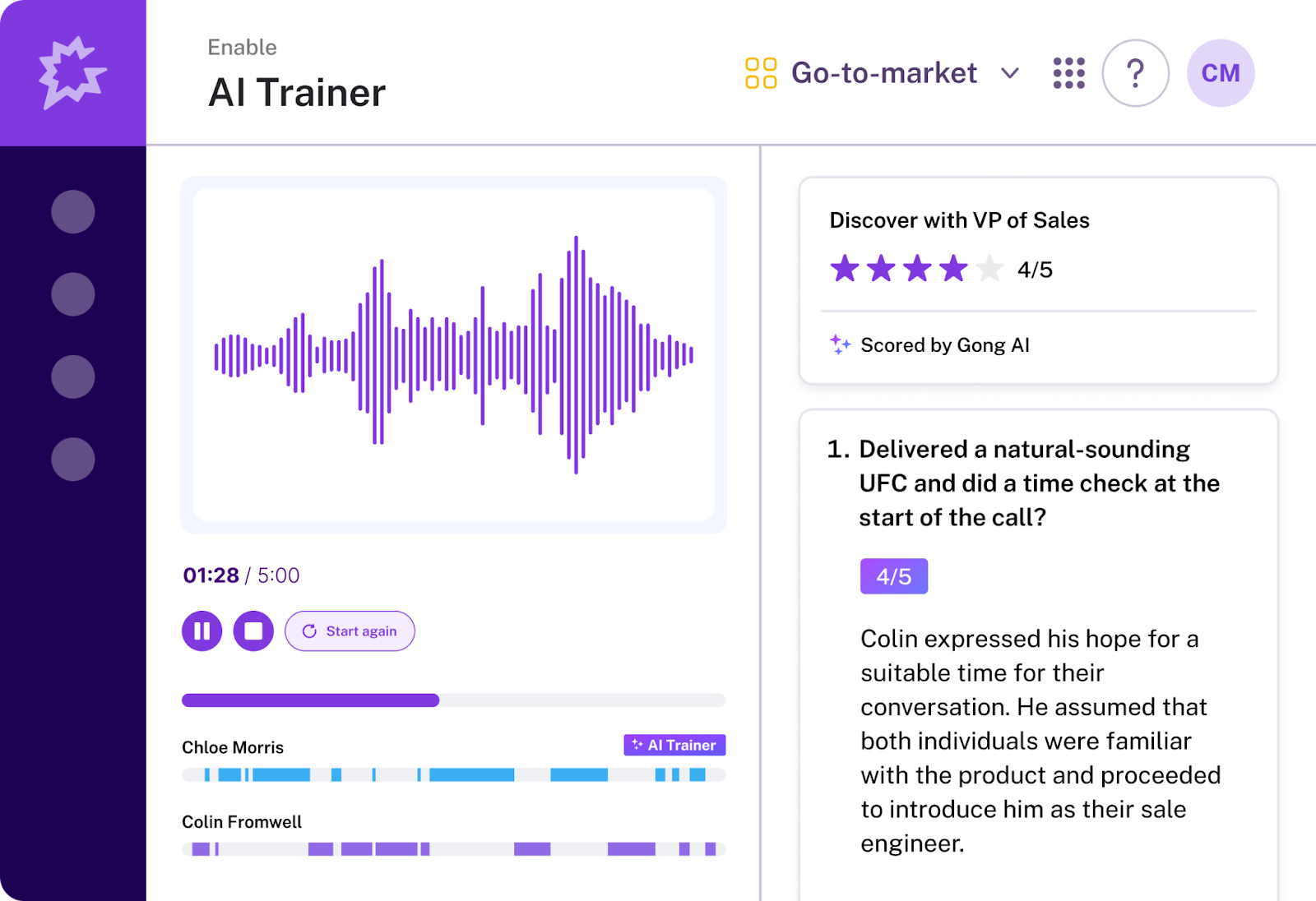
Gong is one of the most well-known names in AI call transcription software and revenue intelligence. It automatically records and transcribes calls across phone, video, and email, then layers AI analysis on top to surface buyer signals, objections, and deal risks.
It's built for sales teams that want more than transcripts and are ready to use conversation data to drive real pipeline decisions.
Key Features:
- Automated recording across Zoom, Teams, and most major dialers.
- AI analysis tracking 300+ signals including talk ratios, sentiment, and competitor mentions.
- Revenue forecasting based on deal velocity and engagement data.
- Manager scorecards and a "best call" library for rep coaching and onboarding.
- Gong Engage for AI-personalized follow-ups based on call context.
Pros:
- Highly accurate transcription paired with deep, actionable insights.
- Strong sales coaching layer with real evidence from actual calls.
Limitations:
- One of the more expensive options on this list with multi-year contracts often required.
- Significant setup time needed, not a plug-and-play solution for smaller teams.
Pricing: Not publicly listed. Typically includes a platform fee of $5,000+ annually plus per-user licensing, often landing at $1,200–$1,600+ per rep per year.
2. Happy Scribe

Happy Scribe is an AI transcription and subtitle platform built for teams that need accurate call documentation and multilingual support. It automatically converts sales calls, meetings, and interviews into searchable transcripts while also generating summaries and exports for CRM or reporting workflows. Its clean interface and high transcription accuracy make it a practical option for sales teams handling large volumes of conversations across different markets.
Key Features:
- AI-powered call transcription with speaker recognition
- Automatic summaries and searchable transcripts
- Supports multiple languages and subtitle exports
- Easy sharing and export options for teams
- Integrations with common productivity workflows
Pros:
- Strong multilingual transcription support
- Clean interface that’s easy for teams to use
Limitations:
- Advanced collaboration features are more limited than enterprise-focused platforms
- Some editing and export features require paid plans
Pricing: Free trial available; paid subscription plans scale based on transcription usage and features.
3. Chorus by ZoomInfo
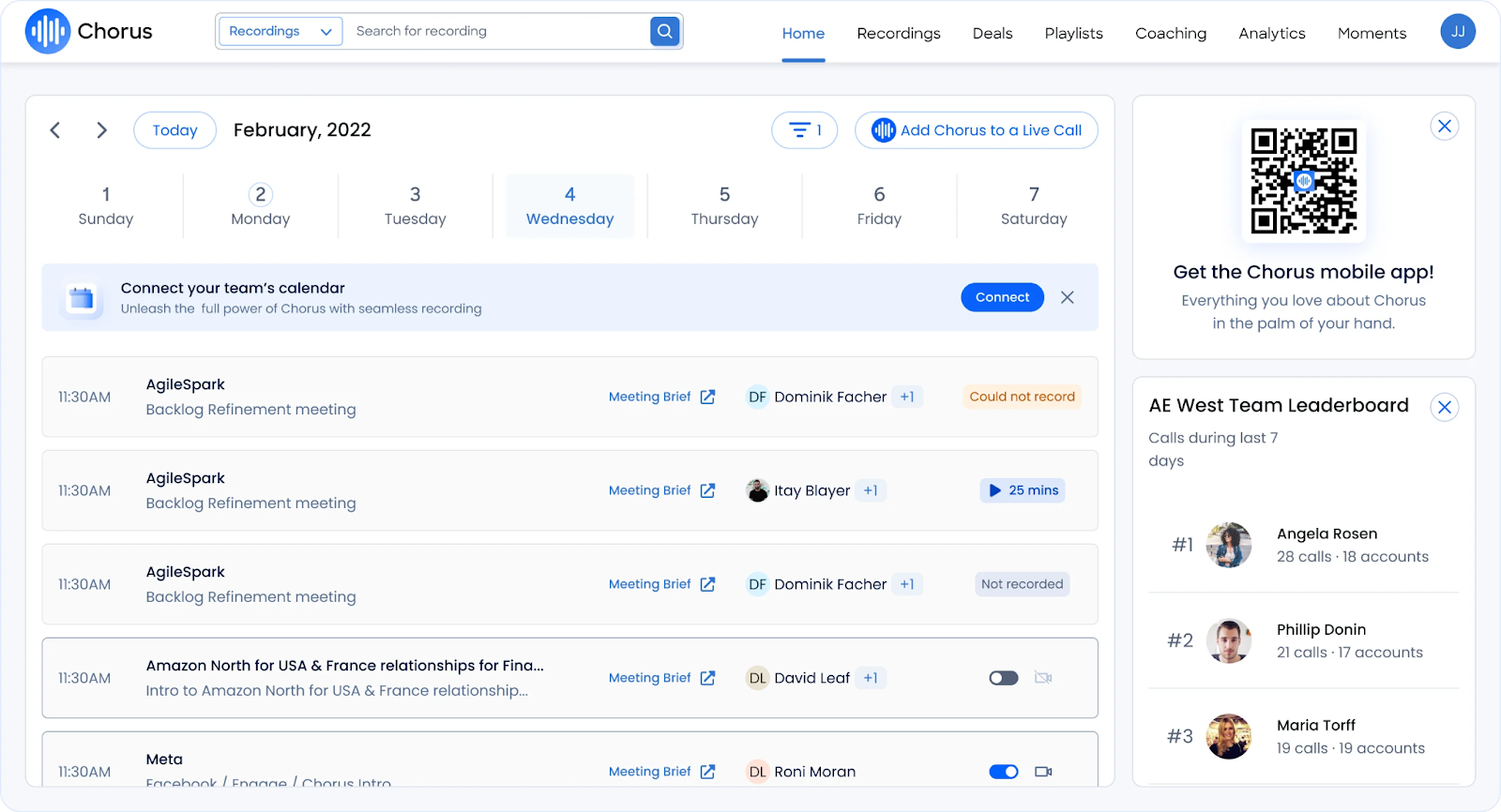
Chorus is a conversation intelligence platform that records, transcribes, and analyzes sales calls, video meetings, and emails. What sets it apart is its deep integration with the ZoomInfo B2B database, which adds real prospect context on top of your call data.
It's a solid pick for mid-market and enterprise teams already in the ZoomInfo ecosystem who want coaching and deal intelligence in one place.
Key Features:
- Automatic recording and transcription across Zoom, Teams, and dialers with searchable transcripts.
- AI analysis of talk ratios, sentiment, question frequency, and competitor mentions.
- Deal intelligence that tracks commitment phrases and flags at-risk opportunities.
- Coaching playlists and clip-based feedback tools for manager-led training.
- Live ZoomInfo contact enrichment to add B2B context during calls.
Pros:
- Standout B2B data enrichment through the ZoomInfo ecosystem.
- Strong coaching analytics with specific, clip-level feedback capabilities.
Limitations:
- Priced for mid-market and enterprise, not accessible for smaller teams.
- Transcription accuracy can be inconsistent compared to some competitors.
Pricing: Starts at roughly $8,000/year for three seats, with additional seats at around $1,200/year each. Typically requires a two-year contract.
4. Otter.ai
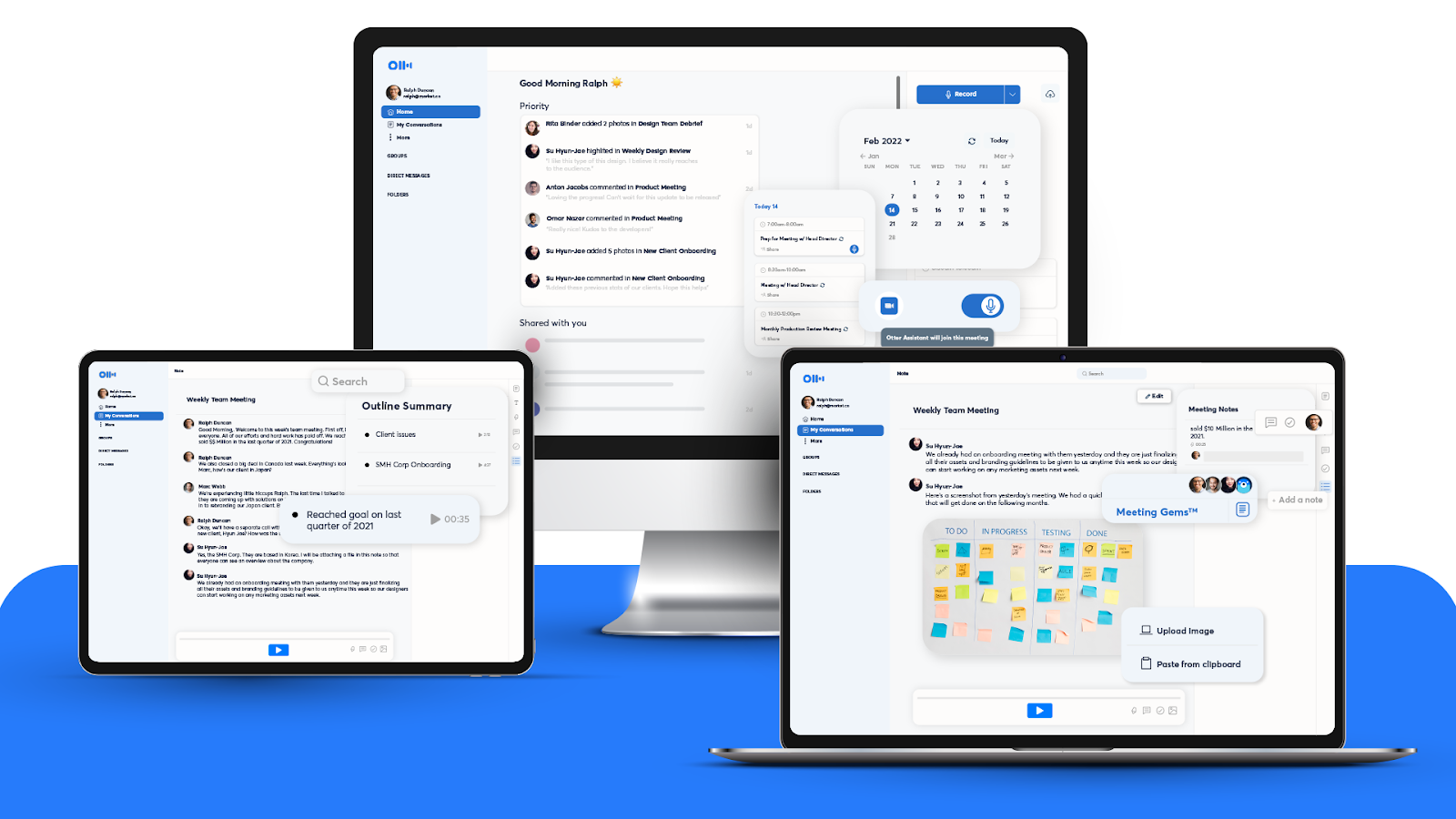
Otter.ai is a widely used AI meeting assistant that transcribes voice conversations in real time and turns them into searchable, interactive notes. It connects directly with Zoom, Google Meet, and Microsoft Teams, making it easy to capture everything without manually recording.
For sales teams that want clean transcripts and automated summaries without a heavy enterprise setup, it's a practical and affordable option.
Key Features:
- Real-time transcription with automatic speaker labeling and timestamps.
- OtterPilot joins your meetings automatically to record and transcribe, even when you're not there.
- AI-generated meeting summaries with key takeaways and action items.
- Otter AI Chat lets you ask questions or draft follow-up emails directly from transcripts.
- Custom vocabulary support for industry terms and powerful search across all past calls.
Pros:
- Accurate real-time transcription with smooth integration into major video conferencing platforms.
- Strong AI summary and action item features that save post-call admin time.
Limitations:
- Free plan is quite limited in minutes and storage, not practical for active sales teams.
- Accuracy drops with heavy accents or noisy call environments.
Pricing:
- Free: 300 mins/month (30 mins per conversation)
- Pro: ~$8.33–$16.99/user/month (1,200 mins/month)
- Business: ~$20–$30/user/month (6,000 mins/month)
5. Fireflies.ai

Fireflies.ai is an AI meeting assistant that records, transcribes, and summarizes conversations across all major video conferencing platforms. It works as a central knowledge base for your team, turning every call into searchable text with action items and key decisions already pulled out.
It's a strong option for sales teams that want reliable transcription, solid CRM integrations, and a clean interface without the enterprise price tag.
Key Features:
- Real-time transcription in 100+ languages with AI-generated summaries, highlights, and next steps.
- AskFred AI assistant for querying meetings, drafting follow-ups, or summarizing specific call segments.
- Smart search with filters for sentiment, speaker talk time, and key topics.
- Direct CRM sync with Salesforce, HubSpot, and integrations with Asana, Trello, and Slack.
- Customizable channels to organize transcripts by team, department, or project.
Pros:
- Unlimited transcription on all paid plans with 90%+ claimed accuracy.
- Strong security certifications including SOC 2, GDPR, and HIPAA compliance.
Limitations:
- Accuracy can slip with background noise or strong accents.
- Video recording is only available on Business tier and above.
Pricing:
- Free: Limited storage and features
- Pro: $10/user/month (billed annually)
- Business: $19/user/month (billed annually)
6. Tactiq
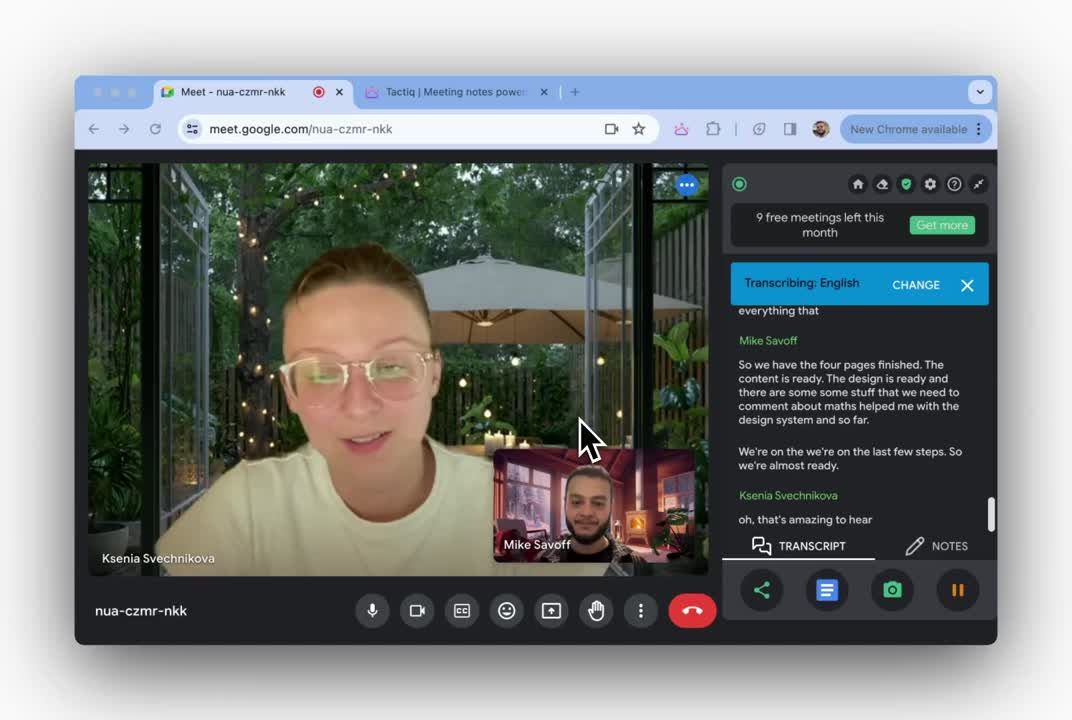
Tactiq is a lightweight, browser-based transcription tool that captures live conversations without sending a bot into your meeting. It works as a Chrome extension, picking up live captions from Google Meet, Zoom, and Microsoft Teams in real time.
For sales reps who want clean transcripts without the awkward "bot has joined" moment, it's a simple and non-intrusive option.
Key Features:
- Real-time, bot-free transcription in 30+ languages directly from live captions.
- Automatic AI meeting summaries, key takeaways, and action items post-call.
- Integrations with Slack, Notion, HubSpot, and Google Drive for easy note sharing.
- Live highlighting and screenshot capture to tag important moments during the call.
Pros:
- No bot joining the call makes it less intrusive and easier for prospects to engage naturally.
- Quick to set up as a browser extension with accurate real-time transcription.
Limitations:
- Chrome-only with no mobile or standalone app support.
- Does not record actual audio or video, only captures text via live captions.
- Free plan has strict AI credit limits.
Pricing:
- Free: Up to 10 meetings/month
- Paid: Starting around $8–$12/user/month (billed annually), with unlimited AI features on higher-tier team plans
7. Rev
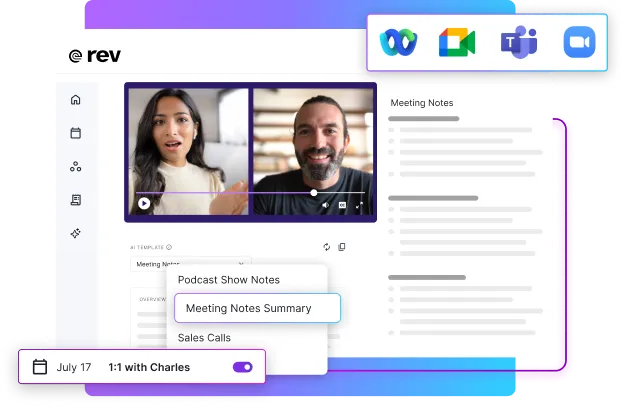
Rev is a speech-to-text platform trusted by 1.3M+ users including Fortune 500 companies. It's built on proprietary models trained on 7M+ hours of verified data, which is why its accuracy stands out. What makes it different from most tools on this list is its hybrid model: you get fast AI transcription with the option to add human review for near-perfect output.
It's a strong fit for teams dealing with sensitive or compliance-heavy conversations.
Key Features:
- AI transcription at up to 95% accuracy, with optional human review hitting 99%, across 57+ languages.
- Live meeting notetaker bot for Zoom, Google Meet, and Teams with real-time transcription, summaries, and action items.
- Collaborative web editor that syncs text with audio and video for easy editing and speaker labeling.
- AI Transcript Assistant to chat with transcripts and pull summaries, key quotes, and insights.
- Enterprise-grade security with HIPAA, GDPR, and SOC 2 Type II compliance plus developer APIs.
Pros:
- Among the highest transcription accuracy on this list with a reliable human fallback option.
- Strong security certifications make it suitable for sensitive or regulated industries.
Limitations:
- The notetaker bot joining calls can feel intrusive for some prospects.
- Paid plans and human-verified transcription can get expensive compared to alternatives.
Pricing:
- AI transcription: $0.25/minute (pay-as-you-go) or ~$15/hour
- Subscription: Starting around $14.99/month
- Human transcription: $1.99/minute
8. Avoma
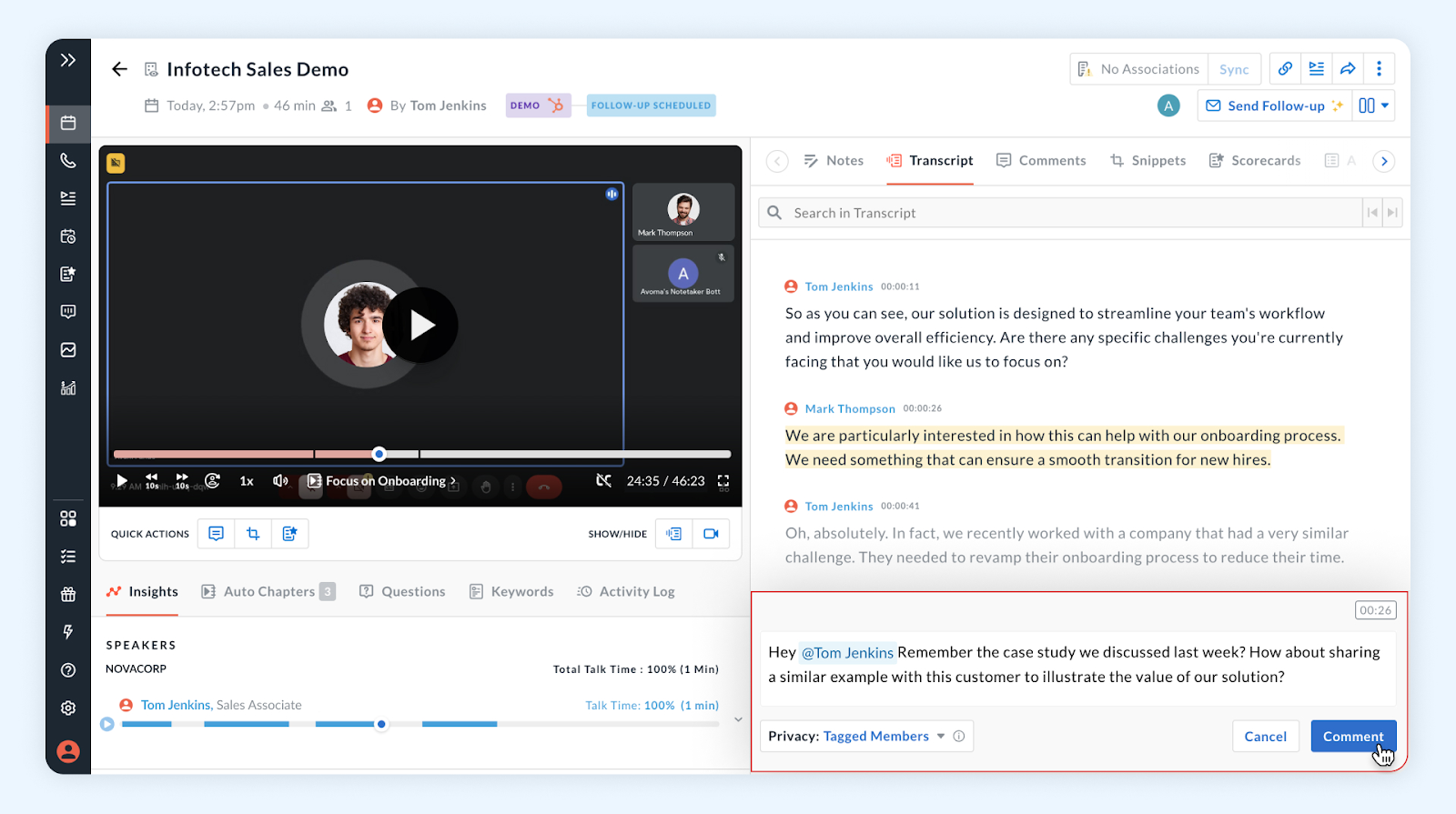
Avoma is an all-in-one AI meeting assistant built specifically for revenue and customer-facing teams. It handles transcription, note-taking, and conversation intelligence in one platform, making it a practical alternative to heavier enterprise tools like Gong or Chorus. If your sales, customer success, or marketing team needs structured call insights with solid CRM sync at a more accessible price point, Avoma is worth a look.
Key Features:
- Real-time transcription in 30+ languages with AI notes categorized by pain points, requirements, and next steps.
- Conversation intelligence covering talk-to-listen ratios, speaker ID, and sentiment analysis for rep coaching.
- Automatic CRM sync with Salesforce and HubSpot, plus integrations with Zoom, Google Meet, and Teams.
- Custom keyword tracking for competitor mentions and deal risk alerts for pipeline management.
Pros:
- Structured, editable AI summaries that go beyond generic recaps and actually map to sales workflows.
- Strong coaching and revenue intelligence features at a mid-market price point.
Limitations:
- More than a basic transcription tool, which can feel like overkill for simpler use cases.
- Transcription accuracy can dip with heavy accents or complex terminology.
- Recording bot occasionally fails to join or drops from meetings.
Pricing:
- Startup: ~$19/user/month (billed annually)
- Organization/Enterprise: Up to $39+/user/month
9. Fathom
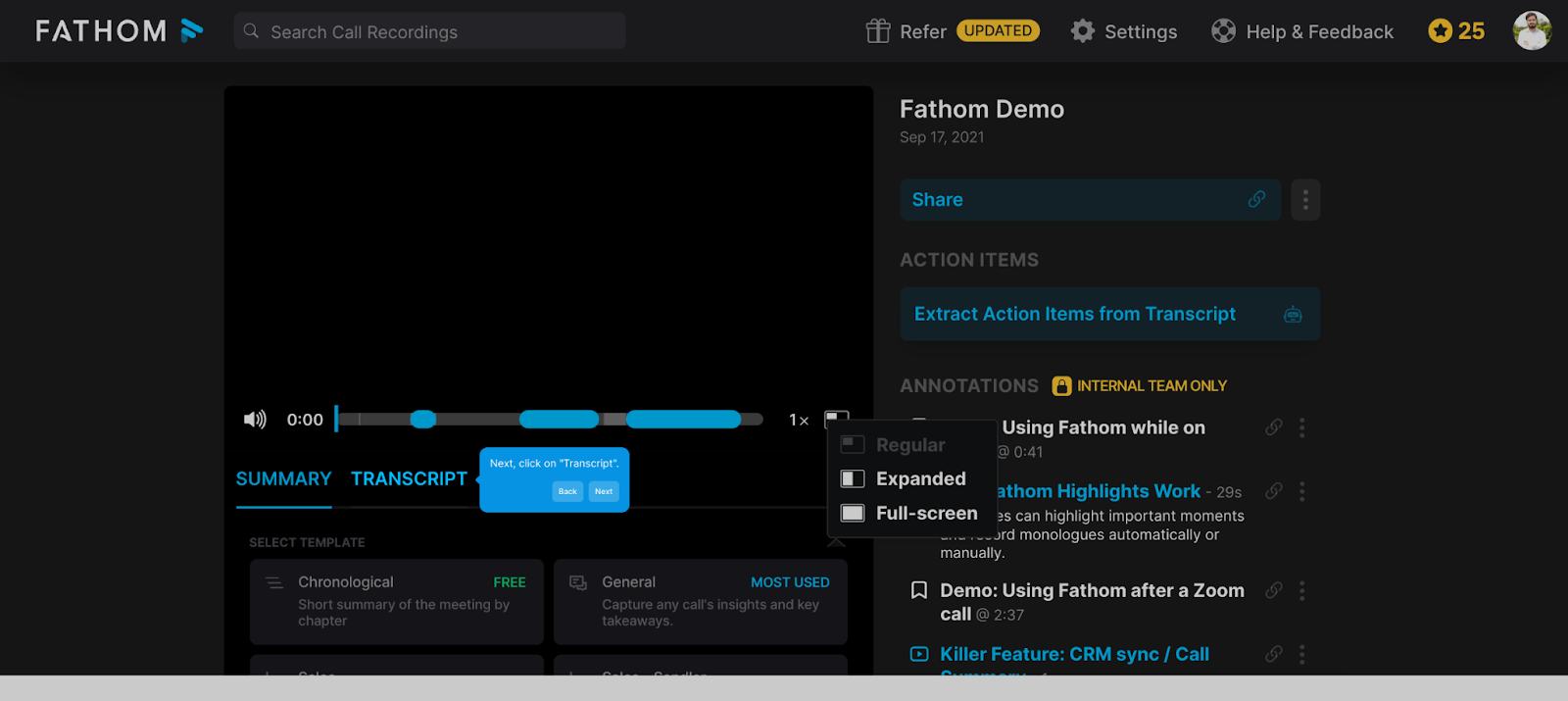
Fathom is a clean, easy-to-use AI meeting assistant that records, transcribes, and summarizes calls on Zoom, Google Meet, and Microsoft Teams. What makes it stand out is its free-forever plan with unlimited recording and no minute caps, which is genuinely rare in this category.
It's a great starting point for individual reps or smaller teams who want solid transcription without any upfront cost.
Key Features:
- Unlimited free recording and transcription with no minute caps on the free plan.
- Instant AI summaries and action items generated within 30 seconds of the call ending.
- "Ask Fathom" AI assistant to query past meetings, find specific details, or draft follow-up emails.
- CRM and productivity integrations with Salesforce, HubSpot, Slack, and Asana.
- In-call highlight and clip creation to mark and share key moments instantly.
Pros:
- One of the most generous free plans available with unlimited usage and 85–95% transcription accuracy.
- Fast post-meeting processing at around 30 seconds makes it easy to act on insights right away.
Limitations:
- No mobile recording app and no support for uploading pre-recorded audio or video files.
- A visible bot joins the meeting, which some users and prospects find noticeable.
Pricing:
- Free: Unlimited recording and transcription for individuals
- Premium: ~$15–$20/user/month (billed annually) for advanced AI summaries and deeper integrations
- Team: ~$19–$29/user/month for collaborative features and shared folders
10. RingCentral AI Conversation Expert
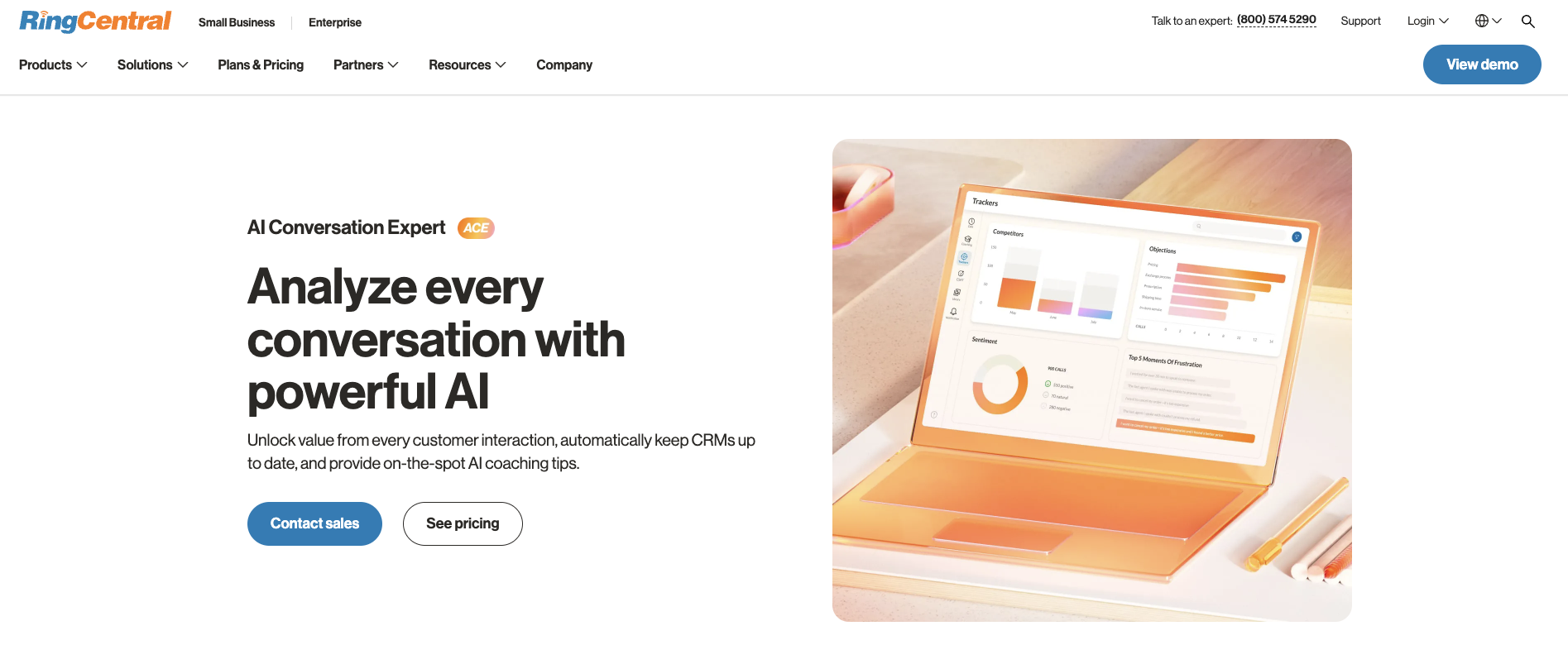
RingCentral AI Conversation Expert (ACE) is a conversation intelligence platform built for sales and contact center teams that need to go beyond basic transcription. It analyzes voice and digital interactions in real time, surfacing coaching signals and compliance alerts during live calls, and then automatically generates summaries, action items, and performance insights when the call ends.
Where most tools on this list are built around meeting transcription, ACE is built around call performance at scale. It evaluates far more interactions than any manual QA process could, giving managers a data-backed picture of what's working across the whole team, not just the calls they happened to sit in on.
Key Features:
- Real-time guidance and prompts for sales reps during live calls.
- Automated post-call summaries, action items, and next steps.
- Customer sentiment and intent analysis across every interaction.
- Objection and compliance monitoring with automated quality signals.
- Performance trend reporting and coaching insights for managers.
- Works across both voice and digital channels natively inside RingCentral.
- Native integration with RingCX and RingEX.
Pros:
- Evaluates every interaction, not just a sample, giving managers a more complete view of team performance.
- Real-time in-call guidance means reps get support when it matters, not just in the debrief.
- Built for voice-heavy environments rather than repurposed from a meeting transcription tool.
Limitations:
- Insight quality improves with higher interaction volume, so smaller teams may see limited value early on.
- Not a standalone tool: works best inside the RingCentral ecosystem.
- Not designed for upload-based transcription of pre-recorded audio files.
Pricing: RingCentral AI Conversation Expert starts at $60 per user per month.
How Sales Teams Use Call Transcription to Improve Performance

The real value of AI call transcription software isn't the transcript itself. It's what your team does with it. Here's how high-performing sales teams are putting call data to work:
- Analyzing objection patterns: When you can search across hundreds of transcripts, patterns emerge fast. You start seeing which objections come up most often, at what stage, and how different reps handle them.
- Improving scripts: Call data tells you what messaging actually lands. If a certain framing consistently moves prospects forward, you build it into your scripts. If something falls flat repeatedly, you cut it.
- Coaching SDRs: Instead of vague feedback like "be more confident," managers can pull up specific call moments and coach on exactly what happened. That specificity makes a real difference in rep development.
- Documenting sales calls: Every call becomes a reliable record. No more relying on rep memory or inconsistent CRM notes. Your pipeline data gets cleaner and more trustworthy.
- Identifying deal signals: Transcripts reveal buying intent through language. When a prospect asks about implementation timelines or pricing structures, that's a signal. AI tools surface these moments automatically so reps can follow up at the right time.
The teams that improve fastest aren't just making more calls. They're learning from every one.
How Cleverly Uses Call Insights to Improve Cold Calling
At Cleverly, we don't just make cold calls. We build a system around them. As a data-driven cold calling agency, we use call insights at every stage to keep performance sharp and results consistent.
How we do it:
- Analyzing call conversations: We review call transcripts to understand what's working across different industries, personas, and market segments. Every data point feeds back into the system.
- Refining cold calling scripts: Scripts aren't set-and-forget. We continuously update them based on what's actually moving prospects to book, not what sounds good on paper.
- Identifying high-performing messaging: When certain openers, value props, or questions consistently drive engagement, we scale them across the team.
- Improving objection handling: We track the most common objections and train our appointment setters with tested, proven responses so no rep is caught off guard.
- Aligning calls with multi-touch outreach: Cold calls don't happen in isolation. We sync call insights with LinkedIn and email outreach so every touchpoint reinforces the same message.
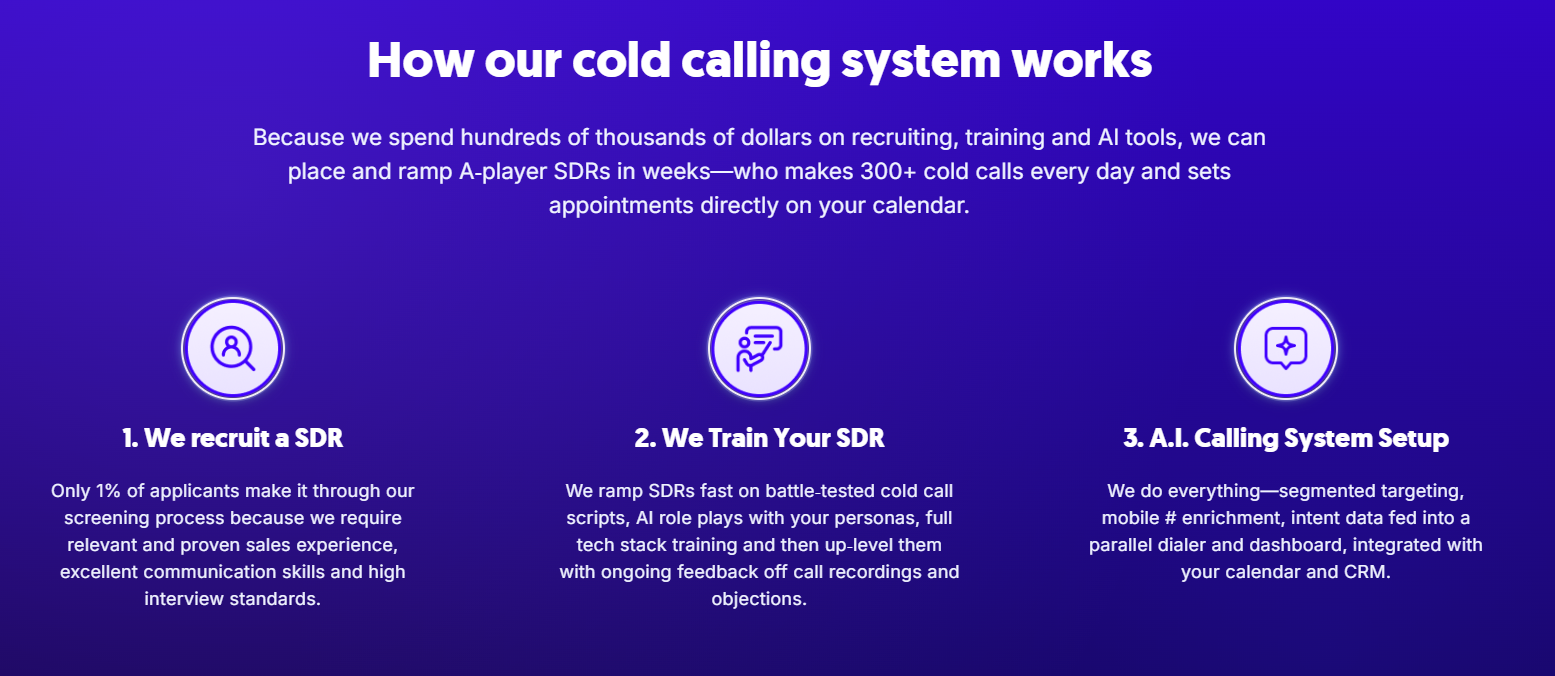
The result is a cold calling system that gets smarter over time, not just louder.
Our $5M cold calling system books you 10 to 30 qualified sales calls every month, guaranteed.
We place no-accent appointment setters, write your call scripts, handle all the data and dialing tech, and back it all with a replacement guarantee if appointments aren't delivered… All at HALF the price of hiring in-house.
We've generated $312M in pipeline across 10,000+ clients including Amazon, Google, Uber, and Slack.

Book a free consultation and see how our cold calling system can fill your pipeline.
Conclusion
Call transcription software has moved from a nice-to-have to a core part of how serious sales teams operate.
The best tools don't just capture words. They surface the insights that help reps improve, managers coach better, and teams close more deals.
Whether you're looking for an enterprise-grade platform like Gong or a generous free option like Fathom, the right AI call transcription software is the one your team will actually use and act on.
The companies pulling ahead in 2026 are the ones treating every call as a data point, not just a conversation.
Frequently Asked Questions
Free Resource
How to Scale a Profitable Cold Call System
Get the complete guide — download it instantly now.
Free Ebook
Download the Free Guide
Enter your details to get instant access.
You're all set! 🎉
Your ebook is downloading now.
Click below if the download didn't start automatically.