Table of Contents
What Are LinkedIn Lead Generation Services?
What Does In-House LinkedIn Outreach Look Like?
Head-to-Head Comparison: LinkedIn Services vs In-House
Pros and Cons of LinkedIn Lead Generation Services
Pros and Cons of In-House LinkedIn Outreach
When Should You Choose a LinkedIn Lead Generation Service?
When Should You Build In-House Outreach Capabilities?
How to Choose Between LinkedIn Lead Generation Services and In-House Outreach
How to Measure Agency and In-House LinkedIn Outreach
Final Verdict: LinkedIn Lead Generation Services or In-House?
Frequently Asked Questions
Modified On :
August 11, 2026
Key Takeaways
- Outsourcing is usually the faster route when a company lacks a dedicated LinkedIn outreach owner.
- In-house teams offer closer product knowledge and message control but carry hiring, training, software, and management costs.
- Compare both models by cost per qualified opportunity and pipeline, not connection requests or booked calls alone.
- A hybrid model works well when an agency manages execution while the internal team supplies expertise and handles sales conversations.
- The right choice depends on your current capability, required launch speed, compliance needs, and long-term ownership plan.
A complete replacement is unnecessary. The existing introduction identifies the decision and the reader’s main questions. Replace the paragraphs beginning “The truth is” and ending “Let’s get into it” with:
There is no universal winner in the LinkedIn lead generation services vs in-house debate. The right model depends on whether your company needs faster execution, closer control, deeper internal learning, or additional campaign capacity.
The comparison also needs to go beyond the agency fee and employee salary. A fair decision includes internal labor, software, management, speed to launch, reply handling, lead quality, cost per qualified opportunity, and pipeline created.
Cleverly has managed LinkedIn outreach across different B2B markets, offers, and sales cycles. The pattern is consistent: the operating model matters less than whether the campaign has a defined owner, accurate targeting, relevant messaging, prompt reply handling, and a shared definition of a qualified opportunity.
This guide compares outsourced, in-house, and hybrid LinkedIn lead generation so you can choose the model that fits your current team and long-term sales strategy.
What Are LinkedIn Lead Generation Services?
When you’re thinking about scaling outreach on LinkedIn but don’t have the time or internal resources to manage it, outsourcing LinkedIn lead generation can be a smart move.
Definition & Scope
A LinkedIn lead generation agency (like us at Cleverly) takes the entire outreach process off your plate.
That means you're not just getting a VA to send messages, you’re getting a full service that’s designed to drive results.
Here’s what’s typically included when you outsource LinkedIn lead generation:
- LinkedIn profile optimization: Your profile is reworked to position you as a trusted expert in your niche—so leads take you seriously when you reach out.
- Prospecting and list building: Agencies use tools like Sales Navigator to build laser-targeted lead lists based on your ICP.
- Custom LinkedIn messaging: No spam here—just tested, personalized messages that get replies.
- Appointment setting: You get warm leads booked directly onto your calendar, without spending hours in your inbox.
It’s like adding a mini sales team that runs silently in the background—without the hiring, training, or micromanaging.
Types of Services
Not all LinkedIn outreach services look the same. You can pick what works best for your workflow and internal capabilities.
Here are the common models:
- Fully managed: The agency handles everything end-to-end—from targeting to booking calls.
- White-label LinkedIn solutions: Ideal for agencies who want to offer B2B lead generation outsourcing under their own brand.
- Hybrid: You provide your own list of prospects, and the agency runs the messaging and follow-up for you.
Each model has its own pros and trade-offs, and we’ll walk through how they compare to building your own outreach team in the next section.
💼 Done-for-You, Done Right
Skip the time, training, and trial-and-error of in-house outreach. Our proven LinkedIn lead gen starts at just $397/month.
What Does In-House LinkedIn Outreach Look Like?
If you decide not to outsource, you’ll be running in-house LinkedIn lead generation—meaning your own team handles everything from prospecting to messaging and follow-ups.
Built and Executed by Internal Team
In most companies, this responsibility lands with the sales or marketing team. Sometimes it's just one SDR juggling LinkedIn with a dozen other tasks.
Other times, there’s a small team dedicated to it—but even then, it requires a solid plan and daily execution.
To make your internal LinkedIn outreach strategy work, you need to:
- Build your own target account list
- Write personalized message templates
- Set up follow-up sequences
- Monitor inboxes and replies daily
- Track everything to know what’s working and what’s not
And of course, someone has to own it—outreach can’t be an afterthought if you want results.
Key Requirements for In-House Success
If you're going the in-house route, here’s what you’ll absolutely need to do it right:
- LinkedIn Sales Navigator: This is essential for advanced search filters and better targeting.
- CRM system: You’ll need a place to track leads, conversations, and follow-up status.
- A dedicated person or team: Ideally, someone who isn’t juggling five other priorities.
- Templates and sequences: Outreach should be systemized—not random messages sent here and there.
- Reporting: You’ll want to know your connection rates, reply rates, and how many leads are actually converting.
The upside?
You get full control. The downside? It’s resource-heavy, and unless someone’s focused on improving it every week, results tend to plateau.
Head-to-Head Comparison: LinkedIn Services vs In-House
Still on the fence between LinkedIn lead generation services and running in-house LinkedIn outreach?
Here’s a quick comparison to help you weigh both options based on what really matters—time, cost, control, and results.
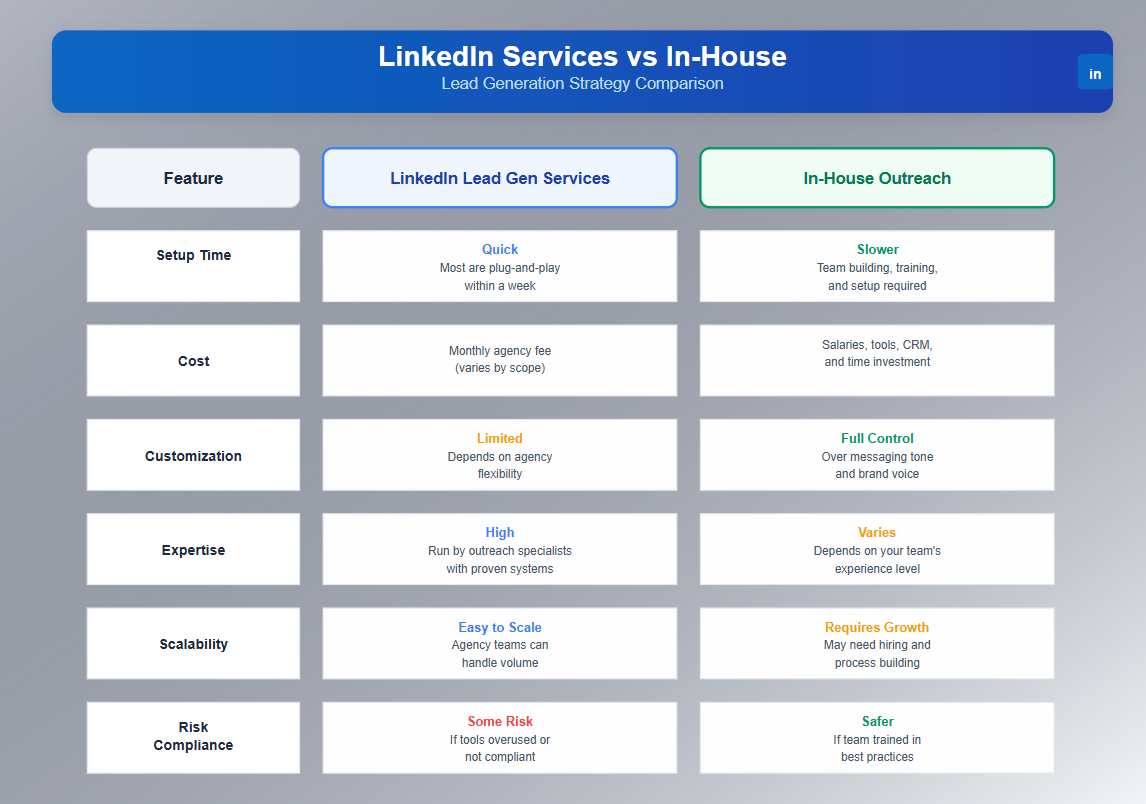
So, should you outsource LinkedIn prospecting or keep it in-house?
It really comes down to your resources, how fast you need results, and how much control you want over the process.
We’ll dive into the pros of each next—starting with why many B2B companies lean toward using a lead gen service.
What Does In-House LinkedIn Lead Generation Really Cost?
The cost of in-house LinkedIn lead generation is not limited to one employee’s salary. It includes the people, tools, management, and lost selling time required to keep the program running.
Calculate the internal cost across these categories:
Personnel
Include the salary, benefits, payroll costs, recruiting expense, and onboarding time for every employee who contributes to the program. Depending on the team, that may include an SDR, sales manager, RevOps support, copywriter, researcher, and designer.
If an existing salesperson owns LinkedIn outreach, calculate the time taken away from discovery calls, proposals, follow-up, and closing. Reassigning work does not make the work free.
Software and Data
An internal program may require Sales Navigator, a CRM, data providers, enrichment, scheduling, reporting, and other sales tools. Confirm which tools the company already owns and which subscriptions exist only because of the LinkedIn campaign.
Do not treat unauthorized LinkedIn automation as a shortcut. LinkedIn states that third-party software that scrapes or automates activity on its website is prohibited.
Management and Quality Control
Someone must review targeting, approve messages, coach the outreach owner, inspect conversations, maintain CRM records, and report results. That management time belongs in the cost calculation even when it is distributed across several employees.
Hiring and Turnover Risk
An internal program can lose momentum when its owner leaves, changes roles, or inherits another priority. Include the cost of recruiting, ramp time, process documentation, and temporary performance loss.
Opportunity Cost
The final cost is what the team could have done with the same time and budget. A founder spending several hours each week researching prospects and managing first messages may save an agency fee but delay sales conversations, partnerships, product work, or customer delivery.
Calculate the monthly internal cost, then divide it by held qualified meetings, accepted opportunities, and pipeline created. This gives you a fairer comparison than placing an agency invoice beside one employee’s base salary.
🚀 More Leads, Less Hassle
We handle targeting, messaging, and booking meetings, so your team can focus on closing deals. Book your free strategy call today.
Pros and Cons of LinkedIn Lead Generation Services
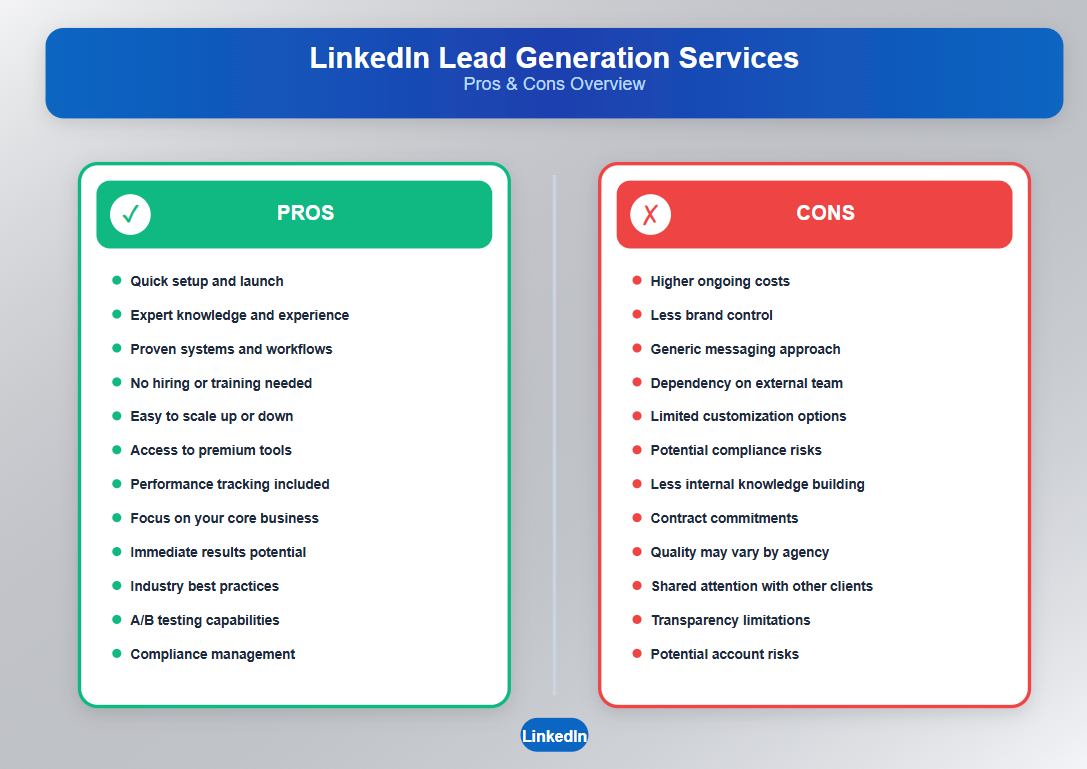
Choosing to outsource LinkedIn outreach to a trusted partner can free up a lot of your team’s time—but like any approach, it comes with trade-offs.
Here’s a closer look at the benefits of LinkedIn lead generation agency support, and what to watch out for.
✅ Pros of LinkedIn Lead Generation Services
- Faster implementation
You don’t need to build anything from scratch. Agencies like Cleverly have ready-to-go systems that can start generating leads within days. - Proven frameworks
Experienced agencies have already tested what works. You get access to optimized messaging, follow-ups, and targeting strategies built from working with thousands of campaigns. - Little to no time commitment from your team
Once the targeting and messaging are approved, most of the day-to-day work is handled for you. - Scalable without hiring
Need to increase outreach volume or target new verticals? Just loop in your agency—no need to hire or train internally.
⚠️ Cons of LinkedIn Lead Generation Services
- Generic messaging if not customized
Not all agencies tailor messages deeply to your brand or audience. Without close collaboration, your outreach might feel templated or cold. - Lack of transparency in some agencies
Some providers don’t share metrics, lead quality, or give you full access to conversations—making it hard to assess what’s working. - Limited learning curve for internal teams
When someone else is handling your outreach, your internal team may not build the skills or insights needed for long-term sales growth.
That said, the downsides can be managed, especially if you work with a partner that values collaboration, customization, and visibility (like we do at Cleverly).
Pros and Cons of In-House LinkedIn Outreach
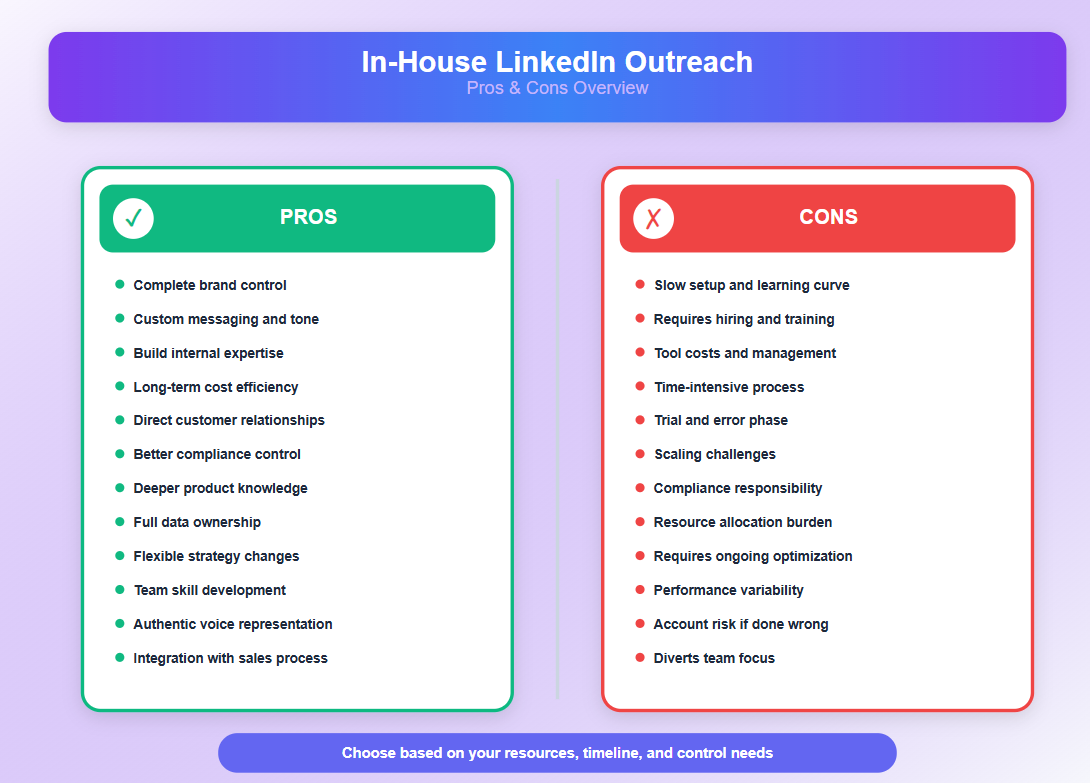
Running your internal LinkedIn B2B outreach can give you more control—but it also demands more time, consistency, and strategy from your team.
Let’s break down the trade-offs of keeping things in-house.
✅ Pros of In-House LinkedIn Outreach
- Full control over brand voice
You write and send the messages, so the tone, language, and positioning are always aligned with your brand. - Deeper understanding of your audience
Because you’re handling conversations directly, you get firsthand insights into what your leads care about, their objections, and what resonates. - Team learns what’s working
Over time, your sales or marketing team builds knowledge on messaging, targeting, and follow-ups—valuable for future campaigns and content.
⚠️ Cons of In-House LinkedIn Outreach
- Requires time and expertise
From writing outreach copy to managing follow-ups daily, in-house LinkedIn takes consistent effort and focus. If no one owns it, it slips. - Steeper learning curve
If your team is new to LinkedIn lead generation, there’s a lot to figure out—from Sales Navigator filters to crafting effective sequences. - May be slower to scale initially
Building an outreach system, training team members, and refining processes takes time—especially compared to an agency that’s already dialed in.
So when it comes to in-house vs outsourced LinkedIn lead generation, it really depends on your team’s capacity and how quickly you want results.
When Should You Choose a LinkedIn Lead Generation Service?
Not every business needs to build their own outreach system from scratch. In fact, there are several situations where it makes more sense to bring in the pros.
Here are some of the best use cases for LinkedIn outreach agencies:
- You lack internal bandwidth or expertise
If your team is already stretched thin—or no one has experience with LinkedIn prospecting—it’s much easier to let specialists handle it for you. - You need results fast
Building an in-house system can take months. If you need meetings on the calendar this quarter, working with a service is a faster route. - You’re testing a new market or segment
Want to explore a new industry, region, or buyer persona? Instead of tying up internal resources, hire LinkedIn lead generation services to run a pilot campaign and gather early learnings. - You’re running short-term campaigns or need appointment setting support
Whether it’s promoting an event, launching a product, or just needing more top-of-funnel activity—outsourcing gives you flexibility without committing long term.
In all these cases, a trusted partner (like us at Cleverly) can help you start generating real conversations and leads on LinkedIn without slowing down your team.
When Should You Build In-House Outreach Capabilities?
While outsourcing is great for speed and scale, there are times when building in-house LinkedIn outreach is the smarter move—especially if lead generation is a long-term priority for your business.
Here’s when an in-house lead generation strategy makes more sense:
- You’re in it for the long game
If LinkedIn is going to be a core part of your sales motion for the next 12–24 months, investing in your own internal system can pay off in the long run. - You need complete control and customization
Some industries or brands require very tailored messaging and outreach style. In-house teams give you full creative control. - You want to build outreach as a core sales function
If outbound is a pillar of your revenue engine, it makes sense to own the process fully—refining it over time as your team grows. - Your ICP is niche or highly specific
If you’re targeting a very narrow buyer group, an internal team that deeply understands your product and market can often craft more relevant and thoughtful outreach.
In these cases, the extra time and effort it takes to build your own team and systems is often worth it, especially if you’re focused on long-term efficiency and alignment.
The Hybrid Model: Agency Execution With Internal Expertise
The decision does not have to be fully outsourced or fully internal. A hybrid model separates campaign execution from the knowledge and conversations that should remain inside the company.
In a practical hybrid arrangement, the external partner can own:
- ICP development and audience research
- Prospect list building
- Profile recommendations
- Message and sequence development
- Campaign setup and daily monitoring
- Test planning and performance reporting
The internal team can own:
- Product and market context
- Audience and message approval
- Compliance review
- Qualified reply handling
- Discovery calls and opportunity qualification
- Feedback on lead quality
- CRM opportunity management
This model preserves internal judgment without asking the sales team to build every campaign process from scratch.
Define the handoff before launch. The agreement should state who monitors replies, how quickly qualified prospects receive a response, which conversations enter the CRM, and what information accompanies each handoff. If those responsibilities remain vague, interested prospects can sit unanswered while both teams assume the other one is handling them.
A hybrid model is especially useful when the company wants faster execution now but may bring more capability in-house later. Require shared documentation of audiences, message tests, reply categories, and campaign results so the learning remains with the business.
How to Choose Between LinkedIn Lead Generation Services and In-House Outreach
Use these questions to make the decision:
1. Does Someone Already Own LinkedIn Outreach?
If no employee has the time and authority to manage targeting, messaging, replies, reporting, and weekly adjustments, the in-house program will compete with other priorities. A service is usually the safer starting point when ownership is unclear.
2. How Quickly Does the Business Need Pipeline?
A company entering a new market or facing an immediate pipeline gap may prefer external execution because the process already exists. A business with a longer planning window can hire, train, and document an internal function more deliberately.
Do not confuse a faster launch with guaranteed results. Both models still need a relevant audience, credible offer, strong messaging, and prompt follow-up.
3. How Much Product Knowledge Does Outreach Require?
Highly technical, regulated, or sensitive offers may require close access to internal experts. That does not automatically rule out outsourcing, but it increases the need for interviews, approval workflows, and detailed campaign documentation.
If the knowledge cannot be transferred accurately, keep message development and reply handling closer to the internal team.
4. Can the Company Manage Replies Properly?
The campaign creates value only when interested prospects receive informed, timely responses. Confirm who will answer questions, handle objections, qualify fit, book meetings, and update the CRM.
If sales cannot follow up consistently, increasing outreach volume will produce more neglected conversations rather than more pipeline.
5. Does the Team Need Control or Capacity?
Choose in-house when control, institutional learning, and direct market feedback matter most and the company can fund dedicated ownership. Choose a service when the immediate constraint is execution capacity or specialist experience.
Choose a hybrid model when internal expertise is strong but the team cannot consistently perform research, campaign administration, and testing.
6. How Will Performance Be Judged?
Agree on qualified lead criteria before comparing options. A booked meeting is not automatically a qualified opportunity.
Define the target account, buyer role, company requirements, disqualifying conditions, and acceptable next steps. Use the same definitions for agency and internal campaigns.
7. Is There a Long-Term Ownership Plan?
Decide whether the service is a permanent operating partner, a temporary market test, or the first stage of building an internal function. The answer affects how documentation, training, data access, and campaign learning should be handled from the start.
How to Measure Agency and In-House LinkedIn Outreach
Evaluate both models with the same scorecard. Otherwise, an agency may be judged by meetings while the internal team is judged by activity, making the comparison meaningless.
Track:
- Time to launch: Days from approval to the first live campaign
- Internal hours required: Time spent on strategy, approvals, replies, management, and reporting
- Connection acceptance rate: Accepted connections divided by connection requests
- Total reply rate: All replies divided by delivered messages
- Positive reply rate: Interested or relevant responses divided by delivered messages
- Held meeting rate: Held meetings divided by prospects contacted
- Meeting show rate: Held meetings divided by booked meetings
- Meeting-to-opportunity rate: Qualified opportunities divided by held meetings
- Cost per held meeting: Total program cost divided by held meetings
- Cost per qualified opportunity: Total program cost divided by accepted opportunities
- Pipeline created: Value of qualified opportunities attributed to the program
- Lead quality: Share of meetings that match the agreed account and buyer criteria
Review performance by audience, offer, sender, and message sequence. One account-wide average can hide a strong segment and a weak segment canceling each other out.
Include all internal labor when calculating the in-house cost. Include fees, internal approval time, and sales follow-up when calculating the outsourced cost. The objective is not to make one model look cheaper. It is to understand which model produces qualified pipeline with acceptable cost and effort.
Final Verdict: LinkedIn Lead Generation Services or In-House?
Choose a LinkedIn lead generation service when your company needs additional execution capacity, lacks a dedicated outreach owner, or wants to test a market before hiring a complete internal team.
Choose in-house outreach when LinkedIn is a permanent sales function, your team can assign clear ownership, and deep product knowledge or close message control outweighs the cost and setup time.
Choose a hybrid model when the internal team understands the market but needs help with research, campaign administration, testing, and daily execution. Keep approvals, qualified conversations, and opportunity ownership inside the business while requiring the provider to document what it learns.
Whichever model you select, measure the same outcomes: held meetings, accepted opportunities, cost per opportunity, pipeline, and internal hours required. The better model is the one that creates qualified pipeline without hiding its true cost or consuming more internal capacity than the business can support.
Cleverly’s LinkedIn lead generation service manages targeting, messaging, campaign execution, and appointment setting while your team retains control over approvals and sales conversations.
If you're interested in generating qualified B2B leads through LinkedIn, book a free consultation with Cleverly.
Frequently Asked Questions
Free Resource
How to Scale a Profitable Cold Call System
Get the complete guide — download it instantly now.
Free Ebook
Download the Free Guide
Enter your details to get instant access.
You're all set! 🎉
Your ebook is downloading now.
Click below if the download didn't start automatically.