Table of Contents
Why You Need a LinkedIn Content Strategy in 2025
Key Elements of a Successful LinkedIn Content Strategy
AI-Powered LinkedIn Content Strategy for 2025
LinkedIn Content Strategy for Lead Generation
Best Tools for LinkedIn Content Creation in 2025
How Cleverly Helps You Turn Content Into Leads on LinkedIn
Frequently Asked Questions
Modified On :
September 22, 2026
Key Takeaways
- A strong LinkedIn content strategy 2025 focuses on engagement, storytelling, and consistency.
- Video, carousels, and thought leadership posts are leading content formats for LinkedIn.
- Defining your ICP and mixing educational, personal, and proof-based posts drives better results.
- An AI-powered LinkedIn content strategy helps with ideation, repurposing, and analytics, but needs your authentic voice.
- Content should flow like a funnel: awareness → engagement → conversations → booked calls.
- Pairing content with outreach (and the right tools) makes LinkedIn a predictable lead generation channel.
If you’re on LinkedIn in 2025, you already know one thing: posting random updates isn’t enough anymore.
To stand out, win trust, and actually book meetings, you need a LinkedIn content strategy that’s built for how the platform works today.
At Cleverly, we’ve seen this shift firsthand. Over the past few years, 10,000+ B2B companies have trusted us not just to generate leads, but also to guide them on how to show up with content that gets noticed.
A smart content strategy for LinkedIn does two things really well:
- It positions you or your brand as a go-to authority in your industry.
- It supports your pipeline by turning impressions and engagement into warm conversations.
In this blog, we’ll walk you through what a winning LinkedIn content strategy 2025 looks like, the tools that make it easier (yes, even AI-powered LinkedIn content strategy tools), and how to connect it all back to real results.
By the end, you’ll have a clear roadmap you can use right away, or let a LinkedIn lead generation agency like us run it for you.
Why You Need a LinkedIn Content Strategy in 2025
If you’re serious about building trust and generating B2B leads on LinkedIn, you can’t wing it anymore. The platform has changed, and so has the way people engage with content.
A strong LinkedIn content strategy 2025 is what separates profiles that get ignored from those that consistently attract the right opportunities.
Here’s why:
Algorithm updates reward engagement-first content
LinkedIn’s algorithm in 2025 favors posts that spark real conversations. It’s no longer about posting for the sake of visibility, the algorithm looks at comments, shares, and meaningful reactions. The better your content gets people talking, the further it spreads.
Video, carousels, and thought leadership posts are rising
Static text posts still work, but multimedia is leading the way. Short videos, carousel posts, and in-depth thought leadership content are now essential parts of any content strategy for LinkedIn.
Consistency builds credibility and an inbound pipeline
Posting once in a while won’t cut it. The accounts that see real results are the ones showing up consistently, several times a week, with insights their audience actually cares about. Over time, this consistency builds trust and naturally creates an inbound pipeline of prospects reaching out to you.
Storytelling differentiates you from competitors
Your audience has seen dozens of “salesy” posts already today. What makes them stop scrolling is a story—something that connects your experience, your clients’ wins, or your industry insights to their challenges. This human angle makes your LinkedIn content strategy for lead generation far more effective.
In short: 2025 is the year where content that sparks engagement, showcases expertise, and feels authentic wins. Without a clear LinkedIn content strategy 2025, you’ll struggle to break through the noise.
📈 Content That Converts to Clients
Great posts build visibility—our LinkedIn lead gen service turns that attention into booked meetings. Start generating leads for just $397/month.
Key Elements of a Successful LinkedIn Content Strategy
Before you start posting, it’s worth asking: who are you actually trying to reach, and why should they care?
A winning content strategy for LinkedIn is less about volume and more about alignment, making sure every post speaks to the right people and moves them closer to trusting you.
Here are the essentials you can’t miss:
Define your ICP (ideal client profile)
Your LinkedIn content strategy will only work if you know who it’s for. Be specific—job titles, industries, company size, even pain points. If you’re targeting SaaS founders, their challenges look very different from enterprise HR leaders. Tailor your content around what matters most to them.
Mix up your content types
A healthy content mix keeps your audience engaged and prevents you from sounding repetitive. We recommend rotating between:
- Educational posts: Share tips, frameworks, and insights.
- Thought leadership: Comment on industry trends or future predictions.
- Personal storytelling: Talk about lessons learned, failures, and wins.
- Case studies: Show real results your clients or team achieved.
Balance organic reach with lead gen content
Not every post should be about your service. Aim for 70–80% content that builds reach and trust, and 20–30% that directly drives leads (like promoting a resource, event, or your done-for-you LinkedIn lead generation services). This balance ensures you don’t burn out your audience.
Hooks, formatting, and CTAs matter
Even the best ideas can flop if they’re poorly presented. Strong opening hooks grab attention in the feed. Short paragraphs and bullet points keep it skimmable. And don’t forget a clear CTA, whether it’s asking a question to drive comments or inviting readers to connect.
When you put these elements together, your content strategy for LinkedIn shifts from random posting to a system that builds credibility, expands your reach, and consistently drives warm leads.
LinkedIn Content Cadence for Lead Gen: How Often, When, and What
Once your content mix is dialed in, the next question is timing. Not the vague kind of timing advice you've seen a hundred times, the specific kind that actually changes your lead flow.
Frequency: quality over quantity, especially for lead gen
3-5 posts a week is the general benchmark for staying visible on LinkedIn. But if lead generation, not follower count, is the goal, we recommend narrowing that down: 3 high-quality posts a week, paired with real engagement on other people's content, consistently outperforms 5 posts that are just okay. Buffer's analysis of over 2 million LinkedIn posts found that posting 2 to 5 times a week delivers roughly 1,182 more impressions per post and a meaningful lift in engagement rate compared to posting just once a week. Past that point, the returns depend entirely on whether the content stays sharp, and for most B2B founders and agency owners, three sharp posts beat five rushed ones.
The weekly cadence we recommend
- Monday: Authority post. Lead the week with a specific insight or data point from your own experience.
- Wednesday: Proof post. A client win, a result, a before/after. This is your credibility post.
- Friday: Engagement post. A question or opinion designed to start a conversation before the weekend lull.
This rhythm gives LinkedIn's algorithm enough consistent activity to keep favoring your profile, while still leaving you room to actually show up in comments, which matters more than the post itself.
Best days and times for B2B audiences
Across major 2026 studies, Tuesday through Thursday between 10 AM and noon, and again from 1 to 4 PM in your audience's local time zone, consistently produces the strongest engagement for B2B content. Early mornings before 7 AM, late evenings, and weekends are close to dead air for most B2B audiences, so don't spend your best content there.
The most underused lever: the comment engagement block
Here's what most people skip. For every 30 minutes you spend writing a post, spend another 30 minutes commenting on other people's posts in your niche, both right before and right after you publish. LinkedIn's ranking system weighs thoughtful comments significantly more heavily than reactions, distinguishing active engagement from passive engagement and favoring the former. Showing up in other people's comment sections isn't just goodwill. It's one of the few remaining growth levers that isn't purely algorithmic luck, and it directly increases your own engagement rate over time.
What consistency actually means
Posting daily for two weeks and then disappearing for a week resets whatever momentum you built. LinkedIn's system rewards accounts it can predict. A steady 3x-a-week cadence held for 90 days will outperform a burst-and-rest pattern almost every time, even if the burst period technically produced more content.
AI-Powered LinkedIn Content Strategy for 2025
In 2025, AI is a practical tool for making your LinkedIn content strategy faster, smarter, and more effective.
Done right, an AI-powered LinkedIn content strategy helps you measure results properly, scale content, and generate leads without spamming and losing the human touch that makes your posts relatable.
Here’s how we recommend using AI:
AI tools for content ideation and copy generation
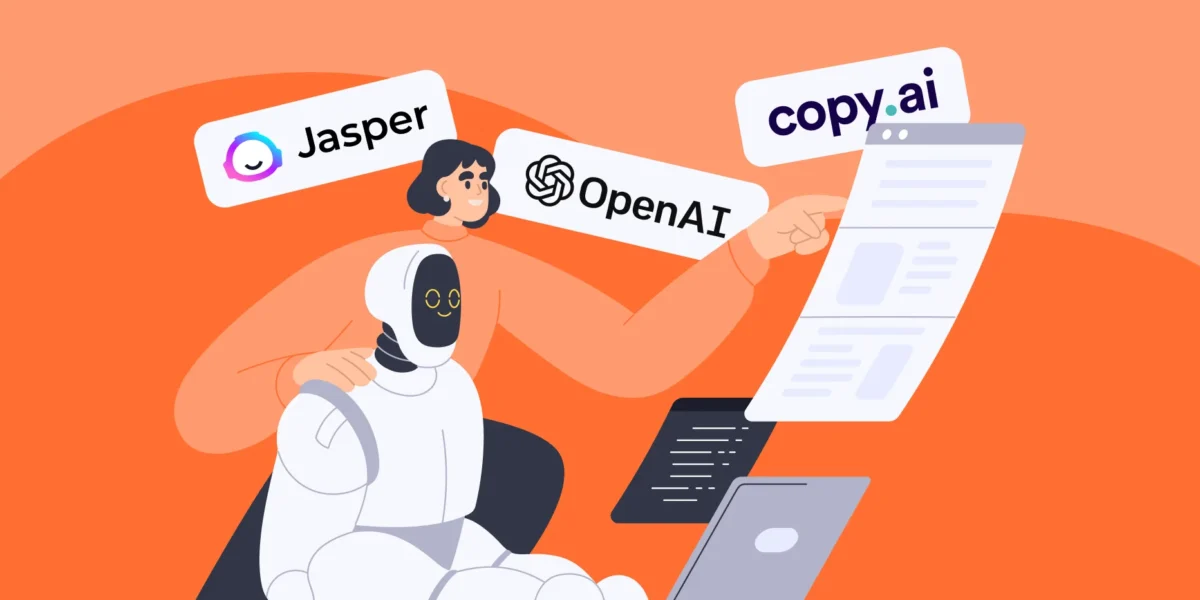
Tools like ChatGPT, Jasper, and Copy.ai can help you brainstorm post ideas, write drafts, and even generate multiple variations of the same message. This saves hours of staring at a blank screen. The trick is to treat AI as a starting point—you’ll still need to edit for tone and authenticity, and run the final version through a plagiarism checker to ensure originality before publishing.
Repurpose content across formats
Let’s say you write a strong text post. An AI video generator can quickly turn it into a video script, a carousel outline, or even a short-form LinkedIn newsletter. Repurposing with AI ensures your best insights don’t get lost in one format.
AI for analytics and optimization
AI-powered tools can analyze your LinkedIn engagement data and highlight patterns—what topics resonate, which post types drive comments, and when your audience is most active. With this feedback loop, your LinkedIn content strategy 2025 becomes more data-driven and effective.

Balance automation with authenticity
AI can help you scale, but it can’t replace your voice. Your audience connects with your stories, your perspective, and your expertise. Use AI for the heavy lifting, drafting, repurposing, analyzing, but always layer on a human touch so your posts feel genuine.
When you strike this balance, an AI-powered LinkedIn content strategy becomes a growth engine: efficient, consistent, and still deeply personal.
💡 Stop Posting, Start Prospecting
Content alone won’t fill your pipeline. With Cleverly, we combine proven LinkedIn outreach + smart positioning to deliver leads. Book a free strategy session today.
LinkedIn Content Strategy for Lead Generation
At the end of the day, great content isn’t just about likes—it’s about driving business. A strong LinkedIn content strategy for lead generation connects the dots between visibility and booked calls.
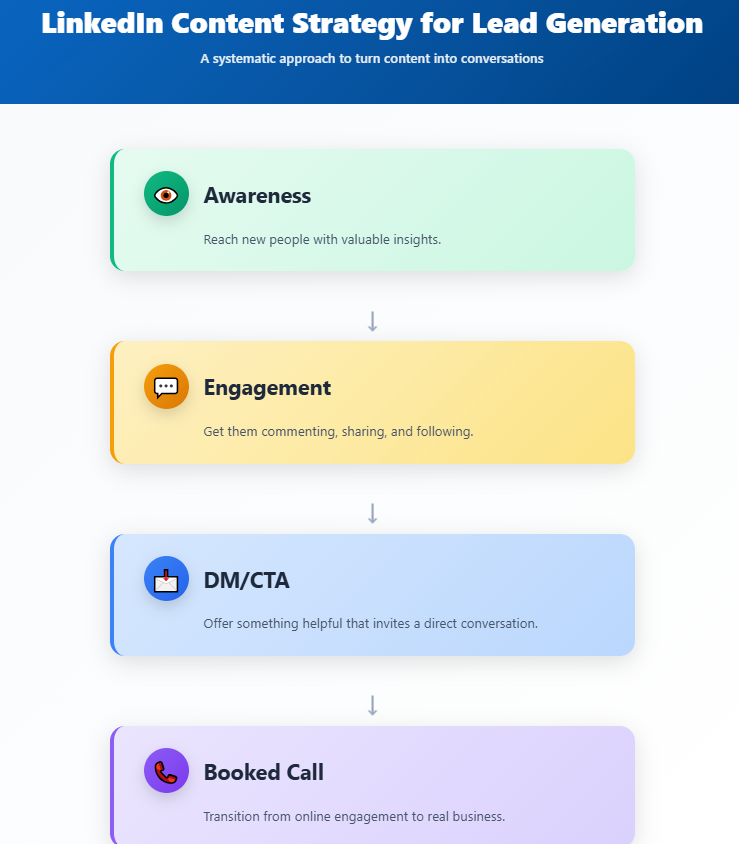
The goal is to move people through a simple funnel:
- Awareness → Reach new people with valuable insights.
- Engagement → Get them commenting, sharing, and following.
- DM/CTA → Offer something helpful that invites a direct conversation.
- Booked call → Transition from online engagement to real business.
Here’s how you can make it happen:
- Use case studies, testimonials, and data-driven posts
Nothing builds trust faster than proof. Share specific results you’ve helped clients achieve, customer quotes, or even industry stats with your perspective. - Nurture leads in comments and DMs
Content is the entry point, but relationships are built in conversations. When someone engages with your post, reply thoughtfully. If the dialogue goes deeper, continue in the DMs. - Integrate with outbound strategies
Your posts don’t live in isolation. Pair your LinkedIn content strategy with outbound channels like cold email lead generation or retargeting ads. For example, if someone is engaged with a case study post, you can retarget them with an ad offering a free strategy call. This multi-touch approach keeps your brand top of mind.
Done consistently, your LinkedIn content strategy for lead generation works as both a magnet (pulling people in) and a bridge (leading them to a real sales conversation).
The 5-Post Inbound Loop: A Proven Framework for Turning Content Into Leads
Most advice on LinkedIn content is a list of tips. What actually works is a repeatable system. We call ours the 5-Post Inbound Loop, and it's built around one idea: every post has a job, and the jobs rotate.
Here's how it breaks down.
1. The Authority Post
One post a week that proves you know something most people in your industry don't. Not general advice, a specific, slightly counterintuitive observation that only someone who's actually done the work would know. This is the post that gets saved and shared, and it's what makes someone stop and check your profile the first time they see your name.
2. The Proof Post
One post a week built around a real result. A client win, a case study number, a before-and-after. The trick is to frame it as a story, not a testimonial. "Here's what happened when..." pulls people in far more than "Here's what our client said about us." Proof posts convert lurkers into DMs faster than any other format on the list.
3. The Engagement Post
One post a week with a single job: start a conversation. A pointed question, a bold opinion, a take that challenges something your industry treats as gospel. The goal here isn't reach, it's comments, because the people commenting are your warmest leads. Just be careful with the format. LinkedIn's 2026 systems actively detect and suppress engagement bait tactics like "Comment YES if you agree," so the question needs to feel genuinely open, not gamified.
4. The Value Post
One post a week that gives something away for free, a checklist, a mini-framework, a resource, with no CTA attached. This is the post that builds trust without asking for anything back. It feels like a small thing, but it's what makes your CTA post later in the week land instead of getting ignored.
5. The CTA Post
Once a week, or once every two weeks if your audience is smaller, make a specific, low-friction offer: a free audit, a strategy call, a short guide. This is the only post in the rotation that's allowed to sell, and it only works because the other four have already built the trust to make the ask feel earned. This is also the one place you can generate leads without spamming your network, because the offer arrives after value, not instead of it.
How to rotate it across a week
If you're posting three times a week, run Authority on Monday, Proof on Wednesday, and alternate Engagement and Value on Friday, with a CTA post dropped in roughly every other week. If you're posting five times a week, you can run the full loop within a single week. Either way, the order matters less than the mix. What kills results is running five Authority posts in a row, or five CTA posts in a row. The loop works because each post type sets up the next.
Building a personal brand around this rotation, instead of posting whatever comes to mind that day, is what turns a LinkedIn presence into an actual pipeline source.
LinkedIn Content Creation: Common Mistakes That Kill Reach and Lead Gen
Even with the right framework and the right tools, a handful of habits quietly cap how far your content goes. Here are the five we see most often.
Posting and disappearing
Publishing a post and closing the tab is the single most common mistake we see. LinkedIn watches your activity in the hour right after you post, and replying to comments, even briefly, meaningfully increases how far that post travels. If you only have time for one thing after publishing, spend it in your own comment section.
Making every post a pitch
The 80/20 rule exists because audiences tune out accounts that constantly sell. If more than 1 in 5 of your posts includes a CTA or a product mention, expect engagement to drop and growth to stall. The accounts generating the most inbound DMs are usually the ones that almost never ask for anything directly. Let the CTA Post in your rotation carry that weight so the rest of your content doesn't have to.
Writing for everyone
Broad posts aimed at "business professionals" tend to underperform because no single reader feels like it was written for them. The posts that actually convert are written so specifically for one persona that they think, "this is about me," even if a hundred other people read it too. If you're not sure who you're writing for, that's usually the real problem, not the topic.
Copying what's already trending
Reposting or lightly rewording a post that's already circulated on LinkedIn earns almost nothing algorithmically and does nothing for your credibility. Original takes, even imperfect ones, consistently outperform recycled ones, because the platform is built to reward what feels new, not what feels familiar.
Skipping the first comment
Leaving a comment on your own post right after publishing, a key insight, a follow-up question, or a teaser of what's inside, gives people a reason to engage and gives the algorithm an early signal that there's a conversation starting. It's a small habit most creators skip entirely, and it's one of the easiest to fix.
Best Tools for LinkedIn Content Creation in 2025
A solid LinkedIn content strategy is only as strong as the tools behind it. In 2025, there’s no need to do everything manually, smart tools can help you design, schedule, analyze, and optimize your posts so you can stay consistent without burning out.
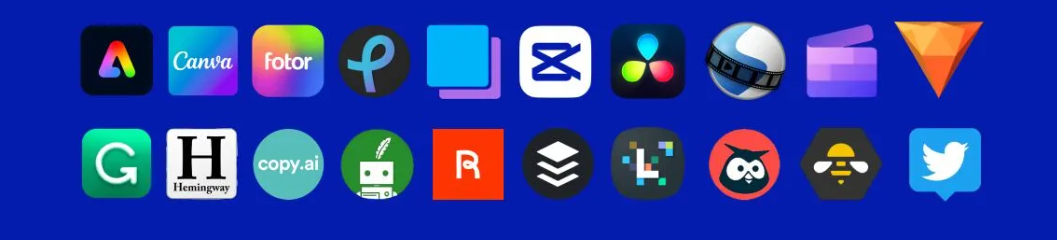
Here are the categories we recommend building into your stack:
- Content design tools
Posts with visuals stop the scroll. Whether it’s a carousel, infographic, or branded graphic, design tools make it easy:
- Canva – user-friendly templates for carousels, banners, and infographics.
- VistaCreate – a Canva alternative with a large library of social media templates, including LinkedIn posts, carousels, and branded graphics.
- Figma – perfect for collaborative design if you’re working with a team.
- Pitch – great for turning data or reports into presentation-style visuals.
- Scheduling tools
Consistency is key in any content strategy for LinkedIn. These tools help you plan posts in advance and keep your cadence steady:
- Buffer and Hootsuite – reliable schedulers for solo creators or teams.
- Shield Analytics – not just scheduling, but also advanced analytics for content performance.
- Engagement tracking
To improve, you need to measure. These tools track how your posts perform and which topics resonate most:
- Shield – deep post and audience analytics.
- Taplio – combines scheduling with personal branding insights.
- LinkedIn’s native analytics – free and surprisingly robust for tracking reach, engagement, and follower growth.
- AI-powered tools
We already touched on AI earlier, but here are our favorites for execution:
- Supergrow – generating LinkedIn posts in your own voice using AI, with built-in scheduling and content planning.
- ChatGPT & Jasper – idea generation, copy drafting, and repurposing content.
- Grammarly – polishing your tone and grammar.
- Surfer SEO – optimizing longer-form LinkedIn articles or newsletters.
- Automation tools
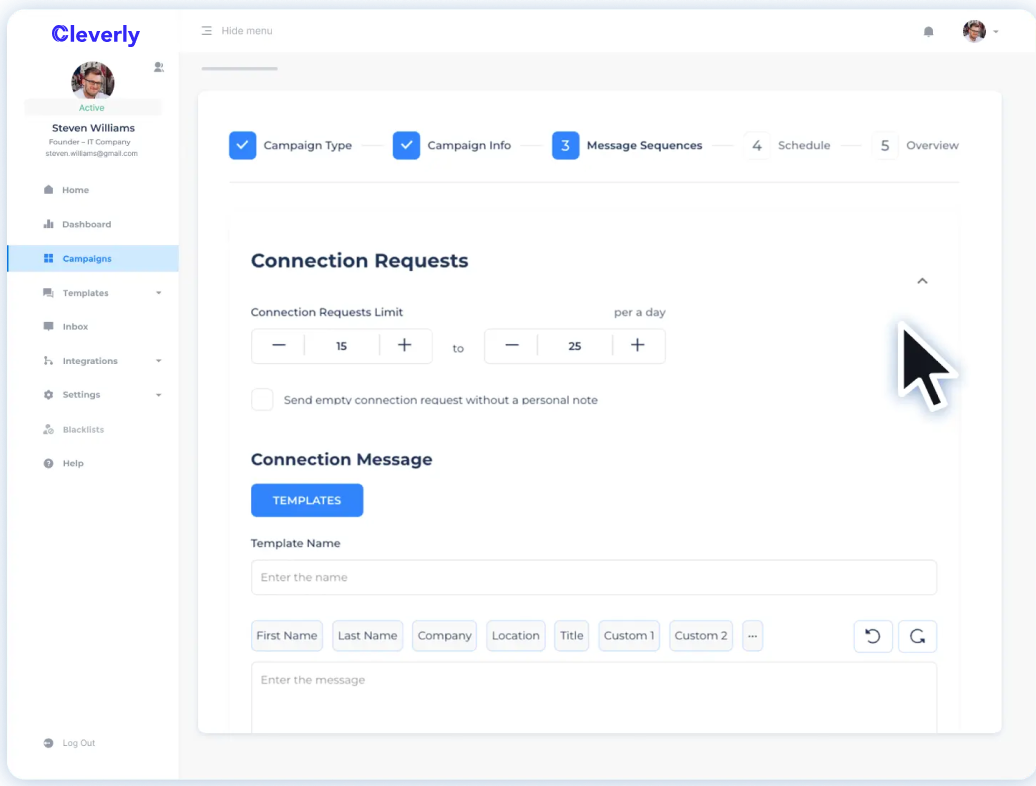
Here’s where we give our clients an edge: every Cleverly client gets access to our premium LinkedIn automation tool. It’s built to safely and efficiently support outreach alongside your content, helping you connect with more of the right people while your posts keep them warm.
The right toolset doesn’t just save time, it makes your LinkedIn content strategy more predictable, repeatable, and scalable.
How Cleverly Helps You Turn Content Into Leads on LinkedIn
You can create good content on your own, but if you want that content to directly fuel your pipeline, partnering with a LinkedIn lead generation agency like Cleverly makes all the difference.
Here’s how we help:
We combine content + outreach
Content gets you visibility. Outreach turns that visibility into conversations. At Cleverly, we run both in sync so you’re not just attracting eyeballs—you’re booking meetings.
We focus on replies, not just likes
A pretty carousel or a viral post is nice, but if it doesn’t drive business, it’s just vanity. Our team specializes in building client-attracting content strategies that spark comments, DMs, and real replies from decision-makers.
We’ve done this thousands of times
Over 10,000+ B2B companies trust Cleverly. From SaaS startups to enterprise service providers, we’ve helped clients consistently generate high-quality leads through a mix of smart posting, thoughtful messaging, and strategic automation.
Real-world results
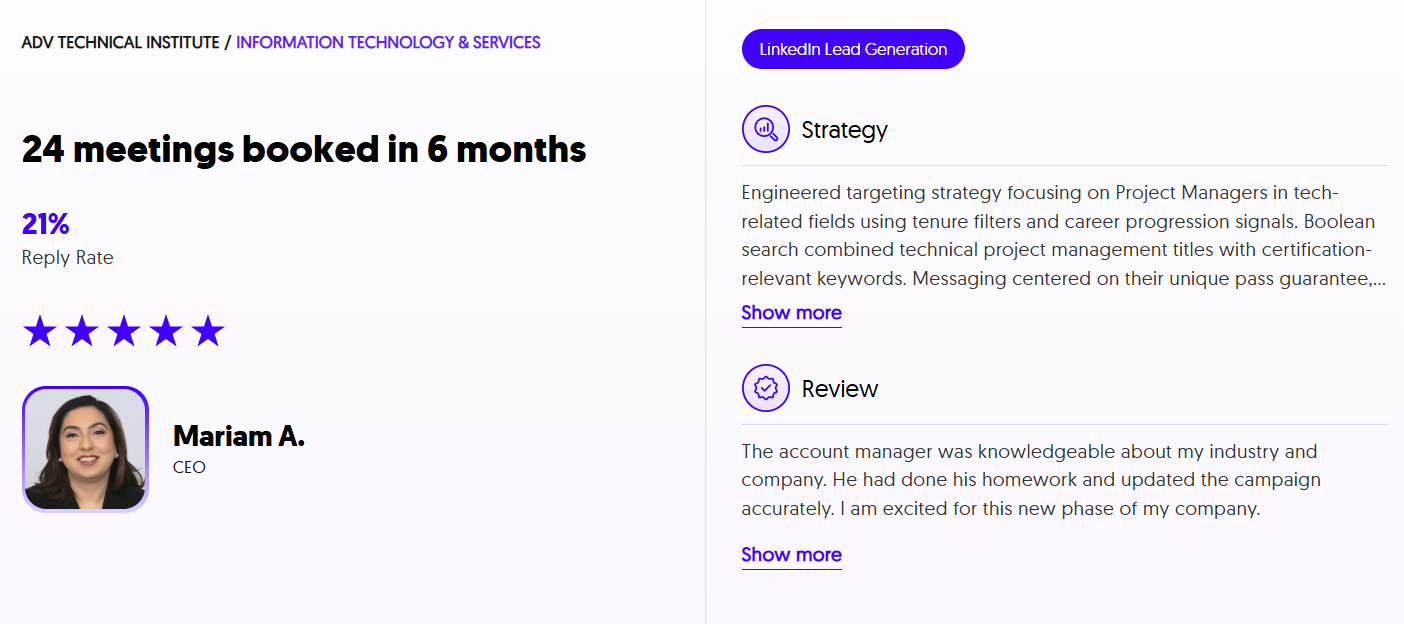
One client in the IT services got 24 meetings booked in 6 months with 21% reply rate. Another advertising & marketing industry client generated $70,000 revenue in 6 months by partnering with Cleverly.
So many more.. Check out our case studies here! These are not one-off wins—they’re the predictable outcomes of a system we’ve refined over years.
If you’re ready to stop guessing and start turning LinkedIn into a reliable growth channel, we’d love to help like we have helped 10,000+ B2B companies generate leads with companies like:
- Amazon
- Google
- UBER
- PayPal
- Slack
- Spotify & more
That resulted in $312 Million in Pipeline Revenue, $51.2 Million in Closed Revenue through LinkedIn Outreach!
Let’s talk and do the same lead gen magic for your business as well!

Frequently Asked Questions
Free Resource
How to Scale a Profitable Cold Call System
Get the complete guide — download it instantly now.
Free Ebook
Download the Free Guide
Enter your details to get instant access.
You're all set! 🎉
Your ebook is downloading now.
Click below if the download didn't start automatically.